“A Space Force is not an aspiration unique to the Trump administration, of course,” she continued on the Beyond Nuclear International website of the Takoma Park, Maryland group, “but it feels worse in his reckless hands.”
Alas, Small Modular Nuclear Reactors (SMRs) will NOT save the collapsing nuclear power industry
 The future of nuclear power in the US is bleak http://thehill.com/opinion/energy-environment/393717-the-future-of-nuclear-power-in-the-us-is-bleak, BY M. V. RAMANA, 06/23/18 Presumably as a way to fulfill election promises, President Trump has ordered the use of emergency federal powers designed for war-time crises to financially prop up coal and nuclear power plants.
Nuclear power that was once advertised as being “too cheap to meter” has evidently become too costly for electric utilities to buy. Apart from two 1,000 megawatt reactors being constructed in Georgia at enormous expense to ratepayers (even after subsidies from tax payers), there are no immediate prospects for new nuclear power plants in the United States. What of the longer-term future?
One possibility for new nuclear reactor construction comes from what are called the Small Modular Reactors (SMRs). One SMR design called NuScale is slowly making its way to potential construction. Developed by a company based in Oregon, a single NuScale reactor is designed to generate just 50 megawatts of power.Earlier this spring, the NuScale design cleared the first phase of the Nuclear Regulatory Commission’s certification process. A group of electrical utilities called the Utah Associated Municipal Power Systems has expressed an interest in purchasing a power plant, which consists of 12 NuScale reactors. The Tennessee Valley Authority also has applied for a permit to develop a site that could host an SMR.
Why SMRs? According to promoters of these scaled-down reactors, they could solve the multiple challenges faced by nuclear power. SMR developers promise lowered costs, decreased production of radioactive waste, reduction or even elimination of the risk of severe accidents, and no contribution to nuclear proliferation. Dozens of companies claim to be developing their own SMR designs, and many have received funding from wealthy private investors and the U.S. Department of Energy.
However, there is little to suggest SMRs will somehow magically remedy all that ails the nuclear industry. SMRs, as the name suggests, produce relatively small amounts of electricity in comparison with currently operational reactors. This puts them at a disadvantage.
One known way to reduce the cost of nuclear electricity has been to build larger reactors because the expenses associated with constructing and operating a reactor do not increase in direct proportion to the power generated. SMRs will, therefore, cost more than large reactors for each unit of generation capacity. Most of the small reactors built in the United States shut down early because they couldn’t compete economically.
SMR proponents argue that they can compensate by savings through mass manufacture in factories and learning how to hold down costs from the experience of constructing lots of reactors. This is a dubious assumption: In both the United States and France, the two countries with the highest numbers of nuclear plants, costs went up, not down, with construction experience.
Even if one were to assume that such “learning” actually occurs, SMRs have to be manufactured by the thousands to achieve meaningful savings. There is simply no market for so many reactors.
Even Westinghouse, the company that has directly or indirectly designed the majority of the world’s nuclear reactors, has realized that there is no market. For a decade or more, Westinghouse pursued a SMR design. But, in 2014, the company abandoned that effort. Its CEO explained: “The problem I have with SMRs is not the technology, it’s not the deployment — it’s that there’s no customers.” Few or no customers means no one would, or should, want to build a factory to construct the modules constituting these SMRs.
What of the claims about safety and nuclear waste? The problem is that the technical demands posed by these different goals conflict with one another, forcing reactor designers to make impossible choices.
For example, safety can be improved by making reactors smaller. But, a smaller reactor, at least the water-cooled reactors that are most likely to be built earliest, will produce more, not less, nuclear waste per unit of electricity they generate because of lower efficiencies. With no long-term solution in sight for nuclear waste, accumulating more radioactive spent fuel aggravates the storage problem.
The poor economic outlook for SMRs also affects safety. Companies that market SMRs propose placing multiple reactors in close proximity to save on costs of associated infrastructure. But this would increase the risk of accidents or the impact of potential accidents on the surrounding population.
At Japan’s Fukushima nuclear complex, explosions at one reactor damaged the spent fuel pool in a co-located reactor. Radiation leaks from one unit made it difficult for emergency workers to approach the other units.
The future of nuclear power in the United States, and indeed in much of the world, is bleak. Small modular reactors will not change that prognosis. There is no point in wasting public money on promoting them.
M. V. Ramana is the Simons chairman in Disarmament, Global and Human Security at the School of Public Policy and Global Affairs, University of British Columbia and the author of “The Power of Promise: Examining Nuclear Energy in India.”
Why is the media not covering the obscenity of Trump’s bombing?
Trump’s Military Drops a Bomb Every 12 Minutes, and No One Is Talking About It, TruthDig, Lee Camp, 19 June 18,
We live in a state of perpetual war, and we never feel it. While you get your gelato at the hip place where they put those cute little mint leaves on the side, someone is being bombed in your name. While you argue with the 17-year-old at the movie theater who gave you a small popcorn when you paid for a large, someone is being obliterated in your name. While we sleep and eat and make love and shield our eyes on a sunny day, someone’s home, family, life and body are being blown into a thousand pieces in our names.
Once every 12 minutes.
The United States military drops an explosive with a strength you can hardly comprehend once every 12 minutes. And that’s odd, because we’re technically at war with—let me think—zero countries. So that should mean zero bombs are being dropped, right?
Hell no! You’ve made the common mistake of confusing our world with some sort of rational, cogent world in which our military-industrial complex is under control, the music industry is based on merit and talent, Legos have gently rounded edges (so when you step on them barefoot, it doesn’t feel like an armor-piercing bullet just shot straight up your sphincter), and humans are dealing with climate change like adults rather than burying our heads in the sand while trying to convince ourselves that the sand around our heads isn’t getting really, really hot.
You’re thinking of a rational world. We do not live there.
Instead, we live in a world where the Pentagon is completely and utterly out of control. A few weeks ago, I wrote about the $21 trillion (that’s not a typo) that has gone unaccounted for at the Pentagon. But I didn’t get into the number of bombs that ridiculous amount of money buys us. President George W. Bush’s military dropped 70,000 bombs on five countries. But of that outrageous number, only 57 of those bombs really upset the international community.
Because there were 57 strikes in Pakistan, Somalia and Yemen—countries the U.S. was neither at war with nor had ongoing conflicts with. And the world was kind of horrified. There was a lot of talk that went something like, “Wait a second. We’re bombing in countries outside of war zones? Is it possible that’s a slippery slope ending in us just bombing all the goddamn time? (Awkward pause.) … Nah. Whichever president follows Bush will be a normal adult person (with a functional brain stem of some sort) and will therefore stop this madness.”
We were so cute and naive back then, like a kitten when it’s first waking up in the morning.
The Bureau of Investigative Journalism reported that under President Barack Obama there were “563 strikes, largely by drones, that targeted Pakistan, Somalia and Yemen.”
It’s not just the fact that bombing outside of a war zone is a horrific violation of international law and global norms. It’s also the morally reprehensible targeting of people for pre-crime, which is what we’re doing and what the Tom Cruise movie “Minority Report” warned us about. (Humans are very bad at taking the advice of sci-fi dystopias. If we’d listened to “1984,” we wouldn’t have allowed the existence of the National Security Agency. If we listened to “The Terminator,” we wouldn’t have allowed the existence of drone warfare. And if we’d listened to “The Matrix,” we wouldn’t have allowed the vast majority of humans to get lost in a virtual reality of spectacle and vapid nonsense while the oceans die in a swamp of plastic waste. … But you know, who’s counting?)
There was basically a media blackout while Obama was president.
…….we now know that Donald Trump’s administration puts all previous presidents to shame. The Pentagon’s numbers show that during George W. Bush’s eight years he averaged 24 bombs dropped per day, which is 8,750 per year. Over the course of Obama’s time in office, his military dropped 34 bombs per day, 12,500 per year. And in Trump’s first year in office, he averaged 121 bombs dropped per day, for an annual total of 44,096.
Trump’s military dropped 44,000 bombs in his first year in office.
He has basically taken the gloves off the Pentagon, taken the leash off an already rabid dog………
Under Trump, five bombs are dropped per hour—every hour of every day. That averages out to a bomb every 12 minutes.
And which is more outrageous—the crazy amount of death and destruction we are creating around the world, or the fact that your mainstream corporate media basically NEVER investigates it? They talk about Trump’s flaws. They say he’s a racist, bulbous-headed, self-centered idiot (which is totally accurate)—but they don’t criticize the perpetual Amityville massacre our military perpetrates by dropping a bomb every 12 minutes, most of them killing 98 percent non-targets.
When you have a Department of War with a completely unaccountable budget—as we saw with the $21 trillion—and you have a president with no interest in overseeing how much death the Department of War is responsible for, then you end up dropping so many bombs that the Pentagon has reported we are running out of bombs.
……….This is about a runaway military-industrial complex that our ruling elite are more than happy to let loose. Almost no one in Congress or the presidency tries to restrain our 121 bombs a day. Almost no one in a mainstream outlet tries to get people to care about this.
Recently, the hashtag #21Trillion for the unaccounted Pentagon money has gained some traction. Let’s get another one started: #121BombsADay.
One every 12 minutes……..
We are a rogue nation with a rogue military and a completely unaccountable ruling elite. The government and military you and I support by being a part of this society are murdering people every 12 minutes, and in response, there’s nothing but a ghostly silence. It is beneath us as a people and a species to give this topic nothing but silence. It is a crime against humanity. https://www.truthdig.com/articles/trumps-military-drops-a-bomb-every-12-minutes-and-no-one-is-talking-about-it/
This is not science fiction. Donald Trump wants war in space

Star Wars Redux: Trump’s Space Force, Counter Punch
 If Donald Trump gets his way on formation of a Space Force, the heavens would become a war zone. Inevitably, there would be military conflict in space.
The Outer Space Treaty of 1967 which designates space as the global commons to be used for peaceful purposes—and of which Russia and China, as well as the United States, are parties—and the years of work facilitating the treaty since would be wasted.
If the U.S. goes up into space with weapons, Russia and China, and then India and Pakistan and other countries, will follow.
Moreover space weaponry, as I have detailed through the years in my writings and TV programs, would be nuclear-powered—as Reagan’s Star Wars scheme was to be with nuclear reactors and plutonium systems on orbiting battle platforms providing the power for hypervelocity guns, particle beams and laser weapons.
This is what would be above our heads.
Amid the many horrible things being done by the Trump administration, this would be the most terribly destructive. “It is not enough to merely have an American presence in space, we must have American dominance in space,” Trump said at a meeting of the National Space Council this week.
“Very importantly, I’m hereby directing the Department of Defense and Pentagon,” he went on Monday, “to immediately begin the process necessary to establish a Space Force as the sixth branch of the armed forces; that is a big statement. We are going to have the Air Force and we are going to have the Space Force, separate but equal, it is going to be something.”
The notion of the U.S. moving into space with weaponry isn’t new…………..
With the Trump administration, there is more than non-support of the PAROS treaty but now a drive by the U.S. to weaponize space.
It could be seen—and read about—coming.
“Under Trump, GOP to Give Space Weapons Close Look,” was the headline of an article in 2016 in Washington-based Roll Call. It said “Trump’s thinking on missile defense and military space programs have gotten next to no attention, as compared to the president-elect’s other defense proposals….But experts expect such programs to account for a significant share of what is likely to be a defense budget boost, potentially amounting to $500 billion or more in the coming decade.”
Intense support for the plan was anticipated from the GOP-dominated Congress. Roll Call mentionedthat Representative Trent Franks, a member of the House Armed Services Committee and an Arizona Republican, “said the GOP’s newly strengthened hand in Washington means a big payday is coming for programs aimed at developing weapons that can be deployed in space.”
In a speech in March at the U.S. Marine Corps Air Station near San Diego, Trump declared: “My new national strategy for space recognizes that space is a war-fighting domain, just like the land, air, and sea. We may even have a Space Force—develop another one, Space Force. We have the Air Force; we’ll have the Space Force.”
Bruce Gagnon, coordinator of the Global Network Against Weapons and Nuclear Power in Space, notes that Trump cannot establish a Space Force on his own—that Congressional authorization and approval is needed. And last year, Gagnon points out, an attempt to establish what was called a Space Corps within the Air Force passed in the House but “stalled in the Senate.”
“Thus at this point it is only a suggestion,” said Gagnon of the Maine-based Global Network.
“I think though,” Gagnon went on, “his proposal indicates that the aerospace industry has taken full control of the White House and we can be sure that Trump will use all his ‘Twitter powers’ to push this hard in the coming months.”
Meanwhile, relates Gagnon, there is the “steadily mounting” U.S. “fiscal crisis…Some years ago one aerospace industry publication editorialized that they needed a ‘dedicated funding source’ to pay for space plans and indicated that it had come up with it—the entitlement programs. That means the industry is now working to destroy Social Security, Medicare, Medicaid and what little is left of the welfare program. You want to help stop Star Wars and Trump’s new Space Force. Fight for Social Security and social progress in America. Trump and the aerospace industry can’t have it both ways—it’s going to be social progress or war in space.”
As Robert Anderson of New Mexico, a board member of the Global Network, puts it: “There is no money for water in Flint, Michigan or a power grid in Puerto Rico, but there is money to wage war in space.”
Or as another Global Network director, J. Narayana Rao of India, comments: “President Donald Trump has formally inaugurated weaponization of space in announcing that the U.S. should establish a Space Force which will lead to an arms race in outer space.”
Russian officials are protesting the Trump Space Force plan, “Militarization of space is a way to disaster,”Viktor Bondarev, the head of the Russian Federation Council’s Defense and Security Committee, told the RIA news agency the day after the announcement. This Space Force would be operating in “forbidden skies.” He said Moscow is ready to “strongly retaliate” if the US violates the Outer Space Treaty by putting weapons of mass destruction in space.
And opposition among legislators in Washington has begun. “Thankfully the president cannot do it without Congress because now is NOT the time to rip the Air Force apart,” tweeted Senator Bill Nelson of Florida.
“Space as a warfighting domain is the latest obscenity in a long list of vile actions by a vile administration,” writes Linda Pentz Gunter, who specializes in international nuclear issues for the organization Beyond Nuclear, this week. “Space is for wonder. It’s where we live. We are a small dot in the midst of enormity, floating in a dark vastness about which we know a surprising amount, and yet with so much more still mysteriously unknown.”
Charisma in the nuclear age is a bitch
Charisma in the nuclear age is a bitch. A century ago, the great German sociologist Max Weber showed that modern political authority has two varieties: charismatic and bureaucratic. Charismatic authority is based on personality and is disruptive; bureaucratic authority is based on rules and promises continuity.
 Charisma in the nuclear age https://thebulletin.org/charisma-nuclear-age11926, SHARON SQUASSONI Sharon Squassoni is research professor at the Institute for International Science and Technology Policy, Elliott School of International Affairs, at the George Washington University.
From his speech patterns to his body language, President Donald Trump exudes charisma. Perhaps to the despair of more stalwart democratic leaders, he acts instinctively rather than methodically. His approach to the historic Singapore summit with North Korean leader Kim Jong Un was, he told the press, to size up Kim in the first few minutes and ascertain whether a deal was possible.
UK grappling with “unstable” canisters for nuclear waste
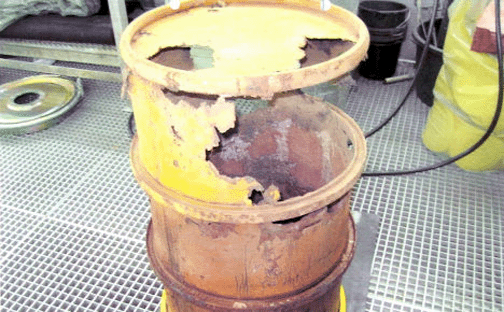
Power Technology 21st June 2018 ,NDA to spend billions stabilising plutonium canisters. The National  Audit Office (NAO) has released a report detailing the unstable condition of highly dangerous plutonium canisters at the Sellafield nuclear plant, said to be “decaying faster than anticipated”.
The report, titled ‘Progress with reducing risk at Sellafield’ warns that if these canisters were to leak it would prove an “intolerable risk” – a label defined by the Nuclear Decommissioning Authority (NDA) as a situation where reducing the risk “becomes the overriding factor”, taking precedence over matters of cost and requiring immediate action.
The NDA has refused to comment on the number of canisters affected, though it has said it is only a “small proportion” of their total number. The UK houses 40% of global civil plutonium, the majority of which is stored at the Sellafield site in Cumbria, itself overseen by the NDA. The substance is a by-product of nuclear fuel reprocessing and the site’s abundant stock has led the NDA to label Sellafield its most hazardous facility.
The new report shows Sellafield, which opened in 2012, to have ‘unsuitable’ containers for storing plutonium. The NAO has proposed the canisters be repackaged through the store retreatment plant (SRP) facility, though until this facility is ready the NDA is recommended to place the more unstable canisters in extra layers of packaging. In response to these measures, the NDA has announced its decision to pledge a further £1bn on these packaging canisters, and £1.5bn on building a new facility to house the plutonium.
https://www.power-technology.com/news/nda-spend-billions-stabilising-plutonium-canisters/
Radioactive waste canisters corroded
One in three nuclear waste barrels damaged , DPA/The Local news@thelocal.de
@thelocalgermany– 10 October 2014 Inspectors in northern Germany have found that a third of barrels containing radioactive waste at a decommissioned nuclear plant are damaged, the Schleswig-Holstein Environment Ministry said on Thursday.
Exposing the weird pro nuclear propaganda from Michael Shellenberger

Steve Dale Nuclear Fuel Cycle Watch South Australia, 21 June 18
Shellenberger’s latest article is pretty strange and contradicts a lot of things I’ve heard from his local supporters.
Most unusual is that he calls nuclear waste a “blessing” – “But achieving that future will first require that we abandon our ridiculous fears and start seeing nuclear waste as the environmental blessing that it is.”
He also doesn’t want nuclear waste moved – not even from the reactor, let alone the USA. He says “Don’t Move The Waste” and “transporting cans of used nuclear waste would increase the threat to the continued operation of our life-saving nuclear plants.” This sort of contradicts the whole push of the NFCRC.
Shellenberger proposes that money set aside for storing nuclear waste for millennia should be diverted to nuclear plants, he says “It should be used to subsidize the continued operation of economically distressed nuclear plants, and subsidize the building of new ones.”
When a nuclear accident occurs we are usually told it’s because it is an old or aging plant? Well Shellenberger claims “Nuclear plants are functionally immortal. Existing plants can operate for 60, 80, 100 years or longer because everything inside the plant from the control panels to the steam generators and even the reactor vessel itself can be replaced, if needed.”
And I’ve heard local nuclear lobbyists claim new “waste eating” reactors are just around the corner, less than 10 years away, but Shellenberger says – “Sometime between 2050 and 2100, new nuclear plants — like the kind being developed by Bill Gates — will likely be able to use the so-called “waste” as fuel.”
I wonder what Shellenberger’s local supporters would think of this article? If Shellenberger gets his way, millennia lasting nuclear waste will be stored in half-inch thin, welded casks (see picture below) for centuries – by which time it would be too fragile to move.
The Forbes article is “Stop Letting Your Ridiculous Fears Of Nuclear Waste Kill The Planet” https://www.facebook.com/groups/1021186047913052/
UK nuclear waste canisters decaying faster than expected – (could this happen in South Australia?)
 Telegraph 19th June 2018 , Highly dangerous plutonium canisters are “decaying faster than anticipated”at the Sellafield nuclear plant and present an “intolerable risk” if they started to leak, the spending watchdog has warned.
Government scientists have now agreed to spend an extra £1billion to make them safe by wrapping them in packaging, the National Audit Office said today. Britain has the largest amount of civil plutonium – a bi-product of nuclear fuel reprocessing – in the world, around 40 per cent of the global total.
Most of the plutonium is stored at Sellafield in Cumbria, where it is managed by the Nuclear Decommissioning Authority (NDA). The problems have occurred because some of the plutonium canisters are judged to be “unsuitable” for storage in a new facility which only opened in 2012, the NAO said.
Staff are now racing against the clock to build a new £1.5billion facility – and are having to make contingency plans for the next two years while the new depot is constructed. The NAO report – titled ‘Progress with reducing risk at Sellafield’ – said: “Some canisters that have already been transferred into modern storage will have to be repackaged through the SRP [the residue store retreatment plant] facility to ensure they do not degrade.”
The report adds: “A leak from any package would lead to an ‘intolerable’ risk as defined by the Office for Nuclear Regulation. “The NDA has therefore decided to place the canisters more at risk in extra layers of packaging until SRP is operational. It has not yet submitted a new business case to support these contingency arrangements.”
Dr Doug Parr, chief scientist for Greenpeace UK, said: “In some ways it is fortunate that this failure was detected whilst the plutonium was still accessible, and the cost of patching the canisters is only £1billion. If an inaccessible deep waste dump were to fail in a similar way, who knows what the full cost might be?”
https://www.telegraph.co.uk/politics/2018/06/19/sellafield-plutonium-decaying-faster-anticipated-intolerable/
The ignored refugees – the growing numbers displaced by climate change

TIM MCDONNELL , This month, diplomats from around the world met in New York and Geneva to hash out a pair of new global agreements that aim to lay out new guidelines for how countries should deal with an unprecedented surge in the number of displaced people, which has now reached 65.6 million worldwide.
But there’s one emerging category that seems to be getting short shrift in the conversation: so-called “climate refugees,” who currently lack any formal definition, recognition or protection under international law even as the scope of their predicament becomes more clear.
Since 2008, an average of 24 million people have been displaced by catastrophic weather disasters each year. As climate change worsens storms and droughts, climate scientists and migration experts expect that number to rise.
Meanwhile, climate impacts that unravel over time, like desert expansion and sea level rise, are also forcing people from their homes: A World Bank report in March projects that within three of the most vulnerable regions — sub-Saharan Africa, South Asia and Latin America — 143 million people could be displaced by these impacts by 2050.
In Bangladesh, hundreds of thousands of people are routinely uprooted by coastal flooding, many making a treacherous journey to the slums of the capital, Dhaka. In West Africa, the almost total disappearance of Lake Chad because of desertification has empowered terrorists and forced more than four million people into camps.
It’s a problem in the United States as well. An estimated 2,300 Puerto Rican familiesdisplaced by Hurricane Maria are still looking for permanent housing, while government officials have spent years working to preemptively relocate more than a dozen small coastal communities in Alaska and Louisiana that are disappearing into the rising sea.
A December study by Columbia University climate researchers in the peer-reviewed journal Science projected that if global temperatures continue their upward march, applications for asylum to the European Union could increase 28 percent to nearly 450,000 per year by 2100.
But so far, there’s no international agreement on who should qualify as a climate refugee — much less a plan to manage the growing crisis………
Yayboke believes that development agencies need to step up funding for climate adaptation programs, which can help prevent displacement and reduce government spending on recovery from predictable natural disasters later on.
“We are spending so much money on this stuff, but we’re being totally reactive,” he says. “There are proactive things we can do that we’re just not doing.”
Few places are more illustrative of that problem than Bangladesh. According to the CSIS report, up to 70 percent of the five million people living in Dhaka’s slums were displaced from their original home by environmental disasters.
“The situation and scope of this problem is entirely new, and of biblical proportions,” says Steve Trent, executive director of the Environmental Justice Foundation, which released its own report on Bangladesh in 2017. “It demands an entirely new legal convention. The global compacts are a start, but it’s clear that they’re not enough.”
Tim McDonnell is a journalist covering the environment, conflict and related issues in sub-Saharan Africa. Follow him on Twitter and Instagram. https://www.npr.org/section
“Radium girls”won their legal case on radioactive poisoning; their graves still radioactive!
 Glowing Girls and Poisonous Paint https://www.thomasnet.com/articles/daily-bite/glowing-girls-and-poisonous-paint Genevieve Mills Jun 15, 2018
Radium is a highly radioactive metal that’s dangerous to inhale, ingest, or be in close proximity to for extended periods of time without the use of proper protective gear. But in the early 1900s, it could be found in everything from cosmetics to paint. After its discovery in 1898 by Marie and Pierre Curie, radium was even believed to be beneficial to your health in small doses. It was mixed with zinc in paint formulations to emit a faint blue-green light and was utilized in the numbers and dials on watches and clocks to allow them to be read more easily in low-light situations.
In 1917, the U.S. Radium Corporation began producing a new, glowing, radium-filled paint called “Undark.” They hired around 70 young women to paint watches with Undark and assured them that the paint was completely nontoxic. So nontoxic that they would wet their paint brushes with their mouths, purposefully paint their skin with it, and let the radium powder coat their best dresses so when they went to parties after work they would glow.
In 1922 Mollie Maggia, a dial painter, died of radium poisoning. She would be the first of more than 50 factory workers to eventually die from prolonged exposure to what the girls believed was harmless paint. They suffered from horrible tumors and the disintegration of their jaws.
Five “Radium Girls” won a lawsuit against the U.S. Radium Corporation that did lead to an increase in workers’ safety regulations, but not in time to save their lives. Visits to their graves today with a Geiger counter show their remains are still radioactive long after their passing.
New York could be attacked with a terrorist nuclear bomb
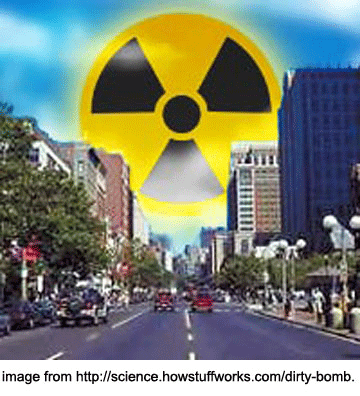 What a nuclear attack in New y
York would look like This Is What a Nuclear Bomb Looks Like (picture of a somewhat rusting ordinary van) Ny Mag. 12 June 18
If America is attacked, the strike probably won’t come from North Korea. And it will be even scarier than we imagine. …….
There are currently at least 2,000 tons of weapons-grade nuclear material stored in some 40 countries — enough to make more than 40,000 bombs approximately the size of the one that devastated Hiroshima. Stealing the material would be challenging but far from impossible. Russia stockpiles numerous bombs built before the use of electronic locks that disable the weapons in the event of tampering. Universities that handle uranium often have lax security. And insiders at military compounds sometimes steal radioactive material and sell it on the black market. Since 1993, there have been 762 known instances in which radioactive materials were lost or stolen, and more than 2,000 cases of trafficking and other criminal activities.
Leaky nuclear reactor in Antarctica

New Zealand warns its Antarctic veterans about radiation risks from leaky US Navy reactor https://www.stripes.com/news/new-zealand-warns-its-antarctic-veterans-about-radiation-risks-from-leaky-us-navy-reactor-1.533546 By SETH ROBSON | STARS AND STRIPES June 19, 2018
The New Zealand government is warning personnel who worked in Antarctica in the 1960s and ‘70s about radiation from a leaky U.S. Navy reactor.
Alerts were posted online by the New Zealand Defence Force, Antarctica New Zealand and other government entities in January and reported by local media last month.
They advise people to contact the New Zealand Office of Radiation Safety or their doctor if they think they may have been exposed to radiation from the reactor used to power McMurdo Station, Antarctica, from 1962 to 1979.
The U.S. Department of Defense has assessed the risk of radiation exposure for those who worked near the power plant as low.
However, the Department of Veterans Affairs ruled in November that retired Navy veteran James Landy’s “esophageal, stomach, liver, and brain and spine cancers, [were] incurred in active duty service.”
Landy worked at McMurdo as a C-130 flight engineer from 1970 to 1974 and from 1977 to 1981 before dying at age 63 in 2012, said his widow, Pam Landy.
“He had pain in his kidneys and went to the doctor and they sent him to an oncologist who said he had cancer from radiation exposure,” she said in a phone interview Monday from her home in Pensacola, Fla.
Veterans who served in Antarctica should have been warned about the radiation risk, Pam Landy said.
“The government knew that thing was there. If they had given people a heads up he could have been diagnosed early and might have a shot at being alive,” she said. “I got a payout from the VA, but it’s a pittance compared to a life.”
The McMurdo reactor had many malfunctions, but personnel might also have been exposed during its decommissioning when soil and rock from the site was trucked through the base to be shipped off the continent, she said.
Peter Breen, 64, was a New Zealand Army mechanic about 2 miles from McMurdo at Scott Base from 1981 to 1982. Rock and soil from the reactor site was taken to a wharf in open trucks, and Breen fears he could have been exposed to contaminated dust blown by the wind or on ice harvested from nearby cliffs.
He’s campaigning for New Zealand Antarctic veterans to be recognized with a medal and offered health checks.
“It is not compensation that guys are after,” he said in a phone interview from his home in Tauranga, New Zealand. “They want a health-check program.”
robson.seth@stripes.com
Twitter: @SethRobson1
Fatal consequences for the nation that first strikes with nuclear weapons
 Paper Reveals Amount Of Nuclear Weapons Fatal To Own Citizens Of The Firing Nation http://www.techtimes.com/articles/230423/20180617/paper-reveals-amount-of-nuclear-weapons-fatal-to-own-citizens-of-the-firing-nation.htm By Athena Yenko Tech Times
In a scenario where the United States launches a nuclear attack against a country, Americans won’t be spared from the fatal consequences of that same strike.
The first thing that comes to mind when discussing a nuclear war is how it could obliterate the target country. A new paper, therefore, examined the consequences of a nuclear strike on the very nation firing the weapons.
The Consequences Of A Nuclear Strike
The repercussions were imagined in “best-case scenario,” where the target nation would not engage in any counterattack. For example, if the United States fired a nuclear weapon, its very own people would suffer an effect called “nuclear autumn” or environmental blowback.
There would be a drastic drop in temperature because of the “soot” or chemical remnants from nuclear blasts that would block the sun from reaching the Earth’s surface. A decreased in precipitation would follow.
As days go by, there would be an increased ultraviolet radiation because of the damaged atmosphere. Eventually, starvation would happen as a result of non-functioning supply chains.
“If we use 1,000 nuclear warheads against an enemy and no one retaliates, we will see about 50 times more Americans die than did on 9/11 due to the after-effects of our own weapons,” reads one example given by Joshua Pearce, one of the authors of the paper.
The paper essentially warned that any nation who plans to launch a nuclear war must first assess whether it could survive the problems of its own making.
A Nuclear War Perspective
According to the paper, Americans would only be saved from the nuclear autumn if the United States would limit its strike to a use of 100 nuclear missiles. The problem, however, is that countries such as the United States and Russia possess thousands of nuclear arsenals.
In its calculation, the paper assumed that the United States would launch nuclear bombs with yields amounting to 15 kilotons. This would just be the same amount of explosive dropped over Hiroshima and Nagasaki.
However, the nuclear bombs owned by the countries at present are five to 25 times more lethal than what was used during the World War II. The explosive yields of nuclear weapons at present range from 100 to 500 kilotons.
The largest, however, has an explosive yield of 5,000 kilotons. The United States, in fact, has one with an explosive yield of roughly 1,400 kilotons.
Amount Fatal To Americans If The US Initiates Nuclear Attack
The paper published in the journal Safety on June 14 calculated the potential damage if the United States were to fire 7,000 nuclear missiles, 1,000 nuclear missiles, and 100 nuclear missiles. The nuclear attacks were imagined to be launched against China.
The 7,000 warheads would produce 30 trillion grams of soot. It could result in a nuclear autumn on a worldwide level and, later on, could starve as much as 5 million Americans. The 1,000 nuclear arsenal fired would produce 12 trillion grams of soot, which could starve 140,000 Americans.
Meanwhile, Americans would be saved from starvation if the United States were to fire 100 nuclear missiles. On the other hand, it could kill as much as 30 million people in China, which in return, could set off a counterattack.
An Appeal To Department Of Defense
The authors of the study argued that there would be no logical reason for any country to maintain nuclear arsenals greater than 100. They now call for the U.S. Department of Defense to include the potential environmental blowback to the American people when designing its nuclear policies
“The U.S. government should greatly increase focus on producing alternative food to provide for survivors in the case of nuclear war,” said David Denkenberger, one of the authors of the paper.
More importantly, the authors of the paper call for worldwide country leaders to reduce the nuclear weapon arsenals they keep in their possessions.
Rural community in Czech Republic votes overwhelmingly against hosting a nuclear waste facility
JAROMĚŘICE NAD ROKYTNOU VOTES AGAINST NUCLEAR WASTER STORAGE SITE http://www.radio.cz/en/section/news/jaromerice-nad-rokytnou-votes-against-nuclear-waster-storage-site Ruth Fraňková17-06-2018
The inhabitants of Jaroměřice nad Rokytnou, a village in the Vysočina region between Bohemia and Moravia, voted overwhelmingly against the construction of a nuclear waste storage site on their land in a referendum on Saturday.
Jaroměřice nad Rokytnou is one of nine Czech locations being considered by experts for the purposes of a nuclear waste store. About 45 percent of the village’s inhabitants took part in the vote, which makes the referendum valid.
Concerns about the safety of Holtec nuclear waste storage casks
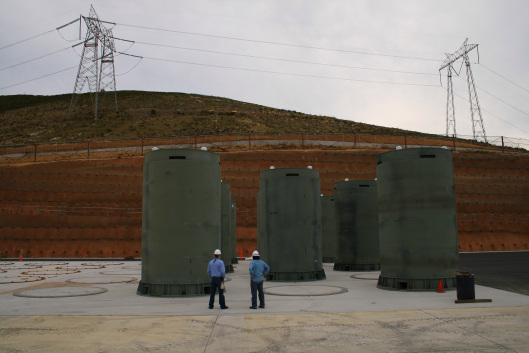 What is Holtec? Company touts experience in nuclear storage, Carlsbad Current-Argus, 16 June 18
1 This month
7 April – WEBINAR – Australia and the Doomsday Clock – Preventing nuclear war through NoFirstUse and other policies
Online | Tuesday April 7, 4:00-5:30pm, Australian Eastern Time / 8:00-9:30am Central Europe Time
– Access the registration link
15 April – Zoom –Nuclear Power is Not the Solution
Apr 15, 2026 01:00 AM in Canberra, Melbourne, Sydney

Join the International Physicians for the Prevention of Nuclear War (IPPNW) on Tuesday, April 14th for a timely webinar exploring the risks associated with nuclear power and challenging the myth that it offers a simple, safe, carbon-free solution to the climate crisis

of the week – Australians for War Powers Reform (AWPR)
To see nuclear-related stories in greater depth and intensity
 Antinuclear