Stranded nuclear wastes: Britain, like Australia’s ANSTO, has no idea what to do with its “interim” radioactive trash
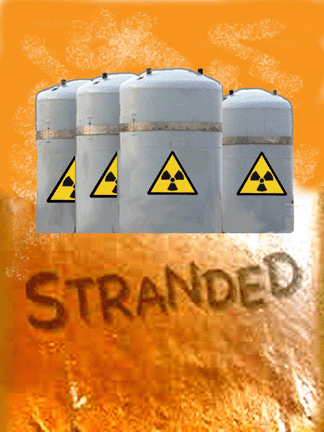 Sellafield to store nuclear waste on site for up to 100 years
Waste will be stored in a facility until there is a long-term disposal solution NWE Mail, UK, By Jenny Barwise, 8 June 2018
Sellafield is seeking permission to store extra nuclear waste in a specialised facility on the site for up to 100 years.
An application has been lodged with the county council to built two extra plant rooms in the existing Self Shielded Box Storage (SSBS) facility. The facility itself was granted permission three years ago and completed earlier this year. It is designed solely for the interim storage of boxes of waste from the Magnox storage pond which ceased operations 25 years ago.
The waste would be stored in the facility as an interim measure until a long term disposal solution – such as a geological waste facility which the Government is currently consulting on – was created. ……..
“This year we completed the construction of a new store which will hold hundreds of self-shielded boxes – these are specially built 30-tonne metal containers which safely hold radioactive waste and provide the necessary shielding from the waste inside them.”…….
As well as creating the extra plant rooms, the security fence needs to be raised by four-metres.
The application has been lodged with the county council as it is the authority which deals with minerals and waste matters, but Copeland Council has been consulted on the plans.
At a meeting earlier this week, Copeland planning officer Heather Morrison said: “In the absence of any long-term disposal options being available for this material, interim storage solutions are required.”…..years http://www.nwemail.co.uk/home/Sellafield-to-store-nuclear-waste-on-site-for-up-to-100-years-fdf84498-08c3-418e-a5f1-f86c0e1aafa2-ds
Linear accelerators (rather than nuclear reactors) for producing medical radioisotopes -a steadily growing system
New Research Study on Linear Accelerators for Radiation market predicts steady growth till 2024
Super confident Donald Trump “doesn’t need to prepare for ” nuclear summit with Kim Jong Un
 Trump: ‘I don’t think I have to prepare very much’ for North Korea nuclear summit
It’s about ‘attitude’ not ‘preparation,’ the president said of upcoming talks on Tuesday with North Korean leader Kim Jong Un in Singapore. by Jonathan Allen and Dartunorro Clark / Jun.08.2018
WASHINGTON — President Donald Trump said Thursday that he doesn’t need to study for his upcoming nuclear summit with North Korean leader Kim Jong Un.
“I think I’m very well prepared. I don’t think I have to prepare very much,” Trump told reporters at the White House Thursday as he posed for photos with Japanese Prime Minister Shinzo Abe. “This isn’t a question of preparation. It’s a question of whether or not people want it to happen, and we’ll know that very quickly.”
the president said he has not removed the U.S. sanctions against North Korea going into the meeting and is willing to walk out of the talks if they aren’t going well.
“All I can say is I’m totally prepared to walk away,” Trump said. “If you hear me saying we’re going to use maximum pressure, you’ll know the negotiation did not do well.”
Trump added that he is also prepared to ramp up sanctions on North Korea if the negotiations fall apart.
……..Pompeo downplayed comments made by Trump’s personal lawyer, Rudy Giuliani, earlier this week, that Kim had gotten “on his hands and knees and begged” for the summit after Trump abruptly canceled it last month.
“I think it was a bit in jest,” Pompeo said of those remarks. “We’re moving forward and focused on the serious issues…Rudy doesn’t speak for the administration when it comes to this negotiation.”
Trump and Kim are scheduled to meet at the Capella Hotel on Sentosa Island, a resort spot just off the coast of mainland Singapore, on Tuesday. https://www.nbcnews.com/politics/white-house/trump-i-don-t-think-i-have-prepare-very-much-n880981
Like South Australians, an American State opposes bringing nuclear wastes in for “temporary” storage
Speakers oppose nuclear waste shipments https://magicvalley.com/news/local/speakers-oppose-nuclear-waste-shipments/article_f7e16017-6629-5152-a73e-5404b61211d8.html TIMES-NEWS TWIN FALLS. 6 June 18 — City Councilman Chris Talkington and Buhl farmer James Reed will speak Friday against the shipments of nuclear waste through Idaho.
Idaho was the nation’s nuclear waste dump until Gov. Phil Batt in 1995 negotiated an end to the practice, by limiting the time nuclear waste can stay in Idaho. But that agreement is now at risk, says the Snake River Alliance, Idaho’s nuclear watchdog. … people are expected to turn out Friday at the Twin Falls Visitor Center in opposition of the U.S. Department of Energy’s plan to ship 7,000 cubic meters of nuclear waste from Hanford, Wash., to Idaho National Laboratory, a nuclear research site near Arco on top of the Eastern Snake Plain Aquifer.
Bangkok restaurants stop serving fish recently imported from Fukushima Pref.
(Mainichi Japan) FUKUSHIMA –– Eleven Japanese restaurants in the Thai capital of Bangkok have stopped serving imported fish caught off the coast of the Fukushima prefectural city of Soma, the prefectural government here said on March 12.
The decision of each restaurant came following fears that they might experience a backlash and a reduction in customer numbers — fueled by citizen group protests that have spread online — even though Thailand does not restrict the import of goods from Fukushima Prefecture…….https://mainichi.jp/english/articles/20180313/p2a/00m/0na/002000c
A New Zealand broadcaster who’s even more ignorant than Australia’s ones!
Mark Richardson calls for nuclear-powered transport
How Kim Jong Un and Donald Trump differ on the meaning of “denuclearisation
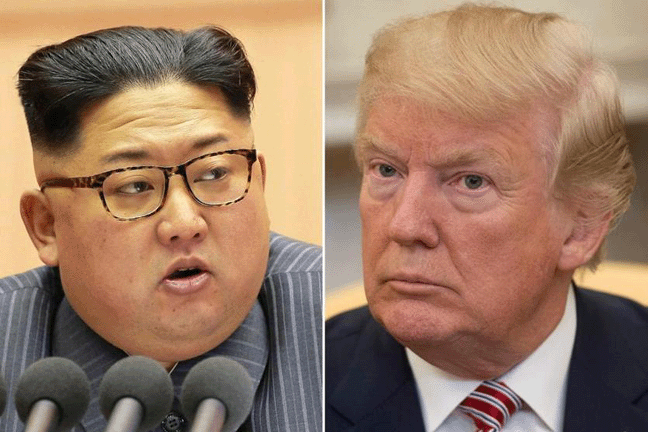 How Kim Jong Un and Trump Differ on Denuclearization. Bloomberg , By David Tweed and Kanga Kong
Donald Trump and Kim Jong Un are preparing to meet face-to-face in Singapore on June 12, a prospect that seemed unthinkable just a year ago when the leaders of the U.S. and North Korea were exchanging insults and threats. The main topic will be denuclearization, but they appear to have different ideas of what that means and how long it might take. Overcoming those differences will be key to reaching a historic outcome.
1. What is the U.S. stance on denuclearization?
The U.S. wants to see “complete, verifiable and irreversible denuclearization” of the Korean Peninsula. Known in the arms-control world as “CVID,” this would involve dismantling North Korea’s nuclear program and stripping Kim of the ability to make nuclear bombs in the future.
2. What does denuclearization mean for North Korea?
North Korea in April committed to work toward “complete denuclearization,” without elaborating on what that meant. In 2016, a government spokesman called for “the denuclearization of the whole Korean peninsula and this includes the dismantlement of nukes in South Korea and its vicinity.” More recently, North Korea has framed its willingness to get rid of nuclear weapons in more of a global context, implying that it will do so in concert with established nuclear powers like the U.S., China and Russia.
3. Does the U.S. have nuclear weapons on the peninsula?
The U.S. hasn’t stationed them in South Korea since 1992, but it does provide a so-called nuclear umbrella that guarantees the safety of allies South Korea and Japan. Kim may ask the U.S. to remove the nuclear bombers it has stationed in Guam and cease patrols by its nuclear-armed submarines. The U.S. would be unlikely to agree to any measures that would leave its allies vulnerable.
4. What about the time frame for removing nuclear weapons?
Speed is crucial for the U.S. to avoid a lengthy process that provides sanctions relief for North Korea as well as time to advance its nuclear program even further. Even so, North Korea has made it clear it will not accept the so-called Libya model proposed by U.S. National Security Adviser John Bolton under which the regime ships its nuclear arsenal out of the country in return for security guarantees and sanctions relief. ……….https://www.bloomberg.com/news/articles/2018-06-04/how-kim-jong-un-and-trump-differ-on-denuclearization-quicktake
Growing risk of nuclear war crisis between India and Pakistan
Another nuclear crisis in the making? Great power competition and the risk of war in South Asia, BAS, Moeed Yusuf 5 June 18, In May 1998, India and, later, Pakistan conducted multiple nuclear tests to become the first pair to go nuclear in the post-Cold War era. Two decades on, these South Asian rivals remain locked in a deeply antagonistic relationship that constantly threatens to boil over.
All nuclear powers must denuclearise – Malaysia
 KL: All nuclear powers must denuclearise, Straits Times, Reme Ahmad, South-east Asia Editor , 3 June 18
Propping up coal and nuclear industries is a priority for Donald Trump
NRDC 1st June 2018 The Trump Administration has made no secret of its desire to prop up coal
and nuclear plants for political purposes and today the White House made it abundantly clear. At the same time, a leaked draft memo unveiled last night repackages a previously rejected idea to bail out coal and nuclear plants, this time arguing that they are needed to protect national security.
The memo proposes that the U.S. Department of Energy (DOE) issue an order requiring electricity grid operators to purchase, for two years, electricity from expensive and uncompetitive coal and nuclear facilities that would otherwise retire. Neither the White House nor DOE have owned up to the memo or its contents.
But White House Press Secretary Sarah Huckabee Sanders stated today that stopping coal and nuclear retirements remains a priority for President Trump, and that he has directed DOE Secretary Rick Perry “to prepare immediate steps to stop the loss of these resources, and looks forward to his recommendations.”
https://www.nrdc.org/experts/john-moore/coal-and-nuclear-bailout-memo-recycled-idea-new-hat
Remediating Fukushima
FUKUSHIMA 2018: FUKUSHIMA CONTAMINATION, OLYMPICS 2020
Without doubt, the road ahead of TEPCO is a long one, beset with challenges greater than those faced to date. The Mid- and Long-Term Roadmap—the Japanese state-curated document outlining the decommissioning of Fukushima—envisions operations stretching a full 30-40 years into the future. Some have suggested it’s an optimistic target, others say that the plan lacks details on key, long-term issues such as permanent solid-waste storage beyond the onsite repository currently being employed. Certainly it is the case that key decisions remain. ……..
By all accounts, it is hard to gauge the costs for the Fukushima clean-up. Kohta told Ars that works completed to date have cost about 500.2 billion yen, or $4.7 billion—a tremendous sum, to be sure, but fractional compared to the estimate of 8 trillion yen ($74.6 billion) approved by the Japanese state last May for the complete decommissioning of Fukushima Daiichi.
THE REMEDIATION OF FUKUSHIMA —Remediating Fukushima—“When everything goes to hell, you go back to basics”ars Technica It may take 40 years for the site to appear like “a normal reactor at the end of its life.” WILLIAM STEEL –
New Zealand seen as “best” place after a nuclear war – but no one gets to opt out of nuclear war.
According to various experts, New Zealand would indeed likely be the best place to be in the event of a nuclear holocaust. But “best” is a relative term, and this belies just how hellish life could become on one of the world’s last inhabitable countries.
It’s a reminder that whatever happens on June 12 and at future global nuclear negotiations, New Zealand is not a disinterested bystander – and neither are those around the globe who want to treat this country like their own personal bomb shelter. No one gets to opt out of nuclear war.
What happens to NZ if global nuclear war breaks out? News Hub, 4 June 18 Anxiety over nuclear annihilation is lodged in our collective psyche. And fair enough: we’ve blundered our way to the precipice of nuclear warfare so many times by this point that it’s a wonder how we never made it over the edge.
This month, Donald Trump and North Korean dictator Kim Jong Un will, all going well, attempt to alleviate these fears somewhat, in what is arguably the best opportunity in decades to end conflict in the Korean peninsula and drive nuclear tensions down. But even if North Korea successfully de-nuclearises and the US stops its sabre-rattling, the world won’t be safe from the threat of future catastrophe: there remain around 15,000 nuclear weapons in the world today, nearly 14,000 of which are held by Russia and the United States, two countries currently experiencing a renaissance of mutual loathing. Continue reading
USA’s secret nuclear transport trains in the past, and now secret trucks
Major challenges remain for nuclear transportation in America
Perhaps the most pressing issue is nuclear waste and in particular, excess plutonium, most of which remains at Amarillo’s Pantex plant and will need to be moved to secure disposal facilities in the years to come.
public fears endure about whether moving such materials can ever truly be “safe.”
 The Secret ‘White Trains’ That Carried Nuclear Weapons Around the U.S. History, BRIANNA NOFIL 31 May 18 At first glance, the job posting looks like a standard help-wanted ad for a cross-country trucker. Up to three weeks a month on the road in an 18-wheel tractor-trailer, traveling through the contiguous 48 states. Risks include inclement weather, around-the-clock travel, and potentially adverse environmental conditions. But then the fine print: Candidates should have “experience in performing high-risk armed tactical security work…and maneuvering against a hostile adversary.”
Climate change will impact more on some regions and peoples
 Climate change won’t heat the planet equally, Bulletin of the Atomic Scientists, By Thomas Gaulkin, 1 June 18
“…..In places closer to the equator that usually see only slight variations in temperature, the consequences of global warming are likely to be far more extreme. The outsize vulnerability of the world’s poorest people to damaging effects of climate change like droughts and floods is well established. It’s harder for people to overcome disasters in regions without the resources and infrastructure that are plentiful in wealthier parts of the world.
Now, a new study published in Geophysical Research Letters adds insult to injury. By mapping economic and social development to climate models’ “signal-to-noise ratio”—which compares normal local temperature fluctuation (noise) to overall increases to average local temperatures (signal)—the authors determined that the poorest populations on the planet will experience more perceptible climate change than the richest. In other words, in places with already fragile social and ecological systems, climate change won’t just be harder to deal with, it will actually be more noticeable, and worse.
Not to be outdone, climate researchers at Oxford University offered their own insults this week. Analyzing vehicle use in Scotland, they concluded that top-down efforts to transition society to electric vehicles and phase out vehicle emissions aren’t enough. Without radical changes to lifestyles and increased demand for less harmful transportation systems, the authors say, there’s no chance of hitting the targets set in the Paris climate agreement. …https://thebulletin.org/climate-change-wont-heat-planet-equally11865
New research on further ways in which ionising radiation causes breast cancer
 Ionizing radiation can cause cells to turn cancerous, Pakistan Observer Islamabad : It is well established that exposure to ionizing radiation can result in mutations or other genetic damage that cause cells to turn cancerous.
1 This month
7 April – WEBINAR – Australia and the Doomsday Clock – Preventing nuclear war through NoFirstUse and other policies
Online | Tuesday April 7, 4:00-5:30pm, Australian Eastern Time / 8:00-9:30am Central Europe Time
– Access the registration link
15 April – Zoom –Nuclear Power is Not the Solution
Apr 15, 2026 01:00 AM in Canberra, Melbourne, Sydney

Join the International Physicians for the Prevention of Nuclear War (IPPNW) on Tuesday, April 14th for a timely webinar exploring the risks associated with nuclear power and challenging the myth that it offers a simple, safe, carbon-free solution to the climate crisis

21 April Webinar: No Nuclear Weapons in Australia
Start: 2026-04-21 18:00:00 UTC Canberra, Melbourne, Sydney (GMT+10:00)
End: 2026-04-21 19:30:00 UTC Canberra, Melbourne, Sydney (GMT+10:00)
Event Type: Virtual
A virtual link will be communicated before the event.
Host Contact Info: australia@icanw.org

of the week – Australians for War Powers Reform (AWPR)
To see nuclear-related stories in greater depth and intensity
 Antinuclear