‘On May 18, activists in Ballarat protested outside the local MPs office and
on May 19 more than 200 gathered outside the Camberwell office of
environment minister Josh Frydenberg.
Rallies were also held in Brisbane and Adelaide.
‘In the Sydney rally, about 400 people rallied at Marrickville Town Hall on May 19,
before marching along the main street past Labor’s infrastructure spokesperson Anthony Albanese’s office.
N Korea’s Destroyed Nuke Site Lays Basis for Denuclearization Talks – Expert https://sputniknews.com/analysis/201805261064829259-north-korea-site-destruction-talks-prospect/ WASHINGTON 27 May 18, – North Korea’s dismantling of its nuclear weapons test site should be seen as a positive step towards resolving the crisis on the Korean peninsula, Institute for Science and International Security President David Albright said in a statement on Friday.
“North Korea’s action should not be trivialized but viewed as an important step to reduce tensions and lay the basis for denuclearization negotiations,” Albright said. “It is not fair to portray it as part of an effort to hide or disguise its nuclear weapons capabilities.”
North Korea’s action, he added, is even better than a freeze because it represents a permanent disabling of the site. Three minutes of film footage taken by a journalist makes it clear that major buildings and tunnel entrances were destroyed, according to Albright.
But like many disabling steps, North Korea could likely resume nuclear weapons tests within a few months by digging tunnels in nearby mountains, Albright said. Moreover, the action does not affect North Korea’s existing stockpile of nuclear bombs and its ability to make additional weapons, even if the lack of a test facility could inhibit the nation’s ability to field reliable and deliverable warheads, according to the release.
On Friday, Trump signaled that the meeting with Kim may actually go forward after the US president received a “warm” letter from Pyongyang. In comments published by North Korea’s state-run news agency KCNA, Kim said on Friday that he wanted the United States to know Pyongyang wants to sit down at “any time” to solve problems with Washington.
Before founding the institute, Albright worked with the International Atomic Energy Agency (IAEA) from 1992 to 1997 and was the first non-governmental inspector of the Iraqi nuclear program. He was also a Senior Staff Scientist at the Federation of American Scientists.
Trump’s nuclear failures from Iran to North Korea
In just over a year, Donald Trump has managed to nudge the world closer to conflict on both ends of the Asian continent. Aljazeera, by Richard Javad Heydarian, 25 May 18
After months of exhilarating anticipation, US President Donald Trump abruptly ditched a scheduled summit with his North Korean counterpart, Kim Jung-un.
The American president vaguely cited North Korea’s “open hostility” and “trail of broken promises” as a pretext for calling off the historic meeting. Not short of bluster, he warned the North Korean regime against committing any “foolish or reckless acts”.
Trump has placed the American military on alert, signalling its readiness to engage in another round of brinkmanship with nuclear-capable North Korea.
And just like that, both protagonists are now back to square one. If anything, the American president may have snuffed the life out of an unprecedented opportunity to end the Korean conflict.
Just weeks earlier, the US unilaterally withdrew from the Iranian nuclear deal – a binding international agreement supported by all major powers, except Trump. To careful observers, both decisions were shocking, yet far from surprising.
The Trump administration simply lacks the basic strategic understanding and diplomatic finesse to cope with perplexing foreign policy challenges. When confronted with difficult geopolitical realities, Trump seems to prefer turning things into reality show episodes.
An unreliable superpower
Trump’s announcement was met by a melange of puzzlement, outrage and profound anxiety across the world. South Korea responded in total confusion, struggling to find a way out of the latest plot twist in the Trump-Kim saga.
South Korean presidential spokesman Kim Eui-kyeom admitted, “We are attempting to make sense of what, precisely, President Trump means.”
The visibly flustered South Korean President Moon Jae-in, who played an instrumental role in facilitating the summit, was confessedly “perplexed“. He described Trump’s decision as deeply “regrettable”.
……. Moon staked his presidency on unlocking the Korean conflict. In an event of actual war, Seoul, which lies within the range of North Korean artilleries, would likely be the first and biggest victim.
…..frustration is running high among allies. In recent days, German Chancellor Angela Merkel, the de facto leader of the “free world”, went so far as stating that Europe can no longer rely on the US as a source of protection.
One by one, the US’ most important allies have openly questioned the Trump administration’s capacity for global leadership. For them, Washington is an increasingly unreliable superpower, which is beginning to threaten the existing international order with “Trump-style” leadership.
Edging towards conflict
Interestingly, North Korea responded with uncharacteristic restraint, expressing its continued “willingness to sit at any time, in any way to resolve issues”. All of a sudden, Pyongyang looked like the adult in the room.
Yet, it’s hard to imagine that the regime would maintain its equanimity for long………..
The upshot is that both Iran and North Korea now feel betrayed and increasingly outraged. And they will likely up the ante in response to Trump’s perfunctory decisions.
A year into power, the controversial American president has nudged the world closer to two potential conflicts on the opposite ends of the Asian continent.
Truthout, May 25, 2018By Jon Letman, Truthout | Report When scores of Korean women representing a coalition of some 30 peace groups and NGOs entered South Korea’s National Assembly on the banks of Seoul’s Han River, they weren’t alone. This week, the Korean peace makers were joined by an international delegation of women peace activists for a symposium focused on ending the Korean War. A women’s peace walk along the Korean Demilitarized Zone (DMZ) is scheduled for May 26.
For the fourth time since 2015, these activists gathered to strategize how to most effectively advance peace on the Korean Peninsula and support diplomatic efforts to that end. #WomenPeaceKorea delegates’ efforts include engaging with South Korean government officials, foreign diplomats and US embassy officials.
Most of the international delegates are members of Women Cross DMZ and the Nobel Women’s Initiative who have traveled to Seoul to lend their support and raise awareness of the vital role women play in ending conflict.
Multiple studies have shown that when women participate in negotiations, the likelihood of achieving peace increases substantially and that peace lasts longer.
Ahn Kim Jeong-ae, one of the symposium’s organizers, said the diplomatic thaw between North and South Korea makes this week’s events even more crucial.
Ahn Kim noted that 2018 marks the 70th anniversary of the establishment of separate governments in Seoul and Pyongyang. This spring was also the 70th anniversary of the April 3 incident in which some 30,000 civilians on South Korea’s Jeju Island were massacred over a seven-year period when US military-backed right-wing forces violently purged opponents of a divided and occupied Korea.
“We want to commemorate these historical facts on May 24, International Women’s Day for Disarmament and Peace,” Ahn Kim said, noting that because women suffer disproportionately in war, they have a critical role to play in conflict resolution.
A Change in Tone
Christine Ahn is the international coordinator for Women Cross DMZ, which crossed from North to South Korea in 2015. She said the fact that this year’s symposium was held at the National Assembly (the South Korean equivalent of the US Congress), was “hugely significant.”
Unlike in 2015, when Women Cross DMZ was barely acknowledged by South Korea’s Ministry of Unification, this year’s symposium was financed by the South Korean Ministry of Gender, Equality and Family, Ahn said.
Donald Trump cancels North Korea nuclear summit, In letter to Kim Jong-un, Trump says talks are ‘inappropriate … based on the open hostility displayed in your recent statement’, Guardian, Julian Borger in Washington and Benjamin Haas in Seoul, 25 May 2018
Donald Trump has cancelled his planned summit with the North Korean leader, Kim Jong-un, blaming his decision on a threatening statement from the Pyongyang regime, and warning that the US military is “ready if necessary”.
n a formal letter to Kim released by the White House, Trump said he had been “very much looking forward” to meeting the North Korean leader.
But he wrote: “Sadly, based on the tremendous anger and open hostility displayed in your most recent statement, I feel it is inappropriate, at this time, to have this long-planned meeting.”
Trump declared that the meeting would not take place “for the good of both parties, but to the detriment of the world”.
In remarks to the press after the letter was released, Trump said it was still possible the summit could go ahead, albeit at a later date, but warned Pyongyang that the US and its allies would respond if it carried out “foolish or reckless acts”.
Asked if cancellation of the summit increased the risk of war, he replied: “We’ll see what happens.”
Meanwhile, the president said his campaign of “maximum pressure” would continue, involving the “strongest sanctions ever imposed”. However, in the wake of Trump’s withdrawal from this summit, soon after abrogating a nuclear deal with Iran that had global support, there are now serious doubts over his ability to galvanise international support for increased sanctions, or even enforce the existing sanctions regime.
Trump’s letter to Kim mixed regretful and conciliatory passages with a reminder of the size of the US nuclear arsenal.
“You talk about your nuclear capabilities, but ours are so massive that I pray to God they will never have to be used,” Trump wrote.
The cancellation came two days after a visit to the White House by the South Korean president, Moon Jae-in, who had sounded hopeful about a historic summit that he portrayed as vital to peace on the Korean peninsula.
Moon held an emergency meeting with top officials just before midnight local time on Thursday night. His office appeared surprised by the announcement, with spokesman Kim Eui-kyeom saying: “We are trying to figure out what President Trump’s intention is and the exact meaning of it.”
Pyongyang also appeared to be taken entirely by surprise.
ICAN wants to stigmatize nuclear weapons, portraying them as inherently immoral and in violation of international law, not symbols of power or guarantors of national security. In July, 2017, the Treaty on the Prohibition of Nuclear Weapons, sponsored by ican, was endorsed by a hundred and twenty-two of the hundred and ninety-three countries in the United Nations. The treaty will attain legal force after being signed and ratified by fifty. It forbids the testing, development, production, acquisition, manufacture, and possession of nuclear weapons. Last November, Pope Francis backed the treaty, altering the Catholic Church’s position on nuclear weapons.
I hope the spirit now animating the demonstrations against gun violence will soon offer resistance to the greatest possible form of organized violence. As government officials in Washington, Moscow, London, Paris, Beijing, New Delhi, Islamabad, Tel Aviv, and Pyongyang discuss how to update and improve their arsenals, the madness at the heart of the whole enterprise must be loudly asserted. How much is enough? The only rational answer: even one nuclear weapon is one too many.
The Growing Dangers of the New Nuclear-Arms Race, The Trump Administration’s push for more nuclear weapons is part of a perilous global drive to miniaturize and modernize devices that already promise annihilation. New Yorker, By Eric Schlosser, 24 May 18,“…………The movement to abolish nuclear weapons began soon after the destruction of Hiroshima and Nagasaki. In January, 1946, the first resolution of the United Nations General Assembly called for “the elimination from national armaments of atomic weapons,” and during the Cold War every American President supported that goal, with varying degrees of sincerity. On September 25, 1961, addressing the U.N. General Assembly, President Kennedy gave perhaps the most eloquent speech on behalf of abolition. “Every man, woman, and child lives under a nuclear sword of Damocles, hanging by the slenderest of threads, capable of being cut at any moment by accident or miscalculation or madness,” he said. “The risks inherent in disarmament pale in comparison to the risks inherent in an unlimited arms race.”
That week, Kennedy also secretly met with military advisers at the White House to discuss the pros and cons of launching a nuclear surprise attack on the Soviet Union. American and Soviet troops were confronting each other in Berlin, and a war between the superpowers seemed possible. Kennedy wanted to hear the benefits of striking first. ……..
Kennedy wrestled with the dilemma, decided not to launch a surprise attack, and made his feelings clear at the U.N.: “Together we shall save our planet, or together we shall perish in its flames.”
……… nuclear weapons have regained their sinister allure. Continue reading →
A collaborative research team from China has published a new analysis that shows the Earth’s climate would increase by 4 °C, compared to pre-industrial levels, before the end of 21st century.
To understand the severity of this, consider the Paris Agreement (https://unfccc.int/process/the-paris-agreement/what-is-the-paris-agreement) of the United Nations. It’s a global effort to prevent an increase of 2°C. Nearly every country on the planet–the United States is the only country to withdraw–has agreed to work to prevent the catastrophic effects of two degrees of warming.
“A great many record-breaking heat events, heavy floods, and extreme droughts would occur if global warming crosses the 4 °C level, with respect to the preindustrial period,” said Dabang Jiang, a senior researcher at the Institute of Atmospheric Physics of the Chinese Academy of Sciences. “The temperature increase would cause severe threats to ecosystems, human systems, and associated societies and economies.”
In the analysis, Jiang and his team used the parameters of scenario in which there was no mitigation of rising greenhouse gas emissions. They compared 39 coordinated climate model experiments from the fifth phase of the Coupled Model Intercomparison Project (https://www.wcrp-climate.org/wgcm-cmip), which develops and reviews climate models to ensure the most accurate climate simulations possible.
They found that most of the models projected an increase of 4°C as early as 2064 and as late as 2095 in the 21st century, with 2084 appearing as the median year.
This increase translates to more annual and seasonal warming over land than over the ocean, with significant warming in the Arctic. The variability of temperature throughout one year would be lower in the tropics and higher in polar regions, while precipitation would most likely increase in the Arctic and in the Pacific. These are the same effects that would occur under 1.5°C or 2°C increases, but more severe.
“Such comparisons between the three levels of global warming imply that global and regional climate will undergo greater changes if higher levels of global warming are crossed in the 21st century,” wrote Jiang.
The researchers continue to investigate the changes associated with 4°C of global warming in extreme climates.
“Our ultimate goal is to provide a comprehensive picture of the mean and extreme climate changes associated with higher levels of global warming based on state-of-the art climate models, which is of high interest to the decision-makers and the public,” said Jiang.
Researchers from the Chinese Academy of Sciences Center for Excellence in Tibetan Plateau Earth Sciences, the Collaborative Innovation Center on Forecast and Evaluation of Meteorological Disasters at the Nanjing University of Information Science & Technology, the Joint Laboratory for Climate and Environmental Change at Chengdu University of Information Technology, and the University of Chinese Academy of Sciences contributed to this study.
This work was supported by the National Basic Research Program of China and the National Natural Science Foundation of China.
An analysis of 97 studies by the EU-funded review body EKLIPSE concluded that radiation is a potential risk to insect and bird orientation and plant health.
However the charity Buglife warned that despite good evidence of the harms there was little research ongoing to assess the impact, or apply pollution limits.
Scientists say there was a significant release of radioactive particles during the Fukushima-Daiichi nuclear accident.
The researchers identified the contamination using a new method and say if the particles are inhaled they could pose long-term health risks to humans.
The new method allows scientists to quickly count the number of caesium-rich micro-particles in Fukushima soils and quantify the amount of radioactivity associated with these particles.
The research, which was carried out by scientists from Kyushu University, Japan, and The University of Manchester, UK, was published in Environmental Science and Technology.
In the immediate aftermath of the Fukushima Daiichi nuclear accident, it was thought that only volatile, gaseous radionuclides, such as caesium and iodine, were released from the damaged reactors. However, in recent years it has become apparent that small radioactive particles, termed caesium-rich micro-particles, were also released.
Scientists have shown that these particles are mainly made of glass, and that they contain significant amounts of radioactive caesium, as well as smaller amounts of other radioisotopes, such as uranium and technetium.
The abundance of these micro-particles in Japanese soils and sediments, and their environmental impact is poorly understood. But the particles are very small and do not dissolve easily, meaning they could pose long-term health risks to humans if inhaled.
Therefore, scientists need to understand how many of the micro-particles are present in Fukushima soils and how much of the soil radioactivity can be attributed to the particles. Until recently, these measurements have proven challenging.
The new method makes use of a technique that is readily available in most Radiochemistry Laboratories called Autoradiography. In the method, an imaging plate is placed over contaminated soil samples covered with a plastic wrap, and the radioactive decay from the soil is recorded as an image on the plate. The image from plate is then read onto a computer.
The scientists say radioactive decay from the caesium-rich micro particles can be differentiated from other forms of caesium contamination in the soil.
The scientists tested the new method on rice paddy soil samples retrieved from different locations within the Fukushima prefecture. The samples were taken close to (4 km) and far away (40 km) from the damaged nuclear reactors. The new method found caesium-rich micro-particles in all of the samples and showed that the amount of caesium associated with the micro-particles in the soil was much larger than expected.
Dr Satoshi Utsunomiya, Associate Professor at Kyushu University, Japan, and the lead author of the study says “when we first started to find caesium-rich micro-particles in Fukushima soil samples, we thought they would turn out to be relatively rare. Now, using this method, we find there are lots of caesium-rich microparticles in exclusion zone soils and also in the soils collected from outside of the exclusion zone”.
Dr Gareth Law, Senior Lecturer in Analytical Radiochemistry at the University of Manchester and an author on the paper, adds: “Our research indicates that significant amounts of caesium were released from the Fukushima Daiichi reactors in particle form.
“This particle form of caesium behaves differently to the other, more soluble forms of caesium in the environment. We now need to push forward and better understand if caesium micro-particles are abundant throughout not only the exclusion zone, but also elsewhere in the Fukushima prefecture; then we can start to gauge their impact”.
The new method can be easily used by other research teams investigating the environmental impact of the Fukushima Daiichi accident.
Dr Utsunomiya adds: “we hope that our method will allow scientists to quickly measure the abundance of caesium-rich micro-particles at other locations and estimate the amount of caesium radioactivity associated with the particles. This information can then inform cost effective, safe management and clean-up of soils contaminated by the nuclear accident”.
Opponents dominate NRC Holtec/ELEA CISF scoping meetings in northern NM! Beyond Nuclear 24 May 18
The growing resistance against Holtec International/Eddy-Lea [Counties] Energy Alliance’s proposed centralized interim storage facility (CISF) for 173,600 metric tons of highly radioactive irradiated nuclear fuel, targeted at southeastern New Mexico, showed its strength in Gallup and Albuquerque (ABQ), on May 21st and 22nd. In Gallup, opponents outnumbered supporters by a count of 36 to 1; in ABQ, it was 63 to 6. Thus far, after a half-dozen public comment meetings, opponents have outnumbered supporters, 233 to 53, a nearly five-to-one ratio! In addition, at the ABQ City Council meeting on May 21st, a Memorial was passed, expressing opposition to the shipment of highly radioactive waste through NM’s largest city.
the chance of accidents, miscalculations, and blunders with tactical weapons—as well as the pressure to “use them or lose them” in battle—greatly increase the risk of an all-out nuclear war.
The Fourth Geneva Convention extends legal protection to civilians during wartime. The rules against deliberately harming noncombatants were expanded by two additional protocols, in 1977. “The civilian population . . . shall not be the object of attack,” Protocol II states. “Acts or threats of violence the primary purpose of which is to spread terror among the civilian population are prohibited.” Despite that admonition, today’s nuclear-targeting policies in many ways resemble medieval hostage-taking. The innocent are threatened with murder in order to preserve the peace.
The Growing Dangers of the New Nuclear-Arms Race, The Trump Administration’s push for more nuclear weapons is part of a perilous global drive to miniaturize and modernize devices that already promise annihilation. New Yorker, By Eric Schlosser, 24 May 18, Less than a decade after President Barack Obama called for the abolition of nuclear weapons, the nine countries that possess them are engaged in a new nuclear-arms race. North Korea has most likely developed a hydrogen bomb, and its Hwasong-15 missiles may be large enough to transport not only a warhead but also decoys, chaff, and other countermeasures that would thwart America’s Ground-Based Midcourse Defense anti-ballistic-missile system. India recently commissioned its second ballistic-missile submarine, launched an Agni-5 ballistic missile that can strike targets throughout Pakistan and China, and tested nuclear-capable BrahMos and Nirbhay cruise missiles. Pakistan now has the world’s fastest-growing nuclear stockpile, including low-yield warheads on Hatf-9 missiles for use against Indian troops and armored vehicles. Israel is expanding the range of its Jericho III ballistic missiles and deploying cruise missiles with nuclear weapons on submarines. France and the United Kingdom are developing replacements for their Vanguard and Triomphant ballistic-missile submarines. China is about to introduce Dongfeng-41 ballistic missiles that will be mounted on trucks, loaded with up to ten nuclear warheads, and capable of reaching anywhere in the United States. Russia is building a wide range of new missiles, bombers, and submarines that will carry nuclear weapons. The R-28 Sarmat missile, nicknamed Satan-2, will carry up to sixteen nuclear warheads—more than enough for a single missile to destroy every American city with a population larger than a million people. Russia plans to build forty to fifty of the Satan-2s. Three other countries—Iran, Japan, and South Korea may soon try to obtain their own nuclear arsenals. Continue reading →
North Korea claims it has demolished its nuclear testing site North Korea has carried out what it said is the demolition of its nuclear test site, setting off a series of explosions over several hours in the presence of foreign journalists. ABC News, 25 May 18
Key points:
Closing of North Korea’s nuclear test site was announced by Kim Jong-un before planned summit with US President Donald Trump
North Korea brought in a small group of foreign journalists to witness the event
Demolition comes after North Korea labelled US Vice President Mike Pence a “political dummy”
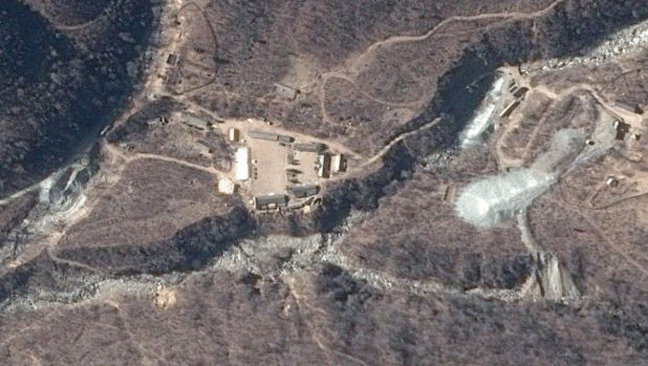
The explosions at the nuclear test site deep in the mountains of the North’s sparsely populated north-east were centred on three tunnels at the underground site and a number of buildings in the surrounding area.
North Korea had completely dismantled its Punggye-ri nuclear test ground “to ensure the transparency of discontinuance of nuclear test,” state news agency KCNA said.
The dismantling of the nuclear test ground “completely closed the tunnel entrances,” it said, adding that two tunnels there had been ready for use in “powerful underground nuclear tests”.
There was no leakage of radioactive material or adverse impact on the surrounding environment from the dismantling, the agency added.
From the Windscale fire in the U.K. to the Chernobyl disaster, from Rocky Flats to Three Mile Island in the U.S., and from Mayak in the USSR to Fukushima, that compulsive secrecy, deviousness, and lack of accountability have persisted, even as the technology has morphed from military to civilian uses. Nuclear subterfuge has eroded public trust, debate, and decision making alike.
How the ‘Compulsive Secrecy’ of the Atomic Age Has Changed the Way We Think, TIME, By FRED PEARCE May 22, 2018
One sunny morning in September 1957, a line of military trucks drove down a narrow lane beside a lake in the foothills of the Ural Mountains, the chain that divides European Russia from Siberia. They stopped at a tiny village called Satlykovo. Red Army troops began knocking on doors and ordering the few hundred inhabitants to strip off their clothes, put on replacements unloaded from the trucks, and climb aboard. The villagers were being evacuated. They could not take any of their possessions, not even banknotes. As the evacuees bid a hasty goodbye to their worldly goods, the soldiers knocked down their homes to prevent them returning, and shot their cattle and pets.
The troops gave no explanation for the evacuation. They could not say — even if they knew — that a week before there had been an explosion in radioactive waste tanks at Russia’s biggest plutonium factory, in the nearby closed city known today as Ozersk. Nor could they say that the strange dark cloud that had descended on Satlykovo hours later contained the deadly fallout from the accident. Most likely it had been responsible for the death of Iran Khaerzamanov’s 10-month-old daughter, who had been in the garden with her grandmother when the cloud descended. She suffered severe diarrhea and died hours later. Her body was the last to be buried at the village cemetery.
The troops could not say any of this because the very existence of the nuclear-weapons complex was a military secret, known only to its fenced-in workers. Nobody outside was supposed to know — ever.
Sixty years later, on another bright, sunny morning, I became the first Western journalist to visit Satlykovo since the accident. I drove through a gate still guarded by armed troops and down a long rutted lane. I found the village, but the remains of the 75 hastily demolished houses were consumed by vegetation. Nettles were everywhere. The hot, sticky air was thick with giant dragonflies. Across overgrown fields, the lake had plenty of fish, though nobody was allowed to catch them. The encroaching forest along the track harbored elk, wild boar and foxes. Radioactive it may have been, but a barren wasteland it was not.
So started my journey to discovery the radioactive legacies of the nuclear age, an age I believe and hope is coming to a close. On this journey I explored the weird radioactive badlands created by nuclear accidents — some famous, such as Chernobyl and Fukushima, and some largely unknown, like the area around Satlykovo. I visited places where atomic bombs have been dropped, in the name of science or as acts of war, and where radioactive wolves roam but people fear to tread. I tried also to make sense of our many personal and collective responses to the unleashing of the power of the atom, to the sense of foreboding and the all-too-real threat that it could be used to annihilate us all. In many ways this new psychological landscape turns out to be the strangest place of all. Continue reading →
Can we protect the brain from cosmic radiation? Medical News Today ,By Maria CohutAs we prepare to enter a new era of space travel, we must find ways of averting health risks posed by the cosmic environment. Deep space radiation, in particular, is known to impair cognitive function………. One main threat comes from cosmic radiation, which can harm the central nervous system, altering cognitive function and leading to symptoms similar to those found in Alzheimer’s disease.
……. ‘Cosmic radiation may affect brain long-term’Previous research conducted by Rosi and team found that, after mice were exposed to a level of radiation roughly equivalent to what human astronauts might encounter during an outer space mission, their capacity to differentiate between familiar and unfamiliar objects was impaired.
Usually, when mice are faced with two objects — one that is new and unknown to them and one that they formerly explored — they will spend more time familiarizing themselves with the new object.
However, the animals that had been exposed to radiation tended to spend an equal amount of time exploring both objects, which suggested to the researchers that the mice had forgotten they had already been exposed to one of the two.
Other symptoms that the mice presented included problems with social interactions and a sense of elevated anxiety. Rosi and team note that this was likely because of the effect the strong radiation had on the microglia, or nerve cells found in the brain and spinal chord that are part of the central nervous system’s immune mechanism.
When microglia are activated, they can cause symptoms — such as impaired memory recall — that are consistent with those of neurodegenerative disorders.
This is partly due to the fact that they are driven to destroy synapses, or the connections formed between brain cells that allow them to convey information.
“We are starting to have evidence that exposure to deep space radiation might affect brain function over the long-term, but as far as I know, no one had explored any possible countermeasures that might protect astronauts’ brains against this level of radiation exposure.” Susanna Rosi………https://www.medicalnewstoday.com/articles/321898.php
State lawmakers, industry leaders tangle with nuclear waste site near Carlsbad Adrian C Hedden, Carlsbad Current-Argus May 19, 2018
Producers in various industries spoke against a proposal to build a temporary nuclear waste facility near Carlsbad and Hobbs, during the initial meeting of a bicameral committee of New Mexico State lawmakers intended to study and provide oversight of the state’s nuclear activities.
Holtec International filed an application with the U.S. Nuclear Regulatory Commission in March 2017, and the application was accepted one year later, sparking outcry from across the state and west Texas.
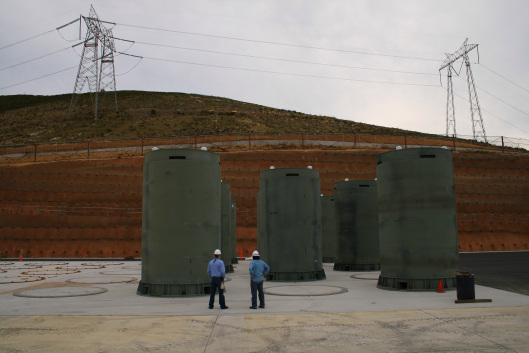
The proposed project, under a 40-year license, would allow Holtec to temporarily store about 100,000 metric tons of spent nuclear fuel rods taken from nuclear generators across the country.
The waste would be transported by rail, and stored underground in casks about 30 feet deep.
It would be kept at the Holtec site, about 35 miles between Carlsbad and Hobbs, until being transported to a permanent repository.
Barring any regulatory hurdles, officials with Holtec predicted the facility could go into operation by 2022.
“This is a very consequential project for New Mexico,” said State Sen. Jeff Steinborn (D-36), who chaired the committee during Thursday’s meeting. This is not just a New Mexico issue. This is a very big deal. There are big policy issues we need to ask as well. The question is, who are the stakeholders in this project? The answer is all New Mexicans. All of us could have this going past our house.”
Opponents feared the facility could become a permanent repository, as no other such facility exists besides a repository at Yucca Mountain, Nevada, which stalled after federal funding was cut amid opposition from Nevada lawmakers.
Many also questioned the need to move the waste without a permanent repository being developed.
“As far as I understand, before the federal government can license an interim site, there has to be a permanent site,” Steinborn said. “It has the feel of putting the cart before the horse, especially for the people of New Mexico.”
………That could come at a massive cost if there is a leak or incident at the proposed facility, said Linda Squire, a dairy farmer from Hagerman who spoke at the meeting.
She said a radiological event could cripple the local dairy industry, which she argued generates 17,000 area jobs and is an essential part of the region’s economy.
Apr 15, 2026 01:00 AM in Canberra, Melbourne, Sydney
Join the International Physicians for the Prevention of Nuclear War (IPPNW) on Tuesday, April 14th for a timely webinar exploring the risks associated with nuclear power and challenging the myth that it offers a simple, safe, carbon-free solution to the climate crisis
21 April Webinar: No Nuclear Weapons in Australia
Start: 2026-04-21 18:00:00 UTC Canberra, Melbourne, Sydney (GMT+10:00)
End: 2026-04-21 19:30:00 UTC Canberra, Melbourne, Sydney (GMT+10:00)
Event Type: Virtual A virtual link will be communicated before the event.













 Antinuclear