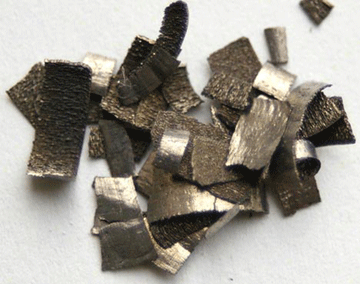
Chile’s lithium – blessing or curse?, DW, 11 May 18 Salar de Atacama is rich in lithium, essential to electric cars and other low-carbon tech. But indigenous people are fighting its extraction, saying private interests are cashing in at the expense of their environment.
The Salar de Atacama’s geysers, volcanoes and flamingos attract tourists from around the world. But beneath its dramatic vistas, the Chilean salt flats hide something of far greater economic potential that’s drawing a different kind of interest – from the world’s chemical companies.
Lithium batteries are essential to all kinds of gadgets from laptops and mobile phones to the electric cars and power storage facilities that are to help wean the world of fossil fuels. As the world shifts to renewables, more and more sectors are to be electrified, and demand for lithium is expected to double by 2025.
Salar de Atacama contains some of the world’s richest lithium deposits. Which means Chile is sitting on a goldmine. But exploiting it could come at a terrible environmental cost, protestors say.
The Chilean government wants to boost lithium production and potentially manufacture batteries in the country, breaking classic supply model where Latin American countries provide materials for products produced elsewhere.
To this end, it signed over lithium concessions to Chilean mining company SQM in January – a deal that’s to see extraction triple by 2030.
But environmentalists and mining unions are outraged. “For us, the contract is illegal,” said Miguel Soto, chairman of the Lithium for Chile movement that organized demonstrations against it on the streets of Santiago de Chile.
……….The full extent of environmental damage mining operations could have is still unclear. Domingo Ruiz, a chemist at the University of Santiago who works on lithium-ion technology, says the government should make an environmental impact study and adopt regulations.
Holly Whittenbury created a poll. No Nuclear Waste Dump Anywhere in South Australia, 12 May 18
If you could say anything to a senior lecturer at one of the state’s public Universities who declared the proposed nuclear waste facility in the state’s north will only be used to store smoke alarms and similar grade nuclear waste after their use, what would you say to him?
LIAR!! Get your facts straight
Zac EagleLies. It’s gonna store vitrified waste brought back from France which is classified high level in Europe and must be isolated from biosphere for hundreds of thousands of years and of course it’s gonna store the nuclear waste from Lucas Heights reactor and we must not forget the leaking barrels from Woomera.
All intermediate and high level waste.
Karrie Lannstrom Liar Liar Earth on Fire..Our nuclear waste dump will become the world’s nuclear waste dump..they been plotting it fir decades..and what about the used plutonium rods coming back from France..last time the first shipment was on a condemned boat…evil lying pro nuclear trying ti do a guilt trip in us with saying it only medical waste…NOT !!!!
Noel Wauchope It will store very very little, if any, medical wastes, as the vast majority of medical radioisotopes have very short half-lives – hours to a few days – no need for transporting 1700km to Kimba. Perhaps the biggest of ANSTO’s lies is the one about needing a rural South Australian radioactive waste dump as a MEDICAL NECESSITY. https://www.facebook.com/groups/1314655315214929/
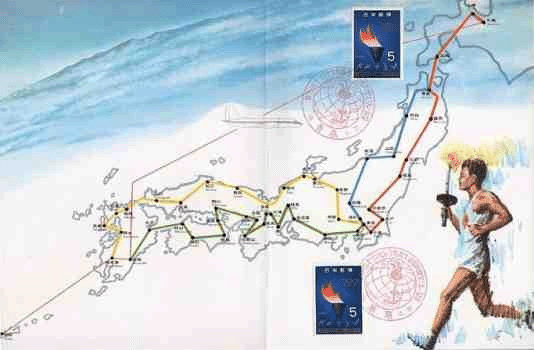
the proposed torch route samples had the highest mean radioactivity due to their close proximity to the plant. Based on the measurement, we estimated qualitatively that the radiation exposure of people living near the Azuma Sports Park area was 20.7 times higher than that of people living in Tokyo. The main tourist and proposed torch routes had radiation exposure of 24.6 and 60.6 times higher, respectively, than in Tokyo.
our results showed that the highest radioactivity level was at the proposed torch route, which is located to the northeast of the plant.
Olympic officials should consider using the results of this project to decide whether the radioactivity level at the proposed torch route and the Olympic venues are within acceptable level.
Measuring Radioactivity in Soil and Dust Samples from Japan Fukushima IQP Final Report. An Interactive Qualifying Project Report Submitted to the Faculty of the Worcester Polytechnic Instituteby Thang Pham Steven Franca Son Nguyen
Abstract
A radioactivity map of Cesium-137, a radioactive material emitted from the Fukushima Dai-ichi Nuclear Power Plant, was created by examining 30 soil and dust samples originating from Japan. A Sodium Iodide (NaI) detector measured gamma rays emitted from the samples. Qualitative evaluation of human exposure to radio-cesium in five sets of locations in Japan shows the radioactivity of tested samples. The Fukushima section of one of the Olympic proposed torch route has a 60 times higher activity of Cesium-137 than the activity of the samples from Tokyo.
Acknowledgements…….
Executive Summary
Overview
On March 11th, 2011, a magnitude 9.0 earthquake hit the Fukushima Prefecture of Japan (AESJ, 2015, p.19). This resulted in major structural damage to the surrounding area. Following the earthquake, a 13-meter tsunami hit the Fukushima Dai-ichi Nuclear Power Plant and disabled the backup the diesel backup power generator and the cooling water pumps needed to keep the Power Plant running in the event of a disaster. Since power restoration was unsuccessful and there was major structural damage caused to the Units by the tsunami, there were high concentrations of nuclear particles released into the air.
The amount of radioactive materials emitted from the Power Plant raised health and environmental concerns to the people living in the areas around the Fukushima Dai-ichi Nuclear Power Plant. In fact, several studies conducted after the accident determined the activity of radioactive isotopes in the environments. These studies around Fukushima provided excellent understanding of the activity of radioactive isotopes in the environment and the health effects on humans.
With the upcoming XXXII Olympiad in 2020 hosted by Japan, it is necessary to look into the radioactivity of Olympic venues as well as tourist attractions in the host cities. Previous studies pose a major gap because they focused on regions that are closer to the Fukushima Daiichi Nuclear Power Plant, where the highest concentration of radioactive fallout is located. On the other hand, the radioactivity in other locations in Japan is relatively less studied. Since thousands of athletes and millions of visitors are travelling to Japan for the Olympics, there has been widespread concern from the international community about radiation exposure. Therefore, it is important to investigate the extent of radioactive fallout from the Fukushima Dai-ichi incident.
Project goals and Objectives
The goals of the project were to measure the radioactivity of Cesium-137 in soil and dust samples from Japan and to generate a map that illustrates the activity of Cesium-137 in five locations in Japan. Continue reading →
Bulletin of the Atomic Scientists, John Mecklin May 2018,
With his decision today to withdraw the United States from the Iran nuclear deal, US President Donald Trump has put the long-term future of the deal in doubt, at the very least. In a televised announcement from the White House, Trump said the United States would reimpose the “highest level” of economic sanctions against Iran and would hold other nations accountable for violating those sanctions. During his truculent presentation, Trump asserted that the Iran nuclear deal—known officially as the Joint Comprehensive Plan of Action, or JCPOA—was “horrible” and “one-sided.” Even if Iran complied with the terms of the “decaying and rotten structure” of the JCPOA, the president claimed, it could move to the verge of creating nuclear weapons in “a very short time” even as it continued to build nuclear-capable missiles and support terrorism across the Middle East and the world. (The president’s claims run counter to the assessments of the numerous international security experts who note that the JCPOA’s intrusive inspection regime and other components would prevent Iran from acquiring nuclear weapons indefinitely.)
As he announced US withdrawal from the Iran deal, Trump threatened dire consequences for Iran if it resumed work toward nuclear weapons. At the same time, he asserted that his administration would work with allies toward a new deal that he was “ready, willing and able” to negotiate with Iran. Iran has previously insisted it will not renegotiate the JCPOA.
In the immediate aftermath of Trump’s decision, it was unclear how Iran, the other five countries that agreed to the JCPOA—Russia, China, the UK, France, and Germany—and the rest of the world would respond over the long term. The Bulletin invited a wide variety of top international security experts to provide comments on Trump’s decision and its potentially wide-ranging ramifications. Their responses are published below, in hopes they will help the international community find the best possible path forward. ………. https://thebulletin.org/trump-withdraws-iran-nuclear-deal-what-now11791
Trump’s decision to reimpose sanctions on Iran clearly violates the multilateral Iran nuclear deal, known officially as the Joint Comprehensive Plan of Action (JCPOA). While the move is unsurprising—given Trump’s failure to recognize the nonproliferation value of the deal and frequent threats to walk away—it is dangerous and irresponsible, and it risks manufacturing a nuclear crisis that the international community cannot afford.
There was no legitimate reason for Trump to reimpose sanctions. For the past two years, the nuclear deal has verifiably restricted Iran’s nuclear program and subjected it to intrusive monitoring and verification. Even critics of the deal, such as Secretary of State Mike Pompeo, have admitted that there is no evidence that Iran is in violation of the agreement.
Trump’s main criticism—that the deal paves the way to an Iranian nuclear weapon in 10 years—is based on a flawed analysis that discounts the value that the permanent monitoring mechanisms and prohibitions put in place by the deal possess. They are a bulwark against nuclear weapons development.
By violating the deal, Trump has only isolated the United States and undermined Washington’s credibility. His “plan B” —to negotiate a “better deal” with Iran— is completely unrealistic. After this clear demonstration that the United States cannot be counted on to implement an agreement in good faith, Trump will hard pressed to gain any support for sanctions, let alone new talks. As a result, Trump is inciting a proliferation crisis, rather than working with allies to develop a long-term diplomatic strategy that would build on the agreement in the years ahead and address Iran’s malign activities outside of the accord.
Despite Trump’s reckless decision to reimpose sanctions, it would be premature to declare the nuclear deal dead. The JCPOA is a multilateral agreement endorsed by the UN Security Council and Washington’s P5+1 partners—China, France, Germany, Russia, and the United Kingdom—which have pledged to implement the deal, irrespective of US actions. And these states and the European Union have powerful tools at their disposal to block the secondary effects of US sanctions.
It will be critical that these states move quickly to insulate legitimate business from US sanctions, demonstrating to Iran that there is still an incentive—trade with Europe and other developed economies—to continue abiding by the nuclear commitments made under the accord. Failure to ensure that Iran has international trading opportunities will make it more likely that Tehran will respond to Trump’s violation by breaching the nuclear limits. While Iran is unlikely to dash for a bomb, Iranian officials have left the door open to restart uranium enrichment to 20 percent uranium 235, a level of fissionable material currently prohibited by the deal. If Iran choses this path it would destabilize the region and increase the risks of conflict.
Trump’s decision has nonproliferation consequences beyond Iran. Trump is about to sit down at an important summit with North Korean leader Kim Jong-un to discuss denuclearization of the Korean peninsula. Violating the Iran deal undermines US credibility in those negotiations and sends a message to Kim Jong-un that even if an agreement is reached and North Korea abides by its terms, there’s no guarantee that Washington will fulfill its commitments. This is a dangerous precedent to set and risks this historic opportunity to de-escalate tensions with North Korea.
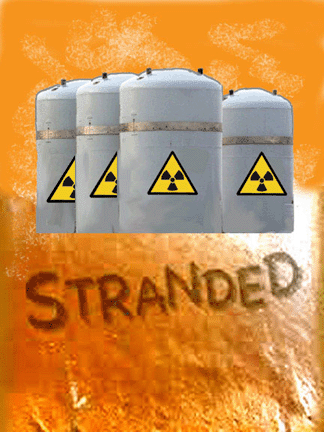
bipartisan negotiations produced “a separate path to interim storage, decoupling it from a permanent repository.”
Sacramento Municipal Utility District (SMUD) SMUD estimates that it spends roughly $5 million each year to essentially “babysit” the waste, which requires tight security and a small crew to oversee its proper storage.
More than two hundred tons of nuclear waste have been sitting a half-hour drive from downtown Sacramento for decades, as policymakers in Washington haggle over where to send the material. Continue reading →
For nine days, representatives from governments across the globe have been meeting in Bonn, Germany, to hammer out details of the Paris climate agreement.
But participating at the talks alongside diplomatic representatives and environmental groups are some perhaps unexpected parties — like the U.S. Chamber of Commerce, which has long opposed climate regulations and is a vocal proponent of fossil fuels.
A coalition of developing nations in Africa and Latin America had hoped to draw attention to the influence that the fossil fuel industry maintains over the climate negotiation process with a formal acknowledgement of conflicts of interest at the conclusion of the talks in Bonn this week.
But developed nations — led largely by the United States — succeeded in preventing such a formal acknowledgement from being included in the meeting’s final notes. Continue reading →
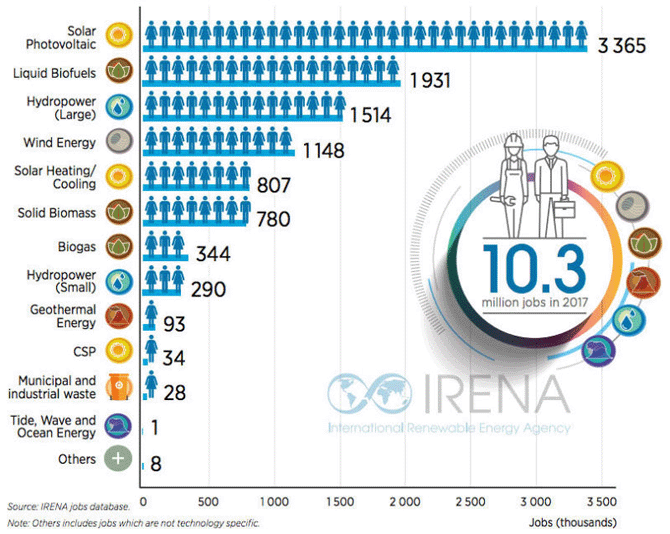
The solar industry accounts for the largest share of jobs in renewable energy, with nearly 3.4 million people employed in research, production, installation and maintenance of solar panels — an increase of 9 percent from 2016. The solar sector is followed by liquid biofuels, with 1.9 million jobs, and hydropower, with 1.5 million. The IRENA report finds that employment in the global wind industry decreased slightly from 2016 to 2017, shrinking to 1.15 million. China is home to 65 percent of the world’s solar jobs, and 43 percent of all renewable energy jobs. Due to the region’s robust manufacturing sector, four-fifths of all renewable energy jobs are located in Asia.
“The data underscores an increasingly regionalized picture, highlighting that in countries where attractive policies exist, the economic, social and environmental benefits of renewable energy are most evident,” said Adnan Z. Amin, director general of IRENA.
Jonathan Ernst 17 10.05 WASHINGTON (Sputnik) – The United States by exiting the Iran nuclear agreement has now essentially outsourced US foreign policy in the Middle East to both Israel and Saudi Arabia, analysts told Sputnik.
On Wednesday, White House Press Secretary Sarah Sanders told reporters the United States is ready to announce an additional set of sanctions against Iran as early as next week in response to its alleged development of nuclear weapons.
President Donald Trump on Tuesday announced that the United States was withdrawing from the 2015 Joint Comprehensive Plan of Action (JCPOA), signed by the P5+1 and EU, which ensures Iran’s nuclear program remains peaceful in exchange for sanctions relief. In addition, the US Treasury said it would reimpose the highest-level economic sanctions possible on Iran.
In the week prior to Trump’s decision Israeli Prime Minister Benjamin Netanyahu in an internationally-broadcast address presented old intelligence and tried to claim that Tehran was continuing to develop nuclear weapons.
In fact, Iran has remained compliant under the conditions of the JCPOA as verified by the IAEA in 11 reports since January 2016 — a reality US Secretary of State Michael Pompeo even admitted during his confirmation hearings.
Israeli, Saudi Victory
Retired US Army Major and historian Todd Pierce told Sputnik that Trump’s announcement was a triumph for the leaders of Israel and Saudi Arabia, both of whom want the United States to confront Iran.
“Trump has placed US foreign policy in the hands of the coalition of Israel under Netanyahu and Saudi Arabia under [Crown Prince] Mohammad bin Salman, which his son in law Jared Kushner helped bring together to collectively wage war against Iran and Syria,” he said.
Trump’s statement on why he was pulling out of the international nuclear agreement with Iran was expressed in terms that made it sound like Trump was determined to go to war, Pierce observed.”Constructively, in effect, Trump’s talk sounded like a declaration of war against Iran, with the first step being to tighten up the ‘blockade’ of Iran, meaning in the 21st century version of that, US sanctions,” Pierce said.
Trump’s address was also notable for how closely it followed the arguments made eight days earlier by Netanyahu in his efforts to persuade the US government and Congress to scrap the agreement, Pierce pointed out.
Trump, like his ally and friend Netanyahu had shown scant regard for factual accuracy in his presentation.Trump was not an extremist or aberration in setting such policies but was fulfilling goals that had been followed for decades, Pierce pointed out.
Tehran Undaunted
Global peace activist and expert on the medical dangers of nuclear energy, Dr. Helen Caldicott, told Sputnik that she expected Tehran to continue honoring its commitmentsunder the 2015 nuclear accord.
“I think there will not be a nuclear arms race in the Middle East despite the fact that Israel was vehemently opposed to the treaty and surreptitiously lobbied against it with the powers that be in the US,” Caldicott said.
Caldicott, founder of Physicians for Social Responsibility, the organization that was the co-winner of the 1985 Nobel Peace Prize, noted that Iranian President Hassan Rouhani had pledged to remain in the accord.
“Rouhani says that Iran will abide by the JCPOA, a stand which I intuitively had predicted,” she said. “It also seems clear that the European nations will definitely not abide by Trump’s terms of increased sanctions, after begging him to comply.”
The United States still needed to realize that Russia was not an ideological enemy of the West any more the way the Soviet Union had been throughout the Cold War, Caldicott maintained.
“If America could come to its senses and decide that all nuclear weapons are useless symbols of annihilation and have absolutely nothing to do with ‘defense’ it could lead the world to sanity, survival and nuclear disarmament,” she said.
Saudi Foreign Minister Adel Jubeir said on Wednesday that the country may start development of nuclear weapons if Iran continues its nuclear program.
Caldicott is the author of many books, including “The New Nuclear Danger: George W. Bush’s Military Industrial Complex” and “War in Heaven:” The Arms Race in Outer Space.” The Smithsonian Institution has named her one of the most influential women of the 20th century.
EcoPeace Middle East and the power of environmentalism, Independent Australia, Sophia McNamara
EcoPeace Middle East teach environmental issues to Israeli, Palestinian and Jordanian children in the hopes they’ll bring awareness back to their communities (screen shot via YouTube).
Sophia McNamara introduces Gidon Bromberg and EcoPeace Middle East — an organisation brokering peaceful cooperation with environmentalism.
ECOPEACE MIDDLE EAST is a unique regional organisation that brings together Israeli, Palestinian and Jordanian environmentalists.
It is the only regional non-government organisation (NGO) that exists in Israel, Palestine and Jordan. Among its many battles, Ecopeace Middle East recently helped increase the supply of clean water and energy to Gaza. This is particularly critical considering the United Nations has predicted that Gaza will become uninhabitable by 2020.
I interviewed Israeli co-director and co-founder of EcoPeace Middle East Gidon Bromberg and he told me:
“Just a one hour drive from here in Tel Aviv, there is a water and sanitation crisis in Gaza … Two million people have run out of water. And today, about 97% of the groundwater is undrinkable.”
Bromberg came up with the idea to start EcoPeace when he realised the environment was being completely left out of the peace agenda of the early 1990s.
Originally from Elsternwick in Melbourne, Bromberg attended Elwood High School (formerly Elwood College) and graduated with degrees in Law and Economics from Monash University. Since age 11, Bromberg had known he wanted to return to his family’s hometown of Tel Aviv, Israel.
Straight after university, he made “aliyah“ — a term that describes the process of a Jewish person returning to Israel.
Bromberg came across an advert saying that a newly established non-profit called the Israel Union for Environmental Defence wanted their first lawyer. He volunteered there one day a week for four years, while still working four days a week in private practice, taking a pay cut in the process.
He was then offered a scholarship to study his Masters of Law at the American University in Washington DC, where he ended up being right on the doorstep of negotiations for the Oslo Accords and the Israel-Jordan Peace Treaty. Bromberg’s Masters thesis posed the question: will peace be environmentally sustainable? He concluded that peace could, in fact, be truly harmful to the environment and sustainability unless it was put on the political track.
Bromberg had the idea to create a regional environmental organisation that would address this exact issue. He wanted to hold a meeting with Israeli, Egyptian, Palestinian and Jordanian environmentalists to discuss the possibility of this organisation. He spoke with potential investors in Washington DC — they all told him it was a great idea, but he needed to come back to them when he was older.
In 1994, he went back to Israel and, as part of his scholarship, he worked for a year at the Israel Union of Environmental Defence as a full-time lawyer.
Bromberg immediately wrote to all the potential investors in the United States again, this time from Israel. One of them called him and said he had thought about it and that if he could make the meeting happen, he would fund it. As these were the days before the internet, Bromberg had never met a Palestinian, Jordanian or Egyptian environmentalist.
The World Wildlife Fund had a guide on environmentalist organisations in the region — so he contacted all of them. Bromberg had a meeting in East Jerusalem with a Palestinian environmentalist, who responded to the enquiry, and spoke over the phone to an Egyptian and Jordanian. …..
Today, EcoPeace has adapted to a changed political climate, increased water scarcity and urgency required by climate change. They focus heavily on shared natural resources, regional water security and sustainable development.
A particularly successful initiative by EcoPeace is the Good Water Neighbours Program. This is where youth and adult activists, as well as mayors and municipal staff from Israeli, Palestinian and Jordanian communities all work together across the borders to advance shared solutions for the rehabilitation of natural watersheds.
The Jordan River, possibly the holiest river in the world, with large religious significance in Christianity, Judaism and Islam, “has been turned into little more than an open sewer now,” says Bromberg.
Bromberg says the issue is about more than the river itself:
“The largest number of volunteers from Jordan who have joined ISIS are from Jordan Valley communities. There is a link between ecological demise, poverty, underdevelopment… and then radical, dangerous ideologies. Water security, ours and our neighbours, are national security concerns.”
BARACK Obama has warned of serious consequences over Donald Trump’s decision to withdraw from a nuclear accord with Iran.Emma Reynolds and wires. news.com.au– 9 May 18
President Trump announces decision on Iran nuclear deal
BARACK Obama has slammed Donald Trump’s decision to withdraw the US from a landmark nuclear accord with Iran.
In a statement, the former president said the announcement was “so misguided” and would see the US “turning our back on America’s closest allies, and an agreement that our country’s leading diplomats, scientists and intelligence professionals negotiated”.
The Joint Comprehensive Plan of Action, or JCPOA, was negotiated and implemented during Mr Obama’s presidency.
“I believe that the decision to put the JCPOA at risk without any Iranian violation of the deal is a serious mistake,” warned Mr Obama. “Without the JCPOA, the United States could eventually be left with a losing choice between a nuclear-armed Iran or another war in the Middle East.
“We all know the dangers of Iran obtaining a nuclear weapon. It could embolden an already dangerous regime; threaten our friends with destruction; pose unacceptable dangers to America’s own security; and trigger an arms race in the world’s most dangerous region.”
Mr Trump will withdraw the US from a landmark nuclear accord with Iran, in a move that is already triggering global panic.
The President warned that “at the heart of the Iran deal is a giant fiction” — that the regime wanted peace.
He said the nation had continued to develop nuclear capabilities, and if he allowed the “defective” accord to remain in place, it would lead to an arms race in the Middle East.
Mr Trump vowed he would reimpose the highest level of economic sanctions, which were lifted under the 2015 deal, warning that any nation helping Iran “in its quest for nuclear weapons” could also be strongly penalised by the US.
“We will not allow a regime that chants ‘Death to America’ to gain access to the most deadly weapons on Earth,” he said.
His decision raised fears Iran could mount an attack on Israel, which pushed for an end to the deal. The announcement also saw oil prices plummet by 1.2 per cent.
Mr Obama, who brokered the deal, said the decision weakened America’s ability to confront Iran’s “destabilising” behaviour.
In a rare public criticism of Mr Trump, the former president said the deal had accomplished the very outcome that is being pursued with North Korea.
“The consistent flouting of agreements that our country is a party to risks eroding America’s credibility, and puts us at odds with the world’s major powers,” he said.
“Every aspect of Iranian behaviour that is troubling is far more dangerous if their nuclear program is unconstrained.”
Mr Trump’s choice had become known as the “nuclear option”, because it is almost certain to signal an end to the multination agreement. Iran will now have to decide whether to follow the US and exit the deal, or try to retain the agreement with other countries.
Mr Trump insisted the US “no longer makes empty threats”, in a televised address from the White House. He also noted that secretary of state Mike Pompeo was on his way to North Korea to discuss the upcoming summit between the US President and Kim Jong-un.
The 2015 deal between multiple world powers lifted most sanctions against the Iran, provided it agreed to restrictions on its nuclear program that would prevent it producing a bomb, and regular inspections.
Now, sanctions on Iran’s central bank — intended to target oil exports — will kick back in on Saturday, the next deadline for renewal, rather than being waived again.
The administration will give those who are doing business with Iran between three and six months to wind down business and avoid breaching those sanctions.
But it is still possible that a new agreement could be reached. Administration officials briefing congressional leaders about Mr Trump’s plans reportedly emphasised that just as with the ditched Trans-Pacific Partnership and Paris climate agreement, he remains open to renegotiating a better deal.
European nations have in recent days given in to many of Mr Trump’s demands in the hope he would choose a more gradual approach, which might have allowed the deal to survive.
But they failed to prevent his decision to reimpose sanctions and walk away from the signature Obama agreement, which Mr Trump has attacked since the election campaign.
Israeli prime minister Benjamin Netanyahu praised Mr Trump’s “historic move”, while while the military said forces were on high alert near its border with Syria after spotting Iranian activity.
French President Emmanuel Macron, who strongly supports the deal and tried to persuade Mr Trump to stay in it during a visit to Washington last month, said he was “disappointed” by the announcement.
EU foreign policy chief Federica Mogherini said: “Together with the rest of the international community, we will preserve this nuclear deal.”
France, the UK and Germany have previously vowed to maintain the deal without the US, but that could potentially put them at risk of sanction.
Hours before the announcement, European members of the agreement met to underline their support for it. Officials from Britain, France and Germany met in Brussels with Iran’s deputy foreign minister for political affairs, Abbas Araghchi.
If the deal collapses, Iran will be free to resume prohibited enrichment activities, while businesses and banks doing business with Iran will have to rush to extricate themselves or run afoul of the US.
American officials have been making plans to sell the pullout to the public and explain its complex financial ramifications, said US officials and others, who weren’t authorised to speak and requested anonymity.
Mr Trump built up anticipation for his announcement by tweeting that he would reveal his decision at 2pm at the White House.
In Iran, many are deeply concerned about how his decision could affect the already struggling economy.
President Hassan Rouhani sought to calm nerves during a speech on Tehran, smiling as he appeared at a petroleum expo in the capital. He didn’t name Mr Trump, but emphasised that Iran continued to seek “engagement with the world.”
“It is possible that we will face some problems for two or three months, but we will pass through this,” Mr Rouhani said.
The first 15 months of the Trump presidency have been filled with many “last chances” for the Iran deal in which he’s repeatedly postponed the decision.
An immense web of sanctions, written agreements and staggered deadlines make up the accord. Sanctions on specific Iranian businesses, sectors and individuals will snap back into place in July unless Mr Trump signs another waiver.
Even the secretary of state and the UN agency that monitors nuclear compliance agree that Iran, so far, has lived up to its side of the deal. But the deal’s critics, such as Israel, the Gulf Arab states and many Republicans, say it’s a giveaway to Tehran that ultimately paves the path to a nuclear-armed Iran several years in the future.
ran has been coy in predicting its response to a US withdrawal. For weeks, Iran’s foreign minister had been saying that a reimposition of US sanctions would render the deal null and void, leaving Tehran little choice but to abandon it as well.
But on Monday, Mr Rouhani said Iran could stick with it if the European Union, whose economies do far more business with Iran than the US, offers guarantees Iran would keep benefiting. For the Europeans, a Trump withdrawal would also constitute dispiriting proof that trying to appease him is futile.
The three EU members of the deal — Britain, France and Germany — were insistent from the start that it could not be reopened. But they agreed to discuss an “add-on” agreement that would not change the underlying nuclear deal, but would add new restrictions on Iran to address what Mr Trump had identified as its shortcomings.
The President wanted to deter Iran’s ballistic missile program and other destabilising actions in the region. He also wanted more rigorous nuclear inspections and an extension of restrictions on Iranian enrichment and reprocessing rather than letting them phase out after about a decade.
Negotiating an add-on agreement, rather than revising the existing deal, had the added benefit of not requiring the formal consent of Iran or the other remaining members: Russia and China. The idea was that even if they baulked at the West’s impositions, Iran would be likely to comply anyway so as to keep enjoying lucrative sanctions relief.
Although the US and Europeans made progress on ballistic missiles and inspections, there were disagreements over extending the life of the deal and how to trigger additional penalties if Iran were found violating the new restrictions, officials revealed.
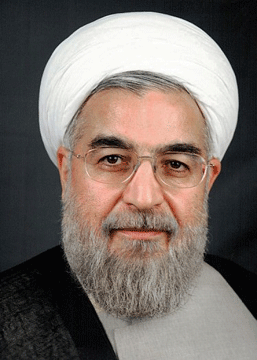
President Hassan Rouhani said on Tuesday that Iran would remain committed to a multinational nuclear deal despite U.S. President Donald Trump’s decision to withdraw from the 2015 agreement designed to deny Tehran the ability to build nuclear weapons, Reuters reported.
“If we achieve the deal’s goals in cooperation with other members of the deal, it will remain in place… By exiting the deal, America has officially undermined its commitment to an international treaty,” Rouhani said in a televised speech.
“I have ordered the foreign ministry to negotiate with the European countries, China and Russia in coming weeks. If at the end of this short period we conclude that we can fully benefit from the JCPOA with the cooperation of all countries, the deal would remain,” he added.
The Joint Comprehensive Plan of Action (JCPOA) is the full name for the nuclear deal, struck in 2015 between Iran, the five permanent members of the U.N. Security Council – the United States, Russia, China, Britain and France – and Germany.
Rouhani added that Iran was ready to resume its nuclear activities after consultations with the other world powers which are part of the agreement.
But the announcement was short on specifics, including which sanctions – they cover industries ranging from petroleum to transportation to insurance – will be restored first. And it was not clear whether the decision will lead to a collapse of the agreement, which involves five other countries.
…….. the American withdrawal does not necessarily mean the Iran agreement collapses — at least not immediately. Britain, China, France, Germany and Russia are still parties to the agreement. If they all agree to maintain it, the effect of restored American sanctions on Iran may be softened.
And Mr. Trump held out the possibility of negotiating a new agreement with Iran, though its leaders have said that won’t happen.
All restrictions on Iran’s nuclear activities under the agreement remain in place. Continue reading →
Heather Mckenzie Stuart, Fight To Stop Nuclear Waste Dump In Flinders Ranges SA, 7 May 18 Just letting people know, no one uses myself, Regina McKenzieVivianne C McKenzie re the proposed nuclear waste dump at Barndioota Wallerberdina in our yarta in the Flinders Ranges. We are women who believe in protecting our cultural heritage and all aspects of it. We are not puppets on anyone’s string in anyone’s hand, we have got our own minds and we wont back down. Conservationists ( God bless them) do not use us, we use them and their resources to stand, protest and fight against evil like a nuclear waste dump that comes into our yarta. They learn from us in reverse. We love our conservationist friends our supporters those who believe what we believe in protecting Gods creation, we with them will never give in to what is been forced on South Australia!
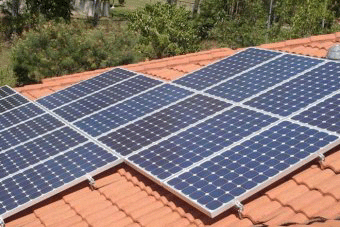
Independent 5th May 2018, California is set to become the first US state to make solar panels
mandatory on most newly built homes. The state’s Energy Commission is due
to vote next week on new energy standards that would require virtually all
new homes to be constructed with solar panels from 2020. Currently around
20 per cent of single-family homes are constructed with solar capacity
built in, but if the new standards are approved as expected this proportion
will rise sharply. https://www.independent.co.uk/news/world/americas/california-solar-power-panels-homes-renewable-green-energy-climate-change-a8337626.html
Apr 15, 2026 01:00 AM in Canberra, Melbourne, Sydney
Join the International Physicians for the Prevention of Nuclear War (IPPNW) on Tuesday, April 14th for a timely webinar exploring the risks associated with nuclear power and challenging the myth that it offers a simple, safe, carbon-free solution to the climate crisis
21 April Webinar: No Nuclear Weapons in Australia
Start: 2026-04-21 18:00:00 UTC Canberra, Melbourne, Sydney (GMT+10:00)
End: 2026-04-21 19:30:00 UTC Canberra, Melbourne, Sydney (GMT+10:00)
Event Type: Virtual A virtual link will be communicated before the event.








 Antinuclear