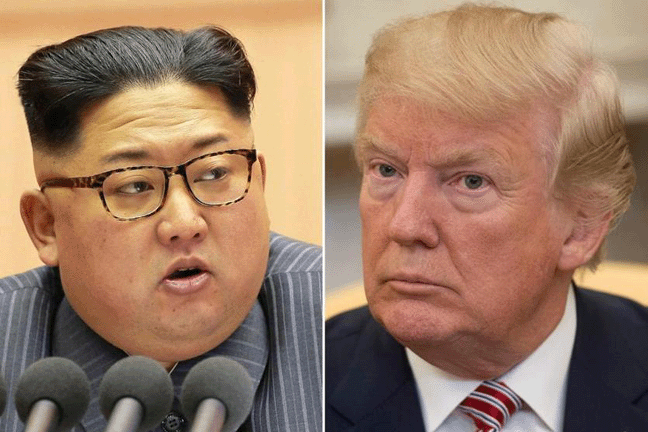
TOKYO – President Donald Trump has agreed to meet with North Korean leader Kim Jong Un for talks, an extraordinary development following months of heightened nuclear tension during which the two leaders exchanged frequent military threats and insults.
Kim has also committed to stopping nuclear and missile testing, even during joint military drills in South Korea next month, Chung Eui-yong, the South Korean national security adviser, told reporters at the White House on Thursday night after briefing the president on his four-hour dinner meeting with Kim in Pyongyang on Monday.
After a year in which North Korea fired intercontinental ballistic missiles capable of reaching all of the United States and tested what is widely thought to have been a hydrogen bomb, such a moratorium would be welcomed by the United States and the world.
Trump and Kim have spent the past year making belligerent statements about each other, with Trump mocking Kim as ‘‘Little Rocket Man’’ and pledging to ‘‘totally destroy’’ North Korea and Kim calling the American president a ‘‘dotard’’ and a ‘‘lunatic’’ and threatening to send nuclear bombs to Washington, D.C.
But Kim has ‘‘expressed his eagerness to meet President Trump as soon as possible,’’ Chung told reporters.
‘President Trump said he would meet Kim
Jong Un by May,’’ Chung said, but he did not provide any information on where the meeting would be. In Seoul, the presidential Blue House clarified that the meeting would occur by the end of May.
The project, a collaboration between scientists at MIT and a private company, will take a radically different approach to other efforts to transform fusion from an expensive science experiment into a viable commercial energy source.
….A newly available superconducting material — a steel tape coated with a compound called yttrium-barium-copper oxide, or YBCO — has allowed scientists to produce smaller, more powerful magnets. And this potentially reduces the amount of energy that needs to be put in to get the fusion reaction off the ground….The planned fusion experiment, called Sparc, is set to be far smaller — about 1/65th of the volume — than that of the International Thermonuclear Experimental Reactor project, an international collaboration currently being constructed in France.
By 2040 or so, we’ll have robots doing all the work and clean, cheap fusion providing all the power we need. You just gotta believe.
Since the government announced plans to bury nuclear waste in Bure, the village has been at the epicenter of France’s anti-nuclear movement — and the scene of recent clashes between activists and police.
Anti-nuclear protesters lug planks and beams across the muddy fields outside Bure, a village of just 90 inhabitants in northeastern France. They’re preparing to build a treehouse in the Lejuc woods to replace those destroyed by police last month.
On February 22, some 500 police were sent to evacuate a few dozen activists occupying the woods in protest against the government’s plan to bury radioactive waste in Bure.
The dawn evacuation took protesters by surprise. “A staggering number of officers came to the woods to demolish our homes, and destroy everything we’d created,” says one activist, who asks to remain anonymous. Like many of his fellow protesters, he wears an owl mask to hide his face.
While tensions have grown between police and demonstrators in recent weeks, opposition to the project goes back decades.
Nuclear waste is a pressing problem in France, which gets 70 percent of its electricity from 58 nuclear plants.
In 1998, France’s nuclear waste agency, Andra, began work on a vast underground laboratory dedicated to researching Bure’s geology. The aim was to determine whether the site could host a deep geological repository — the technical term for an underground nuclear waste storage facility.
The ultimate goal is to store 80,000 cubic meters of high-level radioactive waste — which can remain hazardous to humans for tens of thousands of years — 500 meters underground.
“Our scientists have been studying the viability of deep geological repositories for more than 25 years,” Frederic Plas, a research director at Andra, told DW. “At the Bure lab, we’ve researched the geological site’s characteristics and tested the clay rock formation to determine whether or not it’s capable of confining radioactivity.”
The safest option?
“It’s the best option in terms of security, and we elected officials were satisfied with the public debates that were held on this topic,” Pancher told DW. “The law authorizing research on deep geological repositories also requires that the waste be retrievable for a century, meaning we can remove the waste should any problem arise.”
The concept of “retrievability” is key to the debate. Under French law, deep geological repositories must allow for the waste to be removed from the site for at least 100 years — partly in case of unforeseen problems, but mostly in case scientists come up with a better way of disposing of the waste.
“The idea is not to bury [it] and forget [it] forever,” Nicolas Mazzucchi, an energy expert at the Foundation for Strategic Research, a Paris think tank, told DW.
Most scientists say storing nuclear waste in deep geological repositories is safer than storing it above ground, where it may be exposed to the elements, or even acts of terrorism.
However, few want to live next door to such a repository — which is why potential sites tend to be located in remote areas like Bure.
Tough sell for locals
The French government is also sweetening the deal with a 1991 law, which established that regions hosting nuclear waste projects are to receive state financial aid. The two municipalities near the Bure lab receive some 30 million euros each per year — a considerable sum for rural areas with dwindling populations.
But the police’s forceful response to protests does little to reassure locals the state has their interests at heart.
“I’ve been fighting this project for 25 years,” local farmer Jean-Pierre Simon told DW. “The government wants to quash the opposition and appropriate the land. Eventually there will be no more farmers, and Andra will be able to do whatever it wants.”
For now, the Bure lab is still just that — a lab. The government hasn’t yet authorized it to operate as a deep geological repository. And activists in Bure are determined to keep it that way.
https://mainichi.jp/english/articles/20180307/p2a/00m/0na/017000c(Mainichi Japan) Sixteen pieces of data relating to the underground disposal of highly radioactive waste generated by nuclear reactors, which scandal-hit Kobe Steel Ltd. and a subsidiary analyzed at the request of the Japan Atomic Energy Agency (JAEA), were falsified, forged or flawed in other ways, the nuclear research organization said.
The government-affiliated JAEA, which commissioned Kobe Steel and its subsidiary Kobelco Research Institute Inc. to analyze data on the impact of burying highly radioactive waste deep underground, has demanded that the steelmaker redo the work.
Kobe Steel expressed regret over the matter. “We’ll do our best to prevent a recurrence,” said a company official.
According to the JAEA, the data in question includes that on the corrosion of metal used for cladding tubes and containers for spent nuclear fuel. Between fiscal 2012 and 2016, the Nuclear Regulation Authority and the Ministry of Economy, Trade and Industry (METI) commissioned the JAEA to conduct the analyses, and the agency farmed out the work to the steelmaker and its subsidiary.
JAEA officials said most of the data was not accompanied by records of experiments conducted in the analyses, or had intentionally been altered.
According to METI’s Agency for Natural Resources and Energy and other sources, the report detailing the results of the analyses will be partially corrected following the discovery of the data falsification.
NRA drops consolidation initiative for unwanted nuclear fuel after butting heads with JAEA, Japan Times, 6 Mar 18, KYODO
The Nuclear Regulation Authority has given up on its proposal to gather and store redundant nuclear material from throughout Japan at one common facility run by the Japan Atomic Energy Agency, sources close to the matter said Saturday.
The watchdog had been discussing the idea with the state-backed JAEA but failed to reach a deal due largely to disagreements on cost, the sources said.
Most of the nuclear material targeted by the initiative is small quantities of fuel at around 1,200 universities, hospitals and other places. The owners of the material often try to get rid of it in order to avoid the accompanying safety and maintenance issues.…….
An NRA survey covering the 1,800 holders of relatively small amounts of nuclear material showed that 1,100 of them, or about 80 percent, hope to transfer the fuel elsewhere because they have no use for it.
Pro-nuclear environmentalists’ in denial about power/weapons connections, Energy Post byJim Green
Claims by self-styled ‘pro-nuclear environmentalists’ that “nuclear energy prevents the spread of nuclear weapons” and “peace is furthered when a nation embraces nuclear power” do not withstand scrutiny, writes Jim Green, editor of the Nuclear Monitor newsletter. Green looks at the conclusions of some studies which, he says, downplay the troubling connections between nuclear power and weapons. Courtesy Nuclear Monitor.
As discussed previously in Energy Post, nuclear industry bodies (such as the US Nuclear Energy Institute) and supporters (such as former US energy secretary Ernest Moniz) are openly acknowledging the connections between nuclear power and weapons ‒ connections they have denied for decades. Those connections are evident in most of the weapons states, in numerous countries that have pursued but not built weapons, and in potential future weapons states such as Saudi Arabia.
Ideally, acknowledgement of power/weapons connections would lead to redoubled efforts to build a firewall between civilian and military nuclear programs ‒ strengthened safeguards, curbs on enrichment and reprocessing, and so on.
But that’s not how this debate in playing out. Industry insiders and supporters drawing attention to the connections are quite comfortable about them ‒ they just want increased subsidies and support for their ailing civilian nuclear industries and argue that ‘national security’ and ‘national defense’ will be undermined if that support is not forthcoming.
Some continue to deny the power/weapons connections even though the connections are plain for all to see and are now being acknowledged by a growing number of nuclear insiders and supporters. The most prominent of these are self-styled ‘pro-nuclear environmentalists’.
One such person is Ben Heard from the Australian pro-nuclear lobby group ‘Bright New World‘. Heard claims that nuclear power promotes peace and uses the two Koreas to illustrate his argument: “The South is a user and exporter of nuclear power, signatory to the non-proliferation treaty, and possesses zero nuclear warheads. The North has zero nuclear power reactors, is not a signatory to the non-proliferation treaty, and is developing and testing nuclear weapons.”
Likewise, Michael Shellenberger, founder of the U.S. pro-nuclear lobby group ‘Environmental Progress’, claims that: “One of [Friends of the Earth]-Greenpeace’s biggest lies about nuclear energy is that it leads to weapons. Korea demonstrates that the opposite is true: North Korea has a nuclear bomb and no nuclear energy, while South Korea has nuclear energy and no bomb.”
Heard and Shellenberger ignore the fact that North Korea uses what is calls an ‘experimental power reactor’ (based on the UK Magnox power reactor design) to produce plutonium for weapons. They ignore the fact that North Korea acquired enrichment technology from Pakistan’s A.Q. Khan network, who stole the blueprints from URENCO, the consortium that provides enrichment services for the nuclear power industry. They ignore the fact that North Korea’s reprocessing plant is based on the design of the Eurochemic plant in Belgium, which provided reprocessing services for the nuclear power industry.
Heard and Shellenberger also ignore South Korea’s history of covertly pursuing nuclear weapons, a history entwined with the country’s development of nuclear power. For example, the nuclear power program provided (and still provides) a rationale for South Korea’s pursuit of reprocessing technology.
Nicholas Miller’s article in International Security
Echoing Shellenberger’s claim that “nuclear energy prevents the spread of nuclear weapons”, Heard writes: “Peace is furthered when a nation embraces nuclear power, because it makes that nation empirically less likely to embark on a nuclear weapons program. That is the finding of a 2017 study published in the peer-reviewed journal International Security.” However, the claim isn’t true, and it isn’t supported by the International Security journal article, written by Nicholas Miller from Dartmouth College.
“The annual probability of starting a weapons program is more than twice as high in countries with nuclear energy programs, if one defines an energy program as having an operating power reactor or one under construction” ………..
All the logistic regression models in the world don’t alter the fact that nuclear power/weapons connections are multifaceted, repeatedly demonstrated, disturbing and dangerous:
Nuclear power programs were involved in the successful pursuit of weapons in four countries (France, India, Pakistan, South Africa) according to Miller (and India and North Korea could be added to that list) and have provided many other countries with a latent weapons capability.
Power programs have provided ongoing support for weapons programs to a greater or lesser degree in seven of the nine current weapons states (the exceptions being Israel and North Korea).
The direct use of power reactors to produce plutonium for weapons in all or all-but-one of the declared weapons states (and possibly other countries, e.g. India and Pakistan).
The use of power reactors to produce tritium for weapons in the US (and possibly other countries, e.g. India).
Power programs (or real or feigned interest in nuclear power) legitimising enrichment and reprocessing programs that have fed proliferation.
Power programs (or real or feigned interest in nuclear power) legitimising research (reactor) programs which can lead (and have led) to weapons proliferation.
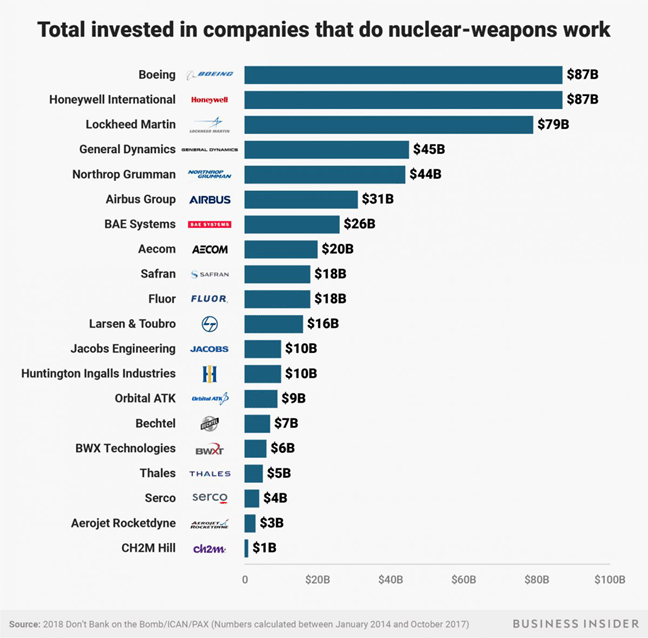
But understanding exactly which companies your funds invest in – and how those entities make money for you – is anything but straightforward.
A new financial report, titled “Don’t Bank on the Bomb,” hopes to shed light on one pervasive and profitable industry that’s powered in part by 401(k)s, pensions, individual retirement accounts, and other private funds: nuclear weapons.
“Financial institutions have a choice, either to contribute to the end of nuclear weapons, or to provide the financing that will allow nuclear weapons to end us,” said the authors of the 2018 report, which was provided to Business Insider in advance of its publication. Continue reading →
Paul Waldon Fight To Stop Nuclear Waste Dump In Flinders Ranges SA, 3 Mar 18 Port Augusta Liberal Senators symposium was chaired by Cory Bernardi where he failed to address multiple questions on the abandonment of radioactive waste, food contamination, cyclotrons, ANSTO’s planed expansion, and recent nuclear accident history.
Sean Edwards and Anne Ruston failure to pull Cory’s fat out of the fire, reaffirms the fact that Cory, Sean and Anne are struggling to understand the direction of the South Australian people. https://www.facebook.com/groups/1021186047913052/
How much nuclear waste has gone into dry storage at San Onofre? Here are the latest numbers, Orange County Register, 4 Mar 18, After “safely and successfully” loading the first multi-purpose spent fuel canister into its new home inside a concrete monolith at San Onofre in early February, Southern California Edison continues to move spent fuel into containers just a short distance from where surfers take on waves at the world-famous surf break.
The most recent fuel tally as of Feb. 20 shows that:
The reactor known as Unit 2 had 1,207 fuel assemblies in its spent fuel pool. Three canisters, containing 111 fuel assemblies, had been moved to dry storage.
Unit 3 had 1,350 fuel assemblies in its pool, with none yet moved to dry storage.
Dry storage is far safer than pools, nuclear experts say. All of the spent fuel is slated to be moved into the “concrete bunker” that is the Holtec HI-STORM UMAX dry storage system by the middle of 2019, Edison said.
Opponents fear it will remain there for decades and pose grave danger to people and the environment.
The most recent fuel tally as of Feb. 20 shows that:
The reactor known as Unit 2 had 1,207 fuel assemblies in its spent fuel pool. Three canisters, containing 111 fuel assemblies, had been moved to dry storage.
Unit 3 had 1,350 fuel assemblies in its pool, with none yet moved to dry storage.
Dry storage is far safer than pools, nuclear experts say. All of the spent fuel is slated to be moved into the “concrete bunker” that is the Holtec HI-STORM UMAX dry storage system by the middle of 2019, Edison said.
Opponents fear it will remain there for decades and pose grave danger to people and the environment………
The most recent fuel tally as of Feb. 20 shows that:
The reactor known as Unit 2 had 1,207 fuel assemblies in its spent fuel pool. Three canisters, containing 111 fuel assemblies, had been moved to dry storage.
Unit 3 had 1,350 fuel assemblies in its pool, with none yet moved to dry storage.
Dry storage is far safer than pools, nuclear experts say. All of the spent fuel is slated to be moved into the “concrete bunker” that is the Holtec HI-STORM UMAX dry storage system by the middle of 2019, Edison said.
Thorium ‒ a better fuel for nuclear technology? Thorium ‒ a better fuel for nuclear technology? Nuclear Monitor, by Dr. Rainer Moormann 1 March 2018 An important, detailed critique of thorium by Dr. Rainer Moormann, translated from the original German by Jan Haverkamp. Dr. Moormann concludes:
“The use of technology based on thorium would not be able to solve any of the known problems of current nuclear techniques, but it would require an enormous development effort and wide introduction of breeder and reprocessing technology. For those reasons, thorium technology is a dead end.”
Author: Dr. Rainer Moormann, Aachen (r.moormann@gmx.de) Thorium is currently described by several nuclear proponents as a better alternative to uranium fuel.
Thorium itself is, however, not a fissile material. It can only be transformed into fissile uranium-233 using breeder and reprocessing technology. It is 3 to 4 times more abundant than uranium.
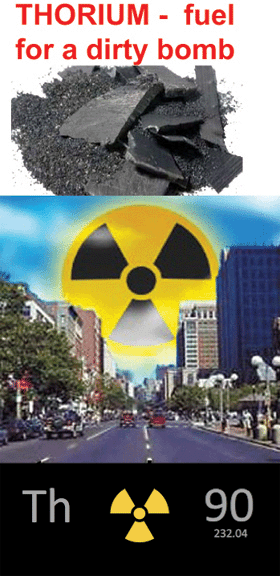
Concerning safety and waste disposal there are no convincing arguments in comparison to uranium fuel. A severe disadvantage is that uranium-233 bred from thorium can be used by terror organisations for the construction of simple but high-impact nuclear explosives. Thus development of a thorium fuel cycle without effective denaturation of bredfissile materials is irresponsible.Continue reading →
Dispelling Claim 2: Thorium did not get a chance in the nuclear energy development because it is not usable for military purposes Thorium ‒ a better fuel for nuclear technology? Nuclear Monitor, by Dr. Rainer Moormann 1 March 2018
In the early stages of nuclear technology in the USA (from 1944 to the early 1950s), reprocessing technology was not yet well developed. Better developed were graphite moderated reactors that used natural uranium and bred plutonium.
For the use of thorium (which, other than uranium, does not contain fissile components), enriched uranium or possibly plutonium would have been indispensable. Continue reading →
Dispelling Claim 3: Thorium use has hardly any proliferation risk Thorium ‒ a better fuel for nuclear technology? Nuclear Monitor, by Dr. Rainer Moormann 1 March 2018
The proliferation problem of Th / U-233 needs a differentiated analysis ‒ general answers are easily misleading. First of all, one has to assess the weapon capability of U-233. Criteria for good suitability are a low critical mass and a low rate of spontaneous fission. The critical mass of U-233 is only 40% of that of U-235, the critical mass of plutonium-239 is around 15% smaller than for U-233. A relatively easy to construct nuclear explosive needs around 20 to 25 kg U-233.
The spontaneous fission rate is important, because the neutrons from spontaneous fission act as a starter of the chain reaction; for an efficient nuclear explosion, the fissile material needs to have a super-criticality of at least 2.5 (criticality is the amount of new fissions produced by the neutrons of each fission.)
When, because of spontaneous fissions, a noticeable chain reaction already starts during the initial conventional explosion trigger mechanism in the criticality phase between 1 and 2.5, undesired weak nuclear explosions would end the super-criticality before a significant part of the fissile material has reacted. This largely depends on how fast the criticality phase of 1 to 2.5 is passed. Weapon plutonium (largely Pu-239) and moreover reactor plutonium have – different from the mentioned uranium fission materials U-235 and U-233 – a high spontaneous fission rate, which excludes their use in easy to build bombs.
More specifically, plutonium cannot be caused to explode in a so-called gun-type fission weapon, but both uranium isotopes can. Plutonium needs the far more complex implosion bomb design, which we will not go into further here. A gun-type fission weapon was used in Hiroshima – a cannon barrel set-up, in which a fission projectile is shot into a fission block of a suitable form so that they together form a highly super-critical arrangement. Here, the criticality phase from 1 to 2.5 is in the order of magnitude of milliseconds – a relatively long time, in which a plutonium explosive would destroy itself with weak nuclear explosions caused by spontaneous fission.
One cannot find such uranium gun-type fission weapons in modern weapon arsenals any longer (South Africa’s apartheid regime built 7 gun-type fission weapons using uranium-235): their efficiency (at most a few percent) is rather low, they are bulky (the Hiroshima bomb: 3.6 metric tons, 3.2 meters long), inflexible, and not really suitable for carriers like intercontinental rockets.
On the other hand, gun-type designs are highly reliable and relatively easy to build. Also, the International Atomic Energy Agency (IAEA) reckons that larger terror groups would be capable of constructing a nuclear explosive on the basis of the gun-type fission design provided they got hold of a sufficient amount of suitable fissile material.1
Bombs with a force of at most 2 to 2.5 times that of the Hiroshima bomb (13 kt TNT) are conceivable. For that reason, the USA and Russia have tried intensively for decades to repatriate their world-wide delivered highly enriched uranium (HEU).
A draw-back of U-233 in weapon technology is that – when it is produced only for energy generation purposes – it is contaminated with maximally 250 parts per million (ppm) U-232 (half-life 70 years).2 That does not impair the nuclear explosion capability, but the uranium-232 turns in the thorium decay chain, which means ‒ as mentioned above ‒ emission of the highly penetrating radiation of Tl-208. A strongly radiating bomb is undesirable in a military environment – from the point of view of handling, and because the radiation intervenes with the bomb’s electronics.
In the USA, there exists a limit of 50 ppm U-232 above which U-233 is no longer considered suitable for weapons.
Nevertheless, U-232 does not really diminish all proliferation problems around U-233. First of all, simple gun-type designs do not need any electronics; furthermore, radiation safety arguments during bomb construction will hardly play a role for terrorist organisations that use suicide bombers.
Besides that, Tl-208 only appears in the end of the decay chain of U-232: freshly produced or purified U-233/U-232 will radiate little for weeks and is easier to handle.2 It is also possible to suppress the build-up of uranium-232 to a large extent, when during the breeding process of U-233 fast neutrons with energies larger than 0.5 MeV are filtered out (for instance by arranging the thorium in the reactor behind a moderating layer) and thorium is used from ore that contains as little uranium as possible.
A very elegant way to harvest highly pure U-233 is offered by the proposed molten salt reactors with integrated reprocessing (MSR): During the breeding of U-233 from thorium, the intermediate protactinium-233 (Pa-233) is produced, which has a half-life of around one month. When this intermediate is isolated – as is intended in some molten salt reactors – and let decay outside the reactor, pure U-233 is obtained that is optimally suited for nuclear weapons.
An advantage of U-233 in comparison with Pu-239 in military use is that under neutron irradiation during the production in the reactor, it tends to turn a lot less into nuclides that negatively influence the explosion capability. U-233 can (like U-235) be made unsuitable for use in weapons by adding U-238: When depleted uranium is already mixed with thorium during the feed-in into the reactor, the resulting mix of nuclides is virtually unusable for weapons.
However, for MSRs with integrated reprocessing this is not a sufficient remedy. One would have to prevent separation of protactinium-233.9
The conclusion has to be that the use of thorium contains severe proliferation risks. These are less in the risk that highly developed states would find it easier to lay their hands on high-tech weapons, than that the bar for the construction of simple but highly effective nuclear explosives for terror organisations or unstable states will be a lot lower.
Kazakhstan signs the treaty on the prohibition of nuclear weapons, Azer News, 5 Mar 18 On the day of the 26th anniversary of Kazakhstan’s accession to the United Nations, an official ceremony was held at the UN Headquarters for signing the Treaty on the Prohibition of Nuclear Weapons by the Republic of Kazakhstan, Kazinform to the Foreign Office’s press service reports.
The agreement was signed by the Permanent Representative of Kazakhstan to the United Nations, Ambassador Kairat Umarov, in accordance with the authority granted to him by Decree, No617 of 9 January 2018, of the President of Kazakhstan Nursultan Nazarbayev.
Kazakhstan had participated actively in the elaboration and adoption of the Treaty, which became the first legally binding document in the history of nuclear disarmament. Its main provisions are in line with the principled position of Kazakhstan, which has taken an ambitious path of becoming a leader in nuclear disarmament and non-proliferation after being a one-time holder of the world’s fourth nuclear arsenal. This was inspired by the historical decisions of President Nursultan Nazarbayev, in particular, on the closure of the second largest nuclear test site and renunciation of the nuclear legacy of the Cold War. Our country’s denuclearization was not an accidental decision, but a well-considered and thoughtful act by a responsible state that had learned the horrors of nuclear tests which have resulted in the suffering with worst possible consequences, subsequently even in the third generation.
Despite the unwillingness of some states, including the leading ones, to pursue disarmament, President of Kazakhstan continues to tirelessly urge the international community to achieve a world free of nuclear weapons……..
As is known, among the three types of WMDs – nuclear, chemical and biological – nuclear weapons are the only ones not prohibited by law. In this regard, the core of the Treaty is Article 1 “Prohibitions”, which contains provisions on the comprehensive ban of nuclear weapons. The Treaty is designed to remove this glaring gap in existing international legal instruments and is the first step towards eliminating nuclear weapons.
The Treaty on the Prohibition of Nuclear Weapons was adopted on 7 July 2017 with the support of 122 UN Member States. It was the outcome of two sessions of a UN Conference to negotiate a legally binding instrument to prohibit nuclear weapons, leading towards their total elimination. The conference took place on March and June-July 2017 in New York. It was open to the participation of all UN member states. However, nine de facto and de jure nuclear weapons possessing states, and their allies boycotted these talks.
To date, the Treaty has been signed by 56 states, five of which have ratified it. Kazakhstan has become the 57th signatory state. The Treaty shall enter into force 90 days after the fiftieth instrument of ratification has been deposited. https://www.azernews.az/region/128206.html
Dispelling Claim 4: Thorium reactors are safer than conventional uranium reactors Thorium ‒ a better fuel for nuclear technology? Nuclear Monitor, by Dr. Rainer Moormann 1 March 2018
The fission of U-233 results in roughly the same amounts
of the safety-relevant nuclides iodine-131, caesium-137
and strontium-90 as that of U-235. Also, the decay heat is
virtually the same. The differences in produced actinides (see
next claim) are of secondary importance for the risk during
operation or in an accident. In this perspective, thorium use
does not deliver any recognisable safety advantages.
Of greater safety relevance is the fact that uranium-233
fission produces 60% less so-called delayed neutrons than
U-235 fission. Delayed neutrons are not directly created
during the fission of uranium, but from some short-lived
decay products. Only due to the existence of delayed
neutrons, a nuclear reactor can be controlled, and the
bigger their share (for instance 0.6% with U-235), the
larger is the criticality range in which controllability is given
(this is called delayed criticality). Above this controllable
area (prompt criticality) a nuclear power excursion can
happen, like during the Chernobyl accident. The fact that
the delayed super-critical range is with U-233 considerably
smaller than with U-235, is from a safety point of view an
important technical disadvantage of thorium use.
During the design of thermal molten salt reactors (breeders),
the conclusion was that the use of thorium brings problems
with criticality safety that do not appear with classical
uranium use in this type of reactors. For that reason, it was
necessary to turn the attention to fast reactors for the use
of thorium in molten salt reactors. Although this conclusion
cannot be generalised, it shows that the use of thorium can
lead to increased safety problems.
As mentioned, a serious safety problem is the necessity to
restart breeder and reprocessing technology with thorium.
Thorium is often advertised in relation to the development
of so-called advanced reactors (Generation IV). The
safety advantages attributed to thorium in this context are
mostly, however, not germane to thorium (the fuel) but
rather due to the reactor concept. Whether or not these
Apr 15, 2026 01:00 AM in Canberra, Melbourne, Sydney
Join the International Physicians for the Prevention of Nuclear War (IPPNW) on Tuesday, April 14th for a timely webinar exploring the risks associated with nuclear power and challenging the myth that it offers a simple, safe, carbon-free solution to the climate crisis
21 April Webinar: No Nuclear Weapons in Australia
Start: 2026-04-21 18:00:00 UTC Canberra, Melbourne, Sydney (GMT+10:00)
End: 2026-04-21 19:30:00 UTC Canberra, Melbourne, Sydney (GMT+10:00)
Event Type: Virtual A virtual link will be communicated before the event.







 Antinuclear