The Arctic is heating: we have no time to lose
Actions today will decide Antarctic ice sheet loss and sea level rise Guardian, [Excellent graphs] 1 March 2018 by dana1981 more https://www.theguardian.com/environment/climate-consensus-97-per-cent/2018/mar/01/decisions-today-will-decide-antarctic-ice-sheet-loss-and-sea-level-rise
A new study looks at how much global sea level will continue to rise even if we manage to meet the Paris climate target of staying below 2°C hotter than pre-industrial temperatures. The issue is that sea levels keep rising for several hundred years after we stabilize temperatures, largely due to the continued melting of ice sheets in Antarctica and Greenland from the heat already in the climate system.
The study considered two scenarios. In the first, human carbon pollution peaks somewhere between 2020 and 2035 and falls quickly thereafter, reaching zero between 2035 and 2055 and staying there. Global temperatures in the first scenario peak at and remain steady below 2°C. In the second scenario, we capture and sequester carbon to reach net negative emissions (more captured than emitted) between 2040 and 2060, resulting in falling global temperatures in the second half of the century.
The authors found that global average sea level will most likely rise by about 1.3 meters by 2300 in the first scenario, and by 1 meter in the second. However, there is large uncertaintydue to how little we understand about the stability of the large ice sheets in Greenland and especially Antarctica. At the high end of possible ice sheet loss, we could see as much as 4.5 meters of sea level rise by 2300 in the first scenario, and close to 3 meters in the second scenario.
The study also shows that it’s critical that our carbon pollution peaks soon. Each 5-year delay – a peak in 2025 instead of 2020, for example – most likely adds 20 cm of sea level rise by 2300, and could potentially add a full meter due to the uncertainty associated with the large ice sheets:
we find that a delay of global peak emissions by 5 years in scenarios compatible with the Paris Agreement results in around 20 cm of additional median sea-level rise in 2300 … we estimate that each 5 years of delay bear the risk of an additional 1 m of sea-level rise by 2300 … Delayed near-term mitigation action in the next decades will leave a substantial legacy for long-term sea-level rise.
And remember, this is all for scenarios in which we meet the Paris climate targets, which we’re currently not on pace to achieve. If we miss the Paris targets, sea levels will rise higher yet.
Another new study, published in the Proceedings of the National Academy of Sciences, found that sea level rise has been accelerating. If the rate of acceleration continues – which the lead author notes is a conservative estimate – we would see an additional 65 cm (close to a meter above pre-industrial sea level) of sea level rise by 2100.
Yet another new study published in The Cryosphere using satellite data found that while the East Antarctic Ice Sheet has remained stable in recent years, ice loss from the West Antarctic Ice Sheet has accelerated. Antarctica is now discharging 1.93 trillion tons of ice each year, up from about 1.89 trillion tons per year in 2008. When accounting for snow accumulation, the continent is losing about 183 billion tons of ice per year – enough to raise sea levels by about 3 to 5 millimeters per decade by itself. The melting of the Greenland Ice Sheet is likewise accelerating and is now responsible for about 25% of annual sea level rise (8.5 millimeters per decade).
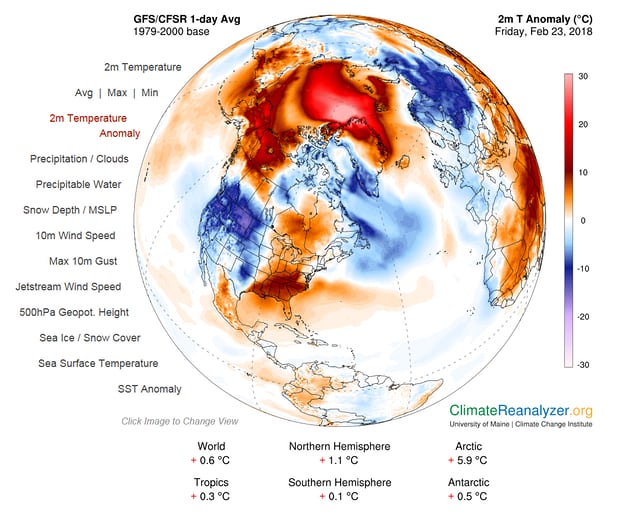
Meanwhile, the Arctic has been remarkably warm in February – as much as 35°C hotter than average in some areas. In mid-winter, when sea ice should be growing, in the Bering Sea it’s instead shrinking.
The hot Arctic is important because the temperature difference between the Arctic and lower latitudes is one of the main forces that keeps the jet stream moving steadily west-to-east. With a hot Arctic, the jet stream is weakened, leading to weird weather in the USA and Europe. As a result, the western states have been experiencing relatively quite cold temperatures, while the US east coast has been unseasonably hot.
To sum up, ice sheet melt is accelerating, as in turn is sea level rise. Even if we manage to achieve the Paris target of less than 2°C global warming above pre-industrial temperatures, we’re likely to eventually see more than a meter of sea level rise, and potentially several meters. The longer we take to reach peak carbon pollution in the coming years, the higher the oceans will rise. Disappearing sea ice in the rapidly-warming Arctic also appears to be causing increasingly weird and extreme weather in places like America and Europe.
South Australian nuclear waste dump means end of tourism?
Paul Waldon Fight To Stop Nuclear Waste Dump In Flinders Ranges SANuclear waste in the Flinders is the loaded gun to the head of all tourism. https://www.facebook.com/groups/344452605899556/
We’re heading to annihilation, warns SA’s nuclear warrior
Anti-nuclear campaigner Helen Caldicott is about to turn 80, but the SA-trained doctor hasn’t lost her fear for the future of the world — or the fire in her belly…….. (subscribers only)
http://www.adelaidenow.com.au/lifestyle/sa-weekend/antinuclear-movement-founder-helen-cadicott-on-nuclear-arms-in-the-era-of-trump-and-putin/news-story/b0a1c3ea794e95e8ce9efbb36aea5879
Daniel Ellsberg on dismantling the doomsday machine
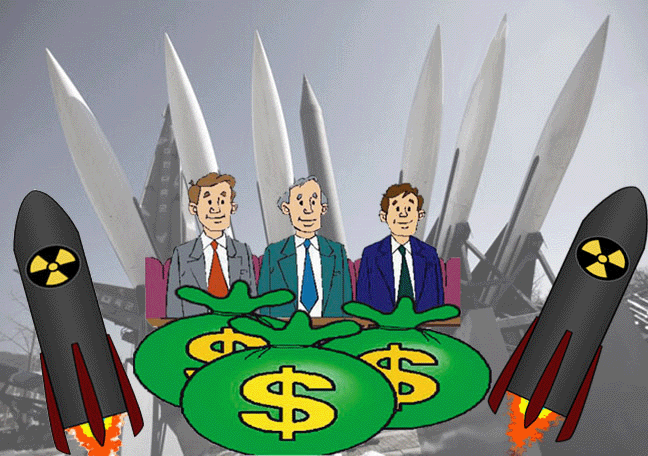 You would not have these arsenals, in the US or elsewhere, if it were not the case that it was highly profitable to the military-industrial complex, to the aerospace industry, to the electronics industry, and to the weapons design labs to keep modernizing these weapons, improving accuracy, improving launch time, all that. The military–industrial complex that Eisenhower talked about is a very powerful influence. We’ve talked about unwarranted influence. We’ve had that for more than half a century.
………. What’s it all for? It is for [military] service share of the budget. Lockheed Martin, Boeing, Grumman, Northrop. Jobs, jobs, jobs, jobs, as one after another official has put it, from James Baker to others. Profits, as I say, jobs, and campaign donations.
Daniel Ellsberg on dismantling the doomsday machine, Bulletin of Atomic Scientists, John Mecklin , 26 FEBRUARY 2018
More than 45 years after he became famous for leaking the Pentagon Papers and earning the wrath of President Richard Nixon and his plumbers, Daniel Ellsberg is again a focus of public consciousness. The hit movie The Post reprises part of the Pentagon Papers story, reminding older Americans (and explaining to younger viewers) how Ellsberg’s decision to reveal a top-secret history of duplicitous US policy in Indochina changed the course of the Vietnam War and American history.
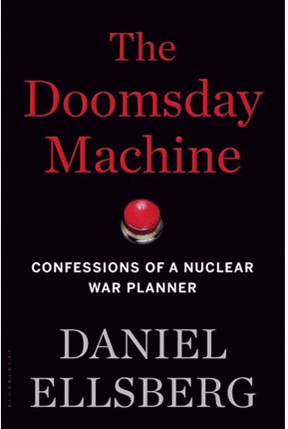 And shortly before The Post premiered early in January, Ellsberg’s latest book, The Doomsday Machine: Confessions of a Nuclear War Planner, was published to significant national media attention.
In the book, Ellsberg chronicles his early career as a RAND Corporation analyst deeply involved in the crafting of American nuclear war plans in the 1960s—plans that were meant to be more controlled and discriminating than earlier versions but, he came eventually to understand, were actually blueprints for the obliteration of civilization. Continue reading
Thorium Church: a trojan horse in the “green” movements.
 Thorium Church: a trojan horse in the “green” movements. Here the Removal Tool. “How do I know if my preferred “green” organization, or group, or leader… is infected by the ‘thorium church’ trojan horse?”. How to protect yourself from malicious propaganda of Thorium Church or from related compromised group or organizations. nonukes Italy, By Massimo Greco (June 2015)
What are trojan horses?
Trojan horses, otherwise known as trojans, are programs or applications that are inadvertently opened by the user, who expects the file to be something else.. by the same way “thorium supporters” are infecting forums, mailing list, debacts and environmental organizations.
It’s a strategy that is working in progress from some year. In few years they infected large part of the web.
Like any malware, thorium’s priests are insinuated through any open space or open port .. and they are able to act at different levels. Mutating depending on the circumstances, improvising them selves as technicians or economists with the sole purpose of creating deviationism which in practice consists of annoying redirect to their cause that is regularly touted as a “green” solution or, even, “pacifist” or as a miraculous solution for the “salvation of the climate”.
Their function is aggressive, especially when you try to contradict them. Continue reading
How to find and get rid of Thorium Troll infections, in environmental groups
nonukes Italy, By Massimo Greco (June 2015) “How do I know if my preferred “green” organization, or group, or leader… is infected by the ‘thorium church’ trojan horse?”
“……..Scanning and Removal, First check if the leader or “group leader” you are referring knows the problem of thorium, whether it has never taken a position on it. If the answer is “I do not know the problem” or “what you’re talking about,” you have the first certainty that your organization or target group is NOT protected.
If the answer is: “It is not a problem that concerns us”, “there is no matter in our topic or with antinuclear matter or uranium …”, or even worse … “nuclear thorium could be a clean way but the NWO prevents “… then you have the most certain that your group or environmental organization is terribly infected and that the leader is highly compromised.
If you are doing this survey “in public”, in a forum related to your organization reference, and after posting these sacrosanct questions and you are reproached or assaulted without causing or leading an intervention by the “admin” able to defend you, that’s another proof that your organization, or environmental group, results hugely infected.
You can also do a very easy search to see if the “admin” or the “most active” subjects are related to pro-thorium forums or registered as supporters of fan in groups offering thorium as a “savior” or “green”, especially when you attend to spam and suspicious behavior in the forums or social networks. You can do the same search about chemtrails or “HAARP” deviationism. As better Explained before, Thorium Church used very much the conspiracy decoy in order to mislead, confused and make it weak, vulnerable and unpractical environmental movements.
How to protect yourself from malicious propaganda of Thorium Church or from related compromised group or organizations.
If, as explained above, your reference group or environmental organization is infected: leave the group. This way you will avoid being accomplices. Thou hast tried, you have already taken the necessary steps. You’re not responsible. You have tried to change things.
If you are a “leader” or admin of a forum, or group… or green or environmental organization, you have to eject such people before they get completely the control of any topic. You have the duty to eject these individuals, without any hesitation of “democracy” and “freedom of confusion”… Because they, in the spaces controlled by the Thorium Church, do not allow you ever to contradict them and erase systematically, as their typical practice, anything that might cast doubt on their truth or propaganda. And, in any case, as admin or “leader” you have a duty to treat these subjects like any nuclearist that want to provoke discussion on the space that you are owning, or controlling.
If you are owning a youtube channel or any social page on social networks and you want to get protection from the thorium worm.. specially concerning antinuclear or environmental documents:
Simply “turn off” the option about “free comments” and choice comments under authorization or moderate. If you are admin of social pages delete their worms (spamming) and eject the vehicle of infection (for the reasons better explained before).
“How can I become active against cultural damages of pro-nuclear business propaganda of the Thorium Church?” Continue reading
How a nuclear attack on North Korea would add to global cancer epidemic
 The Conversation, https://theconversation.com/how-a-nuclear-attack-on-north-korea-would-add-to-global-cancer-epidemic-92161 Professor of Physiology, Columbia University Medical Center,
With tensions high between the United States and North Korea, there is the possibility that the U.S. would launch a “tactical” nuclear strike in the Korean peninsula. There would be consequences far beyond damage to military sites proposed in such an attack.
There is, of course, the danger that North Korea would retaliate and that tensions would escalate. That’s serious political fallout. As a physician scientist who has has worked with radiation for more than 30 years, I am also concerned about a cancer epidemic that would result from such an attack’s nuclear fallout.
Even without a nuclear war, the incidence of cancer is already rising around the world, up by 33 percent worldwide in the past decade. This is largely due to aging of the population and environmental and behavioral patterns such as cigarette smoking. The last thing we need is more of this dreadful disease.
In my research laboratory, we use extremely small doses of radiation to image very small molecules in order to understand how the body works. All of us who work with radiation know about the lethal effects of large doses, but the radiation exposure to the scientists in my laboratory is monitored very closely. Strict federal guidelines define how much radiation is considered “safe.”
During early morning walks in Seoul last year, while on sabbatical at Yonsei University, I could sense the city’s vulnerability as I heard target practice from the top of nearby hills. Seoul, with a population of 22 million, is a mere 35 miles from the North Korean border and would be affected by nuclear fallout. Indeed, it is a medical likelihood that cancer rates in Seoul and the Korean peninsula would be increased for decades following a nuclear attack.
How nuclear fallout causes cancer
INTERVIEW: Niger: “In Arlit, people drink water contaminated by radioactivity”
 This fear is also present in
The word Areva is scary. It’s a taboo subject unless it’s to magnify the business. People want to talk, but like the Nigerian government, they feel helpless against this multinational. When I was doing my scouting, many people told me that I was putting myself in danger. Here, when you talk about Areva, it’s like a God, you should not call your name out loud.
In the documentary, you show this radioactive dust, poisoned water, houses built with land mines, contaminated food, livestock dying .
Houses must even be destroyed because the clay walls contain radioactivity.
The uranium deposits exploited by Orano (formerly Areva) are poisoning the population, explains Amina Weira, author of a documentary on the subject.
Interview by Matteo Maillard (Dakar, correspondence) http://www.lemonde.fr/afrique/article/2018/02/26/niger-a-arlit-les-gens-boivent-de-l-eau-contaminee-par-la-radioactivite_5262875_3212.html THE WORLD 27.02.2018
It was a Tuareg encampment swept by bursts of Saharan simoun. Today it is a city that bears the mark of its development as its decadence. In Arlit, in northern Niger, uranium has been a source of hope since the French group Areva (renamed Orano in January) began mining the deposits in the 1970s.
Many nomads and workers came to this arid region. the workers’ city which was then called “the second Paris”. None knew the invisible danger of radioactivity.
Forty years later, Niger became the second largest supplier of uranium to Areva, but the mining of Cominak and Somair contaminated the population in its daily activities. It is in the sanded streets of her childhood that Amina Weira, a 29-year-old Nigerian filmmaker, posed her camera in front of the elders who lived through the early days of mining. In this film entitled La Rage dans le vent, presented in Dakar as part of the Films Femmes Afrique festival, she shows the invisible threat hanging over Arlit. Interview. Continue reading
The global health threat of climate change
 Impact of climate change on health is ‘the major threat of 21st century’ Skeptical Science [good graphs], 26 February 2018 This is a re-post from Carbon Brief by Daisy Dunne
The health of millions of people across the world is already being significantly harmed by climate change, a major new report finds.
From driving up the number of people exposed to heatwaves to increasing the risk of infectious diseases, such as dengue fever, climate change has had far-reaching effects on many aspects of human health in last few decades, the authors say.
In fact, the effect of climate change on human health is now so severe that it should be considered “the major threat of the 21st century”, scientists said at a press briefing held in London.
The report is the first from the Lancet Countdown on Health and Climate Change, a project involving 24 academic institutions and intergovernmental organisations from across the world. The project plans to release a report tracking progress on climate change and global health every year.
Feeling the heat
Momentum growing globally for 100% renewable energy cities
 Guardian 27th Feb 2018 The number of cities reporting they are predominantly powered by clean energy has more than doubled since 2015, as momentum builds for cities around the world to switch from fossil fuels to renewable sources.
Data published on Tuesday by the not-for-profit environmental impact researcher CDP found that 101 of the more than 570 cities on its books sourced atleast 70% of their electricity from renewable sources in 2017, compared to
42 in 2015. Nicolette Bartlett, CDP’s director of climate change,
attributed the increase to both more cities reporting to CDP as well as a
global shift towards renewable energy. The data was a “comprehensive
picture of what cities are doing with regards to renewable energy,” she
told Guardian Cities. In Britain, 14 more cities and towns had signed up to
the UK100 local government network’s target of 100% clean energy by 2050,
bringing the total to 84.
Among the recent local authority recruits were Liverpool City Region, Barking and Dagenham, Bristol, Bury, Peterborough, Redcar and Cleveland.
But the CDP data showed 43 cities worldwide were already entirely powered by clean energy, with the vast majority (30) in Latin America, where more cities reported to CDP and hydropower is more widespread. The Icelandic capital Reyjkavik, sourcing all electricity from hydropower and geothermal, was among them. It is now working to make all
cars and public transit fossil-free by 2040.
https://www.theguardian.com/cities/2018/feb/27/cities-powered-clean-energy-renewable
Cheap Renewables Are Transforming Global Electricity Business
 IEEFA 21st Feb 2018, We’ve just posted a research brief explaining through a telling combination of charts (and some written analysis) how the fast-growing
uptake of wind and solar around the world continues to shape
electricity-generation trends.
The phenomenon is unfolding across diverse
groups of markets that include ones in Latin America, the Middle East, and
the U.S. We note in the brief— “Cheap Renewables Are Transforming
Global Electricity Business”—how installations of wind and solar
totalled almost 155 gigawatts (GW) last year, actually outpacing coal-fired
power plant development.
We also note how lowest bids for solar dropped a
remarkable 50 percent from records set in 2014 and 2015, as solar power
continued its long-established expansion.
http://ieefa.org/ieefa-update-cheap-renewables-transforming-global-electricity-business/
Study shows climate value of earth’s intact forests
With over 80 percent of forests already degraded by human and industrial activities, today’s findings underscore the immediate need for international policies to secure remaining intact forests–including establishing new protected areas, securing the land rights of indigenous peoples, regulating industry and hunting, and targeting restoration efforts and public finance. Absent specific strategies like these, current global targets addressing climate change, poverty, and biodiversity may fall short, including the United Nations’ Sustainable Development Goals to sustainably manage forests, combat desertification, halt and reverse land degradation and halt biodiversity loss.
“As vital carbon sinks and habitats for millions of people and imperilled wildlife, it is well known that forest protection is essential for any environmental solution–yet not all forests are equal,” said Professor James Watson of WCS and the University of Queensland. “Forest conservation must be prioritized based on their relative values–and Earth’s remaining intact forests are the crown jewels, ones that global climate and biodiversity policies must now emphasize.”
According to the study, the encroachment of human and industrial activity can have catastrophic effects. Once opened up, formerly intact forests become increasingly susceptible to natural pressures such as disease, fires, and erosion; they become less resilient to man-made climate change, and they become more accessible to human use, driving a spiral of decline.
Some key benefits of intact forests include:
- Climate change: Intact forests currently absorb around 25 percent of carbon emissions from all human sources – damaging them will leave far more carbon dioxide in the air to warm the climate.
- Water availability: Intact tropical forests ensure the stability of local and regional weather, generating more rain than cleared forests and thereby reducing the risk of drought.
- Biodiversity: Intact forests have higher numbers of forest dependent species and have higher functional and genetic diversity.
- Indigenous culture: Intact forests enable many indigenous groups to sustain their traditional cultures and livelihoods. In turn these peoples are often staunch defenders of their ancestral lands.
- Human health: Forest degradation and loss compromise the supply of medically-beneficial species that millions of people rely on; additionally, forest degradation drives the spread of many infectious diseases by bringing humans and disease vectors into close contact………..https://www.eurekalert.org/pub_releases/2018-02/wcs-ssc022218.php
Time for Renewed Push to Rid the World of Nuclear Weapons – UN Chief
 U.N. Chief Calls for New Push to Rid the World of Nuclear Weapons, U.S. News Feb. 26, 2018, BY TOM MILES GENEVA (Reuters) – U.N. Secretary General Antonio Guterres called on Monday for a new global effort to get rid of nuclear weapons, drawing a cautious response from envoys of atomic-armed powers at odds for decades over nuclear disarmament.
Speaking to the Conference on Disarmament at the U.N. complex in Geneva, Guterres said many states still wrongly thought that nuclear weapons made the world safer.
“There is great and justified anxiety around the world about the threat of nuclear war,” he said.
“Countries persist in clinging to the fallacious idea that nuclear arms make the world safer … At the global level, we must work towards forging a new momentum on eliminating nuclear weapons.”
The Conference on Disarmament is the world’s main forum for nuclear disarmament, but since 1996 it has been deadlocked by disagreements and distrust between rival nuclear powers.
Ambassadors from the United States, China and France said they shared his concerns about the current security environment but their comments suggested it would be an uphill struggle to end two decades of stalemate in nuclear negotiations………..
DANGEROUS DIRECTION Guterres said talks should target not only nuclear, chemical and conventional arms but also autonomous and unmanned weapons, artificial intelligence, biotechnology and space-based systems.
There are currently around 150,000 nuclear weapons worldwide and the arms trade is flourishing more than at any time since the Cold war, with $1.5 trillion of spending annually, he said.
Taboos on nuclear tests and chemical weapons usage were under threat, he added, while talk of tactical nuclear weapons was leading in an extremely dangerous direction.
……..Last week diplomats and disarmament experts discussed Guterres’s initiative with U.N. officials during a retreat near New York, and he is expected to launch his plans around April or May with “practical and implementable actions”.
“The challenges are enormous, but history shows that it has been possible to reach agreement on disarmament and arms control even at the most difficult moments,” Guterres said.
(Reporting by Tom Miles; editing by Stephanie Nebehay/Mark Heinrich, William Maclean https://www.usnews.com/news/world/articles/2018-02-26/un-chief-calls-for-new-push-to-rid-the-world-of-nuclear-weapons
Temperature extremes – North Pole exceptionally warm
 It will be warmer at the North Pole next week than much of Europe, as sea ice melts, Mashable, In what seems to be becoming an annual occurrence, temperatures at the North Pole are about to reach or possibly exceed the freezing point this week as the North Atlantic and the North Pacific Oceans inject unusually mild air into the Arctic.
In Europe, winds known as “The Beast from the East” will transport frigid temperatures from Russia and Scandinavia to the west, into Germany, France, and the UK, along with potential snowfall.
Consider some of these startling statistics. Arctic sea ice is at its lowest observed level since the satellite era began in 1979. The magnitude and pace of the sea ice decline observed during the 21st century, along with the warming of the ocean surface throughout the region, has been shown to be unprecedented in the last 1,500 years.
Temperatures in parts of the Arctic — including the North Pole — could rise to 45 degrees Fahrenheit above average this week. Already, the northernmost land-based weather station in Greenland, known as Cape Morris Jesup, rose above the freezing mark of 32 degrees Fahrenheit, or 0 degrees Celsius, five times since Feb. 16. That weather station is just about 400 miles from the North Pole.
At the same time as the Arctic heats up (relatively speaking), temperatures will plunge to about 35 degrees Fahrenheit below average across nearly all of Europe, from Moscow to London. ………
study published in Nature about a 2015 sudden polar warming event found that these events are growing more intense, meaning that the temperature extremes are getting more extreme, especially when compared to the overall rate of Arctic warming.
Los Angeles Board of Public Utilities sceptical about viability of Small Modular Nuclear reactors (SMRs)
 BPU has doubts about nuclear power project http://www.lamonitor.com/content/bpu-has-doubts-about-nuclear-power-project, By , February 26, 2018
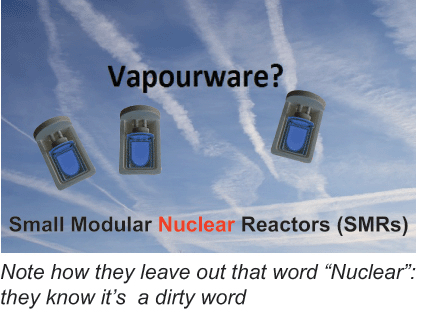
Some members of the Board of Public Utilities voiced doubt about a possible investment in a small-scale nuclear power project Wednesday during a meeting with the Department of Public Utilities.
The board was expecting answers about what the risk would be to the county if the project went sour.
The project is proposed and designed by Nuscale and consists of 12 50-megawatt light water, nuclear reactor modules. The units would be installed in Idaho.
The Board of Public Utilities is expected make a decision about whether to invest $500,000 in the project in late March.
BPU member Stephen McLin wanted to know why they haven’t given them more definite answers, since the initial Jan. 25 meeting explaining the project.
“These cost commitments that we’re about ready to make… I think that the board members, I can’t really speak for them, but I think we had it in our mind that we were going to be voting on about $500,000 commitment for the next six months or so, and that was going to keep us in a kind of holding pattern until other costs could be fleshed out,” McLin said. “I’m really starting to question the wisdom of making even that investment based on tonight’s performance, these questions have not even been summarized. Why not?”
Deputy Manager Steve Cummins replied they were aiming for the Board of Public Utilities March 6 meeting.
“We are working very diligently, everybody is, for the March 6 meeting. As I mentioned during our introduction, one of the biggest concerns we heard was about cost, exposure and things like that to the county. So, we put a lot of time in the last couple of weeks on the resolution I talked about that’s going to be now made into a contract. Actually, we’re pretty happy about that. We see it as a huge step in the right direction,” Cummins said.
McLin then asked what happens to the county’s financial risk while it waits for the project to be approved by the Nuclear Regulatory Commission. He said he would like to see those numbers at the March 6 meeting.
“The track record is very ugly… 12- to 15-year timelines from the license submission to approval,” Mclin said. “In my mind, I’m calling it the second step for the county. What kind of commitment are we making as we submit that application. I think that’s what got a lot of people concerned. It would be helpful to see a lot of these costs and options laid out. To see them in black and white would be very helpful.”
Board of Public Utilities member Kathleen Taylor feared cost overruns on the project would drive up the costs of the construction, which would then affect the rate they pay for the power from the plant, which is expected to be between $45 and $65 per kilowatt hour.
“I want to see cost overruns and what caused them,” Taylor said. We need to see it in black and white. That’s the stopper. If they can’t build this plant in three our four years or whatever it’s going to take, then we’re off into Never Never Land. I’d like to see it in black and white.
Utilities Manager Tim Glasco said he would provide her slides NuScale provided, but said it would be up to her to decide “if they’re all wet or if they’re any validity to the claims of what they did different” in other projects.
1 This month
7 April – WEBINAR – Australia and the Doomsday Clock – Preventing nuclear war through NoFirstUse and other policies
Online | Tuesday April 7, 4:00-5:30pm, Australian Eastern Time / 8:00-9:30am Central Europe Time
– Access the registration link
15 April – Zoom –Nuclear Power is Not the Solution
Apr 15, 2026 01:00 AM in Canberra, Melbourne, Sydney

Join the International Physicians for the Prevention of Nuclear War (IPPNW) on Tuesday, April 14th for a timely webinar exploring the risks associated with nuclear power and challenging the myth that it offers a simple, safe, carbon-free solution to the climate crisis

21 April Webinar: No Nuclear Weapons in Australia
Start: 2026-04-21 18:00:00 UTC Canberra, Melbourne, Sydney (GMT+10:00)
End: 2026-04-21 19:30:00 UTC Canberra, Melbourne, Sydney (GMT+10:00)
Event Type: Virtual
A virtual link will be communicated before the event.
Host Contact Info: australia@icanw.org

of the week – Australians for War Powers Reform (AWPR)
To see nuclear-related stories in greater depth and intensity
 Antinuclear