If Bill Shorten didn’t want to hand ammunition to Labor’s foes in the Batman byelection, he had a funny way of showing it in Townsville this week., (subscribes only) https://www.crikey.com.au/2018/02/20/shorten-shows-his-disregard-for-batman-by-cosying-up-to-coal/
February 21, 2018
Posted by Christina Macpherson |
General News |
Leave a comment
Letter: Nukes don’t kill people — people kill people — and, to protect myself, I need a nuke https://www.sltrib.com/opinion/letters/2018/02/17/letter-nukes-dont-kill-people-people-kill-people-and-to-protect-myself-i-need-a-nuke/ By Brent Pace | The Public Forum
In light of
the recent school shooting in Florida, I have realized that I need to exercise my right to bear arms. It is the only way to keep my family safe. I used to think a knife or a bat was enough. Then maybe a handgun or shotgun. Later I thought, no, an AR-15 under the bed should do the trick. In light of recent events, I have deteremined that the only way I can properly exercise my right to bear arms is to go nuclear.
Yes, Editor, I have decided I need to make my own nuclear weapon. You see, nukes don’t kill people — people kill people (thanks for help in understanding that, NRA!). So I’ve been saving my bitcoin. The plan initially was to buy enough plutonium to build a flux capacitor, which as we all know, is what makes time travel possible.
But now I will need the plutonium to build six miniaturized nuclear weapons. One for me, my wife, and each of my four children. Thank goodness our founding fathers had the foresight to allow us the iron-clad right to keep and bear destructive weapons regardless of any other condition.
Now hold on, I’m gonna have to cancel some of my mental-health doctor appointments to make time for this new project.
February 18, 2018
Posted by Christina Macpherson |
General News |
Leave a comment
Hope for region’s energy options
Federal MP Warren Entsch has urged the state government to open up the Far North to alternative energy retailers after the country’s biggest solar and storage project was connected to the grid north of Cairns. .. (subscribers only)
http://www.cairnspost.com.au/news/cairns/lakeland-solar-and-storage-project-goes-online-to-power-3000-homes/news-story/48c4a101188232f3f6e05f3cb11447ec
February 18, 2018
Posted by Christina Macpherson |
General News |
Leave a comment
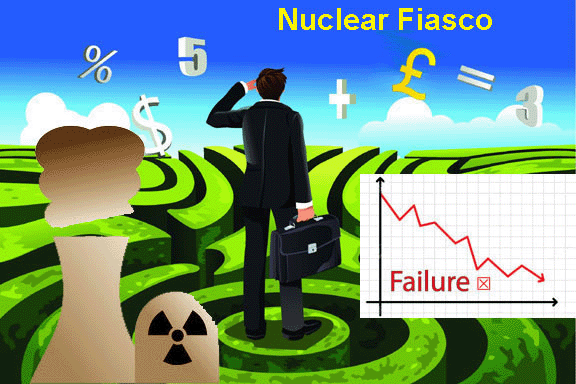
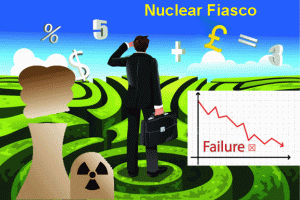 A year in review: the trends in nuclear construction http://www.constructionglobal.com/infrastructure/year-review-trends-nuclear-construction By DAN BRIGHTMORE . Feb 12, 2018
We look back on a mixed year for construction in the nuclear industry with the delivery of further nuclear power plants (NPPs) under threat from both the rise in renewable energy and the global trend for decommissioning in the prolonged aftermath of 2011’s Fukushima disaster.
According to the latest findings of the annual World Nuclear Report, as of January 2018, there are 52 reactors currently under construction worldwide. Four NPPs began the long-term process of construction in 2017 – one each in Bangladesh, China, India and South Korea.
The Chinese project, a pilot fast reactor, was launched on Christmas Day last year at the Xiapu site in Fujian province, but there were no other new NPP projects or construction starts announced in the country. Analysts suggest it’s a sign of a major shift or slowdown in Chinese nuclear policy, following the country’s domination of world nuclear construction for the past decade when it contributed over 60% of all new global sites since 2008.
The sector is experiencing profound structural change. The introduction of renewable energy at scale, thanks to declining costs driven by technological advances, has increased renewable power output at the expense of conventional technologies such as coal and nuclear. Though an operating NPP can provide up to nine times more electricity per installed kilowatt than a photovoltaic plant, the challenge to the industry from renewables is tangible. China’s massive rates of solar capacity deliver over 50GW to its grid. Even when taking into account lower productivity per installed GW from solar, research shows new solar plants in China alone in 2017 will generate significantly more power than all nuclear reactors started up (four) in the same year in the entire world.
Construction delays are common due to a number of factors, Continue reading →
February 17, 2018
Posted by Christina Macpherson |
General News |
Leave a comment
 High start-up costs: Huge investments are needed for thorium nuclear power reactor, as it requires significant amount of testing, analysis and licensing work. Also, there is uncertainty over returns on the investments in these reactors. For utilities, this factor can weigh on the decisions to go ahead with plans to deploy the reactors. The reactors also involve high fuel fabrication and reprocessing costs.
High melting point of thorium oxide: As melting point of thorium oxide is much higher compared to that of uranium oxide, high temperatures are needed to make high density ThO2 and ThO2–based mixed oxide fuels. The fuel in nuclear fission reactors is usually based on the metal oxide.
Emission of gamma rays: Presence of Uranium-232 in irradiated thorium or thorium based fuels in large amounts is one of the major disadvantages of thorium nuclear power reactors. It can result in significant emissions of gamma rays. http://nuclear.energy-business-review.com/news/major-pros-and-cons-of-thorium-nuclear-power-reactor-6058445
February 16, 2018
Posted by Christina Macpherson |
General News |
Leave a comment
 The West risks missing a chance at peace if it continues to treat North Korea’s change of heart with cynicism Could it be that Trump’s bombast over the airwaves cut through in Pyongyang in a way that conventional diplomacy had failed to do? The Independent UK, Mary Dejevsky @IndyVoices 16 Feb 18
“”…………The mixed messages about the North Korean skaters, however, highlighted – or so it seemed to me – something else: a reluctance on the part of the foreign policy establishment, including the media, to look good news in the face, especially when it has not been expected.
How long ago was it –in fact, a bare six weeks – that Kim Jong-un and the US President were trading very public, very macho, insults, culminating in Donald Trump’s memorable boast that his nuclear button was “much bigger and more powerful” than Kim’s and, what is more, “my button works”.
Even the most hardened pessimist would have to admit that between then and now there has been something of a mood swing. Less than three weeks after the “big button” exchange, North Korea suddenly acted on overtures in Kim’s New Year address to broach talks with the South, and even participated in the Olympics. The IOC delayed its deadline for entries, permitted North Korea’s participation, and the next thing we knew was that North and South were concocting a joint ice hockey team, the North’s nonagenarian de facto head of state was on his way to Seoul, and Kim announced that his sister – his sister – would be going to the opening ceremony, too.
Far from hailing these developments as the possible start of a North-South thaw, however, the Western response seemed – to me, at least, – both fearful and curmudgeonly. Kim Jong-un was suspected of the basest of motives. Might he not be deviously stringing the South along, it was asked, just waiting to demand all sorts of impossible concessions at the last moment that would cast the Seoul government as the villain if it refused?
And was Kim not also staging a vast military parade in Pyongyang on the eve of the official Olympic opening? Well, of course, he was. No self-respecting national leader, least of all an autocrat in the mould of Kim, can be seen to be weak in front of his own people. Shows of strength have a habit of going hand in hand with diplomatic U-turns.
As the North Korean nuclear threat vanished from the headlines, however, it was only to be replaced with another menace from the North. Kim’s very presentable little sister, Kim Yo-jong, was accused of stealing the limelight, diluting the world’s attention that should have been Seoul’s, and presenting an image of the North that was scandalously at odds with the cruel and earth-scorched reality. Don’t allow yourself to be fooled, was the message.
That she was received in Seoul at the highest level and filmed handing over an invitation to President Moon Jae-in to visit Pyongyang was also somehow seen as out of order, another trick to gain diplomatic advantage. Surely it would all turn sour even before the Olympic glow over the South had faded. The North Korean threat was still there.
Far from hailing these developments as the possible start of a North-South thaw, however, the Western response seemed – to me, at least, – both fearful and curmudgeonly. Kim Jong-un was suspected of the basest of motives. Might he not be deviously stringing the South along, it was asked, just waiting to demand all sorts of impossible concessions at the last moment that would cast the Seoul government as the villain if it refused?
And was Kim not also staging a vast military parade in Pyongyang on the eve of the official Olympic opening? Well, of course, he was. No self-respecting national leader, least of all an autocrat in the mould of Kim, can be seen to be weak in front of his own people. Shows of strength have a habit of going hand in hand with diplomatic U-turns.
As the North Korean nuclear threat vanished from the headlines, however, it was only to be replaced with another menace from the North. Kim’s very presentable little sister, Kim Yo-jong, was accused of stealing the limelight, diluting the world’s attention that should have been Seoul’s, and presenting an image of the North that was scandalously at odds with the cruel and earth-scorched reality. Don’t allow yourself to be fooled, was the message.
That she was received in Seoul at the highest level and filmed handing over an invitation to President Moon Jae-in to visit Pyongyang was also somehow seen as out of order, another trick to gain diplomatic advantage. Surely it would all turn sour even before the Olympic glow over the South had faded. The North Korean threat was still there.
Nor should the use by potentates – and not just potentates – of close relatives as personal representatives and trusted go-betweens – be discounted as a ploy. Rather than being designed to detract from the South’s Olympic show, Kim Jong-yo’s trip to Seoul might rather be seen as evidence of her brother’s serious intent and esteem.
And what might have changed the equation? How about the US Secretary of State’s low-key offer of direct talks without preconditions that he made in December? Repeated in Seoul by Vice-President Mike Pence this week (once he had done cold-shouldering the North Koreans for the benefit of the US audience back home), this is what first broke the deadlock. There have been concessions on all sides.
So while the doomwatchers see the Olympic thaw as, at best, a deceptive interlude before the nuclear stand-off inevitably resumes, I would argue, for more optimism. A basis has been laid for detente; there is a real chance now to step back from the brink. The risk now is less that the North is insincere, than that suspicion and cynicism everywhere cause this chance to be missed. http://www.independent.co.uk/voices/north-korea-war-nuclear-us-uk-europe-world-peace-conflict-a8212656.html
February 16, 2018
Posted by Christina Macpherson |
General News |
Leave a comment

Kobe Steel firm suspected of nuclear waste data  falsification http://www.asahi.com/ajw/articles/photo/AS20180215003253.html, By MASANOBU HIGASHIYAMA/ Staff Writer,February 15, 2018
A subsidiary of Kobe Steel Ltd. may have falsified test data on highly radioactive waste disposal, the Nuclear Regulation Authority (NRA) announced on Feb. 14.
Kobelco Research Institute Inc. is suspected of tampering with data it gathered on behalf of the Japan Atomic Energy Agency (JAEA), which is contracted to carry out tests by the NRA.
The aim of the tests is to help form a regulatory standard for final disposal sites for nuclear waste, but a report the NRA received from the JAEA said that figures in the original data and those in reports Kobelco submitted to it did not match. Furthermore, some original data could not be located.
The NRA has instructed the JAEA to confirm details about the possible data falsification in response to the report.
A Kobelco source said, “Why data inconsistencies occurred remains unknown at the moment,” but that the research institute “will examine the case with data falsification in mind.”
The tests are designed to examine what happens to metal cladding tubes that had previously contained spent nuclear fuel when they are disposed of deep underground, including possible corrosion and by-products of gas, according to the NRA.
The nuclear watchdog outsourced the testing to the JAEA in fiscal 2012 through fiscal 2014 at a cost of about 600 million yen ($5.59 million).
Kobelco was subcontracted to undertake some of the tests for about 50 million yen.
February 16, 2018
Posted by Christina Macpherson |
General News |
Leave a comment
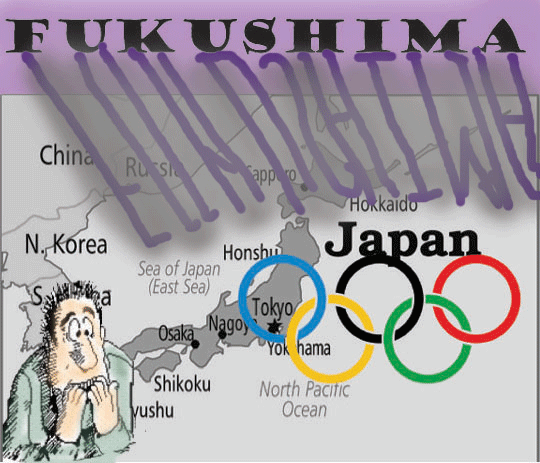
Japan, IAEA agree to cooperate on Tokyo 2020 nuclear counterterrorism, Nikkei Asian Review, 16 Feb 18, VIENNA (Kyodo) — The Japanese government and the International Atomic Energy Agency signed an agreement on Thursday to work together to keep the Tokyo 2020 Olympics and Paralympics safe from the threat of terrorism involving nuclear materials.
According to the Japanese Foreign Ministry, the agreement includes measures to support IAEA experts’ participation in events relating to the Tokyo games, the exchange of information on nuclear security issues and the loan to Japan of equipment to detect radiation.
Foreign Minister Taro Kono and IAEA Director General Yukiya Amano observed the signing in Vienna before holding a meeting at which Kono said they agreed to flesh out cooperation in thwarting nuclear terrorism.
“We want to thoroughly cooperate with the IAEA to make sure the Olympics are safe,” Kono said at the outset of the meeting……..https://asia.nikkei.com/Politics-Economy/International-Relations/Japan-IAEA-agree-to-cooperate-on-Tokyo-2020-nuclear-counterterrorism
February 16, 2018
Posted by Christina Macpherson |
General News |
Leave a comment
 EDF plans to build a giant nuclear garbage pool in Belleville-sur-Loire instead of stopping producing unmanageable waste! http://www.sortirdunucleaire.org/EDF-projette-de-construire-une-piscine-poubellePress release of February 13, 2018
On February 13, 2018, the Reporterre site revealed the new EDF project. In view of the prolongation of the operation of nuclear reactors and to unclog the four basins of the La Hague plant where used fuel is stored, the electrical firm wants to build a giant new “pool of deactivation” near the Belleville plant -sur-Loire (Cher). We strongly condemn this imposed, dangerous and expensive project. Rather than create a new trash, EDF must turn off the tap and dry up the production of unmanageable radioactive waste!
In France, spent fuel is stored in “deactivation pools” for the time needed to cool them (between 3 and 5 years). If each nuclear power plant has its own pool adjoining the reactor building, the La Hague plant (Manche) hosts 4 pools in which are immersed more than 10,000 tons of spent fuel, representing a hundred reactor cores waiting for a improbable “reprocessing”. Supposedly temporary, storage in these pools has been going on for 40 years. Consequences: the pools are full and the space is running out. Instead of starting a decline in spent fuel stocks by stopping the production of electricity from nuclear power, EDF is stubborn and plans to build an additional pool in Belleville-sur-Loire. But the experience of La Hague shows that the use of these pools goes hand in hand with disproportionate risks.
Vulnerable pools and potentially dramatic accidents The 4 cooling pools at the La Hague plant concentrate the largest volume of radioactivity in Europe. Belleville-sur-Loire could soon compete with this facility. Oversized, the giant basin that EDF plans to build in Belleville-sur-Loire could accommodate up to 8,000 tons of spent fuel, the equivalent of 93 cores of reactors.
This project is all the more worrying because EDF is never very concerned about the protection of the reactor deactivation pools it operates. Continue reading →
February 16, 2018
Posted by Christina Macpherson |
General News |
Leave a comment
 Last week we cruised into Sydney Harbour aboard
  Peace Boat for the final leg of the Making Waves speaking tour. Peace Boat, an ICAN partner organisation, visited Australia for the first time in 10 years. Equipped with the Treaty on the Prohibition of Nuclear Weapons and a Nobel Peace Prize, Japanese and Australian nuclear survivors joined forces to demand both governments join the treaty without delay.

Hibakusha from Hiroshima and Nagasaki, former dairy farmers from Fukushima and nuclear test survivors from South Australia travelled aboard the “floating university” from Fremantle to Adelaide, Melbourne, Hobart and finally Sydney. The Making Waves tour combined public forums with political meetings, workshops and press conferences.
Thank you to everyone who participated in Making Waves, and especially all of the organisations that worked with us to amplify the message. Check out a couple of our favourite media reports from SBS News and the Guardian.
You can also click here to see more photos of the Making Waves tour
The “Doomsday Clock” was recently re-set to two minutes to midnight, the closest it has been to global catastrophe since 1953. The Bulletin of the Atomic Scientists, the custodians of the Clock, justified their decision on the current nuclear landscape and the threat of a new arms race. The new US Nuclear Posture Review reinforces that concern, by increasing the range of situations to which the US Government would consider responding with nuclear weapons.
Prime Minister Turnbull has not responded to these dangerous developments. As a country that claims protection from the US nuclear arsenal, Australia has a vital role to play. We can and must remove our consent for the US to threaten to use weapons of mass destruction on our behalf. The nuclear ban treaty is a vital part of the process to stigmatise and eliminate nuclear weapons.
Building political support for the nuclear ban treaty is especially important with an election nearing. While the current government is hostile to the treaty, two-thirds of federal Australian Labor parliamentarians have joined the Parliamentary Pledge in support. All Greens parliamentarians have joined the Pledge, along with a range of other cross-benchers. Please help us grow the list of signatories, which is updated regularly at www.icanw.org/projects/pledge.
It is inevitable that Australia joins the nuclear ban treaty, let’s make it sooner rather than later.
February 14, 2018
Posted by Christina Macpherson |
General News |
Leave a comment
 Uranium Week: The Nuclear Challenge FN Arena, Feb 13 2018
As the spot uranium price fell again last week, Morgan Stanley questioned the role of nuclear power in the future global energy mix.
-Nuclear power being decommissioned globally
-Uranium spot price falls as markets suffer a risk-off episode
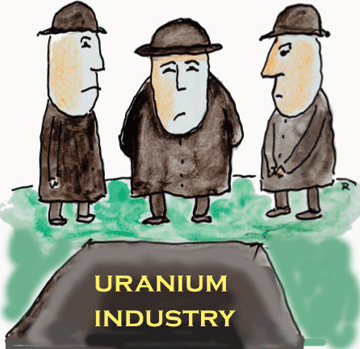
By Greg Peel, As the world’s legacy nuclear plants age and the economics of renewable energy sources improve, the role of nuclear power in the future global energy mix is under question. New nuclear plant construction is highly expensive while the cost of renewables continues to fall. In key nuclear power countries, public policy has turned against nuclear energy.
Morgan Stanley assumes that by 2030, -23% of existing nuclear power will be decommissioned in key nuclear power countries.
Natural gas and renewables are already posing an issue for nuclear power. In the US, the abundance of natural gas made available through modern fracking technology means gas-fired power generation is an increasingly cheap option. As renewable technology improves and economies of scale are achieved, renewables offer another cheaper source.
In the case of renewables, carbon reduction targets have led to government subsidies. Renewables are zero carbon (once up and running). Gas-fired generation emits carbon, but far less than traditional coal-fired. Nuclear energy is also zero carbon (once up and running, but a significant emitter in the construction phase and in the mining of uranium). https://www.fnarena.com/index.php/2018/02/13/uranium-week-the-nuclear-challenge/
February 14, 2018
Posted by Christina Macpherson |
General News |
Leave a comment
 Natalie Cromb is a Gamilaraay writer and social justice advocate who lives in Sydney.’
‘One of the foundational principles of a treaty in Australia would need to be self-determination. Without communities in the driving seat of their futures, the gap will continue to widen.’
‘It is clear that, despite the symbolic Stolen Generations apology
and the campaign for constitutional recognition, structural change needs to occur to ensure Indigenous interests are at the forefront of governmental policies affecting Indigenous people.
And the best means with which to ensure that the above structures can occur is through a treaty where principles of sovereignty, self-determination, right to language and culture, and land rights can be enshrined and protected.
‘I support treaty. I hope non-Indigenous Australians join calls for treaties
so that we can approach the future as a united and mature nation,
well aware of our past and committed never to repeat it.’
Read more of Natalie Cromb‘s insightful, justice-oriented, comprehensive & well-researched article:
www.thesaturdaypaper.com.au/opinion/topic/2018/02/10/the-case-treaty/15181812005785
February 14, 2018
Posted by Christina Macpherson |
General News |
Leave a comment
Trump budget contains $120M to restart licensing of Yucca Mountain By Gary Martin Review-Journal Washington Bureau
“……..Trump included $120 million to restart licensing on the geologic site north of Las Vegas, as well as to establish an interim storage program to address the growing stockpile of nuclear waste produced by power plants in states across the nation….
“Despite Congress’ refusal to fund the Yucca Mountain project, the administration is once again prioritizing it,” Heller said. He claims the project poses a threat to the people of southern Nevada and could have a catastrophic impact on the tourism economy.
“I’ve made it clear why Nevada does not want to turn into the nation’s nuclear waste dump,” Heller said.
…….. congressional lawmakers from Southern Nevada said opposition to the  project would continue……Titus said the $120 million would be “a tiny down payment on a project that will cost $100 billion and ship nuclear waste through hundreds of congressional districts across the country.” ……https://www.reviewjournal.com/news/politics-and-government/trump-budget-contains-120m-to-restart-licensing-of-yucca-mountain/
February 14, 2018
Posted by Christina Macpherson |
General News |
Leave a comment











 Antinuclear