U.N. chief: Threat from nuclear and other weapons gathers force, Asahi Shimbun, THE ASSOCIATED PRESS, January 19, 2018 UNITED NATIONS–Russia’s foreign minister warned Thursday that a failure of the Iran nuclear deal, especially as a result of action by the Trump administration, would send “an alarming message” to North Korea and impact all international agreements.
Sergey Lavrov took aim at U.S. President Donald Trump at a U.N. Security Council meeting on confidence-building measures to tackle the proliferation of weapons of mass destruction, saying that “we cannot for the benefit of political agendas of certain countries abandon a genuine achievement of international diplomacy.”
Last Friday, Trump kept alive the Iran agreement, which has won international praise including from U.S. allies, by extending sanctions waivers. But the president warned that the United States would pull out in a few months unless “terrible flaws” in the deal are fixed.
Lavrov and others worry that a U.S. pullout from the 2015 deal could mean that Washington cannot be trusted to keep agreements, which could harm any future efforts to get North Korea to abandon nuclear weapons.
Secretary-General Antonio Guterres opened Thursday’s meeting warning that the threat from weapons of mass destruction “seems to be gathering force.”
He urged expanded diplomatic efforts to tackle what he called the greatest security challenge in the world today–North Korea.
The international community must build on the “small signs of hope” from the recent contacts between the two Koreas to pursue diplomacy and denuclearize the Korean Peninsula, the U.N. chief said.
“Global anxieties about nuclear weapons are the highest since the Cold War,” Guterres said. “I remain deeply concerned over the growing risk of military confrontation and the unimaginable consequences that would result.”
China’s deputy U.N. ambassador, Wu Haitao, urged all countries to “reject Cold War mentality” and commit to peaceful solutions, including on the Korean Peninsula where he pointed to “some positive changes” emerging.
“All parties should make concerted efforts to extend this hard-won momentum of reduced tension, create conditions for relaunching dialogue and negotiation and return the nuclear issue of the Korean Peninsula to the correct track of dialogue and negotiation,” Wu said…….. http://www.asahi.com/ajw/articles/AJ201801190018.html
Guano, Nuclear Testing, Chemical Weapons Another guano claim converted for U.S. military use is Johnston Atoll (Kamala), located about 800 miles southwest of Honolulu.
One phase of expansion on Johnston Island involved construction of a launch pad for high-altitude missile tests for Operation Dominic in the 1960s. Two of the tests were aborted, with radioactive contamination falling on the runway. Forty years later, in 2002, the Air Force “finished burying thousands of cubic meters of plutonium-contaminated waste in a 25-acre landfill on the atoll.”
The question, then, is not when will islands be submerged, but when will sea-level rise make life on low-lying islands impossible.
The answer to that question is close at hand for a number of Pacific islands.
Perhaps the biggest legal stride in New Zealand is Prime Minister Jacinda Ardern’s recent announcement of plans for a special refugee visa for Pacific Islanders, starting with 100 places annually. “We are anchored in the Pacific,” Ardern told reporters. “Surrounding us are a number of nations, not least ourselves, who will be dramatically impacted by the effects of climate change. I see it as a personal and national responsibility to do our part.”
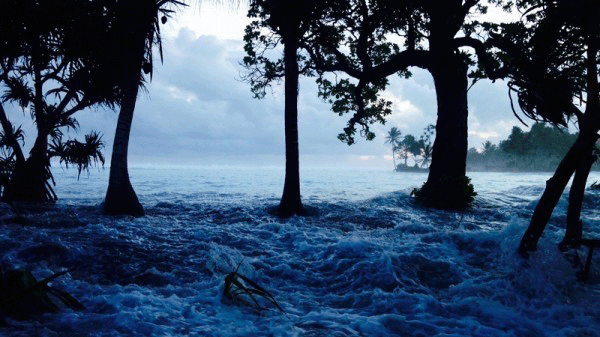
American Polynesia, Rising Seas and Relocation, By Laray Polk, Global Research, January 06, 2018 The Asia-Pacific Journal: Japan Focus 22 December 2017In the next 30 to 50 years, rising sea levels caused by global warming will subsume low-lying islands in the Pacific Ocean. Inhabitants will have to relocate, but there are few choices. Among nations (with the exception of Fiji and New Zealand) there is little preparation for the inevitable migration of Pacific Islanders. Which nations should commit to the processes of equitable relocation?
The following article will address this question through historical context and colonial occupation; current legal debates surrounding climate change and maritime migration; and the potential rights of “deterritorialized” states, such as retention of exclusive economic zones. Historical context includes an examination of U.S. insular territories in the Pacific and the continued exercise of presidential authority over island possessions.
There are strong arguments to be made that the United States has ethical obligations to assist Pacific Islanders as sea levels continue to rise, with assistance taking many forms. The U.S. is obligated namely because it is the second largest emitter of greenhouse gases, and the largest carbon emitter historically; it has extensively tested atomic and hydrogen bombs and biochemical agents in the Pacific Ocean (Marshall Islands, Christmas Island, Johnston Atoll); Continue reading →
BY ANDREAS NIDECKER, EMILIE GAILLARD AND ALYN WARE, OPINION CONTRIBUTORS — 01/18/18 As nuclear tensions increase, dangerous times have raised legally-loaded questions about nuclear weapons. Should the U.S. violate or undermine the Iran nuclear deal? Does the president have unfettered power to launch a preemptive nuclear strike on North Korea? What’s the legal status of the Trump administration’s intention, telegraphed in the newly leaked Nuclear Posture Review, to expand U.S. nuclear capabilities and arsenals when the Nuclear Non-Proliferation Treaty supposedly commits us to cutting and eventually eliminating them?
But there’s an even broader legal dilemma looming over production, testing and threatened use of nuclear weapons: how they affect the human rights of future generations. Those threats to the future are also compounded by nuclear energy, which generates radioactive waste we’re manifestly unable to control, and by destabilizing the climate that has enabled and sustained human civilization.
Can such crimes against the future be legal? How can we respect the human rights of future generations in view of them? International symposia at the University of Basel (Switzerland), University of Caen (France) and Charles University in Prague (Czech Republic) recently grappled with those questions. The Basel conference produced a declaration on human rights and trans-generational crimes resulting from nuclear weapons and nuclear energy.
Protecting future generations from the threat of nuclear weapons was an important consideration in the International Court of Justice’s 1996 affirmation that threat or use of nuclear weapons is generally illegal, given their long-term and indiscriminate impact. But despite the Court’s decision, most nuclear-armed states retain (illegal) policies to use nuclear weapons, including in a first, pre-emptive strike.
In general, current law fails to safeguard the rights of future generations. But that doesn’t make failure defensible, sustainable or in accord with legal principles. Evolution of this area of law is necessary and inevitable.
Some 2000 nuclear weapons were detonated for “testing” since 1945, releasing millions of curies of radiation. This impacted human health globally, and will continue to do so for generations. Most nuclear testing victims live in remote areas like the Pacific islands, the Kazakhstan steppe, or the North African Sahara. They have largely been forgotten; today’s younger generations are unaware of their sacrifice. Yet forgetting is perilous, because today’s youth will be tomorrow’s victims unless the cycle is broken.
There are some legal efforts to break it. For example, the 2017 Treaty on the Prohibition of Nuclear Weapons obligates signatories to provide environmental remediation and assistance for nuclear testing victims. But the provision is unenforceable, because none of the nine nuclear weapons states signed the treaty.
Like nuclear weapons, nuclear energy also poses enduring threats to human health. The Chernobyl explosion caused widespread contamination across the region and the whole European continent. High volumes of radiologically contaminated water from Fukushima continue to leak into the Pacific.
These, too, are crimes against the future. Some lethal isotopes in nuclear waste have half-lives of thousands of years. Waste repositories will need to be guarded for unimaginable time periods, with associated financial, logistical and security implications for future societies, an enormous burden we leave to our descendants.
Like the Treaty on the Prohibition of Nuclear Weapons, the International Covenant on Economic, Social and Cultural Rights (ICESCR) asserts a human right to health, applicable to nuclear contamination. But in practice that right isn’t respected.
For example, Japan ratified the covenant, and the Japanese constitution even defends the trans-generational principle of human rights in articles 11 and 97. But despite those legal principles being articulated, the Japanese media is still prevented from reporting on current events in Fukushima, and medical research on the effects of the meltdown is still restricted. The Japanese government maintains that small amounts of radiation are harmless, so limits for public radiation exposure could be increased from 1 to 20 millisieverts per year, the same as for radiation workers.
That’s unconscionable and untenable, not to mention discriminatory against young women and children who are much more susceptible to radiation exposure than men, with higher risks of cancer and non-cancerous diseases. Radiation exposure may present mutations and diseases in their offspring decades later. That’s why Japan’s handling of the Fukushima fails to accord with its own constitution as well as the ICESCR.
Failing to combat climate change effectively is also a crime against the future. The chances of meeting the Paris goal of limiting global warming to 2°C are receding since the U.S. withdrew and financial contributions of many signatories remain out of scale with the problem. Greenhouse gas emissions have risen in the two years since the Paris accord. If we stay on this too-little, too-late trajectory, we’ll not only fail to protect human rights, but much of life on earth.
Can all this be considered legal? Not for long. The dawn of the nuclear age marked the acquisition of unprecedented human power over the earth and all forms of life, as the Caen symposium pointed out. Many legal experts believe that in this new anthropocene era, a new code of medical and legal ethics is necessary. Trans-generational impacts of nuclear war, nuclear catastrophes and climate change must now be seriously considered, and require a paradigm shift in our legal thinking about the future.
The District Court of Hague took a step in that direction in 2015 when it affirmed in Urgenda Foundation v. the Dutch State that the government had a responsibility to protect future generations by limiting greenhouse gas emissions. A similar case in the United States — People v Climate Change — was granted jurisdiction and is proceeding to consideration of its merits.
There remains a long way to go to adapt the current legal framework to the realities of nuclear threats and climate change. Current laws need better implementation, and new laws need to be established. But those changes are vital to protecting the human rights of future generations.
Emilie Gaillard is an Assoc. Professor of law and a researcher at the University of Caen Normandy (France). She is a member of the Pôle Risques, Qualité et Environnement Durable at Maison de la recherché et des Sciences de l’Homme (Caen).
Andreas Nidecker MD is a Professor Emeritus of Radiology at the University of Basel, Switzerland. Board member and past president of PSR / IPPNW Switzerland and member of the organizing Committees of the symposium “Human Rights, Future Generations & Crimes in the Nuclear Age.”
Alyn Ware is a member of the World Future Council and consultant for the International Association of Lawyers Against Nuclear Arms.
Groups opposed to new nuclear licence march in Ottawa, Opposition groups say private consortium lacks proper oversight for nuclear labs,By Julie Ireton, CBC News Jan 18, 2018 Ole Hendrickson, a former government research scientist, worries that if Canadian Nuclear Laboratories gets the 10-year licence the private consortium wants to keep running the Chalk River nuclear labs in eastern Ontario, approval of a proposed nuclear waste site won’t be far behind.
Hendrickson will be among the concerned citizens, Indigenous leaders, environmentalists and former nuclear scientists marching through downtown Ottawa on Thursday, as they deliver their objection to the licence proposal to municipal and federal politicians.
Nuclear waste in Chalk River will cost billions to deal with and leave a legacy that will last centuries, notes Hendrickson.
In 2014, the federal government gave Canadian Nuclear Laboratories (CNL) control over nuclear operations at Chalk River. The government continues to own the nuclear assets.
The Canadian Nuclear Safety Commission will hold public hearings in Pembroke, Ont., from Jan. 23 to 25 to consider CNL’s licence.
Dozens of delegations have registered to comment at the hearings.
Lynn Jones, who worked in public health for years and now represents a coalition of concerned citizens, will be among those speaking out at the Pembroke hearings next week.
“Personally I have a big problem with profit being part of dealing with nuclear waste. I’m not alone in that,” Jones said.
She noted that two-thirds of the 88 interventions take issue with the 10-year licence and what they perceive as “reduced oversight”.
Lack of stability, oversight: scientists
In submissions already published, former Atomic Energy of Canada scientists write that “a decision by the Commission to grant a 10 year licence to CNL would be an unsafe and unsound decision.”
The scientists allege “instability in CNL management, lack of knowledge of key regulations and international obligations, and lack of open and transparent public engagement.”
Canadian firm, SNC Lavalin is one of the members of the CNL consortium.
The world has been living with the threat of a nuclear apocalypse since the 1950s. Over the past decade, intelligence experts have increasingly warned about the threat of a catastrophic cyber attack. Now the two fears appear to have merged, with the US on the point of revising its defence policy — to allow the use of nuclear weapons, in retaliation for a devastating cyber attack. The Trump administration has not yet released America’s revised, “Nuclear Posture Review”. But the draft document has leaked to the press. According to the New York Times, it would change US policy to allow the first use of nuclear weapons, in response to “attempts to destroy wide-reaching infrastructure, like a country’s power grid or communications, that would be most vulnerable to cyberweapons”.
Developed nations are now almost completely reliant on the internet and functioning computer systems. That, however, increases their vulnerability to cyber warfare. Security experts lose sleep worrying about a range of nightmarish scenarios — including viruses that shut down transport infrastructure, such as air-traffic control; or that disrupt the operations of banks, causing the financial system to seize up. Among the most common horror scenarios are fears for the vulnerability of power generation and distribution.
In recent years, there have been some indications that these scenarios are moving from the pages of science fiction into reality. A computer virus that disrupted Britain’s National Health Service last year, seems to have originated in North Korea. As long ago as 2007, operatives in Russia unleashed a “denial-of-service” attack on Estonia, disrupting the operation of the internet there. A really concerted cyber attack, targeting critical infrastructure, could cause social turmoil and mass casualties. Experts have considered a number of responses to this threat. There are frequent calls for a new international treaty to establish some rules for cyber space. Intelligence agencies have also considered the possibilities for cyber-retaliation — and the balance between offensive and defensive capabilities. Introducing nuclear weapons into the equation is, however, a new departure. It demonstrates how seriously the US is now taking the threat of cyber warfare; and is clearly designed to massively increase America’s deterrence capacity.
At the same time, however, the policy shift carries considerable risks. By lowering the bar to the first use of nuclear weapons, it makes nuclear war more thinkable. The dangers of such a move are increased because concerns about nuclear proliferation are mounting — with North Korea’s nuclear weapons programme making rapid progress, and both Pakistan and Russia incorporating the early use of nuclear weapons into their war-fighting plans. Another danger is that any nation contemplating a cyber attack, may now also have to consider efforts to disable an adversary’s nuclear capability. The US, for example, has almost certainly considered whether, in the event of a war, there are cyber or electronic means of taking out North Korea’s nuclear missiles. Other nations will now have to make similar calculations about the US. gideon.rachman@ft.com
IT was the site of the world’s worst ecological disaster, but Chernobyl has risen from the ashes of its nuclear meltdown and is undergoing a massive makeover. News Corp Australia Network JANUARY 15, 2018AT ground zero of Ukraine’s Chernobyl tragedy, workers in orange vests are busy erecting hundreds of dark-coloured panels as the country gets ready to launch its first solar plant to revive the abandoned territory.
The new one-megawatt power plant is located just a hundred metres from the new “sarcophagus”, a giant metal dome sealing the remains ofthe 1986 Chernobyl accident, the worst nuclear disaster in the world.
“This solar power plant can cover the needs of a medium-sized village”, or about 2,000 flats, Yevgen Varyagin, the head of the Ukrainian-German company Solar Chernobyl which carried out the project, told AFP.
Eventually, the region is to produce 100 times the initial solar power, the company says.Continue reading →
Error days after U.S. state caused panic with similar mistake
NHK apologizes on evening broadcast for erroneous warning
Japanese national broadcaster NHK issued a false alert about a North Korean missile launch, adding to questions about the reliability of early-warning systems after a similar incident in Hawaii.
the global deregulation of American firearms which could, in turn, according to critics, put such weaponry ever more easily in the hands of both criminal gangs and extremist groups
As Donald Trump might put it, major weapons contractors like Boeing, Raytheon, and Lockheed Martin cashed in “bigly” in his first year in office.
This year will undoubtedly be a banner year for arms companies. The only question is: Might it also mark the beginning of a future movement to roll back unconstrained weapons expenditures?
Tomgram: William D. Hartung, 2018 Looks Like an Arms Bonanza OpEd News.com, By Tom Engelhardt 11 Jan 18 This article originally appeared at TomDispatch.com.
Here’s a cheery note for you: the last mass killing of 2017 took place moments before midnight on New Year’s Eve. A 16-year-old New Jersey boy picked up a semi-automatic rifle, “lawfully acquired” by a member of his family, and killed his father, mother, sister, and a family friend. In doing so, he helped ensure that 2017 would be the deadliest year for mass killings in our modern history. (There is now, on average, slightly more than one mass killing a day in this country.) Nonetheless, guns of all sorts, including military-style assault rifles and even bump stocks like the 12 Stephen Paddock evidently used to turn his semi-automatics into functional automatics and slaughter 58 people from a hotel window in Las Vegas, are still readily available. Nowhere on Earth, not even in ravaged Yemen (which takes second place in gun ownership), is more weaponry available to more types of people. As the years go by here, such weapons are more easily and openly carried with only the most minimal of background checks (or less than that). Think about this: Americans, 4.4% of the people on this planet, own 42% of the guns and commit 31% of the mass killings.
Oh, and I did promise you that there was something cheery in all this, didn’t I? So here it is: the Trump administration, knowing a good thing when it sees it, is now hard at work ensuring that American weapons makers will make it a remarkably similar world. Its officials are intent, it seems, on recreating the planet in an American image. Keep in mind that U.S. arms makers like Lockheed, Raytheon, and General Dynamics already monopolize the global arms market in a way that should (but in this country regularly doesn’t) stagger the imagination. Continue reading →
False Alarm Adds to Real Alarm About Trump’s Nuclear Risk , NYT, By THE EDITORIAL BOARD, JAN. 13, 2018 It was the sort of nightmare that had only ever been real for most people’s parents or grandparents — the fear of an impending nuclear attack. “Ballistic missile threat inbound to Hawaii,” read the emergency alert that residents of the Aloha State received on Saturday morning. “Seek immediate shelter. This is not a drill.”
The authorities quickly announced that the alert was a mistake. But it made tangible the growing fears that after decades of leaders trying to more safely control the world’s nuclear arsenals, President Trump has increased the possibility of those weapons being used.
At a time when many are questioning whether Mr. Trump ought to be allowed anywhere near the nuclear “button,” he is moving ahead with plans to develop new nuclear weapons and expanding the circumstances in which they’d be used. Such actions break with years of American nuclear policy. They also make it harder to persuade other nations to curb their nuclear ambitions or forgo them entirely.
Mr. Trump has boasted about the size and power of America’s nuclear arsenal, threatened to “totally destroy” North Korea, pushed for a massive buildup of an arsenal that already has too many — 4,000 — warheads and wondered aloud why the United States possesses such weapons if it isn’t prepared to use them.
Now, as he tries to force North Korea to abandon its nuclear weapons capability and ensure that Iran never acquires one, Mr. Trump is poised to make public a new policy that commits America to an increasing investment in those very weapons, according to a draft document made public by HuffPost and confirmed by The Times.
…….. The proposed nuclear policy says a more aggressive nuclear posture is warranted because the world is more dangerous, with China, North Korea and Iran cited as concerns. Yet blowing up the Iran deal would free Tehran to resume its nuclear activities and make the world less safe. In other words, Mr. Trump’s approach makes no sense.
Under the Nuclear Nonproliferation Treaty, signed in 1968, the United States and Russia promised to reduce the role and number of nuclear weapons. They made significant, although insufficient, progress. After reductions under a succession of past presidents, the American stockpile is 85 percent smaller than it was at the height of the Cold War. Negotiations on further reductions have stalled in recent years as Russia, threatened by America’s superior conventional arsenal, became more reliant on nuclear weapons, and there is no serious sign that Mr. Trump wants to revive the talks.
President Barack Obama made a down payment on a saner policy by narrowing to “extreme circumstances” the conditions under which nuclear weapons would be used and ruling out their use against most non-nuclear countries. Mr. Trump’s policy also talks about “extreme circumstances, ” but it dangerously broadens the definition to include “significant non-nuclear strategic attacks,” which could mean using nuclear weapons to respond to cyber, biological and chemical weapon attacks.
Until Mr. Trump, no one could imagine the United States ever using a nuclear weapon again. America’s conventional military is more than strong enough to defend against most threats. But Mr. Trump has so shaken this orthodoxy that Congress has begun debating limits on his unilateral authority to launch nuclear weapons. Expanding the instances when America might use nuclear weapons could also make it easier for other nuclear-armed countries to justify using their own arsenals against adversaries.
City AM , New York, 13th Jan 2018, Renewable energy to be competitive with fossil fuels by 2020 as prices drop. The cost of generating renewable power is falling at an “unprecedented” rate, and by 2020, all renewable technologies will be price competitive with traditional fossil fuels, a new report says.
Since 2010, the cost of generating power from onshore wind has fallen by around a quarter, while solar photovoltaic (PV) electricity costs have dropped by 73 per cent, according to a report published today by the International Renewable Energy Agency (Irena).
Within just two years years, Irena expects solar energy generation costs to halve, and it said the best onshore wind and solar PV projects could be delivering electricity for an equivalent of 3 cents (2 pence) per kilowatt hour (kWh), or less.
The report said the current cost spectrum for fossil fuel power generation ranges from 5 to 17 cents per kWh. In comparison, all current commercial forms of green energy are expected to generate in the range of 3 to 10 cents per kWh by 2020.
Uranium Miners Pushed Hard for a Comeback. They Got Their Wish. NYT, By HIROKO TABUCHIJAN. 13, 2018 “………The Navajo town of Sanders, Ariz., a dusty outpost with a single stoplight, is a reminder of uranium’s lasting environmental legacy.
In Sanders, hundreds of people were exposed to potentially dangerous levels of uranium in their drinking water for years, until testing by a doctoral researcher at Northern Arizona University named Tommy Rock exposed the contamination.
“I was shocked,” Mr. Rock said. “I wasn’t expecting that reading at all.”
Mr. Rock and other scientists say they suspect a link to the 1979 breach of a wastewater pond at a uranium mill in Church Rock, N.M., now a Superfund site. That accident is considered the single largest release of radioactive material in American history, surpassing the crisis at Three Mile Island.
It wasn’t until 2003, however, that testing by state regulators picked up uranium levels in Sanders’s tap water. Still, the community was not told. Erin Jordan, a spokeswoman for the Arizona Department of Environmental Quality, said the department had urged the now-defunct local water company for years to address the contamination, but it had been up to that company to notify its customers.
Only in 2015, after Mr. Rock raised the alarm, did local regulators issue a public notice.
The town’s school district, whose wells were also contaminated with uranium, received little state or federal assistance. It shut off its water fountains and handed out bottled water to its 800 elementary and middle-school students.
The schools finally installed filters last May. Parents remain on edge.
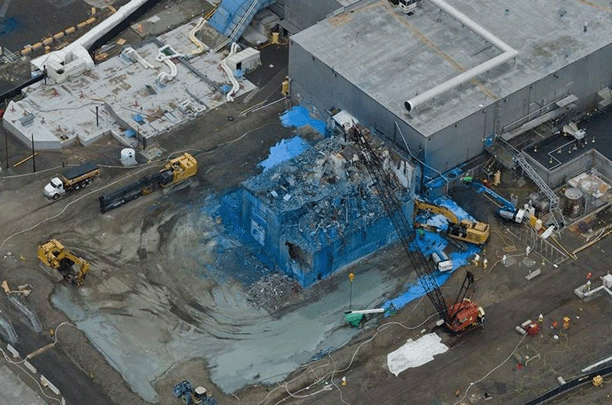
Regulators to DOE: No more Hanford demolition until we say it’s safe http://www.tri-cityherald.com/news/local/hanford/article194318189.html, BY ANNETTE CARY, acary@tricityherald.com, January 11, 2018, Hanford regulators have ordered the Department of Energy not to restart demolition of the nuclear reservation’s highly radioactively contaminated Plutonium Finishing Plant until regulators agree the work can be done safely.
Demolition was stopped at the plant in mid December, after specks of radioactive contamination were discovered to have spread outside of a containment zone established around demolition work.
There is no estimate of when demolition of the plant may restart.The Washington State Department of Ecology and the Environmental Protection Agency notified DOE this week that they would use their authority under the legally binding Tri-Party Agreement to prevent a restart of work if they have concerns about the safety of the public or workers.
The Department of Ecology’s concerns have been growing as more is learned about the extent of the spread of radioactive contamination, said Alex Smith, manager of Ecology’s Nuclear Waste Program.
As recently as Jan. 3, more contamination was detected inside the radiological control area of the plant, indicating that the spread of contamination has not yet been controlled, EPA and Ecology officials said in a letter to DOE this week.
The contamination was found even though a pile of demolition rubble at the plant’s Plutonium Reclamation Facility was covered with fixative and soil multiple times, Ecology officials said.
Although the investigation of the contamination spread is continuing, the suspected source is the pile of rubble left from demolition of the Plutonium Reclamation Facility. The spread of contamination was found just hours after its demolition using heavy equipment was completed.
The facility was expected to be the most hazardous demolition work to be done at the Plutonium Finishing Plant. The facility, added to one end of the plant, was contaminated with plutonium that easily becomes airborne.
The halt to work covers both loading out rubble for disposal and the demolition of the remainder of the finishing plant. Continue reading →
An earlier draft of H.B. 1723 passed tRehe state’s House in early March 2017 but failed to garner enough Senate interest, the spokesman for the bill’s sponsor State Rep. Larry Haler, R-Richland, told Business Insurance in April.
On Tuesday, another version of the bill, reintroduced to the House on Monday, was sent back to committee for a third reading, according to the latest update posted on the Washington State Legislature website Thursday.
The federally operated site, which has gone by several names since it opened in 1943, is known for having manufactured the plutonium used in one of the atomic bombs dropped on Japan in 1945. It is also known for its workers’ illnesses, including various cancers.
The bill would establish presumption under the state’s workers compensation laws for workers who suffer from specific cancers, including leukemia, lung cancer, bone cancer, kidney cancer, lymphoma and other cancers affecting more than a dozen body parts, according to the latest draft.
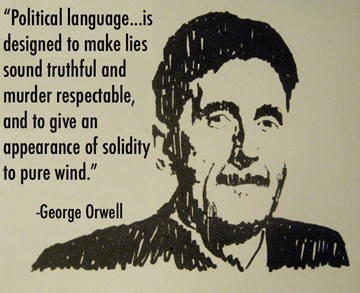
Challenging Trump’s Language of Fascism TruthOut January 09, 2018, By Henry A. Giroux, Truthout | News AnalysisGeorge Orwell warns us in his dystopian novel 1984 that authoritarianism begins with language. Words now operate as “Newspeak,” in which language is twisted in order to deceive, seduce and undermine the ability of people to think critically and freely. As authoritarianism gains in strength, the formative cultures that give rise to dissent become more embattled along with the public spaces and institutions that make conscious critical thought possible.
Words that speak to the truth, reveal injustices and provide informed critical analysis begin to disappear, making it all the more difficult, if not dangerous, to hold dominant power accountable. Notions of virtue, honor, respect and compassion are policed, and those who advocate them are punished.
I think it is fair to argue that Orwell’s nightmare vision of the future is no longer fiction. Under the regime of Donald Trump, the Ministry of Truth has become the Ministry of “Fake News,” and the language of “Newspeak” has multiple platforms and has morphed into a giant disimagination machinery of propaganda, violence, bigotry, hatred and war. With the advent of the Trump presidency, language is undergoing a shift in the United States: It now treats dissent, critical media and scientific evidence as a species of “fake news.” The administration also views the critical media as the “enemy of the American people.” In fact, Trump has repeated this view of the press so often that almost a third of Americans believe it and support government-imposed restrictions on the media, according to a Poynter survey. Language has become unmoored from critical reason, informed debate and the weight of scientific evidence, and is now being reconfigured within new relations of power tied to pageantry, political theater and a deep-seated anti-intellectualism, increasingly shaped by the widespread banality of celebrity culture, the celebration of ignorance over intelligence, a culture of rancid consumerism, and a corporate-controlled media that revels in commodification, spectacles of violence, the spirit of unchecked self-interest and a “survival of the fittest” ethos.
Under such circumstances, language has been emptied of substantive meaning and functions increasingly to lull large swaths of the American public into acquiescence, if not a willingness to accommodate and support a rancid “populism” and galloping authoritarianism. he language of civic literacy and democracy has given way to the language of saviors, decline, bigotry and hatred. One consequence is that matters of moral and political responsibility disappear, injustices proliferate and language functions as a tool of state repression. The Ministry of “Fake News” works incessantly to set limits on what is thinkable, claiming that reason, standards of evidence, consistency and logic no longer serve the truth, because the latter are crooked ideological devices used by enemies of the state. “Thought crimes” are now labeled as “fake news.”
The notion of truth is viewed by this president as a corrupt tool used by the critical media to question his dismissal of legal checks on his power — particularly his attacks on judges, courts, and any other governing institutions that will not promise him complete and unchecked loyalty. For Trump, intimidation takes the place of unquestioned loyalty when he does not get his way, revealing a view of the presidency that is more about winning than about governing. One consequence is myriad practices in which Trump gleefully humiliates and punishes his critics, willfully engages in shameful acts of self-promotion and unapologetically enriches his financial coffers. ………
With the rise of casino capitalism, a “winner-take-all” ethos has made the United States a mean-spirited and iniquitous nation that has turned its back on the poor, underserved, and those considered racially and ethnically disposable. It is worth noting that in the last 40 years, we have witnessed an increasing dictatorship of finance capital and an increasing concentration of power and ownership regarding the rise and workings of the new media and mainstream cultural apparatuses. These powerful digital and traditional pedagogical apparatuses of the 21st century have turned people into consumers, and citizenship into a neoliberal obsession with self-interest and an empty notion of freedom. ……….
Analyzing the forces behind the election of Trump, Steven Levitsky and Daniel Ziblatt provide a cogent commentary on the political and pedagogical power of an old and updated media landscape. They write:
Undoubtedly, Trump’s celebrity status played a role. But equally important was the changed media landscape…. By one estimate, the Twitter accounts of MSNBC, CNN, CBS, and NBC — four outlets that no one could accuse of pro-Trump leanings — mentioned Trump twice as often as Hillary Clinton. According to another study, Trump enjoyed up to $2 billion in free media coverage during the primary season. Trump didn’t need traditional Republican power brokers. The gatekeepers of the invisible primary weren’t merely invisible; by 2016, they were gone entirely.
What is crucial to remember here, as Ruth Ben-Ghiat notes, is that fascism starts with words. Trump’s use of language and his manipulative use of the media as political theater echo earlier periods of propaganda, censorship and repression. Commenting on the Trump administration’s barring the Centers for Disease Control to use certain words, Ben-Ghiat writes:
The strongman knows that it starts with words…. That’s why those who study authoritarian regimes or have had the misfortune to live under one may find something deeply familiar about the Trump administration’s decision to bar officials at the Centers for Disease Control (CDC) from using certain words (“vulnerable,” “entitlement,” “diversity,” “transgender,” “fetus,” “evidence-based” and “science-based”). ….……
how language is used as a tool of state repression. Authoritarians have always used language policies to bring state power and their cults of personality to bear on everyday life………. Continue reading →
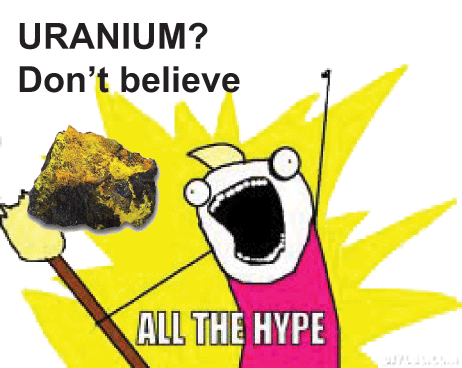
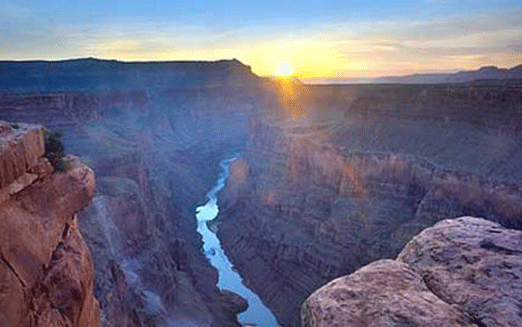
Much has been written about the health and environmental hazards posed by uranium mining near the Grand Canyon; what’s missing is the economic side of the story.
For years, Phoenix New Times has heard that uranium mining in the area is not only environmentally irresponsible, but makes no economic sense. These critics include scientists, conservationists, local politicians, and even leaders in the nuclear power industry. They say that while intuitively, we might think that more mining would be good for the local economy, it turns out this isn’t the case.
Will Trump Dump on Grand Canyon? Experts Say Risk of Uranium Mining Not Worth Reward
MIRIAM WASSER Phoenix New Times JANUARY 11, 2018 “……… In 2012, President Barack Obama’s administration put a 20-year freeze (called a mineral withdrawal) on all new mining claims in 1 million acres around the Grand Canyon. A handful of mines with valid existing rights, like Canyon Mine, were grandfathered in and permitted to move ahead with operations.
The reason for the withdrawal was simple: Scientists didn’t know enough about the complex hydrology of the area to say whether mining could cause irreparable damage. And with the entire Grand Canyon ecosystem and tourism industry at stake — not to mention the Havasupai who live in the park and the millions of people who live downstream from the Colorado River — there was overwhelming public support for the decision.
Fast-forward to the present day, however, and there are signs that the moratorium may not survive Donald Trump’s presidency.
His administration has spent the last year systematically trying to undermine his predecessor’s environmental policies, an agenda that has included reducing regulations and opening up vast areas of public land for mining, drilling, and fracking.
In the case of uranium, “they’re just doing it because they can,” says Chris Mehl of Headwaters Economics, an independent nonprofit research group that studies western land management. “They’re offering an opportunity for a product that is at or near historic low prices”….
As any economist will tell you, sometimes it’s worth taking a big risk in order to get a big reward. But when it comes to reversing the 2012 withdrawal, the potential benefits seem small and the risks seem huge.
Much has been written about the health and environmental hazards posed by uranium mining near the Grand Canyon; what’s missing is the economic side of the story.
For years, Phoenix New Times has heard that uranium mining in the area is not only environmentally irresponsible, but makes no economic sense. These critics include scientists, conservationists, local politicians, and even leaders in the nuclear power industry. They say that while intuitively, we might think that more mining would be good for the local economy, it turns out this isn’t the case.
Given that the whole point of “revising” the withdrawal is to bolster domestic energy production to create jobs, secure energy independence, and help the economy, New Times decided to investigate the economics of uranium mining in the area.
To do this, we spoke with more than a dozen experts in fields like hard-rock mining, mineral economics, hydrology, environmental law, and nuclear power. We analyzed global uranium market trends and data, learned about unconventional mining techniques, and spoke with local politicians who are familiar with the northern Arizona economy.
We also consulted reports from various federal agencies, think tanks, trade groups, the Government Accountability Office, the World Nuclear Association, and the International Atomic Energy Association’s biennial report about the state of the global uranium market, The Uranium Red Book.
Tellingly, no expert or document made the argument that acquiring uranium from within the 2012 withdrawal is a matter of national security. No one said we needed it to keep the lights on now or in the foreseeable future. The world is flush with uranium that’s cheaper to mine and the U.S. Department of Energy has huge stockpiles of enriched and raw uranium that could be used in a pinch, we were told, again and again.
And finally, no one said that it would do much for the local economy. Some suggested that at best, it could create temporary jobs, though most felt that because of the stop-and-go nature of uranium mining, and the fears mining stokes about a radioactive accident, it would be more likely to cause harm than good.
Apr 15, 2026 01:00 AM in Canberra, Melbourne, Sydney
Join the International Physicians for the Prevention of Nuclear War (IPPNW) on Tuesday, April 14th for a timely webinar exploring the risks associated with nuclear power and challenging the myth that it offers a simple, safe, carbon-free solution to the climate crisis
21 April Webinar: No Nuclear Weapons in Australia
Start: 2026-04-21 18:00:00 UTC Canberra, Melbourne, Sydney (GMT+10:00)
End: 2026-04-21 19:30:00 UTC Canberra, Melbourne, Sydney (GMT+10:00)
Event Type: Virtual A virtual link will be communicated before the event.













 Antinuclear