The significance of Antarctica as the world warms
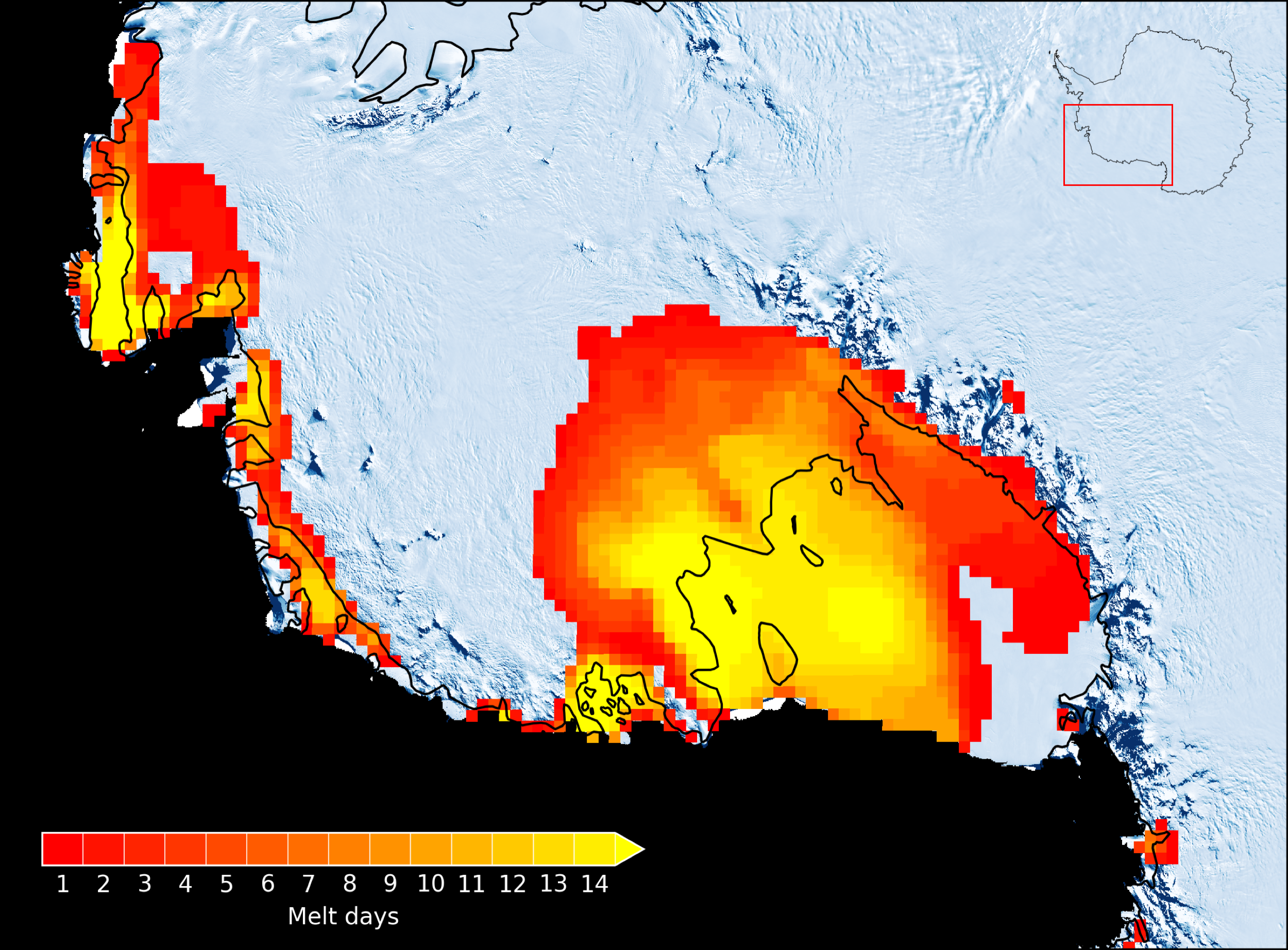 Why remote Antarctica is so important in a warming world The Conversation.Chris Fogwill, Professor of Glaciology and Palaeoclimatology, Keele University, Professor of Earth Sciences and Climate Change, UNSW, Reader in Physical Geography and Sustainability/Director of Education for Sustainability, Keele University
“……..What was once thought to be a largely unchanging mass of snow and ice is anything but. Antarctica holds a staggering amount of water. The three ice sheets that cover the continent contain around 70% of our planet’s fresh water, all of which we now know to be vulnerable to warming air and oceans. If all the ice sheets were to melt, Antarctica would raise global sea levels by at least 56m.
Where, when, and how quickly they might melt is a major focus of research. No one is suggesting all the ice sheets will melt over the next century but, given their size, even small losses could have global repercussions. Possible scenarios are deeply concerning: in addition to rising sea levels, meltwater would slow down the world’s ocean circulation, while shifting wind belts may affect the climate in the southern hemisphere.
A new medical warning on the consequences of nuclear war
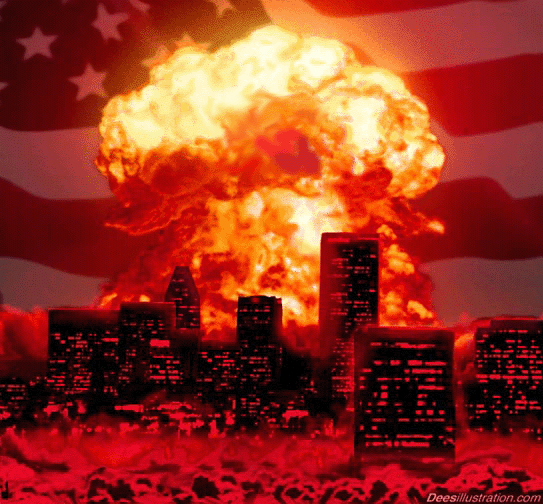 NUCLEAR WAR WITH N. KOREA: WE’RE NOT PREPARED FOR THE SCALE OF CASUALTIES http://www.newsweek.com/nuclear-war-n-korea-were-not-prepared-scale-casualties-729656 BY The global impact of nuclear war—in perception and reality—took a significant, unprecedented and highly negative turn in the summer of 2017 with North Korea’s acquisition of a thermonuclear weapon.
Those of us in the field of emergency preparedness shudder with the realization that a growing number of nations are joining the global thermonuclear arms race.
This reality is fraught with consequences that most people do not recognize, and frankly do not want to know.
In a nutshell, thermonuclear weapons, colloquially known as H-bombs, produce much larger yields of destructive power than the nuclear weapons that countries tested in the early days of nuclear weapon development.
For example, the nuclear bombs that the U.S. dropped on Japan in 1945 were in the 15 to 20 kiloton yield. This means that they had the destructive power of an equivalent of 15,000 to 20,000 tons of dynamite.
In addition to killing about 100,000 people, these weapons cause thousands of traumatic injuries, thousands of radiation injuries and hundreds of thermal burn victims.
Compare that to a thermonuclear weapon which is in the range of 75 to 49,000 kilotons of destructive power. Used on a densely populated urban center like New York City or Tokyo, just one weapon would kill millions of people and produce millions of casualties.
Those numbers are devastating enough, but the real nightmare is that the number of thermal burn casualties greatly multiply with a thermonuclear weapon relative to a simple nuclear weapon.
A typical serious thermal burn injury in a well staffed hospital takes three to four medical personnel per patient to provide adequate care. When we have hundreds of thousands of surviving burn patients due to an urban thermonuclear detonation, we are not going to be able to treat even a tiny fraction of them.
Until now, only wealthy and advanced nations – the United States, Russia, China, the United Kingdom, France and Israel – were able to produce these massively destructive thermonuclear weapons.
Now, with poor and unstable North Korea joining the thermonuclear club, other small nations may realize that this previously difficult threshold may be within their technical reach.
Even worse, nations around the world know that the Earth is getting to be a much more dangerous place when a nation like North Korea has such weapons, and many will perceive that their national safety now depends on procuring these terrible devices as well.
In academic journals and in the media, there is talk of India acquiring thermonuclear weapons on the fast track, which will pressure Pakistan to do the same. The sense of urgency is even touching nations that previously eschewed the development of nuclear weapons.
Even Japan – which by its constitution is significantly restricted in its armaments and has no nuclear weapons at all – could use its enormous stockpile of nuclear waste to rapidly develop an equally enormous stockpile of thermonuclear weapons.
Despite repeated headlines about the growing possibility of nuclear war, most people, curiously, avoid thinking or talking about it. In over a thousand lectures on nuclear war medical response, I find even medical audiences do not want to address the issue.
In fact, I recently published an assessment of U.S. and Asian emergency medical responders’ hypothetical response to a nuclear event which found a striking lack of knowledge about patients affected by radiation after nuclear war and a strong reluctance to treat them, even though it is far less dangerous than treating infectious disease patients.
This fear of radiation is just as pronounced in the general population. We had a very hard time getting the medical and public health community to adequately address this issue even when we were focused on the smaller, Hiroshima-sized weapons, where it is feasible to mount a credible response. Now, we have to discuss the grim prospect of responding to the global thermonuclear arms race that we are now in – and currently losing.
While nuclear nonproliferation remains a top priority, the preparation for responding to the actual use of these terrible weapons is now a regrettable necessity that we must confront.
Cham Dallas is the director of the Institute for Disaster Management at the University of Georgia.
USA air drills over Korean peninsula – North Korea warns of nuclear war danger
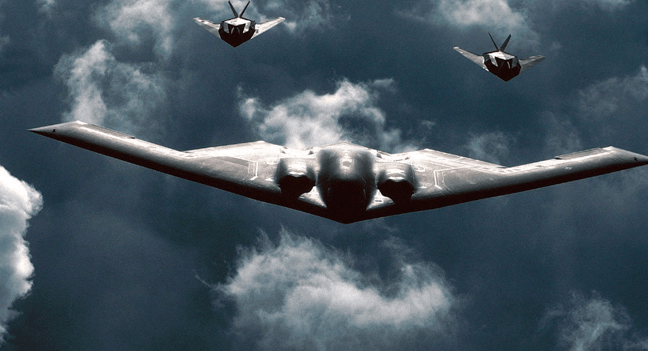 Air drills put region on ‘brink of nuclear war’, warns North Korea, 9 News, By Richard Wood
Climate change preoccupies the mind of Kevin Rudd.
 Kevin Rudd: ‘I don’t know how Malcolm Turnbull faces his grandkids’ CLIMATE HOME NEWS 03/12/2017, Australia’s former prime minister talks about the failure of his country’s climate policy, the rise of China and the Carmichael coal mine By Karl Mathiesen
Climate change preoccupies the mind of Kevin Rudd.
This week it will be ten years since he became prime minister of Australia, a little over ten years since he called climate change “the great moral challenge of our generation”.
It remains foremost in his thoughts and tweets. One of the “great global megatrends”, climate change will define our future as a species, he tells Climate Home News over scones, jam and tea in an Oxford hotel. But Rudd is also keen to deal with the past, where climate change also looms.
Rudd’s 2010 decision to defer an emissions trading scheme is widely seen as a high water mark for Australian climate policy. The point where the tide changed and a decade of lost opportunity began.
Rudd has blamed that decision on the cabinet forces, led by his deputy Julia Gillard, that eventually deposed him.
The current prime minister Malcolm Turnbull faces a similar revolt, led by the man from whom he took the leadership – Tony Abbott. This has led Turnbull to retreat on climate policy, most recently ignoring the advice of his chief scientist to create a clean energy target.
Given he faces similar internecine tensions to those Rudd dealt with as PM, should Turnbull be cut some slack?
“No,” says Rudd………
 he says. “He [Turnbull] choked on climate change, he choked on a whole range of policy measures, hence the collective disillusionment with him. Turnbull’s principle political and policy failing is that it became very clear he just wanted to be there.”…….
In his current life as peripatetic statesman, Rudd says he takes every opportunity to criticise the Australian government over its “inertia” on climate change.
“I don’t know how those guys face their kids and grandkids in the morning. I really don’t. I just genuinely don’t,” he said……. http://www.climatechangenews.com/2017/12/03/kevin-rudd-i-dont-know-how-malcolm-turnbull-faces-his-grandkids/
Even the possession of nuclear weapons is now irrational, says Pope Francis
Pope Francis says mere possession of nuclear weapons is now ‘irrational’ Telegraph UK Associated Press 3 DECEMBER 2017
The Cold War-era policy of nuclear deterrence is no longer viable and that the mere possession of nuclear weapons is now “irrational”, Pope Francis has said.
“We’re at the limit of licitly having and using nuclear arms. Why? Because today, such sophisticated nuclear arsenals risk destroying humanity or at least a great part of it,” he said en route home following his trip to Bangladesh.
Amid increasingly heated rhetoric between the U.S. and North Korea, the Pope s told a nuclear disarmament conference last month that mere possession of nuclear weapons was to be condemned, given the risks, and that the only viable path forward was total disarmament.
Only The Greens opposed the Adani coal mine expansion
Adani looting Australia’s treasures: Gearing up the vox pops in Maiwar, Independent Australia, Tess Lawrence Only one party, the Greens, oppose the  looting of Australia’s natural treasures by Adani — and that may just be enough to get them their first ever seat in the Queensland Parliament. Contributing editor-at-large Tess Lawrence reports, along with exclusive vox pop interviews by Walkley Award winner Amanda Gearing.
THE OLD PARTIES just don’t get it. They’re both on the nose…….
The ALP, like the LNP have brazenly prostituted themselves and Australia’s environmental security to the appalling Adani coal mine operation in the Galilee Basin.
Once again, these two political behemoths have colluded to steal sacred land from traditional owners and the nation’s collective environmental inheritence to onsell/lease to economic carpetbaggers and environmental looters.
The Wangan and Jagalingou people, traditional owners of the land concerned, have been treated with contempt by Adani and the Queensland and Federal governments, in yet another shameful example of Indigenous elders abuse……https://independentaustralia.net/australia/australia-display/adani-looting-australias-treasures-gearing-up-the-vox-pops-in-maiwar,10990
Former Trump security adviser Michael Flynn pleads guilty to lying to federal agents, including about nuclear marketing trip
Flynn started a private lobbying and consulting practice that did business in foreign countries including Russia and Turkey. Flynn didn’t disclose those contacts and payments, as required, when applying for his security clearance to work in the Trump White House.
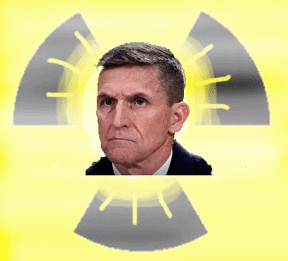 Top House Democrats have pointed out that Flynn failed to disclose a 2015 Middle East business trip tied to a plan to build nuclear plants in the region using money from Saudi and Russian investors. The Democrats called the omission a crime.
Flynn Said to Have Reached Out to Russia at Kushner’s Behest, By David Kocieniewski, Greg Farrell, Andrew M Harris, and David McLaughlin, Bloomberg,
-
Ex-security adviser pleads guilty and agrees to cooperate
Former national security adviser Michael Flynn pleaded guilty to lying to federal agents and is providing cooperation that promises to take Special Counsel Robert Mueller deep into Donald Trump’s administration. Continue reading
U.S. nuclear firms pushing to sell nuclear technology to Saudi Arabia
 U.S. firms push Washington to restart nuclear pact talks with Riyadh: sources https://www.reuters.com/article/us-saudi-nuclear-usa/u-s-firms-push-washington-to-restart-nuclear-pact-talks-with-riyadh-sources-idUSKBN1DV586?feedType=RSS&feedName=worldNews. Reem Shamseddine, Sylvia Westall RIYADH/DUBAI (Reuters) 1 Dec 17, – U.S. firms attracted by Saudi Arabia’s plans to build nuclear reactors are pushing Washington to restart talks with Riyadh on an agreement to help the kingdom develop atomic energy, three industry sources said.
Saudi Arabia has welcomed the lobbying, they said, though it is likely to worry regional rival Iran at a time when tensions are already high in the Middle East.
One of the sources also said Riyadh had told Washington it does not want to forfeit the possibility of one day enriching uranium – a process that can have military uses – though this is a standard condition of U.S. civil nuclear cooperation pacts.
“They want to secure enrichment if down the line they want to do it,” the source, who is in contact with Saudi and U.S. officials, said before U.S. Energy Secretary Rick Perry holds talks in Riyadh early next week.
Another of the industry sources said Saudi Arabia and the United States had already held initial talks about a nuclear cooperation pact.
U.S. officials and Saudi officials responsible for nuclear energy issues declined to comment for this article. The sources did not identify the U.S. firms involved in the lobbying.
Under Article 123 of the U.S. Atomic Energy Act, a peaceful cooperation agreement is required for the transfer of nuclear materials, technology and equipment.
In previous talks, Saudi Arabia has refused to sign up to any agreement with the United States that would deprive the kingdom of the possibility of one day enriching uranium.
Saudi Arabia, the world’s top oil producer, says it wants nuclear power solely for peaceful uses – to produce electricity at home so that it can export more crude. It has not yet acquired nuclear power or enrichment technology.
Riyadh sent a request for information to nuclear reactor suppliers in October in a first step towards opening a multi-billion-dollar tender for two nuclear power reactors, and plans to award the first construction contract in 2018.
Reuters has reported that Westinghouse is in talks with other U.S.-based companies to form a consortium for the bid. A downturn in the U.S. nuclear industry makes business abroad increasingly valuable for American firms.
Reactors need uranium enriched to around 5 percent purity but the same technology in this process can also be used to enrich the heavy metal to a higher, weapons-grade level. This has been at the heart of Western and regional concerns over the nuclear work of Iran, which enriches uranium domestically.
Riyadh’s main reason to leave the door open to enrichment in the future may be political – to ensure the Sunni Muslim kingdom has the same possibility of enriching uranium as Shi‘ite Muslim Iran, industry sources and analysts say.
POTENTIAL PROBLEM FOR WASHINGTON
USA business wants Saudi Arabia to buy nuclear reactors, but is it a terrorist State?
 Is Saudi Arabia also amongst the terrorists? The News, Nigeria Dec 1 2017 By Owei Lakemfa.
A “preventive strike” against North Korea the worst option – would trigger ‘nuclear retaliation’
A ‘preventive strike’ against North Korea would trigger ‘nuclear retaliation’On Tuesday, North Korea test fired what experts believe is its most advanced long range, nuclear-capable missile yet.
In response, Sen. Lindsey Graham told CNN “If we have to go to war to stop this we will.”
A preventive strike against North Korea is not feasible and would have devastating consequences. The best path is still diplomacy. Lt. Col. Daniel L. Davis, USA, Ret.
CNBC , 1 December 17,
If Sen. Graham’s binary choice accurately reflects the president’s thinking, then war will come, and millions could die, including thousands of Americans. Such a war is too costly to seriously consider absent an imminent attack.
It is difficult to overstate the negative consequences that would result should President Trump order any type of “preventive” military strike—that is, an attack to deprive them of a capability rather than to stop an actual, imminent launch—against North Korea.
In case some are tempted to think these threats are merely bluster by the Kim regime, they were echoed almost precisely last month in congressional testimony by the highest ranking North Korean official ever to defect.
Former diplomat Thae Yong-ho told members of Congress North Korean officers are trained to fire their weapons “without any further instructions from the general command if anything happens on their side.” Their response would be immediate and devastating.
Consider the most dangerous course of action: this latest test, reportedly fired from a mobile launcher, indicates North Korea has the ability to launch nuclear-tipped missiles. If the United States tries to take out launch points, or even a massive and sustained bombing campaign in an attempt to destroy their ability to retaliate, we will inflict extraordinary damage—but it is unlikely our attacks would successfully penetrate all their mountain bunkers.
That leaves the possibility that Kim Jong-un would order a mobile launcher to emerge from its protective bunker, and in retaliation, send a nuclear missile crashing into Guam, Hawaii, or Seattle.
Such an act would not be a fringe possibility were the U.S. to launch any type of “preventive” armed attack; it would be a likely outcome.
The window of opportunity to strike North Korea without risk of nuclear retaliation closed many years ago. For more than a decade, it has been impossible to take out North Korea’s ability to launch conventional and nuclear retaliatory strikes against our allies—the only recent development is that our homeland may now also be at risk of a counterstrike.
This further increases the cost of preventive war, making it an even worse policy option rather than a serious policy recommendation……… https://www.cnbc.com/2017/11/30/preventive-strike-on-north-korea-would-trigger-nuclear-retaliation-lt-col-commentary.html
Nuclear weapons nations snub Nobel Peace Prize ceremony
Ambassadors of Western nuclear powers to snub Nobel ceremony
Head of anti-nuke group set to receive prize says decision by US, UK and France not to send top envoys shows its campaign is working, Times of Israel, OSLO, Norway, 30 Nov 17, — Breaking with tradition, nearly all ambassadors of the world’s nuclear powers will not attend this year’s Nobel Peace Prize ceremony which honors efforts to ban atomic weapons, the Nobel Institute said Thursday.
“We are disappointed that the ambassadors from the United Kingdom, the United States and France won’t be there,” the head of the International Campaign to Abolish Nuclear Weapons Beatrice Fihn told AFP.
“They claim to be committed to a world without nuclear weapons, and they should be celebrating civil society’s work on the issue,” she said, regretting their “defensive” position, yet noting that it “shows that this treaty and the campaign is already having an impact on them.”
The Peace Prize was awarded on October 6 to ICAN, a coalition of non-governmental organizations lobbying for a historic treaty banning atomic weapons, which was signed in July by 122 countries though none of the nuclear powers.
ICAN will formally receive its prize at a lavish ceremony in Oslo on December 10.
During a meeting in the Norwegian capital last week, the United States, France and Britain all informed the Nobel Institute of their joint decision to be represented by their embassy’s second-in-charge.
“They clearly received instructions to express their reservations towards ICAN and the global treaty” to ban weapons of mass destruction, the head of the Nobel Institute, Olav Njolstad, told AFP.
Of the nine countries believed to have nuclear weapons capabilities, Russia and Israel, which has never acknowledged having nuclear weapons, will be the only ones sending their ambassadors to the ceremony………
The Nobel Institute said the ambassadors of India and Pakistan will be travelling at the time of the ceremony, while China has not attended the prize-giving since 2010, when a Chinese dissident was awarded the honor.
North Korea does not have an embassy in Oslo. The Nobel Institute said the ambassadors of India and Pakistan will be travelling at the time of the ceremony, while China has not attended the prize-giving since 2010, when a Chinese dissident was awarded the honor.
North Korea does not have an embassy in Oslo. https://www.timesofisrael.com/ambassadors-of-western-nuclear-powers-to-snub-nobel-ceremony/
Why Global Warming Will Accelerate As CO2 Levels Rise
 Study Discovers Why Global Warming Will Accelerate As CO2 Levels Rise, http://www.enn.com/pollution/article/53315 From: The University of Reading
 November 29, 2017 The findings are supported by observations, suggesting that forecasts made by climate models evaluated by the Intergovernmental Panel on Climate Change are realistic.
Paulo Ceppi, researcher at the University of Reading and lead author of the study, said: “This resemblance of computer simulations to observations increases our confidence in projections that the climate sensitivity to the progressive rise in carbon dioxide concentrations will increase over time into the future.”
Evidence suggests that the upper level of the Earth’s atmosphere warms faster than the surface in response to CO? levels. However, the new study shows that as CO? levels increase further, the rate of warming in the upper levels slows in comparison with that closer to the Earth’s surface.
Continue reading at The University of Reading.
How could the Agung volcano in Bali affect global temperatures?
Analysis: How could the Agung volcano in Bali affect global temperatures? Carbon Brief, ZEKE HAUSFATHER 25.10.2017 While human activity has been the dominant driver of climate change over the past century, natural factors can influence short-term variations in global temperature.
Major volcanic eruptions, in particular, can have a sizable cooling impact on the climate lasting for five years or so.
The Mount Agung volcano in Bali, Indonesia has been showing signs that an eruption is likely to occur this year. Last time Agung erupted, back in 1963, it had a noticeable cooling effect on the Earth’s climate.
Here, Carbon Brief examines how volcanoes influence the climate, and suggests that a new Agung eruption would likely only result in a modest and temporary cooling of global temperatures.
Eruptions send a cloud of ash and dust high into the atmosphere. The sulphur dioxidereleased combines with water to form sulfuric acid aerosols, which reflect incoming sunlight and influence cloud formation. When eruptions are powerful enough to reach the stratosphere (18 km or more above the surface at the equator), these sulphate aerosols can stay aloft for a number of years and have a strong cooling effect on the climate.
Volcanic eruptions also release CO2 into the atmosphere, meaning they contribute to warming by strengthening the greenhouse effect. But this influence is very small, and is outweighed by the cooling impact of the dust and ash.
The location of volcanoes also matter. Major volcanic eruptions near the equator are more likely to have a big effect on global temperatures, while high-latitude eruptions (like Laki) will have their effects more limited to the one hemisphere. Sulphate aerosols from high-latitude volcanoes generally will not cross the equator, while tropical volcanoes tend to cool both hemispheres………
This projection, which is based on the historical relationship between volcanic eruptions and temperature, suggests that an Agung eruption would reduce global temperatures between 0.1C to 0.2C in period from 2018 to 2020, with temperatures mostly recovering back to where they otherwise would be by 2023.
There is no guarantee that an eruption of Agung today would be the same size as the one in 1963, however. A small volcanic eruption that doesn’t reach the stratosphere would have a relatively minor climate impact, as sulphur dioxide from the volcano would quickly fall out of the atmosphere.
On the flip side, we have records of much larger volcanic eruptions, such as Tambora in 1815 that may have cooled the globe by 0.6C or more and led to the “year without a summer”. Even in large eruptions this cooling only lasts a few years, however, as once sulphate aerosols eventually fall back to earth the climate quickly returns to normal.
This projection, which is based on the historical relationship between volcanic eruptions and temperature, suggests that an Agung eruption would reduce global temperatures between 0.1C to 0.2C in period from 2018 to 2020, with temperatures mostly recovering back to where they otherwise would be by 2023.
There is no guarantee that an eruption of Agung today would be the same size as the one in 1963, however. A small volcanic eruption that doesn’t reach the stratosphere would have a relatively minor climate impact, as sulphur dioxide from the volcano would quickly fall out of the atmosphere.
On the flip side, we have records of much larger volcanic eruptions, such as Tambora in 1815 that may have cooled the globe by 0.6C or more and led to the “year without a summer”. Even in large eruptions this cooling only lasts a few years, however, as once sulphate aerosols eventually fall back to earth the climate quickly returns to normal……..https://www.carbonbrief.org/analysis-how-could-agung-volcano-bali-affect-global-temperature
Long search for compensation, for Gabon’s sick uranium miners
 For Gabon’s sickly uranium miners, a long quest for compensation,https://www.modernghana.com/news/819514/for-gabons-sickly-uranium-miners-a-long-quest-for-compensa.html , 27 Nov 17, “We are all sick. It’s our health, and we are being conned,” Moise Massala says angrily.
The 82-year-old is a retired geochemist who used to work in a uranium mine in Gabon owned by French nuclear giant Areva.
He and hundreds of other former workers say they fell ill from their work to extract the uranium — a source of nuclear power and warheads, but toxic and potentially carcinogenic.
The miners worked for an Areva subsidiary — the Compagnie des mines d’uranium de Franceville, better known by its abbreviation of COMUF.
Over 38 years, the mine extracted some 26,000 tonnes of uranium near Mounana, southeastern Gabon, before closing in 1999 after the global price of uranium fell and the seam of ore began to thin.
By the end of 2016, 367 former workers had died from “pulmonary respiratory infections” linked to working in the mine, according to MATRAC, a campaign group gathering 1,618 former employees.
The surviving miners, many of them old and sick, have unsuccessfully demanded compensation for 12 years in the belief they were exposed to dangerous levels of uranium contamination.
Areva, a multi-billion-dollar business majority-owned by the French state, has repeatedly denied that it has any case to answer. Continue reading
Lidia Thorpe, Victoria’s first Aboriginal woman Member of Parliament speaks out
State’s first Aboriginal woman MP Lidia Thorpe speaks of genocide, lingering disadvantage, The Age, 29 Nov 17, Adam Carey “…… Ms Thorpe, who replaced Labor’s Fiona Richardson as member for Northcote following the late minister’s death from cancer in August, began her speech with a statement of defiance on behalf of Victoria’s Aboriginal people, noting that they “have never ceded sovereignty”.
“Being Aboriginal is not all I am, but it’s the centre of who I am,” Ms Thorpe said.
“My mother’s family lived their lives as refugees in their own country, on Gunnai land in Gippsland.
Ms Thorpe told Parliament she would fight to put Indigenous people at the heart of political decision-making, in a fiery speech that coincided with the release of a troubling report that revealed Victoria is struggling to close the gap of disadvantage between Aboriginal and non-Aboriginal Victorians……..
Ms Thorpe paid tribute to “the strong line of Aboriginal women before me”, especially her grandmother Alma Thorpe, a prominent Indigenous health activist, who watched from the front row of the public gallery.
Lidia Thorpe was sworn in as an MP on Tuesday, the day Victoria’s annual report into Indigenous wellbeing was tabled in Parliament. ……….
Ms Thorpe’s first speech also made reference to the modern-day impact of historical dispossession.
“In Victoria in 2017, Aboriginal children are still being removed from families, and our literacy rates are among the lowest in the state,” she said.
“Our people are locked up at a rate 11 times higher than the general population. This is not because of fundamental flaws in their character but because of a system that has written them off.” http://www.theage.com.au/victoria/first-aboriginal-woman-mp-lidia-thorpe-speaks-of-genocide-lingering-disadvantage-20171129-gzv2ms.html
1 This month
Chernobyl: The Lost Tapes – A good documentary on Chernobyl on SBS available On Demand for the next 3 weeks– https://www.sbs.com.au/ondemand/tv-program/chernobyl-the-lost-tapes/2352741955560
15 April – Zoom –Nuclear Power is Not the Solution
Apr 15, 2026 01:00 AM in Canberra, Melbourne, Sydney

Join the International Physicians for the Prevention of Nuclear War (IPPNW) on Tuesday, April 14th for a timely webinar exploring the risks associated with nuclear power and challenging the myth that it offers a simple, safe, carbon-free solution to the climate crisis

21 April Webinar: No Nuclear Weapons in Australia
Start: 2026-04-21 18:00:00 UTC Canberra, Melbourne, Sydney (GMT+10:00)
End: 2026-04-21 19:30:00 UTC Canberra, Melbourne, Sydney (GMT+10:00)
Event Type: Virtual
A virtual link will be communicated before the event.
Host Contact Info: australia@icanw.org

of the week – Australians for War Powers Reform (AWPR)
To see nuclear-related stories in greater depth and intensity
 Antinuclear