World solar energy, not just the future: it’s the present
 Forbes 17th Oct 2020, Anyone who follows developments in the energy sector will know that solar energy is no longer just the future but the present. According to thebInternational Energy Agency’s World Energy Outlook 2020, photovoltaic solar energy is already the cheapest source of electricity in history.
https://www.forbes.com/sites/enriquedans/2020/10/17/what-is-happening-with-solarenergy/amp
/
Nuclear waste – a danger for countless generations to come
|
The World’s Growing Nuclear Waste Dilemma, Oil Price, By Haley Zaremba – Oct 15, 2020, ”……….Just last month, the World Nuclear Industry Status Report showed the shocking statistic that nuclear is now the most expensive form of power generation in the world, with the sole exception of gas peaking plants. And then there’s the issue of nuclear waste, and it’s not a minor one. Around the world, radioactive waste is piling up, and managing it is a huge expense, not to mention a public health risk of massive proportions if not handled appropriately. Spent nuclear fuel is so hazardous because the waste, in particular uranium and plutonium, is highly radioactive with a half-life that will outlast all of us. Recently, different nuclear-powered countries around the world have been pursuing “final disposal sites” for their nuclear waste. This process consists of converting this radioactive waste into a kind of glass via a process known as vitrification. This glass will then be stored inside of stainless steel vessels that will be kept in a pool to maintain a cool temperature until they are finally transferred to their final resting place deep underground, where they will remain undisturbed until their amount of radioactivity has decreased to a level that they can be handled safely–a period of time anywhere from 1,000 to 100,000 years. ……. controversy in Japan is directly related to that nation’s particular history to be sure, but it is part of a global problem. Nuclear waste is not just a hazard for ourselves, but for countless generations to come, and we cannot afford to be cavalier with its management. Finding a place for the spent nuclear fuel that has already been created by generations past and that yet to be produced cannot be rushed or thrust upon those who do not want it but have no power to refuse it. Final disposal sites are certainly a step forward but Japan shows us that they’re also, ultimately, a flawed solution. https://oilprice.com/Alternative-Energy/Nuclear-Power/The-Worlds-Growing-Nuclear-Waste-Dilemma.amp.html?fbclid=IwAR0JRIxFnP5MRLyuvJwNwXU8KV39E7ZHA9qeNzRbF-6dr3KQzysGQidJsU4 |
|
Global heating is affecting the Arctic much faster than expected

 The region is unravelling faster than anyone could once have predicted. But there may still be time to act
The great thaw: global heating upends life on Arctic permafrost – photo essay, Guardian,
Gloria Dickie, Tue 13 Oct 2020 At the end of July, 40% of the 4,000-year-old Milne Ice Shelf, located on the north-western edge of Ellesmere Island, calved into the sea. Canada’s last fully intact ice shelf was no more.On the other side of the island, the most northerly in Canada, the St Patrick’s Bay ice caps completely disappeared.
Two weeks later, scientists concluded that the Greenland Ice Sheet may have already passed the point of no return. Annual snowfall is no longer enough to replenish the snow and ice loss during summer melting of the territory’s 234 glaciers. Last year, the ice sheet lost a record amount of ice, equivalent to 1 million metric tons every minute.
The Arctic is unravelling. And it’s happening faster than anyone could have imagined just a few decades ago. Northern Siberia and the Canadian Arctic are now warming three times faster than the rest of the world. In the past decade, Arctic temperatures have increased by nearly 1C. If greenhouse gas emissions stay on the same trajectory, we can expect the north to have warmed by 4C year-round by the middle of the century.
There is no facet of Arctic life that remains untouched by the immensity of change here, except perhaps the eternal dance between light and darkness. The Arctic as we know it – a vast icy landscape where reindeer roam, polar bears feast, and waters teem with cod and seals – will soon be frozen only in memory.
A new Nature Climate Change study predicts that summer sea ice floating on the surface of the Arctic Ocean could disappear entirely by 2035. Until relatively recently, scientists didn’t think we would reach this point until 2050 at the earliest. Reinforcing this finding, last month Arctic sea ice reached its second-lowest extent in the 41-year satellite record………
At outposts in the Canadian Arctic, permafrost is thawing 70 years sooner than predicted. Roads are buckling. Houses are sinking. In Siberia, giant craters pockmark the tundra as temperatures soar, hitting 100F (38C) in the town of Verkhoyansk in July. This spring, one of the fuel tanks at a Russian power plant collapsed and leaked 21,000 metric tons of diesel into nearby waterways, which attributed the cause of the spill to subsiding permafrost.
This thawing permafrost releases two potent greenhouse gases, carbon dioxide and methane, into the atmosphere and exacerbates planetary warming.
The soaring heat leads to raging wildfires, now common in hotter and drier parts of the Arctic. In recent summers, infernos have torn across the tundra of Sweden, Alaska, and Russia, destroying native vegetation………..
The Northwest Passage through the Canadian Arctic Archipelago could soon yield another shortcut. And in Greenland, vanishing ice is unearthing a wealth of uranium, zinc, gold, iron and rare earth elements. In 2019, Donald Trump claimed he was considering buying Greenland from Denmark. Never before has the Arctic enjoyed such political relevance………….
“It’s got to be both a reduction in emissions and carbon capture at this point,” explains Stroeve. “We need to take out what we’ve already put in there.”………..
We’ve had so many wins’: why the green movement can overcome climate crisis

We’ve had so many wins’: why the green movement can overcome climate crisis
Leaded petrol, acid rain, CFCs … the last 50 years of environmental action have shown how civil society can force governments and business to change, Guardian, by Fiona Harvey Environment correspondent, Mon 12 Oct 2020
Leaflets printed on “rather grotty” blue paper. That is how Janet Alty will always remember one of the most successful environment campaigns of modern times: the movement to ban lead in petrol.
There were the leaflets she wrote to warn parents at school gates of the dangers, leaflets to persuade voters and politicians, leaflets to drown out the industry voices saying – falsely – there was nothing to worry about.
In the late 1970s, the UK was still poisoning the air with the deadly toxin, despite clear scientific evidence that breathing in lead-tainted air from car exhausts had an effect on development and intelligence. Recently returned from several years in the US, Alty was appalled. Lead had been phased out in the US from 1975. Why was the British government still subjecting children to clear harm?
Robin Russell-Jones asked the same question. A junior doctor, he quickly grasped the nature of the lead problem, moving his family out of London. His fellow campaigner, Robert Stephens, amassed a trove of thousands of scientific papers, keeping them in his garage when his office burned down – he suspected foul play.
Their campaign took years. But in 1983, a damning verdict from the Royal Commission on Environmental Pollution prompted the UK government to decree that both petrol stations and manufacturers must offer lead-free alternatives. Leaded petrol was finally removed from the last petrol pumps in the UK in 1999.
Today, it seems incredible that lead was ever used as a performance improver in car engines. Clean alternatives were available by the 1970s, but making the transition incurred short-term costs, so the motor industry, led by chemicals companies, clung on, lobbying politicians and ridiculing activists.
Faced with multiplying, and interlinked, environmental crises in the 2020s – the climate emergency, the sixth extinction stalking the natural world, the plastic scourge in our oceans, the polluted air of teeming metropolises – it is easy to feel overwhelmed. Lockdown offered a tantalising glimpse of a cleaner world, but also revealed a starker truth: that the global economy is not set up to prioritise wellbeing, climate and nature. What can we do, in the face of these devastating odds?
It is easy to forget that environmentalism is arguably the most successful citizens’ mass movement there has been. Working sometimes globally, at other times staying intensely local, activists have transformed the modern world in ways we now take for granted. The ozone hole has shrunk. Whales, if not saved, at least enjoy a moratorium on hunting. Acid rain is no longer the scourge of forests and lakes. Rivers thick with pollution in the 1960s teem with fish. Who remembers that less than 30 years ago, nuclear tests were still taking place in the Pacific? Greenpeace’s Rainbow Warrior ship was blown up by the French government in 1985, with one death and many injuries, in a long-running protest.
Unease in USA over Trump’s authority to launch nuclear war
 Trump’s Virus Treatment Revives Questions About Unchecked
 Nuclear Authority
Even before the president was given mood-altering drugs, there was a movement to end the commander in chief’s sole authority to launch nuclear weapons. NYT, By David E. Sanger and William J. Broad, 12 Oct 20,
President Trump’s long rants and seemingly erratic behavior last week — which some doctors believe might have been fueled by his use of dexamethasone, a steroid, to treat Covid-19 — renewed a long-simmering debate among national security experts about whether it is time to retire one of the early inventions of the Cold War: the unchecked authority of the president to launch nuclear weapons. Continue reading
Study shows that renewable energy is clearly better that nuclear at cutting greenhouse emissions
 25-Year Study of Nuclear vs Renewables Says One Is Clearly Better at Cutting Emissions, Science Alert, DAVID NIELD 11 OCTOBER 2020
Nuclear power is often promoted as one of the best ways to reduce our reliance on fossil fuels to generate the electricity we need, but new research suggests that going all-in on renewables such as wind and solar might be a better approach to seriously reducing the levels of carbon dioxide in the atmosphere.
Based on an analysis of 123 countries over a quarter of a century, the adoption of nuclear power did not achieve the significant reduction in national carbon emissions that renewables did – and in some developing nations, nuclear programmes actually pushed carbon emissions higher.
The study also finds that nuclear power and renewable power don’t mix well when they’re tried together: they tend to crowd each other out, locking in energy infrastructure that’s specific to their mode of power production.
Given nuclear isn’t exactly zero carbon, it risks setting nations on a path of relatively higher emissions than if they went straight to renewables….
It’s important to note that the study looked specifically at data from 1999-2014, so it excludes more recent innovations in nuclear power and renewables, and the scientists themselves say they have found a correlation, rather than cause and effect. But it’s an interesting trend that needs further investigation.
“The evidence clearly points to nuclear being the least effective of the two broad carbon emissions abatement strategies, and coupled with its tendency not to co-exist well with its renewable alternative, this raises serious doubts about the wisdom of prioritising investment in nuclear over renewable energy,” says Benjamin Sovacool, a professor of energy policy at the University of Sussex in the UK.
“Countries planning large-scale investments in new nuclear power are risking suppression of greater climate benefits from alternative renewable energy investments.”
The researchers suggest the tighter regulations and longer lead times associated with nuclear power are responsible for some of the statistics explored here, while the large-scale development that nuclear requires tends to leave less room for renewable projects that work on a smaller scale.
There are also broader considerations to weigh up – nuclear and renewables will be two factors among many in the policies put together by governments when it comes to reducing carbon emissions.
Plus, given the time frame, a lot of the nuclear power plants covered by this study are likely to have been getting towards the end of their lifespans, which means more energy is required to maintain them.
Whatever the ins and outs of the nuclear policies, the study does show a clear link between greater adoption of renewable projects and lower carbon emissions overall.
The study authors propose that by cutting out nuclear altogether, these renewable gains could be even greater.
This paper exposes the irrationality of arguing for nuclear investment based on a ‘do everything’ argument,” says researcher for technology policy Andrew Stirling at the University of Sussex.
“Our findings show not only that nuclear investments around the world tend on balance to be less effective than renewable investments at carbon emissions mitigation, but that tensions between these two strategies can further erode the effectiveness of averting climate disruption.”………..
it is astonishing how clear and consistent the results are across different time frames and country sets,” says Patrick Schmid, from the ISM International School of Management in Germany.
“In certain large country samples the relationship between renewable electricity and CO2-emissions is up to seven times stronger than the corresponding relationship for nuclear.”
The research has been published in Nature Energy. https://www.sciencealert.com/here-s-why-nuclear-won-t-cut-it-if-we-want-to-drop-carbon-as-quickly-as-possible
Small modular nuclear reactors create intensely radioactive wastes
 A bridge to nowhere New Brunswick must reject small modular reactors, Beyond Nuclear International, By Gordon Edwards and Susan O’Donnell, 12 Oct, 20 ”……… In New Brunswick, the proposed new reactors (so-called “small modular nuclear reactors” or SMNRs) will create irradiated fuel even more intensely radioactive per kilogram than waste currently stored at NB Power’s Point Lepreau Nuclear Generating Station. The non-fuel radioactive wastes will remain the responsibility of the government of New Brunswick, likely requiring the siting of a permanent radioactive waste repository somewhere in the province.
Interestingly, promoters of both new nuclear projects in New Brunswick – the ARC-100 reactor and the Moltex “Stable Salt Reactor” – claim their reactors will “burn up” these radioactive waste fuel bundles. They have even suggested that their prototype reactors offer a “solution” to Lepreau’s existing nuclear fuel waste problem. This is untrue. Radioactive left-over used fuel from the new reactors will still require safe storage for hundreds of thousands of years.
……… Until now, every effort to recycle and “burn up” used reactor fuel – in France, the UK, Russia and the US – has resulted in countless incidents of radioactive contamination of the local environment. In addition, none of these projects eliminated the need for permanent storage of the left-over long-lived radioactive byproducts, many of which cannot be “burned up.”…….
The nuclear waste problem is not going away. The recent letter from more than 100 groups across Canada, and the recent cancellation of the proposed nuclear waste dump in Ontario have shown that significant opposition to new nuclear energy generation exists. Because producing nuclear energy always means producing nuclear waste as well……. https://beyondnuclearinternational.org/2020/10/12/a-bridge-to-nowhere/,
Resisting nuclear colonialism on Indigenous Peoples’ Day
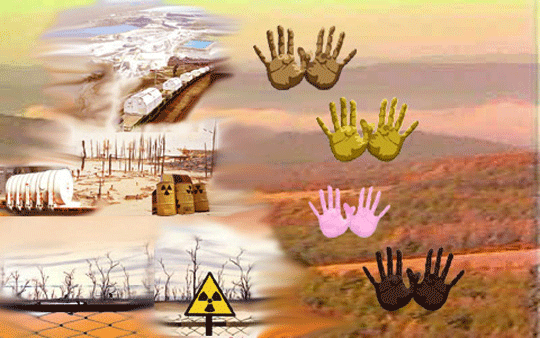
Resisting nuclear colonialism on Indigenous Peoples’ Day | NIRS The resistance of Indigenous peoples and their allies has created greater awareness about abuses and injustices that have been perpetrated against Native peoples since European empires colonized their lands. This is one of the reasons why NIRS commemorates this day as Indigenous Peoples’ Day.
As an anti-nuclear organization, we take Indigenous Peoples’ Day as an opportunity to acknowledge and denounce instances of nuclear colonialism committed against Indigenous peoples all over the world.
For over 70 years, the US nuclear power and weapons industry has consistently targeted Indigenous communities for contamination and environmental sacrifice. The radioactive scars of nuclear colonialism affect Indigenous peoples throughout the lands of Turtle Island (also called North America) and the Pacific Islands occupied by the United States of America, including:
Over 15,000 abandoned uranium mines, affecting Indigenous nations throughout the continent, including the Apache, Dine (Navajo), Lakota, Pueblo, and Sioux. Over 200 above-ground nuclear weapons explosions (and nearly 800 below-ground) affecting the Western Shoshone, Apache, Pacific Islanders (Marshall Islands, Northern Marianas, and Guam), and others. The 1979 Church Rock uranium tailings spill, the US’s worst nuclear disaster, which poisoned Dine (Navajo) communities for nearly 100 miles of the Rio Puerco and upper Rio Grande and has never been cleaned up. The West Valley Demonstration Project reprocessing plant, an immensely radioactive site on Seneca Nation land, which has contaminated Cattaraugus Creek and risks spilling into Lake Erie, the Niagara River, and Lake Ontario. Repeated attempts to site a high-level radioactive waste repository for the whole US nuclear power and weapons industries in Yucca Mountain (Nevada), sacred land of the Western Shoshone. A proposed nuclear waste burial ground in West Valley, California, on sacred homelands of the Chemehuevi, Cocopah, Fort Mojave, Quechan and Colorado River Indian Tribes A 1990s program that targeted Native tribes/nations as possible supposedly ‘interim’ storage places for nuclear power high-level radioactive waste.How can we start making things right for the Indigenous victims of nuclear colonialism? Here’s a step in the right direction: Acknowledging and compensating the victims of the first nuclear weapons test in the US, called ‘Trinity’, and workers poisoned by mining and processing uranium for nuclear weapons and power. Those communities, disproportionately Indigenous peoples, are still living with the fallout from Trinity and over 200 similar nuclear weapons tests—and decades of uranium mines, mills, and spills. Too many of them have never been recognized or compensated for their decades of pain and suffering.
In 1990, Congress passed a law meant to compensate victims of atomic bomb testing, but it doesn’t go nearly far enough and will expire in 2022. A bill in the House of Representatives—H.R.3783, the Radiation Exposure Compensation Act Amendments of 2019—would expand compensation more fully to more of those affected by the tests and uranium extraction. But Rep. Jerrold Nadler, chair of the House Judiciary Committee, hasn’t even scheduled a hearing for the bill yet.
The communities that live downwind from nuclear test sites (“Downwinders”) really need our support right now. Whether you’ve already written your member of Congress about this or not, they need to hear urgently from you now. Tell your member of Congress to ask Jerrold Nadler and Rep. Jim Jordan (the committee’s Republican ranking member) to schedule a hearing for this bill.
If our elected leaders truly care about the rights and sovereignty of our Indigenous relatives, they must take action to repair the harms of nuclear colonialism.
We grieve for the victims of the Trinity test and all other instances of nuclear colonialism. But we can do more. We can start setting things right. Compensating the Downwinders and uranium workers is an essential step in the right direction.
The post Resisting nuclear colonialism on Indigenous Peoples’ Day appeared first on NIRS.
Climate change, nuclear weapons, global health – the American election MATTERS
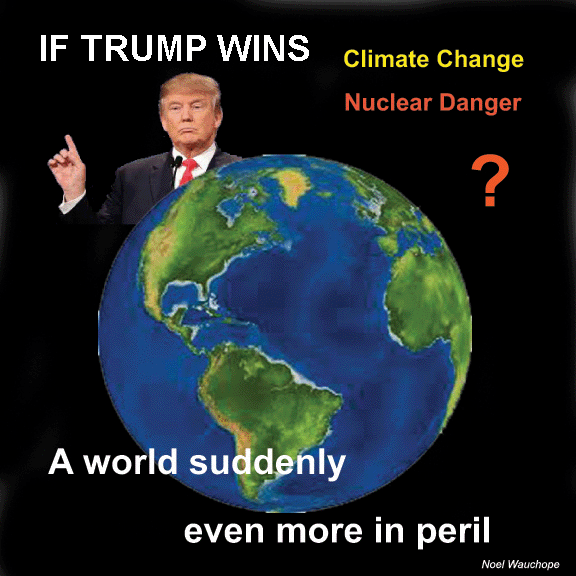 Can the world survive four more years of Donald Trump? From climate change to nuclear weapons to global health — this election isn’t just about you, America
By POLITICO 10/8/20 This article is part of a special report, The Global Election.
A second term could set Trumpism in concrete
In the middle of a devastating pandemic, recurring nationwide protests and a bitter presidential election — not to mention the president’s own COVID-19 diagnosis — Americans can be forgiven for losing track of what Donald Trump’s presidency has meant beyond their borders. But the list of changes he has wrought abroad is not short.
A world order designed to function through slow consensus and underwhelming compromise, on a good day, has had virtually no coping mechanism for the American president’s disruption. In the name of putting America first, Trump has pulled out of one global deal after another, unpredictably reversing course on some of America’s biggest global priorities and moral commitments. He has snubbed democratic leaders and longtime allies while cozying up to Vladimir Putin and other autocrats. While the most important Western institutions — NATO, the European Union, the United Nations, the World Trade Organization, the World Health Organization — are still standing, it’s an open question whether they will be able to survive another four years of pummeling and disinvestment by the world’s superpower.
So, what really happens if the world gets a second Trump term? ……….
Here’s what the world should expect if Trump remains commander in chief.
- By Ryan Heath………. Some of the outlook is unsettling: Trump is already undertaking a nuclear buildup and seems set on dismantling the one remaining treaty between the world’s two main nuclear powers. And there is a real fear that a second Trump term would embolden the authoritarians around the world who have lined up to support him. ……..
Emissions come back, and America bows out
The climate crisis is a slow-moving disaster that hinges on single pivotal moments. Right now, the global community is planning around the year 2050, when experts say humans need to all but eliminate greenhouse-gas emissions to avoid the worst effects of global warming. But the biggest dates on the immediate calendar are November 3 and 4.
Reelecting Donald Trump on November 3 would put America, and possibly other countries, on a new and hard-to-reverse course away from that emissions goal……
his abandonment of the Paris deal is still not official.
That pullout will be final on November 4, the day after the election.
A second Trump term would likely have a far bigger impact than the first, both domestically and abroad. The president would have more time to defend his deregulatory agenda in court, which could lock in rules that allow more pollution from power plants, leaking oil and gas wells, cars and refrigerants
……… If the United States pulls out entirely, the Paris deal could start to fall apart, much as the earlier Kyoto Protocol climate treaty did without U.S. involvement. Saudi Arabia, whose economy depends on petroleum, has long played a role in trying to unpick the U.N. process from within. Some diplomats worry the Saudis would see the U.S. departure as the moment to walk out entirely. What will President Jair Bolsonaro do with Brazil? An exodus of such major players would leave the deal increasingly toothless. …………
Joe Biden is largely promising a reversal of the Trump approach. His platform calls for a $2 trillion investment to clean up the power grid, electrify the transportation sector, and aid minority and low-income communities disproportionately impacted by pollution. And he has pledged to rejoin the Paris accord and put the United States on track toward net-zero emissions by 2050 — though the details of how that will work, in an American economy still reeling from the pandemic, are far from clear.
- By Catherine Boudreau and Karl Mathiesen
US becomes an ever more unreliable ally
……………The far more likely threat is that Trump would remain as NATO’s most influential leader, sowing uncertainty and chaos from within. “It is likely he would persist in disrupting, both politically and militarily,” said retired Lieutenant General Douglas Lute, who was U.S. ambassador to NATO from 2013 to 2017, and is now chief executive of Cambridge Global, a strategic consulting firm. ……
For military commanders, it’s Trump’s sheer unpredictability that is most unnerving. The worst possibility is unilateral military action, which Trump has shown a willingness to take with no warning to allies, as when he withdrew U.S. forces from northeastern Syria. …… — By David M. Herszenhorn
Nuclear weapons. A direct strike on the treaty system
On an existential global threat that often feels like a back-burner issue in U.S. politics, Donald Trump has quietly moved America into much riskier territory — and faces a decision point before February that has nuclear experts of both parties worried…….
If he stays this course in a second term, Trump will have made permanent the biggest nuclear buildup since the Cold War — while simultaneously unraveling the treaties that have steadily reduced the nuclear threat since the end of the Cold War.
A Biden presidency likely would pivot the United States back to its earlier approach, quickly. Biden and his advisers have pledged to extend New START without preconditions before it expires, and to scramble to rebuild some of the previous deals that Trump walked away from. Biden has also expressed support for declaring a “no first use” policy when it comes to nuclear weapons — replacing, for the first time, the purposely vague U.S. position on when it might actually resort to their use. Also, his advisers support proposals to pursue an agreement with Russia to take both nations’ nuclear weapons off “alert” status, a step that arms control advocates believe would do more than anything else to reduce the danger of an accidental nuclear exchange. ………… https://www.politico.eu/article/us-election-2020-implications-for-the-world-trump-biden/?fbclid=IwAR2JOtx6HJgGl8PEAVCfydecyMA4Z_oiCXXjNrl2bN5xwCJ8PkThzHR6Jg8
Ice melt projections may underestimate Antarctic contribution to sea level rise
|
Ice melt projections may underestimate Antarctic contribution to sea level rise, EurekAlert, 9 Oct 20, PENN STATE Fluctuations in the weather can have a significant impact on melting Antarctic ice, and models that do not include this factor can underestimate the global impact of sea level rise, according to Penn State scientists.“We know ice sheets are melting as global temperatures increase, but uncertainties remain about how much and how fast that will happen,” said Chris Forest, professor of climate dynamics at Penn State. “Our findings shed new light on one area of uncertainty, suggesting climate variability has a significant impact on melting ice sheets and sea level rise.” While it is understood that continued warming may cause rapid ice loss, models that predict how Antarctica will respond to climate change have not included the potential impacts of internal climate variability, like yearly and decadal fluctuations in the climate, the team of scientists said. Accounting for climate variability caused models to predict an additional 2.7 to 4.3 inches — 7 to 11 centimeters — of sea level rise by 2100, the scientists recently reported in the journal Climate Dynamics. The models projected roughly 10.6 to 14.9 inches — 27 to 38 centimeters — of sea level rise during that same period without climate variability. “That increase alone is comparable to the amount of sea level rise we have seen over the last few decades,” said Forest, who has appointments in the departments of meteorology and atmospheric science and geosciences. “Every bit adds on to the storm surge, which we expect to see during hurricanes and other severe weather events, and the results can be devastating.” The Antarctic ice sheet is a complex system, and modeling how it will evolve under future climate conditions requires thousands of simulations and large amounts of computing power. Because of this, modelers test how the ice will respond using a mean temperature found by averaging the results of climate models. However, that process smooths out peaks caused by climate variability and reduces the average number of days above temperature thresholds that can impact the ice sheet melt, creating a bias in the results, the scientists said…….. https://www.eurekalert.org/pub_releases/2020-10/ps-imp100920.php |
|
Biden’s ambitious climate policy (d’ya think Scott Morrison has noticed this?)
|
The 2020 presidential election will decide the fate of the climate As we approach planetary tipping points, it’s vital to understand the two candidates’ plans—or lack thereof (Trump doesn’t have one)—for combatting climate change. Fast Company, 9 Oct 20, BY ADELE PETERS Whether the world succeeds in avoiding the worst impacts of climate change is likely to hinge in part on the results of the upcoming U.S. election. Climate scientist Michael Mann has said that a second Trump term would be “game over” for the climate, making it virtually impossible to limit global warming to 1.5 degrees Celsius. Biden, by contrast, is proposing the most ambitious climate policy of any major party nominee in U.S. history. Here’s a closer look at the differences. TRUMP: “IT WILL START GETTING COOLER”
The first major difference: Trump doesn’t accept the science of climate change or even necessarily seem to understand what “climate change” means. On a September visit to California, where heat and drought driven by climate change have helped fuel record-breaking fires, Trump said, “It will start getting cooler.” (He has previously called climate change a “con,” “hoax,” and claimed that it was invented by China.) At the first presidential debate, when asked about climate change, Trump started talking about clean air and water, and then claimed “we have now the lowest carbon.” (In fact, carbon dioxide levels in the atmosphere are now the highest that they have been in 15 million years.)
Through his first term, Trump has actively moved the country in the wrong direction on climate. “Across the board, the Trump administration has rolled or attempted to roll back all of the significant steps that the previous administration took under the Clean Air Act and other laws to reduce the carbon pollution and the other pollutants that are driving dangerous climate change,” says David Doniger, a senior advisor to the NRDC Action Fund, a political affiliate organization of the Natural Resources Defense Council. The administration weakened fuel economy standards, eliminated the Clean Power Plan, and weakened standards for emissions from the oil and gas industry. ……..
Trump’s campaign website says nothing about a plan for climate change. The Republican platform, recycled from 2016, says that climate change is “the triumph of extremism over common sense,” even though military experts have identified climate change as a national security threat and thousands of scientists have warned that we’re facing a climate emergency. To actually tackle climate change, the federal government would need to do far more, and a second Trump term would delay that action as the window of opportunity is closing………..
BIDEN: THE MOST AMBITIOUS CLIMATE POLICY OF ANY MAJOR PARTY NOMINEE
Biden, by contrast, has proposed investing $2 trillion to set us “on an irreversible course to meet the ambitious climate progress that science demands,” with a target of net-zero emissions by 2050. By 2035, he wants to decarbonize the electric grid. “This is more ambitious than the most ambitious states in the country,” says Stokes. (California and Hawaii are aiming for 100% clean electricity by 2045; New York is aiming for 2040.) The work on the electric grid would create millions of jobs. Retrofitting buildings to improve energy efficiency would create another million jobs. Ramping up the electric vehicle industry, and infrastructure like charging stations, would create a million more jobs. The plan also calls for “high-quality, zero-emissions” public transit for every large city, “climate-smart” agriculture, cleaning up pollution from the oil and gas industry, and the construction of 1.5 million sustainable homes and housing units. All of this would be done through the lens of environmental justice, ensuring that communities that have been hardest hit by pollution in the past see the benefits.
Though Biden has said that his plan is different from the Green New Deal, a resolution sponsored by Alexandria Ocasio-Cortez, the core principle is the same—creating jobs and fostering equity while reducing emissions. …..
The scope of the plan has to be massive because the country has waited so long to act; the changes could have been much more gradual if we had started 25 years ago. “We’re in a tough spot now,” Doniger says. “If Biden is elected, there’s a need for very deep reductions very fast.” Still, the vast scope of work means creating millions of jobs at a moment when the country also needs to invest in economic recovery.
If Biden wins—and, crucially, if Democrats also control Congress—it’s possible that the world could still avoid the worst impacts of climate change while addressing the recovery. “We’re going to need a very big recovery package, probably a lot bigger than the one from 2009,” Doniger says. “There’s a huge opportunity to build into that infrastructure spending for the transition to clean energy and low emissions that we need, and to do it in a way that invests in communities that have been underserved and beset by pollution.” https://www.fastcompany.com/90560969/the-2020-presidential-election-will-decide-the-fate-of-the-climate
|
|
Climate misinformation advertisements on Facebook, seen by millions

The ads included calling climate change a hoax and were paid for by conservative US groups, Guardian, Damian Carrington 9 Oct 20, Adverts on Facebook denying the reality of the climate crisis or the need for action were viewed at least 8 million times in the US in the first half of 2020, a thinktank has found.The 51 climate disinformation ads identified included ones stating that climate change is a hoax and that fossil fuels are not an existential threat. The ads were paid for by conservative groups whose sources of funding are opaque, according to a report by InfluenceMap.
Last month Facebook said it was “committed to tackling climate misinformation” as it announced a climate science information centre. It said: “Climate change is real. The science is unambiguous and the need to act grows more urgent by the day.”Facebook uses factcheckers and bans false advertising but also says this process “is not meant to interfere with individual expression, opinions and debate”. Some of the ads were still running on 1 October. The ads cost just $42,000 to run and appear to be highly targeted, with men over the age of 55 in rural US states most likely to see them.
Warren and other senators wrote to Facebook in July calling on it to close the loopholes.
David Attenborough’s call for ending the consumerism, growth, economy
Sir David Attenborough says the excesses of western countries should “be curbed” to restore the natural world and we’ll all be happier for it.
The veteran broadcaster said that the standard of living in wealthy nations is going to have to take a pause.
Nature would flourish once again he believes when “those that have a great deal, perhaps, have a little less”.
Sir David was speaking to Liz Bonnin for BBC Radio 5 Live’s new podcast ‘What Planet Are We On?’.
Speaking personally and frankly, Sir David explained, “We are going to have to live more economically than we do. And we can do that and, I believe we will do it more happily, not less happily. And that the excesses the capitalist system has brought us, have got to be curbed somehow.”
“That doesn’t mean to say that capitalism is dead and I’m not an economist and I don’t know. But I believe the nations of the world, ordinary people worldwide, are beginning to realise that greed does not actually lead to joy.”
Sir David said when we help the natural world, it becomes a better place for everyone and in the past, when we lived closer to nature, the planet was a “working eco-system in which everybody had a share”.
The 10-part podcast is being released on the second anniversary of the publication of a key scientific report on global warming.
The Intergovernmental Panel on Climate Change study looked at how the world would cope if temperatures rose by 1.5C by the end of this century.
The IPCC special report, released in October 2018 didn’t “save the planet” but it may yet prove to be the most critical moment in the story of climate change.
The study made two things very clear. The first was that there was a massive difference in keeping the rise in global temperatures this century to 1.5C as opposed to 2C.
Politicians had for years focussed on the higher number – the special report made clear that was a risky strategy, which could see the end of coral reefs and expose millions of people to the threat of floods.
The second key message from the IPCC was that the world could stay under 1.5C if carbon emissions were essentially slashed in half by 2030.
The urgency of the challenge laid out in the report inspired millions of young people to take action. This pressure is filtering up to politicians…….. https://www.bbc.com/news/science-environment-54268038
Zero interest in the climate
Saturday Paper editorial
On climate policy, the evidence is clear: ambition isn’t dictated by size, density, population or wealth. It comes down to one factor – how willing a government is to accept that rapid action is needed to avert catastrophic climate change. For nearly a decade, Australia’s government has been allergic to this fact. … (subscribers only)
Conservative UK government is considering a carbon tax, in its commitment to reduce greenhouse gas emissions
 Times 9th Oct 2020, Rishi Sunak is examining proposals for a UK-wide carbon tax that could
raise billions of pounds while encouraging the drive towards net-zero emissions. The chancellor is seeking to replace existing EU carbon-reduction schemes with the new tax when the transition period finishes at the end of the year.
“The danger with relying solely on a carbon tax is that no one believes politicians will not scrap it when things get tough, so no one invests. A cap and trade scheme that guarantees an outcome, alongside regulation and innovation support, is much more likely to lead to cuts in emissions.”
1 This month

of the week – Australians for War Powers Reform (AWPR)
To see nuclear-related stories in greater depth and intensity
 Antinuclear