AFP to examine Iluka bribery concerns in Africa, The Age, Nick McKenzie, Richard Baker, 26 Aug 17 A federal police anti-bribery taskforce is examining if ASX-listed firm Iluka Resources has breached Australian corruption laws after acquiring a London firm accused of bribing high-ranking Sierra Leone officials to win mining licences.
The AFP’s involvement in the case – which Iluka has not disclosed to the share market – comes after Fairfax Media revealed earlier this month that a secret internal inquiry by the Australian miner had embroiled a leading Sierra Leone presidential candidate, a cabinet minister and high-ranking officials in a bribery scandal.
Why is climate change’s 2 degrees Celsius of warming limit so important? The Conversation, David Titley, Professor of Practice in Meteorology, Professor of International Affairs & Director Center for Solutions to Weather and Climate Risk, Pennsylvania State University, August 23, 2017
If you read or listen to almost any article about climate change, it’s likely the story refers in some way to the “2 degrees Celsius limit.” The story often mentions greatly increased risks if the climate exceeds 2°C and even “catastrophic” impacts to our world if we warm more than the target.
This short history makes it clear that the goal evolved from the qualitative but reasonable desire to keep changes to the climate within certain bounds: namely, within what the world had experienced in the relatively recent geological past to avoid catastrophically disrupting both human civilization and natural ecosystems.
Climate scientists subsequently began supporting the idea of a limit of 1°C or 2°C starting over three decades ago. They showed the likely risks increase with temperatures over 1°C, and those risks grow substantially with additional warming.
And if we miss the target?
Perhaps the most powerful aspect about the 2°C threshold is not its scientific veracity, but its simplicity as an organizing principle.
The climate system is vast and has more dynamics, parameters and variations in space and time than is possible to quickly and simply convey. What the 2°C threshold lacks in nuance and depth, it more than makes up as a goal that is understandable, measurable and may still be achievable, although our actions will need to change quickly. Goals and goal-setting are very powerful instruments in effecting change.
Ultimately, what should we do if we cannot make the 1.5°C or 2°C limit? The most current IPCC report shows the risks, parsed by continent, of a 2°C world, and how they are part of a continuum of risk extending from today’s climate to a 4°C.
Most of these risks are assessed by the IPCC to increase in steady fashion. That is, for most aspects of climate impacts we do not “fall off a cliff” at 2°C, although considerable damage to coral reefs and even agriculture may increase significantly around this threshold.
Like any goal, the 2°C limit should be ambitious but achievable. However, if it is not met, we should do everything we can to meet a 2¼°C or 2.5°C goal.
These goals can be compared to the speed limits for trucks we see on a mountain descent. The speed limit (say 30 mph) will allow trucks of any type to descend with a safety margin to spare. We know that coming down the hill at 70 mph likely results in a crash at the bottom.
The pathogen with the highest sensitivity to climate factors was Vibrio cholera, the microbe that causes the serious, and often deadly, diarrheal disease, cholera. Cholera had nine climate drivers, indicating high volatility in the face of climate change.
These Infections Are Likely to Get Worse as the Climate Changes, Invisiverse, BY CYNTHIA WALLENTINE, 08/23/2017
When the climate changes, so do all the things that rely on the climate, including people, plants, and pathogens. A European study recently took a broad look at what kind of microorganisms are most likely to be affected as climate change heats, cools, dries, and wets the world around us.
In a study published in the journal Scientific Reports, a research team from the University of Liverpool performed a broad assessment of how factors of climate change impact pathogens that make humans and animals sick. By understanding which microorganisms are more sensitive to environmental change, we have a better idea of how infection rates might change as the environment grows progressively less stable.
Climate change is real. Maybe once it comes for our vino, more people will get on board with trying to slow it.
Climate change is about to mess with your wine supply, so yes, things are very serious http://hellogiggles.com/climate-change-is-about-to-mess-with-your-wine-supply/Karen Fratti August 24, 2017 Most of us know that climate change is an ongoing problem, but it can be hard to see the direct effects of it in our daily lives. Unless you study the populations of animals that are suffering due to it or are a farmer, the change is definitely incremental enough to ignore. But climate change is already affecting wine production, so maybe more people will notice what is going on a little sooner than expected. Because whether you can experience the effects of climate change or not, it’s happening.
European wine crops are suffering under climate change. Continue reading →
North Korea also has the collective memory of the horror wrought by the US in the three year conflict on a country then with a population of just 9.6 million souls. US General Curtis Lemay in the aftermath stated: “After destroying North Korea’s seventy eight cities and thousands of her villages, and killing countless numbers of her civilians … Over a period of three years or so we killed off – what – twenty percent of the population.”
“ … war in our time is always indiscriminate, a war against innocents, a war against children.”(Howard Zinn, 1922-2010.)
“All war represents a failure of diplomacy.” (Tony Benn, MP. 1925-2014.)
“No country too poor, too small, too far away, not to be threat, a threat to the American way of life.” (William Blum, “Rogue State.”)
The mention of one tiny country appears to strike at the rationality and sanity of those who should know far better. On Sunday, 6th August, for example, The Guardian headed an editorial: “The Guardian view on sanctions: an essential tool.” Clearly the average of five thousands souls a month, the majority children, dying of “embargo related causes” in Iraq, year after grinding year – genocide in the name of the UN – for over a decade has long been forgotten by the broadsheet of the left.
This time of course, the target is North Korea upon whom the United Nations Security Council has voted unanimously to freeze, strangulate and deny essentials, normality, humanity. Diplomacy as ever, not even a consideration. The Guardian, however, incredibly, declared the decimating sanctions: “A rare triumph of diplomacy …” (Guardian 6th August 2017.)
As US Secretary of State, Rex Tillerson, the US’ top “diplomat” and his North Korean counterpart Ri Yong-ho headed for the annual Ministerial meeting of the Association of Southeast Asian Nations (ASEAN) in Manila on 5th August, a State Department spokesperson said of Tillerson:
“The Secretary has no plans to meet the North Korean Foreign Minister in Manila, and I don’t expect to see that happen”
Pathetic. In April, approaching his hundredth day in office, Trump said of North Korea:
“We’d love to solve things diplomatically but it’s very difficult.”
No it is not. Talk, walk in the other’s psychological shoes. Then, there they were at the same venue but the Trump Administration clearly does not alone live in a land of missed opportunities, but of opportunities deliberately buried in landfill miles deep. This in spite of his having said in the same statement:
“There is a chance that we could end up having a major, major conflict with North Korea. Absolutely.”
A bit of perspective: 27th July 2017 marked sixty four years since the armistice agreement that ended the devastating three year Korean war, however there has never been a peace treaty, thus technically the Korean war has never ended. Given that and American’s penchant for wiping out countries with small populations which pose them no threat (think most recently, Afghanistan, Iraq, Libya) no wonder North Korea wishes to look as if it has some heavy protective gear behind the front door, so to speak. Continue reading →
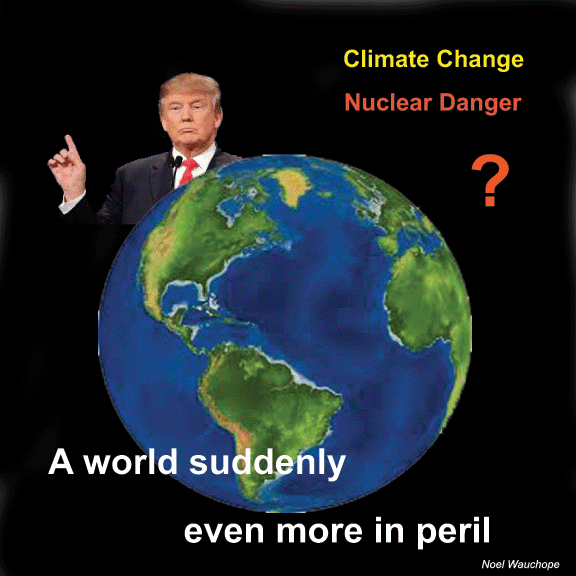
What hope is there for humanity? The answer must be: none, Canberra Times, Julian Cribb, 25 Aug 17, The day foreseen by US journalist HL Mencken when the White House is ‘adorned by a downright moron’ seems, on the face of the accumulating evidence, to have dawned. Regrettably this person has his finger on a certain button.
Why Americans are not more alarmed about this can only be attributed to the very poor level of scientific literacy in what is, to all intents and purposes, the world’s foremost scientific society. How Americans can be so great at science yet, in aggregate, understand so little about it, is a question for the Ages. Unfortunately, the Ages will probably not have the leisure to debate it.
The missing bit of information is that a nuclear war, even a small one, could eliminate most of civilisation, Americans (even those with well-stocked fallout shelters) included.
It is still an obscure historical detail that all-out nuclear Armageddon between the USSR and USA was avoided, in the 1980s, by some rather brave scientists sticking out their necks to warn Reagan and Gorbachev that their calculations had revealed that “a nuclear war cannot be won and should never be fought”, as Reagan summarised it in his Address to the Nation (1984).
These scientists had worked out that – regardless of fireball, blast and radiation – the amount of dust and smoke thrown into the atmosphere by the unleashing of multiple nuclear warheads would chill the planet by several degrees for several years, causing massive crop-killing frosts which would destroy the food supply for just about everyone worldwide.
Fast forward a few decades and climate modelling has become immensely more precise and sophisticated. In more recent times Alan Robock and Brian Toon used it to calculate that the amount of dust and ash from even a ‘limited nuclear war’ would wreck food supplies globally for years. Fifty to 100 small (Hiroshima-sized) nukes would cause 1-2 billion people to starve and possibly end civilization, they calculated. Eight countries presently have this power in their nuclear arsenals.
But, to be brutally frank, how many of the countries are run by someone who is completely sane, and doesn’t suffer from some wild, obsessional hatred for some other branch of humanity?
Thus, the real problem emerges. There are, and will be, innumerable idiots with their finger on a button potent enough to destroy all or most of the 7.5 billion human inhabitants of Earth. The conjunction between nuclear firepower and mental incapacity is unavoidable.
Trump alone, we are told, commands the potential first-strike launch of 900 nuclear weapons – 9-18 times enough to eliminate civilisation. Then he has another 6000 nukes in varying states of readiness to support his initial misjudgement. So the Donald, if he has a bad night’s viewing, can – in theory at least – take out human civilisation 50 times over…
The New York Times recently published a mocking article contrasting Trump with the mad Roman Emperor Caligula, unfavourably to Trump. But Caligula, whatever his bloodlust, never wielded the power to eliminate civilisation, not even his own. Americans, in their naivety, have awarded that power to their present chief…..
like Americans, a third of the world’s countries simply do not grasp the remorseless scientific logic of human extinction. Their education, imagination or simple common sense, does not encompass it. They have no intuition of what global famine, societal disintegration, mass cannibalism and infanticide might look like. So, they block out the issue.
This, alack, does not abolish it.
Only wisdom can do that.
Ban all nukes, their materials and technology. Ban them now. Ban them everywhere. Ban them forever.
Worldwide, the small-scale solar photovoltaic capacity operated by homes and businesses is predicted to grow consistently as depicted by Bloomberg New Energy Finance in the New Energy Outlook 2017.
In countries like the U.S. which face stagnant electricity demand growth, the growth in distributed electricity production will take sales from generators in the wholesale markets and regulated power regions.
Australia leads the way in distributed energy, with around 45 per cent of total demand to be delivered by locally sourced distributed power solar, wind and storage, by 2040.
Climate Migrants Might Reach One Billion by 2050 http://www.ipsnews.net/2017/08/climate-migrants-might-reach-one-billion-by-2050/, By Baher Kamal, ROME, Aug 21 2017 (IPS) – Imagine a world with as many as one billion people facing harsh climate change impacts resulting in devastating droughts and/or floods, extreme weather, destruction of natural resources, in particular lands, soils and water, and the consequence of severe livelihoods conditions, famine and starvation.
Although not yet based on definite scientific projections, the proven speed with which the process of climate change has been taking place, might lead to such a scenario by 2050. If so, 1 in 9 human beings would be on the move by then.
Other specialised sources estimate that “every second, one person is displaced by disaster.” On this, the Oslo-based Norwegian Refugee Council (NRC) reports that in 2015 only, more than 19.2 million people fled disasters in 113 countries. “Disasters displace three to ten times more people than conflict and war worldwide
One Person Displaced Every Second
As climate change continues, adds NRC, it will likely lead to more frequent and severe natural hazards; the impact will be heavy, warns this independent humanitarian organisation providing aid and assistance to people forced to flee.
For its part, the UN International Organization for Migration (IOM) also forecasts 200 million environmental migrants by 2050, moving either within their countries or across borders, on a permanent or temporary basis. Many of them would be coastal population.
In an interview to IPS, the IOM Director General William Lacy Swing explained that political crises and natural disasters are the other major drivers of migration today.
“We have never had so many complex and protracted humanitarian emergencies now happening simultaneously from West Africa all the way to Asia, with very few spots in between which do not have some issue.”
The UN specialised body’s chief added “We have today 40 million forcibly displaced people and 20 million refugees, the greatest number of uprooted people since the Second World War.” See: Q&A: Crisis and Climate Change Driving Unprecedented Migration
Up to 12 million hectares of productive land become barren every year due to desertification and drought alone, which is a lost opportunity to produce 20 million tons of grain, adds the Bonn-based Convention secretariat.
Meantime, the increase in droughts and flash floods that are stronger, more frequent and widespread is destroying the land – the Earth’s main fresh water store, according to UNCCD.
“Droughts kill more people than any other single weather-related catastrophe and conflicts among communities over water scarcity are gathering pace. Over 1 billion people today have no access to water, and demand will increase by 30 per cent by 2030.”
On the other hand, getting sustainable energy to all represents one of the biggest development challenges of the 21st century, it continues.
“Research suggests that 1.4 billion people — over 20 per cent of the global population — lack access to electricity, and that at least 2.7 billion people — some 40 cent of the global population — rely on the traditional use of biomass for cooking.”
In short, land, water and energy as resources are all pillars of our survival and of sustainable development.
“They stand or fall together. To be sustainable and in particular to reach poor rural populations, we need to enhance supply, access and security across all three pillars, at the same time, while supporting global climate ambitions.”
National Security, Migration
On this, based on the UN Environment Programme’s 2009 study “From Conflict to Peace-building. The Role of Natural Resources and the Environment,” UNCCD reminds that 40 per cent of all intrastate conflicts in the past 60 years are linked to the control and allocation of natural resources.
“The exposure of more and more poor people to water scarcity and hunger opens the door to the failure of fragile states and regional conflicts. Non-state actor groups are increasingly taking advantage of large cross-border migration flows and abandoned lands.”
Where natural assets including land are poorly managed, warns the Convention, violence might become the dominant means of resource control, forcing natural resource assets out of the hands of legitimate government.
Meanwhile, the number of international migrants worldwide has been on the rise. According to the International migration report (2015), their number has continued to grow rapidly over the past fifteen years reaching 244 million in 2015, up from 222 million in 2010 and 173 million in 2000.
Losing productive land is driving people to make risky life choices, says UNCCD, adding that in rural areas where people depend on scarce productive land resources, land degradation is a driver of forced migration.
Africa is particularly susceptible since more than 90 per cent of economy depends on a climate-sensitive natural resource base like rain-fed, subsistence agriculture.
“Unless we change the way we manage our land, in the next 30 years we may leave a billion or more vulnerable poor people with little choice but to fight or flee.”
Courthouse News, BIANCA BRUNO August 22, 2017SAN DIEGO (CN)— Families of five Navy service members who died after responding to the Fukushima nuclear meltdown have sued Tokyo Electric Power Co., blaming the deaths on radiation illnesses contracted from the March 2011 disaster.
The families wish to join a lawsuit from 152 other members or survivors of members of the 7th Fleet who performed humanitarian response from March 11, 2011 until March 14, when the USS Ronald Reagan aircraft carrier was moved away from Fukushima due to detection of nuclear radiation in the air and on helicopters returning to the ship.
The new plaintiffs want to join in the third amended complaint Cooper, et al. v. TEPCO, et al., originally filed in the same court in 2012. They say it is only recently that they discovered the extent of the injuries, real and/or expected, due to exposure to radiation from the Fukushima Nuclear Power Plant.
The federal lawsuit was filed Friday and made available Monday in U.S. District Court in the Southern District of California. They sued General Electric in addition to Tokyo Electric Power Co., or TEPCO.
SAN DIEGO (CN) — Families of five Navy service members who died after responding to the Fukushima nuclear meltdown have sued Tokyo Electric Power Co., blaming the deaths on radiation illnesses contracted from the March 2011 disaster.
The families wish to join a lawsuit from 152 other members or survivors of members of the 7th Fleet who performed humanitarian response from March 11, 2011 until March 14, when the USS Ronald Reagan aircraft carrier was moved away from Fukushima due to detection of nuclear radiation in the air and on helicopters returning to the ship.
The new plaintiffs want to join in the third amended complaint Cooper, et al. v. TEPCO, et al., originally filed in the same court in 2012. They say it is only recently that they discovered the extent of the injuries, real and/or expected, due to exposure to radiation from the Fukushima Nuclear Power Plant.
The federal lawsuit was filed Friday and made available Monday in U.S. District Court in the Southern District of California. They sued General Electric in addition to Tokyo Electric Power Co., or TEPCO.
The Navy servicemen and -women want a $5 billion survivor fund for medical expenses.
They say General Electric designed defective the GE Boiling Water Reactors at Fukushima, which was run by TEPCO, Japan’s largest electric utility. The 7th Fleet’s Operation Tomodachi provided humanitarian relief after the tsunami and ensuing nuclear disaster. The sailors say they will need medical monitoring for life, payment of medical bills, and health monitoring for their children, including for possible radiation-induced birth defects.
“These harms include, but are not limited to, the following: illnesses such as leukemia, ulcers, gall bladder removals, brain cancer, brain tumors, testicular cancer, dysfunctional uterine bleeding, thyroid illnesses, stomach ailments, birth defects, death, and a host of other complaints unusual in such young adults and victims,” the complaint states…….
The families say the prime minister of Japan has effectively admitted the negligence of TEPCO. “This negligence was underscored on December 12, 2013, by admission of the former Prime Minister of Japan, Naoto Kan, who was in office when the Fukushima disaster took place. It was at that time that he admitted, for the first time: ‘People think it was March 12th (2011) but the first meltdown occurred 5 hours after the earthquake.’
“Unaware of either the meltdown or any potentially harmful radioactive release, the U.S. Sailor First Responders arrived off the coast of Fukushima during the afternoon of March 12, 2011 in order to carry out their mission of providing humanitarian aid to the victims of the earthquake and tsunami disaster. At no time did this mission include, nor expand into a response to a meltdown or a nuclear emergency at the FNPP. Rather, plaintiffs were carrying out their mission to provide humanitarian aid to the people of Japan by coming to their aid by delivering clean water, blankets, food, and other aspects of providing other humanitarian relief to the inhabitants of Fukushima Prefecture.”
The plaintiffs claim that though the nuclear meltdown was induced by a natural disaster, the Fukushima Nuclear Accident Independent Investigation Commission found in July 2012 that the meltdown was manmade because GE and TEPCO did not take adequate precautions for earthquakes and tsunamis.
The damage for such a poor country sitting at the forefront of a growing climate-change-based destruction from the recent extreme rain event has been tremendous. At least 115 people have died. Nearly six million have been impacted. The government has run out of medicine, water purification tablets, and temporary shelters for the hundreds of thousands of people displaced. More than 400,000 hectares of crops have been destroyed. Fully half a million homes have been damaged or lost. And there is not enough food or water to go around.
Fears of water-borne illness such as cholera are running high and calls for international aid in the flood-stricken state have grown more and more urgent. But the worst is not yet over as floodwaters from Nepal and India continue to swell Bangladesh’s multiple waterways over banks and into communities through central and southern parts of the country. And more rain may be on the way as another powerful storm system gathers.
(This is what happens if you keep burning fossil fuels. According to recent scientific reports, the global number of record-breaking rainfall events has increased dramatically during recent years. This increase has coincided with global temperatures exceeding the 1 C warmer than 1880s temperature threshold. Higher global temperatures amp up the hydrological cycle by squeezing more moisture out of land and ocean surfaces. A warmer atmosphere that’s more heavily loaded with moisture adds move convective energy to thunderstorms which tends to spike rainfall potentials for the strongest storms to higher levels. Image source: Increased Record-Breaking Precipitation Events Under Global Warming.)
In the Indian States of Bahir and Assam more than 430 people have lost their lives as schools have been buried under 8 feet of water, crops have been destroyed, roads have been washed out and power has been disrupted. As with Bangladesh, concern over contaminated water supplies has brought with it fears of water-borne illness as a gargantuan disaster relief effort gets underway.
Nepal has likewise seen its share of the pain and heartbreak. There, more than 140 people have perished in the floods as 40,000 families have been severely impacted.
(This is what happens if you keep burning fossil fuels. According to recent scientific reports, the global number of record-breaking rainfall events has increased dramatically during recent years. This increase has coincided with global temperatures exceeding the 1 C warmer than 1880s temperature threshold. Higher global temperatures amp up the hydrological cycle by squeezing more moisture out of land and ocean surfaces. A warmer atmosphere that’s more heavily loaded with moisture adds move convective energy to thunderstorms which tends to spike rainfall potentials for the strongest storms to higher levels. Image source: Increased Record-Breaking Precipitation Events Under Global Warming.)
In the Indian States of Bahir and Assam more than 430 people have lost their lives as schools have been buried under 8 feet of water, crops have been destroyed, roads have been washed out and power has been disrupted. As with Bangladesh, concern over contaminated water supplies has brought with it fears of water-borne illness as a gargantuan disaster relief effort gets underway.
Nepal has likewise seen its share of the pain and heartbreak. There, more than 140 people have perished in the floods as 40,000 families have been severely impacted.
turning the agency into a hollow shell by whacking its budget, overturning rules based on bogus reports and keeping employees in the dark allows Pruitt and his allies to claim publicly that all they are doing is restricting the EPA to its original purpose, not demolishing it.
In fact, the damage that Pruitt is inflicting will take years to repair.
Scott Pruitt’s EPA Is Crazyland, Clean Technica , August 22nd, 2017 “…..By Meteor BladesCoral Davenport and Eric Lipton at The New York Times report that Pruitt has injected a sense of paranoia at the agency, making career employees feel as if they are the enemy. Those staffers say floors at EPA HQ are frequently locked, and if they wish to see Pruitt, they must have an escort. They are often told to leave their cellphones behind and not to take notes in meetings with him:
“Mr. Pruitt, according to the employees, who requested anonymity out of fear of losing their jobs, often makes important phone calls from other offices rather than use the phone in his office, and he is accompanied, even at E.P.A. headquarters, by armed guards, the first head of the agency to ever request round-the-clock security.
“A former Oklahoma attorney general who built his career suing the E.P.A., and whose LinkedIn profile still describes him as ‘a leading advocate against the EPA’s activist agenda,’ Mr. Pruitt has made it clear that he sees his mission to be dismantling the agency’s policies — and even portions of the institution itself.
“But as he works to roll back regulations, close offices and eliminate staff at the agency charged with protecting the nation’s environment and public health, Mr. Pruitt is taking extraordinary measures to conceal his actions, according to interviews with more than 20 current and former agency employees.”…….
Among the examples of Pruitt’s moves to undermine the agency’s mission is what was done to the analysis of the Waters of the United States rule put in place during the Obama administration to expand EPA’s oversight of large bodies of water to the streams and rivers that feed them. This attempt to preserve wetlands and clean up polluted tributaries was widely attacked by farmers, real estate developers, and rightist ideologues.
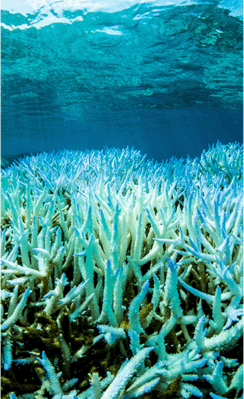
Coral bleaching: Researchers struggle to find anywhere in Pacific Ocean untouched, ABC News, By Nadia Daly, 20 Aug 17 Scientists aboard a French research ship say they have been shocked to see the extent of coral bleaching across the Pacific Ocean, just halfway through their two-year voyage around the world.
The vessel Tara has been sailing around the globe for more than a decade to study the effects of climate change on the ocean.
Its current expedition will cross 11 time zones and span 100,000 kilometres from Europe to Asia and back again, and the group claims it is the biggest study of this scale across coral reefs.
The focus is how coral reefs in the Pacific are adapting to climate change, and on a stopover in Sydney, captain Nicolas De La Brosse said the extent of damage is already deeply troubling.
“What we’ve seen in really isolated spots like Samoa for example, even though it’s very far away from [developed] countries with pollution, we struggled to find any coral life,” he said.
Mr De La Brosse said nowhere was immune to the effects of global warming.
“It doesn’t matter where you are in the Pacific, coral is starting to bleach.”
Iran’s top priority to protect nuclear deal from US http://www.sbs.com.au/news/article/2017/08/20/irans-top-priority-protect-nuclear-deal-us-rouhani Rouhani, Iran’s President Hassan Rouhani said Sunday the top foreign policy priority for his new government was to protect the nuclear deal from being torn up by the United States. “The most important job of our foreign minister is first to stand behind the JCPOA, and not to allow the US and other enemies to succeed,” Rouhani told parliament, using the technical name for the 2015 deal that eased sanctions in exchange for curbs to Iran’s nuclear programme.
“Standing up for the JCPOA means standing up to Iran’s enemies,” he said on the last day of debates over his cabinet selections. Rouhani indicated a week ago that Iran was ready to walk out on the nuclear deal if the United States continued to apply fresh sanctions.
US President Donald Trump repeatedly threatened to tear up the deal during his campaign, and it has come under mounting pressure after Tehran carried out missile tests and Washington imposed new sanctions — with each accusing the other of violating the spirit of the agreement.
But Rouhani has insisted it remains Iran’s preferred way forward, not least to help rebuild the struggling economy and create jobs.
“The second responsibility of the foreign ministry… is to get involved in economic activities. It should help attract foreign investment and technology,” Rouhani said, adding that Iran needed $200 billion in investments for the oil and gas sector alone.
Parliament approved 16 of his 17 cabinet picks, rejecting his suggested minister of energy, a reformist named Habibollah Bitaraf. Foreign Minister Mohammad Javad Zarif, who was the charismatic face of Iran’s nuclear negotiations, retained his position.
So did Oil Minister Bijan Namdar Zanganeh, who recently struck a billion-dollar deal with French giant Total.
Rouhani, a political moderate, worked hard behind the scenes to secure support for his choices, including from the supreme leader and the military. He began his second term earlier this month after winning a resounding victory over a hardline challenger in May, vowing to continue his outreach to the world and improve civil liberties at home.
But he has angered reformists by again failing to appoint a single woman minister, and looks no closer to securing the release of jailed opposition leaders — one of whom, Mehdi Karroubi, briefly went on hunger strike this week to demand a trial after six years under house arrest.
Rouhani has yet to appoint a minister of science, research and technology, which conservatives consider to be a sensitive post.
Minister’s decisions not up for legal challenge, as citizenship toll mounts
Executive decisions, including a possible loan to the Adani coal project, made by ministers now subject to the High Court citizenship challenge, would not be at legal risk if the Court finds the ministers ineligible to be elected, according to the federal government…. (subscribers only) http://www.afr.com/news/ministers-decisions-not-up-for-legal-challenge-as-citizenship-toll-mounts-20170820-gy0a8k