Nuclear promotes what it is, and that is “DEATH”. Look at Japan a country that lived by nuclear and now dying by nuclear, with a population that is reducing every year. The year that followed the triple meltdown at Daiichi Fukushima 20,000 people worked at the plant with many leaving after 3 months with high exposure levels of radiation reaching their safety limits. 3,000 people worked at the plant everyday with a unrealistic program to cleanup in a 40 year time frame.
It’s common for young people to refuse to work there, workers receiving 10x more radiation than other plants, many quit because of pay and perks being cut, contracts reduced by 30%. TEPCO and contractors finding it hard to source skilled workers with the expertise to mitigate the contamination, and the stigma of radiation dividing communities.
So if you are looking for a job at $125 a day for a 20 day month taking home $2500, where you are shunned and treated like a leper with a stigma of radiation, you DON”T need to promote nuclear waste abandonment for the unwilling communities of Hawker or Kimba, just pack your bags and move to Japan.
https://www.facebook.com/groups/344452605899556/
August 28, 2017
Posted by Christina Macpherson |
General News |
Leave a comment
According to a report by the UNEP, the World Food Programme and the National Environmental Protection Agency (NEPA), the biggest climate hazards to Afghan livelihoods are drought and floods, caused by irregular snowmelt or rainfall.
global warming should be taken as seriously as fighting insurgents. “Terrorism is not going to be lingering here for ever,” he says. “But climate change is an ongoing death sentence.”
 How climate change is a ‘death sentence’ in Afghanistan’s highlands,
  Global warming should be taken as seriously as fighting insurgents, say those witnessing the savage impact first-hand, Guardian, Sune Engel Rasmussen , 28 Aug 17 ,
The central highlands of Afghanistan are a world away from the congested chaos of the country’s cities. Hills roll across colossal, uninhabited spaces fringed by snow-flecked mountains, set against blistering blue skies.
In this spectacular, harsh landscape, one can pinpoint more or less where human settlement becomes impossible: at an altitude of 3,000 metres (9,840ft).
This is where Aziza’s family lives, in the village of Borghason. In a good year, they just about survive by cultivating wheat and potatoes for food and a small income. However, when the rains fail, as they increasingly do, the family is plunged into debt, unable to reimburse merchants for that year’s seeds. “Last year, we had to borrow money from the bazaar,” Aziza says.
Things are about to get tougher. The precariousness of life in Bamiyan, one of Afghanistan’s poorest provinces, leaves villages like Borghason at the mercy of climate change.
Continue reading →
August 28, 2017
Posted by Christina Macpherson |
General News |
1 Comment
 What’s the plan for nuclear survivors? No, really, Gympie Times, Julia Lawrence OAM, 27th Aug 2017 I FIND it hard to believe we are not up-to-date with nuclear disaster preparedness in this country.
If there is a plan I cannot locate it. A plan is put together in case we need it. It is for survival and not a declaration of war. It should not involve whether it affects our tourism industry or commerce and if it does, our physical survival is more important than any money can be.
I was in primary school in Brisbane when the Japanese and Germans were going to eat us up. The government and various facilities started to train us up very quickly on what we could do if we were caught in the middle of it, whether outside or inside.
We kids and our parents dug trenches and carried pegs to put between our teeth to save our ears from the bomb blast. We all had an air-raid shelter in the backyard we ran to during the mock raids.
Probably ineffective in the real sense, but it gave us a feeling of safety. And that is important for the community to feel a plan is there to help them….
I feel an urgency now, simply that a nuclear missile will be a quick push of a button in another country. Even so, we will have a little time to do something.
I have spent today trying to find out just who is in charge of this and I haven’t been successful yet. I have emailed our federal member and the council (hopefully it reaches the Mayor) and my only aim is to make sure we have a plan as we have for fire and flood. I am sure these gentlemen will take the situation seriously and we will all know quickly.
On the internet I find some countries are planning to begin school evacuation drills, education campaigns to prepare people with “what to do”.
Public service announcements will no doubt tell people they will need to get inside and stay inside. Not everyone will die so we need a plan to help the survivors too.
There is a lot to do and I am certain our leaders will do the right thing by us. I look forward to hearing about their contributions. https://www.gympietimes.com.au/news/whats-the-plan-for-nuclear-survivors-no-really/3216135/
August 28, 2017
Posted by Christina Macpherson |
General News |
Leave a comment
James Hansen’s Generation IV nuclear fallacies and fantasies, Jim Green, REneweconomy, 28 Aug 2017,
“…….Hansen claims that “modern nuclear technology can … solve the waste disposal problem by burning current waste and using fuel more efficiently” and he states that nuclear waste “is not waste, it is fuel for 4th generation reactors!”
But even if IFRs ‒ Hansen’s favoured Generation IV concept ‒ worked as hoped, they would still leave residual actinides, and long-lived fission products, and long-lived intermediate-level waste in the form of reactor and reprocessing components … all of it requiring deep geological disposal. UC Berkeley nuclear engineer Prof. Per Peterson states: “Even integral fast reactors (IFRs), which recycle most of their waste, leave behind materials that have been contaminated by transuranic elements and so cannot avoid the need to develop deep geologic disposal.”
So if IFRs don’t obviate the need for deep geological repositories, what problem do they solve? They don’t solve the WMD proliferation problem associated with nuclear power. They would make more efficient use of uranium … but uranium is plentiful.
In theory, IFRs would gobble up nuclear waste and convert it into low-carbon electricity. In practice, the EBR-II reactor in Idaho ‒ an IFR prototype, shut down in 1994 ‒ has left a legacy of troublesome waste.
This saga is detailed in a recent article and a longer report by the Union of Concerned Scientists’ senior scientist Dr Ed Lyman. Lyman statesthat attempts to treat IFR spent fuel with pyroprocessing have not made management and disposal of the spent fuel simpler and safer, they have “created an even bigger mess”.
 Lyman concludes:
“Everyone with an interest in pyroprocessing should reassess their views given the real-world problems experienced in implementing the technology over the last 20 years at [Idaho National Laboratory]. They should also note that the variant of the process being used to treat the EBR-II spent fuel is less complex than the process that would be needed to extract plutonium and other actinides to produce fresh fuel for fast reactors. In other words, the technology is a long way from being demonstrated as a practical approach for electricity production.”
Japan is about to get first-hand experience of the waste legacy associated with Generation IV reactors in light of the decision to decommission the Monju fast neutron reactor. Decommissioning Monju has a hefty price-tag ‒ far more than for conventional light-water reactors. According to a 2012 estimate by the Japan Atomic Energy Agency, decommissioning Monju will cost an estimated ¥300 billion (A$3.5bn). That estimate includes ¥20 billion to remove spent fuel from the reactor ‒ but no allowance is made for the cost of disposing of the spent fuel, and in any case Japan has no deep geological repository to dispose of the waste…. http://reneweconomy.com.au/james-hansens-generation-iv-nuclear-fallacies-fantasies-70309/
August 28, 2017
Posted by Christina Macpherson |
General News |
Leave a comment
Cyclones and climate change: connecting the dots,https://au.news.yahoo.com/a/36857982/cyclones-and-climate-change-connecting-the-dots/, by Marlowe HOOD, 27 Aug 17, Paris (AFP) – Scientists freely acknowledge they don’t know everything about how global warming affects hurricanes like the one pummelling southeast Texas.
But what they do know is enough to keep them up at night. The amplifying impact of sea level rise, warming oceans, and hotter air — all incontrovertible consequences of climate change — is basic physics, they say. Likewise accelerated shifts in intensity, such as the sudden strengthening that turned Harvey from a Category 2 to a Category 4 hurricane — on a scale of 5 — just as it made landfall Friday.
What’s missing is a detailed track record of hurricanes past, the kind of decades-long log of measurements that climate scientists need to discern the fingerprint of human influence. Starting in the 1970s, satellite data allowed for a better tally, but even that wasn’t enough.
“It is awfully difficult to see climate change in historical data so far because hurricanes are fairly rare,” Kerry Emmanuel, a professor of atmospheric science at MIT in Boston, told AFP. Experts, in other words, do not disagree on the potential of manmade global warming to magnify the destructive power of the tropical storms known variously around the world as cyclones, hurricanes and typhoons. Rather, they are confounded — for now — by a lack of information.
“Just because the data don’t allow for unambiguous detection yet, doesn’t mean that the changes haven’t been occurring,” noted James Kossin, a scientist at the US National Oceanic and Atmospheric Administration’s Center for Weather and Climate in Madison, Wisconsin.
Kossin figured out that cyclones have drifted poleward in their respective hemispheres over the last three decades, a finding hailed by other hurricane gurus as the most unambiguous evidence so far that global warming has already had a direct impact. Continue reading →
August 28, 2017
Posted by Christina Macpherson |
General News |
Leave a comment
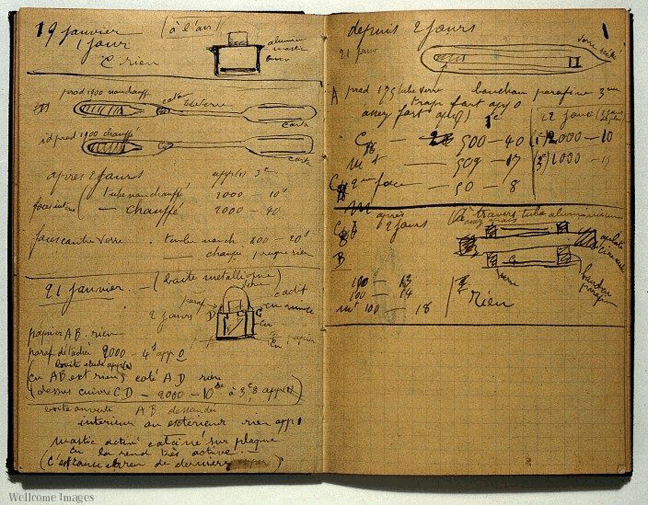
Marie Curie’s Research Papers Are Still Radioactive 100+ Years Later http://webcache.googleusercontent.com/search?q=cache:http://www.openculture.com/2015/07/marie-curies-research-papers-are-still-radioactive-100-years-later.html&gws_rd=cr&ei=nKajWfaeAcGi8QW3wJr4Dw by Ted Mills
When researching a famous historical figure, access to their work and materials usually proves to be one of the biggest obstacles. But things are much more difficult for those writing about the life of Marie Curie, the scientist who, along her with husband Pierre, discovered polonium and radium and birthed the idea of particle physics. Her notebooks, her clothing, her furniture, pretty much everything surviving from her Parisian suburban house, is radioactive, and will be for 1,500 years or more.
If you want to look at her manuscripts, you have to sign a liability waiver at
France’s Bibliotheque Nationale, and then you can access the notes that are sealed in a lead-lined box. The Curies didn’t know about the dangers of radioactive materials, though they did know about radioactivity. Their research attempted to find out which substances were radioactive and why, and so many dangerous elements–thorium, uranium, plutonium–were just sitting there in their home laboratory, glowing at night, which Curie thought beautiful, “like faint, fairy lights,” she wrote in her autobiography. Marie Curie carried these glowing objects around in her pockets. She and her husband wore standard lab clothing, nothing more.
Marie Curie died at age 66 in 1934, from aplastic anemia, attributed to her radioactive research.
Continue reading →
August 28, 2017
Posted by Christina Macpherson |
General News |
Leave a comment
ADANI will chase activists and environmental groups for an estimated $1 million in court damages after receiving a slap on the wrist for coal dust spill…. (subscribers only)
http://www.couriermail.com.au/ news/queensland/adani-plays-ha rdball-with-protesters-to-get- its-carmichael-mine-built/news -story/e9cffaf4f9a0fb631f80ca1 fb3fd1336
August 28, 2017
Posted by Christina Macpherson |
General News |
Leave a comment
‘Ignorant’: Former state agronomists demand scrapping of Shenhua coal mine, The Age, Peter Hannam, 27 Aug 17
Claims that Shenhua’s restricted coal mining will avoid affecting the aquifers of the rich farmlands of the Liverpool Plains are “false and ignorant”, former state and private agronomists have said in a letter to Premier Gladys Berejiklian.
The government last month paid the Chinese coal miner $262 million for just over half the exploration licence area of the proposed mine at Watermark in northern NSW. Energy Minister Don Harwin said the buyback would ensure there was no mining on the fertile black soils of the plains.
But the agronomists, five of whom worked for the Department of Primary Industries or precursor departments, said limiting the proposed open cut mine to ridges would still likely affect surface and groundwater flows in the plains and downstream regions.
“The claim that mining the ridges above Breeza will not have an impact on farming operations is false and ignorant,” the letter’s authors said.
“Hydrogeological investigations have shown that there is a high degree of connectivity between the alluvial aquifers throughout the Namoi Valley.” Brian Tomalin, a retired cattle farmer and a former Namoi Catchment Management board member, told Fairfax Media endangered ecological communities such as whitebox woodlands were also at risk from impacts of an open pit reaching as deep as 300 metres.
“There’s more at stake than just the agriculture,” Mr Tomalin said. “If you drain the alluvial aquifers you’ll never get them back.”…….
The retired agronomists said a range of studies indicated that, at the least, the government should be demanding more research to assess the risks posed by the mine.
“The Namoi Catchment Water Study, the Independent Expert Scientific Committee and the Federal Environment Minister all identified the need for more information to inform the decision-making process,” the letter said. “To date this has not happened.” http://www.theage.com.au/environment/ignorant-former-state-agronomists-demand-scrapping-of-shenhua-coal-mine-20170822-gy1iw1.html
August 28, 2017
Posted by Christina Macpherson |
General News |
Leave a comment
 Hurricane Harvey on verge of reaching Texas coast, could be ‘on par with Katrina http://www.abc.net.au/news/2017-08-26/hurricane-harvey-forecast-to-be-on-par-with-katrina/8844584 The menacing Hurricane Harvey is on the verge of reaching Texas, bringing fierce winds and torrential rain to a wide swath of the state’s Gulf Coast and prompting tens of thousands of residents to flee inland in hopes of escaping its wrath.
Key points:
- Hurricane makes landfall as Category four hurricane
- Residents fleeing most powerful storm on US mainland since 2005
- Locals told to take cover from wind, unprecedented flooding
The National Hurricane Centre said the eyewall of the dangerous category four storm has reached the Texas coast, suggesting that the eye of the storm will make landfall in the coming hours.
The system is packing winds of 215 kilometres per hour, and experts fear could be the most destructive since Katrina left 1,800 people dead in 2005.
Texas Governor Greg Abbott has warned it could be “a very major disaster”, while US President Donald Trump made an early disaster declaration, unlocking federal funding.
Harvey is expected to generate storm surges along with prodigious amounts of rain. The resulting flooding, one expert said, could be “the depths of which we’ve never seen”.
Weather experts have warned areas of the state could be uninhabitable for weeks or months if Harvey is as bad as predicted.
Fuelled by warm Gulf of Mexico waters, Harvey grew from an unnamed storm to a life-threatening behemoth in just 56 hours, an incredibly fast intensification.
It is on track to make landfall at Rockport, a fishing-and-tourist town about 50 kilometres north-east of Corpus Christi. The National Hurricane Centre warned life-threatening storm surges could affect low-lying coastal areas.
“We know that we’ve got millions of people who are going to feel the impact of this storm,” spokesman and meteorologist Dennis Feltgen said.
“We really pray that people are listening to their emergency managers and get out of harm’s way.”
Thousands of people have fled, but many others stayed put, stocking up on food and water, and boarding up windows. Rockport Mayor Pro Tem Patrick Rios had a sombre message to anyone defying the orders to evacuate.
“We’re suggesting if people are going to stay here, mark their arm with a Sharpie pen with their name and Social Security number,” he said.
“We hate to talk about things like that.
“It’s not something we like to do but it’s the reality. People don’t listen.” Galveston-based storm surge expert Hal Needham of the private firm Marine Weather and Climate said forecasts indicated it was “becoming more and more likely that something really bad is going to happen”.
At least one researcher predicted heavy damage that would linger for months or longer.
It may also spawn tornadoes. Even after weakening, the system might spin out into the Gulf and regain strength before hitting Houston a second time as a tropical storm, forecasters said.
“In terms of economic impact, Harvey will probably be on par with Hurricane Katrina,” University of Miami senior hurricane researcher Brian McNoldy said.
“The Houston area and Corpus Christi are going to be a mess for a long time.”
While Mr Trump encouraged “everyone in the path of Hurricane Harvey to heed the advice and orders of their local and state officials”. The heavy rain could turn many communities into “essentially islands” and leave them isolated for days, said Melissa Munguia, deputy emergency management coordinator for Nueces County.
“Essentially there’s absolutely nowhere for the water to go,” she said.
Galveston Bay, where normal rain runs off to, will already be elevated.
The heavy rain is expected to extend into Louisiana, driven by counter-clockwise winds that could carry water from the Gulf of Mexico far inland. The Texas Governor activated about 700 members of the state National Guard ahead of Harvey making landfall.
Harvey would be the first significant hurricane to hit Texas since Ike in September 2008 brought winds of 177 kilometres per hour to the Galveston and Houston areas, inflicting $US22 billion in damage.
It would be the first big storm along the middle Texas coast since Hurricane Claudette in 2003 caused $US180 million in damage.
August 26, 2017
Posted by Christina Macpherson |
General News |
Leave a comment
ALASKA’S PERMAFROST IS THAWING, Alaska’s permafrost, shown here in 2010 [on original] , is no longer permanent. It is starting to thaw. The loss of frozen ground in Arctic regions is a striking result of climate change. And it is also a cause of more warming to come. By 2050, much of this frozen ground, a storehouse of ancient carbon, could be gone. NYT, BY HENRY FOUNTAINAUG. 23, 2017 YUKON DELTA NATIONAL WILDLIFE REFUGE, Alaska — The Arctic is warming about twice as fast as other parts of the planet, and even here in sub-Arctic Alaska the rate of warming is high. Sea ice and wildlife habitat are disappearing; higher sea levels threaten coastal native villages.
August 26, 2017
Posted by Christina Macpherson |
General News |
Leave a comment
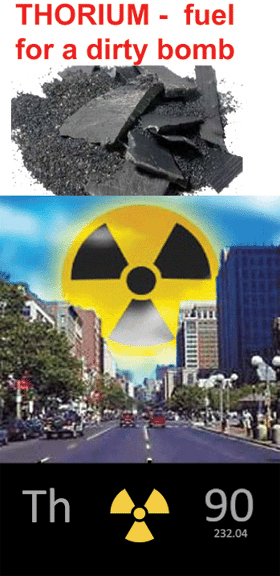 Indonesian militants planned ‘dirty bomb’ attack – sources, Yahoo 7 By Tom Allard and Agustinus Beo Da Costa, 24 Aug 17, JAKARTA (Reuters) – Indonesian militants planned to detonate a radioactive dirty bomb, security sources said, highlighting the rising ambitions of extremists to wreak destruction in the world’s largest Muslim-majority nation.
But experts cast doubt on their expertise, equipment and chances of success.
The plot was foiled when police raided homes and arrested five suspects in Bandung, West Java, last week, the sources with direct knowledge of the plot said. After the raids, police spoke of a plan to explode a “chemical” bomb but provided no other details……
The three counter-terrorism sources, speaking on condition of anonymity, said the militants had hoped to transform low-grade radioactive Thorium 232 (Th-232) into deadly Uranium 233 (U-233).
The highly radioactive uranium would be combined with the powerful home-made explosive triacetone triperoxide (TATP) to create a “nuclear bomb”, according to an instruction manual used by the militants and reviewed by Reuters.
In fact, the device would be, at best, a radiological dispersal device or dirty bomb that could spray radioactive material when the conventional bomb exploded.
A spokesman for Indonesia’s national police, Inspector General Setyo Wasisto, declined to confirm or deny the plot to construct the device, but said it would have been more potent than the two bombs made from TATP that killed three police in Indonesia’s capital Jakarta in May.
“If this bomb was finished, it would have had a more destructive impact than the bomb made from ‘Mother of Satan’,” he said, using the nickname for TATP.
“It could burn anything and make it hard for people to breathe.”
Thorium-232 can be transformed into Uranium-233 but requires the Thorium to absorb a neutron, a process that needs powerful irradiation, generally from a nuclear reactor, according to three analysts contacted by Reuters and the website of the World Nuclear Association, which represents reactor vendors and nuclear engineers, among other industry stakeholders….
One senior Indonesian counter-terrorism source said the Bandung-based cell had bought a large amount of a household item and had begun to extract the Thorium. Reuters has chosen not to name the item.
“They needed three weeks. It was still only one week (into the process when police raided),” the source said…..
According to police, the suspected Bandung plotters were members of JAD and were considering targets like the presidential palace in Jakarta and police headquarters in Bandung and the capital….. (Reporting by Tom Allard and Agustinus Beo Da Costa Additional reporting by Stefanno Reinard; Editing by Ed Davies and Nick Macfie) https://au.news.yahoo.com/a/36844136/exclusive-indonesian-militants-planned-dirty-bomb-attack-sources/
August 26, 2017
Posted by Christina Macpherson |
General News |
Leave a comment
Call for climate change risk disclosures, news.com.au AUGUST 25, 2017 Ross Kerber, Reuters Vanguard Group has urged companies to disclose how climate change could affect their business and asset valuations, reflecting how the environment has become a priority for the investment industry.
August 26, 2017
Posted by Christina Macpherson |
General News |
Leave a comment
Worth reading in the Trump era: Nuclear nightmares, authoritarianism and climate change, The Conversation, MV Ramana, Simons Chair in Disarmament, Global and Human Security at the Liu Institute for Global Issues, University of British Columbia August 25, 2017 Editor’s note: The Conversation Canada asked our academic authors to share some recommended reading. In this instalment, MV Ramana, a nuclear physicist and disarmament expert who wrote about small nuclear reactors, looks at a mix of new and recent books on nuclear disaster, weapons, authoritarianism and climate change.
 My Nuclear Nightmare Leading Japan Through the Fukushima Disaster to a Nuclear-Free FutureBy Naoto Kan. Translated from Japanese by Jeffrey S. Irish. (Non-fiction. Hardcover, 2017. Cornell University Press.)………..Naoto Kan was the prime minister of Japan during this critical period [of the Fukushima nuclear disaster] and this book, published in Japanese in 2012 and newly available in English, offers his inside perspective of how events unfolded at the highest levels.
Kan reveals how little even powerful individuals and institutions like him and the government can do in the face of a major nuclear accident. If a society like Japan that is so well-prepared for natural disasters like earthquakes is unable to deal with a severe nuclear accident like Fukushima, there is little doubt that no country would have been able to do much better.
Kan’s account is testimony of the prevalence of the safety myth: the comforting but illusionary idea that technology can prevent nuclear accidents. Sadly, that myth continues to prevail not just in Japan but in most countries that are operating or constructing nuclear power plants.
 Command and Control Nuclear Weapons, the Damascus Accident, and the Illusion of SafetyBy Eric Schlosser (Non-fiction. Paperback, 2014. Penguin.) ……..The Sept. 18, 1980, incident was just one of the many close calls involving nuclear weapons that the world has experienced. Going through these experiences, it’s hard to attribute the fact that there have been no accidental nuclear explosions to anything but blind luck.
Eric Schlosser, an award-winning American journalist and author, has produced a very readable account of accidents and near-misses, as well as the decades-long history of trying to control these risks through technological and institutional fixes.
Command and Control reminds us of the extraordinary danger posed by the large nuclear arsenals possessed by many countries around the world — most importantly, the United States and Russia…..
 Unmaking the Bomb A Fissile Material Approach to Nuclear Disarmament and NonproliferationBy Harold A. Feiveson, Alexander Glaser, Zia Mian, Frank N. von Hippel (Non-fiction. Hardcover, 2014. MIT Press.)…….. In contrast to proposals for nuclear disarmament that focus on diplomacy and international relations, this book by four physicists at Princeton University (my former colleagues) offers a more technical road map for nuclear disarmament: Namely, through the control and elimination of highly enriched uranium and plutonium — the fissile materials that are the essential ingredients of all nuclear weapons.
The connection is laid out in the introduction of the book: “If we are to reduce the threat from nuclear weapons, we must deal with the dangers posed by the production, stockpiling, and use of fissile materials. Unmaking the bomb requires eliminating the fissile materials that make nuclear weapons possible.”…….
 The Rise of Hindu Authoritarianism Secular Claims, Communal Realities By Achin Vanaik (Non-fiction. Hardcover, 2017. Verso Books.)
The last few years have seen victories by right wing, authoritarian political parties and leaders in multiple countries. The same phenomenon in India, the “world’s largest democracy,” should be — and is — cause for worry…….. The Rise of Hindu Authoritarianism not only explores in great detail the growing communalization of the political arena and civil society, it also delineates what an oppositional and transformative project might look like.
 The Great Derangement Climate Change and the Unthinkable By Amitav Ghosh (Non-fiction. Cloth, 2016. University of Chicago Press.)…… climate change has appeared only sparingly in the world of fiction and literature…..Reading this book makes it clear, at least to me, that climate change is not a problem that can be dealt with through some clever technological inventions or some neat-looking financial instrument, but will require us to fundamentally reshape our economic, political and international structures.https://theconversation.com/worth-reading-in-the-trump-era-nuclear-nightmares-authoritarianism-and-climate-change-83024
August 26, 2017
Posted by Christina Macpherson |
General News |
Leave a comment
Did climate change make Hurricane Harvey worse? https://qz.com/1062574/hurricane-harvey-and-climate-change-did-rising-temperatures-and-sea-levels-make-harvey-worse/ 25 Aug 17, As climatologist Katharine Hayhoe points out, seasonal hurricanes are a natural part of the weather system in the Gulf coast, and attributing the cause of a single storm entirely to climate change is currently an impossible task. “Once you get down to a small regional level, hurricanes are so rare and random that you would not be able to detect a robust trend even if there was one,” says John Nielsen-Gammon, Texas’ state climatologist.
But did climate change-driven factors make Hurricane Harvey more destructive?
The waters of the Gulf of Mexico have been warmer than average this year, with bathtub-like temperatures breaking heat records all last winter.
Researchers can point to a direct relationship between warmer water temperatures and an increase in tropical cyclone formations, but the link between warm water and hurricanes is less clear, in part because hurricanes require several other ingredients, like specific wind patterns, to form.
Climate change is definitely setting up conditions that are known to make storms more destructive, including heating up the oceans. “The warmer the Gulf water is, the greater the amount of moisture will be available” to fuel rainfall, Nielsen-Gammon says. Continue reading →
August 26, 2017
Posted by Christina Macpherson |
General News |
Leave a comment
Tanker becomes first to cross Arctic without icebreaker http://money.cnn.com/2017/08/25/news/arctic-ice-tanker-ship/index.html?sr=twCNN082517arctic-ice-tanker-ship0141PMStory, by Jethro Mullen @CNNMoney, August 25, 2017:
Climate change is helping create new opportunities for shipping companies by melting the ice around the North Pole.
A Russian tanker carrying natural gas has become the first merchant ship to sail across the Arctic without the help of an icebreaker, finishing the journey in record time.
The ship, the Christophe de Margerie, traveled from Norway to South Korea in 19 days, about 30% quicker than the regular route through the Suez Canal, its Russian owner, Sovcomflot, said this week.
Every year, arctic ice naturally shrinks in the spring and summer before growing again during winter. But as global temperatures have risen, the old sea ice that lasts year after year has
shrunk to its smallest level in three decades.
Thinner, younger sea ice — less than a year old — has become the majority across the Arctic. Young ice struggles to reach a thickness of 2 meters (6½ feet) during winter months and then is more likely to melt during the summer.
Related: Watch as old sea ice vanishes
It’s a huge concern. According to NASA, many global climate models predict that the Arctic will be ice-free for at least part of the year before the end of the 21st century. Some models predict an ice-free Arctic by midcentury. That would have a direct impact on weather patterns around the world.
The thinning ice also opens new paths for global trade, saving companies hundreds of thousands of dollars they would spend on longer journeys via more southerly routes.
“This is the paradox of climate change,” said Ben Ayliffe, a campaigner for Greenpeace. “The fossil fuels we’re burning are allowing access into areas that were previously protected by ice.” He expressed concern that increasing sea traffic in the inhospitable environment will bring new risks, such as a fuel spill that would be virtually impossible to clean up.
Shipping tankers making their way across the top of the world typically need to be accompaniedby massive, nuclear-powered Russian icebreakers to plow through patches of six-foot-thick ice.
But the Christophe de Margerie, named for a former CEO of French oil giant Total, is specially designed to sail independently through ice as thick as 2.1 meters (nearly 7 feet), its owner said.
That means it should be able to operate in the harsh Arctic waters year round rather than just the summer months.
Its recent journey ferrying liquified natural gas more than 2,000 nautical miles through ice as thick as 1.2 meters (4 feet) “demonstrates the economic potential of using the Northern Sea Route for large-capacity vessel transits,” Sovcomflot said.
August 26, 2017
Posted by Christina Macpherson |
General News |
Leave a comment