New Generation Nuclear Reactors Unlikely to Deliver on Design, EcoWatch, By Paul Brown, 9 Aug 17
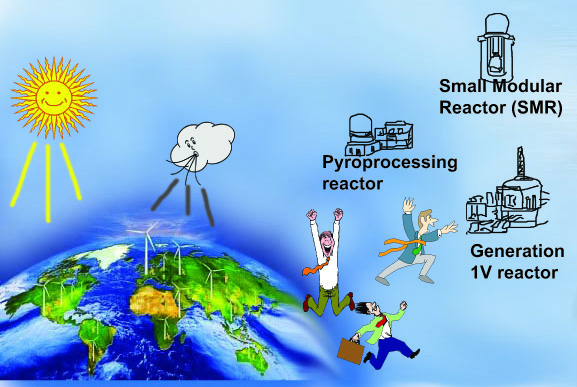
New generation nuclear reactors, promised for the last 18 years by the U.S. Office of Nuclear Energy (NE) as a way to provide cheap and plentiful supplies of electricity, are unlikely to be fulfilled any time in the next 30 years.
That is the conclusion of university researchers who have used the Freedom of Information Act to obtain the program’s budget history to find out what designs the government has spent $2 billion of public money on supporting.
Researchers from the University of California San Diego and Carnegie Mellon University described the research program as “incoherent” and said the government was “unlikely” to deliver on its mission to develop and demonstrate an advanced nuclear reactor by mid-century.
The study, published in the journal Environmental Research Letters, said much of the money that was supposed to be spent on civilian reactors was spent instead on supporting infrastructure, where the main focus was defense programs and not commercial opportunities……..
Overall, the technology’s prospects appear grim, with implications that go beyond energy.
“Without a sense of urgency among NE and its political leaders,” Abdulla warned, “the likelihood of advanced reactors playing a substantial role in the transition to a low-carbon U.S. energy portfolio is exceedingly low…..
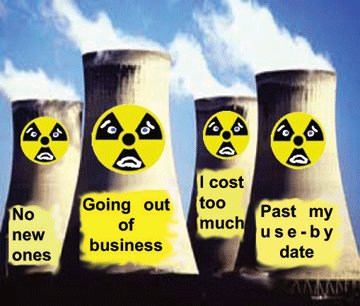
These reported failings in the U.S. research program come at a difficult time for the industry when across the world the current “new” generation of large nuclear reactors is proving difficult to build on time and on budget, and some projects are being abandoned mid-way through construction…….
Most of the money now being spent on research into new generations of nuclear power stations is being provided by nuclear weapon states. Most countries that have never had nuclear weapons but have invested in nuclear power stations are now phasing them out and putting their development money into cheaper renewables. https://www.ecowatch.com/new-generation-nuclear-2471347067.html
The destruction of Hiroshima and Nagasaki was a war crime worse than any that Japanese generals were executed for in Tokyo and Manila. If Harry Truman was not a war criminal, then no one ever was.
The most spectacular episode of Harry Truman’s presidency will never be forgotten but will be forever linked to his name: the atomic bombings of Hiroshima on August 6, 1945, and of Nagasaki three days later. Probably around two hundred thousand persons were killed in the attacks and through radiation poisoning; the vast majority were civilians, including several thousand Korean workers. Twelve US Navy fliers incarcerated in a Hiroshima jail were also among the dead.1
Great controversy has always surrounded the bombings. ……. Continue reading →
Guardian, 9 Aug 17 Interview with UN Special Rapporteur Victoria Tauli-Corpuz to mark the International Day of the World’s Indigenous Peoples Today is the United Nations’ (UN) International Day of the World’s Indigenous Peoples, numbering an estimated 370 million in 90 countries and speaking roughly 7,000 languages. To mark it, the Guardian interviews Kankanaey Igorot woman Victoria Tauli-Corpuz about the UN’s Declaration on the Rights of Indigenous Peoples, which she calls “historic” and was adopted 10 years ago.
Tauli-Corpuz, from the Philippines, was Chair of the UN Permanent Forum of Indigenous Issues when the Declaration was adopted, and is currently the UN Special Rapporteur on the Rights of Indigenous Peoples. In this interview, conducted via email, she explains why the Declaration is so important, argues that governments are failing to implement it, and claims that the struggle for indigenous rights “surpasses” other great social movements of the past:
DH: Why is the UN Declaration so important?
VTC: [It’s] so important because it enshrines and affirms the inherent or pre-existing collective human rights of Indigenous Peoples, as well as the individual human rights of indigenous persons. It is a framework for justice and reconciliation between Indigenous Peoples and states, and applies international human rights standards to the specific historical, cultural, social and economic circumstances of Indigenous Peoples. The Declaration is a standard-setting resolution of profound significance as it reflects a wide consensus at the global level on the minimum content of the rights of indigenous peoples. It is a remedial tool which addresses the need to overcome and repair the historical denial of the fundamental human rights of indigenous peoples, and affirms their equality to all other members of society.
DH: How significant an achievement was it?
VTC: In the 1970s Indigenous Peoples had brought to the UN’s attention the problems and issues they were facing, which led the UN to establish the Working Group on Indigenous Populations in 1982. ……..
DH: What do you think of the mainstream media’s portrayal of indigenous peoples?
VTC: I think that there has been an increase in media coverage over the years. I’m glad to see less coverage that portrays us as primitive, but sometimes the media fails to capture the fact that we are not anti-development. We are also seeing more media coverage – but still not enough – on the contributions of Indigenous Peoples to global goals on climate, poverty and peace. If Indigenous Peoples’ rights are not secured and protected, it will be impossible for the world to deliver on the promises of the Paris Agreement and the Sustainable Development Goals. Secure land rights for Indigenous Peoples is a proven climate change solution, and denying indigenous land rights and self-determination is a threat to the world’s remaining forests and biodiversity. It is also a primary cause of poverty. Many indigenous communities face intractable poverty despite living on resource-rich lands because their rights are not respected and their self-determined development is not supported. Protecting the rights of indigenous women, who are often responsible for both their communities’ food security and for managing their forests, is particularly important. Finally, undocumented land rights are a primary cause of conflict and a threat to investment in developing countries. Securing their rights can help mitigate these conflicts and create a more peaceful world.
DH: Finally, do you think the struggle for indigenous peoples’ rights and territories is comparable to any of the other great social movements in the past?
VTC: I think the Indigenous Peoples’ movement surpasses other social movements. They have struggled against colonisation for more than 500 years and continue against forms of colonisation and racism. At the same time, they continue to construct and reconstruct their communities and practice their cultural values of collectivity, solidarity with nature, and reciprocity even amidst serious challenges. Many still fight to protect their territories, which makes their movement different from others. https://www.theguardian.com/environment/andes-to-the-amazon/2017/aug/09/indigenous-peoples-are-the-best-guardians-of-the-worlds-biodiversity
By AUDREY McAVOY, 11 Aug 17, HONOLULU (AP) — The small U.S. territory of Guam has become a focal point after North Korea’s army threatened to use ballistic missiles to create an “enveloping fire” around the island. The exclamation came after President Donald Trump warned Pyongyang of “fire and fury like the world has never seen.” Here’s a look at the U.S. military’s role on the island, which became a U.S. territory in 1898.
WHAT INSTALLATIONS ARE ON GUAM AND HOW SIGNIFICANT ARE THEY? There are two major bases on Guam: Andersen Air Force Base in the north and Naval Base Guam in the south. They are both managed under Joint Base Marianas. The tourist district of Tumon, home to many of Guam’s hotels and resorts, is in between.
The naval base dates to 1898, when the U.S. took over Guam from Spain after the Spanish-American War. The air base was built in 1944, when the U.S. was preparing to send bombers to Japan during World War II.
Today, Naval Base Guam is the home port for four nuclear-powered fast attack submarines and two submarine tenders.
Andersen Air Force Base hosts a Navy helicopter squadron and Air Force bombers that rotate to Guam from the U.S. mainland. It has two 2-mile (3-kilometer) long runways and large fuel and munitions storage facilities.
Altogether, 7,000 U.S. military personnel are stationed on Guam. Most are sailors and airmen. The military plans to move thousands of U.S. Marines to Guam from Okinawa in southern Japan.
Guam’s total population is 160,000.
___
WHAT ROLES DO THE BASES PLAY IN THE REGION
Guam is strategically located a short flight from the Korean peninsula and other potential flashpoints in East Asia. Seoul is 2,000 miles (3,200 kilometers) to the northwest, Tokyo is 1,500 miles (2,400 kilometers) north and Taipei is 1,700 miles (2,700 kilometers) west.
Because Guam is a U.S. territory, the U.S. military may launch forces from there without worrying about upsetting a host nation that may object to U.S. actions.
The naval base is an important outpost for U.S. fast-attack submarines that are a key means for gathering intelligence in the region, including the Korean peninsula and the South China Sea where China has been building military bases on man-made islands.
___
HOW HAS THE U.S. USED GUAM TO ADDRESS THE THREAT FROM NORTH KOREA?
The U.S. military began rotating bombers — the B-2 stealth bomber as well as the B-1 and B-52 — to Andersen in 2004. It did so to compensate for U.S. forces diverted from other bases in the Asia-Pacific region to fight in the Middle East. The rotations also came as North Korea increasingly upped the ante in the standoff over its development of nuclear weapons.
In 2013, the Army sent a missile defense system to Guam called Terminal High Altitude Area Defense or THAAD.
It’s designed to destroy ballistic missiles during their final phase of flight. A THAAD battery includes a truck-mounted launcher, tracking radar, interceptor missiles and an integrated fire control system.
___
WHAT’S THE HISTORY OF THE U.S. MILITARY ON GUAM?
The U.S. took control of Guam in 1898, when Spanish authorities surrendered to the U.S. Navy. President William McKinley ordered Guam to be ruled by the U.S. Navy. The Navy used the island as a coaling base and communications station until Japan seized the island on Dec. 10, 1941. The U.S. took back control of Guam on July 21, 1944.
During the Vietnam War, the Air Force sent 155 B-52 bombers to Andersen to hit targets in Southeast Asia. Guam was also a refueling and transfer spot for military personnel heading to Southeast Asia. Many refugees fleeing Vietnam were evacuated through Guam.
Ghillar, Michael Anderson, Sovereign Union, 4 August 2017
Recently there has recently been a lot of social media chatter in the Eastern States about the pros and cons of Native Title that has created a lot of angst for many people. It is difficult to get the message across to our people in respect to Native Title, because Native Title in itself is a relatively new, very complex and difficult concept to understand, let alone master………
‘But I can say that, if people were to read The Art of War by Sun Tzu, the most significant aspect of the Native Title Act is the fact that it creates division within the clans and the Nations.
‘Moreover, it creates conflict between environmentalists, First Nations Peoples, mining companies and other extractive industries.
The government and the mining executives sit idly by watching our people tear themselves apart over ideological beliefs,
without our people realising that this is, in fact, a very deliberate process to cause internal conflict between all proponents of opposition to the extractive industries.
Not all glaciers in Antarctica have been affected by climate change https://www.eurekalert.org/pub_releases/2017-08/gsoa-nag080817.phpGEOLOGICAL SOCIETY OF AMERICA Boulder, Colo., USA: A new study by scientists at Portland State University and the National Snow and Ice Data Center (NSIDC) at the University of Colorado Boulder has found that the effects of climate change, which are apparent in other parts of the Antarctic continent, are not yet observed for glaciers in the western Ross Sea coast.
Published online ahead of print for the journal Geology, the study found that the pattern of glacier advance and retreat has not changed along the western Ross Sea coast, in contrast to the rapidly shrinking glaciers on the Antarctic Peninsula.
The western Ross Sea is a key region of Antarctica, home to a complex and diverse ocean ecosystem, and the location of several Antarctic research stations including the U.S. McMurdo Station, the largest on the continent.
The research team compiled historic maps and a variety of satellite images (such as https://eoimages.gsfc.nasa.gov/images/imagerecords/2000/2066/seawifs_south_pole_ross_lrg.jpg) spanning the last half-century to examine glacier activity along more than 700 kilometers of coastline. The NASA-U.S. Geological Survey (USGS) Landsat series satellites were particularly useful, including the newest Landsat 8 instrument, launched in 2013.
The scientists examined 34 large glaciers for details of ice flow, extent, and calving events (formation of icebergs). Although each glacier showed advances and retreats, there was no overall pattern over time or with latitude.
The results suggest that changes in the drivers of glacier response to climate — air temperature, snowfall, and ocean temperatures — have been minimal over the past half century in this region.
The study was part of a National Science Foundation and U.S. Geological Survey study and was motivated by previous work documenting significant glacier retreat and ice shelf collapse along the coastline of the Antarctic Peninsula. The region’s ongoing changes were highlighted recently with the cracking and separation of a large iceberg from the Larsen C Ice Shelf.
Earlier studies had documented little change in the western Ross coastline prior to 1995, and the new study both confirmed the earlier work and extended the analysis to the present time.
This work underscores the complexity of Antarctic climate change and glacier response.
A CONTROVERSIAL draft report on climate change that contradicts claims made by Donald Trump’s administration on global warming has been leaked. A DAMNING report on climate change that contradicts claims made by Donald Trump’s administration on global warming has been leaked, as scientists fear the President may suppress it.
“Americans are feeling the effects of climate change right now,” the report said according to The New York Times, which acquired a draft copy of the report by scientists from 13 federal agencies.
The report says extreme heatwaves have become more common and extreme cold waves have less common since the 1980s. It says emissions of greenhouse gases will affect the degree to which global temperatures continue to rise — a claim President Trump and some members of his cabinet have disputed. One scientist cited anonymously by the Times says he and other researchers are worried that the Trump administration, which must approve the report’s release, will suppress it.
The report “directly contradicts claims by President Trump and members of his cabinet who say that the human contribution to climate change is uncertain and that the ability to predict the effects is limited,” the Times said.
“How much more the climate will change depends on future emissions and the sensitivity of the climate system to those emissions,” a draft of the report states.
The report is part of the National Climate Assessment, which is carried out every four years, The New York Times reports. The National Academy of Sciences has signed off on the draft and is awaiting permission from the Trump administration for it to be publicly released.
The report also found that we would still experience at least 0.30 degrees Celsius of warming over this century compared with today, even if we put a stop to greenhouse gas emissions.
A small increase in global temperatures can lead to prolonged heatwaves, storms and the breakdown of coral reefs. The report found that surface, air and ground temperatures in Alaska and the Arctic are warming twice as fast as the global average.
“It is very likely that the accelerated rate of Arctic warming will have a significant consequence for the United States due to accelerating land and sea ice melting that is driving changes in the ocean including sea level rise threatening our coastal communities,” the report states.
The United States just announced Friday it would still take part in international climate change negotiations in order to protect its interests, despite its planned withdrawal from the Paris accord on global warming. Two months after President Trump announced the United States would abandon the 2015 global pact, his administration confirmed it had informed the United Nations of its “intent to withdraw from the Paris Agreement” — a process that will take at least until 2020.
The United States is the world’s second biggest producer of greenhouse gases after China and its withdrawal was a seen as a body blow to the Paris agreement.
The accord commits signatories to efforts to reduce greenhouse gas emissions that cause global warming, which is blamed for melting ice caps and glaciers, rising sea levels and more violent weather events.
They vowed steps to keep the worldwide rise in temperatures “well below” two degrees Celsius from pre-industrial times and to “pursue efforts” to hold the increase under 1.5 degrees Celsius
Climate change is disrupting the birds and the bees, We all know that climate change will cause more extreme weather and rising seas. But it is also having an unexpected effect on sex. BBC, By Claire Asher, 8 August 2017
Our changing climate seems set to disrupt just about everything. From rising sea levels to ocean acidification, the list of negative consequences from climate change is endless. But one area that often goes unmentioned in the climate change discussion is sex.
Over the last two decades, scientists have found that warmer temperatures are quietly spoiling the mood, making it harder for plants and animals to reproduce.
Here are five ways that climate change is ruining sex lives.
It’s a numbers game
While humans and many other animals determine sex genetically, many reptiles and some fish use the incubation temperature of the eggs to set the gender of their offspring. This means that changing global temperatures could alter the ratio of sexes produced, making it harder for these animals to find mates………
Timing is everything
Phenological shifts are common, because many animals use environmental cues like temperature and rainfall to time key events like migration, flowering and breeding. Climate change is changing the timing and strength of the seasons, and as these cues change, the annual ebb and flow of the natural world is being disrupted.
In fact, one of the first pieces of evidence for the effect of climate change on living things was the discovery that plants are flowering earlier and earlier each year………
Bending the rules of attraction
Changing environmental cues might also influence how animals court members of the opposite sex.
The decorations, displays, dances and songs that animals use to attract a mate are all heavily dependent on the environmental conditions the animal lives in. ……..
A mate for life?
Warmer climates seem to have a tendency to make animals less faithful. In a 2012 study, Botero studied monogamy in 122 species of bird. He found that “in places where environments change more frequently and unexpectedly, apparently monogamous females tend to hedge their bets by mating with more than one partner on the side”.
These “extra-pair relationships” become increasingly frequent as annual climatic cycles become more variable. …..
The heat-wave slump
Finally, climate change might even impact on our own sex lives.
Climate changes is getting so bad, researchers at Columbia University foresee 30 percent of flights being unable to take off by 2050. Since rising temperatures make the air less dense, heavy planes won’t be able to get enough lift to get in the air. We saw this effect earlier this year, when flights were grounded at the Phenoix airport due to high temperature.
To make planes less heavy, airlines will accept less people on board. And more competitive airline seats make for really, really expensive plane tickets. Fun!
Extra bad news for New Yorkers: researchers predict NYC’s LaGuardia will see some of the worst effects of the temperature change.
The paper is only the latest to suggest that climate change will start to become a bigger problem for airlines. Other studies have pointed to a myriad of other issues, including more air turbulence, increased flight times because of changes to certain jet streams, and airport flooding caused by rising sea levels.
Airports and companies could improve engine performance, lengthen runways so that aircrafts get more speed and schedule more flights for cooler parts of the day, but really we humans basically fucked up everything, so things aren’t looking up.
Extreme weather could kill 150,000 people each year in Europe by the end of the century, say scientists. Hundreds of millions of people will be exposed to deadly weather events by 2100, researchers warn, Independent, Andrew Griffin Science Reporter @_andrew_griffin 5 Aug 17 , More than 150,000 people could die as a result of climate change each year in Europe by the end of the century, shocking new research has found.
The number of deaths caused by extreme weather events will increase 50-fold and two in three people on the continent will be affected by disasters, the study – that serves as a stark warning of the deadly impact of global warming – found.
The research by European Commission scientists lays out a future where hundreds of thousands of people die from heatstroke, heart and breathing problems, and flash flooding. It describes a world where droughts bring food shortages, people are at an increased risk of being killed by disease and infection, and the countryside is ravaged by wildfires. Continue reading →
Billions lost in nuclear power projects, with more bills due, Fox Business, By SEANNA ADCOX August 05, 2017 COLUMBIA, S.C. – A decade ago, utilities were persuading politicians around the country to let them spend big to go nuclear…..
With a dozen or more nuclear power projects being developed around the nation, cost savings could be found through simultaneous construction.
State legislators were sold. In South Carolina, they even passed a law allowing utilities to charge customers up front and to recoup their investments even if the projects never produced a kilowatt. Several other Southern states also passed “pay-as-you-go” laws.
This week, having spent more than $10 billion, executives with South Carolina Electric & Gas and Santee Cooper acknowledged that all their assumptions were wrong.
Worse still: Consumers may have to pay billions more on the rusting remains of two partially-built reactors at the V.C. Summer Nuclear Station north of Columbia.
“When we started, there was talk of a nuclear renaissance restarting a whole industry in the U.S.,” said Santee Cooper’s chief financial officer, Jeff Armfield. He was among several executives recommending the project be abandoned. The board of the state-owned utility unanimously agreed at a public meeting Monday.
Most of the 18 nuclear projects pending before the Nuclear Regulatory Commission a decade ago have been aborted or suspended indefinitely. None of the 7 projects the NRC licensed are operational. Only one is still being built, in Georgia, at a cost of $100 million a month. Southern Company financial documents filed Wednesday say the project, slated to cost $14 billion, could cost $25 billion or more if completed…….http://www.foxbusiness.com/markets/2017/08/05/billions-lost-in-nuclear-power-projects-with-more-bills-due.html
With excessive heat warnings and temperatures reaching the triple digits from northern California through Washington state (places where air conditioning is far from a given), it’s a bit hard to fathom that this week should have been even hotter.
All-time records could have been set up and down the coast, if it hadn’t been for the thick smoke streaming down from more than 100 massive forest fires in British Columbia, about 500 miles north.
How Congress Is Cementing Trump’s Anti-Climate Orders into Law These efforts are mostly flying under the radar, but they could short-circuit lawsuits and make it harder to restore environmental protections. Inside Climate News, Marianne Lavelle 31 JULY 17,
How NRDC will fight Trump’s attack on our environment.
President Donald Trump marvels at his own velocity when he boasts about dismantling the Obama climate legacy. “I have been moving at record pace to cancel these regulations and to eliminate the barriers to domestic energy production, like never before,” he said at a recent White House event.
But while Trump focuses on speed, his allies in Congress appear increasingly concerned about the durability of the president’s fossil fuel directives.
In recent weeks, they have advanced a handful of legislative measures that echo and extend various presidential orders meant to boost coal, oil and gas production and set aside consideration of climate change.
These moves may seem redundant, but they could provide bulletproof armor during future challenges to Trump’s agenda.
“They are … covering their bases by trying to legislate the rolling back of these safeguards because the process to repeal, undo or rewrite a regulation is as lengthy as the public process that helped establish the standard in the first place,” explained Melinda Pierce, chief lobbyist for the Sierra Club. “And, of course, any attempt to roll back environmental or public health standards can and will be challenged in court.”
“The Trump administration is attacking every environmental and health protection we have,” said Sara Jordan, legislative representative for the League of Conservation Voters. “If these legislative proposals get passed, it will make it that much harder for the next administration to restore environmental protections.”
That’s why Congressional Republicans are racing to write his instructions into law.
“We need to put the legislative stamp of approval on what the Trump administration is doing,” said Rep. Evan Jenkins (R-W.Va.) during a recent debate on the House floor.
The House already has voted to fast-track Trump’s withdrawal of a clean water rule and to streamline future environmental reviews over cross-border pipelines like Keystone XL. Now, GOP members are pushing forward legislation to bolster Trump’s revival of federal coal leasing, and to bar government regulatory agencies from considering the future damages caused by greenhouse gas pollution.
‘A Very Slippery Slope to Government by Fiat’
The courts have already started chipping away at the Trump administration’s edicts. A federal appeals court ruled July 3 that the Environmental Protection Agency (EPA) cannot simply suspend an Obama-era rule on methane emissions from oil and gas facilities. And a federal judge ruled last month that the Army Corps of Engineers had moved too hastily to permit the Dakota Access pipeline project, without considering environmental justice impacts on the Standing Rock Sioux tribe.
Environmental groups, states, and tribes have planned or filed lawsuits over virtually every aspect of the Trump energy agenda. “We’re going to meet them in court, we’re going to sue them, and we’re going to prevail,” Mitchell Bernard, chief counsel for the Natural Resources Defense Council (NRDC), said in a video the environmental group produced.
But Congress could short-circuit that litigation strategy with measures like the provision passed by the House last week allowing withdrawal of Obama’s “Waters of the U.S.” rule without public notice, comment or any of the other requirements that apply to federal departments and agencies. The Trump administration already has begun rescinding the rule, which was written to protect wetlands from dredge and fill material and created new permitting and reporting requirements that the oil, gas and coal industry abhor. The rider that the GOP tucked into an $800 billion budget bill would hurry the repeal and reduce possibilities for legal challenge……….
These Efforts Are Flying Under the Public Radar
Most of the legislative proposals shoring up the Trump energy agenda originate in the House, and their fate is unclear in the Senate, which already has rejected an effort to undo Obama-era methane regulations by legislative fiat, and where appropriators are less tolerant of budget riders.
Still, Senate negotiators may feel pressured to go along with some provisions to pass budget legislation that would keep the government up and running after the fiscal year ends on Sept. 30.
Senate supporters of the Trump energy agenda already have introduced their own version of the “Ozone Standards Implementation Act” that the House passed on July 18. That bill would help EPA Administrator Scott Pruitt delay implementation of the Obama administration’s standards regulating smog emissions for a year. The House-passed legislation would give states until 2025 to comply with the revised standards and would change long-standing law to allow the EPA to revise the standards every 10 years instead of every five.
Both the NRDC and a coalition of environmental, health and labor groups have published online running tallies of budget provisions that affect regulations, but they lament that the Congressional efforts to cement the Trump agenda have not received attention while the health care repeal effort and Russia investigations crowd out media coverage.
Trump falls flat with climate change retreat, Markets, not politics, drive energy sector’s push to cut greenhouse gas emission Ft.com by: Ed Crooks, 7 Aug 17, US Industry and Energy Editor On Friday, the US state department submitted a notification to the UN that the administration intended to withdraw from the Paris climate agreement reached in 2015. The statement, confirming the decision that President Donald Trump announced in June, is at one level momentous. The world’s largest economy and second-largest emitter of greenhouse gases is quitting a deal that the governments of leading European countries have described as “a vital instrument for our planet”. In terms of the consequences for the global energy industry, however, its impact has so far been negligible.
Of course, the full implications have yet to play out. But in the nine weeks since Mr Trump announced that leaving the agreement would be “a reassertion of America’s sovereignty”, energy companies around the world have been making plans that suggest their views on the outlook have not changed in any significant way.
The most important reason for that is that moves towards reducing greenhouse gas emissions are going with the grain of energy markets, regardless of political decisions. The plunging costs of renewable power and electricity storage, the rise of electric cars, the availability of cheap gas for power generation, and the prospect of abundant supplies of oil, for a while at least, all point towards investment decisions that would curb emissions.
The comments from oil companies reporting earnings over recent weeks have provided a stark illustration of that point. For years, environmental groups have been raising concerns about stranded assets: projects that cannot be viable in a world where greenhouse gas emissions are constrained.
When they first started making that argument, with oil at about $100 per barrel, it was often a tough sell, says Andrew Grant of the Carbon Tracker Initiative, which has pioneered analysis in this area. Now, he adds, they are “pushing at an open door”.
The central idea is that in a world where fossil fuel consumption is curtailed to cut greenhouse gas emissions, investment in high-cost assets is likely to be wasted………..
Whatever happens to international climate policy in the aftermath of Mr Trump’s decision, unless some other shock comes along to shake the industry out of its current mindset, downward pressure on costs and caution on investment decisions are likely to remain the prevailing rules. https://www.ft.com/content/2f687cfe-7abb-11e7-9108-edda0bcbc928
How The Dream Of America’s ‘Nuclear Renaissance’ Fizzled, WBUR, August 06, 2017, Molly Samuel A decade ago, utility executives and policymakers dreamed of a future powered by a new generation of cheap, safe nuclear reactors. Projects to expand existing nuclear plants in South Carolina and Georgia were supposed to be the start of the “nuclear renaissance.”
But following the decision last week by two utilities to scrap the expansion at the Virgil C. Summer Nuclear Generating Station in South Carolina, that vision is in tatters. There’s now just one nuclear expansion project left in the country, its future is also uncertain.
That remaining project is an expansion at the Vogtle Electric Generating Plantin eastern Georgia. As recently as five years ago, then-Energy Secretary Steven Chu visited Plant Vogtle and declared the project the start of “the resurgence of America’s nuclear industry” and a critical part of President Obama’s energy strategy………
Both the Georgia and South Carolina nuclear projects racked up billions of dollars in cost overruns and delays. Then earlier this year, Westinghouse, which was building the reactors in both states, went bankrupt, blaming high construction costs for its problems.