Small Nuclear Reactors look good – on paper!
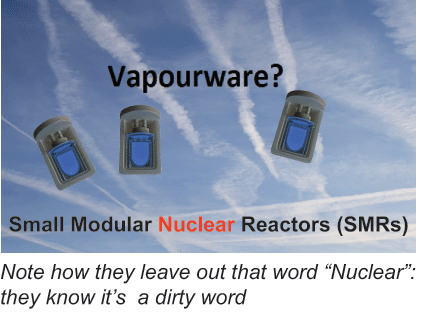 Lockdown alternatives look good on paper: So do nuclear reactors, Independent Australia, By John Quiggin | 22 September 2020, Amid mounting pressure for a “hands-off” approach to pandemic controls, Professor John Quiggin explains the real costs of the “let her rip” strategy.
BACK IN 1953, the founder of the U.S. naval nuclear program, Admiral Hyman Rickover, drew a striking contrast between “paper reactors” and “real reactors”:
An academic [paper] reactor or reactor plant almost always has the following basic characteristics: (1) It is simple. (2) It is small. (3) It is cheap. (4) It is light. (5) It can be built very quickly. (6) It is very flexible in purpose (“omnibus reactor”). (7) Very little development is required. It will use mostly “off-the-shelf” components. (8) The reactor is in the study phases. It is not being built now.
On the other hand, a practical [real] reactor plant can be distinguished by the following characteristics: (1) It is being built now. (2) It is behind schedule. (3) It is requiring an immense amount of development on apparently trivial items. Corrosion, in particular, is a problem. (4) It is very expensive. (5) It takes a long time to build because of the engineering development problems. (6) It is large. (7) It is heavy. (8) It is complicated.
The tools of the academic-reactor designer are a piece of paper and a pencil with an eraser. If a mistake is made, it can always be erased and changed. If the practical-reactor designer errs, he wears the mistake around his neck; it cannot be erased. Everyone can see it.
Rickover’s insight has been borne out many times, as a long series of new reactor designs, promising power “too cheap to meter”, have come in over time and over budget. The latest such paper reactor, the Small Modular Reactor being developed by NuScale Power recently received design approval from the U.S. Nuclear Regulatory Commission. Quietly tucked away in the announcement was the prediction that the first 12-module plant being developed for Utah Associated Municipal Power Systems would be operational by 2030. Until last week, the announced target was 2027. And when the project was first funded, commercial operation was projected for 2023.
The contrast drawn by Rickover applies equally well to the policies proposed by critics of the elimination and suppression policies adopted around the world in response to the COVID-19 pandemic………..
Unlike Rickover’s paper reactors, these theoretical policies are typically not spelt out in much detail. Rather, the adverse effects of real policies, such as the hardship associated with travel restrictions and the economic cost of lockdowns are pointed out, and it is claimed that it would have been far better to accept a few deaths, mostly of old people who were going to die soon anyway. ….
Broadly speaking, the earlier and more comprehensive the control policy, the better the outcomes in terms of both (market) economic activity and health outcomes. (With a proper understanding of economics, health outcomes are economic outcomes, whether or not they affect market activity). ……..
Womankind arise! — Beyond Nuclear International

Still no equal protection under radiation law
Womankind arise! — Beyond Nuclear International
Nuclear exposure standards discriminate on the basis of sex
By Linda Pentz Gunter, 20 Sept 20,
As we mourn the passing of Supreme Court justice, Ruth Bader Ginsburg, we look back at her landmark victories against discrimination “on the basis of sex” and wonder how nuclear regulations might have stood up to her legal scrutiny. As things currently stand, the nuclear power industry gets away with “allowable” radiation exposure levels that discriminate against women……….
And despite RBG’s immense contribution to our greater wellbeing, as women, we still face discrimination in so many walks of life. That could be about to get worse.
That discrimination remains most infuriatingly true when it comes to the nuclear power industry which is not, it turns out, an equal opportunity poisoner, as we have shown in our earlier articles about Native American and African American communities.
Women and children, and especially pregnant women, are more vulnerable — meaning they suffer more harm from a given dose of radiation than the harm a man suffers from that same dose.
One should quickly add here that scientists still agree that there is no completely safe dose of radiation. In fact, when a dose is described as safe, it doesn’t mean harmless. It means something called “As low as reasonably achievable”, which means as safe as we are prepared to protect for — or, really, as safe as the nuclear industry is willing to pay for.
So not really safe then, and when they say “safe”, the question women must ask is: safe for whom?
In the US, that means safe for someone called Standard Man or sometimes Reference Man. That is on whom the “allowable” radiation exposure standards are based.
Who is Standard Man? ….
Discrimination strikes again here, on the basis of race and age, because the amount of radiation exposure that is considered “safe” for an individual in the US is based on what would be safe for a healthy, robust, 20-30-something white male…….. more https://wordpress.com/read/feeds/72759838/posts/2922365220
Global heating is disrupting the ground in Siberia
 Bizarre Bumps come up in Siberia, The tundra climate of Siberia and Russia have been the victim of climate change and the bumps on the grounds bear its scars https://www.outlookindia.com/outlooktraveller/travelnews/story/70633/siberias-ground-bumps, Trinetra Paul, September 20 , 2020 Over the past few decades, climate change and global warming has had a string of adverse effects on the planet. And the signs of damage are increasing day by day. Bizarre Bumps come up in Siberia, The tundra climate of Siberia and Russia have been the victim of climate change and the bumps on the grounds bear its scars https://www.outlookindia.com/outlooktraveller/travelnews/story/70633/siberias-ground-bumps, Trinetra Paul, September 20 , 2020 Over the past few decades, climate change and global warming has had a string of adverse effects on the planet. And the signs of damage are increasing day by day.
Siberia has been facing the wrath of this global phenomenon over the years. Now, the ground bears the scars of climate change. The Siberian permafrost (or frozen organic ground) is slowly thawing and this is resulting in huge, bizarre bumps on the ground. Many of the craters formed in between these bumps have been filled with melting water and have transformed into small lakes. The alarming rate at which the ground is thawing is a cause for major concern. The permafrost has frozen grass and shrubs and is a reservoir of greenhouse gases. When the layer thaws, these gases are directly emitted into the atmosphere. The Siberian city of Yakutsk has been standing on a permafrost, the depletion of which will not only be a hazard for the city but also for Siberian climate and weather. Siberia, and most parts of Russia, has witnessed a huge rise in temperatures, heat waves and an early summer with temperatures reaching almost 35 degrees. A large part of it is due to global warming, oil spills, factory leakages as well as increase in eco-tourism. Yes, even friendlier modes of tourism and travel too play a pivotal role in increasing the temperature. The COVID-19 pandemic too has had its share in this. With lack of proper maintenance, devastating Siberian wildfires in May proved to be deadly due to reduced workforce, and gave out large volumes of greenhouse gases. Though eco-tourism is beneficial in creating awareness about indiginous culture, and in creating employment among locals, it also leads to modernisation and artificial (often damaging) development of a place. Nature-based adventures, trails and extreme offbeat destinations are often held accountable for destruction of untramelled areas. Experts says that there must be conscious efforts in de-escalating these ventures. Such tourism must be curtailed, and introduced with buffers like controlling daily visitor numbers, maintaining a tab over timings, and consulting environmental organisations about the best measures to protect the vulnerable areas. Sometimes that may mean not allowing any tourists at all. |
|
David Attenborough now wants us to face up to the state of the planet
Don’t look away now: are viewers finally ready for the truth about nature?
For decades David Attenborough delighted millions with tales of life on Earth. But now the broadcaster wants us to face up to the state of the planet, PatrickGreenfield @pgreenfielduk
Fri 18 Sep 2020 Sir David Attenborough’s soothing, matter-of-fact narrations have brought the natural world to our living rooms for nearly seven decades and counting. From Australia’s Great Barrier Reef to the jungles of central Africa, the 94-year-old broadcaster has dazzled and delighted millions with tales of life on Earth – mostly pristine and untouched, according to the images on our screens. But this autumn Attenborough has returned with a different message: nature is collapsing around us.
“We are facing a crisis. One that has consequences for us all. It threatens our ability to feed ourselves, to control our climate. It even puts us at greater risk of pandemic diseases such as Covid-19,” he warned in Extinction: The Facts on BBC One primetime, receiving five-star reviews.
53 million tons of plastic could end up in rivers, lakes and oceans every year by 2030
 Annual plastic waste could reach 53m tons by 2030 https://www.dhakatribune.com/world/2020/09/20/annual-plastic-waste-could-reach-53m-tons-by-2030 Annual plastic waste could reach 53m tons by 2030 https://www.dhakatribune.com/world/2020/09/20/annual-plastic-waste-could-reach-53m-tons-by-2030
In a new modelling study published in the journal Science, ecologists monitoring pollution in aquatic ecosystems have voiced their concern, saying more needs to be done to reduce emissions
As much as 53 million tons of plastic could end up in rivers, lakes and oceans every year by 2030, even if global commitments to reduce plastic pollution are met, experts have warned. In a new modelling study published in the journal Science, ecologists monitoring pollution in aquatic ecosystems have voiced their concern, saying more needs to be done to reduce emissions, reports Evening Express. Chelsea Rochman, an assistant professor in the department of ecology and evolutionary biology at the University of Toronto, and senior author on the study, said: “Unless growth in plastic production and use is halted, a fundamental transformation of the plastic economy to a framework based on recycling is essential, where end-of-life plastic products are valued rather than becoming waste.” According to the researchers, about 19 to 23 million tons, or 11%, of plastic waste generated globally in 2016 entered aquatic ecosystems. They say computer modelling shows between 24 and 34 million tons of emissions are currently entering waterbodies around the world every year. The researchers modelled future scenarios to include the strategies that are currently in place to reduce plastic pollution in waters, such as bans on certain plastic products, continuous clean-up of litter, and plastic waste management. They found these mitigation strategies are not enough to keep plastic pollution in check, adding that an “enormous” amount of effort would be required to keep emissions below eight million tonnes a year. This would include a 25%-40% reduction in plastic production across all economies, increasing the level of waste collection and management to at least 60% across all economies, and recovery of 40% of annual plastic emissions through clean-up efforts. Plastics are slow to degrade, and even when they do, bits of them, known as microplastics, make their way into the aquatic food chain, and eventually into humans. The “Great Pacific Garbage Patch” – an enormous raft of plastic waste floating in the sea is located between California and Hawaii and embodies the worsening crisis of global plastic pollution. The patch is said to cover 1.6 million square kilometres, an area about 8 times the size of Wales. |
|
Young Australians call for COVID-19 recovery plan with climate jobs
https://www.sbs.com.au/news/young-australians-call-for-covid-19-recovery-plan-with-climate-jobsYoung Australians protest outside Government offices demanding the Morrison Government implement a Climate Jobs Guarantee as part of the COVID-19 recovery.
What Frogs Can Teach Us about the State of the World

We currently find ourselves on the other side of a stark but intangible line created by the climate tipping points we’ve blown past for and at our leisure, the virulent diseases we’ve helped spread, and the habitats we’ve destroyed in the name of peace and quiet. Being on this side of the line is a lot like grieving: we are in an “after” time.
And, as with other forms of grieving, in times defined by disease and mass extinction, we need to bear witness. We can be quiet and press record to capture what is still there. We can cup our hands around our ears and listen.
What Frogs Can Teach Us about the State of the World, By tracking amphibian songs, citizen scientists are helping us understand what’s happening to our environment, The Walrus , BY CAITLIN STALL-PAQUET 18 Sept 20,
T’S AN HOUR after sunset, one night in early April, and I’m standing on the side of a dirt road in my hometown of Frelighsburg, Quebec, with my hands cupped around my ears. I’m listening for the calls of anurans—amphibians without a tail, so frogs and toads. I am here, more specifically, to hear the croaks of wood frogs, which are one of the first species to peek their little brown heads out after a long winter of hibernation.
This isn’t just recreational listening, mind you—this is also for science. I am a volunteer observer, one of several who are gathering data about dwindling amphibian populations in this region. Continue reading
Don’t make light of the climate apocalypse
|
Is San Francisco’s nightmarish echo of Sydney’s summer now a template for fire seasons to come?, Guardian Kirsten Tranter– 14 Sept 20, Just as in Australia, landscape along the US west coast has evolved to withstand fire. But precedents are collapsing all around us
People love to say that Sydney is like San Francisco: a city built around the water with a temperate climate and a pretty bridge. At certain moments the slant of light on the water of San Francisco Bay looks uncannily like Sydney. Australian foliage thrives here — eucalypts, flowering gums, bottle brush, colourful lantana. Over the seven years that I have spent here in the Bay, after growing up in Sydney and living on the US east coast for a long stretch, those echoes usually bring a nostalgic frisson, a bittersweet longing for home. Now, in September 2020, the reminders of Sydney are frankly alarming. I returned to Australia exactly one year ago with my family for a long sabbatical, just in time for the unprecedented horrors of the bushfire season when smoke choked the cities, ash rained down, and an estimated three billion animals perished. We came back to Berkeley a few weeks before the coronavirus lockdown in March. Over the past several weeks, the fires raging along the west coast have delivered sharp parallels with our Sydney summer………
It can’t be like this again anytime soon, we told ourselves in Sydney, just as we told ourselves here in 2018. It is an instinctive human response, I suppose, to get through a disaster by imagining that it’s a one-time thing, a rarity. But climate change means that the seasons will just keep getting hotter. Records will keep being broken. Will this be the last year we can get away with calling the fires “unprecedented”? …….. “Night is day in Berkeley today — but it’s not the apocalypse,” claimed a headline on 9 September. The story explained plausibly that the red sky was caused by light-filtering effects of smoke floating high above and that air quality in the Bay was surprisingly good, but it failed to reassure me. This is what the end of the world looks like, surely, if only we could bear the grief that envelops that vision right in front of us, in our lungs, under our fingers as we draw a smiley face in the ash on the car to make the small child laugh – because making light of the end of the world is now our full-time job.https://www.theguardian.com/australia-news/2020/sep/14/is-san-franciscos-nightmarish-echo-of-sydneys-summer-now-a-template-for-fire-seasons-to-come |
|
Compelling new documentary ‘I am Greta Thunberg’
Greta Thunberg warns of fallouts from climate change in powerful documentary trailer that gives goosebumps https://www.hindustantimes.com/more-lifestyle/greta-thunberg-warns-of-fallouts-from-climate-change-in-powerful-documentary-trailer-that-gives-goosebumps/story-9XsekuG5cWWEZMOamfWM9N.html
Sweden’s teen climate change activist, Greta Thunberg’s documentary trailer grabs over 1.3 million views, makes hair stand on the ends with climate emergency warnings ahead of cinematic release worldwide starting October 16
Sep 13, 2020, Zarafshan Shiraz, Hindustan Times, Delhi An unprecedented global climate emergency is no secret but many choose to ignore it amid the COVID-19 pandemic and Sweden’s teen activist Greta Thunberg will be shining a light on the same in her upcoming documentary ‘I am Greta Thunberg’. Featuring how the 17-year-old from Stockholm became a global figurehead for climate action, the documentary is set for a cinematic release worldwide starting October 16 but its recent trailer was enough to give viewers goosebumps.
Taking to her Instagram handle, Greta shared the powerful trailer that warned of fallouts from climate change and grabbed over 1.3 million views while still going strong. The compelling, never-before-seen footage in the intimate documentary, from Swedish director Nathan Grossman, follows Greta from her one-person school strike for climate action outside the Swedish Parliament to her extraordinary wind-powered voyage across the Atlantic Ocean to speak at the UN Climate Action Summit in New York City.
Grossman also tracks Greta as a shy student with Asperger’s Syndrome, her rise to prominence, meeting some of the most powerful politicians in the world and her galvanizing global impact as she sparks school strikes around the world. The trailer is sure to leave one not only emotional but also fired-up with hair standing on the end.
It premiered at the Venice Film Festival and debunks some of the criticisms on her by showing her writing her own speeches and other facts that establish her to be the sole driving force in the campaign and not her parents or other environmental interests. Grossman also documents the real the pressures that accumulated on her as the campaign grew.
Climate change causing major changes in Arctic insect communities
HELSINKI Research News 12 Sept 20, Through a unique research collaboration, researchers at the University of Helsinki have exposed major changes taking place in the insect communities of the Arctic. Their study reveals how climate change is affecting small but important predators of other insects, i.e. parasitoids.”Predators at the top of the food web give us a clue to what is happening to their prey species, too. These results increase our understanding of how global warming is changing nature. At the same time, they suggest new inroads for finding answers to big questions in the field of ecology,” says Professor Tomas Roslin from the University of Helsinki and the Swedish University of Agricultural Sciences (SLU).
The researchers’ main discovery was that clear traces of climate change can already be seen in arctic insect communities.
“In areas where summers are rapidly warming, we find a higher proportion of cold-sensitive predators than we might expect based on the previous climate,” Roslin notes.
The study joined research teams working in Greenland, Canada, Russia, Norway, Finland and Iceland, which together compared regions where the climate has changed at different rates and in different ways in recent decades.
Parasitoids are fierce predators but sensitive to changes in climatic conditions
“The climate of the Arctic is currently changing about twice as fast as the global average. Therefore, the Arctic region provides an important laboratory when we try to understand the effects of climate change on nature,” says Tuomas Kankaanpää, lead author of the study and active at the Faculty of Agriculture and Forestry, University of Helsinki.
“To distinguish the key consequences of climate change, we have focused on some of the most important predators in the Arctic, parasitoid wasps and flies. These parasitoids are predators whose larvae develop on or within a single host individual and usually kill it in the process. And now we have found that climate change is dramatically affecting the relative dominance of different types of parasitoids.”………..https://www.eurekalert.org/pub_releases/2020-09/uoh-ccr091020.php
Global population slowdown – good news for the planet’s ecology
|
The best news of 2020? Humanity may never hit the 10 billion mark
MongaBay by Jeremy Hance on 10 September 2020
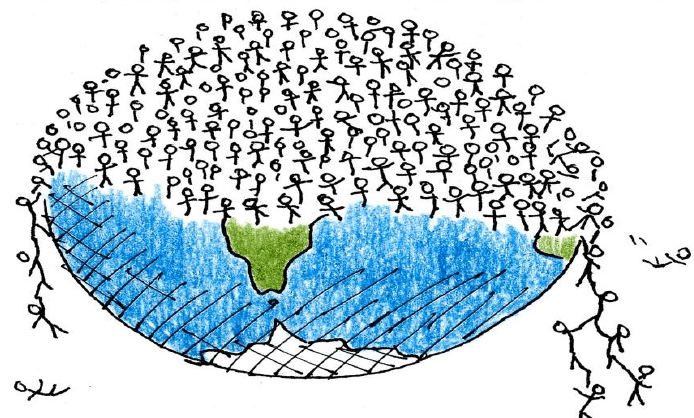
While watching 2020 unfold has been like watching someone set themself on fire with a bucket of bacon grease and a firecracker, one morning I stumbled on something that made me smile, and then jump for joy: A new study found that the global human population might peak at just under 10 billion people in the 2060s before tapering off to 8.8 billion by 2100. What miracle could achieve such a slowdown in human reproduction after a century of smack-yourself-in-the-face runaway growth? It’s not war, or nuclear holocaust, or plague (COVID-19, as tragic as its mishandling has been by certain governments, will do little to slow down population growth). It’s two things, both wonderfully non-violent: women’s education, and access to birth control. The new findings, published in the medical journal The Lancet, differ from other population forecasts, most importantly by the United Nations Development Programme (UNPD) and the Wittgenstein Centre, by predicting that the global population will peak sooner than expected and fall quicker than anticipated (though still, by 2100, the Earth would house more humans than the 7.8 billion of us here today). This was good news. No, no, this was freaking great news. Because if this research — which made some clever shifts in how it analyzed the data and predicted the future — could be believed, it could mean that Planet Earth, in all its ecological glory, might just survive our current devastating onslaught and begin to recover in the coming centuries. Assuming we, of course, actually deal with climate change. A big assumption. However, no one else seemed to see it that way. Coverage of the paper’s findings looked more like Munch’s “The Scream.” Perhaps the most ridiculous of these articles came from the BBC, which spent about 1,000 words freaking out over the idea that the human population won’t go on growing forever and societies might have to … adapt. Oh, no! Humans have never had to do that. There is only a single mention of the environment in the BBC article………. Will there be economic challenges? Sure. But I’d hazard the challenges posed by an aging population are going to be far easier to solve than those posed by a total breakdown of Earth’s ecological limits, something we’re already dangerously close to. When it comes to an older population, we already have potential solutions and examples to soften the impact, such as automation, robotics, policy shifts, new ideas like universal basic income, and evolving views around economics. Maybe we don’t have to play the neoliberal capitalism game forever? Maybe we could increase funding for the care of the elderly instead of giving billionaires tax cuts or spending trillions on the military?…… While the research clearly bemoans the challenges of a world where women have fewer children, the alternative is quite simply ludicrous. Is the human population — already tearing the seams of our planetary ecological limits — supposed to just go on growing forever? Perhaps 10 billion humans just isn’t enough and we should aim for 20, 40, why not 100 billion people? How to feed, house and clothe us all? Oh, no worries, by then I’m sure we’ll have terraformed Mars — easily done on a planet we have never set foot on — and invented light-speed travel to bounce around the galaxy. Ha! Let’s get back to reality: if we can’t even take care of the planet that cradles us, what chance do we have of making good on others? The only alternative to endless population growth is population decline. And the only alternative to wrecking our Earth is treating it differently. And this, of course, highlights the problem with our obsession with GDP and never-ending economic growth. As has been pointed out by many conservationists (originally by the economist Kenneth Boulding in the 1960s), “Anyone who believes in indefinite growth…on a physically finite planet, is either mad or an economist.” ……. humans will be fine — if we avoid ecological catastrophe and total climate breakdown. And a slowing population allows us to have a bit of a better chance on both of those. I say “a bit” because human population is just one part of the equation. The other is consumption. We might miss the worst of the predicted population growth, but we still have to rein in our material consumption.
Just don’t tell the economists that. Meanwhile, I’ll celebrate a little. Our incredible, nonviolent revolution of contraceptives, birth control, women’s rights, and education for girls might just prevent our species from destroying the world. Citation: Vollset, S. E., Goren, E., Yuan, C., Cao, J., Smith, A. E., Hsiao, T., … Murray, C. J. (2020). Fertility, mortality, migration, and population scenarios for 195 countries and territories from 2017 to 2100: A forecasting analysis for the Global Burden of Disease study. The Lancet. doi:10.1016/s0140-6736(20)30677-2 https://news.mongabay.com/2020/09/the-best-news-of-2020-humanity-may-never-hit-the-10-billion-mark/
|
|
How Big Oil Misled The Public Into Believing Plastic Would Be Recycled
These commercials carried a distinct message: Plastic is special, and the consumer should recycle it.
It may have sounded like an environmentalist’s message, but the ads were paid for by the plastics industry, made up of companies like Exxon, Chevron, Dow, DuPont and their lobbying and trade organizations in Washington.
The oil industry makes more than $400 billion a year making plastic, and as demand for oil for cars and trucks declines, the industry is telling shareholders that future profits will increasinglycome from plastic.
an industry that didn’t want recycling to work. Because if the job is to sell as much oil as you possibly can, any amount of recycled plastic is competition.
Analysts now expect plastic production to triple by 2050.
How Big Oil Misled The Public Into Believing Plastic Would Be Recycled, NPR, LAURA SULLIVAN,– 11 Sept 20 Laura Leebrick, a manager at Rogue Disposal & Recycling in southern Oregon, is standing on the end of its landfill watching an avalanche of plastic trash pour out of a semitrailer: containers, bags, packaging, strawberry containers, yogurt cups.
None of this plastic will be turned into new plastic things. All of it is buried.
“To me that felt like it was a betrayal of the public trust,” she said. “I had been lying to people … unwittingly.”
Rogue, like most recycling companies, had been sending plastic trash to China, but when China shut its doors two years ago, Leebrick scoured the U.S. for buyers. She could find only someone who wanted white milk jugs. She sends the soda bottles to the state.
But when Leebrick tried to tell people the truth about burying all the other plastic, she says people didn’t want to hear it.
“I remember the first meeting where I actually told a city council that it was costing more to recycle than it was to dispose of the same material as garbage,” she says, “and it was like heresy had been spoken in the room: You’re lying. This is gold. We take the time to clean it, take the labels off, separate it and put it here. It’s gold. This is valuable.”
But it’s not valuable, and it never has been. And what’s more, the makers of plastic — the nation’s largest oil and gas companies — have known this all along, even as they spent millions of dollars telling the American public the opposite.
“If the public thinks that recycling is working, then they are not going to be as concerned about the environment,” Larry Thomas, former president of the Society of the Plastics Industry, known today as the Plastics Industry Association and one of the industry’s most powerful trade groups in Washington, D.C., told NPR………. Continue reading
The United Nations weather agency on the impact of climate change on the cryosphere

Climate change: UN agency laments northern summer’s ‘deep wound’ to Earth’s ice cover https://www.9news.com.au/world/climate-change-news-un-agency-laments-summers-deep-wound-to-earth-ice-cover/52152578-420d-40af-932f-cab14f5af6ac, By Associated Press-Sep 1, 2020 The United Nations weather agency says this summer will go down for leaving a “deep wound” in the cryosphere — the planet’s frozen parts — amid a heat wave in the Arctic, shrinking sea ice and the collapse of a leading Canadian ice shelf.
***************************************
Arctic melting permafrost a serious problem (and they want to put Small Modular Nuclear Reactors there!)

 Destabilising of infrastructure in Arctic regions , as permafrost melts, is a compelling reason why it is madness to plan for Small Modular Nuclear Reactors in Northern Canada
Whatever Happened To … The Melting Permafrost? 0893 KPCCC, Nadia Whitehead | NPR | September 6, 2020 “…………… It’s not just warmer temperatures that pose a problem for the permafrost. Scientists are now investigating whether rainfall could be causing serious issues in the Arctic’s permafrost – with repercussions for humans.
Since 2013, Fairbanks, Alaska, has had two of the wettest years in recorded history. A total ofo 14.6 inches of rain fell in the summer of 2014; it was the wettest summer yet. And that’s not a good thing for permafrost, says Thomas Douglas, a geochemist in the U.S. Army Corp of Engineers.
Permafrost — completely frozen ground composed of materials like soil, rocks and even bones and plants — makes up a nearly a quarter of the Northern Hemisphere. Much of it has been frozen for thousands of years.
Warming temperatures have begun to thaw permafrost, and now, increased rainfall seems to be intensifying the problem, according to Douglas’ latest study in Climate and Atmospheric Science, published in July.
“In general, across the arctic, the thought is that things are getting wetter,” Douglas says, but particularly in Fairbanks. “2014 and 2016 were the #1 and #3 summer precipitation years in what was then a 90-year record. Shattering records like this is just really unique.”……….
The thaw was worse in some locations more than others, depending on the terrain where measurements were taken. Forests and mossy landscapes seemed to protect the permafrost. There, for every additional inch of rain, the permafrost thawed by an additional quarter of an inch.
But in locations where human activity – such as trails and clearings — had altered the land, the thaw was worse. For every additional inch of rain, the researchers saw an additional inch of thaw. At one particular site, permafrost thaw depth grew from 47 inches in 2013 to nearly 75 inches in 2017.
Douglas explains, “When you remove vegetation, that’s like leaving the lid open on your cooler on a summer day. It allows heat and water to get down in the permafrost pretty rapidly.”
Out of all the team’s research, Douglas says their most important finding was that thinner layers of thawed permafrost seem to be vanishing — literally thawing away……….
Dmitry Streletskiy, a professor at George Washington University who specializes in permafrost, says that Douglas’s study is a great contribution to permafrost research. However, he emphasizes that the study was conducted in a boreal ecosystem, a sub-arctic region with warmer temperatures and relatively warm permafrost. ……..
Streletskiy agrees that permafrost is degrading on a global scale due to climate change. Its impacts are starting to show — and zombie pathogens shouldn’t be our only concern.
He and Douglas both point to the Norilsk oil spill in Russia, where an oil tank spewed more than 150,000 barrels of diesel into the arctic, and officials have been racing to clean it up. Many experts believe thawing permafrost is to blame; the oil tank, which sat on permafrost, collapsed in May.
What’s more, permafrost thaw can lead to deterioration in infrastructure, such as pipelines, railroads and homes, Streletskiy explains. “Small changes in temperature can affect how much weight a foundation built on permafrost can support. Say for example at -10 degrees, the foundation can support 100 tons, but at -8 degrees, it can only support 50 tons.”
For people who don’t live near the oil spill or in arctic regions, it’s easy to forget about permafrost. “Out of sight, out of mind,” Douglas says. But the thaw could one day affect everyone.
An estimated 1,400 to 1,600 billion metric tons of carbon are currently frozen in the permafrost. “There are a lot of questions about what’s going to happen when that [carbon]starts to thaw,” Douglas says……….. https://www.scpr.org/news/2020/09/06/94337/whatever-happened-to-the-melting-permafrost/
Rupert Murdoch’s British papers delayed as climate protesters stop the presses
 Rupert Murdoch’s British papers delayed as climate protesters stop the presses, SMH 6 Sept, 20, London: Distribution of several British newspapers was disrupted on Saturday after climate change activists blockaded printworks used by Rupert Murdoch’s News UK, publisher of The Times and The Sun, drawing condemnation from Prime Minister Boris Johnson.Extinction Rebellion said nearly 80 people had blocked roads leading to two printworks, at Broxbourne in Hertfordshire, north east of London, and at Knowsley, near Liverpool. Hertfordshire police said they made 42 arrests and Merseyside police made 30.
The Murdoch-owned Newsprinters works also print the Daily Mail, the Daily Telegraph and the Financial Times. Campaigners said they had taken the action to highlight what they regard as the newspapers’ failure to accurately report on climate change. ……….
The blockade was part of more than a week of protests by Extinction Rebellion, which says an emergency response and mass move away from polluting industries and behaviours is needed to avert a looming climate cataclysm.
On Saturday it also protested in central London, including holding a “die-in” in front of Buckingham Palace, where demonstrators lay under white sheets to represent corpses. …….. https://www.smh.com.au/environment/climate-change/rupert-mudoch-s-british-newspapers-delayed-as-extinction-rebellion-protesters-stop-the-presses-20200905-p55sqr.html
1 This month

of the week – Australians for War Powers Reform (AWPR)
To see nuclear-related stories in greater depth and intensity
 Antinuclear