$15 billion in investment as Abbott govt tries to trash renewable energy industries
 Clean energy sector warns on RET http://www.businessspectator.com.au/news/2014/7/9/policy-politics/clean-energy-sector-warns-ret STAFF REPORTER 9 July 14, The clean energy industry has hit back at calls for changes to the current renewable energy target, warning that $15 billion in investment could be at risk along with Australia’s profile as a low sovereign risk country, The Australian reports.
Australia’s largest infrastructure investor, IFM Investors, and Spanish firm Acciona have both said they could avoid Australia as a future investment destination should a push to alter the RET succeed.
“If governments flip-flop with policy to the extent that they drive the renewable energy sector out of this country and foreign investors away from this country, don’t expect to be able to attract them back in a hurry,” Andrew Thomson, managing director of Acciona Energy in Australia, said, according to The Australian.
Similar sentiments were echoed by Brett Himbury, chief executive of IFM, who noted the long timeframe for renewable energy investments meant policy uncertainty could cripple the sector.
The comments come amid a push from 25 lower house Coalition MPs to make changes to the current renewables scheme.
Industry minister, Ian MacFarlane, pre-empting Parliament over Australian Renewable Energy Agency – Christine Milne
 Ricky Muir seeking to save the Australian Renewable Energy Agency Lenore Taylor, political editor theguardian.com, Tuesday 8 July 2014 “……….Given that Arena may now not be abolished, the Greens leader, Senator Christine Milne, has written to the industry minister, Ian MacFarlane, complaining that he is pre-empting the parliament by refused to renew the contracts of Arena board members.
MacFarlane’s actions will mean that within a few weeks the secretary of the industry department is the only remaining board member of a multi-million-dollar authority.
“As you will be aware, Arena is a statutory authority, and the future of the institution is not subject to the government’s sole discretion. I therefore urge you to appoint board members until the will of the parliament is clear,” she wrote.
“Without appointing board members, the government would frustrate the intention of the act and place an undue workload on the secretary of the department,” she wrote.
Regarding Muir’s amendment, Milne said “the Greens welcome Ricky Muir’s support for the renewable energy agency and we hope that he will bring his Palmer United party colleagues along with him.”…..http://www.theguardian.com/world/2014/jul/08/ricky-muir-seeking-to-save-the-australian-renewable-energy-agency?cmp=wp-plugin
Three cheers for South Australia’s renewable energy progress, and rejection of nuclear power
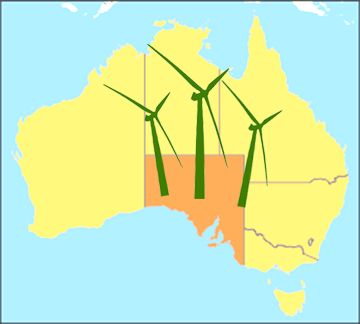 Dennis Matthews, 8 July 14, I’m not a nuclear physicist, although I suspect I know a lot more about the subject than the average journalist or even a Professor of Climate Change cum nuclear policy expert.
My faith in the Australian people is reinforced by their consistent rejection of nuclear power, and this includes the Liberal Government that abandoned its plans to build a nuclear power station in NSW; it came as no surprise that the main driver for that plant was nuclear weapons aspirations.
For all of those sensible Australians from all sides of politics, who could think for themselves, to see the huge strides that solar and wind energy have made, not just in South Australia but in Australia and the world as a whole, must be very gratifying.
Whilst other countries are now struggling with the aftermath of nuclear fervor Australia has by-passed that whole sorry saga. With only one relatively small nuclear reactor in operation and minimal nuclear waste to be managed, Australia can hold its head high on the world stage.
Japan’s P.M. in Australia- talks with Abbott will ignore Fukushima!
 Abbott and Abe should be talking about Fukushima Japanese Prime Minister Shinzo Abe is making an official visit to Australia this week talking free trade and increased resource and defence co-operation. But he should be talking about Australia’s role in fueling Fukushima, says Dave Sweeney. http://www.sbs.com.au/news/article/2014/07/07/comment-abbott-and-abe-should-be-talking-about-fukushima
It would be fitting for the Australian and Japanese PM’s to acknowledge the October 2011 statement by Robert Floyd, the director general of DFAT’s Australian Safeguards and Non-Proliferation Office, that confirmed to the parliament that “Australian obligated nuclear material [uranium] was at the Fukushima Daiichi site and in each of the reactors”.
It would be timely for the leaders to commit to an independent cost-benefit assessment of Australia’s uranium trade, as directly requested by the UN secretary general Ban Ki Moon in the wake of the accident and supported by a recent Senate Inquiry as a pre-condition before any planned new uranium sales. Aptly enough, the Australian uranium sector has been hard hit by the market fallout from Fukushima and low uranium prices have seen existing uranium mines close down. New uranium mining projects are being delayed and the sector is in serious trouble. And that’s before mentioning spills such as the December 2013 uranium tank collapse and the leak at Rio Tinto’s Ranger mine in Kakadu. Ranger got the federal go ahead to resume processing operations last month but the troubled site remains under pressure and under-performing.
Australia also continues to uncritically supply our existing uranium customers, despite evidence of unsafe practices in countries like South Korea. Our yellowcake deal with Russia also deserves greater scrutiny, especially in the light of escalating tensions in Ukraine, as the International Atomic Energy Agency has not carried out any inspections there since at least 2001. We aggressively push new uranium deals to countries like India, whose nuclear industry has been called unsafe by its own auditor general, and which point blank refuses to sign the global nuclear non-proliferation treaty.
PM Abe’s visit is an ideal time to reflect on the very nature of Australia’s uranium – it is not like any other mineral.
Uranium can fuel both nuclear reactors and nuclear weapons and it all becomes radioactive waste. Australia is home to around 40% of the worlds’ uranium, and the decisions we make matter. In the shadow of Fukushima, we need to review the costs and consequences of our uranium trade at home and abroad and act on the UN’s Inquiry call.
If our political leaders continue to put the interests of a high risk, low return industrial sector before those of our nation and region, the consequence is that it is likely that Australia’s uranium sector will fuel future Fukushima’s.
It is said that those who do not heed the lessons of history are doomed to repeat them – we must not allow this to happen. It is time for an independent assessment of the domestic and international costs and consequences of Australia’s uranium trade and it is time for our leaders to acknowledge the increasingly obvious – our shared energy future is renewable, not radioactive.
Illawarra Aboriginal leader Sharralyn Robinson rejects Tony Abbott’s “unsettled Australia” views
Illawarra Aboriginal leader reacts to Abbott’s ‘unsettled’ speech, Illawarra Mercury By BEN LANGFORD July 4, 2014, Prime Minister Tony Abbott’s comments that Australia was “unsettled” before British “foreign investment” arrived in 1788 were out of step with a great number of Australians who recognised Aboriginal history, Illawarra Aboriginal leader Sharralyn Robinson said on Friday.
Mr Abbott surprised many with his comments, made in a speech about foreign investment on Thursday night.
“Our country is unimaginable without foreign investment,” Mr Abbott said.
“I guess our country owes its existence to a form of foreign investment by the British government in the then unsettled or, um, scarcely settled, Great South Land.”
Ms Robinson, the acting chief executive of the Illawarra Local Aboriginal Land Council, said more than 40,000 years of Aboriginal history needed to be remembered.
“It’s very disturbing to think we’ve got a Prime Minister who isn’t aware of what was here prior to invasion,” she said. “This country was very settled. We had our laws in place, we had our Parliament houses, our opera houses, our hospitals, our homes.”
Ms Robinson said most Australians did not cling to the myth that Australia was uninhabited…….
Mr Abbott’s comments exposed him to criticism that he had not moved on from the old doctrine of terra nullius – nobody’s land – that was dumped by the High Court last century.
Northern Territory Labor senator Nova Peris said Mr Abbott’s comments were “highly offensive, dismissive of indigenous peoples and simply incorrect”……http://www.illawarramercury.com.au/story/2396912/illawarra-aboriginal-leader-reacts-to-abbotts-unsettled-speech/?cs=300
Australia in desperate need of true history education, and a Treaty with Indigenous people
 Tony Abbott, terra nullius and Warren Mundine, Independent Australia Natalie Cromb 4 July 2014, “……..This government, and all governments that seek to enact laws in this manner, need a history lesson. A truthful history lesson.
The crux of the matter is that European people settled on land belonging to the Indigenous inhabitants under the falsehood of terra nullius and, thereafter, the settlers imposed English law upon the Indigenous inhabitants, including laws which sought to disperse them from the lands to which they belonged on a spiritual level, and further to diminish and/or destroy the families and culture with which they identified.
This history, however bleak and embarrassing to Australians – and Tony Abbott – is what actually did occur.
Australia needs a leader and a government that will look at the history of this nation and utilise this history as a lesson in tolerance and how to be more appreciative of a culture that owned and cared for this land for at least 40,000 years before European settlement occurred.
This nation needs leaders that understand the racial divide of this nation and how to go about correcting and bridging this divide.
There are two key and pressing ways in which to make the first steps to effect dramatic change that will bridge this divide. The first is education and the second is a treaty. Continue reading
Small solar generators have helped electricity utilities
To The Editor The Advertiser, from Dennis Matthews, 6 July 14
In the National Electricity Market (NEM) it is the active participants who determine supply and demand.
The active participants are large electricity generators and large electricity consumers. It is the large generators that determine the wholesale price of electricity and it is large consumers who are able to negotiate with the generators.
Small electricity generators and consumers, such as small businesses and households have always been passive participants whose options are constrained by the active participants.
It makes more sense that large electricity consumers should be charged according to the maximum load they put on the network. Not only would this have a large and predictable effect on peak demand but it would be much easier than the proposal of the Grattan Institute (The Advertiser, 7/7/14) to put the onus on to households.
Thanks to the growth in roof mounted solar panels, peak demand has not only decreased but has been shifted to late in the day, thus making it easier for industry to reduce its demand at times of peak demand.
It’s getting harder for the Murdoch Limited News to convince Australians on Climate Denial
 When will Australia have its Kodak moment on renewable energy? The Conversation, David Holmes, Senior Lecturer, Communications and Media Studies at Monash University 4 July 14, Ever since Clive Palmer announced that the Palmer United Party (PUP) would support the retention of the Renewable Energy Target (RET), The Australian and News Corp’s tabloids have really ramped up their attack on both renewables and Palmer.
Immediately following the press conference that Palmer shared with Al Gore, News Corp papers presented it as a great victory for the Abbott government and completely downplayed the fact that Palmer had actually committed to retaining the RET, the Climate Change Authority and the Renewable Energy Finance corporation. Continue reading
Australian Capital Territory’s move towards being the nation’s green energy beacon
ACT will pay less to become green energy beacon, Canberra Times July 3, 2014 John Thistleton Funding the ACT’s ambitious 90 per cent renewable energy target by 2020 could be marginally lower from the repeal of the carbon tax and likely watering down of the national RET.
ANU energy and climate economist Dr Frank Jotzo expects renewable energy developers to sharpen competitive bids to supply the ACT with renewable energy because of wider impacts across Australia of climate change policies.
Dr Jotzo says complex interactions will determine how much the ACT needs to do and spend to achieve its 90 per cent renewable target.
The ACT government estimate of each household’s additional energy cost peaking at $250 a year in 2020 was significant, and any change to that was likely to be marginal, Dr Jotzo said.
“In a bigger sense, the more important effect really is the ACT, by continuing with their renewables policy, will stand out more in the national context [and] it will be for the time being, the only remaining beacon of an ambitious renewable energy policy.”………
 Dr Jotzo will be speaking at a seminar on Monday night at the University of Canberra on new energy futures, along with South East Region of Renewable Energy Excellence chair Liz Veitch.
SERREE is establishing an industry cluster in the ACT region of renewable energy generators, businesses, researchers and policymakers, who will collaborate and build a wealth of knowledge, such as best practice on engaging with the community.
“Community engagement is so important to the sustainability of the industry, it’s an area that needs work,” Ms Veitch said. http://www.canberratimes.com.au/act-news/act-will-pay-less-to-become-green-energy-beacon-20140704-zsupt.html#ixzz36dTzRbEr
Tony Abbott’s gaffe about Aboriginal Australia
Tony Abbott says Australia was ‘unsettled’ before British arrived ‘Our country is unimaginable without foreign investment,’ prime minister says in Q&A after speech urging infrastructure spending Guardian, Helen Davidson. 4 July 14 Australia was “unsettled” before the British arrived and owes its existence to Britain’s “form of foreign investment” in the land, Tony Abbott has said…….
“It’s a typical European colonial thing to say and it probably has its origins in the way in which history, for too long, has been taught in this country,” Dodson told Guardian Australia.
“The British view that the place was terra nullius and unsettled still lingers in the minds of people like our prime minister, I’m afraid. It’s very disappointing. I mean he corrected himself, but even ‘scarcely settled’ isn’t quite accurate either because some areas were heavily settled,” he said.
Dodson, who was also Australia’s first Aboriginal and Torres Strait Islander social justice commissioner at the Human Rights Commission, said the lie of terra nullius as the foundation for colonisation is still being perpetuated, despite the high court overturning it in the historic Mabo ruling in 1992.
Dodson said he did find the other portion of Abbott’s comments – that the British arrival was a “form of foreign investment” – highly offensive.
“Foreign investment of troops who slaughter the bloody populace,” he said.
“The first encounter James Cook had with Aboriginal people was to shoot this ancestor of the Sydney people in the back. This hankering for a mythical past is disturbing.” http://www.theguardian.com/world/2014/jul/04/tony-abbott-says-australia-was-unsettled-before-british-arrived
Clean Energy Finance Corporation continuing to fund solar energy initiatives
 Australia’s A$10 Billion Clean-Energy Bank to Reveal Solar Deals http://www.bloomberg.com/news/2014-07-03/australia-s-a-10-billion-clean-energy-bank-to-reveal-solar-deals.html By James Paton Jul 2, 2014 The Australian government’s A$10 billion ($9.4 billion) clean-energy bank is set to announce a number of solar deals in the next week as it looks at investments in industries from mining to manufacturing.
“The interest in solar is across the board,” Clean Energy Finance Corp. Chief Operating Officer Meg McDonald said today after a presentation in Sydney. She declined to give more details.
The CEFC, created as part of former Prime Minister Julia Gillard’s legislation to reduce carbon emissions, invested more than A$800 million in more than 50 projects in its first year, McDonald said. The corporation has been lobbying to stay in business amid efforts by the Tony Abbott-led government to dismantle a price on carbon emissions and related agencies.
Clive Palmer, whose party holds the balance of power in Australia’s upper house starting this month, said last week he will reject Abbott’s plan to get rid of the clean-energy bank. Palmer, joined by former U.S. Vice President Al Gore at a June 26 news conference in Canberra, also said he supports keeping Australia’s renewable energy target to get 20 percent of the nation’s electricity from renewable sources by 2020.
Palmer reiterated that he backs the government’s bid to repeal the price on carbon emissions.
“There had been an acceptance that everything was going to go,” McDonald said in the presentation, referring to Abbott’s plans. Gore’s “intervention allowed space for a rethink about what the future looks like,” she said.
Climate change clearly above party politics
Palmer puts climate in the centre, Financial Review RICHARD DENNISS 01 JUL 2014 Clive Palmer may be voting against a tax but his newfound stance means climate change is no longer just an issue of the left. Richard Denniss….Subscribers only http://www.afr.com/p/opinion/palmer_puts_climate_in_the_centre_7fAcWiGqdYslQyYFZGa4AL
Canberra’s new solar farm plan soon available
 Uriarra solar farm company to reveal new plans to residents 666 ABC Canberra 1 Jul 2014 Uriarra residents will this week see the latest plans for a major solar farm near the rural village in Canberra’s west.
The company behind the project, Elementus Energy submitted a new development application (DA) to build a 26,000-panel solar farm near Uriarra Village, to generate enough electricity to power more than 1,400 homes.
It will make its plans public later this week.
A previous application for solar cells to be built on a paddock across the road from houses in Uriarra Valley was rejected last year.
Resident Judy Middlebrook told 666 ABC Canberra that most of the anger about the project was around the closeness of solar panels to residences.
“From reading this, it looks as if he has moved it back 100 metres or so but we won’t know that until the DA is notified,” she said.
“The mood is now let’s wait and see……http://www.abc.net.au/news/2014-07-01/uriarra-solar-farm-company-to-reveal-new-plans-to-residents/5562570
Only 9% of Australians want Renewable Energy Target cut, but Abbott govt fights on
 Renewable Energy Target Still Under Threat http://www.energymatters.com.au/index.php?main_page=news_article&article_id=4374 While Clive Palmer’s again-found passion for renewables has been encouraging, the battle for the RET is far from over.
It’s becoming increasingly clearer that the government is hell-bent on gutting or destroying the Renewable Energy Target somehow, no matter what evidence is tabled showing that to keep it in its current form is A Very Good Thing.
The Australian has reported on an ABC interview with Prime Minister Abbott, who stated:
“All of us should want to see lower prices and plainly at the moment the renewable energy target is a very significant impact on higher power prices.”
Time and again the impact on residential bills has been shown to be minimal –just a few percent now and that is expected to drop in the next two years to less than 1% of a power bill.
Other fronts are also opening up in the battle.
25 Coalition backbenchers have written to Environment Minister Greg Hunt and Industry Minister Ian Macfarlane asking for the aluminium industry to be given afull exemption from RET associated costs; plus a change to the scheme to reflect a “true” 20 per cent target. This would result in less renewables being installed and heavily impact on jobs and investment in the sector.
Any nobbling of the RET could also come at a huge political cost for the Coalition. There are over 1.4 million solar households in Australia and owners of solar panel systems are generally quite passionate about the technology.
But it’s not just solar owners who support the Renewable Energy Target.
A recent survey indicates the number of people supporting an RET of 20 per cent and above has risen to 71 per cent this year and only 9 per cent want to see the target reduced or abolished altogether.
Are Australians climate dinosaurs?
 Climate of the nation 2014 – Australian attitudes on climate change: are Australians climate dinosaurs? Kristina Stefanova, John Connor, Tim O’Halloran Climate Institute 23 June 2014
Synopsis: Are Australians climate dinosaurs? Climate of the Nation 2014, benchmarking Australian attitudes to climate change, finds that political leaders risk being stuck in the past as public attitudes on climate change and its solutions are on the rebound.
In mid-2014, more Australians think that climate change is occurring and are concerned about impacts, present and future. There is a rebound in desire to see the nation lead on finding solutions and a strong expectation of government to address the climate challenge.
Opposition to carbon pricing has continued to decline and there is a decline in the minority supporting repeal. For the first time more support carbon pricing than oppose it, even though there is lingering confusion around it. http://www.loe.org/shows/segments.html?programID=14-P13-00026&segmentID=2
1 This month


Help Aunty Sue Protect Her Land and Sacred Sites From Destructive Rocket Testing.
.

Australians deserve the truth
about
AUKUS – https://aukuspublicinquiry.com/

PETITION – To: Prime Minister Anthony Albanese and the Australian Labor Government

of the week – Australians for War Powers Reform (AWPR)
To see nuclear-related stories in greater depth and intensity

