International Red Cross and Red Crescent Movement urges all nations to end the nuclear era
 International Red Cross and Red Crescent Movement urges all nations to end the nuclear era https://reliefweb.int/report/world/international-red-cross-and-red-crescent-movement-urges-all-nations-end-nuclear-era , Geneva, 31 July 2020 –Seventy-five years ago, on the morning of August 6, 1945, a B-29 warplane released a terrifying new weapon on Hiroshima.
The nuclear bomb wiped out the city, instantly killing an estimated 70,000 people and leaving tens of thousands more suffering horrific injuries. Three days later, on 9 August, a second nuclear bomb devastated the city of Nagasaki, immediately killing 39,000 people.
By 1950, an estimated 340,000 people had died because of the bombs’ effects, including from illnesses caused by exposure to ionizing radiation. The International Committee of the Red Cross (ICRC) and the Japanese Red Cross Society witnessed the unimaginable suffering and devastation, as medical and humanitarian personnel attempted, in near-impossible conditions, to assist the dying and injured.
The 75th anniversary of the bombings of Hiroshima and Nagasaki comes even as the risk of use of nuclear weapons has risen to levels not seen since the end of the Cold War. Military incidents involving nuclear states and their allies have increased in frequency, and nuclear-armed states have made explicit threats to use nuclear weapons.
Additionally, agreements to eliminate existing arsenals are being abandoned as new nuclear weapons are being developed, putting the world on the dangerous path of a new nuclear arms race. These developments add urgency to the international community’s efforts to prohibit and eliminate these unacceptable weapons. The indisputable evidence of their catastrophic impact makes it extremely doubtful that their use could ever comply with international humanitarian law.
The horror of a nuclear detonation may feel like distant history. But today the risk of nuclear weapons being used again is high. Treaties to reduce nuclear arsenals and risks of proliferation are being abandoned, new types of nuclear weapons are being produced, and serious threats are being made. That’s an arms race, and it’s frightening. We must push all states to ban nuclear weapons and push nuclear weapons states to negotiate, in good faith, steps towards their elimination,” said Peter Maurer, president of the International Committee of the Red Cross (ICRC).
“The international community would not be able to help all those in need after a nuclear blast. Widespread radiation sickness, a decline in food production, and the tremendous scale of destruction and contamination would make any meaningful humanitarian response insufficient. No nation is prepared to deal with a nuclear confrontation,” said Francesco Rocca, president of the International Federation of Red Cross and Red Crescent Societies (IFRC).
Proving the wide support for a nuclear-free world, 122 states in July 2017 adopted the Treaty on the Prohibition of Nuclear Weapons (TPNW). The treaty will become legally binding for countries that ratify it after 50 do so; to date 40 have. The treaty prohibits the development, testing, production, stockpiling, stationing, transfer, use and threat of use of nuclear weapons. For nuclear-armed states that join the treaty, it provides for a time-bound framework for the verified elimination of their nuclear weapons program.
Mr Maurer and Mr Rocca commended the states that have already joined the TPNW and encouraged all others to follow suit, ensuring the events of 1945 never occur again. The two leaders said it was crucial that the TPNW becomes a new norm of international humanitarian law.
“Not since the end of the Cold War has it been more urgent to call attention to catastrophic consequences and fundamental inhumanity of nuclear weapons. We must signal in a clear and unambiguous manner that their use, under any circumstances, would be unacceptable in humanitarian, moral and legal terms,” said Mr Rocca.
There are over 14,000 nuclear bombs in the world, thousands of which are ready to be launched in an instant. The power of many of those warheads is tens of times greater than the weapons dropped on Nagasaki and Hiroshima.
“Weapons with catastrophic humanitarian consequences cannot credibly be viewed as instruments of security,” said Mr Maurer.
More nuclear scandals in USA, more legal cases coming
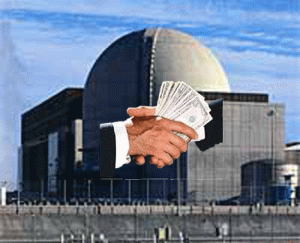 What about the criminal investigation of the project’s failure?
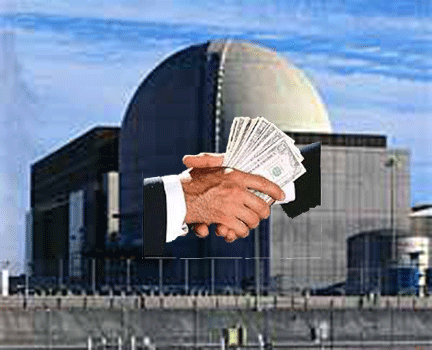
It’s heating up.
The U.S. Attorney’s Office in South Carolina also indicated more charges are coming,
And don’t forget — as a result of the federal investigation, the U.S. Securities and Exchange Commission has sued the company, Marsh and Byrne — alleging they “repeatedly deceived” investors and regulators by hiding the project’s mounting flaws.
That lawsuit is on hold as the criminal probe unfolds.
3 years later: How the fallout from SC’s $9 billion nuclear fiasco continues Post and Courier, By Avery G. Wilks and Andrew Brown awilks@postandcourier.com abrown@postandcourier.com, Jul 31, 2020
- It has been three years since two of South Carolina’s largest electric utilities abandoned their $9 billion effort to build two nuclear reactors, but the legal, political and financial consequences continue to ripple across the Palmetto State.
The scuttled V.C. Summer expansion in Fairfield County is now widely considered one of the biggest business failures in the state’s history. The announcement of the project’s cancellation on July 31, 2017, shook South Carolina’s power industry, state government and business community.
The two homegrown S.C. utilities that partnered on the project were thrown into disarray. Investigations were initiated by state lawmakers, financial regulators and federal law enforcement officials.
The state and federal court systems were flooded overnight with lawsuits by investors, ratepayers, construction workers and lenders. The state regulatory system that backed the project for nearly a decade was called into question.
And more than 1.7 million utility customers with S.C. Electric & Gas, Santee Cooper and the state’s 19 local electric cooperatives realized they might be forced to pay billions of dollars more for a power plant that will never produce a watt of electricity.
Much has changed since Santee Cooper and SCE&G’s leaders suddenly announced the project’s collapse. But the saga isn’t over quite yet. Here is a breakdown of where things stand. Continue reading
Global sea level rise: we need to start planning now
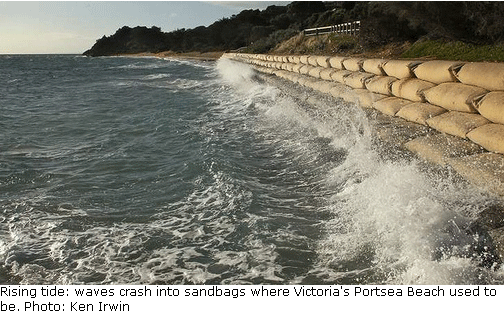 RISING GLOBAL FLOOD RISK DEMANDS ACTION, PURSUIT, 31 Jul 20,
By the end of the century tens of millions more people and trillions of dollars more of the world economy will be at risk of being flooded as sea levels rise We know climate change will cause rising sea levels and increase the frequency of storms and extreme waves, putting large stretches of land at greater risk of flooding. But just how bad will it be?
It is the sort of question that has long frustrated strong policy action on countering and mitigating climate change……
In what is the most comprehensive effort yet to assess the global risks of rising sea levels, researchers have now estimated that in the next 80 years the flood risk across the world will rise by around 50 per cent, putting millions more people and trillions of US dollars more of infrastructure at risk.
In addition, by 2100, extreme floods now thought of as being one-in-100-year events, will be occurring as frequently as every 10 years across much of the world – an increased risk of ten times.
According to the University of Melbourne-led study now published in Nature: Scientific Reports, the land area exposed to an extreme one-in-100-year flood event will increase by more than 250,000 square kilometres, an increase of 48 per cent to over 800,000 square kilometres.
In concrete terms the study’s estimates translate into about 77 million more people being at risk of experiencing flooding, a rise of 52 per cent to 225 million.
The economic risk in terms of the infrastructure exposed will rise by $US3.5 trillion, an increase of 46 per cent to $US11.3 trillion…….
According to the University of Melbourne-led study now published in Nature: Scientific Reports, the land area exposed to an extreme one-in-100-year flood event will increase by more than 250,000 square kilometres, an increase of 48 per cent to over 800,000 square kilometres.
In concrete terms the study’s estimates translate into about 77 million more people being at risk of experiencing flooding, a rise of 52 per cent to 225 million.
The economic risk in terms of the infrastructure exposed will rise by $US3.5 trillion, an increase of 46 per cent to $US11.3 trillion………..
It’s showing that whole coastal communities are at risk of being devastated so we need urgent action.
“Curbing rising greenhouse gases is critical, but much of the predicted sea level rise is already baked-in – it will happen irrespective of what happens with greenhouse gases. So we need to adapt.
“This may mean building coastal defences like those already undertaken in the Netherlands. In other locations it may involve retreating populations from coastal areas.”
And Ms Kireczi notes that like many of the consequences of climate change, some low and middle income countries (LMICs) are particularly exposed.
For example, major populations in South-east and South Asia are at risk. But major populations in wealthier regions are also at risk including parts of China, Northern Europe and the United States.
“We need to start planning now the long-term investments in coastal defences, like dykes and sea walls, that we are going to need to protect vulnerable populations and assets.” https://pursuit.unimelb.edu.au/articles/rising-global-flood-risk-demands-action
Heat shuts down nuclear reactors in France

 EDF warns heatwave may force brief outage for 2.6 GW Golfech reactors, S and P Global, London — Rising temperatures may lead to output restrictions at France’s 2.6 GW Golfech nuclear power plant from July 31, operator EDF warned. “Due to the temperature forecasts on the Garonne, production restrictions are likely to affect EDF’s nuclear power plant at Golfech,” it said July 27. 28 Jul 2020 Author Andreas Franke , Editor Felix Fernandez
HIGHLIGHTS
Restrictions focus on July 31 to August 3 period.
Mini-heatwave only forecast to last until weekend
July’s nuclear average above expectations at 30 GW
London — Rising temperatures may lead to output restrictions at France’s 2.6 GW Golfech nuclear power plant from July 31, operator EDF warned.
“Due to the temperature forecasts on the Garonne, production restrictions are likely to affect EDF’s nuclear power plant at Golfech,” it said July 27.
This could lead to “unavailability of both units” until August 2.
France’s most southerly reactors, located between Toulouse and Bordeaux on the Garonne river, were some of the most impacted units during an extended heatwave last summer when air temperatures rose above 40 C in late June.
The current spell of hot weather is not forecast to stretch beyond the weekend with Meteo France not yet characterizing it as heatwave despite measuring the highest temperature so far this year at nearby Albi at 39.9 C on July 27.
In 2019, temperatures briefly peaked in late June above 40 C amid extended spells of extreme hot weather, increasing river temperatures above critical levels.
Grid operator RTE forecasts power demand to peak above 55 GW on July 31 with average weighted temperatures 7 C above norms.
In June 2019, French demand spiked close to record summer highs of 59.5 GW as temperatures reached 45 C in some regions of southern France.
Around two-thirds of France’s 56 reactor units are river-cooled, with some restrictions due to high temperatures stretching into autumn during past summers…. https://www.spglobal.com/platts/en/market-insights/latest-news/electric-power/072820-edf-warns-heatwave-may-force-brief-outage-for-26-gw-golfech-reactors.
Big doubts about the future of nuclear energy in the UK

 Ministers challenged on future of UK nuclear energy
Industry dogged by doubts about China and rise of renewables calls for clarity, Ft.com, Harry Dempsey in Somerset and David Sheppard in London 31 Jul 20,
Safety concerns about the rush to put nuclear reactors on the moon
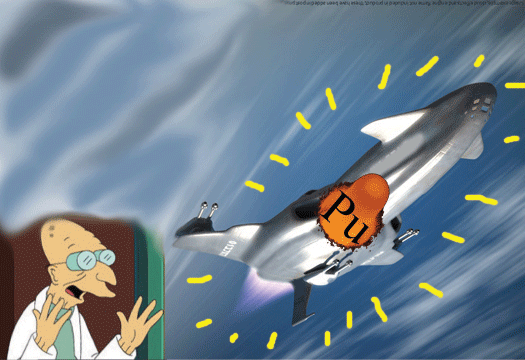 America Wants to Put a Nuclear Power Plant on the Moon
What happens to all that highly enriched uranium in space? Popular Mechanics, BY CAROLINE DELBERT, JUL 30, 2020
- The U.S. Department of Energy (DoE) is looking for technology partners to help power the moon.
- This could begin a project that later includes powering a Mars surface mission.
- The Union for Concerned Scientists doesn’t want highly enriched uranium in space.
Scientists at the U.S. Department of Energy’s (DoE) Idaho National Laboratory have a new design for a nuclear power plant they say could allow humans to more easily live on the moon. As part of a form plan, the scientists say they want to have the fission reactor, safe launch, and landing system ready by 2027
What are the challenges of generating nuclear energy on the moon?
Design Development Today reports that the Union of Concerned Scientists expressed, well, concerns:
“Edwin Lyman, director of Nuclear Power Safety at the Union of Concerned Scientists, a nonprofit, said his organization is concerned the parameters of the design and timeline make the most likely reactors those that use highly enriched uranium, which can be made into weapons. Nations have generally been attempting to reduce the amount of enriched uranium being produced for that reason.”
While the Idaho National Laboratory and the DoE broadly are pushing for “advanced” reactor technology in terms of issues like modularity and safety, the “parameters of the design and timeline” they refer to—in this case advocating for a small, reliable, space-friendly design in just 6 years—almost definitely rules out the modular reactors being developed and certified now.
To fully test and regulate these reactors—and design the special edition to send to the moon in this timeframe—is probably impossible. To rush any nuclear approval is a terrible idea, not just for safety, but also for a public that’s already shy about nuclear energy.Technology like thorium fuel is still far from ready for the market….
Drones could be a real danger to nuclear facilities

What Happens When A Drone Comes For A Nuclear Reactor? Forbes, Kelsey D. Atherton, 31 Juky 20.
How seriously, exactly, should a nuclear reactor take the threat from a quadcopter?
This question sits at the center of a long investigation by The War Zone, built upon a trove of documents about a curious pair of incidents in September 2019. As the authors report:How seriously, exactly, should a nuclear reactor take the threat from a quadcopter?
This question sits at the center of a long investigation by The War Zone, built upon a trove of documents about a curious pair of incidents in September 2019. As the authors report:
The observed drone flights on September 29th were followed by multiple reported sightings on the night of September 30th. The full tale, about what action was taken, and what risks were prioritized, is worth reading in full, as it gives a deep sense of prioritization and uncertainty in the face of novel concern.
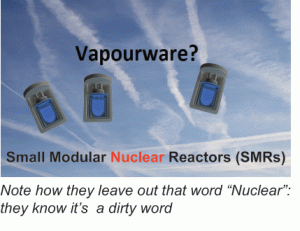
Examining propaganda for NuScam’s small nuclear reactor
 Derek Abbott shared a link. Nuclear Fuel Cycle Watch Australia, 30 July 20
New Mexico Governor opposes nuclear waste dump in that state
 Gov. argues against Holtec nuclear storage site, Albuquerque Journal , BY THERESA DAVIS / JOURNAL STAFF WRITER Gov. argues against Holtec nuclear storage site, Albuquerque Journal , BY THERESA DAVIS / JOURNAL STAFF WRITER
Tuesday, July 28th, 2020 Gov. Michelle Lujan Grisham sent a letter to President Donald Trump on Tuesday, arguing against a proposed nuclear waste interim storage facility in southeast New Mexico.
The proposed Holtec International site would store 500 stainless steel canisters of the nation’s spent nuclear fuel on 1,000 acres between Carlsbad and Hobbs, with a full storage capacity of 10,000 canisters. “New Mexico has grave concerns for the unnecessary risk to our citizens and our communities, our first responders, our environment, and to New Mexico’s agriculture and natural resource industries,” Lujan Grisham wrote in the letter…… The governor said it would be “economic malpractice” to store spent nuclear fuel underground in a region that depends on agriculture and oil and gas. She added that a “perceived or actual nuclear incident” could disrupt those industries. “The proposed (facility) would join the ranks of uranium mining, nuclear energy and defense-related programs that have long created risks to public health and the environment in the state of New Mexico that are disproportionately greater than such risks to the general population of the United States,” she wrote…… https://www.abqjournal.com/1480362/gov-argues-against-holtec-nuclear-storage-site.html
|
The huge, expensive, problematic dismantling of the San Onofre nuclear reactor

Rob Nikolewski, energy reporter for The San Diego Union-Tribune, has been following the progress of decommissioning and storing the radioactive waste.
Nikolewski said one very large chunk classified as low-level nuclear waste has already been transported to a storage site near Clive, Utah. The 770-ton reactor vessel was shipped by rail and a convoy of eight trucks across over 400 miles to its destination. Millions more pounds of low-level waste will be broken down into smaller pieces and transported to Clive, where the private company Energy Solutions has a licensed repository.
However the high-level waste — hundreds of spent fuel rods — remains on-site, since the federal government has failed to approve a long- term storage site for the nation’s high-level nuclear waste. Southern California Edison, which owns the plant, has nearly finished transferring canisters of highly radioactive spent fuel rods into over 70 concrete bunkers next to the beach.
Earlier this month the California Coastal Commission approved Edison’s permit for the decommissioning, including removing the cooling pools which originally held the stored spent fuel rods. The Commissioners reserved the right to review the permit in 15 years and if there is evidence of cracking or other problems such as sea-level rise that threaten the integrity of the canisters, the permit holder could be required to move them.
San Diego Congressman Mike Levin is concerned about the safety of the site, which is in his district and has millions of people living within 50 miles. Levin convened a task force that met for a year and recently came out with a report. One recommendation is that since the federal government has not approved a long-term storage site for high-level nuclear waste, the state of California should take more responsibility for how the nuclear waste is disposed of.
Nikolewski said he has not seen any evidence of state officials stepping forward to hold the companies accountable. He said federal law may need to be changed to allow for that.
The distinctive twin domes that are visible from the Interstate 5 will be removed sometime between 2025 and 2027, and decommissioning the plant, including removal of the low-level nuclear waste, should be complete within 6 to 8 years. The high-level waste will remain indefinitely, in bunkers near the beach.
NT $1.1b rare earths mine could help break China stranglehold
NT $1.1b rare earths mine could help break China stranglehold
The $1.1 billion Nolans mine planned for the Territory near Alice Springs could help break a China stranglehold by producing 10 per cent of the world’s rare earths Neodymium and Praseodymium (NdPr). … (Subscribers only)
When it comes to pandemics, prevention will be a lot cheaper than cure
 Cost of preventing next pandemic ‘equal to just 2% of Covid-19 economic damage’ https://www.theguardian.com/world/2020/jul/23/preventing-next-pandemic-fraction-cost-covid-19-economic-fallout World must act now to protect wildlife in order to stop future virus crises, say scientists, Damian Carrington Environment editor @dpcarrington, Fri 24 Jul 2020 The cost of preventing further pandemics over the next decade by protecting wildlife and forests would equate to just 2% of the estimated financial damage caused by Covid-19, according to a new analysis.Two new viruses a year had spilled from their wildlife hosts into humans over the last century, the researchers said, with the growing destruction of nature meaning the risk today is higher than ever.
It was vital to crack down on the international wildlife trade and the razing of forests, they said. Both bring wildlife into contact with people and their livestock. But such efforts are currently severely underfunded, according to the experts.
Spending of about $260bn (£200bn) over 10 years would substantially reduce the risks of another pandemic on the scale of the coronavirus outbreak, the researchers estimate, which is just 2% of the estimated $11.5tn costs of Covid-19 to the world economy. Furthermore, the spending on wildlife and forest protection would be almost cancelled out by another benefit of the action: cutting the carbon dioxide emissions driving the climate crisis.
“It’s naive to think of the Covid-19 pandemic as a once in a century event,” said Prof Andrew Dobson at Princeton University in the US, who led the analysis. “As with anything we’re doing to the environment, they’re coming faster and faster, just like climate change.”
Prof Stuart Pimm at Duke University in the US, part of the research team, said: “Investment in prevention may well be the best insurance policy for human health and the global economy in the future. We could stop future pandemics before they start.”
The UN’s environment chief welcomed the analysis. “The science could not be clearer,” said Inger Andersen. “As we emerge on the recovery side of Covid-19, we cannot afford a piecemeal approach to tackling diseases [from wildlife]. Irrespective of the final bill [for coronavirus], we can say with certainty that action now will save us billions in future costs, and avoid the tremendous suffering that we continue to see around the world.”
The analysis is the latest plea from experts for governments to address the destruction of the natural world and help prevent future pandemics. This month, a UN report said the world was treating the health and economic symptoms of the coronavirus pandemic but not the environmental cause. In June, experts said the pandemic was an “SOS signal for the human enterprise”; while in April, the world’s leading biodiversity experts said more deadly disease outbreaks were likely unless nature was protected.
The analysis, published in the journal Science, was carried out by experts in environment, medicine, economics and conservation. In particular it noted that wildlife enforcement networks are acutely underfunded. The network in south-east Asia has an annual budget of $30,000, while the global wildlife trade body Cites gets $6m a year.
“The wildlife trade is deeply corrupt,” said Dobson. “Some politicians would much rather that it not be stopped in many countries.
The researchers said indigenous peoples who rely on wildlife for food must be protected from any restrictions.
Ending the wild meat trade in China was key, the researchers said, and would require almost $20bn a year. “I was shocked at the number of people employed: it’s several million,” said Dobson. He said there were also very few wildlife veterinarians in China: “The troops in the frontline trenches are missing.”
Akanksha Khatri, head of the World Economic Forum’s nature action agenda, said: “Covid-19 has shown us that human beings and our economic activity depend on the planet’s ecological balance. If we continue to push against this delicate balance, we do so at our peril.”
Stéphane De La Rocque, a veterinary expert at the World Health Orgazisation, said the analysis was much needed and that, after Covid-19, leaders were starting to understand the issue: ““It is the first time that we really have had a discussion about wildlife [and disease] and realised we have no surveillance system for wildlife.”
710 million metric tons of plastic will enter the environment in the next two decades

|
A Billion More Tons of Plastic Could Blanket Earth by 2040, Wired, 26 July 20, Even with immediate action, 710 million metric tons of plastic will enter the environment in the next two decades, scientists show. Welcome to Plastic Planet. IMAGINE YOUR FAVORITE stretch of coastline—whitesand beaches, rocky tide pools, the cliffs of Dover, what have you. Now transport yourself ahead two decades, after plastic production and waste have continued to skyrocket. Humanity is now unloading 29 million metric tons of bottles, bags, and microplastics (little bits smaller than 5 millimeters) into the oceans annually. That means for every meter of your favorite coastline, 50 kilograms—that’s 110 pounds—of plastic is entering the sea every year.“Now imagine that’s happening for every meter of coastline around the world,” says Richard Bailey, who studies environmental systems at Oxford University. “That’s the amount we’re looking at—it’s a colossal amount.”
Over the past few years, scientists have been exposing the hazards of microplastics—or ground-up particles that easily blow around the world and work their way into plants and animals. But all the while, macro-plastics like bottles have been accumulating in the environment, shedding microplastics as they degrade. Writing today in the journal Science, Bailey and his colleagues are publishing the alarming findings of their comprehensive review of the cycle of all this plastic. If we as a species don’t collectively take action, they warn, 1.3 billion metric tons of plastic will flow into the sea and tumble across the land between the years 2016 and 2040. Even with immediate and drastic action, that figure could be 710 million metric tons—460 million of them on land and 250 million in the water. Making matters worse, throughout much of the world people burn the plastic they can’t easily recycle, to the tune of perhaps 133 million metric tons of waste by 2040. That spews dangerous toxins and CO2 (plastic is made of oil, after all), further warming the planet. To model the plastic waste ecosystem, the researchers created eight “geographic archetypes,” instead of picking apart the dynamics of how individual countries handle trash. “We didn’t want it to become a blame game,” says the study’s co-lead author, Winnie Lau, senior manager of the Pew Charitable Trusts’ project on ocean plastic pollution. “What we wanted to do was to understand the problem and how it came about, rather than pointing out specific countries.”…………
Without drastic and immediate measures, the fight against plastic pollution will follow the same path as the fight against climate change: We’ve waited far too long to stop CO2 from accumulating in the atmosphere, and we’re in danger of waiting far too long to turn off the plastic spigot. “What this paper makes clear is, really, any future scenario for a healthy planet is going to require that this kind of year-over-year growth in plastic production has got to stop,” says Leonard. “It began in 1950, and it continues to accelerate. And there’s really no viable solution that doesn’t result in bending that curve.” https://www.wired.com/story/billion-more-tons-of-plastic-could-blanket-earth/ |
|
|
Space archaeology, space junk and weapons, and long-lasting radioactivity

While the nuclear macho men plan more nuclear, and nuclear weapons in space, it seems that it takes a woman, Alice Gorman, to investigate the radioactive pollution on Earth and in space, due to these activities
Nuclear sites still dangerous in 24,000 years, say space archaeologists
Some nuclear tests were conducted also in outer space and nuclear fuel was employed as propellant for rockets. https://www.jpost.com/health-science/nuclear-sites-still-dangerous-in-24000-years-space-archaeologists-say-636379 By ROSSELLA TERCATIN JULY 26, 2020
Gorman said the issue presents two challenging elements: What materials can survive such a long time, and what form of language can be used to deliver the actual message?
“As for the first difficulty, we know that stones and pottery last a very long time,” she said. “But the second point raises a big archaeological question related to symbolic communication. If we look at rock art from 20,000 years ago, we can see that there are pictures of animals, but we do not know what those pictures mean. Therefore, it is possible that our current symbols to mark radioactive sites, the yellow [and] black sign, will be interpreted as an invitation to explore the area, rather than to keep away from it.”
If the UN Outer Space Treaty of 1967 prohibited nuclear weapons in space, the issue of its weaponization remains very relevant.
“Recently, Russia tested an anti-satellite weapon, reawakening the debate,” Gorman told the Post.
She began to work in space archaeology following years of work focused on stone-tool analysis and the aboriginal use of bottle glass after European settlement.
Space archaeology deals with the same issues of regular archaeology, understanding material culture, human behavior and the interaction with the surrounding environment, Gorman said.
Gorman was drawn to space archaeology by the idea of exploring space junk, those many objects that cannot even be seen in the sky circling the Earth. Currently, she is working on the archaeology of the International Space Station.
The recent attempt by Israel to land a robotic unit on the moon with the Beresheet mission represents a very interesting development for space archaeologists, Gorman said.
“For many decades, the only material cultures present on the moon were the American and the Soviet one,” she said. “As new countries have started to reach the moon, this has changed, bringing more diversity to the field.”
The spread of climate denial on Facebook
‘Everybody’s entitled to their opinion – but not their own facts’: The spread of climate denial on Facebook‘The arguments are that people can’t trust scientists, models, climate data. It’s all about building doubt and undermining public trust in climate science’, Independent Louise Boyle, New York @LouiseB_NY, 24 July 20,
An article linking climate change to Earth’s solar orbit went viral last year, racking up 4.2million views on social media and widely shared on Facebook. It was the most-engaged with climate story in 2019, according to Brandwatch.
There was just one problem. It wasn’t true.
Facebook removed the article from Natural News, a far-right conspiracy outlet with 3 million followers, after it was reported.
But the spread of misinformation on the climate crisis by groups who reject climate science continues on Facebook and other social media platforms.
While tech giants have taken steps to remove, or label as false, potentially harmful misinformation on the Covid-19 pandemic, there has been a seeming acceptance of those who spread false theories on the climate crisis.
In August, an op-ed by two members of the CO2 Coalition, a pro-fossil fuel nonprofit with close ties to the Trump administration, was published in the Washington Examiner and subsequently posted to the group’s Facebook page.
The article, which claimed climate models are inaccurate and climate change has been greatly exaggerated, was initially tagged as “false” by five scientists from independent fact-checkers Climate Feedback who said it used “cherry-picked” evidence and deemed its scientific credibility “very low”.
Facebook doesn’t check content but outsources to dozens of third-party groups. A fact-checker’s false designation pushes a story lower in News Feed and significantly reduces the number of people who see it, according to Facebook policies.
The CO2 Coalition did not take the fact-checkers’ decision lying down, branding Climate Feedback “alarmists” and writing an open letter to Facebook CEO Mark Zuckerberg. They succeeded in having the false label removed.
Andy Stone, Facebook’s policy communications director, told the New York Times last week that all opinion content on the platform, including op-eds, has been exempt from fact-checking since 2016…………
1 This month

of the week – Australians for War Powers Reform (AWPR)
To see nuclear-related stories in greater depth and intensity
 Antinuclear