Australia Rejects Calls From The Fossil Fuel Industry To Roll Back 20 Percent Renewable Energy Target, Think Progress, By Stephen Lacey Nov 1, 2012 An independent body set up to consider Australia’s official target of generating 20 percent of its energy needs by 2020 from renewable sources has rejected calls from incumbent utilities and heavy industry to scale back the target. [Renewable Energy World ] ..
According to a report published on October 17 by the American Wind Energy Association (AWEA), 2012 has been a record year for the development of wind power within the United States. The U.S. wind industry has surpassed 50,000 megawatts of electrical power generation capacity, with a total of 4,728 megawatts added this year alone and another 8,430 megawatts in active development throughout 29 states and Puerto Rico. [Renewable Energy World ]….. http://thinkprogress.org/climate/2012/11/01/1121371/november-1-news-australia-rejects-calls-from-the-fossil-fuel-industry-to-roll-back-20-percent-renewable-energy-target/?mobile=nc
Australian Solar Council Slams Discrimination Against Home Solar , Energy Matters, 31 Oct 12, The Australian Solar Council (previously known as AuSES) has expressed serious concerns with regard to the Climate Change Authority’s (CCA) Review of the Renewable Energy Target Discussion Paper.
As we reported after the release of the paper, the CCA has suggested discounting the number ofRenewable Energy Certificates (RECs) accompanying the purchase of home solar power systems; which would further reduce the subsidy available. This would be in addition to the final phasing out of the Solar Credits multiplier next year, already decided previously……. http://www.energymatters.com.au/index.php?main_page=news_article&article_id=3448
Uranium, nuclear power? not economic
 The [2006 Switkowski] report’s caution that nuclear power would probably be between 20 and 50 per cent more costly to produce than power from a new coal-fired plant is even more unpalatable at a time when electricity costs are soaring,
Forget uranium sales, nuclear riches always bomb out by:Terry Sweetman The Sunday Mail (Qld) October 28, 2012 URANIUM has been the biggest disappointment in my life since Santa Claus turned out to be Dad tripping over the Christmas tree while three sheets to the wind.
People of my generation grew up with fantastic promises of clean, limitless energy that drove everything from flying cars to spaceships. Prowling through newspapers of the late 1940s and ’50s, I find that even adults were fed the same reassuring diet under the label of Atoms for Peace, all the while being pumped with pride over bigger and better nuclear weapons to defend them and democracy.
It never seemed to happen, any more than did the endless riches that were to feed through the land when places like Mary Kathleen sent Geiger counters clicking and Australians went into the uranium business, big-time. Continue reading
Petra Ball, Red Cross and Red Crescent – Towards Eliminating Nuclear Weapons
 Changemakers – Petra Ball Pro Bono News, October 29, 2012 Petra Ball, International Humanitarian Law Officer for Australian Red Cross in South Australia, is profiled in Changemakers – a regular column which examines inspiring people and their careers in the Not for Profit sector.
Australian Red Cross is a member of the International Red Cross Red Crescent Movement, the world’s largest humanitarian movement which operates in more than 188 countries. Red Cross has thousands of members, volunteers and supporters who assist in its disaster, international humanitarian law and ongoing everyday work supporting the most vulnerable people in the community, both here and overseas.
What are you currently working on in the organisation?
Planning and preparing for an international conference on nuclear weapons has been almost my sole focus for a number of months now – and here it is, just around the corner! I am really excited about it!
The conference, called Towards Eliminating Nuclear Weapons , focuses on ways to push forward the debate on a legally binding tool to prohibit and ultimately eliminate nuclear weapons, looks at new ways of measuring the humanitarian and environment impacts of use of nuclear weapons and what fantastic initiatives there are coming from civil society – especially young people to keep this critical topic on the radar of the public and the decision makers in our local and international community.
The speakers are all impressive, the topics really stimulating and a weekend in Adelaide in early November is bound to be lovely! One of the great things about the conference is the opportunity to profile the human agency involved in nuclear weapons and we are really glad to focus on the lived experience of nuclear weapons. One of our presenters will be coming from the Marshall Islands, where communities still live with the impacts of nuclear testing, and Junko Morimoto, a Sydney-based survivor of the Hiroshima bombing in 1945 will share her experiences from that time. http://www.probonoaustralia.com.au/news/2012/10/changemakers-petra-ball#
India’s dimming democracy – censoring Australian filmmaker David Bradbury
 Australia’s best-known documentary film-maker, David Bradbury, was prevented by the Tamil Nadu Police from entering Idinthakarai.
The detention is likely to have international ramifications given the stature of Bradbury as a film-maker
 Australian Film-Maker Stopped by Police in Koodankulam, Tamil Nadu By Sri Lanka Guardian October 26, 2012 Chennai, Amid conflicting reports about detention of Australian Film-maker David Bradbury in Koodankulam, we are posting below the updates as we receive them. After deportation of a German tourist and 3 Japanese activists, this is yet another move of stifling democracy by the Government which must be condemned in strongest terms. Continue reading
Drop in Australia’s wholesale energy prices: success of Renewable Energy Target
Renewable energy target succeeding: report THE AUSTRALIAN, : AAP October 25, 2012 AUSTRALIA’S renewable energy target (RET) has driven $18.5 billion of investment in clean power and eroded wholesale energy prices since it was introduced a decade ago, a new report suggests.
The Clean Energy Council analysis released on Thursday finds wholesale prices are as much as $10 per megawatt hour lower as a result of the RET being in place since 2001.
The target is meant to ensure 20 per cent of Australia’s electricity comes from renewable sources by 2020. It’s currently being reviewed by the Climate Change Authority amid speculation that softer demand and the popularity of rooftop solar
panels means the 20 per cent target may be exceeded… Continue reading
Australia’s uranium deal with India increases world’s nuclear war danger
 Once the “intervention” had got under way, hundreds of licences were granted to companies exploring for minerals, including uranium.
Australia’s Uranium Bonanza: Making the World a More Dangerous Place, The Eager Role of Julia Gillard By John Pilger Global Research, October 24, 2012 “…… The poorest, sickest, most incarcerated people on earth provide a façade for those who oversee the theft of their land and its plunder.
Australia has 40% of the world’s uranium, all of it on indigenous land. Prime Minister Julia Gillard has just been to India to sell uranium to a government that refuses to sign the Nuclear Non Proliferation Treaty (NPT) and whose enemy, Pakistan, is also a non-signatory. The threat of nuclear war between them is constant.
Uranium is an essential ingredient of nuclear weapons. Gillard’s deal in Delhi formally ends the Australian Labor Party’s long-standing policy of denying uranium to countries that reject the NPT’s obligation Continue reading
Australia one of many nations taking action on Climate Change
 “Australia is not alone in acting on climate change … in fact Australia is a major player and an emerging leader.”
Australia a major greenhouse player: UN news.com.au LLOYD JONES AAP October 24, 2012 AUSTRALIA is not in “a lonely desert” as the only nation reducing greenhouse gas emissions, but is an emerging leader in
the field, a key United Nations climate change official says.
Christiana Figeures, the executive secretary of the UN Framework Convention on Climate Change, said there was a misconception among many Australians that their nation was acting alone in combating the problem. Continue reading
Australia’s uranium to India – part of a disgraceful saga
 Anxiety about uranium sales to India arises from the poor safety reputation of that country’s nuclear power industry and its development of nuclear weapons in violation of the Nuclear Non-proliferation Treaty
the visit looked for all the world like a sales pitch. The awarding of an Order of Australia to Indian batsman Sachin
Tandulkar was clearly intended to butter up customers for a big purchase.
The truth is that Australia, taking its cue from the US, is not worried about India having nuclear arms. In fact, it fits in nicely with long-term planning in the Pentagon.
The grubby saga of uranium sales to India, CPA 25 Oct 12 Prime Minister Gillard’s visit to India last week was pure pantomime. She met her counterpart, Mr Manmohan Singh, and took part in all manner of events and photo opportunities in an effort to repair Australia’s damaged reputation on the sub-continent –…– and to seal a deal that has made many observers nervous. Continue reading
Carbon tax cost Australia much less than expected
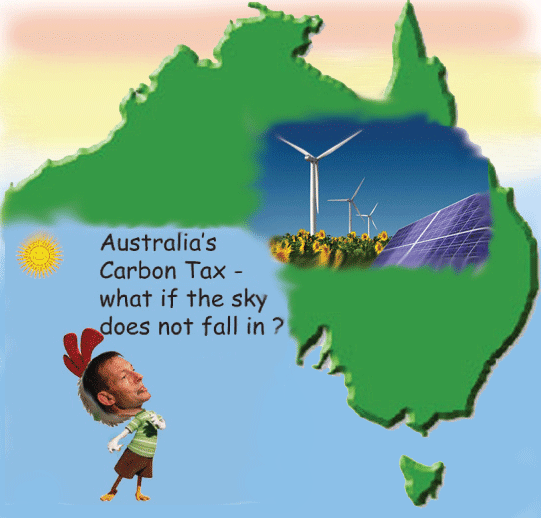
Cost of carbon tax less than estimated The Age, October 25, 2012 Peter Martin THE carbon tax has boosted the cost of living scarcely at all. Despite dire talk of an ”almost unimaginable” increase (Tony Abbott) and $100 for a Sunday roast (Barnaby Joyce) the first official consumer price figures show a far lower impact than predicted by the
Treasury….. http://www.theage.com.au/opinion/political-news/cost-of-carbon-tax-less-than-estimated-20121024-285se.html#ixzz2ALJJiJ5r
Online survey about Australia’s Renewable Energy Target
 The People’s Renewable Energy Target Review http://www.energymatters.com.au/index.php?main_page=news_article&article_id=3436 by Energy Matters, 24 Oct 12 While electricity related carbon pollution in Australia is dropping and 3,000 MW of coal-fired generation is being switched off as a result of the combined impact of the Renewable Energy Target (RET) and the carbon tax, some Big Energy players and industry lobby groups are attempting to slow the development of renewables in Australia the groups say.
“For months now big power companies like Origin Energy have been trying to undermine our Renewable Energy Target. Now it’s time for everyone who loves renewable energy to fight back!” says 100% Renewables; a non-profit group advocating renewable energy.
Together with the Australian Conservation Foundation, the group is asking people across Australia to express their views on how the RET should be working through an online survey that asks a number of related questions and only takes a couple of minutes to complete; with the option of providing additional commentary.
“We will bundle the results up and take them to RET Roundtable events to show the Climate Change Authority the depth of support for the RET in the wider community,” says Andrew Bray, 100% Renewables’ Communications Director.
Submissions to the People’s RET Review are open until October 31, 2012.
A renewable energy target of at least 20% by 2020 was established in 2009 with the support of all major political parties. The Climate Change Authority is currently reviewing the RET and will report its findings at the end of the year. Part of that process are the Roundtable events to be held in Sydney and Melbourne in early November.
Any changes to the Renewable Energy Target may erode investor confidence in clean energy in Australia. The fact a review is even being held is already contributing to uncertainty in the market according to industry sources; a situation exacerbated by some high profile and cashed up parties calling for cuts to the RET.
Queensland’s uranium decision is surprising, in view of uranium market’s collapse
Uranium backflip a speedy decision http://www.couriermail.com.au/news/opinion/uranium-backflip-a-speedy-decision/story-e6frerdf-1226501060691 by:Robert MacDonald :The Courier-Mail October 23, 2012 THE most remarkable thing about the Queensland Government’s unexpected decision to lift the state’s two-decade old ban on uranium mining is the speed of its decision-making process.
It was barely a month ago that Resources Minister Andrew Cripps put the long-dormant issue back on the table by saying there hadn’t been a serious public discussion for years.
And it was less than two weeks ago that Premier Campbell Newman was writing to the Australian Conservation Foundation re-affirming pre-election promises that his Government “has no plans to approve the development of uranium mining in Queensland.”
Yesterday’s announcement caught everyone by surprise – the miners, who were delighted, and environmentalists who immediately described it as “irresponsible, ill-considered and in clear breach of pre-election commitments”.
But what does it mean for Queensland, which hasn’t had an operating uranium mine for 30 years?
In the short term, relatively little. On the raw numbers, uranium mining could one day be a significant part of the state’s economy – the Queensland Resources Council values reserves in the ground at $18 billion, which, in theory, could generate $900 million in royalties.
But the reality is the world uranium market is in poor shape, particularly after the Japanese tsunami, which damaged the Fukushima nuclear power plant.
The spot price for uranium yellow cake is less than US$45 a pound, which one industry insider said was only about two-thirds of the break-even price for an efficient mine.
The announcement will, however, encourage uranium explorers to step up spending. But still, Campbell Newman has gone where no premier has been game to go for more than 20 years. He now needs to convince Queenslanders he’s heading in the right direction.
Australian companies adopting solar energy in droves HYDROGEN FUEL NEWS BY ERIN KILGORE – OCTOBER 23, 2012 Solar energy could be t he key to financial stability
More Australian businesses are making the switch to solar energy in an effort to save money. Energy prices are going up in the country due to the rising tensions, political and otherwise, surrounding fossil-fuels. As it becomes more problematic for oil to find its way to Australia, the cost of the commodity increases. This is beginning to put excessive strain on businesses that could receive the energy they need through renewable sources .
Provincial governments throwing more support behind solar energy It seems that more companies around Australia are taking the notion of renewable energy seriously as energy prices continue to rise. Solar energy, in particular, is becoming extremely popular in Australia due to the country’s near constant exposure to solar radiation. As provincial governments begin to throw their support behind solar energy projects, businesses are looking to make use of the energy generated by these new installations in order to cut down on their electricity bills. Adopting solar energy may also help these companies avoid harsh penalties imposed on them by the government due to new emissions regulations….. http://www.hydrogenfuelnews.com/australian-companies-adopting-solar-energy-in-droves/856403/
Report on Queensland Premier’s uranium push, includes opinion poll
Newman’s uranium backflip means money and jobs to him – what does it mean to you? BY:THE AUSTRALIAN, JOHN MCCARTHY, ROBYN IRONSIDE From:The Courier-Mail October 23, 2012 “…… Premier Campbell Newman’s announcement yesterday came just 11 days after writing to the Australian Conservation Foundation saying he had “no plans to approve the development of uranium in Queensland” .
Mr Newman said the backflip was sparked by Prime Minister Julia Gillard’s trip to India to open negotiations on uranium exports, which put the issue back on the agenda…..
the Government is facing criticism it rushed the decision without consultation after going to the polls claiming it had no plans to lift the ban.
Green groups said it took less than 11 days for Mr Newman to change his mind after he wrote to the Australian Conservation Foundation on October 11 stating that the Government’s position was “crystal clear” and it had “no plans to approve the development of uranium in Queensland”……
it is likely that it will take at least four years for any project to get developed because of the strict environmental approvals needed from both the State and Federal governments.
A hazardous materials port would also have to be built to cope with the exports.
Queensland’s last operating uranium mine, Mary Kathleen, about 80km west of Mount Isa, closed in 1982 after 30 years in use.
The Goss Labor government won office in 1989 with a policy of no new uranium mining, an effective ban that has applied ever since.
Ironically on the exact same day in Brisbane in 1977, 371 people were arrested at an anti-uranium protest in Brisbane, including a Labor senator. http://www.theaustralian.com.au/news/newman-government-backs-resumption-of-uranium-mining-in-queensland/story-e6frg6n6-1226500533462
Red Cross and red Crescent want a nuclear free convention – NOW
AUSTRALIA-NZ PACT FALLS SHORT OF ABOLISHING NUKES IDN-InDepthNews – October 21, 2012
By Neena Bhandari “……. This is where governments should focus their diplomatic efforts. Negotiations need not, and must not, await the entry into force of the CTBT. We need nuclear-free countries to play a leading role, rather than simply waiting for the nuclear-armed countries to act. This is an urgent humanitarian necessity,” Wright told IDN.
Australian Red Cross in conjunction with Flinders University and the Bob Hawke Prime Ministerial Centre at University of South Australia are co-hosting a conference in Adelaide in the first week of November 2012 to advance the debate on the urgent need to develop a legally binding tool to prohibit and ultimately eliminate nuclear weapons. Continue reading
1 This month
17 October, Free Public Talk on Nuclear Issues in South Australia
David Noonan will speak on public interest concerns over the new Roxby Downs Indenture Act 2026 on BHP copper-uranium mining and ore processing in SA, and on how AUKUS may face SA with a High-Level nuclear waste agenda.
Dr Jim Green will discuss international developments in the field of nuclear power including ‘small modular reactors’ and Generation 4 ‘advanced’ nuclear reactor concepts.


Help Aunty Sue Protect Her Land and Sacred Sites From Destructive Rocket Testing.
.

Australians deserve the truth
about
AUKUS – https://aukuspublicinquiry.com/

PETITION – To: Prime Minister Anthony Albanese and the Australian Labor Government

of the week – Australians for War Powers Reform (AWPR)
To see nuclear-related stories in greater depth and intensity

