Christine Milne calls on progressive industry to counter the fear campaign against renewable energy
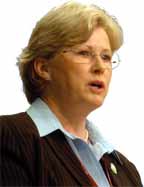 Milne interview: Time for progressive industry to stand up REneweconomy, By Giles Parkinson 16 April 2012 Newly elected Greens leader Christine Milne says it is time for “progressive industry” to stand up and be counted as the debate over the carbon price and complementary measures such as the Renewable Energy Target, the Clean Energy Finance Corp and other measures takes a worrying course.
The Tasmania Senator said in an interview with RenewEconomy that she plans to paint a vision of a low carbon economy that can thrive beyond the inevitable end of the mining boom, but it essential that progressive companies countered the fear campaign against clean energy policies launched by established industry groups.
“I think (these companies) are wondering if Tony Abbott will win the next election and if he does, and they put their heads above the parapet now, that will somehow deny them access or cache with a Coalition government,” Milne said. “But as I say to them, this is the time to stand up and fight for the frameworks necessary for your business.”
Milne also said she would be closely watching the contents of the Clean Energy Finance Corp, for fear that it’s mandate will be “too conservative.”
Here is an edited transcript of the interview:
……..(Milne) – It is a big challenge. But I think there is a real yearning for someone to articulate a vision for Australia that is beyond the mining boom. I think most people realize that the boom will come to an end, that it is not sustainable to talk about a future for Australia which is just about digging it up, cutting it down and shipping it away, and there’s a level of anxiety about where the jobs will come from, what opportunities will there be for my children, how I will be employed into the future when the mining boom comes to an end. There is a lot of concern that Australia is going the way of other places, with increasing levels of inequality and small numbers are benefiting from the boom enormously and the rest are suffering, and there is not much vision as to how to address that. So I think that at one level it is hard, but at another level there is a yearning to hear that there is a bright future and someone needs to paint it for me…..
….Well, there is a concerted campaign from those who want to destroy renewable energy in Australia who say that now we have a carbon price then we should ditch all complementary measures including the RET. That has been there from the start which is why throughout the negotiation I said we needed a carbon price plus, plus, plus, including the RET and the CEFC and I continue to say that……
What I hear around Australia is that people are really pleased about the Carbon Farming Initiative and the Coalition said it won’t repeal that, it has also said it won’t repeal the RET. ….. http://reneweconomy.com.au/2012/milne-interview-time-for-progressive-industry-to-stand-up-16436
ABC running a survey on Australians’ opinions about Climate Change

There’s an ABC doco coming up called ”I can change your mind about climate change”, featuring Anna Rose (AYCC founder) and Nick Minchin (ex Lib senator), followed by a Q & A program on climate change.
 http://www.abc.net.au/tv/changeyourmind/
There’s a survey on the website where they’re attempting to ‘determine Australians differing attitude to climate change’. So far it looks like the climate deniers have all jumped on board and done it
Canberra led in Australia, in what was, globally, the biggest Earth Hour action ever held
 It was the biggest Earth Hour since the symbolic action began in Australia five years ago.
Hour out of this world, Ewa Kretowicz, April 1, 2012 EARTH Hour is not just appealing to people on this planet. The environmental campaign that started in Sydney just a few years ago made its way beyond Earth itself yesterday.
For the first time there were people taking part from the International Space Station, about 390 kilometres above the planet. Dutch astronaut Andre Kuipers had the perfect spot to watch Earth Hour
unfold around the globe from his seat on the station…
.. Canberrans have led the nation for the past three years with almost 60 per cent of residents taking part. Nationally, 41 per cent of the population turned off electrical appliances at the wall and used alternative sources of light. Continue reading
Australia’s campaign for 100% renewable energy, and for Big Solar
 Campaign pushes for Big Yellow power http://www.cairns.com.au/article/2012/04/02/213031_local-news.html , April 2, 2012 The Cairns Post Solar energy stepped into the national spotlight quite literally at the weekend, with the launch of the Big Solar Campaign.
Driven by the Cairns Climate Action Network, the initiative forms part of the wider 100 per cent Renewable Energy campaign, which aims to encourage the development of large scale solar projects across Australia. “As long as we have our power supply tied to fossil fuels … we’re going to have the price of our energy driven up by the fact that as demand goes up for any fuel, prices go up,” Big Solar Campaign launch organiser Jamie David said.
“Solar power is free, so if anyone is concerned about their power bills going up, they should be jumping up and down to demand renewable energy.”
Mr David said the “current aim” of the campaign was to encourage government to support 2000 megawatt large and medium scale solar projects across Australia, which would replace the outgoing coal-fired power stations within the next few years.
One hundred community groups Australia are participating in the 100 per cent Renewable Energy campaign, with Big Solar launched on Saturday to coincide with Earth Hour. For more information on the campaign, visit 100percent.org.au/bigsolar
A billion people take part in Earth Hour. Australian P.M. links it to climate change action
 Light idea now shared by a billion http://www.smh.com.au/environment/energy-smart/light-idea-now-shared-by-a-billion-20120330-1w3is.html#ixzz1qjblt59c March 31, 2012 MORE than a billion people will switch off their lights at 8.30 tonight as a symbol of their commitment to tackle human-induced climate change.
Earth Hour, which started in Sydney in 2007, has now spread to 5251 cities and towns in 147 nations and territories, making it the largest voluntary environment movement in history.
 see this graph – dramatic global growth in Earth Hour Interactive: Earth Hour around the world
The Prime Minister, Julia Gillard, thanked everyone who had pledged to take part, and linked the event to the government’s carbon price plan, which comes into force on July 1.
”What began in Sydney as a simple idea to raise awareness of climate change – to switch off the lights for an hour – has  become a global success,” Ms Gillard said in a statement.
The government plans to cut greenhouse gas emissions to 5 per cent below 2000 levels by 2020, with the biggest greenhouse gas emitting companies forced to buy permits to pollute, with much of the proceeds being spent replacing fossil-fuelled power with renewable energy.
A vast array of organisations, communities and businesses have decided to take part in Earth Hour this year.
“Turning off our lights is a symbol of our commitment to sustainable energy for all. We need to fuel our future with clean, efficient and affordable energy,” said the secretary-general of the United Nations, Ban Ki-moon. The UN headquarters will switch out its lights along with the Opera House and the Harbour Bridge.
Fairfax Media, publisher of the Herald, supports Earth Hour.
Details for all events at @earthhour2012 on Twitter and nsw.gofundraise.com.au
Preparing for Earth Hour tomorrow night – 31 March
Top five energy saving tips for Earth Hour
1. Switch off standby power – eliminate standby power on the night and all year round. Save up to $80 a year and 0.4 tonnes of carbon dioxide.
2. Don’t over heat or over cool rooms – only heat or cool the room you’re using and keep the temperature between 23 and 26 degrees. Save over $80 per year and 0.4 tonnes of carbon dioxide.
3. Get rid of that second fridge – old fridges can use two to three times the electricity of a newer fridge. Trade in the old fridge and save up to $250 per year and more than 1 tonne of carbon dioxide.
4. Switch off the lights and switch to energy saving bulbs – save more than $60 and 0.4 tonnes of carbon dioxide over the life of a CFL.
5. Check your pool pump running times – switch off pumps during Earth Hour and when you reset it don’t run it for too long. Save up to $120 per year and 0.6 tonnes of carbon dioxide.
Earth hour on Saturday night http://www.yasstribune.com.au/news/local/news/general/earth-hour-on-saturday-night/2505434.aspx, 30 Mar, 2012 Households taking part in Earth Hour are being urged to follow some simple tips to reduce energy use on the night – and all year round. Earth Hour is on Saturday March 31 at 8.30pm, and households are being urged to turn off all non-essential lighting and electrical appliances for at least one hour. Continue reading
Aboriginal landowners’ legal battle against nuclear waste dump
At its most basic, advancing the Muckaty site is a case of politicians in Canberra dumping the most dangerous and poisonous radioactive waste we produce on one of Australia’s poorest and least resourced Indigenous communities.
It has happened without transparent or democratic processes and in clear contravention of international obligations, including under the UN Declaration on the Rights of Indigenous Peoples.
Minister Ferguson argues that the dump is needed for nuclear medicine – untrue. He argues that it is needed urgently – untrue. And he argues that it is supported by traditional owners – untrue.
 Muckaty dumps advances in reconcilation, ABC News, DAVE SWEENEY, 28 March 12, “…… This week Maurice Blackburn lawyers, with special assistance from Ron Merkel QC and Julian Burnside QC, will be representing Northern
Territory Indigenous elders in a Melbourne courtroom in a move aimed at stopping the Federal government’s plan for Australia’s first purpose-built national nuclear waste dump at Muckaty, 120 kilometres north of Tennant Creek. Continue reading
Corporate praise for Australia’s carbon tax
26 March 12 On ABC Television yesterday General Electric vice chairman John Rice praised Australia’s carbon tax legislation “I applaud the Australian Government for having the courage to go through with it because I think over the long run, the world is going to be better served if there is a cost associated with the production of carbon,”
A NUCLEAR REACTION ! From Jabiluka to Fukushima to Muckaty?
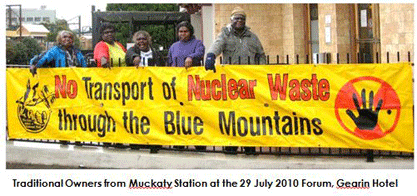
 A N U C L E A R R E A C T I O N ! From Jabiluka to Fukushima to Muckaty? AN AFTERNOON OF FILMS AND SPEAKERS WITH S P E C I A L G U E S T S Meet Filmmaker DAVID BRADBURY and Author/Academic RICHARD BROINOWSKI
In the wake of the first anniversary of the world’s worst atomic accident in a generation, this Blue Mountains Nuclear Free Group event will include a compilation of films presented by acclaimed documentary film maker David Bradbury, who has been twice nominated for Academy Awards and won 5 AFI Awards.
David’s films include interviews with top scientists, environmentalists and Traditional Owners who have been denied genuine consultation as to the impacts of the nuclear industry on their Country.
Richard Broinowski, respected former diplomat, academic, author and commentator will discuss his forthcoming  book “Fallout from Fukushima- national and international consequences”, with emphasis on the implications for Australia.
Adjunct Professor Richard Broinowski lectures in the Department of Media and Communications at Sydney University, has been a commentator in current affairs for SBS / ABC / Al JazeeraTV and has a strong personal interest in nuclear safeguards, writing extensively on the subject.
Come along and be informed of the hazards of the nuclear fuel cycle and why nuclear power is not safe, clean or cheap.
Blue Mountains Nuclear Free Group opposes the mining and export of uranium and the proposed radioactive waste dump at Muckaty in the N.T. The nuclear industry is dirty, dangerous and high risk. We support phasing out nuclear in favour of renewable, sustainable energy. WENTWORTH FALLS SCHOOL OF ARTS SUNDAY APRIL 15 / 2012 2- 5.30 P.M. Entry by donation Refreshments available
Australian opinion against climate science is fuelled by paid ‘sceptics’
Making heretics of scientists casts a shadow, The Age, Sean Hosking, March 19, 2012 Recent revelations that several prominent global warming sceptics are in the pay of the free-market American think tank the Heartland Institute come as no surprise to many who have witnessed the slow descent of the debate from the lofty ”great moral issue of our time” to the cynical “great big tax on everything”.
The national climate report released by the CSIRO and Bureau of Meteorology on Wednesday added to the overwhelming body of scientific evidence supporting anthropogenic warming, but a recent CSIRO survey found politics was the primary factor in determining public views on the matter. Continue reading
China, United Arab Emirates, way ahead in renewable energy, Australia lags
The Global Innovation Index, which analyses the economic strengths and innovation potential of 125 countries, ranked China among the world’s top five renewable energy ”innovation drivers”.
The index gave Australia an overall innovation score of 49.9 out of 100, giving it low scores (again, out of 100) for the number of science graduates (43), engineering graduates (22), share of renewables in energy use (three) and scientific outputs (33).
Just when Australia is getting ready to sell even more vast quantities of coal to the world, the world wants less of it,”
China leads the way with clean-tech,Canberra Times, Rosslyn Beeby, March 19, 2012 Last month, the Chinese government launched a renewable energy think-tank, the China National Renewable Energy Centre. It will draft industry standards and seek to boost global investment in green energy projects.
The centre has already signed research and development co-operation deals with the United States, Denmark and Spain, and is also close to signing agreements with the International Renewable Energy Agency in the United Arab Emirates.
China is now the world’s single largest market for clean technology products and services. Continue reading
Australia should go for 21st Century renewable energy, and move away from outdated fossil fuel power
We cannot afford to be stuck with 19th century fossil fuel thinking and the potential that after spending up big on a one horse gamble that no country will want to buy our dirty energy.
Two-faced climate policy, MATTHEW WRIGHT ABC 19 MAR 2012 It’s ironic that Australia is moving toward a ‘cap’ on carbon emissions because while we’ve got this paper target for a five per cent reduction in carbon dioxide (CO2) emissions by 2020 we’ve also got the foot on the accelerator and running in overdrive expanding the coal and gas mining at an unprecedented rate.
Australia is on target to increase CO2 emissions originating from our shores by over 400 per cent. It’s a simple trick of accounting: claim a five per cent reduction by ignoring our fossil fuels that are burnt off shore.
This approach of saying one thing while doing another isn’t new to politics, but normally doesn’t keep currency with the population for so long. Trumpeting supposed carbon action while quadrupling our carbon emissions is a complete farce and has been going on for half a decade. Continue reading
Pro nuclear Labor Senator Bob Carr basks in Liberal Party approval

Australia’s Labor and Liberal parties are getting cosier and cosier, 15 March 12, It’s hard to tell them apart. Today, THE AUSTRALIAN quotes Dennis Jensen is the Liberal Party’s federal member for Tangney. ” My hope is Carr’s appointment will give new impetus to the nuclear debate. Perhaps this discussion will even turn to the potential of thorium”
Australia’s Nuclear Waste Bill strongly opposed
 Australia passes controversial nuclear waste bill Radioactive material set to be dumped in remote Aboriginal community, despite ongoing court case into legality of proposal Oliver Milman guardian.co.uk, 13 March 2012 The Australian government has passed legislation that will create the country’s first nuclear waste dump, despite fierce opposition from environmental and Aboriginal groups.
The passage of the National Radioactive Waste Management Bill 2010 through the Senate paves the way for a highly controversial plan to store nuclear waste in Muckaty Station, a remote Aboriginal community in the arid central region of the Northern Territory. The ruling Labor party received support from the conservative coalition opposition to approve the bill, despite an ongoing federal court case over the legality of using the Muckaty site to store radioactive material…
Anti-nuclear protesters disrupted proceedings in the Senate as the legislation was debated earlier on Tuesday, with the group heckling lawmakers from the public gallery over their support for the bill.
A recent medical study warned that transporting nuclear waste over long distances to such an isolated location, which is 75 miles north of the Tennant Creek township, could endanger public health.
“The site is in an earthquake zone, it floods regularly, there are very long transport corridors, there are no jobs being applied and it’s opposed from people on the ground, on the front line from Tennant (Creek) all the way up to the NT government and people around the country,” said senator Scott Ludlam of the Greens, which successfully added an amendment to the bill that bans the importing of foreign nuclear waste to the site.
Aboriginal groups launched legal action after claiming that traditional owners of the land around Muckaty do not approve of the dump, despite the government maintaining that the local Ngapa indigenous community supports the plan…… The Northern Territory government has complained that it is being strong-armed into taking the dump due to it being a “constitutional weak link” and not having the same rights as full Australian states….. http://www.guardian.co.uk/environment/2012/mar/13/australia-nuclear-waste-aboriginal?newsfeed=true
Investigative journalism stopped international nuclear waste dump in Mongolia: what about Australia?
the ambassador said she heard of a similar plan in Australia and asked me to provide Mongolia with any information on it, highlighting the Mongolian government’s enthusiasm about overcoming competition with Australia in hosting the disposal facility.
The Mainichi scoop on the secret plan sparked campaigns in Mongolia to demand that the plan on a spent nuclear fuel disposal facility be scrapped and that relevant information be fully disclosed.
Bowing to the opposition, Mongolian President Tsakhiagiin Elbegdorj declared in the U.N. General Assembly session in September last year that the country can never host a radioactive waste disposal facility.

 Mainichi scoop on Mongolia’s nuclear plans highlights problems in dealing with waste. Mainichi Daily News, By Haruyuki Aikawa, 13 March 12, Coverage on a secret document detailing an international nuclear waste disposal site that Japan and the United States had planned to build in Mongolia, for which I won the Vaughan-Ueda Memorial Prize for 2011, has highlighted the difficulties in dealing with radioactive waste.
The secret plan surfaced as the crisis at the tsunami-hit Fukushima No. 1 Nuclear Power Plant has stirred controversy over the pros and cons of nuclear power.
I learned that the Japanese Economy, Trade and Industry Ministry and the U.S. Department of Energy had been secretly negotiating the plan with Mongolia since the autumn of 2010 when I interviewed a U.S. nuclear expert on the phone on April 9, 2011.
“Would you please help the Mongolian people who know nothing about the plan. Mongolia is friendly to Japan, Japanese media certainly has influence on the country,” the expert said. Continue reading
1 This month
17 October, Free Public Talk on Nuclear Issues in South Australia
David Noonan will speak on public interest concerns over the new Roxby Downs Indenture Act 2026 on BHP copper-uranium mining and ore processing in SA, and on how AUKUS may face SA with a High-Level nuclear waste agenda.
Dr Jim Green will discuss international developments in the field of nuclear power including ‘small modular reactors’ and Generation 4 ‘advanced’ nuclear reactor concepts.


Help Aunty Sue Protect Her Land and Sacred Sites From Destructive Rocket Testing.
.

Australians deserve the truth
about
AUKUS – https://aukuspublicinquiry.com/

PETITION – To: Prime Minister Anthony Albanese and the Australian Labor Government

of the week – Australians for War Powers Reform (AWPR)
To see nuclear-related stories in greater depth and intensity

