“Impacts of Climate Change on Nuclear Safety and Supply Security”
 Nuclear Risk & Public Control (accessed) 17th June 2020, Nuclear & Climate** Currently nuclear energy promoters are trying to make use the climate crisis for their goals by claiming that nuclear energy is a solution. But can nuclear energy contribute to a decarbonized future? Rather the contrary: climate change poses new challenges and risks to the operation of nuclear power plants, increasing nuclear risk and challenging supply security. In this Joint Project – Nuclear Risk & Public Control webinar we presented our new working paper “Impacts of Climate Change on Nuclear
Safety and Supply Security”. A report of the webinar can be downloaded here.
Australian government has spent not one sent on finding a permanent solution for ANSTO’s nuclear waste
 Kazzi Jai Fight To Stop Nuclear Waste In The Flinders Ranges, 16 June 20,
Remember that NOT ONE CENT has been spent to find a permanent disposal site for the Intermediate Waste – not ONE!
FORTY YEARS and NOT ONE CENT!
What does THAT tell about this current proposal? That the “promised 30 years +” is somewhat fanciful at best for dealing with the “tag-a-long” Intermediate Level Nuclear Waste at best!
STRANDED WASTE would more aptly describe it! And it becomes SOLELY SA’s responsibility and liability..
…
Oh, and the permanent disposal of the Low Level Nuclear Waste using concrete encasement is meant to hold and contain that Low Level Waste WITHOUT BREACH for 300 years? With our conditions and environment…ALL ABOVE GROUND??
Remember that the sites were chosen by LANDOWNER NOMINATION – not for the VERY BEST GEOLOGY!!
And the ONLY SIDE we have heard from is the Government with a VESTED INTEREST in making this happen.
But the main problem with the Legislation being amended at the moment is that NO-ONE and I mean NO-ONE can debate and perhaps stop a dump being built and a site being selected, based on incorrect assumptions.. That is against our freedoms and rights as Australian citizens to debate and put forward conflicting information and viewpoints to that of the Government.
Don’t get too smug about it – it means that ANOTHER dump can THEN be built anywhere else in Australia upon the Government’s mood without debate…..Let’s see…Rockhampton seems like a nice place for a nuclear dump….or Cradle Mountain….or Uluru….
Green Recovery from COVID-19
 Current 12th June 2020, With renewable energy more cost-efficient than ever before, there is a clear opportunity to forward decarbonisation in COVID-19 recovery plans. A new report entitled Global Trends in Renewable Energy Investment 2020, put
together by the UN Environment Programme (UNEP), the Frankfurt School-UNEP Collaborating Centre and BloombergNEF (BNEF), outlines that globally 2019 saw the highest investment in offshore wind in one year and highest solar power capacity additions in one year, while looking into investment trends for 2020.
3,000GW of renewables by 2030. This may fluctuate somewhat depending on the technology mix.
Do Australia’s politicians really understand the effect of nuclear radioactive contamination on agricultural land?

Mike Hancy Fight To Stop A Nuclear Waste Dump In South Australia, 15 June 20
Green Recovery
 New Statesman 11th June 2020, Post-pandemic packages could provide the perfect opportunity to green up our energy systems for environmental and economic benefit. In June of 1993, Germany’s energy companies took out a series of newspaper adverts. Their
message was a grim, possibly self-serving, prediction, that sun, wind and water power would only ever meet four per cent of the country’s needs.
be exacerbated by the pandemic in the short-term and climate change in the long-term,” says the study published in May 2020.
Cloud studies indicate that global heating may be more alarming than anticipated
 Climate worst-case scenarios may not go far enough, cloud data shows https://www.theguardian.com/environment/2020/jun/13/climate-worst-case-scenarios-clouds-scientists-global-heating Modelling suggests climate is considerably more sensitive to carbon emissions than thought, Jonathan Watts Sat 13 Jun 2020 Worst-case global heating scenarios may need to be revised upwards in light of a better understanding of the role of clouds, scientists have said.Recent modelling data suggests the climate is considerably more sensitive to carbon emissions than previously believed, and experts said the projections had the potential to be “incredibly alarming”, though they stressed further research would be needed to validate the new numbers. Climate worst-case scenarios may not go far enough, cloud data shows https://www.theguardian.com/environment/2020/jun/13/climate-worst-case-scenarios-clouds-scientists-global-heating Modelling suggests climate is considerably more sensitive to carbon emissions than thought, Jonathan Watts Sat 13 Jun 2020 Worst-case global heating scenarios may need to be revised upwards in light of a better understanding of the role of clouds, scientists have said.Recent modelling data suggests the climate is considerably more sensitive to carbon emissions than previously believed, and experts said the projections had the potential to be “incredibly alarming”, though they stressed further research would be needed to validate the new numbers.
Modelling results from more than 20 institutions are being compiled for the sixth assessment by the United Nations Intergovernmental Panel on Climate Change, which is due to be released next year. Compared with the last assessment in 2014, 25% of them show a sharp upward shift from 3C to 5C in climate sensitivity – the amount of warming projected from a doubling of atmospheric carbon dioxide from the preindustrial level of 280 parts per million. This has shocked many veteran observers, because assumptions about climate sensitivity have been relatively unchanged since the 1980s. “That is a very deep concern,” Johan Rockström, the director of the Potsdam Institute for Climate Impact Research, said. “Climate sensitivity is the holy grail of climate science. It is the prime indicator of climate risk. For 40 years, it has been around 3C. Now, we are suddenly starting to see big climate models on the best supercomputers showing things could be worse than we thought.” He said climate sensitivity above 5C would reduce the scope for human action to reduce the worst impacts of global heating. “We would have no more space for a soft landing of 1.5C [above preindustrial levels]. The best we could aim for is 2C,” he said. Worst-case projections in excess of 5C have been generated by several of the world’s leading climate research bodies, including the UK Met Office’s Hadley Centre and the EU’s Community Earth System Model Timothy Palmer, a professor in climate physics at Oxford University and a member of the Met Office’s advisory board, said the high figure initially made scientists nervous. “It was way outside previous estimates. People asked whether there was a bug in the code,” he said. “But it boiled down to relatively small changes in the way clouds are represented in the models.” The role of clouds is one of the most uncertain areas in climate science because they are hard to measure and, depending on altitude, droplet temperature and other factors, can play either a warming or a cooling role. For decades, this has been the focus of fierce academic disputes. Previous IPCC reports tended to assume that clouds would have a neutral impact because the warming and cooling feedbacks would cancel each other out. But in the past year and a half, a body of evidence has been growing showing that the net effect will be warming. This is based on finer resolution computer models and advanced cloud microphysics. “Clouds will determine humanity’s fate – whether climate is an existential threat or an inconvenience that we will learn to live with,” said Palmer. “Most recent models suggest clouds will make matters worse.” In a recent paper in the journal Nature, Palmer explains how the new Hadley Centre model that produced the 5+C figure on climate sensitivity was tested by assessing its accuracy in forecasting short-term weather. This testing technique had exposed flaws in previous models, but in the latest case, the results reinforced the estimates. “The results are not reassuring – they support the estimates,” he wrote. He is calling for other models to be tested in a similar way. “It’s really important. The message to the government and public is, you have to take this high climate sensitivity seriously. [We] must get emissions down as quickly as we can,” he said. The IPCC is expected to include the 5+C climate sensitivity figure in its next report on the range of possible outcomes. Scientists caution that this is a work in progress and that doubts remain because such a high figure does not fit with historical records. Catherine Senior, head of understanding climate change at the Met Office Hadley Centre, said more studies and more data were needed to fully understand the role of clouds and aerosols. “This figure has the potential to be incredibly alarming if it is right,” she said. “But as a scientist, my first response is: why has the model done that? We are still in the stage of evaluating the processes driving the different response.” While acknowledging the continued uncertainty, Rockström said climate models might still be underestimating the problem because they did not fully take into account tipping points in the biosphere. “The more we learn, the more fragile the Earth system seems to be and the faster we need to move,” he said. “It gives even stronger argument to step out of this Covid-19 crisis and move full speed towards decarbonising the economy.” |
|
Researchers find that half ofthe earth’s ice-free land is still free from human influence
 Half the earth relatively intact from global human influence https://www.eurekalert.org/pub_releases/2020-06/uoc–hte061120.php Study presents clear opportunities to conserve what remains, UNIVERSITY OF CALIFORNIA – DAVIS 14 June 20 Roughly half of Earth’s ice-free land remains without significant human influence, according to a study from a team of international researchers led by the National Geographic Society and the University of California, Davis.The study, published in the journal Global Change Biology, compared four recent global maps of the conversion of natural lands to anthropogenic land uses to reach its conclusions. The more impacted half of Earth’s lands includes cities, croplands, and places intensively ranched or mined. Half the earth relatively intact from global human influence https://www.eurekalert.org/pub_releases/2020-06/uoc–hte061120.php Study presents clear opportunities to conserve what remains, UNIVERSITY OF CALIFORNIA – DAVIS 14 June 20 Roughly half of Earth’s ice-free land remains without significant human influence, according to a study from a team of international researchers led by the National Geographic Society and the University of California, Davis.The study, published in the journal Global Change Biology, compared four recent global maps of the conversion of natural lands to anthropogenic land uses to reach its conclusions. The more impacted half of Earth’s lands includes cities, croplands, and places intensively ranched or mined.
“The encouraging takeaway from this study is that if we act quickly and decisively, there is a slim window in which we can still conserve roughly half of Earth’s land in a relatively intact state,” said lead author Jason Riggio, a postdoctoral scholar at the UC Davis Museum of Wildlife and Fish Biology. The study, published June 5 on World Environment Day, aims to inform the upcoming global Convention on Biological Diversity — the Conference of Parties 15. The historic meeting was scheduled to occur in China this fall but was postponed due to the coronavirus pandemic. Among the meeting’s goals is to establish specific, and higher, targets for land and water protection. Approximately 15 percent of the Earth’s land surface and 10 percent of the oceans are currently protected in some form. However, led by organizations including Nature Needs Half and the Half-Earth Project, there have been bold global calls for governments to commit to protecting 30 percent of the land and water by 2030 and 50 percent by 2050. Intact natural lands across the globe can help purify air and water, recycle nutrients, enhance soil fertility and retention, pollinate plants, and break down waste products. The value of maintaining these vital ecosystem services to the human economy has been placed in the trillions of U.S. dollars annually. CONSERVATION AND COVID-19 The coronavirus pandemic now shaking the globe illustrates the importance of maintaining natural lands to separate animal and human activity. The leading scientific evidence points to the likelihood that SARS-CoV2, the virus that causes the disease COVID-19, is a zoonotic virus that jumped from animals to humans. Ebola, bird flu and SARS are other diseases known to have spilled over into the human population from nonhuman animals. “Human risk to diseases like COVID-19 could be reduced by halting the trade and sale of wildlife, and minimizing human intrusion into wild areas,” said senior author Andrew Jacobson, professor of GIS and conservation at Catawba College in North Carolina. Jacobson said that regional and national land-use planning that identify and appropriately zone locations best suited to urban growth and agriculture could help control the spread of human development. Establishing protections for other landscapes, particularly those currently experiencing low human impacts, would also be beneficial. FROM THE TUNDRA TO THE DESERT Among the largest low-impact areas are broad stretches of boreal forests and tundra across northern Asia and North America and vast deserts like the Sahara in Africa and the Australian Outback. These areas tend to be colder and/or drier and less fit for agriculture. “Though human land uses are increasingly threatening Earth’s remaining natural habitats, especially in warmer and more hospitable areas, nearly half of Earth still remains in areas without large-scale intensive use,” said co-author Erle Ellis, professor of geography at the University of Maryland-Baltimore County. Areas having low human influence do not necessarily exclude people, livestock or sustainable management of resources. A balanced conservation response that addresses land sovereignty and weighs agriculture, settlement or other resource needs with the protection of ecosystem services and biodiversity is essential, the authors note. “Achieving this balance will be necessary if we hope to meet ambitious conservation targets,” said Riggio. “But our study optimistically shows that these targets are still within reach.” |
|
France’s submarine accident a reminder of the ever present danger of nuclear catastrophe

Why The Catastrophic Fire On A Nuclear Submarine Is Nothing To Gloat About https://www.forbes.com/sites/hisutton/2020/06/14/why-the-catastrophic-fire-on-a-nuclear-submarine-is-nothing-to-gloat-about/#ef9667d2ffd0
As details emerge of the fire aboard the French submarine Perle on Friday, it seems unlikely to me that the boat will be returned to service. Whichever way you look at it, the fire is a terrible blow for the French Navy (Marine Nationale). Their submarine fleet is already stretched. But France’s misfortune brings home a basic reality that it could happen to any navy.
The cause of the fire, which took most of Friday to extinguish, has yet to be determined. Florence Parly, Minister of the Armed Forces, was reported by Naval News as saying on June 13 that the “cause for such a strong (and rapid) fire is still unknown.” She also said that if the boat turns out to be fixable, everything will be done to repair it. Any hint of optimism in this statement may point to the terrible predicament that it will leave the French Navy in if it cannot be repaired.
No Reason To Gloat
You will not find many in the defense community laughing at France’s expense. When a Russian or Chinese warship suffers a similar accident, many casual observers are quick to make jokes. Less so the defense community.
For example on April 13 a Chinese Type-075 assault carrier caught fire in Shanghai. That ship, the first of its type, was being fitted out before delivery. The types of work done during refit are similar to the deep overhaul that Perle was being subject to. Or in December last year a Russian aircraft carrier caught fire.
But the Western defense community is very aware that these accidents could equally apply to their home navies. Overhauling ships and submarines is ‘hot work’ and fires can easily occur.
The fire took 14 hours to put out, from 10.35am until 00.50 am the next morning. This may sound like a long time, but the U.S. Navy had a similar experience dealing with a fire aboard the Los Angeles class submarine USS Miami in 2012. That fire, which was also during an overhaul, lasted 12 hours and caused so much damage that the boat had to be written off. In the American case it turned out that the fire had been started deliberately by a dockyard worker hoping that the alarm would get him off work early.
In general, fires aboard submarines can be harder to put out. This is because of the cramped spaces aboard, and also because there are very few openings into the submarine. And they can be more devastating than a similar fire aboard a surface vessel because the heat can deform the steel hull. On a surface vessel this can be repaired more easily, but with a submarine it can make the hull weaker so that it is no longer safe to dive. This is why I am not optimistic that she will be repairable.
The fire was not as bad as it could have been. Fortunately the nuclear reactor had apparently already been removed. So the fire has not been categorized as a nuclear accident. And the torpedoes and missiles had also been unloaded so there was no risk of them exploding.
Many core systems, such as the combat system and sonar, had also been removed. So if the hull can be saved, then returning her to service is at least feasible. But everything seems to depend on whether the hull itself has been weakened.
Fast-growing mini-forests spring up in Europe to aid climate
|
Fast-growing mini-forests spring up in Europe to aid climate Miyawaki forests are denser and said to be more biodiverse than other kinds of woods, Guardian, Hannah Lewis, Sat 13 Jun 2020 Tiny, dense forests are springing up around Europe as part of a movement aimed at restoring biodiversity and fighting the climate crisis. Often sited in schoolyards or alongside roads, the forests can be as small as a tennis court. They are based on the work of the Japanese botanist Akira Miyawaki, who has planted more than 1,000 such forests in Japan, Malaysia and elsewhere. Advocates for the method say the miniature forests grow 10 times faster and become 30 times denser and 100 times more biodiverse than those planted by conventional methods. This result is achieved by planting saplings close together, three per square metre, using native varieties adapted to local conditions. A wide variety of species – ideally 30 or more – are planted to recreate the layers of a natural forest. Scientists say such ecosystems are key to meeting climate goals, estimating that natural forests can store 40 times more carbon than single-species plantations. The Miyawaki forests are designed to regenerate land in far less time than the 70-plus years it takes a forest to recover on its own. “This is a great thing to do,” said Eric Dinerstein, a wildlife scientist who co-authored a recent paper calling for half of the Earth’s surface to be protected or managed for nature conservation to avoid catastrophic climate change. “So this could be another aspect for suburban and urban areas, to create wildlife corridors through contiguous ribbons of mini-forest.” The mini-forests could attract migratory songbirds, Dinerstein said. “Songbirds are made from caterpillars and adult insects, and even small pockets of forests, if planted with native species, could become a nutritious fast-food fly-in site for hungry birds.”……. https://www.theguardian.com/environment/2020/jun/13/fast-growing-mini-forests-spring-up-in-europe-to-aid-climate |
|
Climate change is enhancing ocean waves – bigger ones, and more often
 EXTREME WAVES SET TO BE BIGGER AND MORE FREQUENT
As the planet warms, researchers are warning that the frequency and magnitude of extreme wave events may rise by around 10 per cent by the end of century, increasing flood risks. Pursuit, By Dr Alberto Meucci and Professor Ian Young University of Melbourne, 13 June 20
When most of us think about what climate change will do to our coastlines we tend to focus on how sea-levels are rising as the polar ice caps melt and the oceans warm. But that is only part of the story.
What many don’t realise is that at the same time as sea levels are rising, storms are increasing in magnitude and frequency, resulting in larger ocean waves. These waves increase coastal erosion and the risk of flooding.
Our new research suggests that by the end of the century the magnitude of extreme wave events will have increased by up to 10 per cent over extensive ocean regions, and the frequency of storms that generate extreme waves will have increased by five to 10 per year.
This may not sound like a big increase, but it means that almost 60 per cent of the world’s coastline will experience larger and more frequent extreme waves.
At a time when 290 million people already live below the 100-year flood level (that is, they live below levels where there is at least a one per cent probability of flooding every year), an increase in the risk of extreme wave events may be catastrophic, as larger and more frequent storms will cause more flooding and coastline erosion.
Extremes are defined as unexpected, unusual and sometimes unseasonal events. Like extreme floods, extreme waves are classified by the frequency with which they tend to occur, and this frequency drives the design requirements for ocean structures or coastal defences. For example, defences may be designed to cope with a 100-year wave event.
Extreme ocean waves generated by strong surface winds can reach heights of over 20 meters at the high latitudes of the globe – that’s as high as four double-decker buses stacked on top of each other.
But the surface winds that drive wave heights are in turn driven by the climate system, and so are subject to climate change. A warming planet is causing stronger and more frequent storm winds which in turn trigger larger and more frequent extreme waves, and the 100-year events may begin to occur every 50 or even 20 years.
Estimating the probability of occurrence of extreme waves is challenging, let alone estimating how their frequency and magnitude may change in the future. This is due to the small number of ocean observations available.
The buoys and offshore platforms scientists use to observe ocean movements are sparsely distributed, and satellite measurements are limited in how often they sample a single location.
But advances in computing technology and the modelling of data, allows us to simulate the Earth’s changing climate under different wind conditions, recreating thousands of simulated storms to evaluate the magnitude and frequency of extreme events.
Our research used a unique statistical ensemble approach, where we pooled data from an unprecedented collection of thousands of modelled ocean wave extremes to estimate future extreme events. These extremes were derived from global wave models based on wind forces generated from seven different global climate models.
The vast amount of modelled ocean extremes generated allowed us to apply an ensemble statistical analysis that reduces the uncertainty around the estimation of future projections of extremes. …….. Co-authors of the research are: Dr Mark Hemer, CSIRO, Oceans and Atmosphere, Hobart Australia; Professor Roshanka Ranasinghe, Department of Water Science and Engineering, IHE-Delft, Netherlands; and Ebru Kirezci, University of Melbourne
Our existential threat – our extinction
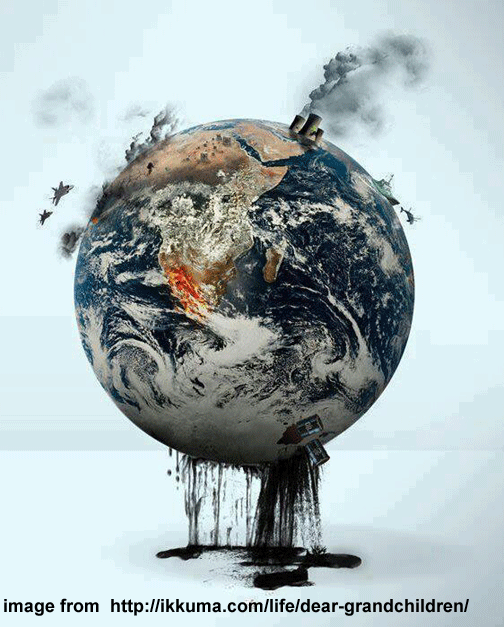 Externalities Are Our Existential Threat, Medium, 10 June 20, It’s the “ex’s” we need to worry about the most. Externalities that create an existential threat. The ultimate threat: Our extinction.
An externality is defined by the Oxford English Dictionary as “a side effect or consequence of an industrial or commercial activity that affects other parties without this being reflected in the cost of the goods or services involved”. Externalities in a global context are the consequence that everyone bears for everyone else’s actions. Externalities result in us all bearing the consequences of living out of synchronization with Nature, but unfortunately in most cases the poor and the vulnerable pay a higher price, disproportionate to their contribution to the cause.
The negative externality consequences of most human economic activity are unaccounted; seemingly off loaded free of charge to the ecosphere. But Nature has a balance sheet — these unaccounted, costs of doing business, that are charged to Nature, are turned into debts. These debts will be settled at a later date and not in a manner of our choosing. The challenge for us is that in many cases the debts are slow to become obvious to everyone, remaining invisible or disguised for a prolonged period. Linking cause and effect is very complex and spans long periods of time, often not directly attributable. It is like a very slow moving train crash — you barely notice it happening but you’ll know when it hits, and then it’s too late. We are all aboard that slow train right now.
In developed countries, we are fortunate to not have to face the poverty, war, famine, diseases that affected humans in the pre-industrial and early industrial times. Capitalism has been an amazing wealth creating and poverty reducing system. Most of us cannot even comprehend how fortunate we are. However, there is a downside to the considerable progress we have made since the industrial revolution; the unintended consequences. Never before were humans able to have an impact on future generations aside from culture or knowledge that was passed on. Today that is different — our actions are determining the fate of billions of people, those currently alive and those not yet born. Unfortunately, we have been brewing trouble……
capitalism can only operate in the best interests of society if it is governed well. It is the good governance part that we have been lacking — unfortunately we have a corrupted, crony capitalism that stems from problems with our democratic system. Quite simply, we seem to be unable to elect leaders who actually care about the long term interests of the people. Our entire political system is deeply corrupted by money — elected officials represent those who contribute to their campaigns, not their constituents, and that’s dominated by the very wealthy, corporations and special interest organizations, not the typical citizen. This is something that needs mainstream understanding as it is the root of all society’s problems and why they are never sensibly addressed.
The common theme is that we have proved ourselves to be incapable of acting in our collective best interests. Together we are all on that metaphorical slow train, steaming towards a cliff edge with no one in the driver’s seat attempting to steer us away from inevitable catastrophe…… Continue reading
Legal fight continues against nuclear waste dump in U.S. District of Columbia
|
Beyond Nuclear filed its appeal on June 4 in the U.S. Court of Appeal for the District of Columbia, questioning the federal Nuclear Regulatory Commission’s April 23 decision to reject challenges to Holtec International’s application for a license to build and operate a consolidated interim storage facility (CISF) that would hold nuclear waste at the surface until a permanent, deep geological repository was available to hold the waste permanently. The facility would store up to 173,000 metric tons of the waste. Such a permanent repository does not exist, and Beyond Nuclear — a non-profit organization that addresses nuclear issues nationwide — worried one wouldn’t be available until 2048. The group also pointed to another NRC order in October 2018 where the NRC deemed contentions inadmissible but argued against both decisions that it said upheld a regulatory process that violated federal law. The licensing process itself was illegal, read NRC’s court filing, because it considered the possibility that the U.S. Department of Energy would take ownership of the waste — a move illegal under federal law unless a permanent repository is available to hold the waste. “This NRC decision flagrantly violates the federal Administrative Procedure Act (APA), which prohibits an agency from acting contrary to the law as issued by Congress and signed by the President,” said Mindy Goldstein, an attorney for Beyond Nuclear. “The Commission lacks a legal or logical basis for its rationale that it may issue a license with an illegal provision, in the hopes that Holtec or the Department of Energy won’t complete the illegal activity it authorized. The buck must stop with the NRC.”…….. https://www.currentargus.com/story/news/local/2020/06/10/federal-appeal-filed-against-nuclear-waste-site-proposed-near-carlsbad/5317995002/ |
|
|

Nuclear waste in Paducah, Kentucky poses extra threat to region facing historic flooding

Nuclear waste in Paducah, Kentucky poses extra threat to region facing historic flooding, Southerly By , For over half a century, the plant was Paducah’s main employer, providing up to 7,000 jobs in a place where nearly a quarter of people now live in poverty. But poor working conditions and unregulated waste disposal also harmed Paducah residents. The legacy of these problems have cost the town and taxpayers. Despite multiple recommendations from a watchdog government agency, the Department of Energy is decades behind schedule on cleanup efforts.
Some experts say the federal government doesn’t know the full cost or scope of what cleaning them up will entail, and that becomes more complicated with more frequent extreme weather.
It’s a problem Superfund sites — and especially nuclear waste sites — around the country face. ……
a 1999 investigation by The Washington Post revealed the federal government used the plant to illegally recycle over 103,000 tons of used nuclear reactor fuel containing plutonium and other transuranics — man-made heavy metals derived from splitting atoms. The same year, workers filed a $10 billion class action lawsuit against three federal government contractors that led to the passage of a federal law intended to compensate current and former employees (or their survivors) for exposure to cancer-causing radiation. ……
While there is no official estimation of how much contaminated material remains, at least 400 buildings — and everything inside them — still need to be decontaminated and demolished at the Paducah site. ……
cleanup isn’t expected to be completed until 2065, and the EPA has said it could take even longer because of the lack of knowledge about sources of contamination and the vast size of the facility. The waste at Paducah includes the gaseous diffusion plant, buried radioactive disposal sites, and waste leftover from neighboring nuclear sites in Ohio and Tennessee. It also includes over 52,000 cylinders of uranium hexafluoride, or spent uranium fuel, much of it from Oak Ridge. ……
The Paducah cleanup is now being managed by Four Rivers Nuclear Partnership, a conglomeration of companies hired by the DOE for soil and groundwater remediation. One of them is Jacobs Engineering, a contractor that was sued for exposing hundreds of workers to toxic substances during cleanup of the nation’s largest coal ash spill in Tennessee; more than 40 have died. At least three other nuclear sites — Oak Ridge, Hanford in Washington, and Savannah River in South Carolina — have also contracted with Jacobs. (Jacobs Engineering declined an interview for this story.)……
n February, Paducah put up its floodgates, families stacked sandbags, and the bridge over the Ohio River to Illinois closed as floodwaters as rains drowned the region. According to local news stations, highway crews reported so much water they had trouble setting up warning signs. Former Kentucky Gov. Matt Bevin declared a statewide emergency due to heavy rainfall and flooding.
The Ohio River, three miles north of the Paducah plant, had record flooding in 2018 and 2019…….
Instead of focusing on cleanup plans, some state lawmakers and federal agencies are loosening regulations on hazardous sites. In 2017, Kentucky passed a bill lifting a nuclear moratorium, a move that some hope will turn the site into a research facility or nuclear reactor; the law loosens the requirements for toxic waste management. Last year, the DOE also moved to relax restrictions on the disposal and abandonment of radioactive waste…….https://southerlymag.org/2019/12/04/nuclear-waste-in-paducah-kentucky-poses-extra-threat-to-region-facing-historic-flooding/
Jacinda Adern – the world’s best leader
 New Zealand’s Prime Minister May Be the Most Effective Leader on the Planet. Uri Friedman 19 April 20 The Atlantic Amid the Trump administration’s calamitous response to the Covid-19 pandemic, media have been looking to other countries for inspiration in responsible leadership during a period of crisis. New Zealand Prime Minister Jacinda Arden has been one popular pick, having capably managed to limit the damage to only 1,504 infections and 22 deaths, as of June 5.
A widely shared article in the Conversation (4/5/20) described Ardern as putting on a “masterclass in crisis leadership.” The Washington Post (4/7/20) characterized her government’s response as a “triumph of science and leadership.” Elsewhere, she has been praised as “the most effective leader on the planet” (Atlantic, 4/19/20) who “should be teaching the rest of the world” (Guardian, 4/10/20). The Financial Times (4/19/20) unironically anointed her “Saint Jacinda.”
Despite its obvious geographical and economic advantages, New Zealand certainly deserves praise. But less deserving have been the European countries corporate media consistently highlight as outstanding performers. With over 185,000 cases and 8,763 deaths, Germany has one of the highest per capita fatality rates in the world. Yet Chancellor Angela Merkel has drawn effusive praise as somebody who “embraces science” (Atlantic, 4/19/20; Guardian, 4/16/20; Financial Times, 4/3/20). CNN (5/7/20) proclaimed her a “global leader on coronavirus”; Vox (5/21/20) said she’d been “praised for her clear and effective communication with her country — and the world.”
In its editorial on crisis leadership, the New York Times editorial board (4/30/20) also praised Merkel (while attacking China for supposedly covering up the outbreak). They highlighted and applauded the leadership of several other countries, including Denmark, Norway and Finland. Amazingly, the editorial also singled out and commended Italian Prime Minister Giuseppe Conte, whose inept response has led to Italy having the third-highest number of deaths in the world at the time of its publication.
There was far less praise for leaders in the Global South. Indeed, the only one mentioned by name was Taiwan’s Tsai Ing-wen, and this was primarily because she “sent millions of face masks to the United States and Europe”—although with 443 total cases and only seven deaths, Taiwan has had a far more enviable record on Covid-19 than most of the countries featured in the editorial. True Asian leadership, according to the Times editorial board, is helping white people, apparently.
Legal challenge to “Interim” storage of nuclear wastes, before permanent disposal determined
Holtec’s interim nuclear waste application challenged in court, BY THERESA DAVIS / JOURNAL STAFF WRITER, AlbuquerquebJournal, June 6th, 2020
Holtec International’s proposed nuclear waste interim storage facility in southeast New Mexico faces a new legal challenge.
Anti-nuclear group Beyond Nuclear filed a petition for review Thursday in the U.S. Court of Appeals for the District of Columbia Circuit. The group asks for review of the U.S. Nuclear Regulatory Commission’s rejection of their petitions.
The group alleges that the NRC cannot issue Holtec a license because the company’s application includes a provision that the U.S. Department of Energy may be the owner of the facility’s nuclear waste. The group says approval would violate the Nuclear Waste Policy Act.
That law prevents the government from taking ownership of nuclear waste from private utilities before a permanent repository is in operation. The government has yet to open such a site.
“The reason that provision is in the NWPA is to protect a state like New Mexico from being forced to store this waste before a permanent repository is opened,” said Kevin Kamps, a radioactive waste specialist with Beyond Nuclear. “(Holtec has) now added a clause that includes ‘and/or nuclear utilities’ in the list of potential customers. That was good enough for the NRC, apparently.”
Beyond Nuclear presented its petition to NRC’s Atomic Safety and Licensing Board. In April, the NRC upheld that board’s dismissal of the petition.
An April 23 NRC order says Holtec “hopes Congress will change the (NWPA) law to allow DOE to enter into temporary storage contracts with Holtec.”………
The petition alleges that the NRC is also violating the Administrative Procedure Act.
“Agencies have to work with what Congress gave (them),” said Mindy Goldstein, an attorney for Beyond Nuclear and the director of the Turner Environmental Law Clinic at the Emory University School of Law. “We feel NRC is stepping around that requirement. Congress has said that DOE can’t own this waste.”
The proposed facility would store spent nuclear fuel in 500 canisters on a 1,000-acre site between Carlsbad and Hobbs. The full project could store 10,000
1 This month

of the week – Australians for War Powers Reform (AWPR)
To see nuclear-related stories in greater depth and intensity
 Antinuclear