Marie Curie and John Wayne – victims of nuclear radiation
John Wayne squares off against Jim Hansen, Medium, Albert Bates, 11 Jan 2020 “…….. In 1896, Henri Becquerel discovered that uranium emitted rays that resembled X-rays. Marie Curie suspected that the radiation was not the outcome of some interaction but came from the atom itself. Her work with uranium disproved the conventional wisdom going back to ancient Greece that atoms were indivisible and set up the later discovery of subatomic particles. Curie discovered that thorium, radium, polonium and radioactive bismuth occurred naturally with uranium. Radium was known to glow in the dark, which made it useful for painting the hour and minute hands on watches and clocks. It was later discovered that radium “radiated” more than just neutrons, but also protons and electrons, becoming another unstable element, radon, and that element radiated its subatomic particles to become others, polonium and bismuth, until those eventually became a stable element, lead. Indeed, the radium Curie discovered was the progeny of another unstable element, thorium, which was the progeny of yet another unstable element, uranium.
Madame Curie was a physicist, not a medical doctor, so she did not recognize the health effects of handling uranium, thorium, radium and the other radionuclides. Indeed, she suspected the effects would be beneficial. One of the papers she and her husband published in the late 19th century announced that, when exposed to radium, diseased, tumor-forming cells were destroyed faster than healthy cells (the basis for today’s radio-chemotherapy). She carried test tubes containing radioactive isotopes in her pockets and stored them in her desk drawer. Although her many decades of exposure to radiation caused chronic illnesses (including near-blindness due to cataracts) and ultimately her death, she never acknowledged the inherent health risks. She likely did not recognize the symptoms when she began to feel weak and lose her hair. She died in 1934 from aplastic anemia without ever knowing that she fought the same mortal enemy as those who had painted the hands on watches and clocks, or those who had mined and processed the uranium on which she worked. After her death, and to this day, her papers and effects are too radioactive to be handled and her laboratory is unsafe to enter.
The famous cowboy actor John Wayne may have been felled by the same foe. From 1951 to 1962 the US Atomic Energy Commission (AEC) detonated more than 100 bombs in the southwestern US desert, sending huge pinkish plumes of radioactive dust across the stony valleys and canyons of southern Utah and northern Arizona. It gave each “shot” names like Annie, Eddie, Humboldt and Badger. Eleven of those tests were part of a series called Upshot-Knothole in Utah in 1953. In 1954, the Upshot-Knothole site was chosen as the location for a John Wayne film called The Conqueror.
The AEC sent a scientist with a Geiger counter to show Wayne that the location was safe enough for him to bring his wife and children to visit the set. The Geiger counter is said to have crackled so loudly Wayne thought it was broken. Waving it over clumps of cactus, rock and sand produced the same loud result. The Duke, by all accounts, shrugged it off. By 1980, 91 out of 220 cast and crew on The Conquerer had contracted cancer and 46 of them, including Wayne and co- stars Dick Powell, Pedro Armendáriz, Agnes Moorehead, and Susan Hayward had died. Those numbers did not include the families of the cast and crew. John Wayne’s wife and two sons all got cancer. While the two sons survived, the daughter of one of Wayne’s sons also died of cancer. Hayward’s son Tim Barker had a benign tumor removed from his mouth. Many of the Native American Paiute extras went on to die of cancer also……..https://medium.com/@albertbates/john-wayne-squares-off-against-jim-hansen-42a258b2260d
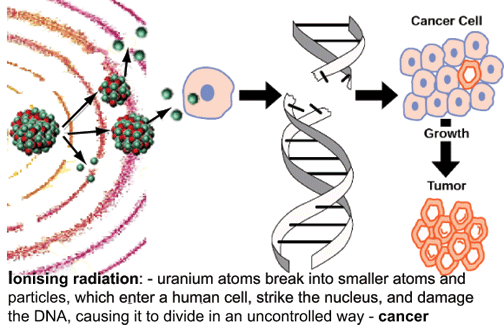
New study finds that low dose radiation in medical imaging causes cell mutations
|
Low doses of radiation used in medical imaging lead to mutations in cell cultures, https://www.sciencedaily.com/releases/2020/01/200116141731.htm– Discovery that radiation creates breaks that allow in foreign DNA must be confirmed in animal studies January 16, 2020 Source: PLOS
|
|
“Hot” radioactive particles a special risk at Fukushima in 2020 Olympics
 Nukewatch 10th Jan 2020, Hundreds of thousands of people—athletes, officials, media, and spectators—will flood into Japan for the 2020 Olympics.
Cumbria (UK’s nuclear waste area) has unusually high incidence of certain cancers
NW Evening Mail 16th Jan 2020, A WORRYING new report has found that Cumbria has the highest incidence rates of certain kinds of cancer in the North West. According to data collated by charity North West Cancer Research, the county ranks 11 per cent higher on key cancers than the national average. As part of the study, analysts assessed the impact of 25 key cancers across the North West and 37 cancers across Wales.
https://www.nwemail.co.uk/news/18165381.cumbria-highest-cancer-rates-region/
Chatham House declares nuclear power’s swansong – welcomes era of sun and wind
 Nuclear Futures, Oil Price 18th Jan 2020
unequivocally entering the era of wind and solar power. https://oilprice.com/Alternative-Energy/Nuclear-Power/Is-This-The-Death-Knell-For-Nuclear.html
Criminal case against Adani over a coal transaction
 “Undue favour” given to “disqualified” Adani Enterprises in award of coal supply contract: CBI, The agency has registered the FIR under charges of criminal conspiracy, cheating under IPC and PPCA after a preliminary enquiry, Energy World ET Bureau | January 16, 2020, NEW DELHI: The Central Bureau of Investigation (CBI) has registered a criminal case against Adani Enterprises and top brass of the National Cooperative Consumer Federation (NCCF) for “giving undue favour” to M/s Adani Enterprises Ltd in award of work for supply of imported coal to Andhra Pradesh Power General Corporation (APGENCO) despite its (Adani) “disqualification”. “Undue favour” given to “disqualified” Adani Enterprises in award of coal supply contract: CBI, The agency has registered the FIR under charges of criminal conspiracy, cheating under IPC and PPCA after a preliminary enquiry, Energy World ET Bureau | January 16, 2020, NEW DELHI: The Central Bureau of Investigation (CBI) has registered a criminal case against Adani Enterprises and top brass of the National Cooperative Consumer Federation (NCCF) for “giving undue favour” to M/s Adani Enterprises Ltd in award of work for supply of imported coal to Andhra Pradesh Power General Corporation (APGENCO) despite its (Adani) “disqualification”.
Besides Adani Enterprises, those named in CBI’s FIR include Virender Singh, the then Chairman; G P Gupta, the then Managing Director (MD); S C Singhal, the then senior advisor of NCCF, New Delhi. Also, unknown public servants and others have been named in CBI’s FIR……..
NEW DELHI: The Central Bureau of Investigation (CBI) has registered a criminal case against Adani Enterprises and top brass of the National Cooperative Consumer Federation (NCCF) for “giving undue favour” to M/s Adani Enterprises Ltd in award of work for supply of imported coal to Andhra Pradesh Power General Corporation (APGENCO) despite its (Adani) “disqualification”.
Besides Adani Enterprises, those named in CBI’s FIR include Virender Singh, the then Chairman; G P Gupta, the then Managing Director (MD); S C Singhal, the then senior advisor of NCCF, New Delhi. Also, unknown public servants and others have been named in CBI’s FIR. https://energy.economictimes.indiatimes.com/news/coal/undue-favour-given-to-disqualified-adani-enterprises-in-award-of-coal-supply-contract-cbi/73304926 |
|
|
Nuclear waste could ruin Kimba, as asbestos ruined Wittenoom
Paul Waldon Fight To Stop A Nuclear Waste Dump In South Australia,17 Jan 2020
Is Nuclear the new Asbestos?
The naturally occurring mineral Asbestos was touted as miracle product used in clothing, building, toothpaste, eating utensils, just about anything and everything with the ignorance that fueled its demand. However the knowledge of its well known dangers were masked by the industry that prospered from its mining.
The story of Benjamin Franklin and his asbestos coin purse so money would not burn a hole in his pocket is well told, yet the taxpayers $31 million as a DIIS sweetener gifted to a community willing to embrace radioactive waste has at this moment started and will continue to erode the social structure, family ties, property values, tourism, the once good name of the town of Kimba, leaving the cancerous tumor that is a forever nuclear stigma.
No purse is worth embracing radioactive waste https://www.facebook.com/groups/344452605899556/permalink/1200278250316983/

Australia has a carbon industrial complex uniting government and greenhouse emitters
Fifty seven million ways the carbon industrial complex infects Australian politics
A closer look at how fossil fuel companies influence policy making shows that Australia has a carbon industrial complex uniting government and greenhouse emitters. BERNARD KEANE. JAN 14, 2020
Fossil fuel companies and climate denialists have pumped at least $57 million into Australian politics in the last twenty years using our lax political donation laws, and the figure is likely significantly higher…. (subscribers only) https://www.crikey.com.au/2020/01/14/how-a-carbon-industrial-complex-shapes-australian-politics/
It would be wise to cancel the plan for dumping Lucas Heights’ nuclear waste in South Australia
 Paul Waldon Fight To Stop A Nuclear Waste Dump In South Australia, 16 Jan 2020
Both dichotomies do agree that radioactive waste as Harry D. puts it “needs to be placed in a managed facility that offers the best centralized logistical location,” and that location is ANSTO, Lucas Heights.
Look at a map and you will see Lucas Heights maybe the most central location amounting to the least average travel distance of such waste per volume and it has security, it also has waste on site as long as the reactor keeps pumping out waste and it’s only half full.
Logistically it would have save the taxpayers $55mil over recent years with the cancellation of the program to shift such waste, but that 55 mil may have been just but the tip of the iceberg of what it has cost communities across South Australia. https://www.facebook.com/groups/941313402573199/
Environmentalists must stress issues of employment in renewables, and the need for energy conservation
Dennis Matthews, 16 Jan 2020, How should environmentalists deal with the results of the ongoing extremely destructive wildfires? Some points that may help them to decide:
First, in my opinion, the last Federal election was not won but was lost by the ALP and the Australian Greens, because they failed to counter the Morrison  message that stopping coal mining would cost jobs. It would have been so easy to point out that investing in the alternatives to coal would generate jobs.
Second, there has been no attempt to counter environmentally and socially destructive economic growth. The “growth is obviously good” ideology is supported by the two major parties and is not seriously challenged by the Greens.
Third, evidence for human global climate change has been gathering speed for 4 decades. The effects have such momentum that as well as needing a drastic reduction in emissions we now also need urgent action on ways to deal with the effects of more destructive weather. Australians are in the top per capita emitters in the world, if we don’t show leadership then we are in no position to criticise others – the most common target for criticism is China which has about half the per capita emissions of Australia.
 Fourth, in all the discussions and suggestions about the supply and use of energy there is negligible content about using less energy. The debate is almost 100% about increasing energy supply and almost nothing about reducing energy demand. The main reason for this imbalance appears to be that increasing supply is equated with economic growth whilst decreasing the energy demand is equated with the opposite.
Nuclear power in terminal decline – cannot tackle climate change
 Nuclear Power ‘Cannot Rival Renewable Energy’, https://www.ecowatch.com/nuclear-power-cannot-rival-renewable-energy-2644813982.html?rebelltitem=4#rebelltitem4 By Paul Brown, 15 Jan 2020,
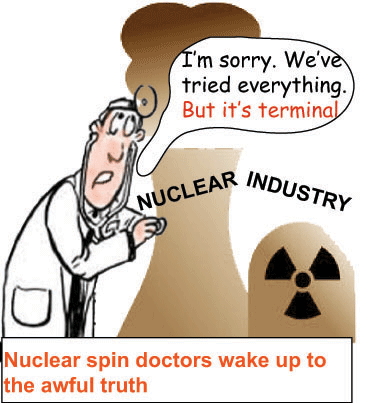
Nuclear power is in terminal decline worldwide and will never make a serious contribution to tackling climate change, a group of energy experts argues.
Meeting recently in London at Chatham House, the UK’s Royal Institution of International Affairs, they agreed that despite continued enthusiasm from the industry, and from some politicians, the number of nuclear power stations under construction worldwide would not be enough to replace those closing down.
The industry was disappearing, they concluded, while the wind and solar sectors were powering ahead.
The group met to discuss the updated World Nuclear Industry Status Report 2019, which concluded that money spent on building and running nuclear power stations was diverting cash away from much better ways of tackling climate change.
Money used to improve energy efficiency saved four times as much carbon as that spent on nuclear power; wind saved three times as much, and solar double.
Amory Lovins, co-founder of the Rocky Mountain Institute, told the meeting: “The fact is that nuclear power is in slow motion commercial collapse around the world. The idea that a new generation of small modular reactors would be built to replace them is not going to happen; it is just a distraction away from a climate solution.”
On nuclear and climate change, the status report says that new nuclear plants take from five to 17 years longer to build than utility-scale solar or on-shore wind power.
“Stabilising the climate is urgent, nuclear power is slow. It meets no technical or operational need that these low-carbon competitors cannot meet better, cheaper, and faster,” the report says.
There was considerable concern at the meeting about the possible danger to nuclear plants caused by climate change. Mycle Schneider, the report’s lead author, said the reason why reactors were built near or on coasts or close to large rivers or estuaries was because they needed large quantities of water to operate. This made them very vulnerable to both sea and coastal flooding, and particularly to future sea level rise.
He was also concerned about the integrity of spent fuel storage ponds that needed a constant electricity supply to prevent the fuel overheating. For example, large wildfires posed a risk to electricity supplies to nuclear plants that were often in isolated locations.
Cost Pressure
Loss of coolant because of power cuts could also be a serious risk as climate change worsened over the 60-year planned lifetime of a reactor. However, he did not believe that even the reactors currently under construction would ever be operated for that long for commercial reasons.
“The fact is that the electricity from new reactors is going to be at least three times more expensive than that from renewables and this will alarm consumers. Governments will be under pressure to prevent consumers’ bills being far higher than they need to be.
“I cannot see even the newest reactors lasting more than a decade or so in a competitive market at the prices they will have to charge. Nuclear power will become a stranded asset,” Schneider said.
Allan Jones, chairman of the International Energy Advisory Council, said one of the myths peddled was that nuclear was needed for “baseload” power because renewables were available only intermittently.
Since a number of countries now produced more than 50% of their power from renewables, and others even 100% (or very close) while not experiencing power cuts, this showed the claim was untrue.
In his opinion, having large inflexible nuclear stations that could not be switched off was a serious handicap in a modern grid system where renewables could at times produce all the energy needed at much lower cost.
Amory Lovins said the UK’s approach appeared to be dominated by “nuclear ideology.” It was driven by settled policy and beliefs, and facts had no connection to reality. “Nuclear is a waste of time and money in the climate fight,” he concluded.
New review confirms that climate change increases the risk of wildfires
|
Climate change increases the risk of wildfires confirms new review https://www.sciencedaily.com/releases/2020/01/200114074046.htm, January 14, 2020, Source: University of East Anglia
|
|
|
THE HEATING OCEANS

 Oceans are as hot as humans have known them and we’re to blame. We must use energy more wisely going forward and trust in the actions of our youth, https://www.theguardian.com/environment/climate-consensus-97-per-cent/2020/jan/13/oceans-are-as-hot-as-humans-have-known-them-and-were-to-blame [excellent graph] John Abraham Oceans are as hot as humans have known them and we’re to blame. We must use energy more wisely going forward and trust in the actions of our youth, https://www.theguardian.com/environment/climate-consensus-97-per-cent/2020/jan/13/oceans-are-as-hot-as-humans-have-known-them-and-were-to-blame [excellent graph] John AbrahamTue 14 Jan 2020 Each year, unfathomable amounts of energy are added to the oceans. Scientists measure heat in joules; the amount of heat in the oceans is so large that we report it in zettajoules. What is a zettajoule? It is 1,000,000,000,000,000,000,000 joules. The amount of heat we are putting into the oceans is equivalent to about five Hiroshima atom bombs of energy every second. I am part of the team of researchers that published a paper on ocean warming that shows the total heat of Earth is increasing with global heating, as scientists have predicted for decades. Each year, we take Earth’s temperature to try to determine what is happening to our climate. Each year the news is worse than the year before. There is hope, which I will discuss later. But first, let’s talk about the new study. As humans emit heat-trapping gases into the atmosphere, it creates an energy imbalance. There is more heat coming in than going out. That means the Earth is out of balance, and temperatures are rising. The vast majority of the excess energy – more than 90% – ends up in the oceans. Consequently, ocean temperatures are rising, and we can measure it. Global warming is really ocean warming, and it has severe consequences. First, it makes ocean levels rise, because warming water expands. Scientists estimate that by the year 2100, oceans will be about 3ft higher than they were in the year 2000, displacing 150 million people around the world. Warmer oceans also make our weather more extreme. They supercharge typhoons and hurricanes. They make rains more deadly and flooding more severe. The rising temperatures are also threatening sea life. We are experiencing major die-offs of coral reefs, which are incredibly important to ocean biodiversity. Rising ocean water is not just a problem for fish and sea life, it is a problem for everyone. The leader of our team, Dr Lijing Cheng, developed an innovative way to measure ocean temperatures. We only get data where we place temperature sensors, and sophisticated mathematics are used to fill in the gaps and create a continuous picture of what is happening. His method of filling in the data gaps has been shown to be very accurate and scientists around the world have adopted the techniques. Often when scientists report climate data, they try to show trends. It isn’t so important what the ocean temperatures were last year or what they will be this year. What really matters is the trend: are the oceans getting hotter or colder? Using the late 1990s as a reference, we see that years prior are colder and years after are warmer. In fact, we see that the oceans have warmed continuously since about 1990. This long-term trend is what climate breakdown looks like, and it is terrible news for the future of the planet. All reasonable people know that the climate is warming and humans are the cause. Sometimes, I am asked for proof of warming, and there are many things I can point to: ice is melting, air temperatures are increasing, sea levels are rising, etc. But the best proof of warming is in the oceans. No one can dispute the data. The oceans are unequivocally warming. So, what do we do about it? Well, we can begin to use energy more wisely. This will not only help with the climate crisis but save money as well. Secondly, we can maximise our energy from renewable sources such as wind, water, and solar. One of the things that gives me hope is that energy from solar and wind power is now cheaper than dirty coal. The benefits of solar and wind depend, of course, on how sunny or windy the conditions are, but with the drop in green energy prices, it no longer makes economic sense to build coal plants. Another bit of hope is represented by the growing actions of our youth. Make no mistake, the Greta Thunbergs of the world will change things in ways that privileged middle-aged white men like me cannot. Their generation will inherit a dire situation, but they have the passion to act, and decades of unarguable evidence that they must. So yes, 2019 set yet another dire record for Earth’s climate. But the fight continues to make the future more habitable for our children and their children.
|
|
Australia should go all-out for renewable energy, not nuclear – Dr Helen Caldicott

“There’s always the risk of a meltdown like Chernobyl, Fukushima or Three Mile Island,” said Dr Caldicott, who once lived at Matcham on the Central Coast.
Despite a strong push towards renewable energy, the nuclear question continues to be asked amid concern that the transition away from fossil fuels isn’t happening fast enough to save the world from catastrophic climate change.
A fortnight before Christmas, the energy committee running the inquiry released its report. It concluded that nuclear energy should be considered as part of Australia’s future energy mix.
“Australia should say a definite ‘No’ to old nuclear technologies but a conditional ‘Yes’ to new and emerging technologies such as small modular reactors,” committee chair and Fairfax MP Ted O’Brien said.
Dr Caldicott said opening the door to nuclear power was “madness”.
She said the so-called “nuclear renaissance” seemed dead and buried after the Fukushima catastrophe.
“One-sixth of the world’s nuclear reactors were closed after the accident,” she said.
She said the corporations that invest in making nuclear plants and radioactive waste had a “new strategy” to develop small modular reactors.
While corporations may claim such reactors could be sold without the dangers inherent in large reactors, she said “there are no safe nuclear power plants”.
If Australia proceeded towards nuclear power, some fear the Hunter could be earmarked as a site for reactors or waste dumps, given its history in the energy sector.
Shortland MP Pat Conroy, who is also Shadow Minister Assisting for Climate Change, has raised serious concerns about this.
“Several sites in our region have been floated as locations for nuclear power stations. I don’t know anyone who wants to live next door to one,” Mr Conroy said.
The Australian Energy Market Operator found that the cheapest new electricity for Australia was renewable energy – wind and solar – backed up by pumped hydro storage and gas.
“Those arguing for nuclear power are arguing for higher energy prices. Nuclear power just does not add up,” Mr Conroy said.
The committee’s report recommends a partial lift of Australia’s moratorium on nuclear energy.
It urged the federal government to keep its moratorium on Generations I, II and III reactors while lifting it for Generations III+ and IV reactors, so “only the newest and best” were considered.
Mr O’Brien said “the Australian people should be at the centre of any approval process”.
“If we’re serious about reducing greenhouse gas emissions, we can’t simply ignore this zero-emissions baseload technology,” he said.
While nuclear plants don’t release emissions, greenhouse gases are emitted in creating and maintaining the infrastructure for nuclear energy, along with uranium mining and enrichment and nuclear waste disposal.
“We can do 100 per cent renewables,”DCr
“What the government should be doing right now is closing down the coal mines and re-employing those people and thousands of others to cover every house with solar panels.
“We should have electric cars powered by solar, not coal, and windmills everywhere including offshore.”
She said geothermal energy should also be tapped.
“South Australia has an enormous amount of geothermal energy,” she said.
“The solutions are there. They will empower the economy, employ millions of people and save the planet. Australia could become the energy superpower of the world.”……
Mr Conroy said there was clear evidence that nuclear power was “expensive, slow, inflexible and dangerous to the environment and human health”.
“In the absence of a coherent energy policy to lower prices and cut greenhouse emissions, Australians are taking matters into their own hands – installing solar panels and batteries,” he said.
“I doubt that any Australians think nuclear power is the way forward – especially those who might end up with it on their doorstep.”…… Mr Conroy said there was clear evidence that nuclear power was “expensive, slow, inflexible and dangerous to the environment and human health”.
“In the absence of a coherent energy policy to lower prices and cut greenhouse emissions, Australians are taking matters into their own hands – installing solar panels and batteries,” he said.
“I doubt that any Australians think nuclear power is the way forward – especially those who might end up with it on their doorstep.”……https://www.standard.net.au/story/6576818/opening-the-door-to-nuclear-power-madness-says-campaigner/?cs=10264
Trump is setting up a massive nuclear crisis with Iran
 Trump is setting up a massive nuclear crisis with Iran, The Week,
First, the fog of war created by the president’s decision to assassinate Soleimani led to tragedy, as Iran seems to have accidentally shot down a planeload of innocent civilians. While most of the blame goes to whichever incompetent Iranian operator pulled the trigger, the reality is that all 176 of those people, including 63 Canadians, would be alive today if the U.S. had not carried out its hit on Soleimani. For another, we should remember that a month passed between the assassination of Archduke Ferdinand and the outbreak of WWI.
More importantly, just because both the Trump administration and senior Iranian leadership seem to share an aversion to full-scale war and pulled back from the brink this time doesn’t mean that the Soleimani killing was costless for the U.S.
The day after the Iranian response, the seldom-seen Teleprompter Trump showed up to deliver a short, sober speech. “As long as I’m president of the United States, Iran will never be allowed to have a nuclear weapon,” President Trump said on Wednesday. He said this before saying “good morning” to the assembled crowd. The specter of an Iranian nuke is still, ostensibly, the overriding goal of American policy vis-à-vis Iran. Yet everything that Trump has done since the day he took office has made an Iranian nuclear breakout more likely.
https://theweek.com/articles/888687/trump-setting-massive-nuclear-crisis-iran
1 This month

of the week – Australians for War Powers Reform (AWPR)
To see nuclear-related stories in greater depth and intensity
 Antinuclear