The fires have forced evacuations worldwide, most recently on Spain’s Canary Islands, where more than 8,000 people have been forced to flee. Smoke from some of the fires is so bad satellites can see it from space, blanketing large portions of South America and the Arctic.
Climate scientists say the fires are partly the result of a world growing warmer, making it easier for flames to spread.
“In these conditions, it is easier for wildfires to grow and to be more long-lived,” said Mark Parrington, a senior scientist in the Copernicus Atmosphere Monitoring Service at the European Centre for Medium-Range Weather Forecasts.
The average global temperature in July was 1.71 degrees F above the 20th-century average of 60.4 degrees, making it the hottest July in the 140-year record, according to scientists at NOAA’s National Centers for Environmental Information.
The previous hottest month on record was July 2016. Nine of the 10 hottest recorded Julys have occurred since 2005; the last five years have ranked as the five hottest. Last month was also the 43rd consecutive July and 415th consecutive month with above-average global temperatures.
Parrington said it’s not possible to draw direct connections between hotter weather and more wildfires, citing human activity. For instance, although there are big fires currently burning in the Amazon, the past 20 years have generally seen a reduction in forest fires there, he said. But now the fires are the worst they’ve been since at least 2010, based on initial data, he said.
Climate experts say there’s always going to be regional variations – the U.S. has had a below-average wildfire year following 2018’s deadly blazes across California – but the overall trend is toward more extreme weather fueled by a hotter climate.
The Arctic’s boreal forests are particularly at risk, said Rick Thoman, a climate specialist with the Fairbanks-based Alaska Center for Climate Assessment and Policy. Like Parrington, he said it’s not a simple connection between hotter weather and more fires, but said the conditions for fires are growing more frequent in the north.
“It’s a reinforcing loop: The more fires you have, the more land you open up, so in future years you’re going to warm that land more because the trees aren’t there to shade it, which will in turn melt permafrost, which will then release carbon and methane, which are greenhouse gases, which contribute to warmer summers and more fires,” Thoman said.
ALASKA: Smoke has once again blanketed Anchorage
Multiple fires are burning near the state’s biggest city, and firefighters have called in assistance from the Lower 48. More than 400,000 acres are currently burning, and one of the biggest concerns is the McKinley Fire, which has destroyed at least 50 structures about 100 miles north of Anchorage. Officials with the Matanuska-Susitna Borough declared a state of emergency, and firefighters hoped that calmer weather predicted for Wednesday could permit evacuees to return.
Experts this spring predicted a long fire season in Alaska because the snow melted several weeks earlier than usual in many parts of the state.
Alaska has had a sweltering summer. July was the state’s hottest month ever, and the long-smoldering Swan Lake Fire roared back up over last weekend, clogging the area with smoke and forcing officials to use pilot cars to lead vehicles through the smoky area on the Kenai Peninsula. Lightning sparked the 138,479-acre fire in June, officials said, and there’s little chance of it being put out until heavy fall rains arrive.
Thoman said Alaskans have become somewhat jaded since this year’s fires have “only” burned 2.5 million acres of land, compared with the 6.6 million acres burned during the worst season on record in 2004. But because this year’s fires burned so close to populated areas, they’ve gotten more attention: “With one-mile visibility in smoke, you can’t get away from it.”
AMAZON: Forest fires are generating smoke that can be seen from space
The sky above São Paulo turned black Monday as wildfires raging more than 1,000 miles away sent smoke pouring over Brazil’s largest city. The smoke resulting from some of these wildfires was also captured in satellite images released by NASA last week.
The Amazon rainforest is burning at a record rate. The fires are no accident, and we need to face it. How does this affect our planet? Just the FAQs, USA TODAY
“The smoke did not come from fires from the state of São Paulo, but from very dense and wide fires that have been going on for several days in Rondônia and Bolivia. The cold front changed the direction of the winds and transported this smoke to São Paulo,” Josélia Pegorim, Climatempo meteorologist, told Globo.
The Twitter hashtag #PrayforAmazonas has been trending as horrified Amazon-watchers share pictures of the devastation.
U.S. scientists say the Amazonian rain forest is typically resistant to fire, but climate changes have left it drier than usual. And while this is the time of year when farmers often set fires in the area to clear off areas for agriculture, Reuters reported the Amazon rain forest has experienced a record number of fires this year, citing new data released by the country’s space agency, the National Institute for Space Research (INPE). The agency said its satellite data detected more than 72,000 fires since January, an 83% increase over the same period of 2018.
The Amazon rain forest fires can be seen from space, and NASA can see these fires from space. Veuer’s Keri Lumm reports. Buzz60
According to an analysis by Copernicus Atmosphere Monitoring Service, the August emissions for the Amazonas area are the highest since 2003, and for the overall Amazonia areas are the highest since 2010.
CANARY ISLANDS: Huge flames force widespread evacuations
A raging wildfire forced large-scale evacuations of residents this week on Gran Canaria, a mountainous volcanic island off northwest Africa. Authorities said the fire burning in forested areas was generating flames up to 160 feet tall in the area of Tamadaba Natural Park, and about 8,000 people had been evacuated. The island is popular with tourists, but officials said the resort areas were so far unaffected, although smoke was widely visible.
Gran Canaria emergency chief Frederico Grillo said recent blazes now are much worse – “nothing like those we used to have” – when families worked in the countryside and forests were kept more orderly, private news agency Europa Press reported.
The Arctic: Areas of normally snow-covered Greenland are burning
The Arctic as a whole has seen unusually high wildfire activity this summer, Parrington said, including areas such as Greenland that typically don’t see fires. One estimate found that the amount of carbon dioxide emitted from fires burning within the Arctic Circle in in June 2019 was greater than all of the CO2 released in the same month from 2010 through to 2018 put together.
While it isn’t uncommon for these areas to see wildfires, there is cause for concern now, Thomas Smith, an assistant professor in environmental geography at the London School of Economics, told USA TODAY last month.
“The magnitude is unprecedented in the 16-year satellite record,” Smith said. “The fires appear to be further north than usual, and some appear to have ignited peat soils.” Peat fires can smolder for months.
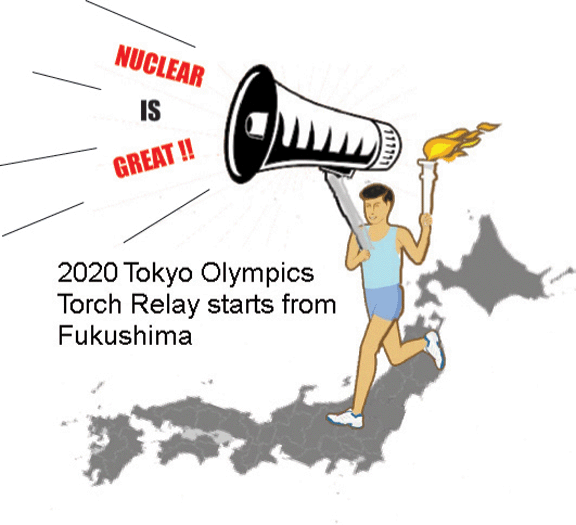
The danger of sourcing food and material from the Fukushima region Ground-level nuclear disasters leave much more radioactive fallout than Tokyo is willing to admit Hankyoreh By Seok Kwang-hoon, energy policy consultant of Green Korea Aug.25,2019 International concerns are growing over the Japanese government’s plans to provide meals from the Fukushima area to squads participating in the 2020 Tokyo Olympics. The starting point for the Olympic torch relay, and even the baseball stadium, were placed near the site of the Fukushima Nuclear Power Plant. It seems to be following the model of the Tokyo Olympics in 1964, where Japan’s rise from the ashes of the atomic bombs was underscored by having a young man born the day of the Hiroshima bombing act serve as the relay’s last runner. Here we can see the Shinzo Abe administration’s fixation on staging a strained Olympic reenactment of the stirring Hiroshima comeback – only this time from Fukushima.
But in terms of radiation damages, there is a world of difference between Hiroshima and Fukushima. Beyond the initial mass casualties and the aftereffects suffered by the survivors, the atomic bombing of Hiroshima resulted in little additional radiation exposure. Nuclear technology being as crude as it was back then, only around one kilogram of the Hiroshima bomb’s 64kg of highly enriched uranium actually underwent any reaction, resulting in a relatively small generation of nuclear fission material. Whereas ground-based nuclear testing results in large quantities of radioactive fallout through combining with surface-level soil, the Hiroshima bomb exploded at an altitude of 580m, and the superheated nuclear fission material rose up toward the stratosphere to spread out around the planet, so that the amount of fallout over Japan was minimal. Even there, most of the nuclides had a short half-life (the amount of time it takes for half the total atoms in radioactive material to decay); manganese-56, which has a half-life of three hours, was the main cause of the additional radiation damages, which were concentrated during the day or so just after the bomb was dropped. The experience of Nagasaki was similar. As a result, both Hiroshima and Nagasaki were able to fully resume as functioning cities by the mid-1950s without additional decontamination efforts.
Ground-level nuclear disasters leave much more radioactive fallout than Tokyo is willing to admit
nternational concerns are growing over the Japanese government’s plans to provide meals from the Fukushima area to squads participating in the 2020 Tokyo Olympics. The starting point for the Olympic torch relay, and even the baseball stadium, were placed near the site of the Fukushima Nuclear Power Plant. It seems to be following the model of the Tokyo Olympics in 1964, where Japan’s rise from the ashes of the atomic bombs was underscored by having a young man born the day of the Hiroshima bombing act serve as the relay’s last runner. Here we can see the Shinzo Abe administration’s fixation on staging a strained Olympic reenactment of the stirring Hiroshima comeback – only this time from Fukushima.But in terms of radiation damages, there is a world of difference between Hiroshima and Fukushima. Beyond the initial mass casualties and the aftereffects suffered by the survivors, the atomic bombing of Hiroshima resulted in little additional radiation exposure. Nuclear technology being as crude as it was back then, only around one kilogram of the Hiroshima bomb’s 64kg of highly enriched uranium actually underwent any reaction, resulting in a relatively small generation of nuclear fission material. Whereas ground-based nuclear testing results in large quantities of radioactive fallout through combining with surface-level soil, the Hiroshima bomb exploded at an altitude of 580m, and the superheated nuclear fission material rose up toward the stratosphere to spread out around the planet, so that the amount of fallout over Japan was minimal. Even there, most of the nuclides had a short half-life (the amount of time it takes for half the total atoms in radioactive material to decay); manganese-56, which has a half-life of three hours, was the main cause of the additional radiation damages, which were concentrated during the day or so just after the bomb was dropped. The experience of Nagasaki was similar. As a result, both Hiroshima and Nagasaki were able to fully resume as functioning cities by the mid-1950s without additional decontamination efforts…… http://www.hani.co.kr/arti/english_edition/e_editorial/907055.html
BY RAMESH THAKUR HIROSHIMA, 25 Aug !9 – The Hiroshima Round Table held its seventh annual meeting last Wednesday and Thursday. For the first time, in recognition of the uniquely dangerous international security environment since the dawn of the atomic age in this beautiful city, the Round Table issued an urgent appeal to maintain existing nuclear arms control, disarmament and nonproliferation pacts and to build on them in order to deepen strategic stability. Continue reading →
Would the U.S. or Denmark be responsible for cleaning up over 47,000 gallons of Cold War-era radioactive waste?
BY DAN POSSUMATO , 25 Aug 19, BRUNSWICK — President Trump’s flippant yet repeated comments about the possibility of the United States purchasing Greenland – Denmark’s semi-autonomous island, which is 25 percent larger than Alaska – are both amusing and worrisome. Amusing because the comments show an astounding lack of diplomatic decorum, and worrisome because the Russians are paying attention, as they are well aware of previous American attempts to utilize the island for military purposes. Since the early 1950s the U.S. has maintained Thule Air Base on the northwest of the island for the purpose of detecting missiles launched against North America, previously from the Soviet Union and now from Russia.
However, the Russians also are aware that in the 1960s, a top-secret U.S. Army operation code-named Project Iceworm attempted to place up to 600 nuclear missiles at another base underneath Greenland’s thick ice shelf. The location of the missiles, so close to our Cold War adversary, would have had enormous offensive capability. Flight time to their targets in the Soviet Union would have been mere minutes, and, therefore, virtually impossible to stop. The missiles were to be constantly moved over rail lines in a network of tunnels dug deep beneath the ice, a plan intended to foil Soviet intelligence from knowing which of the 2,100 siloswould house the missiles. A Cold War version of the old shell game.
Officially, the Army claimed to be operating a facility named Camp Century, whose purported purpose was to conduct experimentation in Arctic construction techniques and engage in other “research.” The installation that Camp Century concealed – Project Iceworm – was powered by an experimental nuclear reactor, which, according to the Atomic Heritage Foundation, produced over 47,000 gallons of radioactive waste that still lies buried, along with the entire camp, under more than 100 feet of ice. Other estimates put the figure at more than 63,000 gallons. The thinking at the time was that the ice would keep the waste entombed forever.
The whole operation proved impractical, as the Army engineers had miscalculated how fast the ice shelf was shifting. The 21 tunnels began to shift and collapse because of the pressure from the ice, the rail tracks buckled, and the reactor began to melt the ice below and it began to sink. Without fanfare, the whole project was abandoned in 1967.
However, the ice is now melting faster than anyone back then had thought possible. In a 2016 article, Science magazine reported that “melting could begin to release waste stored at the camp, including sewage, diesel fuel, persistent organic pollutants like PCBs, and radiological waste from the camp’s nuclear generator.” Fortunately, even with the effects of climate change, the base won’t be exposed for another 90 years or more. Still, who will take ownership of the problem and expend vast sums of money to remediate the environment: the USA or Denmark?
Project Iceworm was so secret that the Danish government was not formally asked for its permission to allow the establishment of the base; thus, it could disavow any knowledge if the operation were ever exposed. Denmark officially did and still does have ban nuclear weapons there, but the country’s prime minister and foreign minister had tacitly allowed U.S. nuclear weapons to be kept in Greenland, at Thule Air Base and at Project Iceworm. The Danish Parliament was unaware of this clandestine decision. (Ultimately, no U.S. missiles were ever deployed to Greenland.)
If President Trump should ever get Denmark to sell us Greenland, perhaps he could get the former base listed on the National Register of Historic Places, and thus preclude any nuclear-waste cleanup for the purpose of preserving a part of our history.
Russian nuclear accident: Medics fear ‘radioactive patients’, https://www.bbc.com/news/world-europe-49432681 Russian medics who treated radiation victims after a military explosion in the Arctic had no protection and now fear they were irradiated themselves.
Two of the medics in Arkhangelsk spoke to BBC Russian about the victims’ evacuation, on condition of anonymity.
Five nuclear engineers died on 8 August when an “isotope-fuel” engine blew up at the Nyonoksa test range, officials said. Two military personnel also died.
President Vladimir Putin said the test involved a new weapon system.
Six people were injured in the accident, but officials gave few details about it.
On 14 August Russia’s weather service Rosgidromet revealed that radiation levels had spiked 16 times above normal, in Severodvinsk, a city 47km (29 miles) east of Nyonoksa.
According to the official data, the radiation that reached Severodvinsk was not heavy enough to cause radiation sickness.
Experts in Russia and the West say the test was most likely linked to the new 9M730 Burevestnik nuclear-powered cruise missile, called “Skyfall” by Nato. Last year Mr Putin said the technology would give the missile “unlimited” range.
The Arkhangelsk medics, who spoke to the BBC’s Pavel Aksenov, said at least 90 people came into contact with the casualties, but the military did not warn them of any nuclear contamination risk.
Contamination fears
The medics were at the civilian Arkhangelsk regional hospital, which treated three of the injured, while three other casualties were taken to an Arkhangelsk hospital called Semashko, which is equipped for radiation emergencies.
The medics said they were speaking out now because they feared for their own health and did not want any similar “[safety] violations” to recur.
“We don’t want them to bring us next time not three, but ten people, God forbid, and hide the information from us again,” said one.
The degree of secrecy surrounding the explosion has drawn comparisons with the 1986 Chernobyl disaster, when Soviet officials were slow to admit the truth.
The Arkhangelsk medics said it was clear that the three brought to their regional hospital were very sick. Doctors examined them in the emergency room, then sent them to an operating theatre.
But the emergency room continued to admit other patients for about an hour, the medics said, until the doctors realised that the three “had received a very high radiation dose”. The hospital handles pregnancy complications and other difficult medical conditions.
“The radiation picture was developing by the hour. Blood tests were being done, and every hour you could see that this or that cell count was plunging. That signified a very high radiation dose,” they said.
The hospital staff kept treating the victims despite knowing about the radiation dose. The staff had to improvise some self-protection – for example, they took face masks from the helicopter crews’ emergency kit.
The next day the three victims were transferred to a hospital in Moscow which has radiation specialists. Their condition now is unknown.
Nuclear decontamination
A military team later carried out decontamination work in the Arkhangelsk hospital.
The medics said the casualties’ clothing was removed, along with stretchers and a “highly radioactive bath”.
“Our cleaners should have been advised, they’re just simple country folk, they were just picking up sacks and bundles and carrying them out,” said one.
The other medic said hospital staff were now mentally stressed, knowing that radiation safety information had been withheld from them during the emergency.
Two weeks after the explosion the Russian health ministry said none of the medics at the Arkhangelsk hospitals had received a hazardous radiation dose. Its conclusion was based on medical examination of 91 staff.
Incomplete data
On Monday an international nuclear agency reported that the two Russian radiation monitoring stations nearest to Nyonoksa had gone offline soon after the explosion. The revelation fuelled suspicions that the radiation could have been heavier than officially reported.
The Comprehensive Nuclear Test-Ban Treaty Organization (CTBTO) said the technical failure at those sites was then followed by a failure at two more. It tweeted an animation showing the potential radiation plume from the explosion.
Russia said the weapons test was none of the CTBTO’s business, and added that handing over radiation data was voluntary. Two of the monitoring stations have since started working again.
South Korea concerned over food safety at Olympics with events slated for Fukushima
Talks to take place over food provision at Tokyo Games
Fukushima to host baseball and softball games next year, Guardian Justin McCurry in Tokyo, Thu 22 Aug 2019 South Korea is considering making its own arrangements to feed its athletes at next year’s Tokyo Olympics, citing concerns over the safety of food from Fukushima, media reports said.
In addition, South Korean sports authorities have requested that international groups be permitted to monitor radiation levels during the 2020 Games.
Food safety concerns in South Korea have grown since Fukushima city was chosen to host six softball games and one baseball game next summer. Fukushima prefecture will also be the location for the start of the domestic leg of the Olympic torch relay, beginning next March.
Tokyo Olympics organisers said South Korea’s National Olympic Committee had sent a letter expressing concern at the possibility of produce grown in Fukushima prefecture being served to athletes in the Olympic village. ……
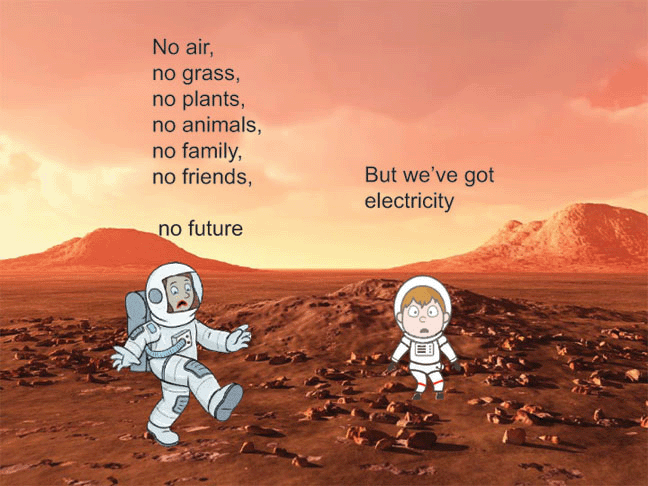
Interview: Martin Rees: ‘Climate change is a doddle compared with terraforming Mars’, Guardian Ian Tucker, 19 Aug 19,
The astronomer royal and risk specialist on cyber-attacks, pandemics, Brexit and life on Mars, Martin Rees is a cosmologist and astrophysicist who has been the astronomer royal since 1995. He is also a co-founder of the Centre for the Study of Existential Risk, Cambridge. His most recent book, On the Future: Prospects for Humanity, is published by Princeton.
Martin Rees……. science is not just a venture for academics – most of our life depends on how it’s applied.
…….. One consequence of modern technology is that the world is more interconnected. It’s possible for small groups or even individuals to produce an effect that cascades very widely, even globally.
Ian Tucker..…The climate crisis is another area where international agreements have had limited impact. There is a strong grassroots movement led by Greta Thunberg and others, yet we have populist presidents in the US and Brazil who are climate-change deniers and reneging on agreements…
Martin Rees Politicians don’t prioritise things when the benefits are diffuse and in the far future. They will only take action if the voters are behind them. That’s why it’s very important to sustain these campaigns.
We want to make sure that these issues of climate stay on the agenda. For instance, the 2015 papal encyclical on climate change. The pope has a billion followers from Latin America, Africa, East Asia and this helped towards consensus at the Paris conference……
The need for sending people into space has evaporated. If you were building the Hubble telescope now, you wouldn’t send people to refurbish it, you would send robots. I hope human space flight will continue, but as a high-risk adventure bankrolled by private companies. If I were American, I wouldn’t support taxpayers’ money going on Nasa’s manned programme. …..
Iceland holds funeral for first glacier lost to climate change
Nation commemorates the once huge Okjokull glacier with plaque that warns action is needed to prevent climate change Guardian Agence France-Presse 19 Aug 2019 ,
Iceland has marked its first-ever loss of a glacier to climate change as scientists warn that hundreds of other ice sheets on the subarctic island risk the same fate.
As the world recently marked the warmest July ever on record, a bronze plaque was mounted on a bare rock in a ceremony on the barren terrain once covered by the Okjökull glacier in western Iceland.
Around 100 people walked up the mountain for the ceremony, including Iceland’s prime minister, Katrín Jakobsdóttir, the former UN human rights commissioner Mary Robinson, and local researchers and colleagues from the United States who pioneered the commemoration project.
“I hope this ceremony will be an inspiration not only to us here in Iceland but also for the rest of the world, because what we are seeing here is just one face of the climate crisis,” Katrín said.
The plaque bears the inscription “A letter to the future”, and is intended to raise awareness about the decline of glaciers and the effects of climate change.
If Trump ends another nuclear treaty, it will be the height of folly, by Michèle Flournoy and Kingston Reif, August 19, 2019 Michèle Flournoy is co-founder and managing partner of WestExec Advisors. She served as the Under Secretary of Defense for Policy from February 2009 to February 2012. Kingston Reif is the director for Disarmament and Threat Reduction Policy at the Arms Control Association.
(CNN)During his first two and a half years in office, President Donald Trump and his administration have laid waste to numerous international agreements originally designed to strengthen US security, bolster US alliances, and constrain US adversaries. The toll has been particularly high with respect to deals concerning nuclear arms control and nonproliferation.
Now the administration is signaling that it might jettison yet another nuclear pact, the2010 New Strategic Arms Reduction Treaty (New START) with Russia. Doing so would be the height of folly and would deal a significant blow to US national security. With the US withdrawal from the INF Treaty having just taken effect on Aug. 2, New START will be the only remaining agreement constraining the size of the world’s two largest nuclear arsenals. Were New START to disappear, for the first time in nearly half a century there would be no legally binding limits on American or Russian nuclear stockpiles. The risk of unconstrained US-Russian nuclear competition, and of even more tense bilateral relations, would grow.
New START is one of the few remaining bright spots in the US-Russian relationship. The treaty requires each side to reduce long-range nuclear forces to no more than 1,550 deployed warheads, 700 deployed long-range missiles and bombers, and 800 deployed and non-deployed missile launchers and bombers by Feb. 5, 2018—a deadline that both countries met.
New START also includes a comprehensive monitoring and verification regime to ensure compliance. But the agreement is set to expire on Feb. 5, 2021. Under its terms, it can be extended by up to five years if both presidents agree.
In an appearance before an activist group this summer, however, US National Security Advisor John Bolton, who before joining the administration calledNew START an “execrable deal,” said that while no decision has been made, he thinks an extension is “unlikely.”
The decision to extend New START should be a no-brainer from both a security and budget perspective.
Brexit will reduce the flow of skilled workers from Europe
Lack of workers will make delivering new plants more difficult
Britain’s plan to revitalize its aging nuclear energy infrastructure is likely to take a hit if Brexit jeopardizes a crucial supply of welders.
The skilled workers have been in short supply for years, a strain that will likely worsen as new nuclear projects are built. About 13% of Britain’s welders come from other countries in the European Economic Area, according to the Migration Advisory Committee, which keeps a list of occupations with a shortage of workers…. (subscribers only) https://www.bloomberg.com/news/articles/2019-08-19/welder-shortage-threatens-boris-johnson-s-u-k-nuclear-revival
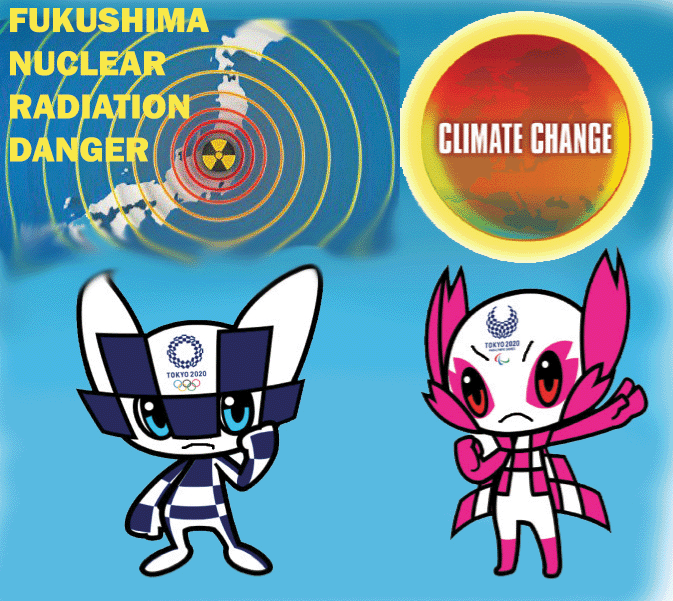
Controversy over radiation and heat surrounding Tokyo Olympics, HANKYOREH
By Kim Chang-geum, staff reporter : Aug.14,2019
“…… Safety from radiation and heat at the Tokyo Olympics
Most of the issues related to the upcoming Tokyo Olympics, which are now only a year away, boil down to safety concerns over radiation and extreme heat. Some baseball and softball matches are scheduled to be held in a stadium located close to the Fukushima nuclear reactor that took direct damage during the 2011 earthquake. Korean civic groups have also pointed out that the Japanese government has failed to properly control water contaminated by radiation from the reactor. Plans to source some of the rice and ingredients for the Tokyo Olympics Athletes Village from Fukushima are adding to these concerns. Although the level of radiation measured in such rice is within the acceptable standards in Japan, it is believed to exceed Korean standards.
Extreme heat is another potential issue. After an open water test competition in Odaiba Seaside Park, Tokyo, on Aug. 11, Sports Nippon reported, “Many athletes complained about a foul odor and the high water temperature, and one male athlete made the shocking claim that it ‘smelled like a toilet.’” Although the Olympic Committee did not reveal the water temperature on that day, it has been reported that the temperature was 29.9 degrees Celsius at 5am. The International Swimming Federation (FINA) cancels events if the water temperature reaches 31 degrees Celsius. There have also been warnings about road races. On August 8, Yusuke Suzuki, Japan’s star race-walker and world record holder in the men’s 20km, stated, “I tried training on the Tokyo Olympics race-walking course. There was no shade, so it could cause dehydration.”
Tokyo Olympics delegation heads meeting from Aug. 20-22It appears that the issue of safety from radiation and concerns about food ingredients will be conveyed during the upcoming three-day meeting with the leaders of each country’s delegation in Tokyo on Aug. 20-22, and a request will be made to the Japanese Olympic Committee to change the name of Dokdo used on maps. If the representatives from each country do raise the radiation issue, the IOC will have no choice but to intervene. The Korean Sport & Olympic Committee is also considering providing separate Korean food to Korean athletes through specially prepared meals or lunchboxes. …. http://english.hani.co.kr/arti/english_edition/e_international/905758.html
By Evan Gershkovich and Pjotr Sauer 16 Aug 19, Five hospital staff workers, including senior doctors, told The Moscow Times that FSB agents had their colleagues sign non-disclosure agreements.The three injured men arrived at the hospital around 4:30 pm, naked and wrapped in translucent plastic bags. The state of the patients made staff suspect they were dealing with something very serious. But the only information they had at the time was that there had been an explosion at a nearby military site around noon.
“No one — neither hospital directors, nor Health Ministry officials, nor regional officials or the governor — notified staff that the patients were radioactive,” one of the clinic’s surgeons told The Moscow Times by phone this week. “The hospital workers had their suspicions, but nobody told them to protect themselves.” Continue reading →
Russian military orders village evacuation, then cancels it, following explosion that killed five nuclear scientists, Secrecy surrounding an explosion that killed five nuclear scientists and caused a spike in radiation levels has sparked fears of a cover-up in Russia, with authorities backflipping on orders to evacuate a nearby village.https://www.abc.net.au/news/2019-08-14/russian-nuclear-explosion-mystery/11411470
Key points:
Medics who treated victims of an accident have been sent to Moscow for medical examination
Russia’s state weather service said radiation levels spiked in Severodvinsk by up to 16 times
Many Russians spoke angrily on social media of misleading reports reminiscent of Chernobyl
State nuclear agency Rosatom said the accident occurred during a rocket test on a sea platform.
The rocket’s fuel caught fire after the test, causing it to detonate, it said in a statement carried by Russian news agencies.
Two days later, after a spike in radiation levels was reported, Rosatom conceded the accident involved nuclear materials.
On Tuesday (local time), the Russian military ordered residents of the small village of Nyonoksa to temporarily evacuate, citing unspecified activities at the nearby navy testing range.
But a few hours later, it said the planned activities were cancelled and told the villagers they could go back to their homes, said Ksenia Yudina, a spokeswoman for the Severodvinsk regional administration.
Local media in Severodvinsk said Nyonoksa residents regularly received similar temporary evacuation orders, usually timed to tests at the range.
Russia’s state weather service said radiation levels spiked in the Russian city of Severodvinsk, about 30 kilometres west of Nyonoksa, by up to 16 times following the explosion.
Emergency officials issued a warning to all workers to stay indoors and close the windows, while spooked residents rushed to buy iodide, which can help limit the damage from exposure to radiation.
‘People need reliable information’
Many Russians spoke angrily on social media of misleading reports reminiscent of the lethal delays in acknowledging the Chernobyl accident three decades ago.
US experts said they suspected the cause was a botched test of a nuclear-powered cruise missile commissioned by President Vladimir Putin.
Boris L Vishnevsky, a member of the St. Petersburg City Council, told the New York Times that dozens of people had called asking for clarification about radiation risks.
“People need reliable information,” Mr Vishnevsky told the Times.
“And if the authorities think there is no danger, and nothing needs to be done, let them announce this formally so people don’t worry.”
While hailing the deceased as the “pride of the atomic sector”, Rosatom head Alexei Likhachev pledged to continue developing new weapons. “The best tribute to them will be our continued work on new models of weapons, which will definitely be carried out to the end,” Mr Likhachev was quoted as saying by RIA news agency.
Medics who treated victims sent to Moscow
Medics who treated the victims of an accident were sent to Moscow for medical examination, TASS news agency cited an unnamed medical source as saying on Tuesday.
The medics sent to Moscow have signed an agreement promising not to divulge information about the incident, TASS cited the source as saying.
US President Donald Trump said on Twitter on Monday the United States was “learning much” from the explosion and the United States had “similar, though more advanced, technology”.
He said Russians were worried about the air quality around the facility and far beyond, a situation he described as “Not good!”
But when asked about his comments on Tuesday, the Kremlin said it, not the United States, was out in front when it came to developing new nuclear weapons.
“Our president has repeatedly said that Russian engineering in this sector significantly outstrips the level that other countries have managed to reach for the moment, and it is fairly unique,” Kremlin spokesman Dmitry Peskov said.Mr Putin used his state-of-the nation speech in 2018 to unveil what he described as a raft of invincible new nuclear weapons, including a nuclear-powered cruise missile, an underwater nuclear-powered drone, and a laser weapon.
Under the moniker of the “Reconstruction Olympics,” they have plotted a torch relay course that begins near the crippled Fukushima Daiichi plant and continues through adjacent prefectures — Miyagi and Iwate — impacted by the disaster. The region will host games in baseball, softball and soccer next summer.
“We are hoping that, through sports, we can give the residents new dreams,” said Takahiro Sato, director of Fukushima’s office of Olympic and Paralympic promotions. “We also want to show how far we’ve come.”
The effort has drawn mixed reactions, if only because the so-called “affected areas” are a sensitive topic in Japan.
Some people worry about exposure to lingering radiation; they accuse officials of whitewashing health risks. Critics question spending millions on sports while communities are still rebuilding.
“The people from that area have dealt with these issues for so long and so deeply, the Olympics are kind of a transient event,” said Kyle Cleveland, an associate professor of sociology at Temple University’s campus in Japan. “They’re going to see this as a public relations ploy.”……
The populace began to question announcements from the Tokyo Electric Power Co. (Tepco) about the scope of the contamination, said Cleveland, who is writing a book on the catastrophe and its aftermath.
“In the first 10 weeks, Tepco was downplaying the risk,” he said. “Eventually, they were dissembling and lying.”……..
Reliable data on radiation risks is difficult to obtain, said Jonathan Links, a public health professor at Johns Hopkins University. …….
In terms of athletes and coaches visiting the impacted prefectures for a week or two during the Olympics, Links said the cancer risk is proportional, growing incrementally each day.
The Japanese government has raised what it considers to be the acceptable exposure from 1 millisievert to 20 millisieverts per year. Along with this adjustment, officials have declared much of the region suitable for habitation, lifting evacuation orders in numerous municipalities. Housing subsidies that allowed evacuees to live elsewhere have been discontinued.
But some towns remain nearly empty.
“People are refusing to go back,” said Katsuya Hirano, a UCLA associate professor of history who has who has spent years collecting interviews for an oral history. “Especially families with children.”……..
With infrastructure repairs continuing throughout the region, evacuee Akiko Morimatsu has a skeptical view of the Tokyo 2020 campaign.
“They have called these the ‘Reconstruction Games,’ but just because you call it that doesn’t mean the region will be recovered,” Morimatsu said.
Concerns about radiation prompted her to leave the Fukushima town of Koriyama, outside the mandatory evacuation zone, moving with her two young children to Osaka. Her husband, a doctor, remained; he visits the family once a month.
Now, why would I post an article about sand being carted along Adelaide beaches to counter erosion? Probably because it is a pointless exercise, since it is done every two years – something to do with tides etc…..and our yearning for beautiful beach sand on Adelaide beaches from West beach to Henley Beach…but in particular for the sum of money involved – “The carting, part of a $48.4 million plan to save city beaches from sand erosion, will last eight to 10 weeks, three or four times over the next two years.”
And how much is this proposed National Nuclear Dump community being paid to have a dump in its community for 300 years?? $31 million dollars– that’s it!A ONCE OFFPAYMENT! And from that $31 million dollars, $8 million is for training, $3 million is for Aboriginal appeasement, and the rest $20 million for community…….
Again, a cheap option for the Federal Government to SHAFT the Nuclear Waste into South Australia, so it SOLELY BECOMES SOUTH AUSTRALIA’S PROBLEM! And South Australia will be coming cap in hand if, or rather when, anything goes wrong! And what pray tell happens to the tag-a-long “temporary” Intermediate Nuclear Waste?? …Ah, that’s right – South Australia’s problem!!
There is NO URGENCY FOR THIS WASTE PROBLEM! We have been told that if a suitable site is not found, that the production of medical isotopes will in no way be affected!
And South Australia has every right to say NO…just as the other states have done. In fact other states have had this proposal over the years, just as SA has previously had, and every time they, and we, said NO!
And it is NO again! South Australia is NOT the Nation’s Nuclear Dumping Ground!





 Antinuclear