Small nuclear reactor blew up in deadly accident
 Russia says small nuclear reactor blew up in deadly accident, The Age, By Jake Rudnitsky and Stepan Kravchenko
Evidence Grows That Russia’s Nuclear-Powered Doomsday Missile Was What Blew Up Last Week
, Seven personnel from a major nuclear weapons research laboratory died in the mysterious incident at a test site in northwestern Russia. Rumors and speculation continue to swirl around a radiological accidentlast week at a missile test site in northwestern Russia even as officials held a memorial service today for those who died in the incident. The Kremlin has now acknowledged that the incident killed at least seven scientists and other personnel from a major state nuclear research laboratory, who were working on a system that included a small nuclear reactor at the time. This same lab is linked to the development of a nuclear-powered cruise missile called Burevestnik and U.S. intelligence officials are reportedly increasingly of the view that one of these weapons, or a test article related to it, exploded in this mishap.
American religious anti-war activists face 25 year gaol term
 Faith-Based Peace Activists, Facing 25-Year Sentence, Defend Disarmament Action at Nuclear Submarine Base Common Dreams, Faith-Based Peace Activists, Facing 25-Year Sentence, Defend Disarmament Action at Nuclear Submarine Base Common Dreams,
“I would argue our communal criminal history has been all about upholding the basic tenets of love and providing for the common good.” The Kings Bay Plowshares Seven (KBP7) nonviolently and symbolically disarmed the Trident nuclear submarine base in Kings Bay, Georgia on April 4, 2018. Last week in federal court, District Judge Lisa Godbey Wood heard the peace advocates’ pre-trial arguments asking her to dismiss the felony and misdemeanor charges against them. Lawyers for Mark Colville, Father Steve Kelly, Elizabeth McAlister, Martha Hennessy, Clare Grady, Patrick Michael O’Neill, and Carmen Trotta say the federal government violated the Religious Freedom Restoration Act (RFRA) when it charged the KBP7 with conspiracy, trespassing, and destruction and depredation of property. The activists say they were acting in the name of their Catholic faith when they cut through fencing and wire at the submarine base and allegedly vandalized a building and static missiles. ……… Circulating their petition on social media after the hearing, the KBP7’s support committee called on the public not only to join their call for the government to dismiss their charges, but also to help rebuild the anti-nuclear weapons movement “that helped disarm the world’s nuclear arsenals from 90,000 down to 15,000 weapons in the 1980s.” “We who share the moral vision of the Kings Bay Plowshares Seven proclaim our support for their courage and sustained sacrifice and call for the immediate dismissal of all charges against them,” reads the petition, addressed to Attorney General William Barr. “The defendants invite us to act creatively. They invite us to join global coalitions working to promote governments’ adherence to, and full implementation of, the Treaty on the Prohibition of Nuclear Weapons. They also invite us to participate in campaigns for divestment from nuclear weapons as complementary efforts towards the realization of a world free of nuclear weapons.” A number of global peace advocates and Nobel Peace Laureates are among the signers of the petition, including Archbishop Desmond Tutu, Poor People’s Campaign leaders Rev. William Barber and Rev. Liz Theoharis, and Medea Benjamin. Judge Wood is currently considering the KBP7’s arguments. https://www.commondreams.org/news/2019/08/12/faith-based-peace-activists-facing-25-year-sentence-defend-disarmament-action |
|
Russia’s radiation leak “clearly a bigger issue than the Russians are letting on”.
 Russia nuclear leak: Mysterious footage of hazmat officials escalates radiation panic https://www.express.co.uk/news/world/1164125/Russia-nuclear-leak-radiation-Putin-iodine-hazmat
CHILLING footage from Russia has intensified fears of a nuclear radiation accident after ambulances were spotted lined with protective chemical sheets and hospitals workers were seen wearing hazmat suits.
Rostam added that the explosion took place during the testing of an “isotope power source”.
The official said five of its employees had died as a result of the accident and three more were being treated for burns.
However, the extent of the incident and threat of radiation has not been disclosed, amid growing global concern.
The Archangelsk naval base has been placed under emergency lockdown for a month, with the nearby White Sea also closed to commercial shipping.
A sudden radiation spike detected in the region following the explosion prompted the initial speculation that the incident was related to a nuclear missile test.
The radiation level was recorded as 20 times higher than the normal level in the nearby city of Severodvinsk.
This has been reinforced by chilling footage filmed in the aftermath of the incident.
One video showed hospital workers wearing hazmat suits while they loaded the injured into an ambulance. Another terrifying video revealed a security escort of ambulances transporting the injured to Moscow.
In this footage, one of the ambulance is clearly coated in a chemical protection film.
A defence ministry source said that the worker’s clothes had been burned as soon as they were hospitalised with suspected radiation. Experts have linked the incident to the testing of the new nuclear-powered cruise missile Burevestnik mentioned during a speech by Vladimir Putin last year.
Local people have reportedly been urged to take precautions against radiation, with children from local kindergartens taken indoors after the blast.
There has also been a rush to buy iodine in Russia’s far north.
Russian expert Dr Mark Galeotti said the incident was “clearly a bigger issue than the Russians are letting on”.
He told the BBC: “Despite what the Kremlin have said, there must have been some sort of radiation leak – and they want people to not just stay out of harm’s way, but also don’t want people coming to the site with Geiger Counters.”
Fukushima’s radioactive water storage approaching full capacity – what next?
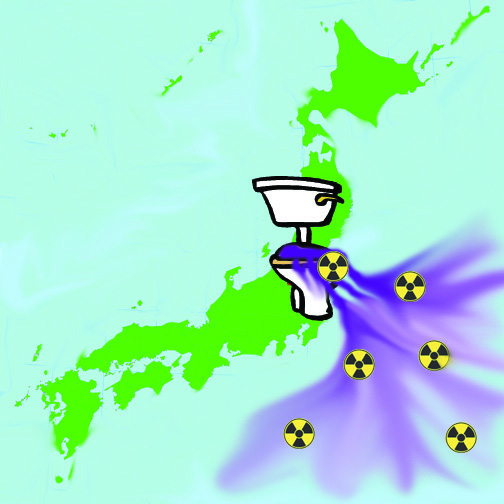 IN THREE YEARS, FUKUSHIMA COULD OVERFLOW WITH RADIOACTIVE WATER, https://futurism.com/the-byte/fukushima-overflow-radioactive-water AUGUST 9TH 19__DAN ROBITZSKI_
Ticking Clock
The effort to safely decommission Japan’s Fukushima Daiichi nuclear power plant just got hit by a looming deadline.
In about three years, the plant will run out of space for the massive quantities of treated but still-radioactive water that officials have been storing there, according to The Associated Press. While a government panel came up with a few possible courses of action, the most feasible one at the moment is to simply dump the water into the Pacific — a bleak sign for nuclear disasters in the future.
Maximum Capacity
At the moment, Fukushima has over 1 million tons of water stored in almost 1,000 on-site tanks, the AP reports. Plans are in place to build enough to store nearly 1.4 million more tons, but that even those will reach capacity by mid-2022.
Local fishers and residents of the area say that dumping the water would devastate the area’s fishing and agriculture industry, per the AP. Other options considered by the panel include vaporizing the radioactive water or injecting it deep underground.
“When we talk about Fukushima’s reconstruction, the question is if we should prioritize the decommissioning at the expense of Fukushima people’s lives,” University of Tokyo professor of disaster social science Naoya Sekiya told the AP. “The issue is not just about science.”
India and Pakistan on the nuclear brink over Kashmir?

Kashmir has been a flashpoint since Imperial Britain divided India in 1947. India and Pakistan have fought numerous wars and conflicts over majority Muslim Kashmir. China controls a big chunk of northern Kashmir known as Aksai Chin.
In 1949, the UN mandated a referendum to determine if Kashmiris wanted to join Pakistan or India. Not surprisingly, India refused to hold the vote. But there are some Kashmiris who want an independent state, though a majority seek to join Pakistan……
What makes this confrontation so dangerous is that both sides have important tactical and nuclear forces arrayed against one another. These are mostly short/medium-ranged nuclear tipped missiles, and air-delivered nuclear bombs. Strategic nuclear weapons back up these tactical forces. A nuclear exchange, even a limited one, could kill millions, pollute much of Asia’s ground water, and spread radioactive dust around the globe – including to North America. ….https://www.commondreams.org/views/2019/08/11/hair-trigger-nuclear-alert-over-kashmir
Pacific nuclear veterans’ descendants sought for study
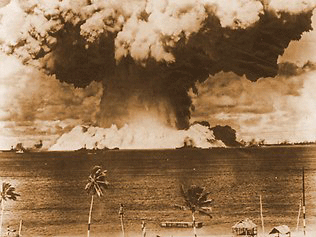 Pacific nuclear veterans’ descendants sought for study. https://www.odt.co.nz/news/national/pacific-nuclear-veterans-descendants-sought-study A search is underway for descendants of service personnel who witnessed a nuclear test at Mururoa Atoll to take part in a nationwide study.A Mururoa Nuclear Veterans Group wants all veterans who were deployed to Mururoa Atoll in 1973, and their families, to be part of a study as it’s believed their children may have been affected by their parents’ exposure to radiation. Pacific nuclear veterans’ descendants sought for study. https://www.odt.co.nz/news/national/pacific-nuclear-veterans-descendants-sought-study A search is underway for descendants of service personnel who witnessed a nuclear test at Mururoa Atoll to take part in a nationwide study.A Mururoa Nuclear Veterans Group wants all veterans who were deployed to Mururoa Atoll in 1973, and their families, to be part of a study as it’s believed their children may have been affected by their parents’ exposure to radiation.
The then Labour government sent a frigate to Mururoa Atoll, including then Cabinet Minister Fraser Colman, to protest against French nuclear testing there. Mururoa Nuclear Veterans Group wants all people on the frigate, and their families to be part of a study as it’s believed their children may have been affected by their parents’ exposure to radiation. The group, which was established in 2013 to press the government to help families with nuclear related illnesses, had 135 members who served at the protest. Of those, 56 had children or grandchildren with unexplained medical conditions. University of Otago associate professor David McBride, has been tasked with conducting the first medical testing of veterans’ children and grandchildren. To establish whether genetic transfer of illnesses are related to exposure to nuclear radiation and create a registry “would be difficult but not impossible,” Mr McBride said. Mururoa Nuclear Veterans Group vice-president, Tony Cox, was concerned veteran’s offspring could be more susceptible to conditions like leukaemia and auto-immune diseases. “If we don’t do it now, when we die no one else is going to care. Their sickness and problems we consider is directly attributable to our service,” Mr Cox said. “Be it Operation Grapple, Christmas Island, Mururoa, anywhere else … widows and children especially we are looking for.” The University of Otago will carry out the study from October or November this year, but a registry needs to be created for the study to work. Mr Cox encouraged anyone with a nuclear testing background to come forward to take part in the study or identify themselves in order to be included in the registry. |
|
Letter to Minister Wyatt in support of Barngarla letter
Two military accidents in Russia, one with release of radiation
Russia explosion: Five confirmed dead in rocket blast, BBC 10 Aug 19 Five people were killed and three injured following a rocket explosion on a naval test range in Russia on Thursday, state nuclear company Rosatom confirmed.
Rostacom said the accident occurred during tests on a liquid propellant rocket engine.
The three injured staff members suffered serious burns in the accident.
Authorities had previously said that two people died and six were injured in the blast at the site in Nyonoksa.
The company told Russian media that its engineering and technical team had been working on the “isotope power source” for the propulsion system.
The Nyonoksa site carries out tests for virtually every missile system used by the Russian navy, including sea-launched intercontinental ballistic missiles, cruise missiles and anti-aircraft missiles.
Authorities in Severodvink, 47km (29 miles) east of Nyonska said that radiation levels shortly after the blast were higher than normal for about 40 minutes but returned to normal……..
Ammunition dump blaze
It is the second accident involving Russia’s military this week.
On Monday, one person was killed and eight others were injured in a blaze at an ammunition dump in Siberia.
Flying munitions damaged a school and a kindergarten in the area. More than 9,500 people were evacuated. https://www.bbc.com/news/world-europe-49301438
Russia’s secrecy over nuclear incident in 2017
A group of scientists called the ‘Ring of 5’ found evidence of a major nuclear accident that went undeclared in Russia, https://www.insider.com/nuclear-accident-unreported-russia-2017-2019-8 Aria Bendix
- In 2017, a group of scientists known as the “Ring of Five” detected “an unprecedented release” of radiation in Europe and Asia.
- At the time, no country claimed responsibility for the release, but a new study from the Ring of Five attributes it to a nuclear accident at Russia’s Mayak nuclear facility.
- The facility was previously the site of the 1957 Kyshtym explosion, the world’s third-worst nuclear accident, behind Fukushima and Chernobyl.
A group of scientists called the “Ring of Five” has been scouring Europe’s atmosphere for elevated levels of radiation since the mid ’80s.
In July, the group released a study detailing evidence of an undisclosed nuclear accident that may have taken place less than two years prior. The likely culprit, the scientists said, was the Mayak nuclear facility in Russia, which was once the center of the Soviet nuclear-weapons program.
At the time of the alleged accident in 2017, Russian officials said the facility wasn’t the source of the release, even though the nation showed elevated levels of a radioactive isotope called ruthenium-106. Instead, officials in Russia attributed the radiation to an artificial satellite that burned up in the atmosphere.
But the latest Ring of Five study contradicts that account. Continue reading
Space Radiation Will Damage Mars Astronauts’ Brains
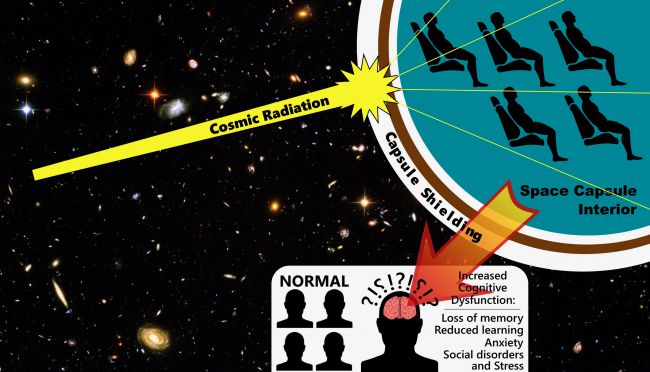
Space Radiation Will Damage Mars Astronauts’ Brains, Space.com By 9 Aug 19, Space radiation will take a toll on astronauts’ brains during the long journey to Mars, a new study suggests.
The connection between indigenous and nuclear issues

“These trucks are carrying radioactive materials over the water supply for seven states, and they are driving by our communities and our families,” “This is an unacceptable risk.”
Local activists highlight connection between indigenous and nuclear  issues, https://news.wbfo.org/post/local-activists-highlight-connection-between-indigenous-and-nuclear-issues, By KYLE S. MACKIE 9 Aug 19, A celebration of Indigenous Peoples and Nuclear-Free Future Day returns Friday to the Buffalo History Museum. Ahead of the event, local Native Americans and environmental activists explained how the issues of indigenous peoples and nuclear power are intertwined.
Representatives from local indigenous communities, the Western New York Peace Center and Peace Action New York State gathered Tuesday at the history museum’s Japanese Garden. Agnes Williams, coordinator of the organization Indigenous Women’s Initiatives, helped hold up two colorful banners that read, “No More Waste” and “Water is Life.”
“The nuclear issue is very important to us as indigenous people because we’re on the beginning and the end of the nuclear chain, at uranium mining and waste disposal,” said Williams, who is a member of the Seneca Nation.
Williams and other speakers discussed the long history of indigenous land around the world and in the U.S. being taken and used for mining, testing of nuclear weapons and then disposal of radioactive waste.
“We thank indigenous wisdom for the guidance,” said Victoria Ross, executive director of WNY Peace Center. “All of our issues are connected. We are working to #UniteTheStruggles.” Continue reading
The current push to normalise the increase in, and use of, nuclear weapons
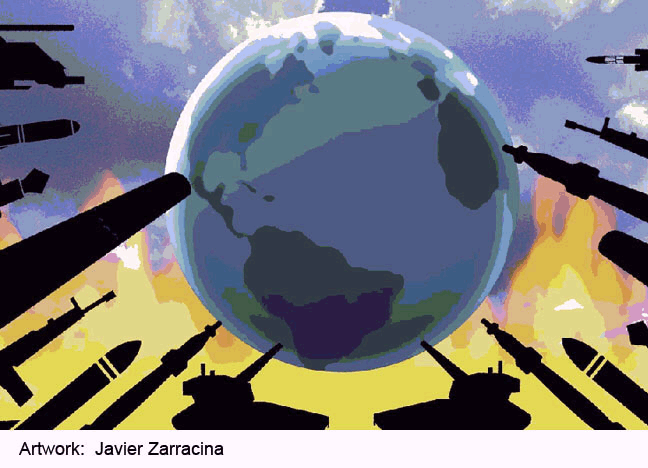 The more that Putin and Trump revalidate the role of nuclear weapons in strengthening national security, the more they normalise the discourse of nuclear weapons use and embolden calls for nuclear weapon acquisition in other countries. In Australia, this debate has been restarted most recently by Hugh White.
A nuclear world in disarray https://www.aspistrategist.org.au/a-nuclear-world-in-disarray/ 7 Aug 2019, Ramesh Thakur We are in a uniquely dangerous period in the atomic age. Geopolitical tensions have spiked in Europe, in the Middle East, on the subcontinent and in East Asia. The nuclear arms control architecture is fraying and crumbling, but no negotiations are underway to reduce global nuclear stockpiles.
A hostile international security environment, the proliferation of nuclear weapons and the emergence of new space, cyber and AI technologies have increased the risk of accidental or deliberate use of nuclear weapons. The growing strategic risks and uncertainty in turn fuel the vicious cycle of renewed interest among US allies in a nuclear deterrent as a hedge against receding US primacy and reliability. Continue reading
America’s nuclear-weapons policy isn’t what you think—it’s much worse
 The US Strategic Command, which was created in the post-Cold War period to manage US nuclear strike capabilities, has even brought back the Orwellian motto of its predecessor, the Strategic Air Command: “Peace is our Profession.”
many experts consider missile defense destabilizing: It doesn’t get you defense—it gets you a new arms race.
Where does this path lead? If history is a guide: nowhere good.
The best-case scenario is that we get out of this era without any nukes going off, having spent our money and resources on weapons that forever sat in silos. That’s money we won’t be able to spend on improving the social safety net, on improving medical care, on basic scientific and medical research, on energy security, on infrastructure upgrades, or on mitigating climate change.
America’s nuclear-weapons policy isn’t what you think—it’s much worse https://qz.com/1680411/us-and-russia-are-starting-another-nuclear-war/, By Alex Wellerstein August 6, 2019
In the chaos that currently makes up the day-to-day of American foreign policy—a trade war here, tearing up international agreements and treaties there—it can be easy to miss the larger developments.
One of these, which occasionally rears its head in a frightened headline, is that there is a new nuclear arms race well under way.
In the United States, we typically get this in the form of news about the capabilities of other countries: Russia is developing a “doomsday torpedo,” China is developed “hypersonic missiles,” and so on. Whether these specifics are real or hype (experts are divided about the reality of the “doomsday torpedo”), they are part of a broader reality:
We’re back in an arms race. But it’s not a new one. Continue reading
New studies find- nuclear power inseparable from nuke weapons – “small” reactors uneconomic
Climate News Network 6th Aug 2019 Two new studies together make an eloquent case against nuclear power: that its civilian uses are inseparable from nuclear warmaking, and that it  is always uneconomic and has to be subsidised by taxpayers.
The first report, by the Berlin-based German Institute for Economic Research (DIW), says that
private economic interests have never played a role in nuclear power;
instead the military have always been the driving force behind their
construction. The report’s title sums up its contents: High-Priced and
Dangerous: Nuclear Power is not an option for the Climate-Friendly Energy Mix.
The researchers calculate, after analysis of the 674 nuclear power
plants built since the 1950s, that on average they make a loss of €5
billion (US$5.6 bn) each, and that is without taking into account the cost
of getting rid of their radioactive waste. The report does not simply
investigate the past.
I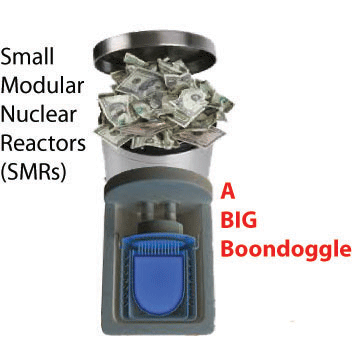 t also looks ahead, reviewing the industry’s plans
for a new generation of nuclear power stations, and particularly the small
modular reactors (SMRs) in which the US, Canada, Russia, China and the UK
are currently investing huge amounts of development money. The researchers
conclude that they too are doomed to be an expensive failure.
The second study, specifically into SMRs, is by the Nuclear Consulting Group (NCG), an
international team of academics and other experts [the writer of this news
report is a member]. It reaches the same conclusion: that they will be
expensive for the taxpayer and never live up to expectations. The NCG,
which works with Nuclear Free Local Authorities in the UK, says its
opposition is based on close scrutiny of the industry. After examining all
the designs of SMRs currently being developed globally, the NCG says: “It
remains likely that no substantive deployment of the technology will be
realised, with just a very few reactors built, at most.
https://climatenewsnetwork.net/nuclear-power-somehow-always-makes-a-loss/
1 This month

of the week – Australians for War Powers Reform (AWPR)
To see nuclear-related stories in greater depth and intensity
 Antinuclear