Bees may be more susceptible to ionising radiation than previously estimated

Insects Might Be More Sensitive to Radiation than Thought
A study of bumble bees exposed to levels of radiation equivalent to those existing in Chernobyl hotspots shows that the insects’ reproduction takes a hit. The Scientist, February 2021 Notebook Alejandra Manjarrez, Feb 1, 2021
A few years ago, on one of her first visits to Chernobyl, Katherine Raines went to the Red Forest, a radioactive cemetery of pine trees scorched by the nuclear accident in 1986. She was curious to see if there were bees living in the area. Research on the effect of chronic exposure to ionizing radiation on insects is limited, and some of the findings are controversial, but most experts support the idea that bees and other invertebrates are relatively resilient to radioactive stress.
Raines, a radioecologist at the University of Stirling in Scotland, didn’t spend long in that forest. In one spot there, her personal radiation dosimeter measured an environmental level of ionizing radiation of 200 microsieverts (µSv) per hour; more than a few hours of that exposure could have increased her cancer risk. But even during that brief visit, she did see bees. Whether they were living there or just visiting, Raines says, is hard to tell.
Back in the UK, Raines and colleagues recreated the same levels of radiation in a specialized facility. Boxes each containing a bumble bee colony made up of a queen, workers, and brood were placed at different distances from a radiation source, creating a gradient where bees in each box received a fairly steady dose of between 20 and 3,000 micrograys (µGy) per hour. (The two kinds of units, sieverts and grays, are essentially equivalent measures of the amount of exposure to radiation; sieverts factor in the type of radiation and account for the sensitivity of the exposed tissue. Bees at the site Raines visited in the Red Forest would experience around 200 µGy per hour.) The bees stayed in their artificial homes for four weeks before being moved outdoors into the university gardens for around one month, until the colonies were no longer viable—that is, once the queen had died and only a few workers remained.
The limited lab studies previously carried out by other groups had suggested that bees and other insects should be safe below 400 µGy per hour. So, Raines says, she was shocked when she found that even those colonies exposed to lower rates showed signs of a negative effect of radiation, especially on reproduction. Bumble bee colonies experiencing just 100 µGy per hour, for example, had reduced their production of queens by almost half, dramatically impairing the chances of successfully founding new colonies. According to the study, the overall effect was stronger than the one-fourth reduction observed in colonies exposed to a popular pesticide.
This work “sheds new light on the importance of chronic low-dose radiation exposure in a nonmodel species [with] profound relevance for the natural world,” says Timothy Mousseau, an ecological geneticist at the University of South Carolina who was not involved in this research. But he adds that it is hard to determine how some of these results, based on experimental manipulations in an artificial setting, can translate “to what’s actually going on in Chernobyl” for these important pollinators.
Mousseau and his colleague Anders Pape Møller (now at CNRS in France) have been doing field studies since 2000 to assess the abundance of wildlife populations living in the Chernobyl Exclusion Zone (CEZ), a 2,600 square-kilometer area surrounding the nuclear power plant. Their results have shown a negative correlation between radiation levels—which vary a great deal within the zone—and wildlife abundance. Insects were no exception: the team observed fewer bumble bees in the most contaminated areas, a relationship that held even within a range of extremely low radiation levels (from 0.01 to 1 µGy per hour)
Those studies have been criticized, partly over the accuracy of their estimations of radiation levels. Mousseau and Møller have collaborated with some of their critics to reanalyze some of their data, and maintain that there has been wildlife reduction in the CEZ due to radiation. ………
Researchers who spoke to The Scientist about the study agree that further work is needed to conclusively demonstrate the effects of radiation on bumble bees. ……. Raines is now gathering more data. The next stage of her research, she says, will be to look at the interaction between parasite load, which reduces longevity, and radiation exposure—both in lab-kept bees and in bees she sampled on one of her visits to deserted agricultural land around Chernobyl. “It would be ideal to directly relate lab and field [data].” https://www.the-scientist.com/notebook/insects-might-be-more-sensitive-to-radiation-than-thought-68366
Fears that a USA ”interim” nuclear waste dump may become permanent
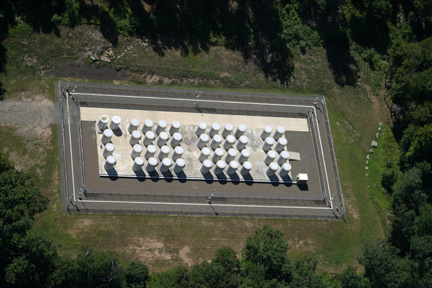
 Is Waterford’s nuclear waste dump status permanent? January 31. 2021 The Day , By Paul Choiniere p.choiniere@theday.com Paul_Choiniere Is Waterford’s nuclear waste dump status permanent? January 31. 2021 The Day , By Paul Choiniere p.choiniere@theday.com Paul_Choiniere
The highly radioactive nuclear waste being stored at Millstone Power Station The lack of concern about the nuclear waste storage problem was one of my takeaways from the editorial board’s meeting last week with leaders from Millstone-owner Dominion Energy, held virtually of course. Chief Nuclear Officer Dan Stoddard seemed too comfortable with the status quo, which has altered Millstone from a nuclear station to a nuclear station and nuclear waste storage facility. I would have felt more comfortable if Stoddard expressed some level of anger over the failure of the federal government to meet its obligation to remove the material and place it in safe storage for the thousands of years it will continue to emit dangerous levels of radiation. But instead of voicing any urgency to get the stuff out of there, Stoddard offered assurances that the metal canisters, encased in concrete, that secure the spent nuclear fuel rods and block the radiation “will be secure for decades and certainly longer.” Only when I reminded him that leaving the material there for decades was not the deal Waterford and Connecticut agreed to when the plants were licensed, did he say he was “sure” that “eventually” the federal government would meet its obligation and remove the nuclear waste. I don’t know why he is so sure. The deal when nuclear reactors were built across the country was that the fuel rods, when their energy was spent, would be temporarily stored in storage pools within the plants. In time they would be placed in canisters and transferred to Yucca Mountain in Nevada, on which the Department of Energy has spent $7.5 billion, collected from electric ratepayers, to build a safe depository deep within the mountain. …….. An alternative idea has surfaced of moving waste to a couple of other sites, rural locations in Texas and New Mexico have been discussed, before a consensus can be reached on what do with it. But I see no urgency, anywhere, to tackle the challenge. No one wants to deal with the outcry that would result as this stuff is moved across the country from nearly a hundred locations, even if the science shows it can be done safely. And as Stoddard told us, the situation is causing no fiscal pain for Dominion and other nuclear energy companies. The U.S. Department of Energy was required by a law passed by Congress to begin removing and permanently disposing of the spent fuel in 1998. When that didn’t happen, energy companies sued, and won. As a result, DOE is obligated to cover all the costs of storing the nuclear waste on site. There are 31 storage containers at Millstone, each with 32 spent nuclear fuel assemblies. Dominion has built a concrete pad large enough for 135 canisters. On a pad in Haddam, along the Connecticut River, 43 steel-reinforced concrete casks hold all the fuel from the 28 years Connecticut Yankee operated. These containers are monitored and secured and extremely robust in their design. They are safe, for now. But their contents will continue to emit dangerous levels of radiation for hundreds and thousands of years. Who knows what dystopian future might await humankind. Who could possibly assure, over that expanse of time, that tons of nuclear waste located along Long Island Sound and a major river that flows through all of New England will remain safely contained. No one can. Which is why the stuff should be entombed deep in a geologically stable depository as planned. Follow the science. https://www.theday.com/article/20210131/OP04/210139981 |
|

USA preparing for war in space

SPACECOM’s New Vision Targets ‘Space Superiority’
Breaking Defense, By THERESAHITCHENSon January 28, 2021 “……… “The intended audience is both internal and external,” Army Gen. James Dickinson told me in an interview yesterday. “Internally, the objective is to set the stage for SPACECOM personnel to develop and sustain a warfighting mindset necessary for our mission challenges in this new warfighting domain.”………
Dickinson’s eight-page manifesto, “Never A Day Without Space: Commander’s Vision” — provided to Breaking D — was briefed to SPACECOM today. It will be the “baseline” for future development of subordinate SPACECOM planning guidance, campaign plans, operational plans and other organizational documents required to running the 18-month-old Combatant Command, Dickinson explained.
The general’s stress on the need for both ‘offensive and defensive’ operations to achieve space superiority is not new, even if it makes some US security experts — including some Democrats in Congress — a bit queasy. It is one of the first things his predecessor, Air Force Gen. Jay Raymond who now heads the Space Force, made clear when SPACECOM was stood up in August 2019……..
Unified Command Plan and Missions
As Breaking D readers were first to learn, the revised UCP sent by Chairman of the Joint Chiefs of Staff Gen. Mark Milley to President Trump included a number of changes designed to delineate the role of SPACECOM — designated as a new geographic command with an area of responsibility (AOR) from 100 kilometers above the Earth to, well, infinity and beyond in theory — vice the 10 other Combatant Commands. These include giving SPACECOM the lead in deciding who gets priority use of communications satellites during combat, and what targets missile warning and space surveillance sensors are tasked to monitor. Trump signed the revised 2020 UCP Jan. 13, a spokesperson for the Joint Staff confirmed……..
Dickison elaborated during his conversation with Mitchell Institute Dean Dave Deptula that SPACECOM now has three primary missions: “One, our enduring, no-fail mission to enable warfighting operations in other domains. Two, our future mission as global SATCOM manager and global sensor manager. And three, our current new mission set compelling us to fight and win in the space domain in order to protect and defend our interests there.
“Additionally, this warfighting domain is growing, and this AOR is by far the biggest and is getting bigger, each day,” he added………
The ‘protect and defend’ mission, which would include any offensive action in a conflict, is carried out by the Joint Task Force Space Defense, commanded by Brig. Gen. Tom James. ………
Despite the new UCP, however, Dickinson was coy with me about how exactly the decisions about who supports whom when are actually made, and at what level of the US military hierarchy. “Command decisions reside with the Combatant Commander,” he said, although “many of those decisions may be made well above us depending on the situation.”
Some of this, he said, is because such details remain classified. However, a number of sources intimately familiar with these issues tell me that a big problem is that there simply hasn’t yet been any agreements codified on how those decisions will be made. The hope is that the impending Joint Warfighting Concept, in which space plays a central role, will go some ways toward clarifying those questions………… https://breakingdefense.com/2021/01/spacecoms-new-vision-targets-space-superiority/
Off to a good START — but it’s not a nuclear disarmament Treaty

Nuclear weapons will be limited, but they need to go away altogether
Off to a good START — Beyond Nuclear International
The US and Russia have extended the treaty, but it’s not about disarmament
This story was prepared by Linda Pentz Gunter largely derived from information provided by ICANThe United States and Russia have agreed on extending New START for another five years.
Extending New START is an important action by these two countries after four years that saw both countries undermining arms control agreements. However, it is important to remember that it is not a disarmament step, but rather an extension of the current levels of nuclear arsenals.
Nevertheless, it is a welcome development to see the new US administration and Russia return to where they left off four years ago rather than escalate. It also comes at an auspicious time, as the world has just witnessed the entry into force on January 22, 2021 of the first global treaty to ban nuclear weapons, the Treaty on the Prohibition of Nuclear Weapons (TPNW).
The United States and the Russian Federation agreed on January 26, 2021 to extend the bilateral cap on U.S. and Russian nuclear arsenals, the New Strategic Arms Reduction Treaty (New START) for five additional years. …………
New START is important for a number of reasons:
- The extension of New START prevents backsliding on nuclear disarmament. However, additional steps will now be needed to make progress on disarmament.
- Since the United States and Russia first agreed to this current cap on nuclear arsenals in 2010, the international community has negotiated, adopted and brought into force a treaty banning nuclear weapons: nuclear weapons are illegal under international law. So, even as the US and Russia may cap nuclear weapons expansion, they remain outlaw pariah states in the eyes of the world as long as they continue to hold onto nuclear weapons.
- Throughout the time the New START agreement has been in place, Russia and the United States have spent billions each year to build new nuclear weapons systems. This is now banned under international law (although non-parties to the TPNW are not bound by it). Under current global pandemic conditions, this kind of spending is even more immoral and obscene.
- With the New START quickly extended and the TPNW in force, the groundwork has been laid for significant disarmament advances in the coming four years. The nine nuclear armed states have no excuses not to walk that path. Nuclear disarmament need not seem daring but simply adherence to international law.
Simply staying at the current nuclear weapon levels will not be enough to protect the world from this catastrophic threat. One nuclear missile is one weapon too many. As studies have shown, even unleashing just 100 nuclear weapons (as India and Pakistan could do against each other) would result in global devastation, suffering and famine. Therefore, New START must be seen as just that; a start. But not enough until all nuclear weapons are abolished.
- With the TPNW in force, there is a new international standard. Russia, the United States and all nuclear-armed nations must take active steps to move towards compliance with this international treaty and join it.
To read more about the implications of the extension of the New START Treaty, please visit this page on the ICAN website. https://beyondnuclearinternational.org/2021/01/31/off-to-a-good-start/
A new USA administration, but the same threat of nuclear war
|
New administration but same threat of nuclear winter, By Matt Hoffmann News-Pres, JAN 30, 2021
Even though we have a new presidential administration, the risk of nuclear and climate destruction is the same as it was last year, according to an organization that tracks threats to the survival of humanity. A “Doomsday Clock” has been used by the Bulletin of Atomic Scientists since 1947 to signal how close we are to nuclear war. The closer to midnight, the closer to nuclear winter. The clock also symbolizes other threats, like climate change. “The hands of the Doomsday Clock remain at 100 seconds to midnight, as close to midnight as ever,” Dr. Rachel Bronson, president and CEO, Bulletin of the Atomic Scientists, said this week. “The lethal and fear-inspiring COVID-19 pandemic serves as a historic ‘wake-up call,’ a vivid illustration that national governments and international organizations are unprepared to manage the truly civilization-ending threats of nuclear weapons and climate change.” Brian Hesse, a professor of political science at Northwest Missouri State University, said the clock represents the threat of grave disaster. While the clock itself is theoretical, the threats have real-world consequences. “For example, from an American standpoint the Department of Defense is already seeing rising sea levels are affecting the infrastructure of the largest naval base,” Hesse said. “What they thought they could spend on defending America now has to be diverted to dealing with infrastructure.” Jerry Brown, the former governor of California, said the United States and Russia must stop “shouting at” each other. President Joe Biden recently spoke with Russian President Vladimir Putin, where the two discussed extending an arms reduction treaty, according to a summary of the call provided by the White House………..https://www.newspressnow.com/news/local_news/new-administration-but-same-threat-of-nuclear-winter/article_40db5254-60cc-11eb-9551-176bee34bb41.html |
|
|
Britain’s unaffordable nuclear power plans collapse, one by one
 Times 31st Jan 2021, Nuclear winter for Britain as power plants close. Hinkley Point is last man standing as other power stations are scrapped. Hitachi president Hiroaki Nakanishi had a grand dream when
the Japanese giant paid £696 million for the right to build two nuclear power stations in the UK. “Today starts our 100-year commitment to the UK and its vision to achieve a long-term, secure, low- carbon and affordable energy supply,” declared Nakanishi in 2012, as he signed a deal to buy the Horizon nuclear project from Germany’s RWE and Eon.
particularly when they are the first of a new design. Theresa May’s government eventually offered to take a third of the equity in Horizon alongside the Japanese government and Hitachi. Boris Johnson’s administration is exploring a new financial model, the regulated asset base, where investors could earn a return during construction.
that had begged Hitachi to grant the project a reprieve, executive Toshikazu Nishino said that it had not received adequate backing from government.https://www.thetimes.co.uk/article/nuclear-winter-for-britain-as-power-plants-close-gb8c5dx07
All-Africa Conference of Churches welcomes Nuclear Weapons Prohibition Treaty
 All-Africa Conference of Churches welcomes Nuclear Weapons Prohibition Treaty https://www.vaticannews.va/en/church/news/2021-01/aacc-treaty-nuclear-weapon-proliferation-africa-church.htmlThe All-Africa Conference of Churches salutes the recent coming into force of the Treaty on Prohibition of Nuclear Weapons (TPNW), hailing it as further inspiration to work for a nuclear-weapons-free world.
Hailing this recent development, the All-Africa Conference of Churches (AACC), in a statement on Tuesday, expressed its support, together with the rest of the ecumenical community, for the Treaty which now becomes international law.
The ecumenical body said that the Treaty “ushers in the possibilities of heralding a new world free of the threats and tensions that have been characterized by the battle to develop and hold nuclear weapons.”
No safe hands for nuclear weapons
In the Tuesday statement, AACC stated its belief “that the very holding and potential threat of use of nuclear weapons is immoral,” adding that it looks forward to the day “when the world will be freed of these weapons permanently.”
“There are no safe hands for these weapons,” added AACC. “The accidental or deliberate detonation of a nuclear weapon would cause severe, long-lasting and far-reaching harm on all aspects of our lives and our environment throughout the world.”
At the same time, these technologies are “part of structures and systems that bring about great suffering and destruction” and have been the cause of “major tensions and threats of widespread devastation.”
TPNW: inspiration for a nuclear-weapon-free world
In the wake of the entry into force of the Treaty, AACC said that at a time when the world desperately needs fresh hope, the TPNW inspires us to work towards fully eliminating “the threat of nuclear weapons, and to create conditions for peace, justice and well-being.”
AACC also pointed out that the treaty addresses the disproportionate impact of nuclear weapons on women and indigenous peoples, as well as the “importance of victim assistance and healing environmental harms in a groundbreaking way.”
Citing the example of the hibakusha – survivors of the two nuclear attacks launched at Hiroshima and Nagasaki at the end of World War II – AACC noted that their courage and perseverance serve as “the inspiration, guidance and moral foundation” in the quest for a world without nuclear weapons.
Appeal to States
Highlighting that none of the nine nuclear global powers, and many countries with defense pacts with them have signed or ratified the Treaty, AACC pointed out that a lot of work still remains to be done. As at its entry into force, the TPNW was signed by 86 countries and ratified by 51.
n this regard, AACC appealed to the ecumenical global community to make its contribution, in whichever way possible, to participate in the global work for peace, justice and respect for life.
Concretely, the ecumenical body is urging all States to sign and ratify the TPNW, as well as join the first meeting of the State parties scheduled for next year. AACC further calls for decisive action “to strengthen the power of the TPNW upon its entry into force, and to work for peace, cooperation and common security.”
“We must not be discouraged at the slow pace, but become even more determined to push for a better world,” AACC said. “This is part of our mission and we know God is on our side.”
AACC
Founded in Kampala, Uganda, in 1963, the AAAC is an ecumenical association that today has 173 member churches present in 40 African countries, representing over 120 million Christians on the continent. Its headquarters is in Nairobi, Kenya.
Avoiding a ‘Ghastly Future’: Hard Truths on the State of the Planet
 Avoiding a ‘Ghastly Future’: Hard Truths on the State of the Planet, Yale Environment 360
BY CARL SAFINA • JANUARY 27, 2021
A group of the world’s top ecologists have issued a stark warning about the snowballing crisis caused by climate change, population growth, and unchecked development. Their assessment is grim, but big-picture societal changes on a global scale can still avert a disastrous future.
Within the lifetime of anyone born at the start of the Baby Boom, the human population has tripled. Has this resulted in a human endeavor three times better — or one-third as capable of surviving? In the 1960s, humans took about three-quarters of what the planet could regenerate annually. By 2016 this rose to 170 percent, meaning that the planet cannot keep up with human demand, and we are running the world down.
“In other words,” say 17 of the world’s leading ecologists in a stark new perspective on our place in life and time, “humanity is running an ecological Ponzi scheme in which society robs nature and future generations to pay for boosting incomes in the short term.” Their starkly titled article, “Underestimating the Challenges of Avoiding a Ghastly Future,” reads less as an argument than as a rain of asteroids encountered in the course of flying blind on a lethal trajectory. The authors’ stated goal is not to dispirit readers. “Ours is not a call to surrender,” they write, “we aim to provide leaders with a realistic ‘cold shower’ of the state of the planet that is essential for planning to avoid a ghastly future.”
Put on your shower cap and step into the cold. Humans have altered about 70 percent of Earth’s land surface and ocean. …….
Referring to the loss of living diversity and abundance, the authors note: “The mainstream is having difficulty grasping the magnitude of this loss, despite the steady erosion of the fabric of human civilization.” But I think the problem is that the fabric of human civilization has been built and fueled precisely by causing erosion of the living world. The pain of other living things is seldom humanly felt, their interests seldom considered, their intrinsic values discounted. (I am still asked “why we should care” about whether even iconic creatures such as right whales, for example, vanish forever.)
Worth noting is that the authors are overwhelmingly ecologists. As am I. This may account for their perceiving a grim future versus the rosy future offered by techno-optimists. Ecologists understand the world as interdependent relationships among diverse living and non-living systems…….
Ecologists understand that building an ever-larger human enterprise has resulted from putting more of the world through a macerator at the expense of the rest of life on Earth and generations unborn. On a planet that is finite, such an enterprise faces inevitable limits. ……
Most economists and politicians catastrophically confuse growth and improvement as synonymous…….
If there is one silver bullet, that bullet is full citizenship and empowerment of women……..
The point of “Avoiding a Ghastly Future” is that we all must recognize the enormity of these problems. But the authors believe that reality can be faced without sowing “disproportionate” fear and despair. They say the necessary choices will entail “difficult conversations about population growth” and “the necessity of dwindling but more equitable standards of living.”…….. https://e360.yale.edu/features/avoiding-a-ghastly-future-hard-truths-on-the-state-of-the-planet
Why nuclear power is a bad way to balance renewable energy
Why nuclear power is a bad way to balance renewable energy https://
 100percentrenewableuk.org/why-nuclear-power-is-a-bad-way-to-balance-
 renewable-energy
See the YOUTUBE video:
David Toke, Ian Fairlie and Herbert Eppel from 100percentrenewableuk discuss how nuclear power effectively switches off wind and solar power and how a 100percent renewable energy system is much better for the UK than one involving nuclear power
The Government, backed by a lot of public policy reports paid for by pro-nuclear interests, constantly pushes out the view that nuclear power is ‘essential’ to balancing wind and solar power.
But what they never mention is the massive waste of renewables that occurs in such a scenario.
Under the scenarios planned by the Government nuclear power is paid very high prices to generate power even when there is excess electricity, which pushes renewables to close down.
The Government also refuses to undertake serious investigations of how a system that uses excess renewables to create short and long term storage is a much better way of organising our energy needs rather than wasting more money on building nuclear power statitons.
If you agree the aims of 100percentrenewableuk please join the discussion via our email group.
Schools of mass destruction —Universities in collusion with nuclear industry

U.S. universities have continued to build connections to the U.S. nuclear weapons complex. Although students and faculty have opposed university participation in nuclear weapons research and development at various points in the last 70 years, such participation continues.
November 15, 2020 by beyondnuclearinternational https://wordpress.com/read/feeds/2663585/posts/3150281214 An ICAN report
Universities across the United States are identified in this report for activities ranging from directly managing laboratories that design nuclear weapons to recruiting and training the next generation of nuclear weapons scientists. Much of universities’ nuclear weapons work is kept secret from students and faculty by classified research policies and undisclosed contracts with the Defense Department and the Energy Department. The following is the executive summary from ICAN’s report: Schools of Mass Destruction, with some changes made for timeliness.
Over the next ten years, the Congressional Budget Office estimates U.S. taxpayers will pay nearly $500 billion to maintain and modernize their country’s nuclear weapons arsenal, or almost $100,000 per minute. A separate estimate brings the total over the next 30 years to an estimated $1.7 trillion. In a July 2019 report, National Nuclear Security Administrator Lisa Gordon-Haggerty wrote, “The nuclear security enterprise is at its busiest since the demands of the Cold War era.”
In addition to large amounts of funding, enacting these upgrades requires significant amounts of scientific, technical and human capital. To a large extent, the U.S. government and its contractors have turned to the nation’s universities to provide this capital. Continue reading
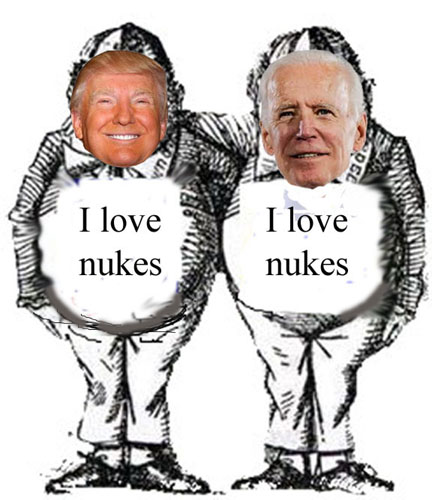
Let’s not forget that President Biden is just as pro nuclear as Trump was
|
Progressive misgivings over nuclear unlikely to derail US strategy, Paul Day , ReutersEvents, Jan 26, 2021
The new U.S. Democratic leadership is making positive noises for the continuation, and possible expansion, of the previous administration’s own beefed up nuclear strategy despite the left’s traditional aversion to the technology, say those in the industry. In a last-ditch attempt to cement Donald Trump’s administration’s advances in the nuclear power industry, the Department of Energy (DOE) Office of Nuclear Energy put out its own ‘Strategic Vision’ on Jan.
The ambitious roadmap pushes for a continuation of technological advances and investigations for existing reactors, advanced reactors and advanced nuclear fuel cycles while rebuilding U.S. global leadership in nuclear energy technology. The strategy, which some have said will likely be instantly dropped by the new administration for its own objectives, will probably be followed closely by President Joe Biden’s DOE, say others………
Part of the enthusiasm for the document, which came shortly after Trump signed an executive order that called for a revitalization of the U.S. nuclear energy sector and on the day the DOE’s Assistant Secretary for the Office of Nuclear Energy Dr. Rita Baranwal stepped down from her post, is that it doesn’t stray far from previously agreed positions………
Five Goals The ‘blueprint’ lays out five goals, breaks down each into explicit objectives and lists timelines for performance indicators. The first, ‘Enable continued operation of existing U.S. nuclear reactors’, calls to demonstrate a scalable hydrogen generation pilot plant by 2022 and begin replacing existing fuel in U.S. commercial reactors with accident tolerant fuel by 2025. Meanwhile, the goal to ‘Enable deployment of advanced nuclear reactors’ sticks to plans laid out in the Advanced Reactors Demonstration Program (ARDP) including to demonstrate two U.S. advanced reactor designs through cost-shared partnerships with industry by 2028.. …… https://www.reutersevents.com/nuclear/progressive-misgivings-over-nuclear-unlikely-derail-us-strategy
|
|
The aerospace industry – headed for military dominance

the Space Force will be given the task to create the technologies to “control and dominate” the pathway on and off our sacred Mother Earth.
Earlier this year, Trump was able to “stand up” his new high-tech legacy branch of the military, called the Space Force. Congress was overwhelmingly in favor – that means both parties supported it
The Real Missions of Space Force….
|
Keep Space for Peace! Save the Heavens fro!m Hegemony https://www.womenagainstmilitarymadness.org/articles/2020/12/22/keep-space-for-peace-save-the-heavens-from-hegemony Bruce K. Gagnon
Recently we learned that the aerospace industry is pushing to turn a former naval air station in Brunswick, Maine, into a spaceport. Promising lots of “high tech” jobs, a bill is being pushed in Augusta, our capital, by some of the most “progressive” legislators in the state. Similarly, we are hearing from many other states where launch complexes are being promoted – from Hawaii to New Mexico to Alaska – that the industry wants some of the most pristine places on Earth to become spaceports. Why? A spaceport in Kodiak Island, Alaska (locals call it “Spacepork”), was built some years ago in spite of overwhelming opposition by local residents. They were promised that it would be used only for civilian launches. So far, all the launches at Kodiak have actually been for Pentagon (and Israeli) space-weapons technology tests. We’ve been hearing for several years now that new companies formed by tech-industry billionaires Elon Musk (whose projects include Tesla and SpaceX) and Jeff Bezos (Amazon, Blue Orbit) plan to launch as many as 35,000 mini-sats (satellites) into orbit. Imagine the enormous hole these polluting launches will punch into the ozone layer. The plan is to have a satellite orbiting over the head of every person on Earth 24 hours a day, making it possible for the new 5G wireless technology system to be profitable. Many questions are being raised about the military (dual-use) applications of these satellites as well. Space Force Continue reading |
Australian companies involved in the uranium plunder of Greenland, and danger to sub-arctic environment
The plundering of Greenland, Uranium and other resources the latest threat to precious sub-arctic ecosystems, Beyond Nuclear International. By Niels Henrik Hooge, 24 Jan 21, The governments of Greenland and Denmark are encouraging large-scale mining in Greenland, including what would be the second-largest open pit uranium mine in the world. Now groups are calling on those governments to halt such desecration and instead establish an Arctic sanctuary. Your organization can sign onto this petition. Read the petition here, then send your organization name (and logo, optional) to either Niels Henrik Hooge at nielshenrik@noah.dk or to Palle Bendsen at: pnb@ydun.net.
No or few World Heritage Sites probably have more or bigger mining projects in their vicinity than the Kujataa UNESCO World Heritage Site (WHS) in Southern Greenland. The property was inscribed on UNESCO’s world heritage list in 2017.
It comprises a sub-arctic farming landscape consisting of five components that represent key elements of the Norse Greenlandic and modern Inuit farming cultures.
On one hand they are distinct, on the other they are both pastoral farming cultures located on the climatic edges of viable agriculture, depending on a combination of farming, pastoralism and marine mammal hunting. The landscape constitutes the earliest introduction of farming to the Arctic.
Some of the world’s biggest mining projects are located near Kujataa
Kujaata is situated in Kommune Kujalleq, the southernmost and smallest municipality of Greenland with its rich mineral resources. These include zinc, copper, nickel, gold, diamonds and platinum group metals, but first and foremost substantial deposits of rare earth elements (REEs) and uranium. ……
Some of the biggest REEs mining projects in the world are located only a few kilometres from the Kujataa WHS. The biggest and most controversial is the Kvanefjeld REEs-uranium mining project, owned by the Australian company Greenland Minerals Ltd., GML. According to GML, in addition to containing the second biggest uranium and by far the largest thorium deposits, the Ilimaussaq Complex, of which Kvanefjeld is a part, possesses the second largest deposits of rare earth elements in the world.
The mine, which would be the world’s second largest open pit uranium mine, is located on top of a mountain, almost one kilometre above sea-level, and only six kilometres away from Narsaq, a town of approximately 1,500 inhabitants, and also near some of the parts of the Kujataa WHS.
A second major project close to Kujataa is the Kringlerne REEs mining project, which is described by its owner, the Australian mining company Tanbreez Mining Greenland A/S, as the probably largest deposit of REEs in the world. …………
Calls for enlargement of the Kujataa WHS
Especially in Southern Greenland, there has long existed a notion that the Kujataa World Heritage Site in its present form has been delineated to accommodate the Kvanefjeld mining project and that the potential impacts of the other mining projects surrounding the site have not been considered. ……………
Kujataa’s OUV under threat
It is also clear that Kujaata’s Outstanding Universal Value, i.e. its exceptional cultural and natural significance, will be under threat if the mining projects surrounding the site are implemented. There have already been calls to put Kujaata on the World Heritage Convention’s danger list. Kujataa’s unique farming traditions have been a determining factor in designating it as world heritage.
However, the Danish Risø National Laboratory has estimated that up to a thousand tons of radioactive dust might be released annually from just the Kvanefjeld open pit mine due to material handling, hauling and blasting and from the ore stock and waste rock piles.
Furthermore, if the tailings by some unforeseen cause such as leakages, technical problems, etc. would turn dry, massive amounts of radioactive and toxic dust would be blown away. The dust from the aforementioned sources will be carried by heavy arctic sea winds across the region, where it will affect among others agricultural activities. The predominant wind direction and the direction for the strongest winds are east- and north- eastwards, where the Kujataa WHS is located. The area, its people, domestic animals and wildlife would be chronically exposed to radioactive and other toxic species via drinking water, food and air1.
Furthermore, most if not all the planned mining projects in the area are open pit mines. Perpetual blasting with explosives on the mountain tops in the open pit mines surrounding the world heritage site and the excavation and transport by dump trucks to the mills, where the rocks are crushed, could cause considerable noise disturbance during the entire operation of the mines.
According to the EIA draft reports for the Kvanefjeld project, a dilution factor in the order of 2000 for the waste water would be required to be rendered safe for the most critical parameters. This would mean that the discharges of waste water during just one year would have to be diluted into 7 km3 of seawater in the Fiord system, which is part of the Kujataa World Heritage Site, and into 260 km3 of seawater during the planned operational lifetime of the Kvanefjeld mine.
Furthermore, seepage, leaks and spills of liquids form the tailings will cause contamination of groundwater and rivers by radioactive and non-radioactive toxic chemical species. Seafood would become contaminated as well, due to the substantial discharges of wastes into the Fiords and the coastal sea.
Large-scale mining and particularly uranium mining are incompatible with the development of three of the four sectors of the farming landscape, namely fishing and hunting, tourism and food production. It is relevant to ask how the entire character of the landscape would change in the development from a rural to an industrial area in the wake of both the big mining projects. This also pertains to the question of urban development, when among others new ports, port facilities and accommodation villages have to be built and corresponding support infrastructure implemented.
No real plans to protect Kujataa…………
in its description of the impacts of the nearby mining activities, the management plan relies on a draft of an Environmental Impact Assessment (EIA) of the Kringlerne mining project, which was rejected by Greenland’s Environmental Agency for Mineral Resources Activities (EAMRA), because it did not contain enough relevant information.
EAMRA has also rejected the four latest EIA draft reports on the Kvanefjeld project because of lack of information. Among other things, Kvanefjeld’s owner, GML, is criticised for not providing a comprehensive assessment of the earthquake risk in the region, final results of tests of toxic elements during extraction and processing, final radiological estimates and results of investigations of impacts of radioactive minerals, and for failing to describe the alternatives regarding management of tailings and the shutdown of the tailings facility.
In September 2019, the CEO of GML was also formally reproached by Greenland’s Prime Minister and the Department of Nature and Environment’s Permanent Secretary for lobbying high-ranking civil servants and ministers who had no competence within the EIA review process in order to undermine EAMRA’s authority.
A Heritage Impact Assessment is not enough
…….. it could be argued that there is already enough reason for the Greenlandic and Danish States Parties to involve UNESCO and – considering that environmental issues are at the core of the problems and Kujataa’s management plan is based on rejected EIA draft reports – to include IUCN in the process.
However, the biggest problem for not only Kujataa, but all Greenland’s three world heritage sites could be the fact that Greenland’s environmental legislation does not mandate strategic environmental impact assessments for minerals exploration areas, which means that the public is not kept informed in advance on what areas could be designated. Thus, implementation of the Aarhus Convention in Greenland should have high priority in order to reinforce Greenland’s environmental legislation.
Niels Henrik Hooge is member of NOAH Friends of the Earth Denmark’s uranium group. https://wordpress.com/read/feeds/72759838/posts/3144708883
Nuclear waste dump plan – ruining the name of the town of Kimba
Paul Waldon Fight to stop a nuclesar waste dump in South Australia, 25 Jan 21 Kimba has already been tagged as an Australian “Shit Town.” Kimba may not tick every box for what criteria defines a shit town, but it ticks enough . We do know it doesn’t have enough people to man a radioactive dump, which is good as the unemployment rate goes, and information of economic hardship isn’t forthcoming as to make any judgement there. Yet the boxes it does tick, would be the elevated prospects of becoming a contaminated environment, a study found that clean environments attract people and businesses, while the closure of the towns hardware store sends a message that other businesses could be struggling, locals shopping outside the community conveys a message that things aren’t right and this is a reduction of sales for the towns remaining businesses and could promote the erosion of existing services.
5 nuclear activities that are now Illegal under international law
|
Here are five examples of the type of activities that will be Illegal under international law on 22 January 2021 https://nukewatch.org/new-and-updated-item/here-are-five-examples-of-the-type-of-activities-that-will-be-illegal-under-international-law-on-22-january-2021/
One of the main problems with talking about nuclear weapons is that it often becomes abstract and hypothetical. Most people barely know which countries have nuclear weapons and do not know to what extent other actors are involved in maintaining and upholding nuclear weapons. WHAT THE TREATY PROHIBITSArticle 1 of the treaty prohibits states parties from developing, testing, producing, manufacturing, transferring, possessing, stockpiling, using or threatening to use nuclear weapons, or allowing nuclear weapons to be stationed on their territory. It also prohibits them from assisting, encouraging or inducing anyone to engage in any of these activities. #1: THE TREATY BANS THE DEVELOPMENT OF NEW NUCLEAR WEAPONS SYSTEMSRight now, all nuclear armed states are quantitatively or qualitatively advancing their nuclear arsenals, to the tune of nearly $73 billion in 2019 alone. Developing nuclear weapons is banned for states parties in Article 1(a) of the treaty. So activities like India’s Agni-V intercontinental ballistic missile? Banned under international law. Pakistan’s Babur-3 submarine-launched ballistic missile? Banned under international law. North Korea’s’ growing nuclear warhead arsenal? Banned under international law. Nuclear-armed states may not be legally obligated to comply with a treaty they haven’t joined. But their behavior contradicts this new instrument of international law and the growing norm it represents. #2: THE TREATY BANS ASSISTING WITH DEVELOPING NUCLEAR WEAPONSDozens of U.S. universities are involved in the U.S. nuclear weapons complex, including through direct management and research partnerships with the laboratories that design and can produce nuclear weapons components. The University of California, Texas A&M University, Johns Hopkins University, the Massachusetts Institute of Technology, and the University of Rochester receive billions in contracts to directly manage laboratories that work on nuclear weapons. The University of California and Texas A&M University are both operators of the Los Alamos National Laboratory, which provides design and engineering for several nuclear warhead types, conducts simulated experiments to evaluate warheads, and has the capacity to produce plutonium pits, the core material for nuclear warheads. An average-sized U.S. nuclear weapon, that could be designed and developed at Los Alamos overseen by the University of California and Texas A&M University, detonated over the center of Paris would immediately kill over 500,000 civilians, and injure more than one million, causing third-degree burns all the way out to the suburbs. From 22 January 2021, these universities, and others that are participating in the development and production of nuclear weapons, are carrying out activities that are banned under international law. Students should demand their universities focus on research to save lives, not end them. #3: THE TREATY BANS THE HOSTING OF NUCLEAR WEAPONSArticle 1(g) of the TPNW explicitly prohibits allowing the stationing, installation or deployment of nuclear weapons. There are five countries in the world that are currently engaged in this soon to be banned behaviour: Belgium, Germany, the Netherlands, Italy, and Turkey.These five countries currently host collectively about 150 U.S. nuclear weapons at bases on their territory. The fact is, there are likely more nuclear weapons in Italy than in North Korea. Not only does the continued hosting of U.S. nuclear weapons run contrary to international law, it also flies in the face of public opinion. Less than one-third of the public in most nuclear hosting states support the continued existence of weapons of mass destruction on their soil. A recent poll in Belgium shows that 77% of Belgians want their government to join the TPNW. #4: THE TREATY BANS THE MANUFACTURING OF NUCLEAR WEAPONSEven outside of nuclear-armed states companies contribute to the development and production of nuclear weapons. Belarus’ Minsk Automotive Factory manufactures mobile launchers for a Russian intercontinental ballistic missile. The multinational Airbus Group, headquartered in the Netherlands, contributes through a German-headquarted subdivision to the development and production of the French submarine-launched ballistic missiles. These companies are engaging in activities outlawed under international law. There is a growing trend for financial institutions to divest from companies producing weapons banned under international law. If these companies do not choose to adhere to the new norm on nuclear weapons, they may pay the price. #5: THE TREATY BANS ENCOURAGING THE USE OF NUCLEAR WEAPONSNuclear-armed states are always ready to use nuclear weapons. They regularly prepare to use nuclear weapons through joint exercises, where many states contribute to nuclear attack exercises. One example is the annual NATO Steadfast Noon nuclear exercise. Non-nuclear-armed states that participate in these mass murder trial runs would be acting contrary to Article 1(e), the prohibition against encouraging prohibited behaviour. This year, countries like the Czech Republic and Poland contributed conventional aircraft to the Steadfast Noon nuclear strike exercise – something that will be illegal under international law when the TPNW enters into force. CONCLUSIONThe entry into force of the TPNW is the perfect opportunity for all countries, companies, universities and other entities to re-evaluate their relationship to this new international legal standard. Countries producing or hosting nuclear weapons or participating in nuclear strike exercises, as well as the companies manufacturing them and universities helping to design them are acting against international law. All entities should end these illegal activities and join the international community in renouncing nuclear weapons entirely. When the Treaty on the Prohibition of Nuclear Weapons (TPNW) enters into force on 22 January 2021, that will need to change. |
|
|
1 This month

of the week – Australians for War Powers Reform (AWPR)
To see nuclear-related stories in greater depth and intensity
 Antinuclear