5 Unknown Nuclear Disasters: Chernobyl Is Far from the Only One
Chernobyl is not the world’s only nuclear disaster, there are plenty of others to keep you up at night., Interesting Engineering, By Marcia Wendorf, 2 Aug 19
The Kyshtym Disaster
In September 1957, Ozyorsk, Russia was a closed city, built around the Mayak plant which produced plutonium for both nuclear weapons and fuel.
After scrambling to build the Mayak plant between 1945 and 1948, all six of its reactors initially dumped high-level radioactive waste directly into Lake Kyzyltash. When it became contaminated, they moved on to dumping into Lake Karachay, which also became contaminated.
In 1968, the Soviet government disguised the EURT area by creating East Ural Nature Reserve, with access allowed to only authorized personnel. Documents describing the disaster were only declassified in 1989.
On the International Nuclear Event Scale (INES), Kyshtym is rated a 6, making it the third-most serious nuclear accident behind only the Fukushima Daiichi nuclear disaster and the Chernobyl disaster, which are both Level 7
In 1953, workers built a storage facility for liquid nuclear waste, but that waste was being heated by residual decay heat from the nuclear reaction. The coolers around one of the tanks failed, and on September 29, 1957, that tank exploded with the force of between 70 to 100 tons of TNT.
While there were no immediate casualties, the explosion released an estimated 20 MCi (800 PBq) of radioactivity into the air. A plume containing 2 MCi (80 PBq) of radionuclides, primarily caesium-137 and strontium-90, moved toward the northeast and contaminated an area of more than 52,000 square kilometers (20,000 sq miles).
At least 270,000 people lived in that area, which is referred to as the East-Ural Radioactive Trace (EURT).
In an attempt to maintain secrecy, no evacuation was ordered, but a week later, on October 6, 1957, 10,000 people were removed from their homes.
Estimates of the death toll caused by the accident go from 200 to more than 8,000, depending on the study. A 2001 work stated that the accident caused 66 diagnosed cases of chronic radiation syndrome.
Amazingly, it wasn’t until 18 years later, in 1976, that the full scope of the disaster was disclosed by Zhores Medvedev in the publication the New Scientist.
In 1968, the Soviet government disguised the EURT area by creating East Ural Nature Reserve, with access allowed to only authorized personnel. Documents describing the disaster were only declassified in 1989.
On the International Nuclear Event Scale (INES), Kyshtym is rated a 6, making it the third-most serious nuclear accident behind only the Fukushima Daiichi nuclear disaster and the Chernobyl disaster, which are both Level 7.
The Windscale Fire……
Soviet Submarine K-19……
The Goiânia Accident…… One https://interestingengineering.com/5-unknown-nuclear-disasters-chernobyl-is-far-from-the-only-one
What Exactly Is Nuclear Weapons ‘No First Use’?
What Exactly Is Nuclear ‘No First Use’? Jalopnik, Kyle Mizokami 2 Aug 19, During the Democratic presidential debates this week, candidates wrestledwith a particularly thorny national security issue: whether they would forsake the use of nuclear weapons first in a conflict. This policy, known as No First Use, is the policy of just a handful of the declared nuclear powers.
Letters to The Advertiser – Store the power
Store the power, MARK SCHUBERT, Glynde, 3 Aug 19
KYM Bray does not believe renewables can supply all our electricity needs, presumably because there are times when the sun doesn’t shine or the wind blow (“Need base power”, The Advertiser, 31/7/19).
For renewables to work full-time, energy needs to be stored.
Present viable energy storage systems are rechargeable batteries; hydrogen, from electrolysis of water; heat (eg hot-water tanks and concentrated solar thermal), and pumped hydro – still the most economical, reliable, long lasting, and efficient bulk-energy storage.
With pumped hydro, water is reused by pumping it uphill using excess power, and then letting it flow back to generate power in times of shortage, as is done now in the Snowy Mountains Scheme in southeast Australia.
Costs of these storage systems are reducing as research continues and mass production ramps up.
I believe we can soon use renewables backed with storage to supply all our electrical power, reliably, economically, and with minimal CO2 emissions. I believe in physics, not fairies, Kym.
US flags new missile test as arms treaty with Russia ends
US flags new missile test as arms treaty with Russia ends, The Age, 3 Aug 19 Washington: With the scrapping of a landmark arms control agreement Friday, the US announced plans to test a new missile amid growing concerns about emerging threats and new weapons. US officials said they are no longer hamstrung and could now develop weapons systems previously banned under the Intermediate-range Nuclear Forces treaty with Russia, a Cold War-era agreement that both sides repeatedly accused the other of violating. The treaty was also criticised because it did not cover China or missile technology that did not exist a generation ago.
The end of the treaty comes amid rising doubts about whether the two countries will extend an agreement on long-range nuclear weapons scheduled to expire in 2021. President Donald Trump said he has been discussing a new agreement to reduce nuclear weapons with China and Russia………
Chinese UN Ambassador Zhang Jun on Friday challenged what he said were efforts to make his country “an excuse” for the demise of the treaty: “You know, the United States is saying China should be a party in this disarmament agreement, but I think everybody knows that China is not at the same level with the United States and the Russian Federation.”
The central issue with the INF was that both Russia and the US had long accused the other of cheating on the treaty, which banned land-based missiles of ranges between 500 and 5,500 kilometres……..
New START imposes limits on the number of US and Russian long-range nuclear warheads and launchers. The deal was made in 2010, but the limits didn’t take effect until 2018.
Trump has called New START “just another bad deal” made by the Obama administration, and Trump’s national security adviser, John Bolton, said in June it is unlikely the administration will agree to the five-year extension to New START that the treaty allows and which can be done without legislative action in either capital.
David Wright, co-director of the Global Security Program at the Union of Concerned Scientists, said if Trump doesn’t extend or replace New START it will be first time since 1972 that the US and Russia will be “operating without any mutual constraints on their nuclear forces.” ……. https://www.theage.com.au/world/north-america/us-flags-new-missile-test-as-arms-treaty-with-russia-ends-20190803-p52dih.html
Nuclear power has never been financially viable
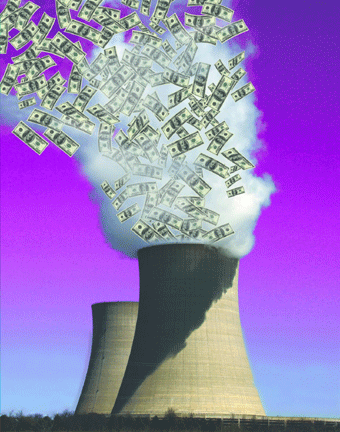 “Nuclear energy is never profitable”, new study slams nuclear power business case https://reneweconomy.com.au/nuclear-energy-is-never-profitable-new-study-slams-nuclear-power-business-case-49596/ 29 July 2019 A new study of the economics of nuclear power has found that nuclear power has never been financially viable, finding that most plants have been built while heavily subsidised by governments, and often motivated by military purposes, and is not a good approach to tackling climate change. “Nuclear energy is never profitable”, new study slams nuclear power business case https://reneweconomy.com.au/nuclear-energy-is-never-profitable-new-study-slams-nuclear-power-business-case-49596/ 29 July 2019 A new study of the economics of nuclear power has found that nuclear power has never been financially viable, finding that most plants have been built while heavily subsidised by governments, and often motivated by military purposes, and is not a good approach to tackling climate change.
““Nuclear energy for climate protection” is an old narrative that is as inaccurate today as it was in the 1970s. Describing nuclear energy as “clean” ignores the significant environmental risks and radioactive emissions it engenders along the process chain and beyond,” the report concluded. While examining the history of nuclear power development globally, DIW Berlin found that it was military considerations that were the primary driver of nuclear reactor developments, with power generation a secondary product. The report echoes an estimate of the costs of new electricity generation in Australia produced by the CSIRO, which found that renewables remain the cheapest cost form of new electricity generation, with nuclear power amongst the most expensive, as a result of substantial upfront costs to build a nuclear plant. Federal energy minister Angus Taylor fuelled speculation that the Government would actively consider the calls from within its own ranks to revisit the question on nuclear power, including those of Barnaby Joyce who said he would welcome nuclear power in his own electorate if it meant constituents would receive free electricity. |
|
Pillars of nuclear arms control are teetering
 Pillars of nuclear arms control are teetering
Collapse of the INF treaty could be followed by the expiry of New Start, Ft.com
THE EDITORIAL BOARD, 31 July 19
Barring a miraculous turnround, a key pillar of the cold war-era nuclear arms control architecture will tumble this week. First the US then Russia suspended participation this year in the 1987 Intermediate-Range Nuclear Forces Treaty, which banned missiles with a range of 500km-5500km, over Washington and Nato’s claims that Moscow has developed missiles breaching the agreement. Unless Russia destroys those missiles by August 2, the US is set to terminate the treaty. This is not just highly dangerous for European security. It is a further step in the unravelling of arms control and rekindling of the nuclear arms race.
More than 40 years of talks between the US and Moscow produced nine significant treaties and agreements to limit and then reduce nuclear weapons. The demise of the INF treaty follows the US withdrawal in 2002 from the Anti-Ballistic Missile Treaty so the country could proceed to develop a missile defence system to counter rockets from “rogue” states such as Iran and North Korea.
Another, bigger, pillar is now teetering. The New Start treaty on reducing strategic nuclear warheads, signed by then US and Russian presidents Barack Obama and Dmitry Medvedev in 2010, will expire in 2021. Though the treaty terms allow it to be extended to 2026, the Trump administration has dragged its feet on doing so. ……..
The demise of New Start, after the INF deal, would not just remove constraints on a new arms race but leave the two big nuclear powers for the first time in decades without the ability to verify each other’s weapons. After Mr Trump’s withdrawal from the 2015 Iran nuclear deal, it would also send a dangerous signal to existing and aspiring nuclear weapons states. If the biggest atomic powers see no need to submit to controls, or honour nuclear deals with third countries, why should they?
It may now be too late to rescue the INF deal. But Washington should engage rapidly with Moscow on renewing New Start. …….https://www.ft.com/content/f040fb68-afca-11e9-8030-530adfa879c2
Japan to scrap remaining nuclear reactors in Fukushima Prefecture
Tepco to decommission four more reactors in the Fukushima prefecture, eight years after Japan’s worst nuclear disaster. Tokyo Electric Power Company has announced plans to decommission its Fukushima Daini nuclear plant, located a few kilometres south of the Fukushima Daiichi plant where three reactors melted down after an earthquake and tsunami in 2011.
The decision by Tepco’s board on Wednesday means all 10 nuclear reactors in the northeastern Fukushima prefecture will be decommissioned.
The prefectural government had previously urged the operator to dismantle the Daini plant, saying its existence has hampered reconstruction efforts, according to Kyodo news agency.
The Daini plant, which started its commercial operation in 1982, only narrowly avoided a major accident at the time of the disaster at the Daiichi. …….In April, Japan partially lifted an evacuation order in one of the two hometowns, Okuma, for the first time since the disaster, but many former residents are still reluctant to return.
The other hometown, Futaba, remains off-limits, as are several other towns nearby.
Tepco said it will take more than four decades to dismantle the four reactors at the Daini plant. The estimated cost for dismantling and decontamination will be 280 billion yen ($2.6bn).
Company president Tomoaki Kobayakawa visited Fukushima Governor Masao Uchibori and told him about the decision and the governor asked Kobayakawa to “make safe and steady progress” on the decommissioning.
The utility plans to build an on-site facility to store spent nuclear fuel from the plant, though it has yet to pick a final disposal site for the fuel, Japanese daily The Mainichi reported.
The decommissioning means Japan is left with 33 reactors to generate electricity nationwide, compared with 54 before the disaster.
Of the 33 units, seven reactors are in operation amid lingering concerns about nuclear energy………. https://www.aljazeera.com/news/2019/07/japan-shut-remaining-nuclear-reactors-fukushima-190731134314037.html
USA movement to unite States against nuclear waste transport and waste dump
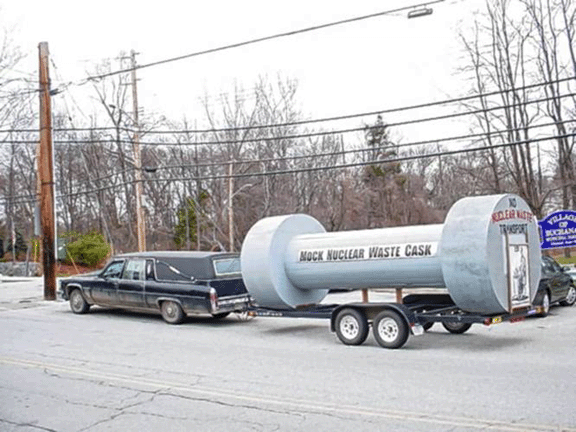
Environmental Groups Call For Unified Voice Against Nuclear Waste In Mountain West,  Wyoming Public Media, By NOAH GLICK 1 AUG 19 Environmental activists are calling for a united voice in protesting the Department of Energy’s recent shipment of nuclear waste through our region.
Earlier this month, the Department of Energy sent a shipment of nuclear waste from Tennessee to southern Nevada. The shipment was incorrectly labeled as low-level waste, but it was actually mixed with waste that needs treatment before disposal. Nevada officials accused the agency of trying to sneak the material into the state illegally.
Now, environmental activists are calling for Utah Governor Gary Herbert to join Nevada and New Mexico’s governors in their fight against nuclear waste shipments…… https://www.wyomingpublicmedia.org/post/environmental-groups-call-unified-voice-against-nuclear-waste-mountain-west#stream/0
Nuclear power ‘seven decades of economic ruin’, says new report
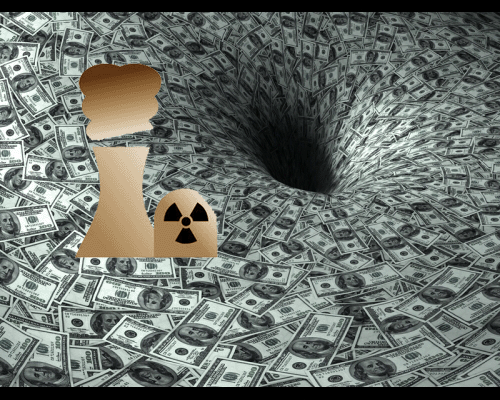 Nuclear power ‘seven decades of economic ruin’, says new report https://www.pressenza.com/2019/07/nuclear-power-seven-decades-of-economic-ruin-says-new-report/ 29.07.2019 – London, United Kingdom – Campaign for Nuclear Disarmament New research has found that almost all nuclear power plants built since the nuclear industry’s inception have generated large financial losses.
The report by the German Institute for Economic Research examines 674 nuclear power plants built since 1951. Its authors found that typical nuclear power plants averaged 4.8 billion euros in losses.
The report authors argue that new technology for nuclear plants won’t solve the underlying economic difficulties: “Those in favor of nuclear energy like to point out the ongoing technological developments that could lead to it growing more efficient in the future.
“They include ‘fourth generation’ nuclear power plants and mini-nuclear power plants (small modular reactors, SMRs). Anything but new, both concepts have their roots in the early phase of nuclear power in the 1950s. Then as now, there was no hope that the technologies would become economical and established.”
Kate Hudson, CND general secretary, said:
“The history of nuclear power is seven decades of economic ruin and environmental catastrophe. Toshiba’s decision last year to abandon plans to build a reactor at Moorside in Cumbria and Hitachi’s suspension of work this year on the Wylfa Newydd plant in Anglesey simply reflect the economic reality that this report sets out.
“Nuclear power isn’t only expensive, it creates an unsolvable waste problem, and as the TV drama Chernobyl so graphically reveals, nuclear accidents create human misery and environmental destruction.
“Our new Prime Minister should learn these lessons and adopt a fresh approach to energy that centres on clean and economically viable renewable technology.”
The huge and long job, of cleaning up Fukushima Daiichi’s high radiation
Robots come to the rescue after Fukushima Daiichi nuclear disaster, CBS News, CORRESPONDENTLesley Stahl, Produced by Richard Bonin and Ayesha Siddiqi , 28 July 19
Eight years after a powerful earthquake and tsunami caused a massive nuclear meltdown in the Daiichi Power Plant, Lesley Stahl reports on the unprecedented cleanup effort
More than eight years have passed since a monster earthquake and tsunami struck Northeast Japan and triggered what became, after Chernobyl, the worst nuclear disaster in history at the Fukushima Daiichi Nuclear Power Plant.
As we first reported last fall, when three of the plant’s six reactors melted down, hot fuel turned to molten lava and burned through steel walls and concrete floors. To this day, no one knows exactly where inside the reactor buildings the fuel is. And it is so deadly, no human can go inside to look for it. So the Japanese company that owns the crippled plant has turned to robots.
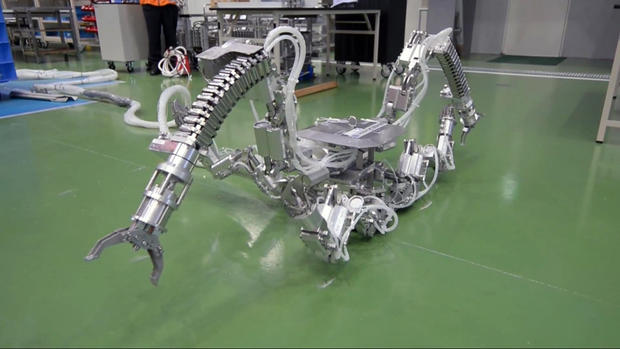
There are four-legged robots, robots that climb stairs and even robots that can swim into reactors flooded with water. They’re equipped with 3D scanners, sensors and cameras that map the terrain, measure radiation levels and look for the missing fuel.
This is part of a massive clean up that’s expected to cost nearly $200 billion and take decades.
Lesley Stahl: Has anything like this cleanup, in terms of the scope, ever happened before?
Lake Barrett: No, this is a unique situation here. It’s never happened in human history. It’s a challenge we’ve never had before………..
Lesley Stahl: Why not just bury this place? Why not do what they did at Chernobyl? Just cover it up, bury it, and just leave it here all– you know, enclosed?
Lake Barrett: Number one this is right next to the sea. We’re 100 yards from the ocean. We have typhoons here in Japan. This is also a high earthquake zone. And there’s gonna be future earthquakes. So these are unknowns that the Japanese and no one wants to deal with………
Lesley Stahl: How many tons of radioactive waste was developed here?
Lake Barrett: Probably 500 to 1,000 tons in each building.
Lesley Stahl: So how long will it be lethal?
Lake Barrett: It will be lethal for thousands of years.
Lesley Stahl: What we’re talking about really is three meltdowns?
Lake Barrett: Yes. It was truly Hell on Earth.
No one is gonna send a worker in there because they’d be overexposed in just a matter of seconds.”
The meltdowns triggered huge explosions that sent plumes of radioactive debris into the atmosphere, forcing the evacuation of everyone within a 12-mile radius – about 160,000 people in all. Weeks later, TEPCO officials engaged in so-called kowtow diplomacy – allowing townspeople to berate them as they prostrated themselves in apology.
Thousands of workers were sent to the countryside to decontaminate everything touched by radiation including digging up dirt and putting it in bags – lots of bags.
But while much of the evacuation zone has been decontaminated, there are still entire neighborhoods that are like ghost towns, silent and lifeless with radiation levels that remain too high.
At the plant they’re capturing contaminated groundwater, about 150 tons a day, and storing it in tanks, as far as the eye can see.
Lake Barrett: Water is always the major challenge here. And it’s going to remain a major challenge until the entire cores are removed.
The closer workers get to the reactors, the more protective gear they have to wear, as we discovered………..
In the years since the accident, much of the damage to the building has been repaired.
But it’s still dangerous to spend a lot of time here. We could stay only 15 minutes.
Lesley Stahl: There’s this number I’ve been seeing, 566.
Lake Barrett: Right. That’s telling you the radiation level that we’re in. It’s fairly high here. That’s why we’re gonna be here a short time.
Lesley Stahl: How close are you and I, right this minute, to the core?
Lake Barrett: The– the melted cores are about 70 feet that way.
Lesley Stahl: Seventy from here–
Lake Barrett: From here.
Lesley Stahl: –is the melted core?
Lake Barrett: Correct, that’s right over in here. We don’t know quite where other than it fell down into the floor.
Lesley Stahl: So if you sent a worker in right now to find it, how long would they survive?
Lake Barrett: No one is gonna send a worker in there because they’d be overexposed in just a matter of seconds.
Enter the robots.
Lesley Stahl: This is the robot research center.
Dr. Kuniaki Kawabata: Yes. This is for remote control technology development.
In 2016, the Japanese government opened this $100 million research center near the plant where a new generation of robots is being developed by teams of engineers and scientists from the nation’s top universities and tech companies………
But even with all the high-tech training and know-how, the robots have run into problems. For the early models, it was the intense levels of radiation – that fried their electronics and cameras.
Lake Barrett: Their lifetime was hours. We hoped it would be days, but it was for hours………
when Scorpion went inside, it hit some debris and got stuck after traveling less than 10 feet. ……
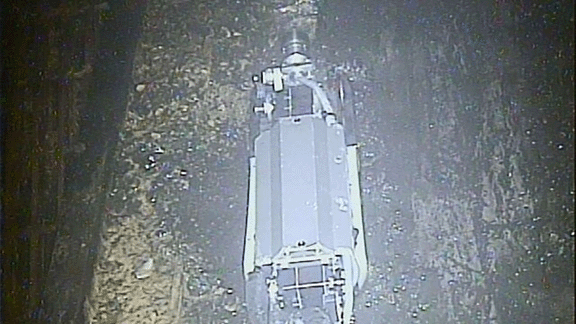
Finally, in 2017, the swimming robot [Little Sunfish] made its foray into the heart of the reactor. ………. It beamed back images reveali ng clumps of debris, fuel rods, half-destroyed equipment and murky glimpses of what looks like solidified lava — the first signs, TEPCO officials say, of the missing fuel.
Lake Barrett: These robotic steps so far have been significant steps. But it is only a small step on a very, very long journey.
Lesley Stahl: This is gonna take you said decades with an “S.” How many decades?
Lake Barrett: We don’t know for sure. The goal here is 40– 30– 40 years. You know, I personally think it may be even 50– 60, but it’s–
Lesley Stahl: Oh, maybe longer………. https://www.cbsnews.com/news/robots-come-to-the-rescue-after-fukushima-daiichi-nuclear-disaster-60-minutes-2019-07-28/
Low dose ionising radiation gives cancer cells a head start
 Cancer-capable cells given ‘advantage’ by low doses of radiation, Sanger Institute study shows, Cambridge Independent , By Paul Brackley paul.brackley@iliffemedia.co.uk, 28 July 2019 Cancer-capable cells given ‘advantage’ by low doses of radiation, Sanger Institute study shows, Cambridge Independent , By Paul Brackley paul.brackley@iliffemedia.co.uk, 28 July 2019
Cells capable of becoming cancerous are given a competitive advantage over normal cells in healthy tissues by low doses of radiation equivalent to three CT scans, scientists have found.
The researchers at the Wellcome Sanger Institute and University of Cambridge studied the effects of low doses of radiation in the oesophagus of mice. They found it increased the number of cells with mutations in p53, a genetic change associated with cancer. Giving the mice an antioxidant before radiation promoted the growth of healthy cells, however, which outcompeted and replaced the p53 mutant cells. The study, published in Cell Stem Cell, recommends that the risk should be considered when assessing radiation safety and also suggests the potential of creating non-toxic preventative measures to cut the risk of developing cancer by helping our healthy cells to eradicate cancer-capable ones. Dr David Fernandez-Antoran, first author from the Wellcome Sanger Institute, said: “Our bodies are the set of ‘Game of Clones’ – a continuous battle for space between normal and mutant cells. We show that even low doses of radiation, similar to three CT scans’ worth, can weigh the odds in favour of cancer-capable mutant cells. We’ve uncovered an additional potential cancer risk as a result of radiation that needs to be recognised.”… Other effects of exposure to low levels of radiation have remained hidden until now, meaning that assessing the associated risk has been difficult. …. Dr Kasumi Murai, an author from the Wellcome Sanger Institute, said it is not know if the antioxidant therapy would work in other tissues, or even have the reverse effect, adding: “What we do know is that long term use of antioxidants alone is not effective in preventing cancer in people, according to other studies.”https://www.cambridgeindependent.co.uk/news/cancer-capable-cells-given-advantage-by-low-doses-of-radiation-sanger-institute-study-shows-9077390/ |
|
|
“Interim nuclear” waste storage really means long-term storage – a lesson for South Australia
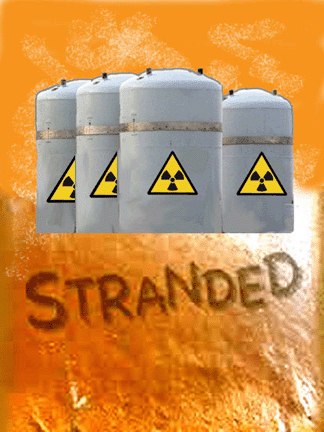 But is interim storage really interim?……. the communities that give the OK to build an interim storage facility may end up having the waste stuck in their backyards for decades to come.
Extreme global temperatures are pushing the human body “close to thermal limits”
How extreme heat affects your body
Independent 27th July 2019 Extreme global temperatures are pushing the human body “close to thermal
limits”, according to a climate scientist. Record-breaking heat has swept
through Europe this week with temperatures topping 40C in a number of
countries.
people are already enduring temperatures reaching up to 54C. Despite all
the body’s thermal efficiencies, these areas could soon be uninhabitable,
according to Loughborough University climate scientist Dr Tom Matthews in
The Conversation.
Unprecedented wildfires in the Arctic release huge CO2 to the atmosphere
Telegraph 27th July 2019 An unprecedented outbreak of wildfires in the Arctic has sent smoke across
Eurasia and released more carbon dioxide in two months than the Czech
Republic or Belgium does in a year.
As 44C heatwaves struck Europe,
scientists observed more than 100 long-lasting, intense fires in the Arctic
in June, the hottest month on record, and are seeing even more in July,
according to Mark Parrington of the European Centre for Medium-Range
Weather Forecasts.
Mostly in Alaska and Russia, the infernos have
collectively released more than 120 million tonnes of CO2, more than the
annual output of most countries. It is the most carbon emitted since
satellite monitoring began in the early 2000s. This will further exacerbate
climate change and has sent smoke pouring toward more populated parts of
the world. Pollutants can persist more than a month in the atmosphere and
spread thousands of kilometres.
“Dark money”helped elect Ohio politicians who were conducive to handing out $1.1billion to the nuclear industry
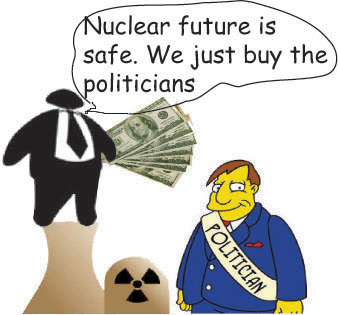
The Ohio legislation reads as if it were designed specifically to undermine the planet’s continued capacity to support a steady human population.
It even ends programs aimed at encouraging Ohio residents to reduce power consumption, through upgrades to appliances or heating and cooling systems
 OHIO REPUBLICANS BALKED AT A NUCLEAR BAILOUT, SO THE INDUSTRY ELECTED NEW REPUBLICANS — AND WALKED AWAY WITH $1.1 BILLION The Intercept, Ryan Grim, , Akela Lacy 25 July 19 ON TUESDAY, a dark-money effort linked primarily to the Ohio nuclear industry delivered an audacious payoff, as a newly elected state legislature overcame years of opposition to shower a $1.1 billion bailout on two state nuclear plants.
Several dark-money groups spent millions to replace key Republican state legislators in the spring of 2018, followed by a furious lobbying campaign to make sure those new lawmakers elected a new House speaker — one who was amenable to the subsidy. The nuclear industry in Ohio has been on the brink of failure for several years, but previous legislatures had objected to a bailout, reading the writing on the wall: Nuclear power is neither a cost-effective solution for power nor an effective response to climate change, despite hopes for its success.
In April 2018, two nuclear plants, both owned by the electric utility FirstEnergy, filed for bankruptcy and have been threatening to cease operations if not bailed out. They were under increasing pressure to compete with cheaper alternatives, ranging from natural gas to wind and solar. The bankruptcy filings give a glimpse into the company’s political spending: more than $30 million from 2018-2019 on lobbying and campaigns in Ohio and Pennsylvania (where the company also sought a bailout, so far unsuccessfully).
The dark-money effort deployed a variety of vehicles that went by names like the Conservative Leadership Alliance and the Ohio Clean Energy Jobs Alliance. Murray Energy, a coal company, also gave heavily to current state House Speaker Larry Householder and his allied candidates, and the bailout from Ohio also includes subsidies to prop up failing coal plants in the state.
The payoff is extraordinary in degree Continue reading
1 This month

of the week – Australians for War Powers Reform (AWPR)
To see nuclear-related stories in greater depth and intensity
 Antinuclear