Antinuclear

Australian news, and some related international items

The ghost towns of Fukushima

Nuclear wasteland
Inside the ghost towns of Fukushima, 
 Eight years on from the tsunami and nuclear meltdown, much of Japan’s Fukushima province remains derelict and deserted. Telegraph, 13 May 19 

There was a chilling silence in the town of Tomioka in the days after the March 2011 Fukushima nuclear disaster.

Shoes were left in porches, half-read newspapers lay abandoned next to cups of tea, long gone cold. As night closed in on the seaside town, lights glared out from a few bare windows, while news of the ongoing crisis at the Fukushima No. 1 Nuclear Power Plant just six miles away drifted from a solitary radio.

Nobody was home.

Eight years on, little has changed. Before March 11, 2011 – the day the tsunami engulfed the nuclear facility, forcing the evacuation of more than 150,000 residents across the region – the town had a population of 15,960. Now, just a few hundred people have returned despite the lifting of the evacuation order in April 2017.

“Officially 835 have returned, but many are plant and other clean-up workers who are renting out abandoned houses,” says Takumi Takano, a local councillor who splits her time between Tomioka and temporary digs in Koriyama an hour’s drive away that she and her husband Kenichi have lived in since evacuating.

Of the remaining locals most are either elderly, or only return during the day, she says. Most worryingly, just 14 are children. When night falls, they return to “temporary” homes elsewhere, she says. “It’s like a ghost town.”

A similar situation is found throughout the entire evacuated region, where only 12,859 of the 100,510 residents who were living in the zone before the disasters have returned, a Cabinet Office official says. Like Tomioka, many of them are clean-up workers, local residents say.

…… After almost eight years, residents, especially those with young families, have settled elsewhere, securing new jobs and starting new schools or moving out of Fukushima entirely,  says  says Kenichi, a former worker at the devastated nuclear plant.. Many are put off returning by the severe shortage of medical facilities in the region.

Then there’s the radioactivity,” he says, as the couple sit outside their caravan, set up on the land of their recently demolished home, which backs on to a 130-square-mile “difficult-to-return-zone” that is still considered too highly contaminated to inhabit.

Eight years on, radioactivity levels have fallen in the reopened parts of Tomioka, though remain 20 times higher than before the disaster. “It’s much higher over there,” he says, pointing to the blockaded zone, where radiation levels exceed 3.8 microsieverts per hour – the designated threshold for issuing evacuation orders.

That zone is a legacy of the nuclear disaster, when multiple reactor meltdowns and explosions, triggered by a magnitude nine earthquake and towering tsunami, spread radioactive materials for hundreds of miles around……..

despite clean-up operations there to reduce radiation levels below the government-set target of 0.23 microsieverts (µSv) per hour, other legacies of the disaster – the crumbling houses and shops, corroding vehicles and overgrown fields, not to mention 16.5 million containers of contaminated earth collected at some 140,000 sites around the region – are impossible to avoid.

The 0.23 µSv figure is significant in that it adds up to an annual dosage level of one millisievert (mSv) (calculated on the premise that a resident spends eight hours a day outdoors), stipulated by the International Atomic Energy Agency as being safe for members of the public.

But while maintaining that level is complicated by recontamination from surrounding woodland, some experts argue the figure says little about the true dangers, or safety, of radiation exposure. That the Japanese government raised this to 20 mSv in the aftermath of the disasters adds weight to their argument…….

Misao Fujita, a doctor who performs thyroid scans at a clinic in Iwaki, about 30 miles south of the nuclear plant, says a connection between the cancers and radiation exposure cannot be ruled out and the screening effect is no reason to disregard the examinations.

“What we do know is that after Chernobyl, many children developed thyroid cancer, and if you take that into account and consider the high risk that Fukushima children were exposed to radiation then I think we should carry out such tests,” Dr Fujita says, adding that thyroid cancer normally occurs in one in one million children.

Noriko Tanaka, whose son is one of Dr Fujita’s patients, says exams revealing cysts in her son’s thyroid are a concern, not least because iodine-131 – a substance that causes thyroid cancer – was contained in the plume released by the Fukushima plant that landed on Iwaki after the disasters. At the time, she was pregnant with her son. “I worry because nobody knows for sure what the future holds,” she says……….

The issue of the one million tons of contaminated water being stored at the stricken nuclear plant is another worry for residents. After receiving assurances from Fukushima plant operator Tokyo Electric Power Company (TEPCO ) that the water had been successfully treated and stripped of all but one radioactive material, tritium, the government announced in 2017 it would start releasing the water into the ocean, despite protests, especially from local fisheries.

TEPCO released convoluted data to demonstrate the water’s safety, but was forced to backtrack last September when further tests showed the sums didn’t add up and 80 per cent of the water was in fact up to 20,000 times higher than the official safe threshold. Furthermore, it contained harmful radionuclides such as iodine, caesium and strontium.

Moreover, while the initial suggestion was that tritium was relatively harmless some studies have shown it to be a cause of infant leukaemia, says Ayumi Iida of NPO Tarachine, which independently analyses seawater samples taken from the ocean near Fukushima’s two nuclear plants.

“Tritiated water is easily absorbed and hazardous when inhaled or ingested via food or water,” she says. “There’s already data indicating infant leukaemia rates are higher near to nuclear plants, and tritium is known to cause DNA damage, so while there are claims that tritium is harmless, there are counterclaims it can adversely affect health, especially among young children.”…….

Shaun Burnie, a nuclear expert with Greenpeace says that discharging the water into the ocean is “the worst option” available, and one whose main consideration is economic.

“The only viable option, and it’s not without risks, is the long-term storage of the water in robust steel tanks over at least the next century, and the parallel development of water processing technology,” he says. ……….

“The reality is there is no end to the water crisis at Fukushima, a crisis compounded by poor decision-making by both TEPCO and the government,” says Mr Burnie.

Among more pressing issues, Mr Burnie says, is 400,000 cubic meters of sludge being stored within the Fukushima plant grounds that contains high concentrations of strontium – known as a “bone-seeker” because, if introduced into the body, it can accumulate in the bones in the same way as calcium does.

With the plant still generating waste, this sludge is expected to nearly double over the next 10 years, he adds.

Strontium releases into the environment from the plant were relatively small following the 2011 disaster, but significantly greater 30 months later, when in 2013 a large strontium-laced plume contaminated land as far away as Minamisoma – a city about 20 km from the plant, Mr Burnie says. Such an event could re-occur, he says.

“Is it a good idea to lift the evacuation orders? Absolutely not. The public are right to be concerned about the possibility of further offsite releases.”

They can also be forgiven for being sceptical over official reassurances that foodstuffs are safe, says Ms Iida of Tarachine, which also runs a produce-testing laboratory and has found “plenty” of items with levels of contamination exceeding the safe limits.

Meanwhile tests on samples of soil – which has no official safe threshold in Japan – have also revealed high levels of radiation in the area, she adds.

Namie’s Obori district, about six miles northwest of the nuclear plant and within the difficult-to-return-zone, is one place where soil radiation levels remain high. In woodland backing the pretty hamlet, which is famed for its pottery but has slowly surrendered to nature, the Telegraph recorded up to 127 µSv per hour – over 350 times the IAEA’s safe threshold……

May 14, 2019 Posted by | General News | Leave a comment

USA government is not likely ever to secure local consent for disposal of spent nuclear fuel

Former DOE Nuclear Waste Chief Critical of Consent-Based Siting    https://www.exchangemonitor.com/former-doe-nuclear-waste-chief-critical-consent-based-siting/

BY EXCHANGEMONITOR   13 May 19, The federal government is not likely ever to secure local consent for disposal of spent fuel from commercial nuclear reactors, but that approach could nonetheless be tested in a plan for temporary storage of the radioactive material, according to a former head of the Energy Department’s Office of Civilian Radioactive Waste Management (OCRWM).

“Consent-based siting does sound very appealing. I just don’t see it leading to a successful leading to a successful conclusion. Of course, I may be wrong,” Ward Sproat, who managed OCRWM from June 2006 to January 2009 before it was dismantled by the Obama administration, wrote in a May 2 letter to Sens. John Barrasso (R-Wy.) and Tom Carper (D-Del.), the top members of the Senate Environment and Public Works Committee.

Among the obstacles to consent, Sproat wrote: history, as illustrated by failed Private Spent Fuel storage project in Utah; politics, including the potential for elected officials who support a facility to be replaced by opponents; and the need for at least two layers of local approval to analyze a selected location and then to begin licensing.

Still, Sproat indicated support for assessing the viability of a consent-based approach for interim storage discussed before the committee by an attorney with the Natural Resources Defense Council (NRDC).

Geoff Fettus, senior attorney for the NRDC’s nuclear program, was among the witnesses for a May 1 hearing on a draft bill from Barrasso that is intended to advance interim storage and permanent disposal of U.S. spent fuel and high-level radioactive waste. Among the measures, the legislation would authorize the secretary of energy to site, build, and operate at least one monitored retrievable storage facility and to store DOE-held waste in a privately operated facility.

In his prepared testimony, Fettus said the NRDC supports changing existing federal laws to give states more authority for regulating radioactive waste as part of a consent-based approach. A pilot program for interim storage should specifically involve a hardened structure at an operational nuclear power plant, Fettus said.

May 14, 2019 Posted by | General News | Leave a comment

Tepco to start taking apart one highly radioactive chimney at Fukushima


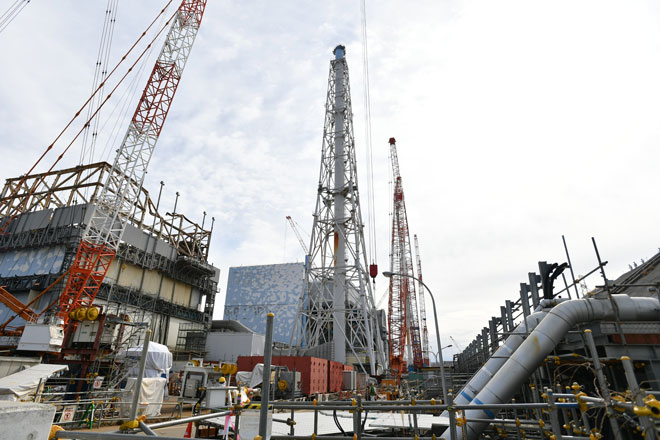
TEPCO to slice dangerous chimney at Fukushima plant    http://www.asahi.com/ajw/articles/AJ201905100045.html, By CHIKAKO KAWAHARA/ Staff Writer, May 10, 2019 Tokyo Electric Power Co. plans to start work on May 20 to dismantle a 120-meter-tall, highly contaminated chimney that could collapse at the crippled Fukushima No. 1 nuclear power plant.

It will be the first highly radiated facility at the plant to be taken apart, the company said May 9.

The stack, with a diameter of 3.2 meters, was used for both the No. 1 and No. 2 reactors. TEPCO plans to remove the upper half of the chimney within this year to prevent the structure from collapsing.

The dismantling work will be conducted by remote control because the radiation level around the base of the chimney is the highest among all outdoor areas of the plant. Exposure to radiation at the base can cause death in several hours.

After the Great East Japan Earthquake and tsunami struck in March 2011, pressure increased in the containment vessel of the No. 1 reactor. Vapors with radioactive substances were sent through the chimney to the outside.

TEPCO also found fractures in steel poles supporting the chimney. The damage was likely caused by a hydrogen explosion at the No. 1 reactor building when the nuclear disaster was unfolding.

Since then, the chimney has been left unrepaired because of the high radiation levels.

Immediately after the nuclear accident, a radiation level exceeding 10 sieverts per hour was observed around the base of the chimney. In a survey conducted in 2015, a radiation level of 2 sieverts per hour was detected there.

TEPCO will use a large crane that will hold special equipment to cut the chimney in round slices from the top.

The company set up a remote control room in a large remodeled bus about 200 meters from the chimney. Workers will operate the special cutting equipment while watching footage from 160 video cameras.

May 14, 2019 Posted by | General News | Leave a comment

Beyond the Anthropocene – humans aim for planetary powers

Accidental changes are entirely different from deliberate ones.

May 14, 2019 Posted by | General News | Leave a comment

Call for a carbon tax for UK

FT 13th May 2019 Nick Butler: There is a very simple measure the UK’s Committee on Climate
Change could have flagged. We need a carbon tax to change consumer
behaviour. Introduced at a level designed to alter behaviour (perhaps £50
a tonne), a carbon tax would encourage consumers of all kinds – from
manufacturers to domestic customers – to switch to lower-carbon energy
supplies and encourage the development of technology to make that possible.

Charged at this level a tax would be far more effective than the current
EU-based measures and would allow energy users to identify low-cost
alternatives, or where necessary develop them. In the process, it would
demonstrate whether the most expensive options, such as carbon capture and
the reconstruction of the way we heat buildings, are really necessary.

https://www.ft.com/content/2c5f19d6-7245-11e9-bf5c-6eeb837566c5

May 14, 2019 Posted by | General News | Leave a comment

Majority of UK voters want to slash greenhouse gases to nearly zero by 2050

Independent 12th May 2019 A majority of voters would support radical action to slash greenhouse gases
to nearly zero by 2050 at a cost of tens of billions of pounds, a new poll
has found. The public has thrown its weight overwhelmingly behind calls by
the government’s independent climate change advisers to make a legally
binding commitment to achieving net zero carbon emissions by the middle of
the century. The exclusive survey by BMG Research found 59 per cent of
voters would support such action, with only 8 per cent opposing it and 34
per cent who had no view.

https://www.independent.co.uk/news/uk/politics/climate-change-greenhouse-gasses-public-support-poll-greta-thunberg-a8909641.html

May 14, 2019 Posted by | General News | Leave a comment

Mothers in Fukushima set up a radiation testing lab because they didn’t trust government results

May 13, 2019 Posted by | General News | Leave a comment

USA government, like the Australian govt ignores the danger of transporting nuclear wastes across the country

Federal panel rejects all objections to proposed New Mexico nuclear dump   https://www.krwg.org/post/federal-panel-rejects-all-objections-proposed-new-mexico-nuclear-dump?fbclid=IwAR1ROpcdsAWDegwnW0vib6ICXXy3q2lzDVTrrOuEbKN4ZbM90Q169XCM6Cc

 • MAY 7, 2019  On Tuesday, the Nuclear Regulatory Commission announced that its Atomic Safety and Licensing Board had rejected every objection made by intervenors challenging Holtec International’s application to build a storage facility for high-level nuclear waste in southeast New Mexico.

Among the requests the panel refused to consider was the objection raised by Sierra Club that U.S. law clearly prohibits nuclear waste being moved to interim facilities before a permanent storage site has been identified. No such permanent sites exist in the U.S.

“This ‘interim’ storage facility could well become a permanent repository without the protections of a permanent repository,” Sierra Club attorney Wally Taylor said in response to Tuesday’s ruling. “Now it is up to the people and public officials in New Mexico to protect New Mexicans from this boondoggle.”

“New Mexico citizens should be very concerned about this project,” Sierra Club Rio Grande Chapter Nuclear-Waste Co-Chair John Buchser said. “Energy Secretary Rick Perry has indicated he is OK with the storage-site proposal in Texas, just across the New Mexico border, becoming a permanent facility.  The Sierra Club is very concerned about possible radioactive releases from containers designed for short-term storage. The transport of this highly radioactive waste is even more risky, and the nation’s rail system is not safe enough to transport this waste.”

Taylor, representing the Sierra Club Rio Grande Chapter, and attorneys for Beyond Nuclear, Fasken, AFES and transportation intervenors raised nearly 50 different contentions before the three-judge board during oral arguments in January in Albuquerque.

The panel, charged with ruling on petitioners’ standing and the admissibility of their contentions under NRC regulations, agreed that some of the six petitioners, including the Sierra Club, had standing, but ruled that not not a single one of nearly 50 contentions raised were admissible for even an evidentiary hearing.

“The board won’t even consider transportation risk,” Buchser said.

“This decision is a perfect example and a lesson for the citizens of New Mexico and the United States of how the NRC process is shamelessly designed to prevent the public from participating,” Taylor said.

“It’s clear from the hearings across the state that the people of New Mexico don’t want this. They need to join forces and make that clear to New Mexico officials,” Taylor said. “State officials can pass and enforce laws that would require permits or other protections from the dangers posed by the transport of high-level radioactive waste to southeast New Mexico.”

The next step for Sierra Club is to appeal to the Nuclear Regulatory Commission.

May 13, 2019 Posted by | General News | Leave a comment

Chernobyl – A Timeline of The Worst Nuclear Accident in History

In the immediate aftermath of Chernobyl, a total of 31 firemen and plant workers died. Some of their bodies were so radioactive, they had to be buried in lead coffins. A report by the World Health Organization estimated that 600,000 people within the Soviet Union were exposed to high levels of radiation, and of those, 4,000 would die. Those who lived near the Chernobyl site have reported increased instances of thyroid cancer, and they have an increased risk of developing leukemia.

700 Million Years

The Chernobyl accident is one of only two nuclear energy accidents that is classified as a “Level 7 Event,” the highest classification. The other is 2011’s Fukushima disaster in Japan. At the lowest level of Reactor 4 lies the famous “elephant’s foot”, a several-meter wide mass of corium that is still giving off lethal amounts of radiation. The half-life of radioactive elements is defined as the amount of time it takes for the radioactivity to fall to half its original value. The half life of U-235 is 700 million years. 

Chernobyl – A Timeline of The Worst Nuclear Accident in History [the original of this article gives details on how the accident happened. ]

33 years ago, a series of missteps caused the worst nuclear accident in history, and its effects are still being felt to this day. Interesting Engineering, By  Marcia Wendorf, 11 May 19, 

Located 65 miles north of Kiev, Ukraine, the V.I. Lenin Nuclear Power Station at Chernobyl was a model of Soviet engineering. Its four RBMK nuclear reactors produced enough electricity for 30 million homes and businesses.

The RBMK reactor is a class of graphite-moderated nuclear power reactor that was designed and built by the Soviet Union. Certain aspects of the design contributed to the Chernobyl disaster, and there were calls for the reactors to be decommissioned. However, the reactors were redesigned, and as of 2019, ten are still in operation.

1,600 Radioactive U-235 Fuel Rods

In 1986, Chernobyl had four working reactors, with two new ones under construction. The newest of the four, Reactor No. 4, contained 1,600 radioactive uranium-235 fuel rods. Because U-235 is unstable, its atoms spontaneously release neutrons, which hit other U-235 nuclei, causing them to release neutrons. This is what is called a chain reaction.

……… This night involved the continuation of a test that was begun twelve hours earlier.

……..“The odds of a meltdown are one in 10,000 years.” — Vitali Sklyarov, Minister of Power and Electrification of Ukraine

Saturday, April 26, 1986

Continue reading

May 13, 2019 Posted by | General News | Leave a comment

Crooked nuclear deals in South Africa

Did Australians know that the Australian nuclear lobby, presumably The Australian Nuclear Science and Technology Organisation (ANSTO, had done a deal to partner with the corrupt Zuma South African regime, to develop nuclear technologies?
Nuclear deal’ claims first scalp: Necsa’s CEO Phumzile Tshelane News 24 2019-05-11 The Russian nuclear deal is claiming its first victim with the Nuclear Energy Corporation of SA (Necsa) poised to fire its chief executive, Phumzile Tshelane.

Tshelane – who was party to a cooperation agreement signed with Rusatom Healthcare, a subsidiary of Russian nuclear agency Rosatom – was found guilty on Friday of four charges of misconduct by its chairperson advocate Nazeer Cassim SC.

Documents obtained by City Press revealed that Tshelane was found guilty of having signed the nuclear cooperation agreement without the approval of Energy Minister Jeff Radebe, as well as splurging R500 000 on a golf day when the entity could not afford to pay salaries and unlawfully appointing one of the board members and paying him a monthly retainer.

“The CEO was not entitled to participate in the signing of the so-called nuclear deal without ministerial approval,” Cassim said…….

According to the charge sheet, in July last year Necsa, with the State Atomic Energy Corporation (Rosatom), concluded the Strategic Document on Cooperation in the Sphere of Non-Power Related Uses of Nuclear Technologies.

That agreement “bound Necsa to cooperate with Rosatom to investigate the possible deepening of commercial cooperation in areas of production and distribution of MO-99 Radio Isotope for the global market”.

They also wanted to build solution reactors in South Africa.

The charge sheet states that the draft agreement was discussed with Radebe who said the collaboration would amount to a conflict of interest as South Africa was already in partnership with Australia on similar projects.

But the Rosatom signing went ahead, regardless, and it was announced soon after………. https://city-press.news24.com/News/nuclear-deal-claims-first-scalp-necsas-ceo-phumzile-tshelane-20190511

May 13, 2019 Posted by | General News | Leave a comment

UK to become the first major economy to embrace a legally-binding net zero emissions goal.

Business Green 10th May 2019 The UK government is preparing to announce that it will broadly embrace the
recommendations of the Committee on Climate Change and introduce a new target to cut emissions to net zero by 2050, according to reports from news agency Bloomberg. Citing officials familiar with the plan, the agency
reported the new target is likely to be announced within two months. Such a fast tracked timetable could potentially allow for amendments to theClimate Change Act to be passed before Parliament’s summer recess,
especially given the limited nature of the government’s legislative agenda in the wake of the delay to Brexit.

Since the CCC’s wide-ranging report was released last week, leading Ministers have repeatedly hinted they want to
see the government adopt the target as quickly as possible and ensure the UK becomes the first major economy to embrace a legally-binding net zero emissions goal.

https://www.businessgreen.com/bg/news/3075426/reports-uk-prepares-to-fast-track-new-net-zero-target

May 13, 2019 Posted by | General News | Leave a comment

UK piously espouses climate action, while trying to stifle domestic solar power

Independent 10th May 2019 James Dyke – Professor of Sustainability Southampton Univ. The UK can’t
fight the climate emergency when the Tories are entirely opposed to renewables like solar. The party’s decision to increase tax on domestic solar power shows that its head is still firmly in the sand.

Why does the UK government appear to be intent on frustrating the deployment of solar power? The real reason for this tax hike is that domestic solar has proved too popular. The cost of solar panels have plummeted and people
increasingly see them as desirable improvements to their homes.

The accelerating update of domestic solar threatens to disrupt the UK’s still largely centralised energy grid. It also butts up against seemingly ideological opposition to renewable energy in the current Conservative Party. The decision to increase tax on domestic solar power needs to be considered alongside its support of fracking for gas, billions of pounds of subsidies to continue to pump fossil fuels out of the North Sea, and resistance to onshore wind turbines.

https://www.independent.co.uk/voices/solar-panels-energy-climate-breakdown-vat-conservatives-a8908366.html

May 13, 2019 Posted by | General News | Leave a comment

Climate change still key in election social media

Climate change still key in election social media, SBS, 11 May 19 Australians were keen to talk about climate change and civil rights on social media in the fourth week of the election campaign.Climate change has continued to feature prominently in Facebook hashtags in posts about the federal election.

But data provided by the platform shows civil rights were discussed more heavily in the fourth week of the election campaign.

The hashtags #stopadani and #climateelection were among the top 10 used on Facebook for the fourth week running, as #religiousfreedoms, #freespeech grew in popularity…… https://www.sbs.com.au/news/climate-change-still-key-in-election-social-media

May 11, 2019 Posted by | General News | Leave a comment

Crustaceans at the bottom of the ocean are eating radioactive carbon from nuclear bomb tests

Deep ocean animals are eating radioactive carbon from nuclear bomb tests, Earth.com, By Kay Vandette ,,10 May 19, A new study has revealed that even the most remote and deep regions on Earth are not isolated from human activities. According to the research, radioactive carbon leftover from nuclear bomb tests in the 1950s and 1960s has made its way to the bottom of the ocean.

May 11, 2019 Posted by | General News | Leave a comment

Melting Glaciers Could Unleash Radioactive Fallout  

“Anthropocene Nuclear Legacy” –Melting Glaciers Could Unleash Radioactive Fallout  https://dailygalaxy.com/2019/05/anthropocene-nuclear-legacy-melting-glaciers-could-unleash-radioactive-fallout/ May 9, 2019 “These materials are a product of what we have put into the atmosphere. This is just showing that our nuclear legacy hasn’t disappeared yet. It’s still there,”said Caroline Clason, a lecturer in Physical Geography at the University of Plymouth of a study published in Nature that surveyed 19,000 of Earth’s glaciers and found their total melt amounts to a loss of 335 billion tons of ice each year, more than measurements of previous studies.“When it was built in the early 1900s, the road into Mount Rainier National Park from the west passed near the foot of the Nisqually Glacier, one of the mountain’s longest,” reports the New York Times. “Visitors could stop for ice cream at a stand built among the glacial boulders and gaze in awe at the ice. The ice cream stand (image below) is long gone.”

The glacier now ends more than a mile farther up the mountain, and they are melting elsewhere around the world too.

This scary scenario of our nuclear legacy was explored by an international team of scientists who studied the spread of radioactive contaminants in Arctic glaciers throughout Sweden, Iceland, Greenland, the Norwegian archipelago Svalbard, the European Alps, the Caucasus, British Columbia, and Antarctica. The researchers shared their results at the 2019 General Assembly of the European Geosciences Union (EGU) in Vienna.

It found man made radioactive material at all 17 survey sites, often at concentrations at least 10 times higher than levels elsewhere. “They are some of the highest levels you see in the environment outside nuclear exclusion zones,” said Caroline Clason

“Missing –14 Billion Tons of Antarctica’s Ice”

Fallout radionuclides (FRNs) were detected these sites. Radioactive material was found embedded within ice surface sediments called “cryoconite,” and at concentration levels ten times greater than the surrounding environment.“ They are some of the highest levels you see in the environment outside nuclear exclusion zones,” Clason, who led the research project, told AFP.

The Chernobyl disaster of 1986—by far the most devastating nuclear accident to date—released vast clouds of radioactive material including Caesium into the atmosphere, causing widespread contamination and acid rain across northern Europe for weeks afterwards. “Radioactive particles are very light so when they are taken up into the atmosphere they can be transported a very long way,” she told AFP. “When it falls as rain, like after Chernobyl, it washes away and it’s sort of a one-off event. But as snow, it stays in the ice for decades and as it melts in response to the climate it’s then washed downstream.”

The environmental impact of this has been shown in recent years, as wild boar meat in Sweden was found to contain more than 10 times the safe levels of Caesium.

“We’re talking about weapons testing from the 1950s and 1960s onwards, going right back in the development of the bomb,” Clason said. “If we take a sediment core you can see a clear spike where Chernobyl was, but you can also see quite a defined spike in around 1963 when there was a period of quite heavy weapons testing.”

Weapons tests can fling radioactive detritus up to 50 miles in the air. Smaller, lighter materials will travel into the upper atmosphere, and may “circulate around the world for years, or even decades, until they gradually settle out or are brought back to the surface by precipitation,” according to the Environmental Protection Agency.

Fallout is comprised of radionuclides such as Americium-241, Cesium-137, Iodine-131, and Strontium-90. Depending on a material’s half-life, it could remain in the environment minutes to years before decaying. Their levels of radiation also vary.

Particles can return to the immediate area as acid rain that’s absorbed by plants and soil, wreaking havoc on ecosystems, human health, and communities. But radionuclides that travel far and wide can settle in concentrated levels on snow and ice—large amounts of radioactive material from Fukushima was found in 2011 on four glaciers in the Tibetan Plateau, for example.

One of the most potentially hazardous residues of human nuclear activity is Americium, which is produced when Plutonium decays. Whereas Plutonium has a half-life of 14 years, Americium lasts 400.

Americium is more soluble in the environment and it is a stronger alpha (radiation) emitter. Both of those things are bad in terms of uptake into the food chain,” said Clason. While there is little data available on how these materials can be passed down the food chain—even potentially to humans—Clason said there was no doubt that Americium is “particularly dangerous”.

As geologists look for markers of the epoch when mankind directly impacted the health of the planet—known as the Anthropocene—Clason and her team believe that radioactive particles in ice, soil and sediment could be an important indicator.

The team hopes that future research will investigate how fallout could disperse into the food chain from glaciers, calling it a potential “secondary source of environmental contamination many years after the nuclear event of their origin.”

The Daily Galaxy via AFP, France24, and Nature

May 11, 2019 Posted by | General News | Leave a comment