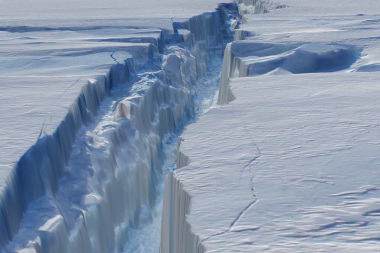
Siren sounds on nuclear fallout embedded in melting glaciers https://phys.org/news/2019-04-siren-nuclear-fallout-embedded-glaciers.html, by Patrick Galey, 10 Apr 19, Radioactive fallout from nuclear meltdowns and weapons testing is nestled in glaciers across the world, scientists said Wednesday, warning of a potentially hazardous time bomb as rising temperatures melt the icy residue.
For the first time, an international team of scientists has studied the presence of nuclear fallout in ice surface sediments on glaciers across the Arctic, Iceland the Alps, Caucasus mountains, British Columbia and Antarctica.
It found manmade radioactive material at all 17 survey sites, often at concentrations at least 10 times higher than levels elsewhere.
“They are some of the highest levels you see in the environment outside nuclear exclusion zones,” said Caroline Clason, a lecturer in Physical Geography at the University of Plymouth.
When radioactive material is released into the atmosphere, it falls to earth as acid rain, some of which is absorbed by plants and soil.
But when it falls as snow and settles in the ice, it forms heavier sediment which collects in glaciers, concentrating the levels of nuclear residue.
The Chernobyl disaster of 1986—by far the most devastating nuclear accident to date—released vast clouds of radioactive material including Caesium into the atmosphere, causing widespread contamination and acid rain across northern Europe for weeks afterwards.
“Radioactive particles are very light so when they are taken up into the atmosphere they can be transported a very long way,” she told AFP.
“When it falls as rain, like after Chernobyl, it washes away and it’s sort of a one-off event. But as snow, it stays in the ice for decades and as it melts in response to the climate it’s then washed downstream.”
The environmental impact of this has been shown in recent years, as wild boar meat in Sweden was found to contain more than 10 times the safe levels of Caesium.
Clason said her team had detected some fallout from the Fukushima meltdown in 2011, but stressed that much of the particles from that particular disaster had yet to collect on the ice sediment.
As well as disasters, radioactive material produced from weapons testing was also detected at several research sites.
“We’re talking about weapons testing from the 1950s and 1960s onwards, going right back in the development of the bomb,” she said. “If we take a sediment core you can see a clear spike where Chernobyl was, but you can also see quite a defined spike in around 1963 when there was a period of quite heavy weapons testing.”
One of the most potentially hazardous residues of human nuclear activity is Americium, which is produced when Plutonium decays.
Whereas Plutonium has a half-life of 14 years, Americium lasts 400.
“Americium is more soluble in the environment and it is a stronger alpha (radiation) emitter. Both of those things are bad in terms of uptake into the food chain,” said Clason.
While there is little data available on how these materials can be passed down the food chain—even potentially to humans—Clason said there was no doubt that Americium is “particularly dangerous”.
As geologists look for markers of the epoch when mankind directly impacted the health of the planet—known as the Anthropocene—Clason and her team believe that radioactive particles in ice, soil and sediment could be an important indicator.
“These materials are a product of what we have put into the atmosphere. This is just showing that our nuclear legacy hasn’t disappeared yet, it’s still there,” Clason said.
“And it’s important to study that because ultimately it’s a mark of what we have left in the environment.”
NY Radiation Specialists Unveils State-of-the-Art Linear Accelerator at NYCBS benzinga, 8 Apr 19, Port Jefferson Station, NY, April 08, 2019 –(PR.com)– On Tuesday, March 25, New York Radiation Specialists unveiled its brand new Varian Halcyon Linear Accelerator, at New York Cancer & Blood Specialists’ Eastchester Center for Cancer Care. The “NYCBS” Eastchester location is a multi-lingual facility located at 2330 Eastchester Road in the Bronx, just minutes from the Pelham Parkway. The Halcyon makes the NYCBS Eastchester Center for Cancer Care the most state-of-the-art radiation site in the region.
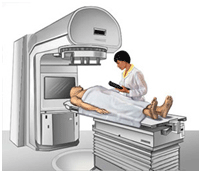
This cutting edge machine boasts features and benefits previously considered impossible. The Halcyon uses optimized guided radiotherapy technology to shape radiation beams to precisely match a patient’s tumor. These “beam shapers” deliver pinpoint accuracy of radiation to the areas that need it, protecting surrounding tissue and reducing the risk of side effects. In addition, the sophisticated design drastically reduces a patient’s table time. Since the accelerator is a self-contained unit, it is free to rotate up to four times faster than traditional models. The Halcyon can deliver effective radiation therapy in as little as five minutes. “Having the ability to deliver more effective treatment in less time is a win for the patient and aligns perfectly with New York Cancer & Blood Specialist’s mission to provide the highest quality of care,” said Dr. Reuven Grossman, an NYCBS Radiation Oncologist. “This new technology provides the most targeted and effective radiation treatment available anywhere.” Patients even have the option of checking themselves into the unit using a touchscreen and their I.D.
Barbara Cecil, Truthout, 8 Apr 19, A global student uprising is underway, with youth worldwide demanding that adults face the climate crisis head on. They need a strong foundation in themselves and adult partnership for the challenges ahead.
Sixteen-year-old Swedish climate activist Greta Thunberg became one of the most well-recognized faces of this movement following her speech before world leaders at a UN climate conference in Poland in December 2018, when she said, “Since our leaders are behaving like children, we will have to take the responsibility they should have taken long ago.”
Youth leaders like Thunberg are rising up across the globe. I had the privilege of working with a group of them from the United World College of the Atlantic in early March this year when I co-led a retreat in the U.K. with 17- and 18-year-olds. There were six adults in the retreat as well as students from 11 countries. All of the students had been on the front lines of the most recent strike; all of them carry deep questions about their futures. A young woman from the Netherlands named Maura Van der Ark — whom I had met in the Amazon Rainforest two summers ago, as Truthout reporter Dahr Jamail and I conducted research for his book, The End of Ice — had organized the retreat to help fellow students find a solid footing in these times.
These young people were exhausted from overwork, highly pressured to succeed by society’s standards, confused about their pathways into the future, and angry at their planetary inheritance. They were harboring a severe need to slow down, be themselves, reflect, and connect deeply with the Earth, with one another and with supportive, understanding adults. My experiences with them left a deep impression on me…….. https://truthout.org/articles/standing-in-the-fire-with-young-climate-activists/
South Asia’s nuclear-armed neighbors pull back from the abyss…barely
India and Pakistan have created the most perilous place on Earth. Salon DILIP HIRO, APRIL 7, 2019 This piece originally appeared on TomDispatch.
It’s still the most dangerous border on Earth. Yet compared to the recent tweets of President Donald Trump, it remains a marginal news story. That doesn’t for a moment diminish the chance that the globe’s first (and possibly ultimate) nuclear conflagration could break out along that 480-mile border known as the Line of Control (and, given the history that surrounds it, that phrase should indeed be capitalized). The casus belli would undoubtedly be the more than seven-decades-old clash between India and Pakistan over the contested territory of Kashmir. Like a volcano, this unresolved dispute rumbles periodically — as it did only weeks ago — threatening to spew its white-hot lava to devastating effect not just in the region but potentially globally as well.
The trigger for renewed rumbling is always a sensational terrorist attack by a Pakistani militant group on an Indian target. That propels the India’s leadership to a moral high ground. From there, bitter condemnations of Pakistan are coupled with the promise of airstrikes on the training camps of the culprit terrorist organizations operating from the Pakistan-controlled part of Kashmir. As a result, the already simmering relations between the two nuclear-armed neighbors are quickly raised to a boiling point. This, in turn, prompts the United States to intervene and pressure Pakistan to shut down those violent jihadist groups. To placate Washington, the Pakistani government goes through the ritual of issuing banning orders on those groups, but in practice, any change is minimal.
And in the background always lurks the possibility that a war between the two neighbors could lead to a devastating nuclear exchange. Which means that it’s time to examine how and why, by arraying hundreds of thousands of troops along that Line of Control, India and Pakistan have created the most perilous place on Earth.
https://www.eurekalert.org/pub_releases/2019-04/uoo-rrc040519.php UNIVERSITY OF OXFORD, 5 Apr 19, A new modelling study from the University of Oxford and collaborators has estimated how changing the reflectivity of roofs can help keep cities cooler during heatwaves and reduce heat-rated mortality rates.
Cities are generally a few degrees warmer than the countryside, due to the urban heat island effect. This effect is caused partly by a lack of moisture and vegetation in cities compared with rural landscapes, and because urban building materials store up heat. During heatwaves, daytime temperatures can get dangerously high in cities, leading to serious health effects and increasing mortality risk.
The idea of ‘cool’ roofs is to make roof surfaces more reflective to sunlight (for example by painting roofs a lighter colour) thereby reducing local temperatures.
Scientists used a regional weather model to look at how temperatures changed across the study city of Birmingham and the West Midlands, depending on the extent of cool roof deployment. They looked at the hot summers of 2003 and 2006, and found that the intensity of the urban heat island (the urban-rural temperature difference) reached up to 9oC for Birmingham city.
Previous work has shown that the extra heat associated with the urban heat island is responsible for around 40-50% of heat related mortality in the West Midlands during heatwaves.
This latest study, published in Environment International, suggests that implementing cool roofs across the city can reduce peak daytime local temperatures by up to 3oC during a heatwave. This reduction in temperature could potentially offset around 25% of the heat-related mortality associated with the urban heat island during a heatwave.
The urban heat island effect is most pronounced at night time, because urban materials slowly release their stored heat overnight, however, the biggest benefits of cool roofs were seen to be during the hottest part of the day where sunlight was reflected away. The type of building made a difference too: modifying only half of all the industrial and commercial buildings had the same impact on lowering temperatures as modifying all the high-intensity residential buildings.
Co-author Dr Clare Heaviside, of the University of Oxford’s Environmental Change Institute comments: “Climate change and increasing urbanisation mean that future populations are likely to be at increased risk of overheating in cities, although building and city scale interventions have the potential to reduce this risk.
“Modelling studies like this one can help to determine the most effective methods to implement in order to reduce health risks in our cities in the future.”
‘How does this serve US interests?’ Gabbard slams decision to sell Saudi Arabia nuclear weapons tech https://www.rt.com/usa/455279-gabbard-saudi-arabia-extremism-isis/2 Apr, 2019 Tulsi Gabbard has slammed the US for allowing firms to sell Saudi Arabia nuclear tech despite its history of exporting extremism which inspires Islamic State (IS, formerly ISIS) and Al-Qaeda, which she says the Kingdom supports.
The Hawaiian congresswoman and Democratic presidential candidate took aim at the Kingdom’s history of extremism in a Twitter video that criticized Energy Secretary Rick Perry’s secret authorizations, to six US companies, allowing for the sale of nuclear power technology and assistance to Saudi Arabia, as Reuters revealed last week. Gabbard said the move is “both mind-blowing and inexplicable.”
Saudi Arabia is the “primary exporter of jihadist ideology, Wahhabi Salafist ideology that is the motivation and inspiration for terrorist groups like ISIS and al Qaeda – groups that the Saudis both directly and indirectly support,” Gabbard said.
The kingdom has been tied to Al-Qaeda and extremism in the past, with 15 of the 19 9/11 hijackers coming from Saudi Arabia, according to the CIA. In 2015, one of the alleged hijackers, Zacarias Moussaoui, claimed several members of the Saudi royal family had been listed as Al-Qaeda donors in the database he worked on under orders of Osama bin Laden, US media reported.
WikiLeaks cables from the US State Department from 2009 revealed“donors in Saudi Arabia constitute the most significant source of funding to Sunni terrorist groups worldwide.” In a 2014 email, published by WikiLeaks, then-Secretary of State Hillary Clinton said Saudi Arabia was “providing clandestine financial and logistic support to ISIL and other radical Sunni groups in the region.” It has also supplied weapons to IS in Syria.
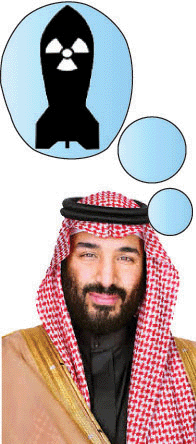
Saudi Arabia is reportedly planning to create at least two nuclear power plants, but many are concerned that’s a precursor to developing nuclear weapons, which would further destabilize the region. It was also reported, last year, that Israel was selling Saudi Arabia nuclear secrets.
How global climate change is already devastating Banglades
Climate change threatens millions of Bangladeshi children, warns UNICEFSBS News A new report shows environmental disasters linked to climate change are threatening the lives and futures of more than 19 million children in Bangladesh, including prompting many families to push their daughters into child marriages., BY CHARLOTTE LAM, 5 Apr 19,
Climate change in Bangladesh could impact the lives of more than 19 million children, according to a new UNICEF report.
The humanitarian agency said on Friday that the country’s flat topography, dense population and weak infrastructure makes it “uniquely vulnerable to the powerful and unpredictable forces that climate change is compounding”.
The report author, Simon Ingram, said the danger was “flooding is extreme and it is almost on an annual basis”.
The report, titled “Gathering Storm: Climate change clouds the future of children in Bangladesh”, showed about 12 million children currently live in and around powerful river systems, which flow through Bangladesh and regularly burst their banks.
A further 3 million Bangladeshi children live in farming communities, which are facing increasing periods of drought.
The report also found a link between climate change and child marriage, child labour and access to education is evident in various parts of Bangladesh.
“Climate change is undoubtedly increasing the number of children who are pushed into the workplace, where they miss out on an education and are terribly exposed to violence and abuse,” UNICEF Bangladesh Child Protection specialist Kristina Wesslund said……….
Mr Ingram said there were already six million climate refugees in Bangladeshi cities, a number that could double by 2050.
Fortunately, Chernobyl health records are now available to the public. They show that people living in the radioactive traces fell ill from cancers, respiratory illness, anaemia, auto-immune disorders, birth defects, and fertility problems two to three times more frequently in the years after the accident than before. In a highly contaminated Belarusian town of Veprin, just six of 70 children in 1990 were characterised as “healthy”. The rest had one chronic disease or another. On average, the Veprin children had in their bodies 8,498 bq/kg of radioactive caesium (20 bq/kg is considered safe).
Currently, policymakers are advocating a massive expansion of nuclear power as a way to combat climate change. Before we enter a new nuclear age, the declassified Chernobyl health records raise questions that have been left unanswered about the impact of chronic low doses of radioactivity on human health.
As researchers monitored Chernobyl radioactivity, they made a troubling discovery. Only half of the caesium-137 they detected came from Chernobyl. The rest had already been in the Cumbrian soils; deposited there during the years of nuclear testing and after the 1957 fire at the Windscale plutonium plant. The same winds and rains that brought down Chernobyl fallout had been at work quietly distributing radioactive contaminants across northern England and Scotland for decades. Fallout from bomb tests carried out during the cold war scattered a volume of radioactive gases that dwarfed Chernobyl.
The Chernobyl explosions issued 45m curies of radioactive iodine into the atmosphere. Emissions from Soviet and US bomb tests amounted to 20bn curies of radioactive iodine, 500 times more. Radioactive iodine, a short lived, powerful isotope can cause thyroid disease, thyroid cancer, hormonal imbalances, problems with the GI tract and autoimmune disorders.
As engineers detonated over 2,000 nuclear bombs into the atmosphere, scientists lost track of where radioactive isotopes fell and where they came from, but they caught glimpses of how readily radioactivity travelled the globe.
https://www.theguardian.com/commentisfree/2019/apr/04/chernobyl-nuclear-power-climate-change-health-radioactivity, Kate Brown , 5 Apr 19, Before expanding nuclear power to combat climate change, we need answers to the global health effects of radioactivity In 1986, the Soviet minister of hydrometeorology, Yuri Izrael, had a regrettable decision to make. It was his job to track radioactivity blowing from the smoking Chernobyl reactor in the hours after the 26 April explosion and deal with it. Forty-eight hours after the accident, an assistant handed him a roughly drawn map. On it, an arrow shot north-east from the nuclear power plant, and broadened to become a river of air 10 miles wide that was surging across Belarus toward Russia. If the slow-moving mass of radioactive clouds reached Moscow, where a spring storm front was piling up, millions could be harmed. Izrael’s decision was easy. Make it rain.So that day, in a Moscow airport, technicians loaded artillery shells with silver iodide. Soviet air force pilots climbed into the cockpits of TU-16 bombers and made the easy one-hour flight to Chernobyl, where the reactor burned. The pilots circled, following the weather. They flew 30, 70, 100, 200km – chasing the inky black billows of radioactive waste. When they caught up with a cloud, they shot jets of silver iodide into it to emancipate the rain.
In the sleepy towns of southern Belarus, villagers looked up to see planes with strange yellow and grey contrails snaking across the sky. Next day, 27 April, powerful winds kicked up, cumulus clouds billowed on the horizon, and rain poured down in a deluge. The raindrops scavenged radioactive dust floating 200 metres in the air and sent it to the ground. The pilots trailed the slow-moving gaseous bulk of nuclear waste north-east beyond Gomel, into Mogilev province. Wherever pilots shot silver iodide, rain fell, along with a toxic brew of a dozen radioactive elements.
If Operation Cyclone had not been top secret, the headline would have been spectacular: “Scientists using advanced technology save Russian cities from technological disaster!” Yet, as the old saying goes, what goes up must come down. No one told the Belarusians that the southern half of the republic had been sacrificed to protect Russian cities. In the path of the artificially induced rain lived several hundred thousand Belarusians ignorant of the contaminants around them.
The public is often led to believe that the Chernobyl exclusion zone, a depopulated 20-mile circle around the blown plant, safely contains Chernobyl radioactivity. Tourists and journalists exploring the zone rarely realise there is a second Chernobyl zone in southern Belarus. In it, people lived for 15 years in levels of contamination as high as areas within the official zone until the area was finally abandoned, in 1999.
In believing that the Chernobyl zone safely contained the accident, we fall for the proximity trap, which holds that the closer a person is to a nuclear explosion, the more radioactivity they are exposed to. But radioactive gases follow weather patterns, moving around the globe to leave shadows of contamination in shapes that resemble tongues, kidneys, or the sharp tips of arrows. Continue reading →
Saudi Arabia’s first nuclear reactor nearly finished, sparking fears over safeguards, Riyadh has so far resisted international watchdog’s requests to accept a strict inspection regime, Guardian, Julian Borger in Washington, 4 Apr 2019
Saudi Arabia is within months of completing its first nuclear reactor, new satellite images show, but it has yet to show any readiness to abide by safeguards that would prevent it making a bomb.
The reactor site is in the King Abdulaziz city for science and technology on the outskirts of Riyadh. The site was identified by Robert Kelley, a former director for nuclear inspections at the International Atomic Energy Agency (IAEA), who said it was very small 30-kilowatt research reactor, not far from completion.
“I would guess they could have it all done, with the roof in place and the electricity turned on, within a year,” said Kelley, who worked for more than three decades in research and engineering in the US nuclear weapons complex………
Before inserting nuclear fuel into the reactor, Saudi Arabia would have to implement a comprehensive set of rules and procedures, including IAEA inspections, designed to ensure no fissile material was diverted for use in weapons – something it has so far avoided
The reactor has been designed by an Argentinian state-owned company, Invap SE……..Saudi Arabia joined the Non-Proliferation Treaty (NPT) in 1988 but signed a comprehensive safeguards agreement with the IAEA only in 2005, and at the same time exempted itself from regular inspections, by signing a “small quantities protocol” (SQP), designed for countries with negligible quantities of nuclear material.
Nuclear power has never lived up to the promise of cheap energy for all, but the costs have included displacement and sickness to nearby communities, contamination of land and water resources, and a build up of 70 years worth of nuclear waste.
In the UK, the costs of nuclear developments have been borne by the taxpayer. Under the ‘Contracts for Difference’ scheme, bills for electricity from the new plant at Hinkley C will be twice what we currently pay.
This does not cover the costs of accidents, which are underwritten by the Government. Nuclear plants typically run overtime and over-budget.
Nuclear waste
The Government’s consultation about burying nuclear waste is about to end, kicking off a five-year search for a willing host community with ‘suitable’ ground conditions.
We are presented with two options: leave the waste in crumbling storage facilities like Sellafield; or bury it and let it contaminate the environment.
In Scotland, new surface-level management facilities are being built but in England this is deemed too expensive. It is clear that we need a solution to managing the waste before we create more of it.
Springfields is where nuclear fuel is produced for both civil and military use, and waste processed from both the UK and abroad.
‘Surround Springfields’ on 27 April is an opportunity to follow the route of radioactive waste and to understand how this issue affects everyone, everywhere.
Creative action
We will even be dressing as barrels of waste in an attempt to break a world record for surrounding a nuclear site.
We will also be having a live conversation with indigenous people in other countries via a webinar about the impacts of uranium mining and nuclear waste. You can join this remotely if you cannot get there – check our Facebook page for details.
Do we choose a long term, socially responsible and ethical energy supply, with a moral commitment to the wellbeing of future generations?
We need to come together and make the Government approach these challenges with vision and creativity, not with the poverty of ambition, opacity and lack of foresight that characterises the nuclear solution.
Take part
Surround Springfields will take place on Saturday 27 April. For more information, contact the organisers.
This Author
Chris Bluemel is a music teacher and campaigner and part of the Stop New Nuclear network. He has been involved in a wide range of campaigning from standing in elections as a Green Party candidate to direct action against road-building, fracking, the DSEI arms fair, and Trident. He is also part of the radical protest-folk band Seize The Day.
Nuclear power is not a viable solution for Green New Deal https://thehill.com/opinion/energy-environment/437003-nuclear-power-is-not-a-viable-solution-for-green-new-deal, BY DAMON MOGLEN, — 04/02/19The Green New Deal resolution is a bold and necessary path forward to tackle the climate crisis. To be successful, it must leave nuclear power behind. With just a decade left to stop the worst effects of climate change, we must dramatically transform how we produce, use and pay for energy. And as momentum around the Green New Deal turns into concrete proposals, we must recognize why nuclear power is a discredited and dishonest distraction, not a solution.
To reduce global greenhouse gas emissions by 40 to 60 percent by 2030, and down to zero by 2050, we need cost-effective, proven energy generation technology that can be scaled up to meet these benchmarks. Nuclear power does not and will not ever meet these criteria.
After 60 years, despite massive subsidies, the nuclear industry is dying of its own accord. Why? Because it’s too expensive, too dangerous and dirty, and takes too long to deploy. Reactors are closing across the country, and major corporations have declared bankruptcy.
Nuclear power simply cannot compete against safer, cleaner and cheaper renewable energy. Nuclear power is also expensive. Nuclear’s subsidies have been buried in hundreds of spending bills, it’s costs externalized to the environment and future generations, and its bills literally unpaid, defaulted on or passed to taxpayers. Conservative estimates suggest that the nuclear industry has received more than $85 billion in subsidies. A centrist estimate might double that.
For 60 years, nuclear power has posed a serious risk to people and our planet. It will be the same for the next 10,000 years. Our children and generations of their children will be forced to endure the radioactive pollution and fallout from devastating accidents like 3 Mile Island, Fukashima and Chernobyl, and the permanent waste that no one can safely store. The risks of nuclear proliferation and the spread of dangerous weapons and technology only adds to this.
Nuclear power is too slow to scale up to our current challenge. Far too slow. In 1997, when the historic Kyoto Protocol was signed, nuclear power’s share of electricity generation globally was around 17 percent. Now, after two decades, the aging fleet of reactors account for barely 10 percent of global electricity generation and about 4.4 percent of global commercial primary energy consumption. Even the nuclear industry’s grandiose and preposterously expensive proposal to build two new nuclear reactors a month, from now to 2050, would be far too little and far too late.
The endless talk of a new nuclear technology that will magically transform this problem is a pipe dream that has a proven record of failure. Hundreds of billions were spent on “breeder” reactors and other esoteric designs and not a single one has yielded a commercial scale reactor.
And continuing to subsidize and retool current reactors will re-direct massive resources that should be put into renewables, while doing nothing to slow global warming.
The task ahead is indeed daunting if we are to turn around global greenhouse gas emissions in the time we have. We must move from a 20th-century energy system based on dirty, dangerous and expensive fossil fuel and nuclear power to a 21st-century energy system based on renewables.
The solution is a massive commitment to ramping up renewable energy coupled with energy storage while applying modern energy efficiency technologies to decrease demand. Wind and solar are cheap, clean and proven to work. We must focus all resources on scaling those up.
Some have suggested that climate change is so dire that all options must be on the table. But that’s an ideology, not a strategy. We must choose the technologies that will not produce greenhouse gases and can be scaled up quickly, safely and at lowest cost. That means the path ahead must be based on renewable energy. If we want to stop the worse of the climate crisis and pull humanity back from the apocalypse, this is the only way forward.
Damon Moglen is a senior strategic advisor to Friends of the Earth, with over 30 years experience campaigning on climate and nuclear issues.
Over the years, those who sought care from Dispensary No. 4 or the IRME were logged in the state’s medical registry, which tracks the health of people exposed to the Polygon tests. People are grouped by generation and by how much radiation they received, on the basis of where they lived. Although the registry does not include every person who was affected, at one point it listed more than 351,000 individuals across 3 generations. More than one-third of these have died, and many others have migrated or lost contact. But according to Muldagaliev, about 10,000 people have been continually observed since 1962. Researchers consider the registry an important and relatively unexplored resource for understanding the effects of long-term and low-dose radiation2.
Geneticists have been able to use these remaining records to investigate the generational effects of radiation…….
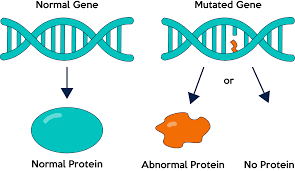
In 2002, Dubrova and his colleagues reported that the mutation rate in the germ lines of those who had been directly exposed was nearly twice that found in controls3. The effects continued in subsequent generations that had not been directly exposed to the blasts. Their children had a 50% higher rate of germline mutation than controls had. Dubrova thinks that if researchers can establish the pattern of mutation in the offspring of irradiated parents, then there could be a way to predict the long-term, intergenerational health risks.
The nuclear sins of the Soviet Union live on in Kazakhstan https://www.nature.com/articles/d41586-019-01034-8– 3 Apr 19, Decades after weapons testing stopped, researchers are still struggling to decipher the health impacts of radiation exposure around Semipalatinsk. The statues of Lenin are weathered and some are tagged with graffiti, but they still stand tall in the parks of Semey, a small industrial city tucked in the northeast steppe of Kazakhstan. All around the city, boxy Soviet-era cars and buses lurch past tall brick apartment buildings and cracked walkways, relics of a previous regime.Other traces of the past are harder to see. Folded into the city’s history — into the very DNA of its people — is the legacy of the cold war. The Semipalatinsk Test Site, about 150 kilometres west of Semey, was the anvil on which the Soviet Union forged its nuclear arsenal. Between 1949 and 1963, the Soviets pounded an 18,500-square-kilometre patch of land known as the Polygon with more than 110 above-ground nuclear tests. Kazakh health authorities estimate that up to 1.5 million people were exposed to fallout in the process. Underground tests continued until 1989.
Much of what’s known about the health impacts of radiation comes from studies of acute exposure — for example, the atomic blasts that levelled Hiroshima and Nagasaki in Japan or the nuclear disaster at Chernobyl in Ukraine. Studies of those events provided grim lessons on the effects of high-level exposure, as well as the lingering impacts on the environment and people who were exposed. Such work, however, has found little evidence that the health effects are passed on across generations.
People living near the Polygon were exposed not only to acute bursts, but also to low doses of radiation over the course of decades (see ‘Danger on the wind’). Kazakh researchers have been collecting data on those who lived through the detonations, as well as their children and their children’s children. Continue reading →
By Dale Spridgeon 1 Apr 19,WE don’t welcome radioactive waste sites in Wales says Anglesey’s AM Rhun ap Iorwerth.The Plaid Cymru Shadow Minister for Economy and Finance is urging Local Authorities in Wales to respond to a consultation by Radioactive Waste Management (RWM) before the consultation closes on April 14.
In a question to Welsh Government Minister for Environment, Energy and Rural Affairs Lesley Griffiths Mr ap Iorwerth raised his own and constituents’ concerns that the consultation process being undertaken by RWM, as they seek a site for a Geological Disposal Facility to bury radioactive waste.
Mr ap Iorwerth said: “Constituents of mine have raised concerns that there is an effort here by Radioactive Waste Management to move towards a less open consultation process.
“I also have a number of concerns regarding the consultation process.
“My main concern is that it is possible for one landowner or one business even to express an interest in make an application to express interest in hosting a site for radioactive waste disposal.
“I think that is totally unacceptable, especially in the context where Local Authorities may have long since said they don’t want such sites in their area, as Isle of Anglesey County Council has done.
“If a Local Authority has said they don’t want a disposal site in their area then that should be the end of the matter.
“Councils in Wales should be declaring clearly between now and the end of the consultation on April 14 that we don’t welcome permanent geological waste sites here in Wales.”
North Wales Chronicle 30th March 2019, Anglesey Council has confirmed that it will not volunteer the island to take part in a government search for sites to bury the UK’s stockpile of its most dangerous radioactive waste despite the promise of substantial financial incentives and “well paid jobs.”
Gwynedd Council, meanwhile, says that no discussions have taken place despite a local AM urging Welsh local authorities to respond to a consultation by Radioactive Waste Management (RWM) and “declare clearly” that Wales doesn’t welcome
permanent geological waste sites.
Linear Accelerators for Radiation Market Trends Research and Projections for 2018-2026 Truth Daily Mirror NICOLE SMITH — APRIL 1, 2019The Global Linear Accelerators for Radiation Market has witnessed continuous growth in the past few years and is projected to grow even further during the forecast period (2018-2026). The research presents a complete assessment of the market and contains Future trend, Current Growth Factors, attentive opinions, facts, historical data, and statistically supported and industry validated market data………https://truthdailymirror.com/linear-accelerators-for-radiation-market-trends-research-and-projections-for-2018-2026/4870/






 Antinuclear