Asahi Shimbun 10th March 2019 In a startling disparity, a private think tank puts the cost of addressing the 2011 Fukushima nuclear disaster between 35 trillion yen and 81 trillion yen ($315 billion and $728 billion), compared with the government estimate of 22 trillion yen.
The calculation, by the Tokyo-based Japan Center for Economic Research, showed that the total could soar to at least 60 percent more and up to 3.7 times more than the 2016 estimate by the Ministry of Economy, Trade and Industry. In releasing the latest estimates on March 7, the center said it is time for serious debate over the role nuclear energy
should play in the nation’s mid- and long-term energy policy.
Of the highest price tag of 81 trillion yen, 51 trillion yen would go toward decommissioning the crippled Fukushima No. 1 nuclear power plant and treating and disposing of radioactive water. The ministry put the cost for these tasks at 8 trillion yen. The center calculated the compensation to victims at 10 trillion yen, while the comparable estimate by the ministry
was 8 trillion yen.
http://www.asahi.com/ajw/articles/AJ201903100044.html
March 12, 2019
Posted by Christina Macpherson |
General News |
Leave a comment
I hope a lot of school kids join this global children’s strike on Friday and I hope they’re mocked and traduced by their elders in politics and the media, because those elders aren’t really their betters on this issue; they’re mostly either dangerous fools or mendacious swine.
The hammer of the coming climate catastrophe will fall most heavily on these kids and eventually upon their children and grandchildren, 20, 30, 40 years from now, and it will do them no harm to take a few rhetorical knocks from a bunch of bloviating, overpaid idiots simply because they chose to step up and take action now. It’ll be good practice.
They’re going to be doing this for the rest of their lives, unless they’re cool with those lives ending in famine, superstorms and wars over diminishing water supplies, and shrinking remnants of arable land.
Protest won’t directly change that of course. Only radically revised policy settings, massive expenditure on clean energy R&D, and the accelerated deployment of paradigm shifting new technologies can change that. But that change will come only when political actors feel a real sense of terror for their futures. Not the future of the planet and its inhabitants, mind you. Just for their own immediate futures. Their pay cheques.
When they feel that existential terror creeping up on them, you’ll start to see things like Tony ‘climate change is BS’ Abbott, perform the sort of tortured interpretive dance routine the electors of Warringah have enjoyed this week.
Abbott is tying himself into Yogi Master knots as he tries to fend off the challenge of Zali Steggall, a highly accomplished and impeccably conservative independent candidate for his seat, who somehow manages to believe in the free market, the primacy of the individual, franking credits for everyone and how awesome it would be if our lives didn’t end in famine, superstorms and war over diminishing water supplies etc, etc.
The only reason Abbott and his fellow travellers on the dirty great coal train to oblivion feel any need to move away from their previous embrace of pro-apocalypse energy policy is because they can see that public opinion has moved on. Year after year of worsening climate and extreme weather events will eventually do that to people.
All those kids who strike on Friday are helping to move that opinion. Yeah, they’ll be derided and ridiculed, their motives questioned and belittled. But they just need to remind themselves that those who caused this problem will soon enough all be dead, leaving them to clean up the mess.
Best they get started now.
March 12, 2019
Posted by Christina Macpherson |
General News |
Leave a comment
TV5 Monde 8th March 2019, Japan: 8 years after the tsunami, the Fukushima power station remains a huge construction site. The immediate risk seems to be averted, but where arduous tasks and unforeseen events continue.
Here are the three main issues:
Nuclear fuel Four of the six reactors at the plant were damaged. The cores of units 1 to 3 have melted at the time of the accident and it is now known that the fuel has almost completely fallen to the bottom of the primary containment of each unit, which it even partially started.
Contaminated water, waste. The site is teeming with contaminated water, “although the various measures taken have mitigated” the problem, according to Mr. Ono. The water is initially that of the tsunami that ravaged the facilities, water that had to pump, sanitize and store. It is then the one
used to cool the reactors and finally the one that falls from the sky and down the mountain upstream and contaminates the way. However, an underground barrier wall and pumps make it possible to limit the amount of water contaminated by the installations.
March 12, 2019
Posted by Christina Macpherson |
General News |
Leave a comment
An obituary for small modular reactors Jim Green, The Ecologist, 11 March 2019, https://theecologist.org/2019/mar/11/obituary-small-modular-reactors
The nuclear industry is heavily promoting the idea of building small modular reactors (SMRs), with near-zero prospects for new large power reactors in many countries. These reactors would have a capacity of under 300 megawatts (MW), whereas large reactors typically have a capacity of 1,000 MW.
Construction at reactor sites would be replaced with standardised factory production of reactor components then installation at the reactor site, thereby driving down costs and improving quality control.
The emphasis in this article is on the questionable economics of SMRs, but a couple of striking features of the SMR universe should be mentioned (for details see the latest issue of Nuclear Monitor).
First, the enthusiasm for SMRs has little to do with climate-friendly environmentalism. About half of the SMRs under construction (Russia’s floating power plant, Russia’s RITM-200 icebreaker ships, and China’s ACPR50S demonstration reactor) are designed to facilitate access to fossil fuel resources in the Arctic, the South China Sea and elsewhere. Another example comes from Canada, where one application of SMRs under consideration is providing power and heat for the extraction of hydrocarbons from oil sands.
A second striking feature of the SMR universe is that it is deeply interconnected with militarism:
- Argentina’s experience and expertise with small reactors derives from its historic weapons program, and its interest in SMRs is interconnected with its interest in small reactors for naval propulsion.
- China’s interest in SMRs extends beyond fossil fuel mining and includes powering the construction and operation of artificial islands in its attempt to secure claim to a vast area of the South China Sea.
- Saudi Arabia’s interest in SMRs is likely connected to its interest in developing nuclear weapons or a latent weapons capability.
- A subsidiary of Holtec International has actively sought a military role, inviting the US National Nuclear Security Administration to consider the feasibility of using a proposed SMR to produce tritium, used to boost the explosive yield of nuclear weapons.
- Proposals are under consideration in the US to build SMRs at military bases and perhaps even to use them to power forward operating bases.
- In the UK, Rolls-Royce is promoting SMRs on the grounds that “a civil nuclear UK SMR programme would relieve the Ministry of Defence of the burden of developing and retaining skills and capability”.
Independent economic assessments
SMRs will almost certainly be more expensive than large reactors (more precisely, construction costs will be lower but the electricity produced by SMRs will be more expensive). Continue reading →
March 12, 2019
Posted by Christina Macpherson |
General News |
Leave a comment
 Libbe HaLevy Nuclear Spinbuster, 11 Mar 19,
Today is the 8th anniversary of the earthquake/tsunami/start of the Fukushima nuclear disaster. I’m taking note of the full-court-press of MSM articles extolling nuclear (Shellenberger in pro-nuclear Forbes really twisted his mental knickers in a bunch) and denigrating everyone/thing from Linear No Threshold (which holds that radiation exposure is cumulative and there is no exposure level that is safe) to that perennial target, Dr. Helen Mary Caldicott. The nuclear industry pays millions every year to their PR shills and focus groups to psychologically hone their talking points and convince us that they’re AOK! All we’ve got is us – and the truth. To my dear friends who mourn the earthquake, tsunami and nuclear consequences of 3/11/11, may we be safe and persist and succeed… whatever that may mean https://www.facebook.com/groups/373984659617522/
March 12, 2019
Posted by Christina Macpherson |
General News |
Leave a comment
 Bulletin of the Atomic Scientists By Maddy Fernands, Isra Hirsi, Haven Coleman, Alexandria Villaseñor, March 7, 2019 Editor’s note: The authors are the lead organizers of US Youth Climate Strike, part of a global student movement inspired by 16-year-old climate activist Greta Thunberg’s weekly school strikes in Sweden and other European countries.
We, the youth of America, are fed up with decades of inaction on climate change. On Friday, March 15, young people like us across the United States will strike from school. We strike to bring attention to the millions of our generation who will most suffer the consequences of increased global temperatures, rising seas, and extreme weather. But this isn’t a message only to America. It’s a message from the world, to the world, as students in dozens of countries on every continent will be striking together for the first time.
For decades, the fossil fuel industry has pumped greenhouse gas emissions into our atmosphere. Thirty years ago, climate scientist James Hansen warned Congress about climate change. Now, according to the most recent Intergovernmental Panel on Climate Change report on global temperature rise, we have only 11 years to prevent even worse effects of climate change. And that is why we strike.
We strike to support the Green New Deal. Outrage has swept across the United States over the proposed legislation. Some balk at the cost of transitioning the country to renewable energy, while others recognize its far greater benefit to society as a whole. The Green New Deal is an investment in our future—and the future of generations beyond us—that will provide jobs, critical new infrastructure and most importantly, the drastic reduction in greenhouse gas emissions essential to limit global warming. And that is why we strike.
To many people, the Green New Deal seems like a radical, dangerous idea. That same sentiment was felt in 1933, when Franklin D. Roosevelt proposed the New Deal—a drastic piece of legislation credited with ending the Great Depression that threatened (and cost) many lives in this country…….
The alarming symptoms of Climate Denialism—a serious condition affecting both the hallways of government and the general population—mark our current historical crossroads of make-it-or-break-it action on climate change. Although there are many reasons for this affliction—such as difficulty grasping the abstract concept of a globally changed climate, or paralysis in the face of overwhelming environmental catastrophe—the primary mode of Climate Denialism contagion involves lies spouted by politicians, large corporations, and interest groups. People in power, like Senator McConnell and the Koch brothers, have used money and power to strategically shift the narrative on climate change and spread lies that allow themselves and other fossil fuel industry beneficiaries to keep the fortunes they’ve built on burning fossil fuels and degrading the environment. …….
We strike because our world leaders haven’t acknowledged, prioritized, or properly addressed the climate crisis. We strike because marginalized communities across our nation—especially communities of color and low income communities—are already disproportionately impacted by climate change. We strike because if the societal order is disrupted by our refusal to attend school, then influential adults will be forced to take note, face the urgency of the climate crisis, and enact change. With our future at stake, we call for radical legislative action—now—to combat climate change and its countless detrimental effects on the American people. We strike for the Green New Deal, for a fair and just transition to a 100 percent renewable economy, and to stop creation of new fossil fuel infrastructure. We strike because we believe the climate crisis should be called what it really is: A national emergency, because we are running out of time. https://thebulletin.org/2019/03/adults-wont-take-climate-change-seriously-so-we-the-youth-are-forced-to-strike/?utm_source=Bulletin%20Newsletter&utm_medium=iContact%20email&utm_campaign=ClimateStrikeOpEd_03072019
March 12, 2019
Posted by Christina Macpherson |
General News |
Leave a comment
Prepare to leave’: Bushfire could worsen
Residents in a community near Bundaberg have been told to gather their belongings and prepare to leave their homes as a bushfire burns in a nearby national park … (subscribers only)
March 12, 2019
Posted by Christina Macpherson |
General News |
Leave a comment
Running a Citizens’ Lab to Track Nuclear Radiation https://broadly.vice.com/en_us/article/panwqb/fukushima-nuclear-radiation-monitoring-tarachine
After the 2011 tsunami triggered a nuclear disaster in Fukushima, there were widespread fears about radiation leaking into the environment. Now a group of volunteers—who are mostly mothers—is tackling the issue head-on.
A woman in a lab coat and surgical mask analyzes a screen full of data. Only those with some training in physics—and in this case, a fear of of radiation—would be able to make sense of these numbers.
Ayumi Iida, 33, is one of twelve volunteers at Tarachine, a local NGO in Fukushima, Japan. She runs the Citizens’ Lab, as the volunteers like to call their laboratory. From the window of the facility, you can catch a glimpse of the Pacific Ocean, precisely eight years ago today the stage for one of the greatest natural disasters of the 21st century. Continue reading →
March 12, 2019
Posted by Christina Macpherson |
General News |
Leave a comment

https://havanatimes.org/?p=149927 March 9, 2019 By Akio Matsumura HAVANA TIMES – On March 11, we commemorate the 8th anniversary of the Fukushima nuclear disaster. To an outside observer, this anniversary passes as a technical progress report, a look at new robot, or a short story on how lives there are slowly returning to normal.
Yet in Japan, the government has not figured out how to touch or test the irradiated cores in the three crippled reactors, which continue to contaminate water around the site of the melt down. The government does not know where it will put that radioactive material once it can find a way to move it.
Meanwhile, the government and site operator are running out of room to store the contaminated water, which is filling up more and more tanks. The cleanup is estimated to take forty years and the cost is estimated at $195 billion.
The latest publicly released findings of radiation levels are from 2017, when Tokyo Electric Power Company had to use a remote-controlled robot to detect the levels in Reactor 2, since no human can approach the crippled reactor.
The rates read 530 sieverts per hour, the highest since the March 2011 meltdown. We have no reason to believe that they have fallen since then. Remote-control robots are being used in the other reactors as well, indicating that radiation levels are similarly high there.
Even using the robot, work can only be carried out for very short times, since the robots can only stand 1000 sieverts of exposure – less than two hours in this case.
This is an extremely high amount of radiation. After TEPCO published the rate, the Asahi Shimbun reported that “an official of the National Institute of Radiological Sciences said medical professionals have never considered dealing with this level of radiation in their work.”
The Japan Times quoted Dr. Fumiya Tanabe, an expert on nuclear safety, who said that the “findings show that both the preparation for and the actual decommissioning process at the plant will likely prove much more difficult than expected.”
Fukushima’s Children Need International Attention
There have been many victims of this disaster. Thousands of people have been displaced from their homes. Local fishermen are worried that the government will proceed with its plan to dump the storage tanks of contaminated water into the ocean.
Others worry that the flow of the radioactive wind and contaminated water are reaching North America and will continue to do so for the next forty years.
Above all of these important issues, it is the children of Fukushima who most need our attention. They are at risk of higher rates of cancer because of their exposure to the contamination from the initial explosion. In Chernobyl, the only comparable case we have, more than 6,000 cases of thyroid cancer were found in children according to the UN through 2005.
There is evidence that thyroid cancer rates are higher among Fukushima’s children than the national population, but it is a latent disease: it is still too early to tell what the full impact will be. But it is clear the case needs action.
Scientists will always offer different opinions, swayed first by uncertainty, but also, sadly, by politics, money, and ambition.
Some will claim that the evidence has been exaggerated, underestimated, or that perhaps we’re at too early a stage to be certain. Or that we need more time to clarify the results. I have seen many instances of these arguments at the United Nations and international science conferences. Why do we wait and make another mistake?
Helen Caldicott, a medical doctor and founding president of Physicians for Social Responsibility, part of a larger umbrella group that was awarded the Nobel Peace Prize in 1985, wrote: “The truth is that most politicians, businessmen, engineers and nuclear physicists have no innate understanding of radiobiology and the way radiation induces cancer, congenital malformations and genetic diseases which are passed generation to generation. Nor do they recognize that children are 20 times more radiosensitive than adults, girls twice as vulnerable as little boys and fetuses much more so.”
UNICEF Can Lead
We face many complex challenges of climate change, poverty alleviation, and national security. The health and welfare of children must always be our top priority. They are our future; our deepest purpose is to care and provide for them. By deciding not to fully investigate the effects of Fukushima, we fail them.
We all agree with that personally, but which institution is best positioned to carry out the mission? To me, UNICEF, the United Nations Children’s Fund, is the only answer. Indeed, putting children above national security is at UNICEF’s core.
Maurice Pate, an American humanitarian and businessman who joined UNICEF at its inception in 1947, agreed to serve as the Executive Director upon the condition that UNICEF serves the children of “ex-enemy countries, regardless of race or politics.” In 1965, at the end of Pate’s term, the organization won the Nobel Peace Prize.
To this day, its mission includes a commitment to “ensuring special protection for the most disadvantaged children – victims of war, disasters, extreme poverty, all forms of violence and exploitation and those with disabilities.” The children of Fukushima deserve the protection of UNICEF.
——
*Akio Matsumura is also the Secretary General of the Global Forum Moscow Conference hosted by President Gorbachev at the Kremlin in 1990 as well as of the Parliamentary Earth Summit Conference hosted by Brazil National Assembly in Rio de Janeiro in 1992
March 10, 2019
Posted by Christina Macpherson |
General News |
Leave a comment
Rebuilding trust among locals may be significantly harder, thanks to a culture of cover-ups and denials that contributed to the nuclear accident and continues to dog Japan’s efforts to restart its nuclear industry, experts say.
…….. at least 24 countries and territories ban some produce from Fukushima. South Korea and China still impose a total food ban. The US prohibits Fukushima produce such as mushrooms, leafy vegetables and broccoli. Fishermen now only ply the seas two days a week: Fish from Fukushima, which once enjoyed a high reputation in Tokyo’s fish market, is no longer the flavour of the day.
The government blames “harmful rumours”, a phrase that dominated the two-day press tour and has been labelled the fourth disaster to hit Fukushima, after the earthquake, tsunami and nuclear accident.
Yet there is a much deeper trust deficit that remains extremely hard to overcome.
Tokyo Electric Power Company (TEPCO), the operator of the ill-fated plant, spent two months after the nuclear disaster denying that a meltdown had occurred. TEPCO later apologised for a “cover-up” that remains the source of much bitterness among people here.
Katsunobu Sakurai, former mayor of the nearby town of Minamisoma, said TEPCO gave out very little information about the disaster during a chaotic evacuation that ultimately led to the deaths of 3,700 people, including many elderly people whose medical care was interrupted.
In 2012, TEPCO was forced to admit that it had failed to heed safety warnings before the accident, or even consider the risk of a large tsunami, because it feared doing so would undermine public confidence in the industry.
Experts say TEPCO has still failed to come clean about the problems associated with decommissioning the reactors and decontaminating the environment.
“To me, talking about ‘harmful rumours’ sounds like they are making someone else the bad guy or villain, as if they are blaming people for saying negative things because they don’t understand science and radiation,” said Riken Komatsu, a community activist in Onahama.
“But those who have lost our trust do not have the right” to talk about harmful rumours, Komatsu added.
The government and TEPCO say the nuclear power plant itself could take 30 or 40 years to decommission and estimates the cleanup will cost 22 trillion yen (USD200 billion).
But in 2015, the plant’s manager told London’s Times newspaper that the technological challenges involved in removing hundreds of tonnes of molten radioactive fuel from three reactors could mean decommissioning will take 200 years.
The Japan Center for Economic Research, a conservative think tank, estimates the cleanup bill could come to 50 trillion to 70 trillion yen (USD460 billion to 640 billion).
One of the biggest problems involves groundwater that seeps into the reactor buildings, mixes with cooling water and becomes radioactive.
TEPCO has been trying to limit water contamination ever since the accident, creating a mile-long “ice wall” of sunken, frozen soil around the reactors to keep water out, and another concrete wall to prevent it from reaching the ocean.
In 2016, TEPCO admitted that the ice wall was only slowing – but not preventing – water seeping in. Today, around 100 cubic metres of groundwater still become contaminated at Fukushima every day, and one million tonnes of radioactive water is stored in 994 huge tanks around the site.
A new tank fills up every seven to 10 days, and storage space is running out.
TEPCO had initially claimed that 26 out of 27 radioactive nuclides had been removed from that water through an advanced treatment system, living only tritium behind.
But after reports by Kyodo news and local media, and a protest by fishermen, the company acknowledged last September that 80 per cent of the tanks contain water that is still contaminated with dangerous radioactive elements, including strontium-90, a bone-seeking radionuclide that causes cancer.
Launching his successful bid for the 2020 Summer Olympics, Japanese Prime Minister Shinzo Abe said the situation at Fukushima was “under control”. One of his predecessors, Junichiro Koizumi said the water crisis showed that was a lie.
An external committee established by TEPCO to advise the board of directors said it is “very frustrated” at the company’s inability to communicate properly. ……… https://borneobulletin.com.bn/trust-fails-to-recover-from-nuclear-disaster/
March 10, 2019
Posted by Christina Macpherson |
General News |
Leave a comment
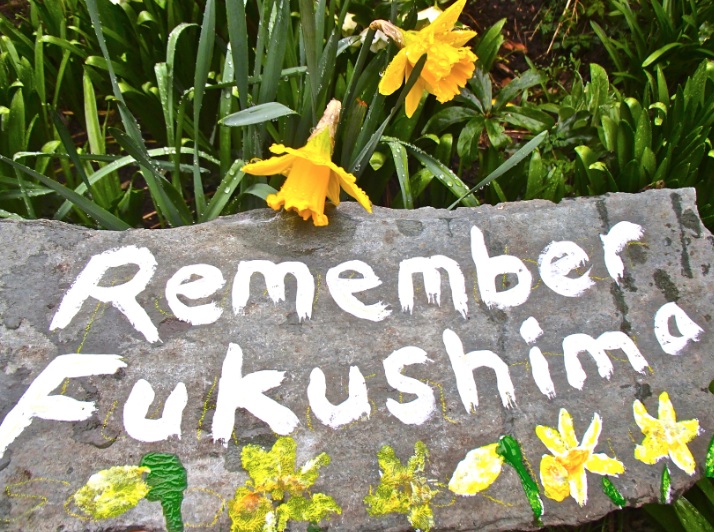
There’s not a lot in the mainstream media, about this important anniversary. But much of what there is – concerns the “recovery” of the area, the Olympic Games, the robots, the ice wall, the (forced) return of evacuees, the story that tritium contamination doesn’t really matter, does it? …… etc etc – whitewashing the real situation. And, perhaps more importantly, encouraging the world to forget about the nuclear catastrophe. And above all, let’s pretend that it does not have global significance.
All sorts of experts, scientists etc propound ways to fix Fukushima’s nuclear problem, get rid of the molten nuclear fuel debris, and the nearly 2 million tons and counting, of radioactive water.
I could believe in their sincerity – IF all this concern were not linked to the promotion of the global industry. Indeed, if their concern were linked to a plan to stop producing toxic radioactive trash.
The people of Fukushima need help from the world – but not the kind of help that teaches them, and the global community, that everything is OK really, and the nuclear industry can charge ahead.
March 9, 2019
Posted by Christina Macpherson |
Christina themes, General News |
2 Comments
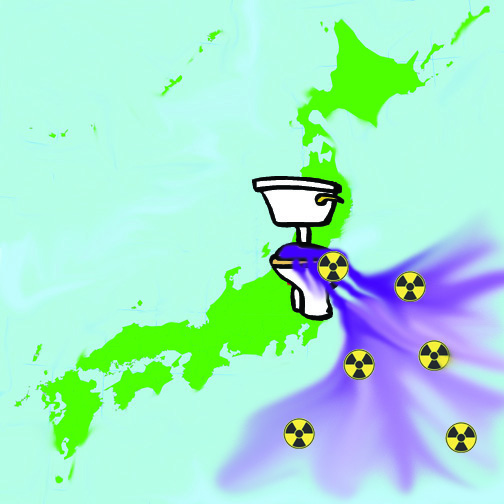
Bay View, National Black Newspaper, by Harun Minhaj, March 4, 2019 In 2011, an unprecedented series of die-offs began to strike dead hundreds of millions of sea creatures in the northern Pacific Ocean. As one sailor who frequently travels the Pacific remarked in October of 2013:
“I’ve done a lot of miles on the ocean in my life and I’m used to seeing turtles, dolphins, sharks and big flurries of feeding birds. But this time, for 3,000 nautical miles, there was nothing alive to be seen.”
What precipitated such a dramatic devastation of marine life in the Pacific Ocean?
Just a few months before the die-offs began, the meltdown of three nuclear reactors at the Fukushima Daiichi Complex in Japan caused the greatest pollution of the marine environment by radioactive contaminants in history. Far from over, these releases are still ongoing.
More than 400 tons of radioactive water have been flowing into the Pacific every day since the meltdowns began.
Although the full extent of the damage from Fukushima Daiichi has yet to be determined, the volume of these releases alone shows that we are dealing with something unprecedented in history.
Indigenous elders and scientific community sound the alarm
I was first alerted to the severity of the Fukushima disaster by Bay Area Indigenous Elder Zachary RunningWolf. A full-time activist and community leader in the Bay Area, RunningWolf has long campaigned for racial and environmental justice in a myriad of ways……..
For the last nine years, he has also led a four-day monthly stop driving boycott to combat global warming……
When RunningWolf ran for mayor of Berkeley in 2016, he made addressing Fukushima a central component of his campaign. For RunningWolf and many Indigenous elders concerned about the ongoing violence against Mother Earth, stopping the Fukushima nuclear crisis is of the highest priority.
Consider this call for action released in 2013 by a council of Indigenous elders called the Caretakers of Mother Earth:
“The People of the Earth understand that the Fukushima nuclear crisis continues to threaten the future of all life. We understand the full implications of this crisis even with the suppression of information and the filtering of truth by the corporate owned media and nation states. We strongly urge the media, corporations and nation states to acknowledge and convey the true facts that threaten us, so that the international community may work together to resolve this crisis, based on the foundation of truth” (emphasis added).
The deep concern expressed by RunningWolf and the Caretakers of Mother Earth about the impact of Fukushima’s radiation on the Pacific is shared by thousands of scientists. For instance, the platform adopted by the more than 5,000 scientists who make up the Society for Environmental Toxicology and Chemistry declared in 2014 that “the Fukushima nuclear accident on 11 March 2011 emerged as a global threat to marine biodiversity in the Pacific Ocean and human health in coastal communities.”
Other scientific organizations such as the Nordic Probabilistic Safety Assessment Group have gone even further. This institution – which is by no means “anti-nuclear” as it was founded by the nuclear utilities of Finland and Sweden – predicted in 2011 based on official estimates of radioactivity released into the Pacific that around 50-100 million fish would die from just one of the most deadly and prolific isotopes which had been released. ……….
Along with the unprecedented die-offs, a consistent set of symptoms frequently occurring together was observed across species:
Some of these symptoms (such as cancer, hair loss, and mutations) are well-known consequences of radiation sickness, while other more obscure ones such as high levels of parasites have been confirmed in studies of sea life to occur as a consequence of radiation. Altogether, only radiation sickness can produce such a widespread, prolonged epidemic exhibiting all these symptoms.
The genocidal impact of Fukushima radiation in the Pacific
It would be extremely foolish to assume this devastation in the Pacific Ocean will not profoundly impact human life. It is widely recognized that for numerous reasons our very survival depends on the health of the oceans, most notably because they produce the majority of the oxygen that we must breathe to live.
Native peoples, whose traditional livelihoods are often intimately bound up with the health of the ocean, are on the front line of this struggle. ……..
As aboriginal advocates have argued, the violence of nuclear contamination in desecrating their lands and culture must be recognized as a kind of cultural genocide. In this case, where the Pacific Ocean itself has been desecrated, Fukushima’s radiation must be recognized as constituting a genocidal assault on numerous Indigenous peoples’ cultures and livelihoods.
Furthermore, the radiation in Pacific seafood poses a significant health risk to the people who consume it. Estimates calculated by a wide variety of experts in nuclear power, chemistry and medicine show that this risk has been severely underestimated, and in fact more than 1 million people would die from cancer and other diseases if the consumption of radioactive Pacific seafood continues unabated.
In the Bay Area, Indigenous Blackfeet Elder RunningWolf has long been warning the public to avoid consuming Pacific seafood since even before the 2016 Berkeley mayoral race, while calling for the University of California – with its flagship campus located in Berkeley – to be held accountable for issuing no health warnings in turn.
As aboriginal advocates have argued, the violence of nuclear contamination in desecrating their lands and culture must be recognized as a kind of cultural genocide…………… https://sfbayview.com/2019/03/the-future-of-all-life-indigenous-sovereignty-and-the-fukushima-nuclear-disaster/
March 9, 2019
Posted by Christina Macpherson |
General News |
1 Comment
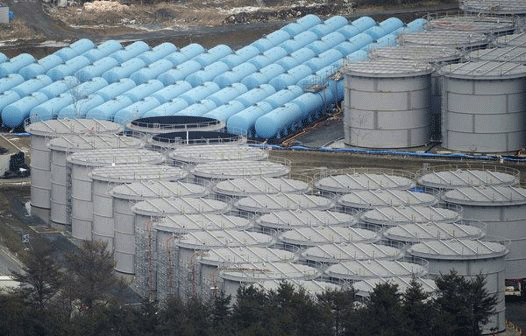
Eight years after triple nuclear meltdown, Fukushima No. 1’s water woes show no signs of ebbing, Japan Times, BY RYUSEI TAKAHASHI, STAFF WRITER, 8 Mar 19,
This is the first in a series examining how the northeast and the nation are progressing with efforts to deal with the March 2011 earthquake, tsunami and nuclear crisis.
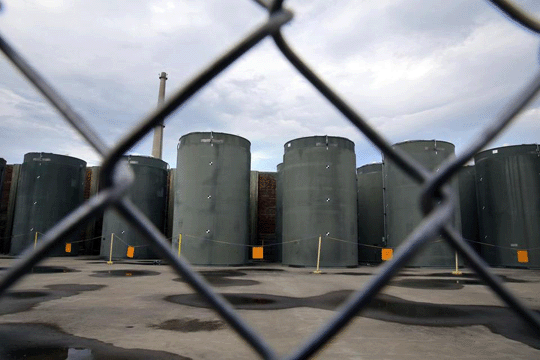
OKUMA, FUKUSHIMA PREF. – Nearly a thousand storage tanks are scattered across the Fukushima No. 1 nuclear power plant, holding a staggering 1.1 million tons of treated water used to keep its melted reactor cores cool while they rust in the sun. Continue reading →
March 9, 2019
Posted by Christina Macpherson |
General News |
1 Comment
 Nuclear waste solution remains elusive amidst polarized debate,The Coast News
  group, by Jordan Ingram, 8 Mar 19, …………‘Chernobyl in a can’
In November 2018, a retired systems analyst silently held up a fistful of lemons during a Community Engagement Panel discussion with officials from Southern California Edison and the Nuclear regulatory Commission regarding a near-miss canister incident on Aug. 3 at San Onofre Nuclear Generating Station (SONGS).
Donna Gilmore, who spent her career designing and analyzing IT systems at Caltrans and the state Controller’s Office, had a clear message: the “Holtec nuclear waste dry storage system is a lemon and poses a risk to Californians.”
When Gilmore, 71, discovered that Edison was using “thin-walled” Holtec canisters to store tons of nuclear waste at decommissioning SONGS, she saw a potential for error with an incalculable cost…….
According to Gilmore, each of the canisters currently stored at San Onofre holds roughly the same amount of Cesium-137 that was released after the 1986 Chernobyl nuclear disaster.
“You basically have a Chernobyl disaster in each can,” Gilmore said.
Stephen Waters, a retired electrical engineer for Dillingham Construction during large hydroelectric projects such as PG&E’s Kerckhoff No. 2 and Edison’s Balsam Meadows, agreed with Gilmore’s assessment.
In an email correspondence with Gilmore, Waters wrote:
“The bottom line is these tables confirm your ‘Chernobyl in a can’ claim. Each can would contain approximately 35 times the amount of Plutonium, the same amount of Cesium-137 and roughly six times as much Strontium-90 as released at Chernobyl.”…….
Gilmore said there are much safer canisters currently used in other parts of the world, including the CASTOR V/19 — the “Cadillac of the industry, according to Gilmore — which boasts nearly 20-inches ductile cast-iron protection……..
Reports released earlier this year by Samuel Lawrence Foundation further supports Gilmore’s claims, finding that the damage, or “gouging,” caused to the “thin-walled” steel canisters as they are lowered into the vaults is the most serious issue facing the storage facility.
In a 2017 report by the Electric Power Research Institute, steel canisters were found to be susceptible to chloride-induced stress corrosion cracking, chloride-rich salts combined with moisture that eat holes through metals over time.
Several cases of through-wall cracks due to chloride-induced corrosion were reported at nuclear power stations, including Koeberg, Turkey Point, St. Lucie and San Onofre, according to a report by the NRC.
In 2009, three examples of chloride-induced cracks were discovered in steel pipes at SONGS…..
what is more alarming, according to Gilmore and Waters, is that no approved method currently exists to deal with a failed canister.
During an Oct. 11, 2018, meeting on spent fuel storage, NRC Commissioner David A. Wright asked engineer Christian Araguas about the ability to inspect and repair canisters.
Araguas responded that the NRC and DOE are “trying to develop techniques to be able to inspect, you know, casks in service” and hopes that “they’re going to be able to inspect these in the future,” according to the meeting transcript.
Even more damning is the admission by Holtec President Kris Singh that it is “not practical to repair a canister if it were damaged” and that “all it takes is a microscopic crack” to get a release of millions of curies of radiation. ….“Why don’t they make containers that can be inspected and monitored in a manner that they don’t leak or explode,” Gilmore said. “Even the cheapest automobile can be inspected, maintained and repaired before something goes wrong.”
What’s the plan, man?
“The first step in emergency planning is prevention,” Gilmore said. “We have to focus on prevention and not get distracted with anything else. This idea that there’s an evacuation plan is giving false hope.”…… https://www.thecoastnews.com/nuclear-waste-solution-remains-elusive-amidst-polarized-debate/
March 9, 2019
Posted by Christina Macpherson |
General News |
Leave a comment
The Fukushima nuclear disaster’s legacy: An inescapable stigma, Commentary: Pockets of innovation, like a drone testing field, have some hoping the region sheds its notoriety. But it’s not that simple. CNet
BY ROGER CHENG MARCH 7, 2019 The J-Village hotel and sports complex in Fukushima was immaculate, its grand lobby welcoming us with bright lights and pristine marble floors. Several furnished conference rooms stood ready to host one event after another.
There’ was just one jarring thing: the utter silence throughout the facility.
It was our first night in the Fukushima region, and my photographer, James Martin, and my interpreter had arrived a little after 10 p.m. Initially, we weren’t sure if this was the right location – we seemingly had the only vehicle in the parking lot, and a quick search of those conference rooms found no staff.
It wasn’t until we located the reception desk, tucked out of sight from the main lobby, that we found another human. The employee noted that only 15 guests were staying in the 200-room hotel.
Welcome to Fukushima.
That first night proved to be one of the more memorable moments in a trip that included a visit inside one of the most radioactive hotspots in the world, a look at a massive underground ice wall and a virtual reality experience that took me to places no human could survive. It stood out because it illustrated the long way this area has to go before any semblance of normalcy can return…….
Eight years on, there’s been little progress with the actual cleanup. While three of the six reactors have been safely decommissioned, the remaining three have proven to be such a challenge that Tokyo Electric Power Company, or Tepco, just last month finally succeeded in sending a robot down to the Unit 2 reactor to pick up some of debris in the highly radioactive core. ………
Tepco and local government officials are pushing the concept of an “Innovation Coast” in the region through facilities like the Naraha Center for Remote Control Technology and the
Robot Test Field in nearby Minamisoma. The idea is to tap into the investment already being made in the cleanup effort and create a Silicon Valley of robotics and drone technology.
“What we want to do is turn that on its head and create a positive image of Fukushima around the world,” Akifumi Kitashima, director of the robot industry promotion unit for the Fukushima prefectural government, says through an interpreter…….
there are reminders of the disaster everywhere. Drive on the nearby Joban Expressway and you’ll periodically run into signs with a readout of the radiation level. The daily weather report on the local evening news contains an update on the radiation in the area.
I periodically drove past fields containing hundreds of bags of radiated dirt.
March 9, 2019
Posted by Christina Macpherson |
General News |
Leave a comment






 Antinuclear