Does anyone really think such a system could produce a fair trial?
The column I didn’t want to write about Julian Assange, SMH, By Elizabeth Farrelly, 8 December 2018 This is a piece I had no desire to write. Julian Assange, still holed up after six years in his self-imposed Knightsbridge prison, his fine view of Harrods’ Christmas lights filtered through an encircling fence of bobbies, has so thoroughly fallen from favour that even smart and kind-hearted people (and here I include self) find themselves somewhere between bored and hostile. Yet two questions remain: is this view manufactured? And, either way, should Assange be dumped into the lightless sewers of America’s imperial security system?
Assange’s welcome in the embassy is growing thin. When Ecuador throws him out, as is likely any moment, he’ll be arrested. For what? The only current charge, on an arrest warrant that a British judge recently refused to quash, is for skipping bail on a rape allegation that has since been dropped. The fear, and the reason he skipped, is that he’ll be extradited to the US to be face a secret grand jury indictment on charges of espionage for which Chelsea Manning has already been pardoned. …….
Assange’s welcome in the embassy is growing thin. When Ecuador throws him out, as is likely any moment, he’ll be arrested. For what? The only current charge, on an arrest warrant that a British judge recently refused to quash, is for skipping bail on a rape allegation that has since been dropped. The fear, and the reason he skipped, is that he’ll be extradited to the US to be face a secret grand jury indictment on charges of espionage for which Chelsea Manning has already been pardoned. So the legality of Assange’s transgression is less important than political perceptions of its public-interest value. His defence depends entirely on political intervention and, therefore, on public perception. This is why the public’s desertion of him is so critical. But is it justified?
But counterbalancing all that is the far bigger question of the American security machine, and whether we trust that to safeguard anyone’s interest but its own. ….
secrecy has been the anti-Assange campaign’s defining characteristic. Naturally, no one ever conceded that the rape charges were shaky or explained the prosecutor’s refusal to interview Assange in London (generating fear of a ruse to facilitate his extradition to the US). The charges have since been dropped without explanation yet America’s determination to capture Assange remains undiminished.
Back in 2011 a grand jury was convened in Virginia to determine whether Assange was indictable. Grand jury proceedings are inherently secret. Involving neither judge nor jury they are prosecutor-led, with no defendant right to a defence, attendance or even knowledge. Their findings too are secret. Thus, despite years of enduring rumours of a “sealed indictment” against Assange we know only that last month, US prosecutors inadvertently revealed that secret charges had been laid against Assange.
Put it together. An old arrest warrant for skipping bail on a charge that was always feeble and has since been dropped, a refusal to deny extradition intentions, secret charges emerging from a secret court over an act that may not even be illegal and for which the principal culprit has already been pardoned. Does anyone really think such a system could produce a fair trial?
Radioactive legacy of Bukit Merah rare earths processing plant
Some of the surviving residents of Bukit Merah are still plagued with severe health problems. Until this very day, the Malaysian authorities refuse to acknowledge that the radioactive waste was responsible for the sudden escalation of health problems among the residents
Today, the government is the official custodian of this repository in Bukit Merah. This site in Bukit Merah is declared as a restricted and dangerous dump site for radioactive materials but a curtain of official silence has descended on it. Has the government not learnt from Bukit Merah?
The Lynas project is likely to be a replay of the ARE fiasco but on a much larger scale.
The benefits gained by Malaysia from the Lynas investment are very little relative to the risks involved. Whilst the profits of the project go to Lynas (untaxed) and the few Malaysian companies that are involved in the construction of and the provision of supplies to the Gebeng rare earth plant, the radioactive waste will remain in Malaysian soil for hundreds of years.
Lynas issue: Not learning from bitter experience —The Malaysian Insider, Richard Pendragon, April 12, 2012 “……..Bukit Merah The history of the rare earth industry in Malaysia is little known to most Malaysians. Most Malaysians in fact think that the Lynas project in Pahang is the first time Malaysia has been associated with this industry.
Few Malaysians actually know that there was a rare earth plant in Bukit Merah, Perak, which has been closed some 10 or more years ago, following a ruling by the High Court of Malaysia that the company involved was in negligence, and that the radioactive waste generated by the plant was dangerous and had to be removed and secured in a safe
place away from people for hundreds of years.
The evidence of the hazardous legacy of this rare earth plant is still present in our midst as a reminder to every one of the risks involved.
All you need is to take a trip to Bukit Merah and you will see the
existence of a restricted site where the toxic radioactive waste has
been stored in specially engineered concrete cells, and entombed
deeply in a repository, to prevent any leakage of radiation from the
radioactive waste for the next few hundred years.
T
he company that was involved in the rare earth plant was called Asian
Rare Earth Sdn Bhd (ARE). This was a joint venture established between
Mitsubishi Chemical Corp (MCC) of Japan, Beh Minerals Sdn Bhd, the
local partner and the government, through Tabung Haji in the early
nineties.
ARE was based in Menglembu, Ipoh and the joint venture was founded on
the basis that the local partner would supply the raw materials
(tailings from the many tin mines in Perak) and MCC would provide the
technology and expertise to extract the rare earth minerals, by a cracking process.
In this cracking process, along with the extraction of rare earth
minerals such as Monazite, Xenotime, Zircon, Yttrium etc, a waste
product called thorium hydroxide is produced and this substance is
radioactive.
Experts brought in to present evidence in support of the court hearing
against ARE testified that prolonged exposure to radiation leaked from
the radioactive waste materials from ARE’s rare earth plant would be
harmful to the health of the residents living in the Menglembu area,
where the plant was located.
ARE was subsequently closed and wound up.
The shareholders of the company had to engage a highly specialised
radioactive waste management consultancy firm from the US, called
Dames and Moore, to relocate, treat and dispose of the radioactive
waste from the dump site in Menglembu to a safe repository. The cost
of the whole exercise ran into hundreds of millions of US dollars to
contain radiation leak from the radioactive waste.
Meanwhile local residents have blamed the ARE refinery for the high
numbers of birth defects and leukaemia cases within the last five
years in a community of 11,000 — after many years of local history.
with no leukaemia cases. Seven of the leukemia victims have died.
Some of the surviving residents of Bukit Merah are still plagued with severe health problems. Until this very day, the Malaysian authorities refuse to acknowledge that the radioactive waste was responsible for the sudden escalation of health problems among the residents
Greta Thunberg, 15, told UN summit that students are acting in absence of global leadership Action to fight global warming is coming whether world leaders like it or not, school student Greta Thunberg has told the UN climate change summit, accusing them of behaving like irresponsible children.
Thunberg began a solo climate protest by striking from school in Sweden in August. But more than 20,000 students around the world have now joined her. The school strikes have spread to at least 270 towns and cities in countries across the world, including Australia, the United Kingdom, Belgium, the US and Japan.
“For 25 years countless people have come to the UN climate conferences begging our world leaders to stop emissions and clearly that has not worked as emissions are continuing to rise. So I will not beg the world leaders to care for our future,” she said. “I will instead let them know change is coming whether they like it or not.”
“Since our leaders are behaving like children, we will have to take the responsibility they should have taken long ago,” she said. “We have to understand what the older generation has dealt to us, what mess they have created that we have to clean up and live with. We have to make our voices heard.”
………Toby Thorpe, a school student from Hobart, Tasmania, who took part in the recent school strikes in Australia and is also at the UN summit, said: “We are in this together. Together we are strong and we will not give up.” Australia’s resources minister, Matt Canavan, had dismissed the school strike – “the best thing you’ll learn about going to a protest is how to join the dole queue” – but the Senate later approved a motion in support of the students……..
The first two weeks of Thunberg’s strike were spent protesting outside the Swedish parliament. Now she spends every Friday on strike. “I like school and I like learning,” she told the Guardian. She said her strike would end when Sweden begins cutting its carbon emissions by a dramatic 15% a year: “Sweden is such a rich country and we have high per capita emissions, so we need to reduce more [than others].”
She also had a message for other school students: “You don’t have to school strike, it’s your own choice. But why should we be studying for a future that soon may be no more? This is more important than school, I think.”
Thunberg’s father, Svante, said: “As a parent you cannot support your child striking from school. I said to her you have to go out and do it for yourself.” But he added: “It’s OK in the holidays.”
Mideast nuclear plan backers bragged of support of top Trump aide Michael Flynn http://www.smh.com.au/world/mideast-nuclear-plan-backers-bragged-of-support-of-top-trump-aide-michael-flynn-20171201-gzxau2.html, Warren Strobel, Nathan Layne and Jonathan Landay, 3 Dec 17, Washington: Backers of a US-Russian plan to build nuclear reactors across the Middle East bragged after the US election they had backing from Donald Trump’s national security adviser Michael Flynn for a project that required lifting sanctions on Russia, documents reviewed by Reuters show.
The documents, which have not previously been made public, reveal new aspects of the plan, including the proposed involvement of a Russian company currently under US sanctions to manufacture nuclear equipment. Continue reading →
Carbon emissions will reach 37 billion tonnes in 2018, a record high, December 6, 2018 The Conversation,Pep Canadell, CSIRO Scientist, and Executive Director of the Global Carbon Project, CSIRO, Corinne Le Quéré, Professor, Tyndall Centre for Climate Change Research, University of East Anglia, Glen Peters, Research Director, Center for International Climate and Environment Research – Oslo, Robbie Andrew, Senior Researcher, Center for International Climate and Environment Research – Oslo, Rob Jackson, Chair, Department of Earth System Science, and Chair of the Global Carbon Project, globalcarbonproject.org, Stanford University.
Carbon dioxide (CO₂) emissions from fossil fuels and industry are projected to rise more than 2% (range 1.8% to 3.7%) in 2018, taking global fossil CO₂ emissions to a new record high of 37.1 billion tonnes.
The strong growth is the second consecutive year of increasing emissions since the 2014-16 period when emissions stabilised, further slowing progress towards the goals of the Paris Agreement that require a peak in greenhouse gas emissions as soon as possible. Strong growth in emissions from the use of coal, oil and natural gas suggests CO₂ emissions are likely to increase further in 2019.
Strong energy demand is behind the rise in emissions growth, which is outpacing the speed at which decarbonisation of the energy system is taking place. Total energy consumption around the world increased by one sixth over the past decade, the result of a growing global middle class and the need to provide electricity to hundreds of millions of people living in poverty. The challenge, then, is for all nations to decarbonise their economies while also satisfying the need for energy, particularly in developing countries where continued growth in energy supply is needed.
BBC 5th Dec 2018 An effective ban on new coal mines in Wales getting planning permission isto come into effect. The measure is part of the Welsh Government’s new planning policy, published on Wednesday. Applications for opencast and deep-mine coal mining will only be allowed under “exceptional
circumstances”. Environment Secretary Lesley Griffiths said the policy will
ensure “we have well-designed spaces which will benefit future
generations”. It comes after the assembly passed legally-binding carbon
emissions targets on Tuesday. Planning Policy Wales governs what councils
can allow through planning permission. https://www.bbc.co.uk/news/uk-wales-politics-46447290
World Bank to raise $200 billion to fight climate change SBS News 4 Dec 18The World Bank Group will spearhead a five-year, $200 billion investment to fight climate change. The World Bank has unveiled a $200 billion in climate action investment for 2021-25, adding this amounts to a doubling of its current five-year funding.
The World Bank said the move, coinciding with a UN climate summit meeting of some 200 nations in Poland, represented a “significantly ramped up ambition” to tackle climate change, “sending an important signal to the wider global community to do the same.”
Developed countries are committed to lifting combined annual public and private spending to $100 billion in developing countries by 2020 to fight the impact of climate change — up from 48.5 billion in 2016 and 56.7 billion last year, according to latest OECD data.
Southern hemisphere countries fighting the impact of warming temperatures are nonetheless pushing northern counterparts for firmer commitments.
In a statement, the World Bank said the breakdown of the $200 billion would comprise “approximately $100 billion in direct finance from the World Bank.”
Around one third of the remaining funding will come from two World Bank Group agencies with the rest private capital “mobilised by the World Bank Group.”……..
Much of the climate action financing is being set aside for reducing greenhouse gas emissions, notably through development of renewable energy strategies.
However, the World Bank stated that “a key priority is boosting support for climate adaptation,” given the millions of people already battling the consequences of extreme weather.
“By ramping up direct adaptation finance to reach around $50 billion over (fiscal) 21-25, the World Bank will, for the first time, give this equal emphasis alongside investments that reduce emissions,” the bank stated.
Given the urgency to act in the face of sea level rise, flooding and drought “we must fight the causes, but also adapt to the consequences that are often most dramatic for the world’s poorest people,” said World Bank CEO Kristalina Georgieva.
The countries whose representatives are meeting at the UN climate summit which opened Sunday in the Polish city of Katowice are seeking to make good on commitments made in the 2015 Paris climate accord.
Our greatest threat’: David Attenborough’s grim warning on climate Naturalist David Attenborough has told delegates at a UN conference the world is facing the end of civilisation if it does not unite to tackle climate change. SBS News, 4 Dec 18British broadcaster and environmentalist David Attenborough has urged world leaders, meeting in Poland to agree ways to limit global warming, to get on and tackle “our greatest threat in thousands of years”.Known for countless nature films, Attenborough has gained prominence recently with his Blue Planet II series, which highlighted the devastating effect of pollution on the oceans.
Leaders of the world, you must lead,” said the naturalist, given a “People’s seat” at the two-week UN climate conference in the Polish coal city of Katowice alongside two dozen heads of state and government.
“The continuation of our civilisations and the natural world upon which we depend, is in your hands,” he said.
“Climate change is running faster than we are and we must catch up sooner rather than later before it is too late.”
Attenborough told the delegates: “Right now, we are facing a man-made disaster of global scale. Our greatest threat in thousands of years. Climate Change.”……….
Representatives of some of the most powerful countries and biggest polluters were conspicuous by their absence, and the United States is quitting the UN climate process.
To maximise the chances of success in Poland, technical talks began on Sunday, a day early, with delegates from nearly 200 nations debating how to meet the Paris target of limiting global warming to between 1.5 and 2.0 degrees Celsius (2.7 and 3.6 Fahrenheit).
Michal Kurtyka, Poland’s deputy environment minister and president of the talks, said that without success in Katowice, Paris would not be a success, as it had only decided what was needed, not how it could be done.
Moreover, the wider political environment had changed.
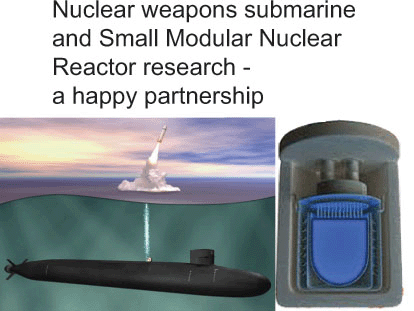
the decision to pursue Molten Salt Nuclear Reactors (MSRs )may not be based on market laws. For MSRs to succeed, they will likely be developed with appropriate political support and military funding.
If a nation wants an unlimited power supply for cutting-edge military technologies, then the MSR is indeed a very good candidate.
small modular reactors fitted with MSR technology could effectively supply electricity at remote military bases.
When a technology has some potential, the military sector can provide appropriate funding to quickly prototype products, which won’t necessarily have commercially viable features
Molten Salt Reactors: Military Applications Behind the Energy Promises, POWER,12/02/2018 | Jean-Baptiste Peu-Duvallon The commercial nuclear power sector has evolved with great help from the military-industrial complex. Research and development funded for the purpose of national defense has resulted in advances directly applicable to the power industry. For molten salt reactor designs to succeed, political support and military dollars may again be necessary. Continue reading →
nuclear emits twice as much carbon as solar PV and six times as much as onshore wind.
Beyond Nuclear, 2 Dec 18Nuclear power has no constructive role to play in climate change solutions. In fact, it is a hindrance.
Nuclear power does have a carbon footprint When nuclear power is said to have “zero emissions,” this refers only to the electricity generation phase and only to greenhouse gas emissions. There are emissions at this stage, especially heat and radioactivity. Certain emissions during reactor operations, such as carbon-14 in CO2 form and methane, are greenhouse gases.
However, there are plenty of carbon emissions involved in making a nuclear power plant a reality. Therefore, when discussing the carbon footprint of nuclear energy compared to other energy forms, the entire uranium fuel chain needs to be taken into account. In doing so, nuclear energy compares poorly to renewable energy and energy efficiency. Lifecycle emissions along the nuclear fuel chain occur through uranium mining and milling, transportation, plant construction, operation, reactor site decommissioning, and nuclear waste management.1
Life-cycle carbon emissions of a nuclear power plant When taking into account planning, permitting, construction, operation, refurbishing and decommissioning, a nuclear power plant emits at least 6-24 times more carbon-dioxide equivalent emissions than wind per unit energy produced over the same 100-year period.2
Life-cycle carbon emissions from the entire nuclear fuel chain How do we calculate this? Evaluating the total carbon output of the nuclear industry involves calculating emissions from every carbon-emitting phase of the uranium fuel chain, then dividing them by the electricity produced over the entire lifetime of the plant.3 Some of the most reliable analysis on this has been done by Dr. Benjamin Sovacool whose data we use here (see footnote 1).
Let’s take a look at the mean carbon emissions of each phase:Continue reading →
Portrait of a planet on the verge of climate catastropheAs the UN sits down for its annual climate conference this week, many experts believe we have passed the point of no return, Guardian, byRobin McKie, 2 Dec 18
On Sunday morning hundreds of politicians, government officials and scientists will gather in the grandeur of the International Congress Centre in Katowice, Poland. It will be a familiar experience for many. For 24 years the annual UN climate conference has served up a reliable diet of rhetoric, backroom talks and dramatic last-minute deals aimed at halting global warming.
But this year’s will be a grimmer affair – by far. As recent reports have made clear, the world may no longer be hovering at the edge of destruction but has probably staggered beyond a crucial point of no return. Climate catastrophe is now looking inevitable. We have simply left it too late to hold rising global temperatures to under 1.5C and so prevent a future of drowned coasts, ruined coral reefs, spreading deserts and melted glaciers.
One example was provided last week by a UN report that revealed attempts to ensure fossil fuel emissions peak by 2020 will fail. Indeed the target will not even be reached by 2030. Another, by the World Meteorological Organization, said the past four years had been the warmest on record and warned that global temperatures could easily rise by 3-5C by 2100, well above that sought-after goal of 1.5C. The UK will not be exempt either. The Met Office said summer temperatures could now be 5.4C hotter by 2070.
At the same time, prospects of reaching global deals to halt emissions have been weakened by the spread of rightwing populism. Not much to smile about in Katowice.
Nor will the planet’s woes end in 2100. Although most discussions use the year as a convenient cut-off point for describing Earth’s likely fate, the changes we have already triggered will last well beyond that date, Continue reading →
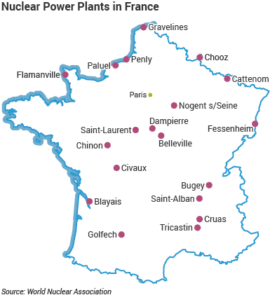
President Emmanuel Macron of France depressed nuclear executives globally in late November 2018, announcing the planned retirement of 14 of 58 reactors by 2035. This was still less than was promised in his election campaign, but represents a major internal political battle, as well as a major change of France’s circumstances.
This has been an emerging story for several years.
France did a better job than most of building nuclear plants. They picked a single design and built a bunch of them over a relatively concentrated 20 years from about 1978 onward. It was a massive, state-funded, state-managed energy infrastructure initiative at a scale rarely seen. They dodged a bunch of the mistakes of other geographies somewhat by accident. They aren’t subject to earthquakes or tsunamis. They kept the technology highly standard. They developed a skilled workforce for building them and rewarded them well.
But the last nuclear reactor went live almost 20 years ago, the oldest ones are at end-of-life, and the skilled workforce only knows how to maintain and operate existing reactors now, not build new ones. The current President of France, Macron, used to be the Minister of Industry. He’s stated publicly that even he couldn’t find out how much the build-out actually cost, with the clear assertion that a bunch of actual costs were hidden.
“Nobody knows the total cost for nuclear energy,” he said. “I was minister for industry and I could not tell you.”
And France had to build nuclear to be load-following due to its over-reliance on a more usually inflexible form of generation. Nuclear is good for baseload up to 30–40%, but when it has to be turned on and off it gets a lot more expensive very quickly. France has the good fortune to have been able to export a lot of electricity to the rest of the EU for several years, but the energy mix on the continent is strongly favoring more flexible forms of generation.
And now, a few things have changed in the decades since France made its huge bet on nuclear generation in the Messmer Plan in 1974.
Renewables are dirt cheap, with Lazard’s latest figures bringing them in at 3–6 times cheaper than new nuclear. (Amusingly, Lazard still labels wind and solar as ‘alternative energy‘.) Europe is a leading geography for wind and solar, so skilled trades and supply chains all exist. Europe’s grid has strengthened and expanded over the past 30 years, so the need for a country to go it alone has diminished substantially.
The EU was founded in 1993 and France is an integral part of it, and that has two impacts. The first is that France’s energy independence policy that was part of the impetus for a massive nuclear fleet looks archaic in context of modern politics and economics. The second is that EU regulations forbid destabilizingly large governmental subsidies for energy, something which the Hinkley plant in the EU had to fight through. As Macron’s experience shows, it’s actually impossible for anyone to figure out how much any nuclear plant actually cost due to budget fudging. This last is true globally, by the way.
And Chernobyl and Fukushima both happened since the French nuclear build-out began. Public support diminished substantially after those events, one on the same continent and one a world away.
France receives a greater percentage of its electricity from nuclear than any country in the world, at 72% close to 50% more than its nearest ‘competitor’, Slovakia. And it will diminish over the coming decades. Its last-built reactor will reach end-of-life in 2040 or so. It’s unlikely that it will be replaced. And it’s unlikely that more than a fraction of the aging reactors will be refurbished at all.
Wind, solar, a continent-scale grid, and open economic borders all contributed to the death of the French nuclear dream. It’s time for France to wake up and join the future, and it has. It voted in Macron, a politician who promised to reduce France’s nuclear fleet. He fought the entrenched bureaucracy and EDF, and while the new plans are slower than the promised ones, they are the right plans on a pragmatic timeline.
Cleanup cost more than 10 times initial estimate, Adam Hunter – CBC News, November 28, 2018The Saskatchewan government is suing Ottawa over costs associated with the cleanup of the Gunnar mine site, an abandoned uranium mine.
The lawsuit, filed on Tuesday, calls on the federal government to honour a 2006 memorandum of agreement (MOA) that saw both sides committing to sharing the cost of cleaning up the northern Saskatchewan site.
When the MOA was signed, the estimated cost was $24.6 million over 17 years. The two sides agreed to split the cost.
The cost has now ballooned to an estimated $280 million. To date, the province has paid $125 million cleaning up the mine and its associated satellite sites. The province said the federal government has contributed $1.13 million.
“The federal government agreed to cost-share this project equally, but has since refused to uphold its end of the agreement,” said Minister of Energy and Resources Bronwyn Eyre.
She said after years of back and forth the province was left with “no choice” because it has an obligation to fully remediate the site.
In an emailed statement to CBC, a spokesperson from the Ministry of Natural Resources said, “as the owner of the site, the Government of Saskatchewan is responsible for the Gunnar Mine Remediation Project.”
It goes on to say the federal government has provided funding for the first phase of the project and it will commit to funding the remaining two phases “after Saskatchewan obtains all the necessary approvals required to proceed with remediation.”
News Lens 22nd Nov 2018,The UK’s so-called ‘nuclear renaissance’ is once again in crisis. In
November, it was announced that Toshiba were pulling out of investing in the new Moorside nuclear power station after years of expensive planning, for which British citizens will be paying for years to come.
Meanwhile in Scotland (nuclear power is not being pursued and emissions are falling faster than elsewhere in the UK), 98 percent of final electricity demand was met by wind power alone in October.
Just as the ‘atomic dream’ is rendered ever more clearly obsolete by renewables, UK Government nuclear
enthusiasm intensifies. The UK has one of the most ambitious nuclear new build agendas in the world. The program was justified on the basis that it would produce power “significantly before 2025.” It was claimed “keeping the lights on” with nuclear, would be cheaper than renewables and require no subsidy. The first new nuclear station, Hinkley C, would be operating by Christmas 2017. https://international.thenewslens.com/article/108612














 Antinuclear