In water-scarce Australia, cooling water for nuclear power would become an impossible burden
In summary, in a hot dry continent like Australia, providing cooling water for a nuclear power plant would prove a huge cost and distortion to the water industry.
 Nuclear cost and water consumption – The elephants in the control room, Open Forum, Peter Farley | December 20, 2019 “…..Cooling Water Nuclear cost and water consumption – The elephants in the control room, Open Forum, Peter Farley | December 20, 2019 “…..Cooling Water
A key issue with nuclear plants is cooling. Because of the cost of shutdowns and the degradation of materials by irradiation, the plants are designed to run at lower peak temperatures (260-320 C) than coal (500-670 C), gas turbines (1,300-1430C) or internal combustion plants (2,000 C). The thermal efficiency of a plant is directly related to the difference between the peak temperature and the cooling medium – what is termed Carnot efficiency. Lower temperature means lower efficiency, as less of the heat energy is converted into work and more is removed by the cooling system. So for a given amount of electrical energy delivered, more cooling is required in a nuclear plant. Furthermore the warmer the cooling water or air the more coolant is required. Thus the Barrakah plants require 100 tonnes of Gulf seawater per second for each generator. In higher latitudes with seawater temperatures in the range of 2-12C, water requirements can still be 40-60 tonnes per second per GW. Just to put that in perspective Melbourne Water supplies 15-20 tonnes per second to the entire Metropolitan area of almost 5 million people. Even so, the water temperature is raised by 7-10C which is enough to kill any fish larvae unfortunate enough to be sucked into the cooling intakes. It is enough to change the local environment for all sea life, so finding a suitabable site is very difficult. There are currently no nuclear plants operating using warm seawater for cooling although Barrakah is soon to be commissioned. The problem there is not just the temperature but the accelerated rates of corrosion and biofouling which will mean the heat exchangers need to be larger, pumping losses will be higher and maintenance bills higher still. Perhaps the area near Portland in Victoria might work, but then the 500kV line would have to be triplicated to carry away the power, further adding to the cost. Plants at the edges of the grid have a whole lot of other issues so a South Australian plant would be extremely difficult to integrate. On land in very cold climates, a small number of air cooled plants have been built but the offset is that about 5% of the output of the power plant is used to run the fans. However in warm climates it is virtually impossible to run an air cooled nuclear power plant. It would require in the order of 450-500 tonnes of air per second to be moved over the heat exchangers per GW of electrical output. At typical air velocities for cooling fans that would have a fan area of 75,000 square meters or if each fan was the cross section of a shipping container, 17,000 fans. It is enough to change the local environment for all sea life, so finding a suitable site is very difficult. There are currently no nuclear plants operating using warm seawater for cooling although Barrakah is soon to be commissioned. The problem there is not just the temperature but the accelerated rates of corrosion and biofouling which will mean the heat exchangers need to be larger, pumping losses will be higher and maintenance bills higher still. Perhaps the area near Portland in Victoria might work, but then the 500kV line would have to be triplicated to carry away the power, further adding to the cost. Plants at the edges of the grid have a whole lot of other issues so a South Australian plant would be extremely difficult to integrate. On land in very cold climates, a small number of air cooled plants have been built but the offset is that about 5% of the output of the power plant is used to run the fans. However in warm climates it is virtually impossible to run an air cooled nuclear power plant. It would require in the order of 450-500 tonnes of air per second to be moved over the heat exchangers per GW of electrical output. At typical air velocities for cooling fans that would have a fan area of 75,000 square meters or if each fan was the cross section of a shipping container, 17,000 fans. In other cases straight through cooling is used from large rivers or lakes. The Murray at the South Australian border is often down to 9 GL/day or even less. 9 Gl/day is about 105 tonnes/second, and so a single unit nuclear power plant located on the Murray would often need the entire flow to cool it, while heating the water by 8-12 C. This is obviously an environmentally impossible situation. That is why cooling towers are the most common cooling method because they are the most efficient. Evaporating water carries away much more heat than liquid flows. In typical Australian conditions the nuclear plant would evaporate between 20 and 24 GL per year per GW so a two unit 2.2 GW plant like Plant Vogtle currently under construction in the US would need 44-50 GL/ year. That is more than the 4.7 GW of coal in the Latrobe Valley and almost 30% more than the entire demand served by Barwon Water which includes 320,000 people and all their business homes, parks and gardens. At current spot prices for irrigation water that would be an additional cost of $50m per year. In summary, in a hot dry continent like Australia, providing cooling water for a nuclear power plant would prove a huge cost and distortion to the water industry. There are many other issue with nuclear power, including a lack of flexibility, large and long duration backup requirements for refueling and outages and large spinning reserve requirements, but these can be explored at another time…….https://www.openforum.com.au/nuclear-cost-and-water-consumption-the-elephants-in-the-control-room/?fbclid=IwAR2M3NxMjfrDJNWTG9tatKSARHGUKWVcG_CE-bSW5wtnAbwhGnYxd1ElugU |
|
Flaws in the Senate Committee’s nuclear report
Parliamentary Committee Supports Nuclear – But Only If Everyone Is Into It , Solar Quotes, December 19, 2019 by Ronald Brakels “……..The Parliamentary Nuclear Committee used 214 pages to come to the wrong conclusion. But arriving at the right conclusion can’t be easy if you have no ability to smell bullshit in your own research.
One Solar Panel Does Not Cause 0.8 Tonnes Of CO2 Emissions
Take a look at this table included in the report, taken from a publication that advocates nuclear power:
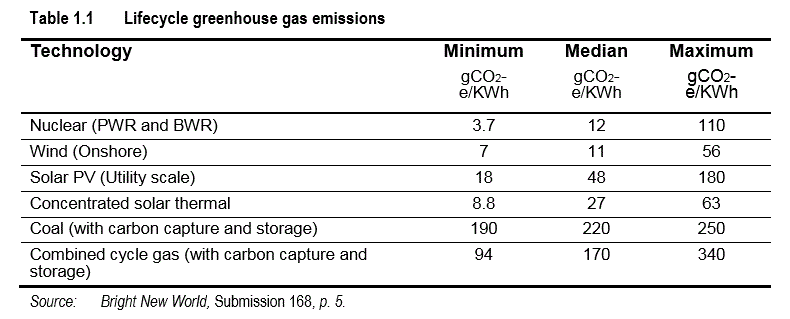
Casually looking at that you might think CO2 emissions for both nuclear energy and solar PV are pretty low. But if we stop for one minute and use basic mathematical ability that’s available to anyone who doesn’t have to take their socks off to count to 20, then we can see that a Parliamentary committee saw fit to include a table in an official report that gives ridiculous results.
Looking at their minimum figure for Solar PV (Utility scale), I see they are claiming a large solar farm will result in at least 18 grams of CO2 emissions per kilowatt-hour generated. While generating electricity from PV doesn’t result in any emissions, they are involved in the manufacture of solar panels, so they aren’t completely emissions-free. However, they are a lot bloody closer to emission free than this table suggests.
These days a typical standard sized solar panel is around 300 watts. In a solar farm in Australia on a fixed mount it will generate around 12,300 kilowatt-hours over 25 years. This means they are saying the solar panel will result in a minimum of 222 kilograms of CO2 emissions. If we use their maximum figure it will result in 2.22 tonnes of CO2, all for a panel that weighs about 18 kilograms. So they are saying manufacturing and installing one solar panel results in emissions equal to burning 80-800 or more kilograms of coal.
Jinko Solar, the world’s largest solar panel manufacturer, has a figure from 2017 of just 2.19 grams of CO2 per kilowatt-hour generated by a solar farm. As this has been decreasing year by year it will be even lower now. However, this is just for the solar panel and doesn’t include emissions from the construction of its ground mount or inverter, so I’ll double it to 4.4 grams. This means the actual emissions per kilowatt-hour are probably less than the best figure on the table and more than 40 times less than the worst figure. Even if we triple the Jinko figure it still comes to less than their median emissions for nuclear energy and less than 4% of their maximum figure for PV.
It’s clear the committee had no ability to detect figures that were bullshit — or they simply didn’t care.
Renewable Energy Increases The Cost Of Nuclear
Here is section 1.50 of the report:
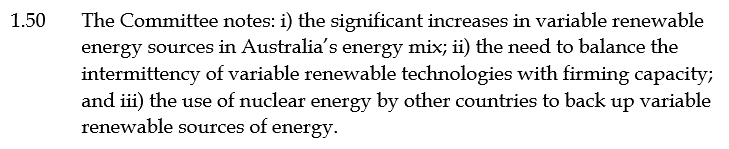
I note the committee has failed to understand the economics of nuclear power if they think it works well with solar and wind energy. This is because if a nuclear power station produces half the energy its capable of, it almost doubles the cost of that energy. This is due to nuclear fuel being very cheap1 per kilowatt-hour, so very little money is saved by ramping down, while nearly all other costs remain the same.
This means nuclear power, which is already too expensive when operated in the most economical way — almost continuously at full normal power — becomes even more expensive when used in a grid with a significant amount of solar energy and/or wind power capacity. Australia already has more than enough to adversely affect the economics of nuclear energy and, even if we approve and build a nuclear power station in one quarter the average time it has taken overseas this century, things will be much worse for its economics by the time it’s complete….. https://www.solarquotes.com.au/blog/nuclear-energy-australia/
A tiny percentage of South Australian people coerced into the decision on nuclear waste dump
This is a decision which will affect all South Australians, not just a tiny percentage of people who have experienced four years of federal government promises and pressure to acquiesce.
the Minister failed to mention the main component of the project — long lived intermediate level waste from the Lucas Heights reactor
 Farmers and Traditional Owners decry SA nuclear more
  https://www.eurekastreet.com.au/article/farmers-and-traditional-owners-decry-sa-nuclear-vote, Michele Madigan,20 November 2019
-
- On 12 November, Senator Canavan, federal Minister for Resources, took a question from the rather more junior Senator Alex Antic. The questioner wondered whether there was any recent progress on the federal nuclear facility proposed for Antic’s own state of South Australia.
Union spokespeople are under no illusion that accidents are inevitable and about who will be automatically called for the cleanup. As Jamie Newlyn, South Australian Branch Secretary of the Maritime Union of Australia, warns: ‘MUA members work in critical points of the logistics cycle and therefore the safe handling and above ground storage for decades is of great concern to the MUA … ‘
A day of high temperatures and strong winds last month did nothing to deter opponents of the federal government’s nuclear plans from the latest Port Augusta Rally. Terry Schmucker, who owns a farm in nearby Poochera, had no vote in the recent poll. He was scathing about the inability of the nuclear industry to guarantee project safety when ANSTO has been unable to prevent radioactive leaks even on site.
After the rally, Aboriginal Co-Chairs of the Australian Nuclear Free Alliance (ANFA), Dwayne Coulthard and Vicki Abdulla, led a strong contingent to present ANFA’s petition to the office of South Australia’s Minister for Energy and Mining, Dan van Holst Pellekaan: ‘South Australia has legislation that makes such waste facilities illegal: The Nuclear Waste Storage (Prohibition) Act 2000 … We ask you to act now and protect South Australia and its people from Minister Canavan’s site selection process that has caused so much distress to South Australian communities … ‘
No, Senator Canavan, South Australians don’t believe that 452 people in one small town have the right to agree to burden us with all the nation’s nuclear waste — and forever.
In fact the Barngarla Determination Aboriginal Corporation has just set another challenge. With the results of their own Australian Electoral Company internal members vote showing 83 No and zero Yes votes, the Barngala have issued a statement which reads in part: ‘BDAC has written to Minister Canavan advising him of the result. BDAC has requested that given the first people for the area unanimously have voted against the proposed facility that the Minister should immediately determine that there is not broad community support for the project. ‘
With the arrival of the voting papers for the proposed alternative Flinders Ranges site on 14 November, the intensity of the division between potential yes and no voters in the small towns and hinterlands of Hawker and Quorn seems to have hit fever pitch. The potential yes voters welcoming of a new ‘industry’ to the area seem to disregard the effect a nuclear facility will have on the major tourism industry and Adnyamathanha heritage; not to mention the threats to groundwaters in an area subject to seismic activity and floods.
This is a decision which will affect all South Australians, not just a tiny percentage of people who have experienced four years of federal government promises and pressure to acquiesce.
Australian Government report states that Lucas Heights spent nuclear fuel rods (for Kimba dump?) are High Level Wastes
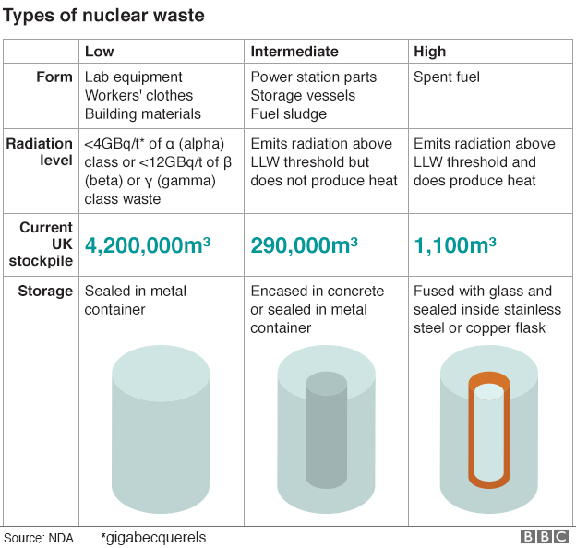
This is an extract from a government report from1993.
The report calls the nuclear fuel rods from the decommissioned Hifar reactor High Level waste.
This would be dumped in the Flinders or Kimba.
Stop the lies, stop the dump.
“The report of the Research Reactor Review examines, among many other things, the issue of the management of spent fuel rods from the HIFAR reactor, which had been accumulating at Lucas Heights since 1963. The Report says:
The spent fuel rods at Lucas Heights can only sensibly be treated as high level waste.
The pretence that spent fuel rods constitute an asset must stop’ (p. 216)
waste. … The pretence that spent fuel rods constitute an asset must stop.”
(McKinnon Review, Principal Conclusions p.xxiii, July 1993)
Can the Australian government impose a nuclear waste dump on South Australia?

Under section 109 of the Australian Constitution, if a state parliament and the federal Parliament pass conflicting laws on the same subject, then the federal law overrides the state law. Section 122 of the Constitution allows the federal Parliament to override a territory law at any time
|
Tim Bickmore Fight To Stop Nuclear Waste Dump In Flinders Ranges, 26 Oct 19, SA Despite this reference to the Federal Act over-riding State laws; however there may be constitutional grounds rendering the FA invalid ie State’s Rights are enshrined in the Constitution & there is no provision for, nor mention of radioactive waste or nuclear power.
This deficiency was recognised decades ago [1959] as described by former WMC ODM exec Richard Yeeles (also adviser to 2 State Premiers inc current one) to the NFCRC….
“… Pointing to ‘other aspects of the application of nuclear science which put beyond all doubt the national character of the health and safety problems to which they give rise,’ the Committee raised the scenario that ‘it would be possible for dangers to health to occur in one state which would affect another state,’ such as ‘the spread of radioactive materials following a disaster.’ It also instanced, with considerable foresight as subsequent events would confirm, that ‘disposal of radioactive waste is an important problem demanding strict control. Waste from one state may need to be stored in another.’ In conclusion, the Committee advised the Government and the Parliament that: In the interests of health and safety, complex uniform regulations, standards and conditions are necessary in relation to the construction of reactors, operation of reactors, processing of fuel elements, use of isotopes, transport of radioactive material and the technical, industrial and medical standards of persons engaged. To facilitate such arrangements, ‘any doubts would be removed by an express power with respect to nuclear energy’ to be provided for in the Australian Constitution. – Report of the Joint Committee on Constitutional Review, November 1959.The advice of the Joint Committee on Constitutional Review to amend the Australian Constitution to facilitate the development of a national nuclear industry was not taken up by the Menzies Government, or any subsequent federal administration.” p20 http://nuclearrc.sa.gov.au/…/Richard-Yeeles-19-05-2015.pdf https://www.facebook.com/groups/941313402573199/ |
|
Exposing misleading evidence to the federal nuclear inquiry
Big claims and corporate spin about small nuclear reactor costs, Jim Green, 19 September 2019, RenewEconomy https://reneweconomy.com.au/big-claims-and-corporate-spin-about-small-nuclear-reactor-costs-65726/
The ‘inquiry into the prerequisites for nuclear energy in Australia’ being run by Federal Parliament’s Environment and Energy Committee has finished receiving submissions and is gradually making them publicly available.
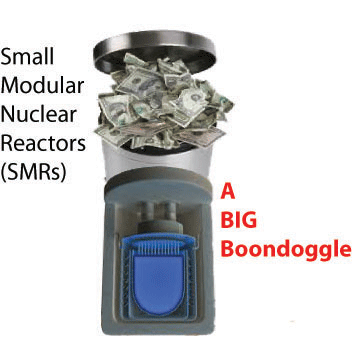 The inquiry is particularly interested in ‘small modular reactors’ (SMRs) and thus one point of interest is how enthusiasts spin the economic debate given that previous history with small reactors has shown them to be expensive; the cost of the handful of SMRs under construction is exorbitant; and both the private sector and governments around the world have been unwilling to invest the billions of dollars required to get high-risk SMR demonstration reactors built.
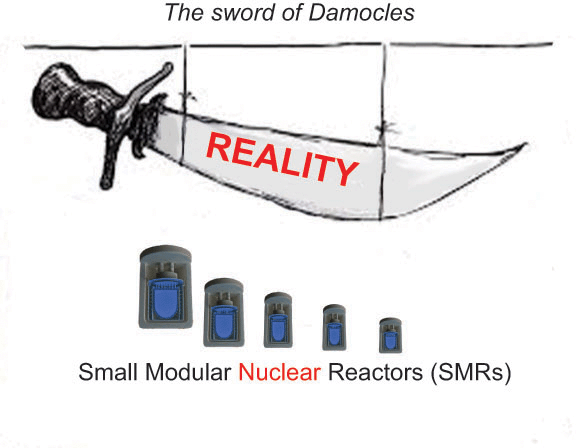 To provide a reality-check before we get to the corporate spin, a submission to the inquiry by the Institute for Energy Economics and Financial Analysis notes that SMRs have been as successful as cold fusion – i.e., not at all. The submission states:
“The construction of nuclear power plants globally has proven to be an ongoing financial disaster for private industry and governments alike, with extraordinary cost and construction time blow-outs, while being a massive waste of public monies due to the ongoing reliance on government financial subsidies. … Governments have repeatedly failed to comprehend that nuclear construction timelines and cost estimates put forward by many corporates (with vested interests) have proven disastrously flawed and wrong.”
The Institute is equally scathing about SMRs:
“For all the hype in certain quarters, commercial deployment of small modular reactors (SMRs) have to-date been as successful as hypothesized cold fusion – that is, not at all. Even assuming massive ongoing taxpayer subsidies, SMR proponents do not expect to make a commercial deployment at scale any time soon, if at all, and more likely in a decade from now if historic delays to proposed timetables are acknowledged.”
Thus the Institute adds its voice to the chorus of informed scepticism about SMRs, such as the 2017 Lloyd’s Register survey of 600 industry professionals and experts who predicted that SMRs have a “low likelihood of eventual take-up, and will have a minimal impact when they do arrive“.
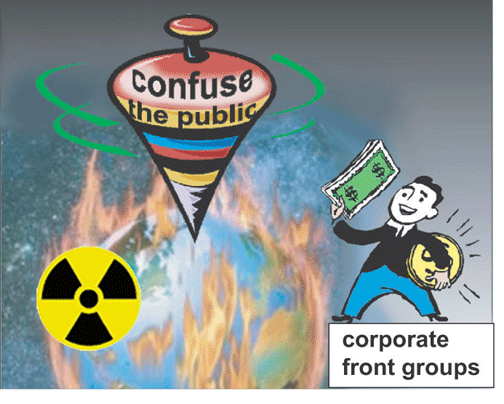 Corporate spin #1: Minerals Council of Australia
The Minerals Council of Australia claims in its submission to the federal inquiry that SMRs could generate electricity for as little as $60 per megawatt-hour (MWh). That claim is based on a report by the Economic and Finance Working Group (EFWG) of the Canadian government-industry ‘SMR Roadmap’ initiative.
The Canadian EFWG gives lots of possible SMR costs and the Minerals Council’s use of its lowest figure is nothing if not selective. The figure cited by the Minerals Council assumes near-term deployment from a standing start (with no-one offering to risk billions of dollars to build demonstration reactors), plus extraordinary learning rates in an industry notorious for its negative learning rates.
Dr. Ziggy Switkowski noted in his evidence to the federal inquiry that “nuclear power has got more expensive, rather than less expensive”. Yet the EFWG  paper takes a made-up, ridiculously-high learning rate and subjects SMR cost estimates to eight ‘cumulative doublings’ based on the learning rate. That’s creative accounting and one can only wonder why the Minerals Council would present it as a credible estimate.
Here are the first-of-a-kind SMR cost estimates from the EFWG paper, all of them far higher than the figure cited by the Minerals Council:
- 300-megawatt (MW) on-grid SMR: C$162.67 (A$179) / MWh
- 125-MW off-grid heavy industry: C$178.01 (A$196) / MWh
- 20-MW off-grid remote mining: C$344.62 (A$380) / MWh
- 3-MW off-grid remote community: C$894.05 (A$986) / MWh
The government and industry members on the Canadian EFWG are in no doubt that SMRs won’t be built without public subsidies:
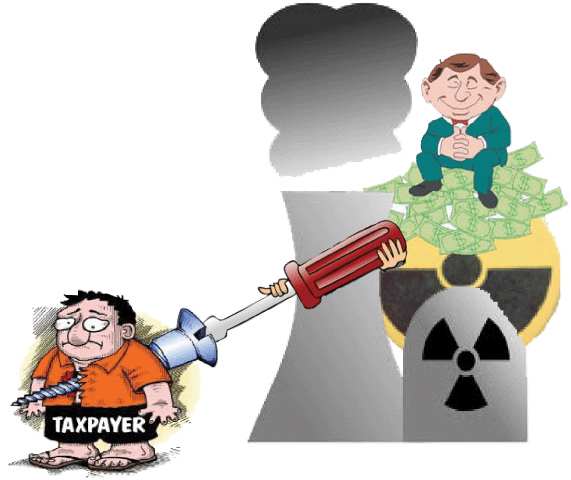 “The federal and provincial governments should, in partnership with industry, investigate ways to best risk-share through policy mechanisms to reduce the cost of capital. This is especially true for the first units deployed, which would likely have a substantially higher cost of capital than a commercially mature SMR.”
The EFWG paper used a range of estimates from the literature and vendors. It notes problems with its inputs, such as the fact that many of the vendor estimates have not been independently vetted, and “the wide variation in costs provided by expert analysts”. Thus, the EFWG qualifies its findings by noting that “actual costs could be higher or lower depending on a number of eventualities”.
Corporate spin #2: NuScale Power
US company NuScale Power has put in a submission to the federal nuclear inquiry, estimating a first-of-a-kind cost for its SMR design of US$4.35 billion / gigawatt (GW) and an nth-of-a-kind cost of US$3.6 billion / GW.
NuScale doesn’t provide a $/MWh estimate in its submission, but the company has previously said it is targeting a cost of US$65/MWh for its first SMR plant. That is 2.4 lower than the US$155/MWh (A$225/MWh) estimate based on the NuScale design in a report by WSP / Parsons Brinckerhoff prepared for the SA Nuclear Fuel Cycle Royal Commission.
 NuScale’s cost estimates should be regarded as promotional and will continue to drop – unless and until the company actually builds an SMR. The estimated cost of power from NuScale’s non-existent SMRs fell from US$98-$108/MWh in 2015 to US$65/MWh by mid-2018. The company announced with some fanfare in 2018 that it had worked out how to make its SMRs almost 20% cheaper – by making them almost 20% bigger!
Lazard estimates costs of US$112-189/MWh for electricity from large nuclear plants. NuScale’s claim that its electricity will be 2-3 times cheaper than that from large nuclear plants is implausible. And even if NuScale achieved costs of US$65/MWh, that would still be higher than Lazard’s figures for wind power (US$29-56) and utility-scale solar (US$36-46).
Likewise, NuScale’s construction construction cost estimate of US$4.35 billion / GW is implausible. The latest cost estimate for the two AP1000 reactors under construction in the US state of Georgia (the only reactors under construction in the US) is US$12.3-13.6 billion / GW. NuScale’s target is just one-third of that cost – despite the unavoidable diseconomies of scale and despite the fact that every independent assessment concludes that SMRs will be more expensive to build (per GW) than large reactors.
Further, the modular factory-line production techniques now being championed by NuScale were trialled with the AP1000 reactor project in South Carolina – a project that was abandoned in 2017 after the expenditure of at least US$9 billion.
Corporate spin #3: Australian company SMR Nuclear Technology
In support of its claim that “it is likely that SMRs will be Australia’s lowest-cost generation source”, Australian company SMR Nuclear Technology Pty Ltd cites in its submission to the federal nuclear inquiry a 2017 report by the US Energy Innovation Reform Project (EIRP).
According to SMR Nuclear Technology, the EIRP study “found that the average levelised cost of electricity (LCOE) from advanced reactors was US$60/MWh.”
However the cost figures used in the EIRP report are nothing more than the optimistic estimates of companies hoping to get ‘advanced’ reactor designs off the ground. Therefore the EIRP authors heavily qualified the report’s findings:
“There is inherent and significant uncertainty in projecting NOAK [nth-of-a-kind] costs from a group of companies that have not yet built a single commercial-scale demonstration reactor, let alone a first commercial plant. Without a commercial-scale plant as a reference, it is difficult to reliably estimate the costs of building out the manufacturing capacity needed to achieve the NOAK costs being reported; many questions still remain unanswered – what scale of investments will be needed to launch the supply chain; what type of capacity building will be needed for the supply chain, and so forth.”
SMR Nuclear Technology’s conclusions – that “it is likely that SMRs will be Australia’s lowest-cost generation source” and that low costs are “likely to make them a game-changer in Australia” – have no more credibility than the company estimates used in the EIRP paper.
SMR Nuclear Technology’s submission does not note that the EIRP inputs were merely company estimates and that the EIRP authors heavily qualified the report’s findings.
The US$60/MWh figure cited by SMR Nuclear Technology is far lower than all independent estimates for SMRs:
- The 2015/16 South Australian Nuclear Fuel Cycle Royal Commission estimated costs of A$180-184/MWh for large light-water reactors, compared to A$225 for an SMR based on the NuScale design (and a slightly lower figure for the ‘mPower’ SMR design that was abandoned in 2017 by Bechtel and Babcock & Wilcox).
- A December 2018 report by CSIRO and the Australian Energy Market Operator found that electricity from SMRs would be more than twice as expensive as that from wind or solar power with storage costs included (two hours of battery storage or six hours of pumped hydro storage).
- A report by the consultancy firm Atkins for the UK Department for Business, Energy and Industrial Strategy found that electricity from the first SMR in the UK would be 30% more expensive than that from large reactors, because of diseconomies of scale and the costs of deploying first-of-a-kind technology. Its optimistic SMR cost estimate is US$107-155 (A$157-226) / MWh.
- A 2015 report by the International Energy Agency and the OECD Nuclear Energy Agency predicted that electricity from SMRs will be 50−100% more expensive than that from large reactors, although it holds out some hope that large-volume factory production could reduce costs.
- An article by four pro-nuclear researchers from Carnegie Mellon University’s Department of Engineering and Public Policy, published in 2018 in the Proceedings of the National Academy of Science, concluded than an SMR industry would only be viable in the US if it received “several hundred billion dollars of direct and indirect subsidies” over the next several decades.
SMR Nuclear Technology’s assertion that “nuclear costs are coming down due to simpler and standardised design; factory-based manufacturing; modularisation; shorter construction time and enhanced financing techniques” is at odds with all available evidence and it is at odds with Dr. Ziggy Switkowski’s observation in a public hearing of the federal inquiry that nuclear “costs per kilowatt hour appear to grow with each new generation of technology”.
SMR Nuclear Technology claims that failing to repeal federal legislative bans against nuclear power would come at “great cost to the economy”. However the introduction of nuclear power to Australia would most likely have resulted in the extraordinary cost overruns and delays that have crippled every reactor construction project in the US and western Europe over the past decade – blowouts amounting to A$10 billion or more per reactor.
Nor would the outcome have been positive if Australia had instead pursued non-existent SMR ‘vaporware‘.
Dr Jim Green is lead author of a Nuclear Monitor report on SMRs and national nuclear campaigner with Friends of the Earth Australia.
Dr Jim Green explodes the Australian Financial Review ‘s propaganda promoting Small Modular Nuclear Reactorsll
|
|
|
How the Mirrar Aboriginal people, helped by environmentalists stopped uranium mining at Jabiluka

Leave it in the ground: stopping the Jabiluka mine, Red Flag Fleur Taylor, 15 July 2019 “…… The election of John Howard in March 1996 marked the end of 13 years of ALP government…..
The reason Australia doesn’t have nuclear power: the workers fought back
The movement’s real strength always depended on its grassroots – on the willingness of activists to defy the rightwingers in Labor and the unions, even to the extent of facing arrest.
The reason Australia doesn’t have nuclear power: the workers fought back https://www.theguardian.com/environment/commentisfree/2019/jun/24/the-reason-australia-doesnt-have-nuclear-power-the-workers-fought-back Jeff Sparrow Workers have been fighting uranium mining for decades – the environment needs mass civil disobedience @Jeff_Sparrow 24 Jun 2019
What do Clive Palmer, Tony Abbott, Cory Bernardi, Barnaby Joyce, Mark Latham, Jim Molan, Craig Kelly, Eric Abetz and David Leyonhjelm have in common?
No doubt many answers will come to to mind. But whatever else unites them, they all support nuclear power.
Jim Green from Friends of the Earth Australia, which compiled the above list, says that nuclear energy now functions more as a culture war troll than a serious policy, not least because the people who want atomic solution to climate change are usually the same people (as the group above illustrates) who don’t believe climate change requires a solution at all.
Despite the best efforts of Queensland conservatives, Australia will not go nuclear. The former chair of Uranium King, Warwick Grigor, says flatly: “No one is going down that path in the foreseeable future.” Even industry boosters see nuclear power stations as feasible only if the government introduces, um, a carbon tax, a proposal to which the culture warriors would react like vampires to garlic.
Nevertheless, progressives should discuss nuclear energy and climate change, if only because the campaign we need against coal can learn from the historic struggle against a different mineral. Continue reading
Corruption in the Australian uranium industry
Radioactive Corruption Video 1
Gal Vanise, · PREPARE TO BE ABSOLUTELY SHOCKED ………………….Pilot Plant near Roxby 1996 . This was an elaborate Government and corporate cover up under the Lib Government of the day. If you think the mining companies are doing ALL THE RIGHT THINGS…They are not. You only need to ask anyone who works in a mine how things don’t get reported..Out of sight out of mind.
This site was later ‘repatriated’ but no one can say where the contaminated waste was taken to other than ALLEGEDLY by the truckloads carried on trucks from Roxby Downs to Port Adelaide ….through townships and urban residential areas.. I fully expect I will get in trouble for this even though I haven’t committed any free speech crimes. SHARE TO AS MANY PEOPLE AS POSSIBLE.. NOW I ASK YOU THIS!.. WILL THIS NEW LIB GOV DO THE RIGHT THING IN REGARD TO THE PROPOSED RADIOACTIVE WASTE DUMP IRREGARDLESS OF WHERE IN SA THEY PLACE IT?.. NOT IF THESE VIDEOS ARE ANY INDICATION. THIS IS DYNAMITE… AND I WILL NEED A BLOODY GOOD LAWYER ONCE ITS OUT.
Radioactive Corruption Vid 2
-
Peter Jack I worked at Roxby Downs in 1986. I got to go underground. Back then there was about 60 kilometres of roads down there. As we drove around we were shown these massive caverns some were filled with water possibly direct access to the great artesian basin and others with floor to ceiling blue plastic barrels full of yellow cake.
I assume they were all transported through residential areas.
-
Brett Burnard Stokes These unsealed radioactive sources are highly dangerous and illegal. The dust is the big issue, along with radon gas which is heavy and collects in cellars etc, What are the longer term health impacts, you might ask. Radon and uranium dust can cause lung cancer and other issues.
These and other radioactive poisons cause genetic damage and more. -
Trevor Vivian Outta sight, outta mind is the MO of all mining the world over and in Australia the state & Federal govt’s refuse to support whistleblowers. At Mt Todd (NT) photo evidence of unbunded drill pads with waste polluting local creeks caused A Senate review(early 90’s) which shut down this disasterous destruction of Jaywon Sacred sites. The hostility from Mine managers toward bird survey whistleblowers meant never working in Australian mining ever. To me it is a badge of honour to reveal these lying thieving Global Corporate miners outta sight, outta mind operations.
- Gal Vanise HERE IS A QUOTE FOR THE DISBELIEVERS.. I WONT REVEAL THE WHO’s OR IDENTIFY THE PARKERS IN THE SIN BIN. I GAVE MY WORD…………………………”I was XXXXXXXXXXXX I know where it is. 198X. I was told to never tell anyone. It’s worried me ever since We dumped the unprocessed concentrate into the main tailings dam. It’s was blowing all over the place as the nylon bags had broken. Took two nights. Myself xxxxxxxxxxxxxxxboss who oversaw the job.
A couple of days later one of those 7:30 type shows questioned the ……….. mining on tv. He denied any waste dumped.
xxxxxxxxxx only had about xxxxxxx working for xxxxxxxxx. But after we did that job he got all the contracts.
Really shonky. Ive never heard what happened toxxxxxxxxxxxxx but one of the older xxxxxxxxx mining blokes had to take samples from the bags.
Mr.xxxxxxxx went off at him because his radiation tag came back high.
He accused him of putting it in the concentrate. I never wore mine. xxxx was also a lazy buggar.
At the same time they had a ball mill break down.
It was going to take forever to screen the steel balls from the mill. xxxxxxxx got us to dump this as well.
We pushed the whole lot into the water and by day light it was covered.
We then went back and covered the pilot plant with fresh crusher dust.
and finished just before the inspector arrived.” MY ONLY HINT TO THIS IS… WHO WAS A PROMINENT COMPANY THEN AND ISNT ANYMORE? THANK YOU ELEMENTARY FOR YOUR STORY… I HOPE YOU CAN BREATHE NOW YOU GOT IT https://www.facebook.com/danlee67/posts/587530574936680
News Corp – a propaganda machine for the mining industries

Veneer of ‘impartiality’ no longer needed
When it was founded in 1923, News Limited concealed its mining company connections at the same time it promised the public that its news would be “independent” and “impartial”.
Lip service or not, notions of balance and the public interest were important then. This was because News Limited’s founders knew that respect was an important precondition for influence, and that newspapers had to be responsive to the communities they served in order to attract a wide audience and prosper.
News Corp’s recent behaviour suggests it now sees such notions as quaint.
From attacking the decision of the jury in the sexual assault trial of Cardinal George Pell to last week’s Daily Telegraph attack on Bill Shorten using his deceased mother as ammunition, there are mounting signs of panic and folly at one of Australia’s largest media companies.
If the next generation of Murdochs starts looking to sell unprofitable assets, the Australian newspapers have reason to be concerned. Because they are no longer financially valuable to the newly slimmed down company, the Australian papers seem to be trying to prove their worth by being politically useful while they still can.
A Maralinga nuclear veteran’s grim story
 Maralinga nuclear bomb test survivor reveals truth of what happened in the SA desert https://www.adelaidenow.com.au/messenger/east-hills/maralinga-nuclear-bomb-test-survivor-reveals-truth-of-what-happened-in-the-sa-desert/news-story/697b17f6d3427a78aa0262b09727c169, 24 Apr 19
The nuclear bomb tests, under British Government control, at Maralinga in far west South Australia in the 1950s were conducted at the highest level of secrecy. But they had thousands of witnesses. Most were Australian servicemen, innocently used as guinea pigs and exposed to deadly radiation. Craig Cook talks to a survivor, one of the last of a group of men who built the Maralinga camp as part of 23 Construction Squadron and watched in awe as the bombs were exploded, little knowing they were risking their lives and the futures of their children.
Tony Spruzen knew the drill at the top secret Maralinga facility in the South Australian desert in the spring of 1956.
Just like hundreds of others at the nuclear site at 11-mile camp during Operation Buffalo, he was told to turn his back and cover his eyes to protect himself from the gigantic glare of the exploding atomic bomb.
What they didn’t tell the Australian Army sapper was, at the moment of the flash of detonation, he would see the bones of his hand through his tightly shut eyelids.
“It was like a massive x-ray,” Tony, 83, from Glengowrie says. ‘Unlike anything I’d ever known before.”
A week after One Tree, on October 6, 1956, Spruzen witnessed the detonation of Buffalo 2, named Marcoo.
The bomb was only a tenth the size of One Tree but this time was detonated directly above and just under the ground.
“The bomb was in an amphitheatre of hills and we were far closer to that one, maybe only 200 yards away,” he remembers.
“We were close enough to see the trenches with dummy soldiers in them holding rifles and fake aeroplanes and tanks used to test the blast effect.
“And we could see the scientists walking around in their white suits checking out the site before and afterwards but we were just in khaki shorts and short sleeved shorts. Even the dignitaries had no protection.”
Every hour, from five hours out, an elaborate PA system across the complex announced the timing of the bomb detonation.
In the final 30 seconds, and with a rising and excited inclination, the voice on the PA dramatically counted….ten, nine, eight…down to zero.
When Marcoo exploded at 7am it only took a few seconds for a heavy shower of dust to descend on the witnesses.
“We had this large piece of litmus paper attached to our shirts,” Spruzen recalls
Spruzen, originally from Victoria and a carpenter by trade, enlisted in the Army at just 16.
Four year later he was at Maralinga as part of a detachment of 23 Construction Squadron, an acclaimed unit of the Royal Australian Engineers and exclusively raised in South Australia.
Around 40 young men were selected from the unit to build a desert tent camp with cook houses and latrines for the Commonwealth military ‘high-ups’ who were having their first look at the impact of the devastating nuclear weapon.
Around 200km from the ocean, the tent city gained the facetious name of the ‘Sea View Holiday Camp’.
“It was an adventure…we were all excited,” he recalls.
“A lot of young single guys together and we had some fun.”
The lads knew it was serious too as this was a hush-hush operation. They weren’t even allowed to take a camera along for snapshots so Spruzen has no personal photos from Maralinga.
“Then we all turned around to see this mushroom cloud climbing into the sky. The next thing was the blast. The boom was deafening…and then the wind came about thirty seconds after that blowing dust and soil and debris all over us.”
But he does have a terrible reminder of his three months spent in far western South Australia.
“Of the 40 men who went up with me I only know of three of us still around,” he says. “The rest have all died – many from cancers.”
The first Maralinga bomb, Buffalo 1, with the nickname One Tree, was detonated after being dropped from a 31m high tower.
At 15 kiloton it was the same size as Little Boy, the bomb dropped by the US air force that demolished the Japanese city of Hiroshima in August 1945, killing more than 100,000 instantly and tens of thousands slowly in the aftermath from burns and radiation poisoning.
“They said, keep an eye on that and if it changes to pink come and see us. Well it turned pink for every one of us.
“Had I have known what I know now I wouldn’t have been so close.”
Transferred to Sydney on a training course, Spruzen missed the final two detonations at Maralinga that year: on October 11, 1956, Buffalo 3 (Kite) was released by a Royal Air Force Vickers Valiant bomber, the first drop of a British nuclear weapon from an aircraft; and then on October 22, and again dropped from the 31m tower, (Buffalo 4) Breakaway exploded.
There were a total of seven nuclear desert tests at Maralinga performed during Operations Buffalo and Antler.
The 1985 McClelland Royal Commission heavily criticised the detonations, declaring the weather conditions were inappropriate and led to the widespread scattering of radioactive material.
The radioactive cloud from Buffalo 1 reached more than 11,000m into the air and with a northerly wind blowing radioactivity was detected across Adelaide.
Radioactive dust clouds from other bombs were detected in Northern Territory, Queensland and across New South Wales, as far away as Sydney, 2500km from Maralinga.
Around 12,000 Australian servicemen served at British nuclear test sites in the southern hemisphere between 1952 and 1963.
In recent years, the British Government’s claim that they never used humans “for guinea pig-type experiments” in nuclear weapons trials in Australia has been revealed to be a lie.
Tony Spruzen has struggled to come to terms with being placed in danger by his own government who had full knowledge of the consequences of exposure to radiation.
“Once we all found out later what we’d been exposed to at Maralinga it makes you very angry,” he says.
“We believed them when we were told we would be safe — but we haven’t been.”
Spruzen met his wife Shirley, the daughter of an army veteran, in Adelaide where they settled after marriage in June 1960. He left the army seven months later to work in civil construction. He thought his Maralinga days were well behind him but soon after they came to haunt him.
In the first four years of marriage, the couple agonisingly suffered six miscarriages, including twins.
Alarm bells started ringing when he was sent a survey from Veterans Affairs asking about his general health and, specifically his history of cancers.
“It turned out those involved in the atomic tests had a 30 per cent higher chance than getting cancers than the general public,” he says.
“Most of those got them within the first five years and a majority of those were dead before a decade had passed.”
Spruzen, who eventually had three children with Shirley, didn’t get cancer at that time, although he has since had several melanomas removed.
But when his son was diagnosed with acute myeloid leukaemia at the age of 41, he wondered about the possibility of faulty genes, damaged by exposure to radiation, as has been documented in Japanese survivors of the atomic bombs, jumping a generation.
“My son was told by the QEH (Queen Elizabeth Hospital) there was nothing could be done for him but we went up to Queensland and after a bone marrow transfer from his sister he survived,” he adds.
“A decade on he’s working as strong as he has but I don’t think his condition was a coincidence given my history.
“There’s been nothing (compensation) for those of us who were there although they gave us a white card for our cancers and now we have a (full health) gold card.”
Ken Daly, President Royal Australian Engineers Association says it is the least the men, who literally put their bodies on the line, deserve.
“You get these young men, aged around 25-30, with a history of exposure to radiation, coming down with cancers in those numbers and you just know what has caused it,” he says.
“Many died within a few years of being exposed to the fallout and many passed on generational health problems and birth defects to their children.”
Mr Daly, who was based at Warradale Barracks for 15 years, where 23 Construction was based until being disbanded in the early 1960s, hadn’t heard of the Squadron until around five years ago.
Since then he has been central to the group gaining due recognition.
In its earliest days the Squadron, with a strength of eight officers and 160 in other ranks, built the El Alamein Army Reserve camp, part of which later became the Baxter Detention Centre, outside of Port Augusta.
It also assisted the South Australian community by providing aid during bush fires, the grasshopper plague of 1955, and significant infrastructure construction.
During the record flood of 1956, while those squad members were at Maralinga, the rest of 23 Construction were out sandbagging River Murray towns and then cleaning up after the water receded.
In 2011, the Royal Australian Engineers constructed a memorial at Warradale to all who have served in its ranks.
This year a bronzed engineer’s slouch hat, of actual size, by Western Australian sculptor and former army engineer Ron Gomboc will be incorporated into the memorial.
“The hat will be mounted on the memorial in such a way it will look like it’s suspended in mid-air,” Daly adds.
“It acknowledges the ultimate sacrifice of the more than 1250 engineers who died in World War I and the remarkable service and sacrifice of 23 Construction Squadron that has never been recognised before.”
The slouch hat, costing $6,000 and one of only six to have been cast, will be unveiled during a service at Warradale Barracks at midday on Sunday April 28.
Contact Ken Daly at dailydouble@bigpond.com for further details.
The Court Of Public Opinion And The Blood-Curdling Untold Story – on Julian Assange
This prospect prompted the UN Working Group on Arbitrary Detention and 33 EU parliamentarians to issue strongly worded statements to both the UK and Ecuadorian governments in December last year, warning against facilitating the prosecution of a journalist, editor and publisher for “publishing the truth”. The statements demanded Assange’s “immediate release, together with his safe passage to a safe country”, and reminded the UK of its “binding” legal obligations to secure freedom for Assange.
A critical task for propagandists such as those waging a psychological war on Wilkileaks, then, is to feed audiences material that supports official narratives and exclude that which does not. Since its inception, the smear campaign against Julian Assange and Wikileaks has been remarkably concerted and consistent in that regard.
With the new year, however, news broke that the International Monetary Fund (IMF) had offered Ecuador a $10 billion bailout in return for handing Julian Assange over to the United States. This bounty came on top of earlier US pressures and inducements, reportedly including increased oil exports, military co-operation and another $1.1 billion in IMF loans, with the US representative of the IMF instructing Ecuador that it must “resolve” its relationship with Julian Assange in order to receive the IMF money.
Australian Barrister Greg Barns has called it the blackmailing of a nation. News website 21st Century Wirecalled it “one of the biggest international bribery (or extortion) cases in history.”
While there is “not a single shred of evidence that any of [Wikileaks’] disclosures caused anyone harm”, writes journalist and author Nozomi Hayase, what Wikileaks did do in 2010 was expose thousands of previously unreported civilian deaths in Iraq and Afghanistan. These deaths included the nonchalant gunning down of children, journalists and their rescuers, and other “indiscriminate violence… torture, lies [and]bribery”, writes Chris Hedges. According to Pentagon Papers whistleblower Daniel Elsberg, the leaks exposed “a massive cover-up over a number of years by the American authorities”.
Julian in ‘critical danger’, new rules ‘torture’ – Assange mother *AUDIO*
The Psychology Of Getting Julian Assange, Part 2: The Court Of Public Opinion And The Blood-Curdling Untold Story, New Matilda, By Dr Lissa Johnson February 25, 2019 In her ongoing special investigation into the detention of Julian Assange, Dr Lissa Johnson turns to the art of smear, and how to corrupt a judicial system.
On Friday 14th February, the Editor in Chief of news website Consortium News, Joe Lauria, visited Sydney to host a ‘Politics in the Pub’ event: Whistleblowing, Wikileaks and the Future of Democracy. The event took place in anticipation of upcoming rallies to free Assange…….
. It is imperative that we pressure the Australian government to make sure its citizen, Julian Assange, is protected from the lawlessness of the American Empire.” Continue reading
Australia and Britain’s shameful history of Nuclear Bombing of First Nations Lands
Living with the legacy of British Nuclear testing: Bobby Brown
Maralinga No More: The British Nuclear Bombing of First Nations Lands https://www.sydneycriminallawyers.com.au/blog/maralinga-no-more-the-british-nuclear-bombing-of-first-nations-lands/?fbclid=IwAR0UIC6VK_x6i8NAStEyZHZXK-Sld-IH4HFyE9gy-Zngp4RzaLtVeiWV7tM, By 31/03/2019
As former Australian Conservation Foundation anti-nuclear campaigner David Noonan put it in 2005, “Australia is the only society to have ever provided its own uranium to an overseas nuclear weapons state to make nuclear weapons to then bomb back on their own land.”
And it was Scott Morrison’s pin-up boy, former prime minister Robert Menzies, who in 1950 said yes to the British government carrying out secret nuclear weapons tests without initially consulting cabinet, whilst making assurances that no negative radioactive impact would occur.
Around 800 kilometres northeast of Adelaide, Maralinga was chosen as the main nuclear testing site, as the government found that the Maralinga Tjarutja people – who’d been living there since time immemorial – weren’t actually using the land.
The local Indigenous peoples were never consulted about the testing. Many were forcibly removed from their lands and taken to Yalata mission in SA, which effectively served as a prison camp. Some remained in the vicinity of the test site. Signs written in English were erected warning them to leave.
Indeed, on 27 September 1956, when the first nuclear device, One Tree, was detonated at Maralinga, First Nations peoples had no rights under Commonwealth Law. The vote didn’t come until 1962, while citizenship rights weren’t granted until the 1967 Referendum.
A toxic legacy
The Menzies Liberal government passed the Defence (Special Undertakings) Act 1952, which effectively allowed the British to access remotes parts of Australia to test atomic weapons. The general public for the most part had no awareness or understanding of what would take place.
British and Australian servicemen built a test site, airstrip and township at Maralinga known as Section 400. Australian troops signed documents under Australian secrecy laws that required them never to divulge any operational information, with the threat of harsh prison sentences.
Between September 1956 and October 1957, the British set off seven above ground nuclear bombs ranging from 1 to 27 kilotons. The first four were part of Operation Buffalo, while the last three made up Operation Antler.
Following these tests, the British continued to carry out around 600 minor nuclear warhead tests up until 1963. And it was these that caused the greatest contamination. The most dire being the Vixen B tests that led to massive contamination of plutonium, which has a half-life of over 24,000 years.
The impact upon First Nations
Around 1,200 Aboriginal people were exposed to the radioactive fallout of the tests. This could lead to blindness, skin rashes and fever. It caused the early deaths of entire families. And long-term illnesses such as cancer and lung disease became prevalent amongst these communities.
As for those who were moved away from their homelands, their way of life was destroyed. The Maralinga Tjarutja Land Rights Act was passed by the SA parliament in 1984, which ensured the damaged land was handed back freehold to traditional owners, as soon as it became “safe” again.
The Maralinga Tjarutja people, as well as other First Nations peoples, gradually returned to their homelands. Australia and reluctant British governments carried out initially terribly shonky clean-ups, that got progressively better, of the Maralinga site in 1967, 2000 and 2009.
And the British government eventually paid affected Aboriginal peoples $13.5 million in compensation for the loss and contamination of their lands in 1995.
Prior to Maralinga
The late Yankunytjatjara elder Yami Lester was just a boy living at Walatinna in the South Australian outback, when at 7 am on 15 October 1953, the British detonated a nuclear bomb at a test site at Emu Fields, northeast of Maralinga.
Mr Lester watched as a long, black cloud of smoke stretched out from the bomb site towards his homelands. In the wake of two tests carried out at Emu Fields within 12 days of each other, Yemi permanently lost his site, sudden deaths occurred, and his people suffered long-term illnesses.
The Emu Fields blasts were not the first on Australian soils. The initial nuclear bomb blast was carried out on the Monte Bello Islands in October 1952, while two more blasts took place in this Indian Ocean region in 1956.
And just like the Maralinga and Emu Fields blasts, the radioactive waste from these islands travelled across the entire continent. Two hotspots of excessive radioactive fallout resulting from the Emu Fields blasts were the NSW towns of Lismore and Dubbo.
Adding insult to injury
In 1989, the federal government announced it was establishing a nuclear waste dump near Coober Pedy in SA on the lands the Kupa Piti Kungka Tjuta, a senior women’s council representing the local peoples, many of whom had directly suffered the impacts of British nuclear testing.
As opposition to the dump grew, the government used the provisions of the Land Acquisition Act 1989 to seize the land, where it proposed to store the waste that was being produced at Sydney’s Lucas Heights reactor.
n July 2004, after a six year long battle the Kungka Tjuta senior women brought a stop the nuclear waste repository being situated on their land. And the federal government then turned to the NT’s Muckaty Station to dump the NSW waste. However, after that fell through, it’s still looking for a site.
The global threat continues
Maralinga took place at the height of the Cold War, after the US government refused to continue its nuclear program with British participation. And following World War Two, the crumbling empire sought to develop its own nuclear capacities in its faraway colonial backyard.
But, while many believe the threat of nuclear war faded with the end of the Cold War, renowned political analyst Noam Chomsky still warns that the two major threats in the world today are climate change and nuclear war.
Chomsky has pointed to a March 2007 article published in the Bulletin of the Atomic Sciences that revealed the “extremely dangerous” threat the Trump administration’s nuclear forces modernisation program is creating.
And as of January this year, the Doomsday Clock – which measures the likelihood of human-made global catastrophe – is still set at two minutes to midnight, as it first was 12 months prior. Based on the two threats identified by Chomsky, this setting is the closest to midnight it’s been since 1953.
The truth about Lucas Heights and the supposed medical need for the nuclear reactor
Kazzi Jai shared a link. 18 Feb 19, Fight To Stop Nuclear Waste In The Flinders Ranges
 X-rays and CAT scanners (which use x-rays) in hospitals do not use radioactive sources. The films
 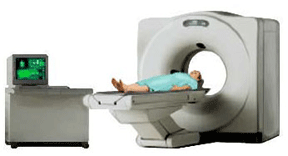 from X-rays are very valuable due to their silver content, and can be recycled if they are no longer required. There are now hospitals which are using phosphor flat plate detectors on their X-ray machines, so that a digital image is obtained and kept on hospital computer files instead of generating a film.
The disposable items such as gloves, gowns, sheets etc used in hospitals for loved ones using nuclear medicine are withheld for a period of 10 or more days, then deemed, according to safety regulations, to be safe to be discarded in normal waste.
Of the isotopes which ANSTO – Lucas Heights reactor produces, only 28% are actually used in Australian Hospitals. The rest – 72% – are sent overseas. Which is interesting as the majority of Lucas Heights reactor use is for nuclear medical isotope production!
And of that 28% which is quoted as used in Australian hospitals, the majority of those isotopes are used for nuclear medical imaging – the rest is for treatment. So in fact actual nuclear medical treatment using isotopes is very small.
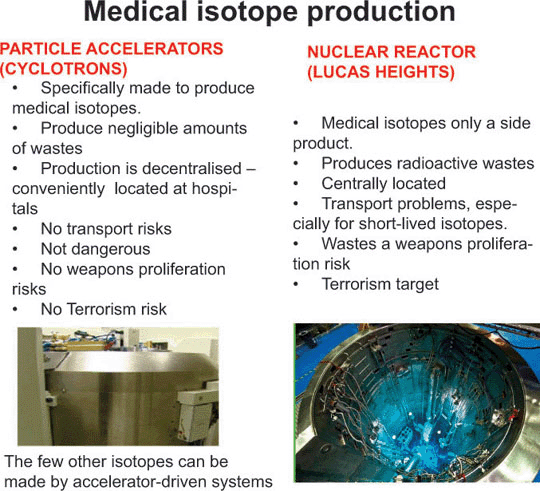 Also noteworthy is that now cyclotron/imaging partnership locations are found in all of the capital cities in Australia including Darwin – only Hobart does not. This means there will be less reliance on the isotope production from Lucas Heights, as cyclotrons allow generation of isotopes for imaging on site, and do not utilize radioactive sources such as a nuclear reactor to generate them! In other words they do not produce nuclear waste!
In Adelaide you will find the cyclotron and an imaging partnership in the SAHMRI building.
And ANSTO is heavily involved in the cyclotron sector as well. They have a cyclotron in Sydney and a similar piece of equipment called a synchrotron in Melbourne. But you rarely hear about those in South Australia……..
The solution to the waste generated at Lucas Heights – and they have the majority of the nuclear waste generated in Australia by the way, because they generate it there – is to keep it at Lucas Heights!
They claim it is safe there – then keep it there, until they have found a way to properly deal with the Intermediate Level Nuclear Waste, and the Low Level Nuclear Waste can follow that!
Double handling of Intermediate Level Nuclear Waste is NOT World’s Best Practice! Neither is transporting nuclear waste 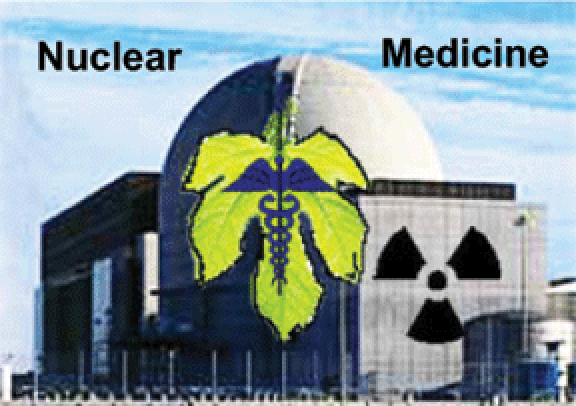 over 1500+kms away from where it is generated!
And Lucas Heights has plenty of space to deal with its waste – and we have been told by DIIS and ARPANSA that should a suitable site not be found, that production of isotopes would not be affected nor Lucas Heights licensing and regulations be affected, and they would simply build more buildings to accomodate it.
Oh….and here is a link on how X-rays in hospitals (both used in X-ray machines and CAT scanners) are generated, if you are interested – https://en.wikipedia.org/wiki/X-ray_tube?fbclid=IwAR1u7fjU4_VazLAkx48teUiEHXccLTZZFKB99C_029yGUXWu18wkbmXaxow
1 This month

of the week – Australians for War Powers Reform (AWPR)
To see nuclear-related stories in greater depth and intensity
 Antinuclear