Your money, their rules. Super funds support Israel war machine
by Andrew Gardiner | Mar 24, 2026, https://michaelwest.com.au/your-money-their-rules-super-funds-support-israel-war-machine/
Australian industry super funds are investing in companies involved in the Gaza genocide, and unions are not demanding they stop. Andrew Gardiner reports.
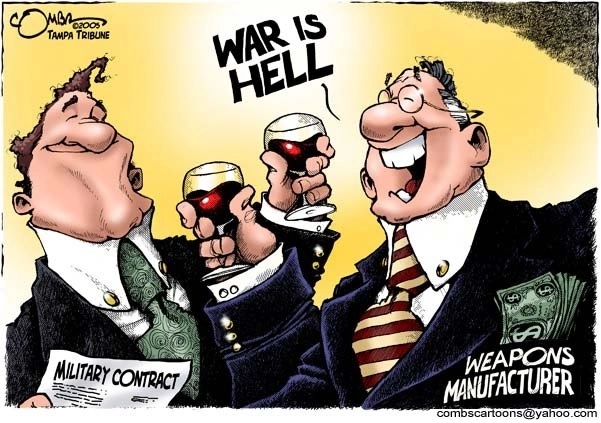
Protected by rules putting a member’s “best financial interests” over ethical, environmental or social considerations, the vast majority of Australia’s industry superfunds are all-systems-go on pouring money into projects connected to the decimation of Gaza, dispossession in the West Bank, and bombing Israel’s neighbours.
An MWM investigation has confirmed that just two of Australia’s 20 industry super funds are making modest changes to their investment portfolios. The other 18 remain invested in Israel’s war machine, with Australian Super alone funding corporations like Elbit Systems (drones), ICL Group (white phosphorus) and Palantir (AI/software for weapons systems).
This, even as the IDF is again using the banned white phosphorus in Lebanon, in which Australian super is invested.
The two funds which did divest – Vision Super and HESTA – still have some money tied up in Israeli projects in Gaza and the West Bank. “HESTA and Vision divested from Israeli banks (but) they still have money in companies listed on a UN database as operating from Israel’s illegal settlements”, Molly Coburn from the Australia Palestine Advocacy Network (APAN) told MWM.
Activist Jill Sparrow says even those modest changes could be quietly reversed “as soon as we look away”. “Divestment isn’t set and forget (and)
“there’s a lot of money to be made in dropping bombs,”
“so super funds could be sorely tempted”, she said.
If you’re in a union-partner industry super fund and have a problem with genocide, chances are you’re out of luck on the socially-conscious investments front. Unions routinely route members’ super into partner funds with little regard to the social or environmental impact when it’s invested.
Ethics ignored
Under 2005 rule changes, union members can transfer their super to retail super funds, Australian Ethical and Future Group, which shun companies whose work enables the carnage in Gaza. These funds show it can be done, so why have industry super funds not done it?
Instead, unions aligned with the Labor Party, under pressure from Zionist lobbyists, are content to send members’ money to super funds that aid the Israeli war effort, funding what the UN calls “a moral stain on us all”.
Like so many other ACTU affiliates, the United Workers Union (UWU), with 151,000 members, talks a good game on Israel’s actions in Gaza, but hasn’t put its members’ super where its mouth is. MWM’s efforts to ascertain how much the union had done to lobby its super funds – HostPlus, Australian Super and HESTA – yielded nothing.
What we learned from UWU members is that in early 2024, a rank-and-file motion including divestment was passed at the council level in various states before being “soft-blocked” by union officials, who reportedly sat on it. Later that year, a more formal “Boycott, Divestment and Sanctions” (BDS) motion, requiring real action compelling divestment by the super funds, was defeated.
“Social issues are bread and butter issues, and funding war is a dead end. Our leadership – who are on the boards of HESTA and Australian Super – (need) to stop hiding behind ‘fiduciary duties’ to fund death and destruction”, UWU delegate (early childhood education) Nicki Toupin told MWM.
Fidiciary duties
Fiduciary duty doesn’t just provide cover for unions putting the bottom line first. “In the interests of members”, it’s cited time and again by super funds whenever there’s pressure to divest.
Buttressing their argument is case law precedent, which will raise the hackles of Australian republicans: Cowan v Scargill, a UK decision dating back to the Thatcher years (1985), helped redefine a member’s “best interests” as “best financial interests” (emphasis added). 2021 changes to fiduciary duty here in Australia reflect that new emphasis.
How do you define “best financial interests”? Wouldn’t a stable Middle East be good for the world’s economy, providing investment opportunities for our super funds that don’t involve genocide?
“Egregious war crimes, crimes against humanity and devastating environmental impacts mean you can argue that the financial interests of super fund members are undermined by investments that support the Israeli military”, Claire Parfitt, Senior Lecturer in Political Economy at Sydney University, told MWM.
It seems our super funds, and their investment managers, are ignoring these arguments in the quest for a quick return, their investment in the Israeli war machine rendering Middle East instability something of a self-fulfilling prophecy.
There are, of course, equal and opposite rules against super funds investing in projects “maintaining the situation created by Israel’s illegal presence in the occupied Palestinian territory”. But some rules, it seems, are more equal than others; successive Australian governments barely lift a finger to enforce international court rulings, human rights obligations and social considerations (ESG), which might trouble the bottom line.
To quote a famous movie line, “a foul is not a foul unless the ref blows his whistle”. The failure to enforce international and ethical obligations means super funds can go on hiding behind “fiduciary duty”; at least 18 of our 20 industry funds are doing just that.
The “fiduciary duty” chestnut, and “soft blocking” tactics by union officials aligned with an ALP which quietly supports the Gaza carnage, have rendered meaningful “change from within” on divestment all but impossible. So groups like ASU for Palestine and UWU 4 Palestine are taking matters into their own hands.
Following a 1000-strong “community picket” of the Israeli-owned ZIM Ganges cargo ship at Port Melbourne, ASU for Palestine started looking at divestment as a way to hit Israel where it hurts. After ASU secretary (now Senator) Lisa Darmanin, then a board member at Vision Super, inevitably advised ASU for Palestine of its “fiduciary and statutory obligations” (adding it wasn’t legal for her to “act as (a) representative” of ASU members on divestment) it became clear something more compelling was called for.
What did ASU for Palestine do? It began a campaign to raise awareness on divestment, suggesting ASU members “switch their super fund” elsewhere, while lobbying to change the default super fund in enterprise agreements to none other than Australian Ethical.
It’s amazing how the threat of losing thousands of ASU members (and untold millions) can motivate a super fund to abandon “fiduciary” rhetoric and do the right thing. A couple of months later, amid much fanfare at the ASU conference, Vision Super announced its limited divestment, full details of which are expected by the end of this month.
These kinds of ‘direct action’ appear to actually work, although (per APAN) the extent of Vision’s divestment was limited. “If it’s not good enough, we’ll just have to go again”, Sparrow told MWM.
For their part, UWU 4 Palestine sees divestment as a major social cause that it and Members First, a grassroots change ticket at upcoming union elections, can get their teeth into. “Building a rank and file, fighting union that isn’t remote from members gives us the power to push for the kind of world we want, not just on workplace issues but in investing our money in something other than genocide”, Toupin told MWM, adding
That’s right. Direct Action works.
The high costs of Albo’s rubber-stamp war in the Middle-East
by Stuart McCarthy | Mar 19, 2026, https://michaelwest.com.au/costs-of-albos-rubber-stamp-war-in-the-middle-east/
While the “Iran war” is fuelling Israel’s desire for Middle East chaos, Australia finds itself in strategic quagmire of confused priorities and escalating energy costs. Stuart McCarthy reports.
According to the 2023 Defence Strategic Review, Australia is confronting the “worst strategic circumstances since WWII.” A need to “pivot” from pointless “forever wars” in the Middle East towards the Indo-Pacific and counter a rapid build-up of Chinese military power evidently warrants an overhaul of our “not fit for purpose” defence force, expenditure of up to $368B on AUKUS submarines and a plan to enter the “missile age.”
No mention is made in that “strategic” document of this country’s most serious vulnerability. Namely, our systemic exposure to exactly the kind of global oil shocks triggered by the latest Middle East military fiasco.
Our lack of preparedness for these shocks is the result of at least two decades of inexcusable incompetence across the political spectrum.
The reality we face is that Australia has been caught with its pants down during a seismic but foreseeable shift in the global geopolitical landscape. The fallout from the current Middle East war will hit us hard, and we are not prepared.
Even if the Strait of Hormuz – the vital artery for 20% of global oil supplies – is miraculously reopened to merchant shipping within the next few weeks, an economic recession is already a safe bet. The 1979 oil shock saw a severe recession across industrialised countries. Australia saw a double-dip recession, and unemployment rose to more than 10%.
Oil dependency
Australia produces less oil now than it did in 1979, but demand has doubled over the same period, in line with economic growth. We are now 90% dependent on imported petroleum fuel.
The 20 years needed to transform our road transport fleet have been squandered, and we are at the tail end of a jet fuel-dependent global air transport system. The demand-led Covid recession saw a 7% decline in domestic petroleum fuel consumption, mostly as a result of the near total shut down of the aviation sector, but we now face a collapse in the availability of globally traded petroleum fuels, affecting the entire transport sector.
And there’s more. As much as two-thirds of the Urea fertiliser used by Australian farmers also usually comes through the Strait of Hormuz. There are already shortages of some essential medicines and other manufactured goods, which rely on fragile, just-in-time global supply chains.
The stability of our financial system remains as dependent on the assumption of perpetual economic growth as it did before the 2008 financial crisis. Oil supply and economic shocks such as these are blithely dismissed as “externalities” in business-as-usual finance and economic models. Much of the financial capital we need to properly transform our economy to a sovereign resilience model is sure to evaporate in equities and finance markets.
This shock will undoubtedly be much worse than what we saw in 1979.
“And who will pay the price? In short, we all will.”
The cost of war
Since the end of WWII, the human costs of Australia’s wars have been carried solely by the tiny proportion of our community who serve in the defence force, their families and the populations of countries “over there.”
For most of us, mere curiosities on the evening news or social media feeds.
Within military circles, Australia’s contributions to US-led wars in the Middle East and elsewhere have often been disparaged as niche wars. Relatively small contingents of “niche” capabilities were assigned to US-led military coalitions with little impact on overall strategic outcomes other than legitimising US hegemony, while minimising domestic political risk and accountability in case things went wrong.
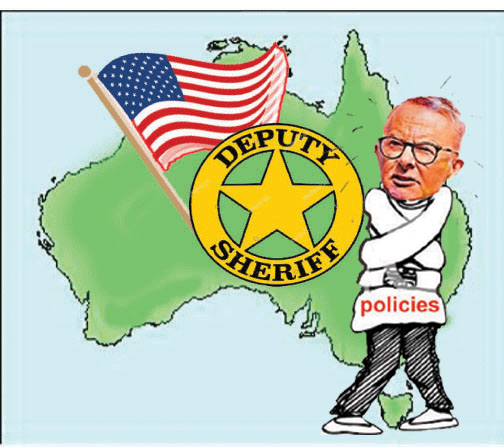
Given this government reflexively committed us to this war with even less forethought than previous governments in the last several wars, it would more accurately be described as Albanese’s rubber-stamp war.
Within hours of the first Israeli and US air strikes against Iran on 28 February, Albanese regurgitated the Israeli pretext that Iran posed an imminent nuclear threat. This pretext has already been publicly debunked by the US Director of National Intelligence.
Unprovoked attacks
For the second time in less than a year, the attacks were launched even as US officials were negotiating with the Khamenei regime over its uranium enrichment program. Iran would be irrational to come back to the negotiating table because that is now proven indicator of the next Israel-US aerial bombardment campaign.
“The degree of Israel-US incompetence on display here is breathtaking,”
even before any moral or legal considerations are made.
Now facing a direct existential threat, the Khamenei regime, on the other hand, has responded with a coherent strategy of lateral escalation, for which they have been preparing since at least 2003.
From their perspective, to “win” this war, all they need to do is survive.
Their strategy is to inflict severe economic pain on the global economy by closing the Strait of Hormuz until the US eventually comes to its senses, and to drive a wedge between the US and the Gulf states, which host permanent US military bases that project power across the region.
These bases have been a growing source of tension in the Middle East since the Iranian revolution in 1979 and the Russian invasion of Afghanistan later in the same year. The US at the time saw a Russian presence in Afghanistan as a threat to its vital national interests in maintaining access to Middle East oil exports, responding with a permanent military presence in the Gulf states under its “Carter doctrine.”
Over time, this US support also allowed the Gulf states and Israel to contain the perceived threat to regional stability from the Iranian regime.
Now, almost fifty years later and with the NATO-led Afghanistan and Iraq wars in the rear view mirror, US bases nonetheless remain, part of a self-perpetuating escalatory spiral with Iran.
Iran will not be content with Israel and the US merely stopping their attacks. They are now demanding that US bases in the Gulf be shut down permanently. The Gulf states – despite their serious diplomatic efforts to establish stable relations with Iran – are trapped in the middle of a war they didn’t want, and they have no clear way out.
War out of control?
On Wednesday night, Israel bombed South Pars, the world’s largest gas field jointly owned by Qatar and Iran. Iranian officials have vowed to launch retaliatory strikes against gas and oil infrastructure elsewhere in the region. This marks the next step up the escalatory ladder, and it means the duration of the energy and economic shock will be measured in years, not months.
Trump no longer has control of the situation, even if he ever did. Netanyahu has for many years envisaged not merely regime change but the fracturing of the Iranian state as a strategic win for Israel, and he – not Trump – is calling the shots.
For Australia’s part, our rubber-stamp contribution of an air force Wedgetail surveillance aircraft, ostensibly to help defend the United Arab Emirates from incoming Iranian missiles, has actually played into the hands of the Iranian strategic narrative.
Regardless of Foreign Minister Penny Wong’s nauseating semantics over this aircraft playing a “defensive” role,
“Australia is now party to the war with Iran,”
from our own base at Al Minhad in the UAE, which has already been targeted by the Iranians at least twice. We are one of only a small handful of Western countries with a permanent military presence in the Gulf, a presence that in and of itself is helping to fuel the escalatory spiral.
While all this plays out “over there”, for the first time in almost a century, some of the human cost of this war will be carried by the wider public here at home. Costs for fuel, food and utilities will continue to soar, as will mortgage payments and rents. Savings and investments will take a hit. Many people will lose their jobs. Some will lose their homes.
Among them are those who used to be considered Labor’s core constituents – the “Aussie battlers” who work hard but struggle to make ends meet – before the “workers’ party” abandoned its principles in favour of banal neoliberal economic rationalism, political careerism and mindless identity politics.
We can only hope that this shock might at last see a consensus emerge for a rational, sovereign, independent national security and foreign policy. Our policies of vassal state subservience to the US and, in this case, Israel are beyond unfit for purpose. They are directly undermining our vital national interests. In the meantime, we’re in for a rough ride.
Stuart McCarthyStuart McCarthy is a medically retired Australian Army officer whose 28-year military career included deployments to Afghanistan, Iraq, Africa, Indonesia and Papua New Guinea. Stuart is an advocate for veterans with brain injury, disabilities, drug trial subjects and abuse survivors. Twitter: @StuartMcCarthy_
The war against Iran:Lessons still unlearned
By William Briggs | 26 March 2026, https://independentaustralia.net/life/life-display/the-war-against-iran-lessons-still-unlearned,20853
The dreams of the U.S. President, that it would all be over in days – that the Iranian people would rise against their tyrannical regime – is now a nightmare that Trump has visited upon the world.
The global economy is on the brink of disaster as oil dries up. America and Israel have further isolated themselves from world public opinion and, apart from an ever- shrinking clique of semi-vassal states like Australia, Trump appears to be alone and increasingly dangerous.
The war offers a great many lessons, but while life and history can be great teachers, there seem to be precious few pupils ready to learn those lessons. This applies equally to apologists for U.S. power, to governments of all stripes and to many of those who inhabit the Left and lay claim to Marxist credentials.
The war was never about “liberating” the Iranian people from the right-wing theocracy. It was about securing a compliant regime that would ensure the flow of oil and to make sure that the USA, as a fading imperial power, maintained global hegemony — both politically and economically.
The slogan that accompanied the wars of aggression against Iraq, that tore Libya apart and which laid waste to so much of the Middle East was simply, No Blood for Oil! The years have slipped by, and yet the same foul motivation for despoiling the globe and destroying a people remains.
Our mainstream media know this to be true, even as the “story” turns its focus to the retaliation by Iran and to the oil pressure that the blocking of the Straits of Hormuz entails. The same media focuses on potential oil shortages, and rightly so, but seems less keen to link that invasion to the fact that people are paying stupid prices for petrol and diesel.
Fewer voices can be heard that would remind the people of how the war started and who is responsible. That has become largely the responsibility of the Left — the Marxists, the campaigners against war and imperialism.
This is as it should be, but something is very wrong. Marxism is quite clear that economics is the defining factor and that politics works with and responds to economic demands. The war, then, can only be understood from an economic perspective. But is it being understood in this way? Sadly, no.
Some see it as a political gamble by a beleaguered and dangerously unhinged U.S. President. Some portray it as a means, by Israel, of destroying any potential risk to its domination of the region. Some come a step closer by recognising the strategic desire to weaken China, as it is a principal customer for Iranian oil.
Any and all of these considerations are enough to allow blame to be sheeted home to the USA and Israel, but there is a deeper, more worrying aspect to this. The United States has been and remains the single biggest military force and greatest economic power that the world has seen. It is, as the Marxist Left will say, an imperialist power. It is also a declining power.
For decades, its main preoccupation has been how to hold back the rising tide of its one great rival. China’s rise, accompanied by a global capitalist economy that has run out of ideas and resilience, ensures that wars are either finishing, beginning, or in the planning stage. A failing economic structure is driving the world to the point of no return. The war against Iran is one battle in this endless spiral into decay. The USA, as the central power in the capitalist global economy, is more than willing to destroy entire nations in its quest to keep the sinking ship afloat.
No crime is too much. The U.S. bombing the girls’ school in Iran, the Israeli destruction of oil facilities on the edge of Tehran that have led to acid rain and an unimaginable civilian health disaster, sicken all reasonable people. But those who plan such actions are not among the reasonable.
These acts need to be condemned. Governments need to show at least a modicum of decency. Our Prime Minister needs to stop slinking in the shadows and act. He needs to denounce such actions. He needs to find the courage to say “No!” and to work to secure the natural resources needed to keep Australia functioning. This is unlikely. Our political structures are such that we remain totally subservient to the demands and interests of the USA..
Those whose anger compels them to take to the streets deserve better than the Babel that has become the protest movement. The most recent action in Melbourne, which was dominated by ever more shrill denunciations of Israel, while mention of the USA and its causal responsibility for the war was at best an afterthought. Protest has merit, it is necessary and has purpose. It also needs focus, if it is to have either merit or purpose.
Protest is also about winning the hearts and minds of people. Sound and fury might be a therapy for some, but numbers count and numbers must grow, people must be educated, encouraged to talk to others, to build a movement that can go beyond noise.
Part of that building process must include the raising of collective consciousness. It must be able to show and convince people that this or that crime of the USA, of Israel, of imperialism, is not isolated, or in any way an aberrant thing, but is a symptom of a deeper, structural crisis. It is not enough for the ideologues to make demands that cannot be achieved. The protest movement, the anti-war movement, should aim at providing a vehicle, a voice for those who want something better than news screens full of war stories and a Federal Government pathetically marching to the fifes and drums of a fading U.S. empire.
European Union leaders have been prepared to stand back a little; to say that the war is not their war. It is hard to imagine an Australian government being daring enough to question anything that comes from Washington. As the sun sinks on U.S. hegemony, Australia seems ready to go down with the American ship.
Trump is the most dangerous man in the world

By Mark Beeson | 21 March 2026, https://independentaustralia.net/politics/politics-display/trump-is-the-most-dangerous-man-in-the-world,20838
Trump’s Iran war raises fears of global conflict — while allies stay silent and diplomacy collapses, writes Mark Beeson.
U.S. PRESIDENT DONALD TRUMP is the most dangerous man in the world. Why are we supporting him?
Many people were concerned about what a second Trump presidency might look like, but it’s uncontroversial to claim that it’s much worse than even the gloomiest pessimists feared.
It has been plain for a long time that Trump has little regard for the truth and is determined to silence independent media. But the one thing his supporters and the world in general might have hoped for was that he wouldn’t have gone back on his promise to not start unnecessary, ill-conceived wars, especially in the Middle East.
And yet, not only has Trump launched an illegal war with Iran, which has already resulted in the deaths of thousands, including innocent schoolgirls, but he is also displaying a psychopathic delight in using America’s overwhelming military might ‘just for fun’.
Given that the assault on Iran is being conducted with – or even on behalf of – Israel there is a breathtaking irony in the fact that Trump is displaying the same sort of indifference to human suffering that allowed individual Nazis to take part in the ‘final solution’ and the murder of six million Jews.
It is, of course, entirely possible that Trump doesn’t really know what’s going on given his increasingly obvious cognitive decline, but he has never exhibited much human empathy and is a compulsive liar and confabulator. These qualities arguably made him unfit to be a property developer, much less the most powerful man on Earth.
Given his famously child-like need for attention and adulation, which his courtiers and cronies are only too willing to provide, there is absolutely no chance of him changing. On the contrary, his belief that God is proud of him ought to alarm ought to alarm friend and foe alike.
After all, this is a man with the capacity to blunder into World War 3 without having any idea what he’s doing. The complete absence of any plan or exit strategy in the escalating conflict with Iran demonstrates that even the most apocalyptic of unforeseen consequences cannot be ruled out.
While an international economic crisis may not be the worst thing that could happen, for those of us fortunate enough to live in peaceful Australia it really ought to demonstrate that Trump is a threat to supposed friends and allies, as well as the innocent Iranians he promised to help.
If nothing else, Trump’s behaviour should make the danger and folly of relying on someone quite so delusional and self-obsessed clear to even our most unthinking policymakers. Trump will be satisfied with nothing less than the complete support and cooperation of allies, no matter how misguided or inhuman his policies may be.
Given the decades of uncritical fealty Australia’s leaders have displayed to the United States, it is no surprise that there has generally been an uncomfortable silence about ‘our’ response to the latest American-led fiasco.
Penny Wong wrote:
‘We (sic) support the United States acting to prevent Iran from obtaining a nuclear weapon and to prevent Iran continuing to threaten international peace and security.’
It’s worth remembering that Iran was attacked while trying to negotiate a new agreement to replace the one Trump tore up, a tactic that may have allowed the U.S. to decapitate Iran’s leadership but won’t making resolving the conflict any easier. Truth, diplomacy and trustworthiness are clearly for losers. Might clearly does make right in Trump-world. This reality may help to explain why the Albanese government is keeping its collective head down.
Other leaders have not been quite so supine and gutless, however. German Chancellor Friedrich Merz, after fruitless attempts at ingratiating himself with Trump, unambiguously stated that the “government will not participate in this war”. Moreover, Merz pointed out that Trump’s war had nothing to do with NATO, which was a defensive alliance, not one designed for wars of aggression.
Trump responded in his usual fashion with threats and bluster, suggesting a failure to support his ill-conceived war would be ‘very bad’ for NATO. Although we have learned not expect truth or consistency when dealing with Trump, suggesting that the foundation of the Western alliance may be in jeopardy is hardly a minor threat. Trump’s great friend Vladimir Putin must be delighted.
If our leaders are too unimaginative and cowardly to speak up in defence of international law, or to criticise unilateralism and the intensification of great power politics, civil society must do what it can. The absence of the sort of activism and protests that characterised opposition to the equally ill-conceived and pointless Vietnam War is disappointing and revealing, however. Perhaps it takes 500 actual combat deaths and the prospect of being called-up to bring home the reality of war to Australians.
Or perhaps rising interest rates, the cost of filling up a monstrous SUV, or re-routing your European holiday might do the trick. Either way, it’s reassuring to know that President Trump thinks the war with Iran is going so well that he gives if 15 out of 10. Nothing for our leaders to worry about after all.
The Iran war is Australia’s margin call

the Greens’ Senator Larissa Waters captured the mood of many when she warned:
‘…every day Trump and Netanyahu’s demands of Australia keep growing.’
She accused Labor of having ‘no red lines’. Australia’s significant Iranian, Israeli, Lebanese, and broader Middle Eastern diaspora communities bring both personal grief and political intensity to the debate.
By Vince Hooper | 19 March 2026, https://independentaustralia.net/politics/politics-display/the-iran-war-is-australias-margin-call-,20830
Operation Epic Fury is exposing the true cost of alliance dependence, energy fragility, and strategic distraction from the Indo-Pacific, writes Vince Hooper.
ON 28 FEBRUARY 2026, the United States and Israel launched Operation Epic Fury against Iran. As the war enters its third week, the scale is staggering: at least 1,348 Iranian civilians killed and over 17,000 injured, 3.2 million displaced, approximately 6,000 U.S. strikes, and a new supreme leader – Mojtaba Khamenei – vowing to keep the Strait of Hormuz closed.
The International Energy Agency warns of the ‘largest supply disruption in the history of the global oil market’. Oil has breached US$100 (AU$142.11) a barrel. More than 820,000 have been displaced in Lebanon as Israel–Hezbollah hostilities reignite.
For Australia, geographically distant but entangled through alliance commitments, intelligence infrastructure, energy dependence and a 115,000-strong diaspora in the Middle East, the ramifications are immediate. In financial economics, alliance membership functions like a call option — the right to draw on a protector’s military power, but at a price paid in sovereignty foregone, bases hosted, and conflicts joined.
The Iran crisis is Australia’s margin call. The price is suddenly, painfully visible.
The alliance reflex
The Albanese Government endorsed Operation Epic Fury with speed that surprised even American officials, while insisting Australia was “not participating” offensively.
By 10 March, that distinction had eroded: Albanese deployed an E-7A Wedgetail early warning aircraft, air-to-air missiles for the UAE, and 85 Australian Defence Force personnel to the Gulf. The Wedgetail’s capacity to map missile launch locations and coordinate battle management in real time makes it far more than a passive shield — the line between defensive and offensive enablement is, as one analyst observed, a blurry one at best.
It has since emerged that three Royal Australian Navy sailors were aboard the U.S. submarine that torpedoed the Iranian frigate IRIS Dena near Sri Lanka on 4 March — the first U.S. submarine torpedo attack since the Second World War.
Albanese confirmed their presence but insisted they did not take part in offensive action. Meanwhile, the Joint Defence Facility Pine Gap near Alice Springs – now hosting 45 satellite radomes and dishes – continues to provide real-time intelligence across the Middle East. A former NSA analyst confirmed in 2023 that Pine Gap was collecting data on the Gaza conflict and “surrounding areas”.
That intelligence flows to Washington and, in turn, to Israel. Having invested decades in this facility, Australia cannot credibly claim neutrality. It is infrastructure that commits the country irrevocably — a strategic investment with no exit clause.
The Indo-Pacific opportunity cost
Here is the dimension that should concern Australian strategists most. In what economists call “real options” theory, the value of an investment depends on keeping the opportunity alive until conditions are ripe. AUKUS is precisely such an option: a ticket to a credible submarine deterrent, but only if the U.S. industrial base and technology transfers remain available. The Iran conflict is degrading every one of those conditions.
The U.S. submarine industrial base produces around 1.2 Virginia-class boats per year against a combined requirement of 2.3.
An Iran war that diverts Navy priorities means no spare construction capacity for Australian boats. Congressional approvals, State Department licences, and Department of Energy support all stall when those agencies are managing Iran’s nuclear fragments. Australia’s planned 2030s submarine delivery could slip to the 2040s. We know the cost of American distraction: between 2001 and 2020, while Afghanistan and Iraq consumed U.S. bandwidth, China militarised the South China Sea, developed carrier-killing missiles, and built the world’s largest navy.
The U.S. has already spent over US$11 billion (AU$15 billion) in Epic Fury’s first week. As the Hudson Institute’s Zineb Riboua has argued, every dollar spent defending Red Sea shipping lanes is a dollar unavailable for Pacific basing or Taiwan contingency planning.
Fat tails at the fuel bowser
Australia imports roughly 90 per cent of its refined liquid fuel. The Strait of Hormuz, carrying a fifth of global petroleum, has been reduced to what the IEA calls ‘a trickle’ — global supplies down an estimated eight million barrels per day. IEA members have agreed to release 400 million barrels from emergency stockpiles, the largest coordinated release in history, but analysts warn this only partially offsets prolonged disruption.
For anyone who studies what statisticians call ‘fat-tailed’ distributions — events that are rare but devastating when they occur — this is a textbook case. Australia’s fuel supply architecture is built for normal times: 36 days of strategic reserves against an IEA benchmark of 90.
According to Westpac’s modelling, a one-month Hormuz disruption lifts the Australian CPI by approximately 1 percentage point; a three-month closure spikes it by 1.5 points and reduces GDP by 0.5 points. Petrol prices could rise 40 cents per litre. LNG prices have surged 12 per cent, and Qatari production remains halted. These pressures compound: higher oil costs flow through shipping, fertilisers, and manufacturing into broader inflation, landing on an economy where the RBA is already navigating delicate disinflation.
115,000 reasons to worry
An estimated 115,000 Australians were in the Middle East when the conflict erupted.
Foreign Minister Penny Wong said:
“This is a consular crisis that dwarfs any that Australia has had to deal with in terms of numbers of people.”
The closure of airspace across Bahrain, Iraq, Iran, Qatar, Kuwait, and Syria stranded thousands.
By 10 March, over 2,600 had returned on 18 flights from the UAE.
Tens of thousands remain, with Smartraveller now advising against all travel to the UAE, Qatar, Kuwait, Bahrain, Israel, and Lebanon. Bus convoys to Kuwait and Bahrain, overland routes to Oman, and limited commercial flights have been the improvised lifelines. Canberra also granted asylum to five members of Iran’s women’s football team who were in Queensland for the AFC Women’s Asian Cup — a gesture that only hints at the potential for larger refugee flows if the conflict deepens further.
The rules-based order — selectively applied
Operation Epic Fury was launched without UN Security Council authorisation. Ben Saul the UN Special Rapporteur on the promotion and protection of human rights and fundamental freedoms while countering terrorism, has stated that Iran had not enriched uranium to the point of building a nuclear device — the case for self-defence, in his words, “does not fall anywhere close”.
Australia’s refusal to address the strikes’ legality places it in what ANU’s Don Rothwell calls a “say nothing” posture — conspicuously at odds with its willingness to assert the illegality of Russia’s invasion of Ukraine.
In my own work on alliance behaviour, I model geopolitical commitments using the same frameworks that price financial options. International law functions as a hedge — an insurance policy limiting everyone’s downside. When a country lets that insurance lapse for allies while enforcing it against adversaries, it is strategically exposed.
For a middle power whose influence rests on normative authority rather than military mass, this shapes standing in ASEAN, the Pacific Islands Forum, and every multilateral setting where Western double standards are a live issue.
Domestically, the Greens’ Senator Larissa Waters captured the mood of many when she warned:
‘…every day Trump and Netanyahu’s demands of Australia keep growing.’
She accused Labor of having ‘no red lines’. Australia’s significant Iranian, Israeli, Lebanese, and broader Middle Eastern diaspora communities bring both personal grief and political intensity to the debate.
The energy transition as strategic hedge
If the conflict carries a silver lining, it may be in strengthening the case for energy transition. Renewables and storage now provide nearly 45 per cent of electricity on Australia’s main grid and contributed to halving wholesale power prices in late 2025. Renewable energy is a natural insurance policy against geopolitical oil shocks: its fuel cost is zero and its supply chain is overwhelmingly domestic.
Accelerating electrification of transport, homes, and industry reduces exposure to precisely the kind of extreme energy price events that the Strait of Hormuz crisis illustrates. But the transition is capital-intensive: a one-year delay in wind or transmission projects could increase residential power prices by up to 20 per cent. The conflict sharpens both the urgency and the stakes.
The margin call
The Iran conflict is a stress test for Australian strategic policy on every front: alliance dependence, energy fragility, consular capacity, and commitment to international law. Most importantly, it reveals the opportunity cost in the Indo-Pacific.
Every month of Middle Eastern entanglement is a month in which AUKUS – and a credible deterrent posture in the Western Pacific – loses value. The conflict is not just consuming Australian resources. It is consuming the strategic future those resources were meant to buy.
For policymakers, the lessons are uncomfortable but clear. Diversification – of energy sources, strategic relationships, and economic exposure – is not merely desirable but urgent. The capacity to make independent strategic judgements, rather than reflexively aligning with allied positions, must be cultivated alongside the alliance itself. International law must be applied consistently, not selectively invoked when adversaries breach it and quietly set aside when allies do the same. The margin call has arrived. The question is whether Australia can pay it without liquidating the portfolio.
Vince Hooper is a proud Australian-British citizen and professor of finance and discipline head at SP Jain School of Global Management with campuses in London, Dubai, Mumbai, Singapore and Sydney.
“Grow your own and buy local”: Networks seek change and flexibility to manage a 100 pct renewable grid

RENEW ECONOMY. Giles Parkinson, Mar 19, 2026
The head of Australia’s peak network group has called for regulatory change and more flexibility for homes and their power assets, to help local networks manage the consumer-driven push towards 100 per cent renewables across the country.
Andrew Bills is the chair of Energy Networks Australia, and finds himself at the cutting edge of this transition as CEO of SA Power Networks, where the output of rooftop solar alone exceeds grid demand about every second day of the year.
South Australia is expected – within 18 months – to become the first gigawatt-scale grid in the world to reach 100 per cent “net” renewables (the net refers to the fact that it imports and exports at times and is not an isolated grid), and is already running at a 75 per cent share of wind and solar.
Much of that solar comes from households, with nearly half (48 pct) of all homes supporting a total of 3.2 gigawatts of rooftop solar capacity, which is significant in a grid with average demand less than half of that.
That solar penetration is also world leading, and at a level that stuns network peers in other countries. It is rapidly being followed by a faster uptake of home batteries (double that of the country average), and a growing interest in electric vehicles.
This has required South Australia to be at the forefront of key technologies designed manage this home energy revolution, initially with the blunt and rarely used “solar switch-off”, required by the market operator as a last resort to help maintain grid security.
That has been followed, more successfully, by the rollout of innovative technologies that allow for flexible exports for solar households, and no longer limits the amount of rooftop solar that can be installed.
iis now being augmented with the trial installation of home energy management systems and tariffs that reward homes for cutting imports, as well as exports, at key times………………………………………………………………………………………………………………………………………………………………………………………………. https://reneweconomy.com.au/grow-your-own-and-buy-local-networks-seek-change-and-flexibility-to-manage-a-100-pct-renewable-grid/
The Software Upgrade Australia Didn’t Need
18 March 2026 AIMN Editorial, By Ricky Pann https://theaimn.net/the-software-upgrade-australia-didnt-need/
Palantir and the Digital Dictator’s Operating System
Australia is undergoing a system update. It didn’t pass through a referendum, nor was it meaningfully debated in Parliament. Arriving quietly under the guise of maintenance and safety, Palantir Technologies has embedded itself into the central nervous system of Australia’s financial and intelligence apparatus. Through AUSTRAC and the Fintel Alliance, data from banks, law enforcement, and government agencies are now integrated into a single “God view”. The Australian Government is in fact investing in Palantir through stocks held by our Future Fund.
An Upgrade Without an Uninstall
Palantir represents a new phase in Silicon Valley’s evolution, a shift from consumer platforms to sovereign infrastructure. From apps designed to distract us to systems designed to govern us.
Palantir’s software deployment in Australia comes ahead of a coordinated lobbying push to expand adoption of its systems, positioning them to become a de facto operating system for governments globally through sheer market dominance.
Australia is making an unspoken admission: that social democracy is now seen as too slow and inefficient for an AI-driven world, where speed is quietly replacing human judgment. This is the great deception of hasty AI adoption.
These are the quiet admissions of a society steered by populist fear: the myth that productivity driven growth is limitless, and the delusion that automating human empathy will not edge us toward autocracy.
So where do we stop?
Do we outsource judgment.
Do we automate trust.
Do we accept a black box view of reality in exchange for speed.
The result is a feedback loop. Data feeds the system. The system reshapes perception. Perception justifies more data. Slowly, the world begins to look exactly as the software expects it to.
There’s a familiar feeling after a software update.
Nothing looks different.
The icons are where you left them.
The system boots. The coffee still tastes the same.
But something subtle has shifted.
Menus rearranged.
Permissions altered.
A few options you used to have simply evaporated.
We’re expected to accept a system that doesn’t reason, doesn’t ask permission, operates without consent, and collapses the complexity of human context, nuance, and lived experience into binary outcomes.
No announcement. No apology. Just a new normal.
The quiet inversion Orwell warned about: not brute force, but soft machinery. Not the scream, but the hum.
A world where seeing everything replaces understanding anything, where speed outranks judgment, and probability passes for truth.
The system doesn’t need to lie.
It just decides what is perceived as real.
Palantir isn’t a surveillance scandal. It’s a design choice.
Who’s Watching the Watchers?
One day, sitting on a bench, watching light move through trees, you realise something small but irreversible.
You’re no longer being seen by people.
You’re being interpreted by infrastructure.
That’s not a crisis moment.
It’s an installation moment.
And installations, once embedded deeply enough, rarely come with an uninstall option.
Australia didn’t choose authoritarianism.
It chose efficiency
We didn’t suspend democracy.
We quietly routed around it.
You don’t lose freedom all at once. You outsource it, piece by piece, to systems that promise to manage burden for us.
The pitch is seductive to politicians and bureaucrats: efficiency, seamless integration, prevention over response. But this isn’t a routine upgrade. It’s a Trojan Horse, quietly ushering in a new era of global corporatocracy.
Palantir does not merely process data; it installs a proprietary “ontology” with a map of clusters of a calculated reality that dictates to a government what is considered relevant or risky.
It replaces the presumption of innocence with algorithmic probability, shifting justice from what you did to what you might do. Once a sovereign nation relies on such a system, it no longer acts as a customer but as a dependent, outsourcing responsibility and accountability.
Authors note: I don’t mean to be nasty but…
I’m not in the habit of playing the man/woman/person instead of the ball but, this is the age of disruption in a period of brazen populism that rewards narcissism.
People like Trump, Musk, Altman, Karp and Thiel routinely make statements that are disconcerting, extreme, misleading, and at times plainly unhinged.
They face little consequence because wealth and power insulate them, reinforcing the belief that billionaire status equates to insight – despite being far removed from the lived reality of the people most affected by the chaos caused by the systems they shape.
Buyer Beware: To understand the creeping authoritarianism we as Australians just installed, we must look at the radically unhinged ideologies of the architects who designed it.
Peter Thiel: The Sovereign Dream
Founder Peter Thiel has been unusually candid about his beliefs. He has stated that he no longer believes freedom and democracy are compatible.
His worldview, influenced by René Girard’s theory of mimetic conflict, treats human society as inherently unstable, something to be managed, contained, and overseen by a competent elite.
Thiel’s Zero to One philosophy celebrates monopolies. Competition, he argues, is wasteful. Governance by consensus is inefficient. The future belongs to singular systems operated by those smart enough to bypass friction.
This worldview is not theoretical. Thiel is now a New Zealand citizen and has publicly acknowledged preparing for large scale civilisational disruption.
He owns property on New Zealand’s South Island, widely reported as part of a network of fortified survival infrastructure intended to function during a catastrophic global event, often described in Silicon Valley as an H2 scenario, a hard reset moment involving systemic collapse.
This may sound like a dramatic interpretation of his intention however, considering the dots we are joining, Palantir is the practical expression of this thinking.
Its a monopoly on state intelligence designed to operate beyond the slow checks and balances of democratic process, resilient not just to crime or terrorism, but to political instability itself.
This is mostly true for all disruptive big tech firms. They grow and evolve so fast that the consequential fallout of the technology lags years behind legislation. They operate in the wild west at the expense of law, privacy, social cohesion, mental health, criminality and human rights till the sheriff arrives.
Alex Karp: The Dialectical Justifier
CEO Alex Karp presents differently. He speaks the language of philosophy, progress, and reluctant necessity. He frames Palantir through a dialectical lens, civil liberties on one side, a dangerous world on the other, resolved by a system powerful enough to neutralise chaos.
Alex Karp acts as the “dialectical justifier, using Hegelian philosophy to reframe total mass surveillance and the reduction of citizens to managed variables as a necessary, moral “synthesis” between civil liberties and global chaos.
In this framing, surveillance is not abuse but compromise.
Dominance becomes protection.
Efficiency becomes morality.
Karp has acknowledged that bad times are very good for Palantir. The company is built for crisis. It thrives on instability, on moments when societies are willing to trade uncertainty for control.
The contradiction is hard to miss. In claiming to prevent fascism by enforcing order, the system quietly adopts fascism’s core mechanism, total visibility, preemptive control, and the reduction of citizens to managed statistical variables.
It is not win lose.
It is domination.
It is founder Peter Thiel who pushes this idea of world domination into the realm of absolute madness.
Thiel delivered a series of private, unhinged lectures titled “The Antichrist”. Using cobbled-together 1st-century doomsday theology and pop-culture manga like One Piece, he attempted to frame himself and his fellow technocrats as heroic rebels holding back a demonic, stagnant global state.
If you strip away this ridiculous theatrical charade, you don’t find a philosopher. You find the Nero of Silicon Valley, a wanna be digital dictator actively engineering the end of inconvenient democracy.
Here is the actual plumbing behind the smoke and mirrors:
A: The Hypocrisy of the “Anti-Satanist” Thiel preaches that global governance and regulation are the “Antichrist” of our era. Yet, his primary engine of wealth, Palantir, is the ultimate weapon of the administrative state.
Palantir provides the data-mining backbone for ICE, the Pentagon, and global police forces. He decries the global surveillance state while acting as Big Brother’s lead software engineer.
He isn’t fighting the system as a small government libertarian; he just wants the monopoly on its operating system.
B: The Untruths of “Stagnation” In his lectures, Thiel claims the world is trapped in scientific “stagnation,” literally labelling anyone who advocates for climate change mitigation, environmental survival, or AI safety guardrails as a “Luddite” and a “legionnaire of the Antichrist”.
This is a blatant untruth used to mask regulatory capture. He doesn’t care about stagnation; he simply demands a world where his tech monopolies can operate without the friction of human empathy, environmental protection, or legal boundaries.
C: The Puppeteer Behind the Chaos Thiel presents a false binary choice between total “Armageddon” and a stagnant global state.
But he is not a prophet warning us of the fire; he is the arsonist selling the fire extinguisher.
Operating through dark money donor networks, Thiel is the primary financial engine behind figures like J.D. Vance and organisations such as the Heritage Foundation – the architects of the Project 2025 blueprint.
He is one of the chief puppeteers behind the Trump-era chaos. Thiel actively funds anti-establishment disruption to dismantle regulatory frameworks, intentionally manufacturing the very societal chaos he claims only Palantir’s mass surveillance can manage.
D: The Delusion of Superiority and Human evolution Driven by René Girard’s “Mimetic Theory,” Thiel views the general public as a mindless, moronic mob that must be controlled by elites like him.
Embracing the delusion of the Sovereign Individual, Thiel has no intention of fixing the democratic systems he helps break. Instead, he is hoarding fortified doomsday bunkers in New Zealand, actively preparing for an “H2 scenario” heralding a catastrophic, systemic global collapse.
This deep disregard for humanity culminates in an obsession with redesigning human evolution itself. Thiel treats human limitation and death as defects to be solved, pouring massive investments into transhumanism, cryonics, and young blood transfusions.
His endgame is a complete evolutionary split: engineering a future where the billionaire class achieves digital eternity as a sovereign, immortal species, leaving the masses to burn on an unregulated, collapsing planet.
This may be hard to grasp but thats the type of people Australia has entrusted their government data to.
The Verdict
Australia didn’t choose authoritarianism; it chose efficiency. We are quietly outsourcing our reality to an unaccountable technocracy.
Thiel’s lectures aren’t a warning about a coming digital dictator; they are a job application for the position.
He is the man who sells you the matches, then offers to build you a fireproof bunker for the price of your freedom.
Palantir isn’t just software. It is an installation moment. And installations this deep rarely come with an uninstall option.
The Architecture of Silence: Palantir, AUKUS, and the Business of Genocide
While Palantir refines its “kill chain” in Gaza, Australia is engaged in the largest military transfer of wealth in its history.
The submarines will not arrive until the early 2040s. In the meantime, Australia has established an export licence-free environment with the UK and US, allowing military and dual-use goods to be transferred between AUKUS partners without oversight. This includes AI and autonomy technologies
The line between Australian defence procurement and U.S. military-industrial interests has effectively dissolved.
18 March 2026 Dr Andrew Klein, Australian Independent Media
On December 10, 2025, Responsible Statecraft published a report that should have shaken capitals around the world. Buried in the details of President Trump’s 20-point “peace plan” for Gaza was a revelation: two American surveillance firms, Palantir and Dataminr, had embedded personnel inside the U.S.-run Civil-Military Coordination Center (CMCC) in southern Israel.
Their presence was not incidental. Palantir’s Project Maven – an “AI-powered battlefield platform” that collects surveillance data from satellites, drones, and intercepted communications to “optimize the kill chain” – was being positioned to shape Gaza’s post-war security architecture. Dataminr, which scans social media to provide “event, threat, and risk intelligence” to governments and law enforcement, was also inside the room.
This is not conspiracy. This is confluence – the quiet alignment of corporate interests, military objectives, and political capture. This article traces that confluence from the battlefields of Gaza to the boardrooms of Australia, and asks a simple question: Who benefits?
Part One: The Business Model – AI as Occupation
Palantir’s “Kill Chain” Optimisation
Palantir Technologies has been explicit about its ambitions. CEO Alex Karp has described the company’s technology as “optimising the kill chain.” Project Maven, for which Palantir recently secured a $10 billion Pentagon contract, sucks information from multiple sources and “packages it into a common, searchable app for commanders and support groups.” It has already been deployed to guide U.S. airstrikes across the Middle East, including in Yemen, Syria, and Iraq.
Since January 2024, Palantir has been in a “strategic partnership” with Israel’s military for “war-related missions”. The company has expanded its Tel Aviv office significantly over the last two years. Karp defended this collaboration amid international concerns over war crimes, saying Palantir was the first to be “completely anti-woke”.
The Gaza Laboratory
For the last two years, Gaza has functioned as an incubator for militarised AI. Israel’s Lavender system, an AI-assisted surveillance tool, used predictive analytics to rank Palestinians’ likelihood of being connected to militant groups, based on an opaque set of criteria. Public sector workers – healthcare workers, teachers, police officers – were included on kill lists because they had ties to Hamas by virtue of working in a territory the group governed.
The Gospel system functioned as a “mass assassination factory.” One source admitted spending only “20 seconds” per target before authorising bombing – just enough to confirm the Lavender-marked target was male.
Under Trump’s proposed “peace plan,” these technologies would be scaled up. The plan envisions “Alternative Safe Communities” – fenced, heavily monitored compounds where Palestinians would be relocated, their movements tracked by AI systems, their online activity scanned by Dataminr, their phones monitored by Palantir’s platforms. Entry would be contingent on approval by Israel’s Shin Bet, with criteria that could disqualify hundreds of thousands based on algorithmic “risk scores.”
For tech companies, war is opportunity. Access to vast datasets, real-world testing for new military systems, and long-term contracts for post-war surveillance infrastructure.
For Israel, the arrangement offers a way to outsource occupation while maintaining control.
For Palestinians, it promises more of what they have already endured: unremitting horror, dragnet surveillance, and death by algorithm.
Part Two: The Australian Connection – Wealth Transfer and Complicity
AUKUS: The $368 Billion Commitment
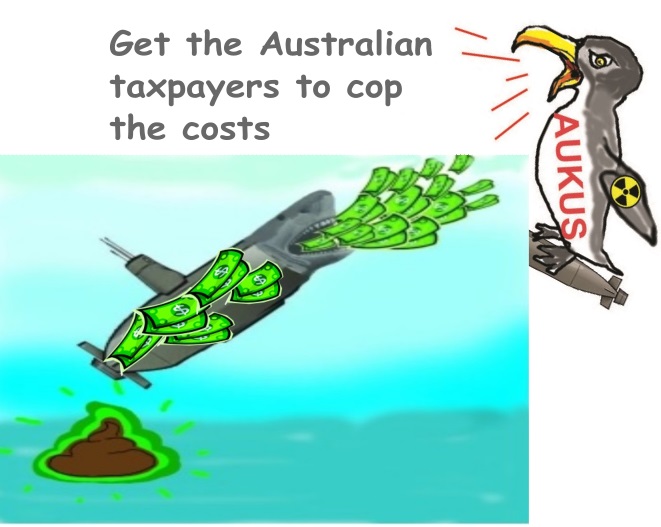
While Palantir refines its “kill chain” in Gaza, Australia is engaged in the largest military transfer of wealth in its history. The AUKUS nuclear submarine program is estimated to cost $368 billion over coming decades, with $53–63 billion allocated for the first decade alone.
The submarines will not arrive until the early 2040s. In the meantime, Australia has established an export licence-free environment with the UK and US, allowing military and dual-use goods to be transferred between AUKUS partners without oversight. This includes AI and autonomy technologies developed under Pillar 2 of the agreement, which focuses on “artificial intelligence and autonomy, quantum science, advanced cyber, and electronic warfare.”
The same technologies being tested on Palestinian populations in Gaza are, under AUKUS, being integrated into Australia’s defence infrastructure.
The Ghost Shark Precedent
In September 2025, the government announced a $1.7 billion investment in “Ghost Shark” autonomous submarines – underwater drones developed by Australian company Anduril, whose U.S. parent has close ties to the defence establishment. Assistant Minister Matt Thistlethwaite described the technology as so impressive that “the Americans have invested in the company.”
The line between Australian defence procurement and U.S. military-industrial interests has effectively dissolved.
The Cost of Living vs. The Cost of War
While this wealth transfers to the United States, Australians struggle with a cost-of-living crisis that the government refuses to adequately address. The Robodebt scheme – an automated system that raised unlawful debts against welfare recipients – offers a template for how algorithmic governance can devastate vulnerable populations .
The National Anti-Corruption Commission recently found two public servants engaged in “serious corrupt conduct” in relation to Robodebt. But as Economic Justice Australia noted:
“The system punishes only the vulnerable. The main sanction for damaging behaviour at the top levels of the Department has been naming and shaming.”
No one went to jail. No one lost their pension. The system protected itself.
The same pattern is now repeating at scale: algorithms making life-and-death decisions, with no one accountable when they fail.
Part Three: The Segal Nexus – Silencing Critics, Enabling the Agenda
The Envoy’s Role
Jillian Segal AO, Australia’s Special Envoy to Combat Antisemitism, occupies a unique position at the intersection of power. Her credentials are impeccable: former ASIC deputy chair, board member of the Sydney Opera House Trust, the Garvan Institute, and the Australia-Israel Chamber of Commerce. She is deeply embedded in the networks that connect Australian business to Israeli interests.
In December 2025, the Albanese Government formally adopted Segal’s Plan to Combat Antisemitism, accepting all 13 recommendations………………………………………………………………………………………..
The framework created by the antisemitism envoy – however well-intentioned – provides cover for those who would shut down debate. Critics are not engaged; they are managed. Those who persist are not answered; they are silenced.
The Business Connection
Segal’s husband’s company, Henroth Investments, donated $50,000 to Advance Australia, a right-wing lobby group that has shared anti-immigration content and claimed Palestinians in Australia were a “risk to security.” She has disclaimed knowledge of the donation, and government ministers have accepted her statement .
But the appearance matters. When the antisemitism envoy is married to a donor to an organisation that promotes anti-Palestinian rhetoric, it feeds a perception that her role serves a particular
political agenda rather than a genuine anti-racism brief. When her networks connect Australian business to Israeli interests, and when those interests align with the very AI companies testing their technologies on Palestinian populations, the confluence becomes visible.
Part Four: The Alignment of Values
In a bizarre way, the values of Palantir’s leadership align with the values of Australia’s political class…………………………………………………………………………………
What if they were, instead, a mechanism to enable and facilitate Israel’s transition to an AI-driven economy independent of the United States?
Consider the logic:
- Israel seeks economic independence. Netanyahu has announced plans to “taper off” U.S. military aid, pivoting toward AI sovereignty. A $200 million joint AI and quantum science center with the U.S. is in development.
- A state reliant on a single product must ensure demand. If Israel’s future exports are AI-driven surveillance and warfare technologies, it needs customers. It needs a demonstrated market. It needs a proof of concept.
- Gaza provides the laboratory. The technologies tested there—Lavender, Gospel, the Maven platform – are refined in real-world conditions, with a population that cannot resist, cannot refuse, cannot escape.
- Critics must be silenced. This is where the antisemitism framework becomes essential. If criticism of Israel’s actions can be reframed as antisemitism, if legitimate concerns about algorithmic warfare can be dismissed as hatred, if the very people documenting war crimes can be delegitimised – then the business model is protected.
- Australia plays its part. By adopting the antisemitism envoy’s recommendations, by embedding the IHRA definition into policy, by creating legal frameworks that can be used to silence critics, Australia becomes an enabler of this system. Not through conspiracy—through confluence. Through the quiet alignment of interests that requires no coordination, only opportunity
Part Six: The Accountability Vacuum
The Robodebt scheme offers a template for what comes next………………………………………………………………………………………………………………………..Conclusion: What We Have Discovered
This article has traced a network of connections that is not conspiracy but confluence:
- Palantir and Dataminr embedded in Gaza, testing AI systems on a captive population, refining technologies that will be exported worldwide.
- AUKUS transferring Australian wealth to the U.S. military-industrial complex, integrating the same AI and autonomy technologies into our defence infrastructure.
- Jillian Segal positioned at the nexus of Australian business, government, and Israeli interests, her office providing the framework that silences critics.
- The antisemitism claim deployed not against genuine hatred, but against legitimate criticism of Israeli policy – protecting the business model, enabling the silence.
· The accountability vacuum ensuring that when things go wrong, no one is responsible.
The pattern is consistent. The players are visible. The evidence is documented.
Australian news analysis
What remains is for Australians to ask themselves: Is this who we want to be?
Do we want our wealth transferred to corporations that “optimize the kill chain“? Do we want our government to enable the testing of AI warfare on a captive population? Do we want our political class to silence critics while profiting from death?
The answer, for those with eyes to see, should be clear.
But the system is designed to keep those eyes closed. To cry “antisemitism” at anyone who questions. To ensure that the only voices heard are those that align with the business model.
We have seen through it. Now we must help others see. https://theaimn.net/the-architecture-of-silence-palantir-aukus-and-the-business-of-genocide/
Millions in tax-deductible donations to IDF, illegal settlements
by Stephanie Tran | Mar 11, 2026 , https://michaelwest.com.au/millions-in-tax-deductible-donations-to-idf-illegal-settlements/
An Australian charity receiving over $200 million in tax-deductible donations is ignoring international law, while the Government looks the other way. Stephanie Tran reports.
Jewish National Fund Australia (JNF Australia) has remitted more than $125.4m to Israel since 2009, according to financial records, while receiving $213m in tax-deductible donations since 2013.
In 2024 alone, the organisation reported $12m in donations and bequests, with $10.4m transferred to Israel.
Despite JNF Australia’s assertion that it operates independently of its Israeli parent, Keren Kayemet LeYisrael (KKL-JNF), an investigation by MWM has revealed that tax-deductible donations raised by JNF Australia have been directly transferred to KKL-JNF. Some of these funds have been used to support IDF soldiers and fund illegal settlements.
Independent really?
NF Australia has repeatedly stated that it operates independently of KKL-JNF in Israel.
In 2017, Israeli Prime Minister Benjamin Netanyahu demanded that KKL-JNF transfer 80% of its revenue to the Finance Ministry to help fund state-run infrastructure projects or risk losing its tax-exempt status.
Following the announcement, JNF Australia declared that it was a “separate independent entity” from KKL-JNF. They stated that “funds raised by JNF Australia go directly towards these projects, with not one dollar used to fund KKL”
In 2021, KKL-JNF’s board voted to officially permit the purchase of private land in the occupied West Bank for settlement expansion, a decision that was criticised as an open violation of international law.
Shortly after the decision, JNF Australia’s president and CEO again attempted to distance the organisation from its Israeli parent, stating that the Australian body was “an independent entity from KKL”.
“JNF Australia only applies donor contributions towards JNF Australia projects and priorities [and] is therefore unaffected by any changes to KKL’s priorities and policies, whether in respect to land acquisition or elsewhere,” they said, adding that the organisation “has no representatives on the KKL board, nor is it involved with or bound by any of their decisions”.
However, our analysis of Israeli financial filings shows that JNF Australia has transferred millions of dollars directly to KKL-JNF (also known as the Israel National Fund) since making these statements.
Although the sources of foreign donations were redacted in Israel National Fund’s 2024 financial report, financial reports lodged in previous years identify Australia as a source of overseas donations.
Between 2021 and 2024, KKL-JNF received 41.86m Shekels ($19.4 million) in donations from Australia and New Zealand.
The financial reports state that these donations “are received from residents of various countries, including through KKL-JNF offices abroad”.
The Jewish National Fund was founded in 1901 to purchase land in Palestine for Jewish settlement, decades before the establishment of Israel. Over the past century, KKL-JNF has played a central role in land acquisition and large-scale “forestation” projects across the occupied Palestinian territories.
These activities have long been intertwined with the displacement of Palestinians. An investigation by Haaretz revealed that the Israeli Defence Ministry recruited KKL-JNF to secretly purchase Palestinian land in the West Bank for settlers. Israeli NGO Zochrot has accused JNF of contributing to the “ongoing Nakba” through projects that plant forests or develop parks on land where Palestinian communities once stood, while supporting illegal settlement initiatives.
In July 2024, the International Court of Justice (ICJ) issued a landmark advisory opinion finding that Israel’s occupation of Palestinian territory is illegal under international law.
The ICJ held that Israel must end its presence in the Occupied Palestinian Territory as rapidly as possible, and immediately cease all new settlement activity. The Court also held that third states have an obligation “not to render aid or assistance in maintaining the situation created by Israel’s illegal presence in the Occupied Palestinian Territory”.
In a subsequent position paper responding to the ruling, the United Nations Independent International Commission of Inquiry on the Occupied Palestinian Territory, including East Jerusalem and Israel, said states should not provide tax deductibility for donations to organisations that support illegal occupation.
JNF supporting illegal settlements
The Jewish National Fund was founded in 1901 to purchase land in Palestine for Jewish settlement, decades before the establishment of Israel. Over the past century, KKL-JNF has played a central role in land acquisition and large-scale “forestation” projects across the occupied Palestinian territories.These activities have long been intertwined with the displacement of Palestinians. An investigation by Haaretz revealed that the Israeli Defence Ministry recruited KKL-JNF to secretly purchase Palestinian land in the West Bank for settlers. Israeli NGO Zochrot has accused JNF of contributing to the “ongoing Nakba” through projects that plant forests or develop parks on land where Palestinian communities once stood, while supporting illegal settlement initiatives.
In July 2024, the International Court of Justice (ICJ) issued a landmark advisory opinion finding that Israel’s occupation of Palestinian territory is illegal under international law.
The ICJ held that Israel must end its presence in the Occupied Palestinian Territory as rapidly as possible, and immediately cease all new settlement activity. The Court also held that third states have an obligation “not to render aid or assistance in maintaining the situation created by Israel’s illegal presence in the Occupied Palestinian Territory”.
In a subsequent position paper responding to the ruling, the United Nations Independent International Commission of Inquiry on the Occupied Palestinian Territory, including East Jerusalem and Israel, said states should not provide tax deductibility for donations to organisations that support illegal occupation.
“States shall not give support to these organizations, for example, through allowing the organization to have tax-exempt status or providing tax deductibility for donations to the organization and must ensure that financial contributions to support the unlawful occupation, including settlements and settlers, cease,” the Commission said.
Chris Sidoti, a commissioner on the UN inquiry, said the implications for Australian charities that fund Israeli settlements were clear.
“We should end tax deductibility for any Australian charities that provide funding for Israeli settlements or for Israeli organisations that support the establishment or maintenance of settlements,” he said, “Any organisation that is financially or politically supporting the unlawful occupation, including funding settlements,
“should have its tax-exempt status removed and should be deregistered.”
Despite the UN General Assembly adopting a a resolution in September 2024 demanding that Israel end its unlawful occupation no later than 12 months after the adoption of the resolution, the Israeli government has accelerated settlements in the West Bank.
Last month, Israel’s security cabinet repealed land laws, enabling settlers to purchase land in the West Bank without limitation and without government oversight to “enable accelerated development of settlement on the ground”.
Since the US-Israeli war with Iran began, Israel has imposed a total military closure on the West Bank and Israeli settlers have seized the opportunity to expel more Palestinian communities from their land.
Support for IDF soldiers and settlers
Jewish National Fund Australia publicly promotes programs providing financial support to soldiers in the Israel Defense Forces (IDF), including “Ach Gadol”, “Atidim Lone Soldier Education Support” and “Panim el Panim”.
The Ach Gadol initiative offers one-on-one support for “lone soldiers” serving in the IDF. The project aims to create a support system for lone soldiers throughout their army service and “deepen the values of Zionism and love of the land among young new immigrants”.
According to JNF, “there are over 7,000 lone soldiers currently serving in the IDF. About 45% of these soldiers are new immigrants, coming from Jewish communities all over the world.”
Panim-El-Panim is a program launched in cooperation with the IDF Chief Rabbinate to “provide the soldiers with the tools and ability to cope with the complex challenges they face during their military service and life afterwards”. According to JNF Australia, Panim-El-Panim meets with over 90 thousand soldiers annually.
Atidim Lone Soldier Education Support assists lone immigrant soldiers after their service, providing the “support they need to become part of Israel’s vital nation building”.
According to Al Jazeera, more than 50,000 foreign soldiers have fought for IDF during Gaza genocide. 621 of these soldiers are Australian citizens.
JNF Australia has also fundraised for Ateret Cohanim, an extremist settler group active in East Jerusalem. Ateret Cohanim has filed eviction lawsuits against around 100 Palestinian families living in East Jerusalem. JNF Australia removed the fundraiser from its website after members of the Australian Jewish Democratic Society wrote an article about the fundraiser.
Daniel Luria is the executive director and spokesman of Ateret Cohanim later claimed that “Ateret Cohanim does not receive any money from the JNF Australia and Ateret Cohanim has not appeared on the JNF site as a partner project.”
MWM put questions to JNF Australia regarding their relationship to KKL-JNF and their funding of IDF soldiers and settlers. They did not respond to the request for comment.
“Public Benevolent Institution”
JNF Australia operates through three charities registered with the Australian Charities and Not-for-profits Commission (ACNC):
- Jewish National Fund Environmental Association of Australia Inc
- The Jewish National Fund (Australia) Pty Limited
- Jewish National Fund of Australia Ltd
All hold deductible gift recipient (DGR) status. The Jewish National Fund (Australia) Pty Limited is also registered as a public benevolent institution (PBI).
Under Australian law, charities must pursue exclusively charitable purposes and comply with governance and external conduct standards, including obligations relating to overseas activities.
PBIs receive the most concessional treatment under Australia’s charity law, including exemption from income tax, eligibility to receive tax-deductible donations, and access to fringe benefits tax concessions not available to most other charities.
The three charities are overseen by the same 8 person board. Doron Lazarus is the CEO of JNF Australia and long-time board member Pamela Krail is the current president.
ACNC response
MWM put questions to the ACNC, regarding whether providing funds to the IDF and illegal settlements was compatible with JNF Australia’s DGR and PBI requirements. They stated that:
“The United Nations’ view that settling civilian populations in an occupied territory is contrary to international law has not, at this stage, been incorporated into domestic Australian law. The ACNC cannot enforce international law unless that law has been incorporated into Australian domestic legislation.”
See the ACNC’s full response below: [on original]
………….Violating international law
Despite the ACNC’s assertion that they “can’t enforce international law”, legal experts say the use of tax-deductible donations to fund projects connected to Israeli settlements and the IDF raises significant issues under both Australian law and international legal obligations.
The Australian Centre for International Justice (ACIJ), which has been monitoring potentially unlawful activities of Australian charities operating in the occupied Palestinian territories, said the legal position regarding settlements is well established.
“It is well established that Israeli settlements in the occupied Palestinian territory are unlawful under international law, and this position has been repeatedly affirmed by the international community,
“including through Australia’s own foreign policy.“
According to ACIJ, Australian charities supporting activities connected to settlements could face scrutiny under Australia’s criminal and taxation laws.
“Australian charities supporting activities connected to unlawful settlements raise serious questions about compliance that extend beyond charity regulation to broader concerns under Australia’s criminal and taxation laws,” the organisation said.
“Conduct that amounts to direct or indirect participation in the transfer of the civilian population of an occupying power into territory it occupies is a criminal offence under Australia’s Commonwealth Criminal Code.”
ACIJ also warned that funding directed to the IDF may raise additional legal risks given the current proceedings against Israel and its leadership in the ICJ and ICC:
“Directly or indirectly funding the Israeli military raises additional concerns, particularly in circumstances where Israel is currently before the International Court of Justice over alleged violations of the Genocide Convention, and where senior Israeli leadership, including the Prime Minister, is subject to arrest warrants issued by the International Criminal Court for alleged war crimes,
“These circumstances raise serious questions about the risks of complicity for those financially supporting Israel’s military apparatus.”
Human rights lawyer Rita Jabri Markwell, who is part of the coalition of lawyers developing the proposed “Red Lines Package” legislation aimed at preventing Australian institutions from supporting genocide, war crimes and crimes against humanity, said the issue also engages Australia’s international obligations.
“In July 2024, the International Court of Justice found that all third-party states, including Australia, have a mandatory positive obligation not to render aid or assistance that would maintain Israel’s illegal presence in the occupied Palestinian territory.
“The court further stated that all states must abstain from entering into economic or trade dealings with Israel concerning the occupied Palestinian territory or parts thereof which may entrench its unlawful presence in the territory.”
Markwell noted that Australia supported the UN General Assembly resolution calling on Israel to end its unlawful presence in the occupied territories.
“Australia has recently voted in favour of a United Nations resolution demanding that Israel rapidly end its unlawful presence in the occupied Palestinian territories, aligning ourselves with 142 other nations, including the United Kingdom, Canada and New Zealand,” she said.
“What we say at the United Nations must be matched by what we do at home.”
Markwell said the Red Lines Package seeks to close the gap in Australian law.
“This gap in domestic law is precisely why the upcoming Red Lines Package is urgently needed. The bill incorporates these international obligations into domestic law and empowers the ACNC commissioner to revoke charity status where there are breaches.”
“Tax-deductible donations are a form of public subsidy. Every Australian taxpayer contributes when charities are granted Deductible Gift Recipient status. It is therefore vital that charities ensure these funds are used solely for genuine public benefit,” she said.
“Under this system of occupation, settler violence against Palestinians is rife, often armed, protected and facilitated by the Israeli Military. In the West Bank, Israeli settlers have assaulted, tortured, and committed sexual violence against Palestinians, stolen their belongings and livestock, threatened to kill them if they did not leave permanently, and destroyed their homes and schools under the cover of the ongoing campaign in Gaza and now Iran.”
“Behind every donation are attacks on real people and lives, and real suffering.”
In 2024, the Canada Revenue Agency revoked the charitable status of the Jewish National Fund of Canada over the use of donations for Israeli military infrastructure projects.
There is an ongoing campaign in the UK to revoke the charitable status of JNF UK for its role in funding the Israeli military and supporting Israel’s illegal settlements in the occupied Palestinian territory.
Pointless sending of UK nuclear submarine HMS Anson to Australia?
Peter Remta, 6 Mar 26
It seems incongruous that with a fleet of nine nuclear
powered submarines the United Kingdom has only one
operational vessel from the fleet which has been sent to
Garden Island in Western Australia instead of using it for
protective deployment around the British Isles
That submarine being HMS Anson still requires some minor
maintenance work for its continued operations which is
being undertaken at Garden Island
It appears that the real reason for Anson being sent to
Australia is for the United Kingdom to demonstrate some
capacity in being able to be an active participant in the
AUKUS agreement but this may be a rather hopeless
exercise in view of the strained relationship with the United
States over the Iran war
The lack of naval capacity of the United Kingdom is best
demonstrated by the fact that the destroyer HMS Dragon
proposed to be send to Cyprus for protection of its naval
1 of 2 base on the island cannot be put to sea due to the
incapacity of undertaking the necessary dockyard work for
it seagoing status
All of this should be borne in mind when planning for the
future development of the AUKUS proposals
It is therefore beyond the wildest dreams to contemplate
the design and subsequent construction of the SSN-
AUKUS submarine
How will the Australian government react to this situation
when AUKUS is a major part of its defence strategy?
The Perfect Storm: How the Far-Right Surge and Labor’s Silence are Reshaping Australia
8 March 2026 Michael Taylor, https://theaimn.net/the-perfect-storm-how-the-far-right-surge-and-labors-silence-are-reshaping-australia/
The Australian political landscape is currently being squeezed by a powerful vice. On one side, we are witnessing the alarming and undeniable rise of the far-right, supercharged by a mastery of social media that has the major parties looking like digital dinosaurs. On the other, a growing tide of progressive disappointment with the Albanese government is curdling into outright anger, fueled by perceptions of secrecy, a moral failure on Gaza, and a lack of spine in standing up to the belligerence of the Trump administration. These two forces, seemingly opposed, are feeding off each other, and the result is a political discourse that is becoming increasingly toxic and fragmented.
The most immediate shock to the system is the surging popularity of Pauline Hanson’s One Nation. Recent polling is nothing short of a political earthquake, with One Nation tying with the Liberal-National Coalition on 23 per cent of the primary vote. This isn’t just a protest vote; it’s a realignment. Analysts point to a “perfect storm” of factors: a Coalition riddled with infighting, the “cost-of-living crisis biting hard,” and a sophisticated, decades-long mastery of direct communication.
Senator Hanson and her team have effectively bypassed traditional media gatekeepers. They dominate Facebook and use YouTube for “comedic and sometimes quite bizarre content” that feeds directly into the algorithms that capture younger viewers. This isn’t just politics; it’s a highly effective content engine that peddles consistency and certainty in an uncertain world. The recent call by Labor frontbencher Julian Hill for the Liberal Party to stop “playing footie” with these “populist forces” feels less like a strategy and more like a desperate plea. The horse has already bolted, and it’s wearing a “Please Explain” t-shirt.
The danger here is profound. As an ABC investigation has shown, the lines between populist protest movements and organised neo-Nazi groups are becoming dangerously blurred. While One Nation distances itself from the most extreme fringes, its rhetoric creates the fertile ground in which they grow. When Minister Hill warns that our society is being “ripped apart” and that Muslim women in his community are “scared to go to the shops,” he is describing the real-world consequences of a political debate that has lost its moorings.
If the rise of the hard right represents one side of the vice, the government’s perceived timidity represents the other. For many who voted for change in the 2025 election, the Albanese government has become a cipher. The disappointment is multifaceted, but three failures stand out.
First, there is the perception of secrecy and a lack of courage in foreign policy. The government’s response to Donald Trump’s invitation to join his so-called “Board of Peace” was emblematic. While the world braced for the return of Trump’s brand of disruptive diplomacy, reports emerged that the government’s internal strategy was simply to hope the “hot potato” would “just fizzle out.” This is not leadership. It is a fearful hope that a problem will disappear, a posture that does nothing to assure allies or inform the public.
This timidity pales, however, in comparison to the government’s stance on Gaza. The moral weight of the conflict has landed heavily on Australian shores. There is a deep and growing sense of betrayal among pro-Palestinian advocates, and indeed many human rights-focused Australians, who see a government that has bent over backwards to avoid upsetting Israel. This sentiment is amplified by the international treatment of UN Special Rapporteur Francesca Albanese.
While the news is careful to distinguish between the UN official Francesca Albanese and our Prime Minister, the public discourse often conflates the two, creating a cloud of confusion and frustration. For many, the spectacle of the Trump administration sanctioning Albanese – and her family suing over it – while European nations call for her resignation, is a clear litmus test. Regardless of one’s view of her rhetoric, she is seen as a voice holding Israel to account. Against this backdrop, the Australian government’s quiet diplomacy and failure to issue more forceful condemnations is perceived not as prudence, but as pandering. It looks like a lack of courage to stand up for Palestinian civilians and a capitulation to the same US-led pressure campaign that targets her.
So, here we are. We have a government that appears paralysed, hoping difficult issues will “go away” while simultaneously losing the narrative to a far-right machine that offers simplistic, and often hateful, answers to complex problems. The government’s silence on the issues that matter to its progressive base – whether it’s housing policy or a principled foreign policy – creates a vacuum. And into that vacuum rushes the certainty of the hard right.
The great danger for Australia is that this dynamic becomes self-perpetuating. The more the government fails to articulate a bold, humane, and courageous vision, the more disillusioned voters will look elsewhere. Some will go to the Greens, but a significant and growing number are being seduced by the siren song of the far-right. We are left with a discourse dominated by either the inflammatory culture war talking points of the fringe or the cautious, fearful whispers of a government that has forgotten how to lead. Until the Labor party finds its voice and its courage, this perfect storm will only continue to gather strength.
Still no China invasion despite ‘red alert’ predictions
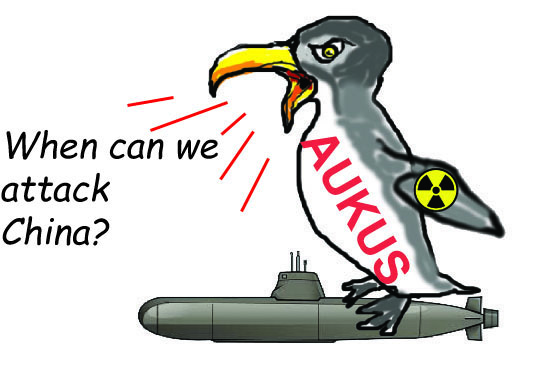
7 March 2026 AIMN Editorial, War Powers Reform https://theaimn.net/still-no-china-invasion-despite-red-alert-predictions/
Today marks three years since a widely criticised media series predicted Australia would be at war with China within three years.
The Red Alert series was published by the Sydney Morning Herald and the Age, and featured a panel of national security experts who claimed war was just around the corner and Australia was woefully unprepared.
“As it turns out all five “experts” were wrong and the authors of the series, Peter Hartcher and Matthew Knott, were also wrong,” said AWPR President and former Senator Andrew Bartlett.
No doubt all of Australia is breathing a sigh of relief today as the threat of annihilation recedes.
While it is easy to make fun of this laughable series of reports, it is depressing to think that the views expressed in the articles are common among establishment defence commentators.
We have had years of fearmongering about imminent threats to Australia, all of which have been shown to lack any credibility. Yet this is what currently passes for mainstream defence expertise.
Rarely does a day go by without a news article featuring a so called expert, demonising our largest trading partner and demanding that Australia spends billions more on the military.
This is despite the fact that the government’s own Defence Strategic Review in 2023 found that there is very little risk of an invasion.
Many commentators regularly suggest that if a war over Taiwan erupted, Australia would be compelled to get involved.
This is a dangerous suggestion and should be rejected outright. The Australian government has the right to decline any US request to join foreign wars.
This is why Australia should urgently re-visit War Powers Reform, which would ensure the whole parliament gets a say on overseas wars.
The John Howard-style ‘captain’s call’ decision-making, which we saw over the Iraq and Afghanistan wars is no longer acceptable in modern Australia” Mr Bartlett concluded.
Review of Nuked: The submarine fiasco that sank Australia’s sovereignty
Morgan Rees, 4 Oct 20225, https://www.thenewdaily.com.au/life/entertainment/books/2025/08/04/aukus-nuked-review
Andrew Fowler’s book Nuked: The submarine fiasco that sank Australia’s sovereignty critically examines the decision by the Australian government – under the leadership of Liberal prime minister Scott Morrison – to enter into the most expensive military acquisition agreement in Australia’s history.
On September 15, 2021, Australia signed a trilateral security agreement with the US and the United Kingdom, known as AUKUS.
The selling point was that Australia would acquire nuclear-powered submarines to replace its ageing Collins-class conventionally-powered fleet. The cost? $368 billion – and possibly, the sovereignty of the nation.
Amid a deep web of lies, deception and media spin, Fowler painstakingly unpacks the extensive efforts Morrison took to deceive the French government as he concocted a highly secretive plan to acquire nuclear submarines.
A mission that, Fowler suggests, has led not only to a massive financial commitment but has ultimately “sunk” Australian sovereignty.
Fowler is well-placed to offer such a deeply penetrating account into Australia’s decision to enter AUKUS. He is an award-winning investigative journalist having previously worked for the ABC’s Four Corners and Foreign Correspondent programs.
Through interviewing many of the main people involved and talking to sources in Paris, London, Washington, and Canberra, Fowler pieces together a devastating account of Australia’s latest military acquisition agreement.
Key themes
Throughout the book, Fowler addresses key themes from the Liberal Party’s long-term desire for closer ties to Washington, to the incremental loss of Australia’s sovereignty in the alliance, and the secrecy around the chain of events that led to the scuttling of the French submarine deal and negotiations for AUKUS.
Liberal Party and US alliance
Central to the story is the long-running narrative within the Liberal Party of Australia’s deep desire to become increasingly tied with the US, despite the lack of guaranteed reciprocity.
From the activation of ANZUS after 9/11, to Australia’s unquestioned following of the US into Iraq, to John Howard’s “captain’s call” on the F35 Joint Strike fighter, Fowler argues that successive Australian governments – particularly conservative Liberal governments – have often made questionable foreign policy decisions to bolster the relationship with the US.
To this end, he shows how even in the lead-up to signing the French submarine deal, there was a push among conservative elements of the Liberal Party to instead go for the inferior Japanese option because that would enable closer cooperation in US-led naval missions.
One of the other interesting issues pointed out was the degree to which the Labor Party felt hamstrung by the agreement. According to Fowler, this was largely due to Labor’s fear of being accused of being weak on matters of national security.
So, pushing back on the agreement was a political minefield ahead of the 2022 election.
Loss of sovereignty
Key to the book is an analysis of the impact of the AUKUS deal on Australia’s sovereignty.
Fowler begins by unpacking the somewhat lopsided history of the alliance as military cooperation grew closer – noting that the Australian government has not always been fully aware of the functions of major military installations like Pine Gap, whose operations, up until the 1970s, had been kept from the government.
Similarly, he touches on the use of other military infrastructure across Australia that is used to relay battlefield commands – and possibly in the future, a nuclear strike.
Fowler makes the case that while there are numerous instances in Australia’s history in which sovereignty has been challenged by alliance partners, AUKUS takes this problem to another level.
Citing a lack of expertise in nuclear-trained operatives, the lack of a domestic nuclear industry, and an acquisition contract in which Australia essentially ceded all negotiating rights, Fowler argues that Australia’s future defence will essentially be at the mercy of the US – a situation that Australia would not have found itself in under the French agreement.
Secrecy and issues in foreign policy
Perhaps one of the most significant issues has to do with the level of secrecy and lack of oversight that is evidently possible in making Australian foreign policy.
Fowler shows how Morrison went about sowing seeds of doubt in the agreement with the French, and used the media to create a sense of urgency by inflating the possibility of conflict with China so that the AUKUS announcement would be received with irreverence.
In doing so, it evaded public debate – and even debate within his own government by keeping the prospective deal secret even from Barnaby Joyce, then leader of the Nationals – on an issue that would ultimately come to undermine Australia’s sovereign capabilities for decades to come.
Conclusion
Nuked is essential reading for researchers and the broader public alike.
Fowler challenges the unquestioning faith in the US alliance held by many on the political right and advances a compelling narrative of Australia’s loss of sovereignty as it edges closer and closer to the US.
The book comes during a critical period in the Australia-US alliance. When written, Joe Biden was in the White House.
While many of the book’s criticisms speak to issues around the decimation of Australian sovereignty resulting from AUKUS, the re-election of President Donald Trump certainly amplifies the need for a critical re-evaluation of AUKUS as the US seems set on departing from its democratic ideals.
Significantly, Fowler raises important questions not just about the future viability of AUKUS, but of the processes of future military acquisition and the significant gaps in checks and balances when it comes to foreign policy decision-making.
The broader implications of AUKUS are immense. Given the political climate and the growing concerns around the viability of AUKUS, the importance of this book has grown.
Overall, Fowler provides the reader – whether an academic or lay person – with a well-written, comprehensively researched account of the events that resulted in the sinking of the French submarine deal through stealth-like manoeuvring to establish AUKUS.
Andrew Fowler’s Nuked: The Submarine Fiasco that Sank Australia’s Sovereignty is published by Melbourne University Press.
The Toxic Legacy of Britain’s Nuclear Testing in Australia
The era of British nuclear testing in Australia was exrraordinary, and its secrets are still being uncovered. Because of ongoing British secrecy, we may not discover them all. In her talk Professor Tynan will examine the complex circumstances taht led the British first to Monte Bello Islands off the coast of Western Australia, then Emu Field and Maralinga in South Australia, to test their atomic weapons. The decision to do so followed the United States’ exclusion of Britain from nuclear weapons and energy R&D after World War II, ostensibly because of the detection of Manhattan Project spies. Australia acquiesced to the atomic tests without asking hard questions, and as a result considerable damage and suffering was inflicted, particularly on Indigenous people and service personnel.
Those hard questions only came decades later, and there are still many to be asked. The British conducted their testing with a greater emphasis on speed than safety. The recklessness of some of the tests carried out in Australia is stunning. Tynan will share specific stories of these dangerous tests and their deadly ramifications for Australians. She will also cover what happened after the British terminated the test series and deliberately misinformed the Australian government about the extent of contamination they left behind. All three test sites were abandoned without proper remediation. The aftermath led to a judicial enquiry, known in Australia as a Royal Commission, in the mid-1980s. This enquiry makred a major shift in Australian attitudes to the tests, and was an important mileestone in an era of uncovering and truth-telling that continues.
Professor Elizabeth Tynan is Head of the Professional Development Program at James Cook University’s Graduate Research School, where she teaches academic writing, editing, and critical thinking skills to postgraduate researchers. She is a former science journalist in both print and broadcast media. Her PhD from the Australian National University examined aspects of the British nuclear tests in Australia in the 1950s and 1960s.
Australian PM Anthony Albanese gave Donald Trump model nuclear submarine on golden plate at White House

Prime minister also presented Melania Trump with a $3,000 Paspaley pearl pendant
Josh Butler, Guardian, Thu 5 Mar 2026
The Australian prime minister, Anthony Albanese, gave Donald Trump a gift of a model nuclear submarine with golden plates and finishes, internal documents reveal, during his visit to the White House last year which sealed the president’s support for the Aukus pact.
The prime minister also presented the US first lady, Melania Trump, with a A$3,000 Paspaley pearl pendant.
The information, obtained by Guardian Australia from the Department of Prime Minister and Cabinet after a four-month freedom of information process, revealed more about the delicate diplomatic planning and charm offensive that went into Albanese’s long-awaited first face-to-face meeting with Trump.
“Gift form” documents from the department reveal Albanese came to the White House bearing a two-foot-long model Virginia-class submarine, mounted on a base with gold plates, and a pearl necklace from one of Australia’s most famous jewellers.
Albanese had previously stated he’d given the Trumps a model submarine and jewellery, but at the time neither Albanese’s office nor his department would reveal any further information about the gifts.
Other world leaders and business titans have showered Trump with expensive gifts – often gold. The Fifa president, Gianni Infantino, presented Trump with a gold medal and golden trophy for a newly created “Fifa peace prize”; the Apple CEO, Tim Cook, gave Trump a glass disc with a golden base; South Korea’s president gave him a golden crown; while a group of Swiss billionaires gave him a golden clock and engraved gold bar………………….https://www.theguardian.com/australia-news/2026/mar/05/australian-pm-albanese-trump-white-house-visit-gold-submarine-gift
1 This month

of the week – Australians for War Powers Reform (AWPR)
To see nuclear-related stories in greater depth and intensity
 Antinuclear