Tourism industry at Maralinga – but how safe is Maralinga nuclear bomb site?
from THE AUSTRALIAN, 26 Oct 15 …… Robin Matthews, the weathered caretaker of Maralinga nuclear test site, welcomes his visitors with some soothing words: the endless expanse of red gibber plain is safe — just as long as you do not dig.
Concealed under the rusty soil lies 60-year-old secrets of the British Empire, where seven nuclear bombs were detonated and hundreds of minor trials using plutonium and other radioactive materials contaminated kilometres of land.

But look close enough and the remnants of the tests are there — from the salt bush that refuses to grow any taller than 30cm and marks out a wide circle in the blast zones to scattered shrapnel and dark-green glass scattered across ground zero at the Breakaway nuclear test site, created by the heat of the explosion……
Most of the land was handed back to the Maralinga Tjarutja Aboriginal people in 2009 after rehabilitation work was finished, but Defence held on to the weapons-testing range in the Woomera Prohibited Area. In November last year, the 1782sq km site was officially handed back to the Aboriginal people.
Government papers released in 2011 show the site had required further remediation, with the topsoil over the massive Taranaki trench — four football fields wide and three storeys deep and now the burial site for contaminated topsoil and machinery — eroding over time.
Maralinga-Tjarutja general manager Richard Preece said the traditional owners of the land still did not want anything to do with the area, which they described as mamu (devil) country…..
Mr Preece said Maralinga was not only a legacy for Aboriginal people, but also for all Australians who had to remediate the site and were now left with buried radioactive material.
“I find it incredible that somehow it was all right for the British government on foreign soil to create a radioactive mess that was completely left to Australia,” he said.
Energy resources of Australia abandons plan to expand Ranger uranium mine
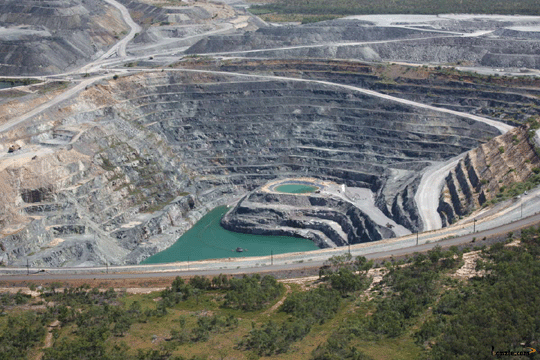 Energy Resources of Australia Accepts Defeat on Ranger Uranium Mine Extension, http://investingnews.com/daily/resource-investing/energy-investing/uranium-investing/energy-resources-of-australia-accepts-defeat-on-ranger-uranium-mine-extension/ Uranium Investing News, Kristen Moran • October 19, 2015 Mining Australia reported that Energy Resources of Australia (ASX:ERA) has decided to accept defeat on plan to extend Ranger uranium mine beyond 2021.
As quoted in the market news:
A statement from ERA this afternoon revealed the Mirrar Traditional Owners and Gundjeihmi Aboriginal Corporation do not support an extension to the authority to mine at Ranger, in Kakadu National Park.
A statement from ERA said the company respected the views of the Traditional Owners, and would undertake a business review in light of their decision.
“In light of this development, ERA has commenced a process of assessing whether the company’s assets may be impaired,” the company said.
The news was welcomed by Environment Centre NT, where Nuclear Free campaigner Lauren Mellor said it was time for “the era of rehabilitation and a staged and managed exit from Kakadu to begin”.
“ERA must now accept full financial responsibility for the costly and complex task of rehabilitation, accept Rio’s funding offer and cooperate with all stakeholders in the transition to a post-mining phase of operations,” Mellor said.
Indigenous owners will manage huge new protected area in New South Wales
 Historic return of land to Indigenous owners in biggest protected area in South Australia There’s been an historic handover to traditional landowners in New South Wales, SBS, 27 SEP 2015 The 22,000 hectare Mawonga Station is now the biggest piece of Indigenous protected land in Southern Australia.
It’s located in central New South Wales, about 550 kilometres west of Sydney, and is the home of the Ngiyampaa Wangaaypuwan people…….
The handover happened thanks to a partnership between the federal government, the Indigenous Land Corporation, and the Nature Conservation Trust of NSW.
Nature Conservation Trust Board Member Russell Taylor said it will protect, preserve and maintain the natural and cultural heritage of country.
The land repatriation isn’t a native title claim. Former Labor environment minister Peter Garrett signed off on its purchase by the Indigenous Land Council in 2011.
“It was one of the great pleasures in my life as environment minister when i could start this process as a government and i think the tax payers got pretty good value from it to tell you the truth,” he said.
The former owner recognised sacred rock art sites on the property and pushed for its sale to an Aboriginal group, then to return it to its rightful owners.
It’s become the largest Indigenous Protection Area in southeast Australia. ……http://www.sbs.com.au/news/article/2015/09/27/historic-return-land-indigenous-owners-biggest-protected-area-south-australia
Aboriginal women will fight on against nuclear waste dumping in South Australia
Aboriginal women reaffirm fight against nuclear waste dump in South Australia ABC Radio National, The World Today By Natalie Whiting 16 Oct 15 The first shipment of Australia’s nuclear waste to be returned from re-processing in France has now left a French port, and will arrive on our shores by the end of the year. The return of the 25 tonnes of nuclear waste is putting renewed pressure on the Federal Government to find a location for a permanent waste dump.
The shipment began its journey just a day after senior Aboriginal women gathered in Adelaide to mark their fight against a proposed dump in South Australia in the 1990s.
The women say they will fight against any new move to put the waste on their land…..
SA Aboriginal women remember waste dump victory A Federal Government plan to build a  nuclear waste dump in the South Australian outback in 1998 attracted fierce opposition, especially among local Aboriginal people.
An event in Adelaide last night celebrated the work of a group of women called kupa piti kungka tjuta, who campaigned against the dump. Emily Austin from Coober Pedy was one of them. (centre in picture)
The women campaigned for six years until a Federal Court challenge from the South Australian government put an end to the dump. Ms Austin said she could remember the day the court found in South Australia’s favour.
“I was out in the bush hunting and I heard it on the radio in the Toyota. We were all screaming, ‘We won’.
“All the kungkas (women) were happy.”
While the Federal Government is in the midst of a voluntary process for finding a site for a dump, South Australia’s outback is still seen as an ideal location.
The South Australian Government’s attitude to the industry has been shifting.
It has launched a royal commission to investigate possible further involvement in the nuclear fuel cycle.The royal commission is looking at everything from mining uranium, processing, waste storage and nuclear power.
The organiser of last night’s event, Karina Lester, is the granddaughter of one of the women who campaigned and her father was blinded by the British nuclear tests at Maralinga half a century ago.
She said the Aboriginal people in South Australia’s north have a long and tortured history with the nuclear industry. “Maralinga’s had a huge impact because people speak from first-hand experience,” she said.
“People like the amazing kupa piti kungka tjuta, many of those old women who are no longer with us today, they were there the day the ground shook and the black mist rolled.
“It’s an industry that doesn’t sit comfortably with Anungu community.”
Ms Lester said it was good to see the royal commission consulting with people before a decision is made.”Credit to the royal commission that they’ve made an effort to engage with a broader community of Aboriginal communities,” she said.
“But how many of those Anangu are really understanding he technicality of this royal commission and what industry really means?” Ms Austin said she was ready to fight any future attempts to set up a waste dump in the region.
“Oh yeah, I’ve still got fight yet. They might stop yet, they might listen, I dunno,” she said. http://www.abc.net.au/news/2015-10-16/aboriginal-women-fight-against-nuclear-waste-dump-in-sa/6861012
There needs to be a stronger framework for Aboriginal property rights
At the heart of current concerns are two apparent contradictions.
First, to get back their land, Indigenous claimants need to legally demonstrate continuity of rights and interests under traditional laws acknowledged and traditional customs observed and to demonstrate continuity of connection with lands and waters since colonisation. Similar requirements are stipulated in earlier land rights law to demonstrate primary spiritual responsibility for land and to have a right to forage, to economically use, land claimed.
Such special relationship with land that is usually of low commercial value, in turn requires land owners to live remote from mainstream work opportunities. The maintenance of tradition that is required to claim the land, and hold it, geographically disadvantages land holders in their engagements with 21stcentury global capitalism. This also raises important questions about what constitutes ‘economic development’ from the perspective of Indigenous land owners.
Second, in accord with tradition land is inalienable. There was no trade in land pre-colonially and so land was passed inter-generationally on the basis of descent.
I am not convinced that inalienability is a major hurdle to development………
What is more significant, in my opinion, is the issue of property rights and the legal finding that mineral ownership is vested with the crown alongside state assertion of exclusive rights to own and regulate valuable natural resources like fresh water, fisheries and even carbon for commercial purposes….
Unfortunately, the Native Title Act framework provides native title groups a far weaker property right, a mere right to negotiate with a window of opportunity of six months, at best, and a right of consultation, at worst. This has resulted in many benefit sharing agreements, although whether they are equitable remains a contentious point.
And as Indigenous people get back more and more of the continent, political pressure continues to deprive them of ownership of commercially valuable resources: minerals, fisheries and fresh water. And as resource hungry developers look to explore and exploit Indigenous lands, there is a risk that disparities between Indigenous and non-Indigenous Australians might increase rather than decline.
Equally unfortunately, while the dominant approach to Indigenous development focuses on ‘mainstreaming’ the only guarantees that Indigenous people have to resources are outside the market system. So, Indigenous groups may be guaranteed ‘customary’ non-market rights, but not commercial market rights.
The Australian Law Reform Commission has produced the only policy response to grasp this key issue when it recommends that native title rights and interests might be exercised for any purpose, including the commercial alongside hunting, fishing, gathering and trading rights and interests. This is a means to empower Indigenous land owners to have the freedom to make development choice, although such policy reform could exacerbate wealth and wellbeing differentials between those who own land and those who do not.
Others like the White Paper and the Australian Human Rights Commission focus too much on real or imagined over-regulation of Indigenous lands and seek the removal of what Mick Gooda and Tim Wilson refer to as ‘red and green tape that stifles Indigenous development’. This all sounds too much like Keating’s warnings about ‘workability’ and risks change that will be structural and disempowering of the Indigenous disadvantaged in favour of the rich and powerful.
It might be timely for those who champion ‘rights to development’ to advocate for stronger Indigenous property rights either by making them inclusive of commercial rights, at best, or by making them the equivalent of the free prior informed consent rights proposed by Justice Woodward and embedded in land rights law nearly 40 years ago.
Such advocacy might see prospects for Closing the Gap enhanced for those Indigenous people who prioritise development in the mainstream while simultaneously enhancing livelihood prospects from alternate forms of development for those who choose otherwise.
As the Broome Communiqué of May 2015 noted there are tensions between cultural matters, environmental protection and development objectives. Stronger native title property rights are a potentially important means to ameliorate such tensions.
A version of this article was published in Land Rights News Northern Edition August 2015/Edition 3.

Western Australia’s govt slow to re-register Aboriginal sacred sites
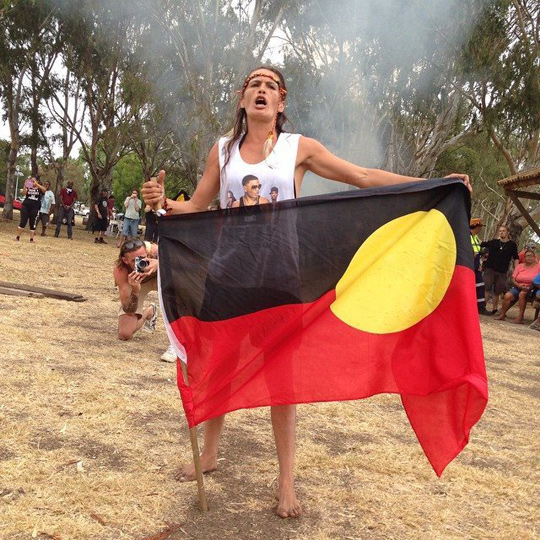 WA Government ‘dragging feet’ over sacred site registration: Indigenous group, ABC News 25 Sep 15 By Kathryn Diss An Aboriginal heritage group has accused the State Government of dragging its feet on reinstating several sacred sites it deregistered over the past year.
Several culturally significant sites around WA have had their protection withdrawn on the basis they no longer fit the definition of a sacred site.
Guidelines issued by the Department of Aboriginal Affairs stated that to be a recognised sacred site, a place needed to have been devoted to religious use rather than simply mythological stories, songs or beliefs.
But in a test case in April challenging the Aboriginal Cultural Materials Committee’s (ACMC) deregistration of a site in Port Hedland, the Supreme Court quashed the decision to remove it from the protected list.
Dr Stephen Bennetts from the Aboriginal Heritage Action Alliance said it had been months since the ruling was handed down and the government had not yet reinstated the other sites.
Dr Bennetts said he is concerned the sites could be damaged if they were not adequately protected. “It is quite possible some of those may have already been damaged,” he said.
Dr Bennetts said it was a scandal none of the custodians of the deregistered sites had been notified of the court’s decision.
“Because we know the reasoning the ACMC deregistered them in the first place was to make it easier for developers to get their approvals that was the exact reason,” he said………..http://www.abc.net.au/news/2015-09-25/call-for-indigenous-heritage-sites-to-be-re-registered/6804082
We do not want nuclear anything on our Land – Anangu Pitjantjatjara Yankunytjatjara Law and Culture
APY LAW & CULTURE – CONCERNS FOR NUCLEAR WASTE, Coober Pedy Regional Times, 24 Sept 15, Anangu Pitjantjatjara Yankunytjatjara Law and Culture is declaring its intention to move away from the APY Administration. For a long time our committee has been worried about the direction the APY Administration is taking.
On several occasions we have been told Law and Culture is a side committee, that it is second to the APY.
Law and Culture comes first. It always has. The administration needs to understand this. All Anangu know that our Law and Culture comes first, our Law and Culture must be at the heart of decision making. We have decided to stand alone. Our Law and Culture will come first. Our lives depend on it. We will source alternate funding.
One of our big concerns is the Royal Commission into Nuclear Energy. Law and Culture says no to APY Lands being used to mine uranium or dump the waste.
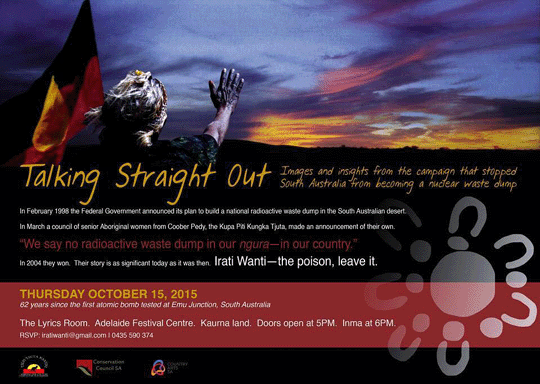
#SOSBLAKAUSTRALIA: Stop the Forced Closure of Aboriginal Communities in Australia
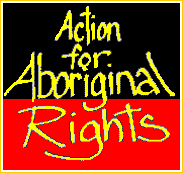 #SOSBLAKAUSTRALIA 5th Global Call to action announced:
Stop the Forced Closure of Aboriginal Communities in Australia
https://www.facebook.com/sosblakaustralia/photos/a.1042299689120174.1073741828.1042255972457879/1158023780881097/?type=1&theater
16 Sep 15: “With the recent change of leadership in the current LNP government and last week’s announcement of eight Indigenous individuals confirmed to determine the fate of 274 Aboriginal Communities in Western Australia alongside what the Government claims to be a ‘consultative process’, a new date has been set for the 5th Global Call to Action – Friday 27th November 2015.
… #SOSBLAKAUSTRALIA grew out of necessity in the response to the threatened forced closure of Aboriginal communities. Our extended reach is in excess of 12 million people and our direct reach is close to 75,000. Our goal goes well beyond any ‘consultation’. Regardless of who is prime minister, we
are committed to keeping our communities on their homelands and we have been consulting among our own people to develop sustainable and viable models for communities, outstations and seasonal campsites.
To support this work, we are steadily galvanising support from NGOs, unions, the legal fraternity and public figures and have built a skills database with submissions from thousands of everyday people worldwide, who care as much as we do about our Aboriginal culture and human rights.
#SOSBLAKAUSTRALIA itself will be scaled up to increase its capacity, whilst supporting a cultural revolution, political platform and fundraising campaign.
Walkatjurra Walkabout completes 5th walk against uranium mining in West Australia
http://walkingforcountry.com/2015/09/17/41888/ 16 Sep 15: “The Walkatjurra Walkabout, which started in 2011, finished its 5th walk in the North Eastern Goldfields town of Leonora on Tuesday. The walk, a collaboration of Aboriginal and non-indigenous people, is a moving community protest against the proposed uranium mines in the region.
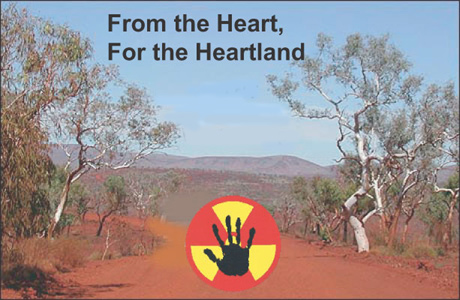
The month long walk, lead by local Traditional Owners, covered almost 450 km’s from Wiluna to Leonora, passing Toro Energy’s Wiluna uranium mine proposal at Lake Way and Cameco’s proposed uranium mine at Yeelirrie Station. Walk participants included local Traditional Owners, people
from Australia, Japan, Taiwan, England, Sweden, Aotearoa (New Zealand), America and France.
The walks continue to attract people interested in learning about Aboriginal culture, caring for country and to share a united vision for a nuclear free world.
 The walk was also joined at Yeelirrie for two days by Federal Greens senators Rachel Siewert and Co-Deputy Greens leader Scott Ludlam along with state Greens MLC Robin Chapple.
The visit included a tour of Toro Energy’s uranium project at Lake Way near Wiluna with walkers and Toro Energy. Many of the participants have first hand experience of the
dangers of the nuclear industry, especially those from Japan and Taiwan, whose nuclear industry are fuelled by Australian uranium. … “
AUDIO: Aboriginal Freedom Summit 2 pushes for Treaty
 AUDIO Freedom Summit 2 pushes for Treaty http://caama.com.au/freedom-summit-2-pushes-for-treaty 14/09/2015 Organisers of the three day Freedom Summit held in Alice Springs say they will continue to push Government towards how treaties can be made with Aboriginal and Islander communities across the country.
Grass root Aboriginal leaders including South Australian Narungga Elder Tauto Sansbury came together in Central Australia to discuss and address a range of issues and government policies that continue impact on his people.
Winda-Mara – Aboriginal success stories that we just don’t hear about
Stories like Winda-Mara’s need to be told—they show how Aboriginal communities are more than capable of creating their own forms of livelihood, if given space to do so. Winda-Mara’s diversity has been key to its success—rather than being just a “health” or “employment” program, it approaches issues holistically, asserting that cultural heritage protection and community health are fundamentally linked. Now that my eyes are open to it, I’ve realised that other Aboriginal communities across the country have similar stories. Let’s find and share these stories, and support these communities in articulating their own visions for their futures.
The Indigenous Australia We Don’t Talk About http://honisoit.com/2015/08/the-indigenous-australia-we-dont-talk-about/
By Andy Mason on August 8, 2015 It’s not very often that most of us hear success stories from Aboriginal communities. The overwhelming majority of the mainstream media treatment of Indigenous issues focuses on the (very real) problems which affect Aboriginal people, problems which can seem so complex and entrenched that imagining solutions usually seems impossible. In a society still dominated by a collective denial of our violent past and oppressive present, a society which hides behind empty sloganeering about ‘progress’ as it continues to punish Aboriginal people whenever they articulate their desire for control over their own lives, any coverage at all can seem like a blessing. But I wonder if only ever hearing the negative stories helps to reinforce an understanding of the situation as intractable and hopeless—if it perhaps leads us away from imagining and articulating alternatives.
A couple of weeks ago, my partner and I were privileged to be able to visit Winda-Mara, an Aboriginal co-operative run by local Gunditjmara people in Heywood, south-western Victoria. Winda-Mara was established in 1991 as an Aboriginal health organisation with the aim of providing culturally appropriate healthcare to the community. Since then, the organisation has expanded to also include housing, education, employment, and environmental and cultural heritage management. Continue reading
Mirrar people mourn Hiroshima, and regret impacts of uranium sourced from their land
Mirarr recognise 70 years since nuclear bombs destroyed Hiroshima and Nagasaki 06 Aug 2015 The Mirarr traditional owners of lands in Australia’s Northern Territory, including parts of Kakadu National Park and the Ranger and Jabiluka uranium deposits, acknowledge with sadness the seventy year anniversary of the world’s first nuclear bomb attacks.
Gundjeihmi Aboriginal Corporation, which represents the Mirarr, is supporting commemoration events around the country in recognition of the strong links between Mirarr country and Japan and the great damage that the nuclear industry has inflicted on people and country over these 70 years.
Gundjeihmi Aboriginal Corporation CEO Justin O’Brien said: “There is a strong history between Mirarr country and Japan. Mining began at Ranger- against the wishes of the Mirarr – in large part because of agreements between the Australian and Japanese governments.”
In 1978 before Ranger mine opened, then Senior Traditional Owner Taby Gangale was worried the uranium from his land might be used in nuclear weapons stating: “What if they make an atom bomb or something? Same as they did in Japan. Very dangerous.”
The Mirarr feel great responsibility for the impacts of uranium sourced from their land. Soon after the 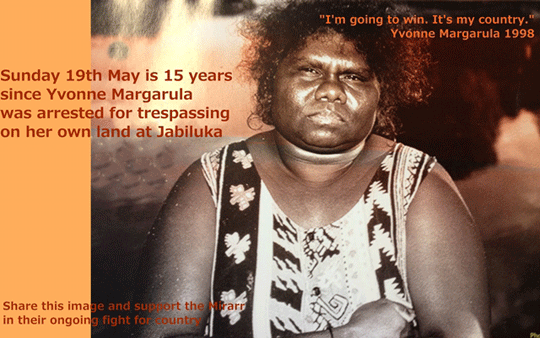 nuclear emergency started at Fukushima, Mirarr senior traditional owner Yvonne Margarula wrote a letter to UN Secretary General Ban Ki Moon expressing her concern and sadness at the devastation that uranium from her lands was causing in Japan: “This is an industry we never supported in the past and want no part of in the future. We are all diminished by the events unfolding at Fukushima” Ms Margarula wrote at the time.
“In 2014 the Mirarr hosted a visit from Naoto Kan, who was Prime Minister of Japan at the time of the Fukushima nuclear emergency. Mr Kan’s visit marked a new chapter in the longstanding partnership between our two countries. We discussed the ways in which uranium has damaged both Mirarr country and Japan and the importance of working together towards peaceful energy sources and better outcomes for all people.” Mr O’Brien concluded
For details of commemoration events visit the website of the International Campaign to Abolish Nuclear Weapons www.icanw.org.au For further information including photographs of the Mirarr, Naoto Kan and Ranger mine contact Kirsten Blair:  0412 853 641
Northern Territory development : Aboriginal owners asked to agree to extinguish native title
 Northern Land Council calls for major rethink of northern development amid concerns about Ord expansion talks PM By Sara Everingham ABC New, 25 July 15, The head of the Northern Land Council (NLC) has said a major rethink of northern development is needed and he fears one of the Northern Territory Government’s key strategies for boosting agriculture will lead to little but heartache for Indigenous people.
Chief executive officer Joe Morrison said traditional owners were being asked to agree to extinguish native title to allow for the expansion of the Ord Irrigation Scheme from the East Kimberley into the Northern Territory but he said he was worried there would be few lasting benefits in return.
Western Australia’s Barnett goverment moving Aborigines off their land to benefit miners
 It is a trend that points to one thing — move indigenous people off their country so that the miners get a free hand and they can do as they will.
Michael Martinez: WA stance on indigenous Australia a worrying sign, MICHAEL MARTINEZ GEELONG ADVERTISER JULY 09, 2015 “…….. Mr Barnett and his pro-mining party members are trying to change the Aboriginal Heritage Act so that one bureaucrat can make a decision determining if a site is sacred or not.
There has already been a Supreme Court decision questioning the deregistering of a sacred site in Port Headland, and there are 22 other sites that the West Australian Government has removed during the past few years.
 A government committee in Western Australia and the minister decided that the land and waters around parts of Port Hedland port should no longer be considered an Aboriginal sacred site because it had not been used for religious purposes.
Justice Chaney said in his judgment: “I conclude that the committee did not give consideration to the question of whether or not the Marapikurrinya Yintha was a place of importance or special significance because the question did not arise for consideration in light of the conclusion that it was not a sacred site.” Continue reading
The hypocrisy of Abbott and Shorten in the constitutional “recognition” for Aborigines
On July 1, just days before the Kirribilli gathering, the Abbott government cut off funding for the Aboriginal Medical Service at Mount Druitt in western Sydney, cutting adrift its 11,000 active patients and 96 doctors, nurses and other staff.
Since the 2014 federal budget, the Abbott government has stripped $600 million in funding from indigenous community organisations, including health, legal and language support services. It has also driven, via funding cuts, moves to shut down hundreds of remote settlements in Western Australia and elsewhere, forcing their residents off traditional lands.
Despite the hype, no concrete proposals emerged from Monday’s gathering
Australia: The political fraud of constitutional “recognition” for Aborigines, World Socialist Website By Mike Head 8 July 2015 A hand-picked group of 40 indigenous officials and academics joined Prime Minister Tony Abbott and opposition Labor Party leader Bill Shorten in Sydney on Monday for what was billed by the establishment media as an “historic summit” to discuss a proposed referendum to “recognise” indigenous people in the Australian Constitution.
The contrived event, staged at Kirribilli on Sydney Harbour, one of the city’s most affluent neighbourhoods, exposed the widening social and economic gulf between these privileged layers and the vast majority of Aboriginal and Torres Strait Islander people, who live in poverty-stricken working class suburbs, rural towns and remote settlements……. Continue reading
1 This month.
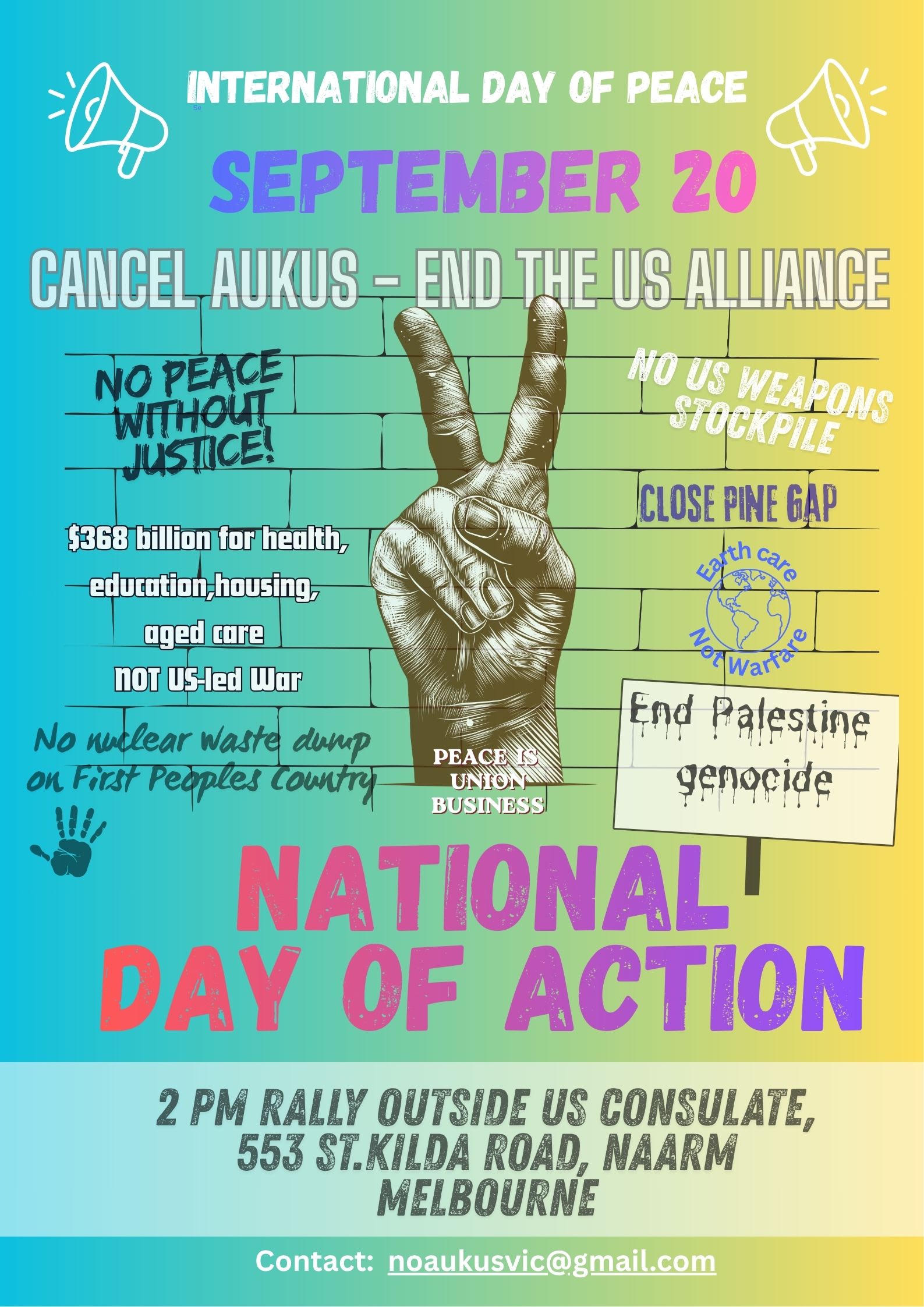
20 September –National Day of Action in Melbourne on the International Day of Peace

Help Aunty Sue Protect Her Land and Sacred Sites From Destructive Rocket Testing.
.

Australians deserve the truth
about
AUKUS – https://aukuspublicinquiry.com/


PETITION – To: Prime Minister Anthony Albanese and the Australian Labor Government

of the week – Australians for War Powers Reform (AWPR)
To see nuclear-related stories in greater depth and intensity
 Antinuclear