Respected Aboriginal women elders explain the importance of the Homelands
 ‘People wanted to go back to homeland’
Mr McLarty said many of the small communities were created in response to government policy last century which saw Aboriginal people forcibly amalgamated into camps with other tribes.
“People wanted to move back to their own homeland,” he said.
“People wanted to go out to their own community, to feel some ownership, because they didn’t feel like they belong here in another tribal area.”
He said the Prime Minister’s comments may come from a lack of understanding of Aboriginal people’s history.
The women said remote communities were being unfairly painted as dysfunctional.
They argued that in most communities, children were safer and happier being raised ‘on-country’, where there was not the steady flow of drugs and alcohol and they could learn the traditional culture.
 Remote Aboriginal community closures: Return to country or risk losing traditional homes forever, elders warn http://www.abc.net.au/news/2015-03-11/indigenous-community-members-called-on-to-return-to-country/6304716 By Erin Parke and Rebecca Trigger Senior Aboriginal women from WA’s Kimberley say the Prime Minister’s “lifestyle choice” comments are a wake-up call and people who have drifted from their bush communities should return or risk losing them forever.
The call comes in the wake of Tony Abbott’s suggestion that living in remote Aboriginal communities was a “lifestyle choice” that could not be endlessly subsidised by the Government.
Senior Miriuwung Gajerrong woman and chairperson of the Kimberley Aboriginal Law and Culture Centre Merle Carter said the comments should spur people into action.
“For all of our people who are living in town, who are fringe-dwellers, just because of alcohol, go back to your communities,” she said.
“With the statement that Premier Colin Barnett made about closing the Aboriginal communities, and Tony Abbott backing him up, this might be a wake-up call.” Continue reading
Four years on: Kakadu Traditional Owners remain saddened by ongoing Fukushima disaster
11 March 15 The Mirarr Traditional Owners of parts of Kakadu National Park including the Ranger and Jabiluka uranium deposits have expressed their continued sadness on the fourth anniversary of the Fukushima nuclear disaster. Contamination from the failed reactors has forced over 150,000 people to permanently leave their homes and details of the ongoing human and environmental devastation continue to emerge with new leaks of highly radioactive water from the site detected just last month.
In October 2011 the Australian Safeguards and Non-Proliferation Office (ASNO) confirmed the Fukushima nuclear crisis was directly fuelled by uranium from Australia. At the time Mirarr Senior Traditional Owner Yvonne Margarula wrote to UN Secretary General Ban Ki Moon expressing her concern and sadness at the devastation that uranium from her lands was causing in Japan: “This is an industry we never supported in the past and want no part of in the future. We are all diminished by the events unfolding at Fukushima,” Ms Margarula wrote.
In August 2014 the Mirarr along with national environment, union and public health groups, hosted an Australian tour of Mr Naoto Kan. Mr Kan was Prime Minister of Japan when the Fukushima reactors failed and, though previously a supporter of nuclear power, is now a passionate advocate for safe renewable energy sources. Mr Kan was particularly affected by his visit to Mirarr country and the Ranger mine which has supplied Japan with uranium for over three decades.
Gundjeihmi Aboriginal Corporation CEO Justin O’Brien said: “Mirarr country and Japan have been linked by nuclear issues for many years. On this fourth anniversary of the Fukushima disaster we send our thoughts to the people of Japan, whose lives have been irrevocably changed by that terrible event.”
“The impacts of the nuclear industry will be felt for generations in every place and amongst all peoples it touches. Here in Kakadu the legacy of uranium mining is all too evident and we are deeply saddened to learn of the ongoing and increasing impacts of the failed reactors on the people and country of Japan,” Mr O’Brien concluded.
Tony Abbott completely out of touch with understanding of Aboriginal culture
West Australian Greens Sentor Rachel Siewert joined the chorus of criticism, releasing a statement describing Mr Abbott’s comments as “unbelievably racist and completely out of touch”.
“The cultures that exist within these communities are thousands of years old and stretch far beyond the Prime Ministers bizarre idea of a ‘lifestyle choice’,” she said
By Rebecca Curtin and political reporter Jane Norman The Prime Minister backs a WA Government proposal to close a number of remote Indigenous communities, saying it is not the taxpayer’s job to subsidise “lifestyle choices”, prompting a backlash from Indigenous Australians. The Federal Opposition is demanding the Prime Minister apologise after he suggested it is a lifestyle choice to live in remote indigenous communities.
Rolf de Heer on Tony Abbott and”lifestyle choices” for Aboriginals
Rolf de Heer slams Tony Abbott over ‘lifestyle choice’ comments on remote Aboriginal communities, SMH March 11, 2015 Garry Maddox Australian filmmaker Rolf de Heer has lashed out at Prime Minister Tony Abbott for saying that indigenous Australians live in remote communities because of “lifestyle choices”.
Speaking after the Aboriginal drama Charlie’s Country won best film and best director at the Film Critics Circle of Australia Awards in Sydney, the director of such acclaimed indigenous dramas as The Tracker and Ten Canoes described the comment as “offensive”.
“It’s so inappropriate that it’s laughable,” de Heer told Fairfax Media after the awards. “It shows such ignorance that he has no right to be the prime minister of Australia.” ………
A fired up De Heer said that to make those comments about the residents of remote communities was “profoundly misunderstanding” of Aboriginal culture and economic reality.
“It’s hypocritical that our Prime Minister pretends to be the Minister for Aboriginal Affairs and has so little understanding of what it is to be on country and that there is no choice involved,” he said.
“There are no jobs so they earn nothing. So they get welfare and they pay twice as much for their food as we do. Welfare is not enough here, let alone there. So they have a choice to move somewhere else?”
De Heer said David Gulpilil, the acclaimed actor whose struggles with alcohol, drugs and the law inspired the fictional central character in Charlie’s Country, had been forced to live in Murray Bridge outside Adelaide.
“He can’t afford to live in Darwin and somebody will put him up in Murray Bridge. That’s a lifestyle choice? Yeah. Thank you Mr Abbott.” http://www.smh.com.au/entertainment/movies/rolf-de-heer-slams-tony-abbott-over-lifestyle-choice-comments-on-remote-aboriginal-communities-20150310-140it3.html#ixzz3U1KMlmDc
Murky dealings in Western Australia’s Kintyre uranium mine proposal
Do the Martu people really want uranium mined nearby their communities? It does not sound like it but their permission is ‘official’…….
Wiluna Elder Geoff Cooke will fight to the end to prevent mining on his Country.
“We are the custodians of the land. Uranium is a poison. Our rivers will be poisoned. Our trees will be poisoned. Our food will be contaminated. Our people will become sick.

Uranium mine proposal approved – on Martu Country, The Stringer, by Gerry Georgatos March 7th, 2015 Western Australia’s largest national park is facing its biggest threat – uranium mining. Last Thursday, the State’s Environment Minister approved a uranium mine proposal while in the background an investigation is plodding along into allegations of improper dealings by some Traditional Owners.
Anti-uranium campaigner and conservationist Mia Pepper said, “The Minister, Albert Jacobs, approved the proposed uranium mine at Kintyre, a unique ecosystem that was excised from the Karlamilyi National Park to allow mining.” In the Northern Territory, Jabiluka was excised from the World Heritage listed Kakadu. When it comes to uranium mining – and mining in general – anything can happen, even in the middle of a world famous and world heritage listed national park.
“Uranium mining would impact on scarce water resources and a number of significant and vulnerable species including the bilby, marsupial mole and rock wallaby, ” said Ms Pepper.
The Federal Environment Minister, Greg Hunt, will decide the final approval check, but it is a given. The national park and Kintyre are surrounded by Martu communities. It is Martu Country but for those with the huge quid in mind, it is uranium country. The Parnngurr community has been fighting against the uranium proposal. Continue reading
WA Premier Colin Barnett talks about “review” of remote Aboriginal communities, but won’t meet their leaders
Barnett made the comments to PerthNow on Thursday morning, the same time as a meeting of the alliance of WA land councils in Broome.
Aboriginal land councils used the meeting to insist that Aboriginal people be given a say in issues like the remote community closures, declaring in a joint statement that “governments cannot decide where Aboriginal people live in Western Australia”.
Barnett was invited to attend that meeting but declined due to “prior commitments”.
He told PerthNow that a “comprehensive look” at the viability of remote Aboriginal communities was “under way” and he expected it to uncover evidence of “abuse”…… Continue reading
Marcia Langton doesn’t get it right on mining agreements
 Marcia Langton should go back to the drawing board on mining agreement praise Australian Conservation Foundation, March 6, 2015 Declaring mining agreements a success in Aboriginal communities after reviewing less than two percent of agreements seems a stretch, writes Dave Sweeney
Earlier this month mining executives mingled with politicians in federal Parliament’s Mural Hall as Indigenous Affairs Minister Nigel Scullion launched a new publication from the Minerals Council of Australia.
From Conflict to Cooperation, by Melbourne University’s Professor Marcia Langton, sets out to examine the “transformations and challenges in the engagement between the Australian minerals industry and Australian Indigenous peoples”.
Professor Langton’s main contention is that there has been an enormous improvement in relations and outcomes between miners and Aboriginal peoples over the past two to four decades. Aboriginal communities have experienced significant economic benefit and these now need to be consolidated through regulatory reform and a new economically driven Aboriginal financial trust and organisational structure.
Professor Langton has fulsome praise for the collaborative, indeed transformative, nature of the new era of Industry-Indigenous relationships and lauds mining companies and executives.
Two aspects of this paper are surprising.
One, Professor Langton sharply identifies the institutional bias and capacity constraints that work against Aboriginal communities and organisations in complex negotiations processes, yet she still claims the system delivers.
Two, her enthusiasm about the benefits of mining agreements is based on surprisingly scant information.
Late last decade the Native Title Working Group identified obstacles that frequently get in the way of successful agreements between Indigenous communities and mining companies. The working group noted that “there are only a limited number of good agreements to provide models… The reasons for the absence of more agreements containing substantial financial and other benefits for traditional owners after almost 15 years of the operation of the Native Title Act 1993 (NTA) is, in itself, deserving of inquiry”.
Indeed, it still is. This fact is highlighted by the confusing data on Aboriginal employment in the resources sector and the lack of detail on economic benefits.
The plentiful talk of jobs and dollars is not backed up with many hard facts.
Mining Agreements are rarely agreed and seldom seen. In the everyday world an agreement is a deal based on shared understanding, but in the world of the Native Title Amendment Act (1998) and the mining sector it means the right to negotiate, but not to say no……..https://www.acfonline.org.au/news-media/acf-opinion/marcia-langton-should-go-back-drawing-board-mining-agreement-praise
South Australian government wanting to radioactively pollute Aboriginal land yet again?
“You know you feel gutted when they want to bring the nuke agenda back on,” she said. “The place has already been contaminated.
Maralinga could be flagged as nuclear dump site, opponent says in wake of SA royal commission, ABC News, 28 Feb 15 By Wendy Glamocak Less than four months after land used for nuclear testing in the 1950s was officially handed back to its traditional owners in full, nuclear is back on the agenda at Maralinga in South Australia.
Most of Maralinga’s 103,000 square kilometre lands were handed back to the Maralinga-Tjuarutja people in the 1980s, and in 2009, a 3,000 square kilometre site known as Section 400 that had been heavily contaminated by radiation and hazardous chemicals, was also handed back.
In November last year, the Defence Department officially gave the Maralinga-Tjarutja full control and unrestricted access to the lands.
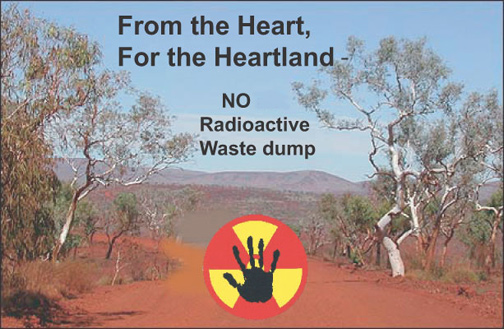
Those connected to the land are worried that a newNuclear Fuel Cycle Royal Commission announced recently by Premier Jay Weatherill will see the land flagged as a potential site for a nuclear waste dump.
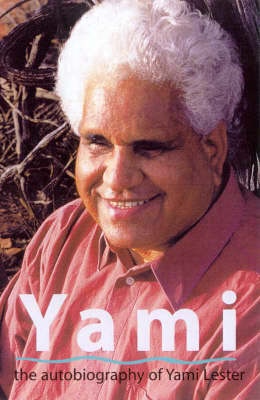
Karina Lester is the daughter of Yammi Lester, a man who said he was blinded by atomic tests on the site half a century ago. She said her grandmother was part of the Kupa Piti Kungka Tjuta, a council of senior Aboriginal women from northern SA who fought against the Howard Government’s plans in 1988 to build a national radioactive waste dump near Woomera.
After strong opposition from the local community, and from former SA premier Mike Rann, who won a High Court challenge against the proposal, the plan was abandoned in 2004.
Ms Lester said many custodians of the land were worried that the royal commission set up by Mr Weatherill meant they would soon have another fight on their hands.
“You know you feel gutted when they want to bring the nuke agenda back on,” she said. “The place has already been contaminated.
“Traditional owners are trying to move on from what happened back in the ’50s, but to perhaps propose that it’s a site for the waste, I think, is just another kick in the guts to the traditional owners up there at Maralinga-Tjaratja.
“Enough’s enough.”
Language difficulties could ‘stand in the way’
Ms Lester said many traditional owners will want to make a submission to the royal commission but she was worried language difficulties would stand in their way.
The Premier’s office did not respond to ABC questions on Ms Lester’s concerns……..http://www.abc.net.au/news/2015-02-28/maralinga-could-be-flagged-as-nuclear-dump-site-opponents-say/6270848
Highly respected South Australian Aboriginal, Yami Lester, speaks out on nuclear waste dump plan
I’m hoping you will support us with this very important issue which has arisen from SA Goverenment regarding a Royal Commission into Nuclear Energy and proposal to store high-level nuclear waste at Maralinga, South Australia
Please read. With thanks, Yami Lester, Yankunytjatjara Walatinna Station, South Australia (08) 8670 5077
 Statement on Royal Commission into Nuclear Energy and proposal to store high-level nuclear waste at Maralinga, South Australia:

In 1953 I was just ten years old when the bombs went off at Emu and Maralinga, I
didn’t know anything about nuclear issues back then, none of us knew what was happening. I got sick, and went blind from the fallout from those tests, and lot of our people got sick and died also.
Now I’m 73 years old and I know about nuclear issues, and I have some friends who know about nuclear waste, and they will fight the South Australian Government on their plans to put high-level nuclear waste at Maralinga and to develop nuclear energy in South Australia.
Why does the government keep bringing back nuclear issues when we know the problems last forever?
The Royal Commission into British Nuclear Tests in Australia (1984-85) revealed
what happened at Maralinga but it never told what happened to Aboriginal people; the findings were left open.Lawyers proved that there was radiation fallout over Walatinna, but because wenever had any doctors records to document what happened to us, (the closest clinic was Ernabella, 160km away as the crow flys and we didn’t have any transport to get there), we only had our stories and they were never written down.
A few years ago they cleaned up Maralinga from the waste that was leftover from the bomb tests; they spent $1 million, and now they’re going to put more waste back there?
That’s not fair because it’s Anangu land and they won’t be able to use that land.
Members from the APY, Maralinga-Tjarutja and Arabunna, Kokatha lands say we don’t want nuclear waste on our land.
The best thing the government can do is the leave the uranium in the ground, stop mining it.
We ask the South Australian Premier, Jay Weatherill, to talk to Aboriginal people on the lands, and to everyone who has been directly affected by the atomic tests and nuclear industry in Australia before he makes any decisions for South Australia.
South Australia’s proud history of the win against nuclear waste, a win led by Aboriginal women
One media narrative, as espoused in the AFR, is that this defeat was the result of a revolt by SA politicians. But this version of the story ignores the powerful campaign led by the Kupa Piti Kungka Tjuta, the senior aboriginal women’s council of Coober Pedy.
This story has been recorded by movement researchers Nina Brown and Sam Sowerwine and in a book, Talking Straight Out: Stories from the Irati Wanti Campaign.
Many members of the Kunga-Tjuta were survivors of the British government’s atomic testing in the 1950s and 60s, and so understood the devastating history of the nuclear industry. Upon hearing about the waste dump proposal, the group issued this statement:
We are the Aboriginal Women. Yankunytjatjara, Antikarinya and Kokatha. We know the country. The poison the Government is talking about will poison the land. We say, “No radioactive dump in our ngura – in our country. It’s strictly poison, we don’t want it.
The traditional residents of this supposedly “benign and sparsely populated geology” fought hard to protect their country using the tools they had available. They explained, demanded, marched and sang. They worked with green activists and wrote passionate letters. They urged politicians to “get your ears out of your pockets”. They won.
As South Australia faces another push from the nuclear industry, we would do well to remind ourselves of these stories. To paraphrase the late historian Howard Zinn, we need to emphasise what is possible by remembering those moments in our recent history when people demonstrated their capacity to resist, come together, and occasionally, to win.http://theconversation.com/south-australias-broad-brush-nuclear-review-is-meant-to-sideline-opponents-38110
Continuing process of removing Aboriginals from their land, making way for mining
Aboriginal people driven from their land Green Left, Friday, February 20, 2015 By Emma Murphy “…………..It is now eight years since the Howard Coalition government launched its appalling intervention into NT Aboriginal Communities — the NT Emergency Response package. While the intervention may seem like old news, it continues to be raised as an example of the increasing neoliberal offensive against Aboriginal people’s right to their own land, identity, and self-determination.
History certainly did not stop in 2007 when the intervention started. Aspects of the intervention, such as income management and increased police presence, have continued and there have been many more attacks as well, not just in the NT, but across the country.
The intervention and policies banning bilingual education and undermining NT homelands, were really about launching an attack on Aboriginal identity and culture. They were about undermining a way of life that really isn’t compatible with capitalism; a way of life that involved collective property rights and aspirations other than home ownership and careers. It is a way of life that embraces multilingualism, sustainability and quite often strong opposition to the extractive resource industry.
Many of the policies in the NT were seen, in one way or another, as forcing Aboriginal people off their land, whether to free up resource-rich land for the extractive industries or to push remote Aboriginal people into larger, more “viable” service hubs.
Right now in Western Australia, Aboriginal people living in remote communities are facing a similar disastrous social experiment. The Barnett government has foreshadowed the closure of more than 100 remote communities. Continue reading
Australian Aboriginals’ widespread resistance to fracking
Australia Needs New Approaches to Fracking http://firstpeoples.org/wp/australia-needs-new-approaches-to-fracking/ Fracking in Australia continues to meet widespread resistance from Aboriginals. In Western Australia, Buru Energy’s negotiations with traditional landowners in the Canning Basin have been largely unsuccessful, and communities are organizing camp outs to stop the company. In Queensland, the weakening of environmental protections has prompted the Mithaka Peoples to go the UN Special Rapporteur on the Rights of Indigenous Peoples, claiming that “Australia has taken no action to ensure that we are consulted and involved in these decisions, or to protect our rights to our culture.” In the Northern Territory, communities have formed the Northern Territory Frack Free Alliance to oppose the drilling of boreholes and wells near aquifers.
The Australian government is attempting to circumvent these groups with legislative and regulatory changes. While this may accelerate the issuance of permits in the short term, Australia cannot expect to develop a sustainable oil economy without Aboriginal support, and will need to drastically shift its approaches to fracking on Aboriginal territories.
This post is excerpted from First Peoples Worldwide’s Corporate Monitor, a monthly report on key trends affecting companies interacting with Indigenous Peoples. To sign up for monthly e-mail updates, click here.
Australian government gave Jeffrey Lee an OBE, but not a house, when he gave his land to Kakadu
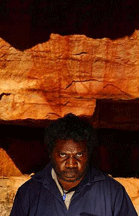 Jeffrey Lee’s Koongarra – where love for land trumps love for money, Crikey,
BOB GOSFORD | FEB 16, 2015 “I have said no to uranium mining at Koongarra because I believe that the land and my cultural beliefs are more important than mining and money. Money come THE words projected on a big screen at the final plenary session of the World Parks Congress in Sydney late last year said it all: “I could be a rich man today. Billions of dollars … You know, you can offer me anything, but my land is a cultural land,” read the script accompanying an image of Jeffrey Lee on his land at Koongarra which is now incorporated into the World Heritage-listed Kakadu National Park.
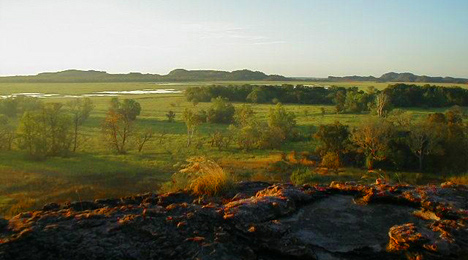
Jeffrey Lee, the senior Traditional Owner of the Djok clan, speaks for the 12,000 hectares of land which used to comprise the former Koongarra Project Area. It contains an estimated 12,000 tonnes of high grade uranium which the French nuclear and mining company, Areva, has long been trying to access and develop.
Mr Lee told thousands of delegates to the World Parks Congress of his decision to gift the land at Koongarra to the World Heritage estate, rather than reap a fortune in royalties if it had been mined for uranium. And he told them of his modest request to the Australian Government for help to build a house on his country.
Alas, it seems that the Government is not prepared to reciprocate his generosity……..
“I don’t want the Government to forget me. They came to visit me; they congratulated me on my hard work and said they will support me in this. The Government knows how hard I worked, they gave me an Order of Australia and I’m happy for that. Now I just want a commitment from them for a house so I can live on that country that I fought for.”
Jeffrey Lee was granted an Order of Australia award in January 2012.
The citation said: “For service to conservation and the environment in the Northern Territory, particularly through advocacy roles for the inclusion of the Djok Gundjeihmi country as a World Heritage area within Kakadu National Park.”
Land Rights News asked the Federal Environment Minister, Greg Hunt, whether he was considering assistance for Mr Lee to build an outstation on his country. The reply, from his Parliamentary Secretary, Simon Birmingham, was far from positive…… “Unfortunately, there is no Australian Government funding available to construct an outstation at Koongarra, but we are helping where we can……..http://blogs.crikey.com.au/northern/2015/02/16/jeffrey-lees-koongarra-where-love-for-land-trumps-love-for-money/
Western Australian Premier would not meet Aboriginal land councils about remote communities
Colin Barnett turned down invitation to meet Aboriginal land councils, Guardian, Calla Wahlquist, 20 Feb 15
Councils called meeting with WA premier because they had received no offer of consultation over plans to pull funding from remote Aboriginal communities The Western Australian premier, Colin Barnett, turned down an invitation to meet Aboriginal land councils about a government proposal to close up to 150 of the state’s remote communities, one day before telling parliament he would consult Aboriginal people closely. Continue reading
Australian govt to cut off basic services to up to 200 indigenous communities
The remote communities are mainly located across the northern tip of Australia and the Kimberley in the country’s northwest. The federal government announced late last year that it would stop paying for the utilities, making states responsible for the communities. The Western Australia (WA) state government says it can’t afford to cover the costs.
Rodney Dillon, an indigenous advisor at Amnesty International Australia, told VICE News that some members of the indigenous communities might not survive a move.
“It would be a complete culture shock, a complete mental shock,” Dillon said. “This is their homeland. It’s where they belong it’s where they are proud. They are the keepers of the land. Some might stay and die on the land. The older individuals won’t manage it — it might kill them.”……..
Initial hopes of establishing a $1 billion “Royalties for Regions” fund, which would have used 25 percent of the state’s mining royalties to cover the cost of power and water for the communities, were quashed this week by WA Premier Colin Barnett, who stressed that the government has not yet reached a solution.
Minster for Regional Development Terry Redman originally floated the “Royalties for Regions” idea, but has since said he was “misunderstood” by the media. He stressed to VICE News that it was simply one option……….
Asked if communities had been contacted about the potential closures, the state’s Aboriginal Affairs Minister Peter Collier said last week that a consultation that involved “going out to all the communities” would be “just nonsensical,” and that “consultation in a general sense will continue” instead.
Dillon said such a consultation has been non-existent so far.
“The communities haven’t been contacted, no one’s asking anything,” he said. “This is going to be done without consultation, it will be a couple of blokes with a coffee in Perth making these decisions.”
The government will decide which communities stay open and which are “not viable” for investment, Dillon added.
The Partnership of Western Australian Aboriginal Land Councils invited Barnett and other key WA politicians to discuss the issue in early March, but they have yet to receive a response…….
The criteria that determines whether a community is viable has not been released, but both Redman and Barnett have stressed the likelihood that at least some of the 274 communities in the state will have to close, perhaps as many as 200.
Lauren Pike, a spokeswoman for the Kimberley Land Council, described what happened in 2011 when the government shuttered an indigenous community in Oombulgurri, a community in the eastern Kimberley, and relocated the residents to Wyndham, about 45 kilometers away.
“The result was just devastating,” Pike said. “They literally told these people to get out of their homes and that they couldn’t stay or come back, and then dumped them in the mangroves around the town.
“Houses weren’t provided — nothing was provided,” she continued. “People in the town literally had to hand out borrowed sleeping bags and blankets for these people coming in so they could have something to sleep on outside. It caused so much trouble in the community, and it only got worse from there. Suddenly people had access to alcohol, to illicit substances. It was just an absolute state of poverty.”……..
Dillon believes any future living conditions in the remote communities would consist of the bare minimum.
“They would be moved to very poor conditions,” he said. “They’re frightened and scared and they speak a different language. Now they’re all possibly going to be moved into slums and shanty towns in the city.”
Groups campaigning against the closure also believe moving the indigenous people into new towns would cost the government more in the long run than if they just maintained the status quo. https://news.vice.com/article/australia-may-stop-providing-water-and-power-to-remote-aboriginal-communities
1 This month

of the week – Australians for War Powers Reform (AWPR)
To see nuclear-related stories in greater depth and intensity
 Antinuclear