Australian government gave Jeffrey Lee an OBE, but not a house, when he gave his land to Kakadu
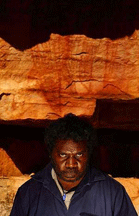 Jeffrey Lee’s Koongarra – where love for land trumps love for money, Crikey,
BOB GOSFORD | FEB 16, 2015 “I have said no to uranium mining at Koongarra because I believe that the land and my cultural beliefs are more important than mining and money. Money come THE words projected on a big screen at the final plenary session of the World Parks Congress in Sydney late last year said it all: “I could be a rich man today. Billions of dollars … You know, you can offer me anything, but my land is a cultural land,” read the script accompanying an image of Jeffrey Lee on his land at Koongarra which is now incorporated into the World Heritage-listed Kakadu National Park.
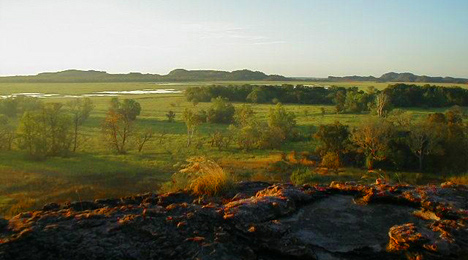
Jeffrey Lee, the senior Traditional Owner of the Djok clan, speaks for the 12,000 hectares of land which used to comprise the former Koongarra Project Area. It contains an estimated 12,000 tonnes of high grade uranium which the French nuclear and mining company, Areva, has long been trying to access and develop.
Mr Lee told thousands of delegates to the World Parks Congress of his decision to gift the land at Koongarra to the World Heritage estate, rather than reap a fortune in royalties if it had been mined for uranium. And he told them of his modest request to the Australian Government for help to build a house on his country.
Alas, it seems that the Government is not prepared to reciprocate his generosity……..
“I don’t want the Government to forget me. They came to visit me; they congratulated me on my hard work and said they will support me in this. The Government knows how hard I worked, they gave me an Order of Australia and I’m happy for that. Now I just want a commitment from them for a house so I can live on that country that I fought for.”
Jeffrey Lee was granted an Order of Australia award in January 2012.
The citation said: “For service to conservation and the environment in the Northern Territory, particularly through advocacy roles for the inclusion of the Djok Gundjeihmi country as a World Heritage area within Kakadu National Park.”
Land Rights News asked the Federal Environment Minister, Greg Hunt, whether he was considering assistance for Mr Lee to build an outstation on his country. The reply, from his Parliamentary Secretary, Simon Birmingham, was far from positive…… “Unfortunately, there is no Australian Government funding available to construct an outstation at Koongarra, but we are helping where we can……..http://blogs.crikey.com.au/northern/2015/02/16/jeffrey-lees-koongarra-where-love-for-land-trumps-love-for-money/
Western Australian Premier would not meet Aboriginal land councils about remote communities
Colin Barnett turned down invitation to meet Aboriginal land councils, Guardian, Calla Wahlquist, 20 Feb 15
Councils called meeting with WA premier because they had received no offer of consultation over plans to pull funding from remote Aboriginal communities The Western Australian premier, Colin Barnett, turned down an invitation to meet Aboriginal land councils about a government proposal to close up to 150 of the state’s remote communities, one day before telling parliament he would consult Aboriginal people closely. Continue reading
Australian govt to cut off basic services to up to 200 indigenous communities
The remote communities are mainly located across the northern tip of Australia and the Kimberley in the country’s northwest. The federal government announced late last year that it would stop paying for the utilities, making states responsible for the communities. The Western Australia (WA) state government says it can’t afford to cover the costs.
Rodney Dillon, an indigenous advisor at Amnesty International Australia, told VICE News that some members of the indigenous communities might not survive a move.
“It would be a complete culture shock, a complete mental shock,” Dillon said. “This is their homeland. It’s where they belong it’s where they are proud. They are the keepers of the land. Some might stay and die on the land. The older individuals won’t manage it — it might kill them.”……..
Initial hopes of establishing a $1 billion “Royalties for Regions” fund, which would have used 25 percent of the state’s mining royalties to cover the cost of power and water for the communities, were quashed this week by WA Premier Colin Barnett, who stressed that the government has not yet reached a solution.
Minster for Regional Development Terry Redman originally floated the “Royalties for Regions” idea, but has since said he was “misunderstood” by the media. He stressed to VICE News that it was simply one option……….
Asked if communities had been contacted about the potential closures, the state’s Aboriginal Affairs Minister Peter Collier said last week that a consultation that involved “going out to all the communities” would be “just nonsensical,” and that “consultation in a general sense will continue” instead.
Dillon said such a consultation has been non-existent so far.
“The communities haven’t been contacted, no one’s asking anything,” he said. “This is going to be done without consultation, it will be a couple of blokes with a coffee in Perth making these decisions.”
The government will decide which communities stay open and which are “not viable” for investment, Dillon added.
The Partnership of Western Australian Aboriginal Land Councils invited Barnett and other key WA politicians to discuss the issue in early March, but they have yet to receive a response…….
The criteria that determines whether a community is viable has not been released, but both Redman and Barnett have stressed the likelihood that at least some of the 274 communities in the state will have to close, perhaps as many as 200.
Lauren Pike, a spokeswoman for the Kimberley Land Council, described what happened in 2011 when the government shuttered an indigenous community in Oombulgurri, a community in the eastern Kimberley, and relocated the residents to Wyndham, about 45 kilometers away.
“The result was just devastating,” Pike said. “They literally told these people to get out of their homes and that they couldn’t stay or come back, and then dumped them in the mangroves around the town.
“Houses weren’t provided — nothing was provided,” she continued. “People in the town literally had to hand out borrowed sleeping bags and blankets for these people coming in so they could have something to sleep on outside. It caused so much trouble in the community, and it only got worse from there. Suddenly people had access to alcohol, to illicit substances. It was just an absolute state of poverty.”……..
Dillon believes any future living conditions in the remote communities would consist of the bare minimum.
“They would be moved to very poor conditions,” he said. “They’re frightened and scared and they speak a different language. Now they’re all possibly going to be moved into slums and shanty towns in the city.”
Groups campaigning against the closure also believe moving the indigenous people into new towns would cost the government more in the long run than if they just maintained the status quo. https://news.vice.com/article/australia-may-stop-providing-water-and-power-to-remote-aboriginal-communities
Western Australia’s remote Aboriginal communities will not be getting state royalties – Premier Barnett
Aboriginals, Maralinga nuclear bomb tests, and The Australian Nuclear Free Alliance.
“The elderly people had talked about the Nullarbor[12] dust storm, not knowing that they had seen the fall-out from Maralinga. I knew about Maralinga and started questioning the amount of cancer deaths…..More and more people were dying of leukemia and thyroid cancer
In terms of measuring radioactivity we are totally cut off from acquiring information because it is illegal to have a Geiger counter! We are particular concerned of the uranium mining industry, exploiting sands found near the former testing site. Plutonium testing took place at the Woomera rocket range site. The place is military territory and we do not know what actually is going on there.
 The Australian Nuclear Free Alliance. ANFA (http://anfa.org.au). “Our alliance is well connected and once a month the community leaders link up by phone and we talk about what to do next. During meetings, governmental people are absent. We have international visitors from France, Japan and so on. People from all over the world should know that we do exist, that we are humans (laughter).
THE CARETAKER AND THE PLAGUE: BRITISH NUCLEAR WEAPONS TESTING IN AUSTRALIA, Nuclear Age Peace Foundation, 30 Jan 15 by Ursula Gelis Ursula Gelis, Executive director of the ‘Global Women’s Association against Nuclear Testing’ works for the rights and needs of victims of nuclear weapons explosions and nuclear testing. Her partners are in Kazakhstan and other states, affected by the long-term effects of nuclear weapons testing. At the Vienna Conference on the Humanitarian Impact of Nuclear Weapons in December 2014[1], she interviewed an anti-nuclear activist and nuclear test victim from Australia.
The Plague column in Vienna convincingly depicts human suffering; in this case – the tragedy of the Black Death epidemic from 1679 in Austria which killed about 30 000 to 75 000 souls. A Black Death does not distinguish between a noble and a beggar, and a nuclear weapon explosion does not either.
In today’s Australia, Aboriginal communities are still suffering from European racism that came in the aftermath of Captain Cook (1770) who looked at the Aborigines as lucky people, even if they did not own many material goods! Continue reading
In 2015 Aboriginal rights movement is rising, with renewed strength
an Aboriginal Spring – has arisen where now there is the urgent call for more of the changes still  outstanding to be addressed for the descendants of the First Peoples.
The last remaining founder of the 1972 Aboriginal Tent Embassy, Michael Anderson, leader of the Euahlayi People, announced at the forecourt of Federal Parliament, “We will be back February 9 and we will stay.
From the western most region of the continent, an advocate of the Noongar people, Marianne Mackay journeyed six days to reach Canberra. “The Government wants to push our people  off our homelands to make it easier for the miners and big business. Our homelands will be dispossessed unless we stand up.”
In Australia, there is the Aboriginal rights struggle, The Stringer, by Gerry Georgatos January 30th, 2015 In Australia there is no greater rights struggle than the Aboriginal rights struggle. It is a human rights struggle where not only the First Peoples of this continent were violently and murderously dispossessed of their lands but since the advent of British colonialism onto their shores they were subjected to segregation, apartheid and the systematic destruction of their cultures and languages – more than 350 First Peoples’ nations and languages have been impacted.
On January 26, 1972, four young Aboriginal men pitched a beach umbrella on the front lawns of Australia’s Federal Parliament in Canberra, and then sat under the umbrella. They declared it Aboriginal Tent Embassy. This inspired a peaceful resistance movement, with at first hundreds and then thousands converging to Canberra to join them on the parliamentary lawns – setting up tents and camping. Their stances shone the lens of the media – domestic and international – onto the horrific social inequalities and disparities between the First Peoples of this continent and the rest of the population. Their stance contributed to the demise of the then incumbent Government. Some positive changes occurred but 43 years later for far too many of the descendants of the First Peoples little has changed while for many circumstances have worsened – to third world-akin conditions. Continue reading
Precedent-setting Aboriginal native title grant over large area of SA Eyre Peninsula
 AUDIO: Barngarla people granted partial native title over large area of SA Eyre Peninsula
The Barngarla people filed a native title claim for the area in April 1996.
Justice John Mansfield delivered his judgment on their right to the land on Thursday.
The group’s claim covered 44,500 square kilometres, an area almost triangular in shape and encompassing the coast between Port Augusta and Port Lincoln and the surrounding land and sea……..
Judgment could set precedent for claims in SA, interstate
Solicitor Philip Teitzel said the case was one of the first in the nation to go over densely settled areas and could have broad implications…….http://www.abc.net.au/news/2015-01-22/barngarla-people-granted-partial-native-title-in-eyre-peninsula/6033826
For the convenience of uranium mining, Aborigines are moved off remote homelands
Waging a war over land rights MEENA MENON , THE HINDU,January 19, 2015 ‘Protests are continuing in various parts of Australia over mining’
In her book of poems, Love Dreaming, aboriginal writer Ali Cobby Eckermann from Australia writes, “Every grain of sand in this big red country is a pore on the skin of my family.” Her writing and her new book, Too Afraid to Cry reflect the alienation of the ‘Stolen generation’ of children who were selectively taken away from their families and raised by white people and also the plight of her people who are waging a war over land rights.
Thousands of people from indigenous communities plan to hold massive protests over land issues on Australia Day on January 26, she says. Protests are continuing in various parts of Australia over mining uranium and minerals and even Kakadu National Park, on the UNESCO World Heritage Site is under threat.
In New Delhi to deliver the annual Navayana lecture, she told The Hindu in an interview that a serious lack of understanding between cultures persists in Australia at a political level and with mining it has expanded. “We worry for our children. Now the Western Australian government wants to use bulldozers and close 150 or 180 small aboriginal communities — they say it is not sustainable to keep these communities going. Where do these people go? They can wander to the city to become a makeshift community under tarpaulin as they are not going to rehouse them,” she says.
The sudden move, she suspects, is to do with mining and removing people from the area so that even that little bit of resistance is gone. That’s the scary part but the aboriginal people will survive. It’s all about land, the war is over land, she says and no one really articulates it like that. “Why would they want these remote areas which are mineral rich to be emptied of people. Western Australia is among the richest mining areas but why is not the government saying some percentage of that mining rights should go to the community. That doesn’t happen, the miners don’t pay tax and we watch the money fly away,” she points out. Continue reading
John Pilger discusses his film “Utopia” on Australia’s land steal from Aborigines
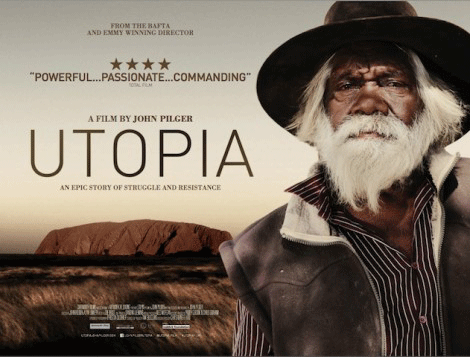 John Pilger Interview: White Australians Would Like Aboriginal People to DisappearSunday, 18 January 2015 00:00By Mark Karlin, Truthout | Interview Noted journalist John Pilger directed and is the lead investigator in an extraordinary documentary, Utopia: An Epic Story of Struggle and Resistance.
Pilger incisively and tenaciously reveals the brutal conquest and continued racist treatment of the Aboriginal people in Australia. Against this appalling historical documentation of conquest, discriminating and neglect, Pilger also highlights the continued resistance of the original inhabitants of the land stolen by British settlers.
The following is a Truthout interview with John Pilger about Utopia. Continue reading
Western Australian Government’s plan to extinguish native title & land rights in one hit
Deal to extinguish native title & land rights in one hit, The Stringer by Gerry Georgatos January 14th, 2015 More than 300 Noongar people gathered at a Perth park last Saturday to speak out against the South West Aboriginal Land and Sea Council’s (SWALSC) support for the Western Australian Government $1.3 billion in-kind package proposal. The Government offer if accepted by Noongar people will come on the condition that their native title rights are extinguished, and therefore whatever shot they have at land rights are extinguished.
It was the largest gathering of the Noongar community, with many high profile Elders, together in the one place on the issue of the Government proposal. The SWALSC have held many community consultations but not one of these community meetings brought together as many Noongars as were present at the ‘No Surrender’ event. The majority of SWALSC community consultations have had less than a dozen people attend.
One of the ‘No Surrender’ campaign organisers, Mervyn Eades said that if the Government proposal is passed through authorisation meetings then “our land and cultural rights will be extinguished.”
“There is nothing in this deal by the Government that provides any certainty over our land rights. We must not accept this deal. We must preserve our lore over the White man’s law.”
“There have been more than 300 native title determinations and more than 900 Indigenous land use agreements but our people wherever in this country have not benefited. Native title has divided and sold out our people. We will not sell out Noongar people,” said Mr Eades.
Noongar cultural advisor and language speaker, Joe Collard, said the South West Aboriginal Land and Sea Council is short-changing the claimant groups.
“Our native title representative body, our champion, the South West Aboriginal Land and Sea Council has let down our people. It has got nothing right in any of this. It does not even know or have any idea of our rightful claimant areas, of our clans, of our family run lines.”
Mr Collard said there is enough support in the Noongar community that if it is galvanised can topple the executive leadership of the SWALSC……….
Senior Elder Margaret Culbong said, “We never ceded this land, so we are not going to just give it up. Native title I never agreed with and this deal is less than native title. Neither is native title or this Government’s offer anything to do with land rights.”
Authorisation meetings commence at the end of the month. hestringer.com.au/deal-to-extinguish-native-title-land-rights-in-one-hit-9339#.VLlxTdKUcnk
Will constitutional recognition really make any difference to Australia’s indigenous people?
Baird calls on states to support Indigenous recognition. But what difference will it make?, Guardian, Celeste Liddle– 15 Jan 15 “……………-If, after consultation, a preamble statement is what we’re left with when we go to vote, then the examples set by the states do not leave me with a great deal of confidence. Why would we believe that federal recognition would lead to a great shift of consciousness and more collaborative and equitable governance based on state records?
Baird may have success convincing other Australian premiers and chief ministers that they need to support constitutional recognition but he is going to have a much harder time convincing the Indigenous electorate. We have a lot of experience of being handed pyrite by politicians dressed up as gold.
While we may have differing views on constitutional recognition across the spectrum, you can be certain we will always question the motives of governments who talk of the importance of our rights on one hand, yet attempt to strip our rights on another. http://www.theguardian.com/commentisfree/2015/jan/15/baird-calls-on-states-to-support-indigenous-recognition-but-what-difference-will-it-make
Western Australia’s dramatic drop in indigenous sites receiving heritage listing
Slump in recommended indigenous sites receiving heritage listing VICTORIA LAURIE, THE AUSTRALIAN JANUARY 10, 2015 A STEEP drop in Aboriginal sites being added to Western Australia’s heritage register is leading to “a vast sea of ignorance” that will thwart heritage protection, according to Carmen Lawrence, the chair of the Australian Heritage Council.The dramatic drop in Aboriginal sites being registered — from 80 per cent of sites recommended to the Department of Aboriginal Affairs to only 6 per cent — has occurred over three years, from 2011 to May last year.
At least 27 sites registered under the Aboriginal Heritage Act have also had their status cancelled in the past year.
Ms Lawrence said the failure to register sites would make it even harder to identify the state’s heritage, lore and culture, which needed protection. “I’m concerned that we’re going back in time to a place we’d abandoned, the respect and protection levels of the 1950s,” she said.
“In the case of Burrup rock art in the Pilbara, it was unprotected for many years because nobody knew anything about it and Aboriginal voices weren’t heard.”………
Ms Lawrence said amendments to the Aboriginal Heritage Act, now before parliament, removed the requirement for a specialist anthropologist to assess sites. She was also concerned a “sacred” site applied only to those places where religious activity was conducted.
“I’m deeply concerned that song cycles and dreaming lines are explicitly excluded from consideration in this state due to a narrowing of definition,” she said. “Leaving that out is a major part of indigenous heritage. James Price Point is a good example: there are middens and burial sites along the Lurujarri Heritage Trail near Broome, but a lot of the significance relates to songs and dreaming tracks.”
She said a 2011 State of the Environment report found indigenous heritage was neither well protected nor well recorded……..http://www.theaustralian.com.au/national-affairs/indigenous/slump-in-recommended-indigenous-sites-receiving-heritage-listing/story-fn9hm1pm-1227180010783?sv=dc1f2218356b75c3fbcaafe8c6f6e071
Once again, Aboriginal Land Rights are Under Attack
WGAR News: Land Rights Act is under attack… yet again: Land Rights News – Central Australia 3 January 2015
Contents:
* Analysis / Opinion: Ian Viner AO QC, Land Rights News – Northern Edition: The plan to undermine the Land Rights Act
* Analysis / Opinion: Dr Murray Garde, Land Rights News – Northern Edition: Lost without translation: what the Bininj missed
* News: Land Rights News – Northern Edition: Land Rights under attack
* News: Land Rights News – Central Australia: Land Rights Act is under attack… yet again
* Analysis / Opinion: Northern Land Council: Land Rights News – Northern Edition: In response to the Forrest Review
* Timeline: Respect and Listen: Land Rights: Timeline
* Northern Land Council Background: Land Rights News-Northern Edition
* Central Land Council Background: Land Rights News-Central Australia
* Respect and Listen Background: Land Rights under attack
* Respect and Listen Background: Dismantling the Land Rights Act – 99 year leases
* WGAR Background: Undermining the Aboriginal Land Rights Act (NT) through 99 year leases and privatisation
* Analysis / Opinion: Central Land Council: Land Rights News – Central Australia: Nuke dump dilemma
* WGAR Background: Proposals to dump nuclear waste on Aboriginal lands
WGAR News Public Google Group: https://groups.google.com/forum/?hl=en-GB#!forum/wgar-news
WGAR News – Working Group for Aboriginal Rights (Australia)………… https://indymedia.org.au/2015/01/02/wgar-news-land-rights-act-is-under-attack-yet-again-land-rights-news-central-australia
The Maralinga nuclear bomb test scandal lingers on
Lingering impact of British nuclear tests in the Australian outback http://www.bbc.com/news/world-australia-30640338 Jon DonnisonSydney correspondent 1 Jan 2015, “It seems remarkable today but less than 60 years ago, Britain was exploding nuclear bombs in the middle of Australia. In the mid-1950s, seven bombs were tested at Maralinga in the south-west Australian outback. The combined force of the weapons doubled that of the bomb dropped on the Japanese city of Hiroshima in World War Two.
In archive video footage, British and Australian soldiers can be seen looking on, wearing short sleeves and shorts and doing little to protect themselves other than turning their backs and covering their eyes with their hands.
Some reported the flashes of the blasts being so bright that they could see the bones of their fingers, like x-rays as they pressed against their faces.Much has been written about the health problems suffered by the servicemen as a result of radiation poisoning.
Far less well-documented is the plight of the Aboriginal people who were living close to Maralinga at the time.
“Every night I cry for them,” Hilary Williams tells me as she sits around a campfire for an impromptu picnic of kangaroo tails laid on for our visit.
Her mother and grandparents all witnessed at least one of the explosions from just a few kilometres away.
Ms Williams said all three of them died young after suffering lung problems.
“It’s so sad. They’re not here anymore,” she said, adding that she had heart problems she believes were also linked to the bombs.Locals around Maralinga spoke about a black mist of radioactive dust over their communities following the explosions.
“A lot of people got sick and died,” said Mima Smart, an aboriginal community leader.
“It was like a cancer on them. People were having lung disease, liver problems, and kidney problems. A lot of them died,” she said, adding that communities around Maralinga have been paid little by way of compensation……….
Robin Matthews, caretaker of the Maralinga Nuclear Test Site. “They thought they’d pick a supposedly uninhabited spot out in the Australian desert. Only they got it wrong. There were people here.”

During the 1960s and 70s, there were several large clean-up operations to try and decontaminate the site. All the test buildings and equipment were destroyed and buried. Large areas of the surface around the blast sites was also scraped up and buried.
But Mr Matthews said the clean-up, as well as the tests themselves, were done very much behind closed doors with a high level of secrecy. “You’ve got to remember that this was during the height of the Cold War. The British were terrified that Russian spies might try and access the site,” he said.
The indigenous communities say many locals involved in the clean-up operation also got sick..
‘Sick land’
Maralinga has long been declared safe. There are even plans to open up the site to tourism. But it was only a few months ago that the last of the land was finally handed back to the Aboriginal people. Most, though, say they have no desire to return there.
Mima Smart told me she regards Maralinga as sick land. “I don’t want to go back. Too many bad memories.”
And even almost 60 years on, the land still hasn’t recovered. Huge concrete plinths mark the spots where each of the bombs was detonated.
Around each, the blast area would have stretched for several kilometres.The orangey red soil of the outback sparkles strangely green.If you look closely, you can see the ground is covered with what looks like broken glass, where the soil got so hot it literally melted and turned to silicon.
And even after all this time, the natural vegetation still won’t grow back. “The grass here only ever grows a few inches,” said Mr Matthews. “Even the birds and the kangaroos still stay clear of this area.”
More than half a century on, most people here still regard Maralinga as a dark chapter in British Australian history
Cabinet papers 1988-89; Bob Hawke and the Aboriginal Treaty that never came
Cabinet papers 1988-89 SMH: Aboriginal Treaty SMH Damien Murphy 1 Jan 15 “……...The treaty that never came Bob Hawke attended the Barunga festival in the Northern Territory in June 1988 and promised an historic treaty with the Aboriginal people.
 The Hawke government had been promising to improve representation of Aboriginal interests and issues, but by 1985 attempts to frame a “national model” for land rights had stalled in compromise, amid farmer and miner opposition and distrust from Aboriginal groups. So Hawke’s treaty had more than a touch of the sun about it. Continue reading
1 This month
17 October, Free Public Talk on Nuclear Issues in South Australia
David Noonan will speak on public interest concerns over the new Roxby Downs Indenture Act 2026 on BHP copper-uranium mining and ore processing in SA, and on how AUKUS may face SA with a High-Level nuclear waste agenda.
Dr Jim Green will discuss international developments in the field of nuclear power including ‘small modular reactors’ and Generation 4 ‘advanced’ nuclear reactor concepts.


Help Aunty Sue Protect Her Land and Sacred Sites From Destructive Rocket Testing.
.

Australians deserve the truth
about
AUKUS – https://aukuspublicinquiry.com/

PETITION – To: Prime Minister Anthony Albanese and the Australian Labor Government

of the week – Australians for War Powers Reform (AWPR)
To see nuclear-related stories in greater depth and intensity

