Aboriginal people not participating in govt’s decisions that savagely cut indigenous funding
AUDIO: Indigenous affairs hit by ‘savage budget cuts’ ..http://www.sbs.com.au/news/article/2014/05/14/indigenous-affairs-hit-savage-budget-cuts By Darren Mara, 14 May 14 Government to dramatically reduce Indigenous programs, NITV News reports
Before his election last September, Tony Abbott claimed he’d be a Prime Minister for Indigenous affairs.
But in his government’s first budget, Indigenous affairs have taken some of the most savage cuts……..The budget will see 150 Indigenous program areas cut down to five: employment and land, education, health and safety, culture and remote strategies.
Funding for Indigenous languages has been cut by almost 10-million dollars over four years.
Indigenous leader and head of the Indigenous Land Corporation, Dawn Casey, says there are no other elected bodies in Australia that could fill the role played by Congress.
 “It means that Aboriginal people aren’t truly making decisions about what ever area they’re dealing in and that should happen. This is the 21st Century. What comes with the decision making comes responsbility and accountability, so don’t take that away from people, given that it’s well over 200 years since Australia was colonised. We should in fact be growing organisations to take on more of those.”
There will be some money going into Indigenous affairs – or perhaps a redirection of funding…..
Environmental and racial injustice. The saga of Northern Territory radioactive trash dump plan continues
 Environmental Injustice in Australia – Nuclear Waste, The Stringer, by Kate O’Callaghan, May 8th, 2014 Muckaty Station is a small township in the remote Northern Territory, 110km north of Tennant Creek and roughly 800km south of Darwin. Also known as Marlwanpa, the land is held under Native Title having formally been returned in 2001 to thetraditional owners – the Milwayi, Ngapa, Ngarrka, Wirntiku, Kurrakurraja, Walanypirri and Yapayapa peoples. Muckaty is also the proposed site of Australia’s first national nuclear waste dump or, as it’s officially called, radioactive waste repository.
Despite the absence of consultation with the broader community, in 2007 the Howard government approved the Muckaty dump site with plans to open the facility in 2011. After thesecretive deal was negotiated with the NLC, so secretive that some members of the Ngapa clan were not even given a copy, a bitter conflict erupted. Other clans, environmental groups, unions and the NT Government expressed outrage at the lack of proper consultation with the traditional owners. Despite ongoing attempts to contact the government, opposing community groups had their meeting requests ignored, correspondence unanswered and were continually ignored.
In 2010, the subsequent Rudd government introduced legislation giving them the ability to override the Northern Territory’s threat to block the construction of the Muckaty dump. After years of opposition, the Gillard government passed the legislation in 2012. The National Radioactive Waste Management Bill removed community appeal rights, indigenous & environmental protections, and gave the government the ability to override state or territory concerns about environmental impacts. After her election in 2013, Northern Territory Senator Nova Perris expressed her objection to the Muckaty site, stating it would cause “profound grief, suffering and loss on Aboriginal people.”……..
while there are still disagreements on the best way to deal with nuclear waste, there is consensus that the process must involve a high level of community consultation. According to a UK report by an expert committee on nuclear waste, “There is a growing recognition that it is not ethically acceptable for a society to impose a radioactive waste facility on an unwilling community.” It is clear at Muckaty that the Australian government did not engage in meaningful consultation with the community as a whole. More deplorable than this is the willingness of successive governments to dump this problem on marginalised indigenous communities. This is in direct conflict with our international obligations under the UN Declaration on the Rights of Indigenous Peoples which requires that no disposal takes place on  indigenous lands without without “their free, prior and informed consent.”
So what’s next for the people of Muckaty? After being postponed, the legal battle against the Commonwealth Government and Northern Land Council is expected to commence in the Federal Court in June 2014. The legal team will include prominent human rights lawyers Julian Burnside and George Newhouse, who will challenge the nomination of the indigenous land for the nuclear dump site. The case will be an important litmus test for any similar legal challenges in the future. It is crucial that the government looks toward the responsible and transparent management of radioactive waste and away from the secretive tactics that have defined the past decadehttp://thestringer.com.au/environmental-injustice-in-australia-nuclear-waste/#.U3Er04FdWik.
New website makes Aboriginal ecological knowledge available
 First Nation knowhow to help save our landscapes http://phys.org/news/2014-05-nation-knowhow-landscapes.html May 08, 2014 The deep knowledge of First Nation (Aboriginal) people is being called on as part of a nationwide effort to stem the tide of extinction and decline that is engulfing the Australian landscape and its wildlife.
At a major scientific meeting in Canberra today, a new website will be unveiled which brings together thousands of records documenting Aboriginal traditional knowledge about Australian native landscapes, plants and animals.
The knowledge is presented in the form of a world-first map, which records publically-available Australian Indigenous bio-cultural knowledge (IBK) that is place-based. The detailed content of the identified documents is only made available with the express permission of the Aboriginal communities which own it.
Aboriginal people and non-Indigenous scientists and managers are currently working together on hundreds of projects across Australia to understand and better manage country using a combination of indigenous bio-cultural knowledge and ecological science.
The map draws together, for the first time worldwide, the wealth of projects, documents, reports, research and management plans where Indigenous bio-cultural knowledge is being used and Aboriginal people are adding value to today’s understanding of Australian ecology and land management practices.
This website maps the places where projects have been or are being carried out, documents results and provides examples of current leading practice, useful information and case studies of “living knowledge” and its practical application.
These include cases of Aboriginal-led landscape restoration, fire management, knowledge about native plants and animals and knowledge about wetlands and other important ecosystems.
“This is the first time that Aboriginal knowledge about landscape and Australian ecological science have been brought together across the whole continent in a single resource,” says ACEAS director Associate Professor Alison Specht
“It also represents a major contribution to documenting and preserving traditional knowledge for future generations of Aboriginal people – and for all Australians.”
The project is part of a worldwide trend to bring the knowledge held by First Nation peoples together with science and conservation policy, and makes Australia one of the global leaders in this field, she says.
“We have shown that all of Australia’s conservation priorities could be greatly informed by Indigenous bio-cultural knowledge – although the existing opportunities far outweigh the advances made to date,” says the team behind the project, in a soon to be published discussion paper. The ACEAS IBK Working Group is led by Dr Emilie Ens and includes twenty Indigenous and non-Indigenous researchers and land managers from around Australia.
“Threats to global environments are increasing, so it is timely to rethink our ecological knowledge base and develop more holistic and inclusive research, management and funding options for the future.
“Enhanced cross-cultural and cross-disciplinary engagement has great potential to strengthen global capacity to build socio-ecological resilience for … inclusive and sustainable environmental management strategies.”
Why the Walinu Martu People will do everything possible to prevent Toro Energy’s Wiluna Uranium project
WESTERN AUSTRALIA’S WILUNA MARTU CONDEMN EXPANSION OF URANIUM MINING PROJECT , InterContinental Cry, by Curtis Kline on May 7, 2014 In Western Australia, plans of expanding Toro Energy’s mine site into a much larger uranium mining wasteland–spanning 100km and two lake systems–has been condemned by elders of the Wiluna Martu people.
“The lives of not only our people today are at stake but the future of our people into time immemorial. This uranium mining if it goes ahead will spell the end of us as custodians of the land. It will make toxic the land, preventing us from caring for the land, it will poison the rivers that we swim in, drink and fish from,” said Wiluna Elder, Glen Cooke to The Stringer.
On March 25, Western Australia’s EPA made the Toro Wiluna uranium expansion project open for public review. Wongi anti-nuclear campaigner, Kylie Fitzwater, commented that Toro had a long way to go before gaining new approvals to expand their single-mine approved project. “The company needs to complete additional environmental management, mine closure, tailings management and transport plans for assessment before any mining can commence at the Wiluna site,” she said.
Included in the proposal, Toro Energy wants to double its water consumption and store radioactive mine waste from several mine sites in a Lake bed. The company’s new plan also involves four more deposits covering over one hundred kilometers – Lake Way, Centipede, Millipede and Lake Maitland, with longer term plans including mining an additional three deposits at Nowthanna, Dawson Hinkler and Firestrike – covering another one hundred kilometers in the other direction.
Stop the bull – the Wiluna uranium program
This region is also home to Western Australia’s largest uranium deposit at Yeelirrie, owned by the Canadian uranium mining giant, CAMECO. This project has been consistently opposed for forty years by Traditional Owners, now led by Kado Muir. Mr. Muir has said “The only safe place for uranium is in the ground, where it belongs. For 40 years my people have campaigned to protect Yeelirrie. We have walked this Country for thousands of years, it should not become Country that we fear to tred.”
While Toro’s original mine plan is expected to be operational next year, the traditional lands on which it is situated is covered by two native title claims at an advanced stage towards a consent determination of native title under the Native Title Act………
As the majority of uranium exploration and mining occurs on Indigenous lands all over the world, this project would continue the denial of the Walinu Martu Peoples right of free, prior and informed consent and their self-determination. They have particularly been striving for the right to negotiate with uranium explorers directly to ensure that their culture and rights are adequately protected.
As the first of Western Australia’s mining projects, the government and industry are hoping this will be the first of many. This is why, the Walinu MArtu People will do everything possible to prevent it. http://intercontinentalcry.org/western-australias-wiluna-martu-condemn-expansion-of-uranium-mining-project-22980/
Warren Mundine helping uranium mining companies to get Aborigines off their land?
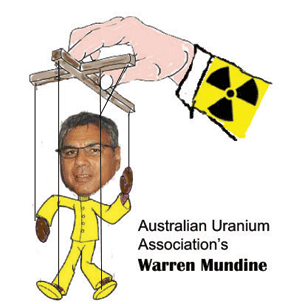 Cut land councils, says Warren Mundine PATRICIA KARVELAS THE AUSTRALIAN MAY 01, 2014 TONY Abbott’s top adviser on indigenous affairs has called for the reform of land rights and the slashing of the number of land councils with gatekeeper powers over development.
Prime Minister’s Indigenous Advisory Council chairman Warren Mundine also called for an end to the requirement to establish a continuous connection with land to establish native title, arguing it “discourages indigenous people from moving away”.
In an address to the West Australian Chamber of Minerals and Energy, Mr Mundine attacked green groups for holding up indigenous development.
“I’m not aware of one new development project in mining, energy or infrastructure that has been supported by green groups,’’ he said yesterday…….http://www.theaustralian.com.au/national-affairs/policy/cut-land-councils-says-warren-mundine/story-fn9hm1pm-1226901405997#
Clive Palmer’s poor record on Aboriginal relations –
Clive Palmer firm Mineralogy’s ‘poor’ indigenous relations HEDLEY THOMAS AND PAIGE TAYLOR THE 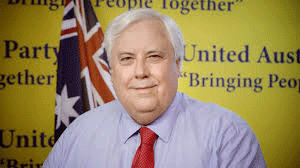 AUSTRALIAN MAY 01, 2014 CLIVE Palmer’s flagship company Mineralogy has a “particularly poor” record of working with Aborigines, who say their rights and culture have been trampled in his pursuit of mineral wealth on sacred sites.
Mr Palmer’s new political merger with three indigenous Northern Territory politicians comes amid his expressions of grave concern about the health and poverty of Aborigines.
But an examination by The Australian of findings by magistrates in mining court and native title cases show his main company has failed to act in good faith, flouted rules, operated combatively, had little regard for indigenous landowners and may even have destroyed ancient burial sites.
A key witness and senior member of the native title claim group whose evidence was accepted by the mining court, Mathew Sampi, said yesterday he had no confidence in Mr Palmer as the tycoon had broken past pledges to spend money on indigenous health.
“We don’t believe anything he says now,’’ said Mr Sampi, who represents the Kuruma Marthudunera people and grew up fishing and hunting in the Cape Preston area in the Pilbara, near an iron ore project built by Chinese companyCITIC Pacific.Findings by magistrates include that Mr Palmer’s company and staff exhibited “a sense of absolute entitlement in relation to mining endeavours” and “adopted an unduly confrontational approach” with indigenous owners. One of Mr Palmer’s top executives was found to have been an unreliable witness and the architect of “misleading” sworn documents.
Trumpeting the defection of the three indigenous MPs to his Palmer United Party this week, Mr Palmer appealed to indigenous voters to trust his commitment to reduce child deaths above other parties.
“He can suck a lot of Aboriginal people in and some of them really don’t know what they have been talked into. He seemed real good in the beginning, saying he was going to help the Aboriginal people in the area. They destroyed a lot of things, they disturbed special places where there used to be ancient tools.”……
In an earlier Native Title Tribunal case, Mineralogy was found to have given a “take it or leave it” ultimatum to indigenous owners of the land the company wanted to mine. Tribunal deputy president John Sosso found that Mineralogy had not acted prudently, reasonably or responsibly in its dealings with Aborigines. In a case involving the Kuruma Marthudundera group, elders Neil Ricky Finlay and Mr Sampi told the court of bad experiences with the company in the Pilbara region, which includes sacred burial grounds near the Cane River and the town of Karratha.
The Mining Court’s magistrate, Elaine Campione, described the two elders as “respected, senior and knowledgeable men” and she accepted their evidence………http://www.theaustralian.com.au/news/investigations/clive-palmer-firm-mineralogys-poor-indigenous-relations/story-fnk76wj3-1226901468114#
A treaty with Australia’s Aboriginal people
 TREATIES ARE AGREEMENTS BETWEEN EQUALS IC Magazine, by Callum Clayton-Dixon on April 28, 2014 All of a sudden [Australia’s] conservative coalition government is welcoming discussion about something we have demanded for decades, something Prime Minister Bob Hawke promised to deliver by 1990, and a proposal the current Labor opposition has labelled “stupid”.
While Herald Sun columnist Andrew Bolt claims treaties will cause “racial division”, Indigenous Affairs Minister Nigel Scullion says they are “agreements between equals” and considers this to be one of the issues Abbott’s Indigenous Advisory Council (IAC) should be looking at.
However, many would dispute whether a handpicked government advisory body has the mandate to control such a debate. The nature of any treaty process must be owned by Aboriginal people on the ground.
WHAT IS OUR STATUS?
Before going any deeper, it’s probably a good idea to take a step back and have a look at what exactly is our status as First Nations peoples. Continue reading
Aboriginal climate ambassadors assess impact of climate change
Indigenous ambassadors assess climate impact on native land SBS World News, Two young Indigenous climate ambassadors have been touring Australia to document the impact of the changing natural environment on traditional communities. By Gary Cox Source NITV News, 27 April 14 Narelle Long and Malcolm Lynch were the first young Indigenous people to set foot in Antarctica back in 2012.
Remembering that other war: the war against Australian Aborigines
Lest we forget, wars undeclared Canberra Times April 25, 2014 Although war was never declared, armed conflict between Australia’s indigenous people and Europeans was widespread. The consequences echo still. In an extract from his book Forgotten War, Henry Reynolds examines the evidence. Anyone acquainted with conditions on the Australian frontier knew that bloody work had been done. Writing in 1880 the pioneer ethnographers Lorimer Fison and Alfred Howitt declared:
”It may be stated broadly that the advance of settlement has, upon the frontier at least, been marked by a line of blood. The actual conflict of the two races has varied in intensity and in duration . . . But the tide of settlement has advanced along an ever-widening line, breaking the native tribes with its first waves and overwhelming their wrecks with its flood.”
We will never know how many Aborigines died directly or indirectly as a result of the conflict, how wide or how deep was the line of blood. Contemporaries often estimated the death rate in particular districts and a few observers attempted to calculate a more general figure. But then as now problems abound with making such estimations.
We are uncertain of the size of the indigenous population when settlement began. We have no idea how many people died in the smallpox epidemic that swept across south-eastern Australia in advance of settlement. We are unsure what the population was in particular regions when the tide of settlement arrived. We are even unsure of the number of indigenous people alive after localised conflict came to an end. There appears to have been no official estimate of those killed in conflict anywhere in Australia.
Even if a government had sought out such information the task would have been immensely difficult. Much of the killing happened on the edge of settlement in regions remote from the reach of authority. Because there was no official recognition of a state of war any killing was technically murder. Frontier communities were notorious for keeping secret their exploits in the war. Killing was referred to using a lexicon of known euphemisms. Punitive parties may often not have known how effective their attacks were, particularly when they operated in the dark or if they shot at groups some distance away. When the bodies of victims were encountered they were almost universally burnt to destroy the evidence. The long career of the Queensland Native Police was cloaked in official secrecy and most of the records were destroyed. If it is difficult to determine how many people died in direct conflict with the settlers. It is even harder to estimate how many more must have subsequently died of wounds or from the fierce rigours of prolonged and uneven warfare.
There was considerable interest in the question in the late 19th century but as the Aborigines themselves disappeared from the historiography of the first half of the 20th century, no one seems to have thought it an important matter for speculation. With the new interest in Aboriginal history that arose in the 1970s and 1980s attempts were made to assess how many people, both white and black, died in the frontier wars.
Historian and author Henry Reynolds: “Much of the killing happened on the edge of settlement in regions remote from the reach of authority. Because there was no official recognition of a state of war, any killing was technically murder.” Photo: Justin McManus
In my book The Other Side of the Frontier (1981), I argued that it was ”reasonable to suppose that at least 20,000 Aborigines were killed as a direct result of conflict with the settlers”…………
A compilation of regional studies does not allow us to assess the overall death rate in Australia’s frontier wars. But some things are clear. Aborigines were killed by settlers every year somewhere in Australia from 1788 to the early years of the 20th century, and died in disproportionate numbers. The research of the last decade has led most engaged scholars to conclude that the controversial 1981 estimate of 20,000 Aboriginal dead needs to be revised not downwards but steeply upwards to 30,000 and beyond, perhaps well beyond. And the dead do matter. They intimidate us. They force us to reassess many other aspects of Australian history. That is the least that can be done.
This is an edited extract from Forgotten War. It is published by NewSouth and won the 2014 Victorian Premier’s award for non-fiction. Henry Reynolds is a Tasmanian historian. http://www.canberratimes.com.au/national/lest-we-forget-wars-undeclared-20140424-376r3.html#ixzz2zvtw4pCi
ABORIGINAL AUSTRALIANS AND THE WAR OF INVASION ,
ACKNOWLEDGEMENT SOUGHT: KEVIN GILBERT, ABORIGINAL AUSTRALIANS AND THE WAR OF INVASION , Philippa Scarlett 24 April 2014 by Indigenous Histories In early September 1991 Kevin Gilbert was photographed by Richard Briggs against the background of the Australian War Memorial. He carries a cross in almost Christ like manner as he walks towards Anzac Parade. However it is unlikely that this symbolism was Christian. Gilbert’s creation spirit was Baiame. Rather the cross was generally symbolic of the sacrifice of the Aboriginal inhabitants of Australia during more than 200 years of undeclared war against invasion and of the ongoing suffering of his people. Gilbert himself said at the time
I represent Aboriginal people who have fought with honour and given their lives for justice and for the land – as none have done for so long as my people. This is a memorial to those who have fought and died and continue to die in the continuing massacre against us. Interview with Amanda Uhlmann, Canberra Times 3 September 1991.
In seeking recognition of Australia’s first and unfinished war, and commemoration of the sacrifice of its participants he brought his plea and protest to the hub of remembrance of the war service of Australians and linked it with the phrase used to encapsulate the act of remembering war: LEST WE FORGET. The wayside memorial he constructed in a then vacant space on Anzac parade – already lined with officially sanctioned memorials – bears the sign THIS SITE IS A MEMORIAL TO ALL ABORIGINAL PEOPLE WHO HAVE DIED IN DEFENSE OF OUR LAND LEST WE FORGET…… http://indigenoushistories.com/2014/04/23/acknowledgement-sought-kevin-gilbert-aboriginal-australians-and-the-war-of-invasion/
Aboriginal science: their knowledge completely underestimated by white Australia
Aboriginal people – how to misunderstand their science, The Conversation, Ray Norris, 21 April 14 Just one generation ago Australian schoolkids were taught that Aboriginal people couldn’t count beyond five, wandered the desert scavenging for food, had no civilisation, couldn’t navigate and peacefully acquiesced when Western Civilisation rescued them in 1788.
How did we get it so wrong?
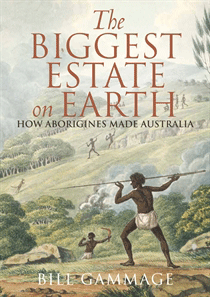 Australian historian Bill Gammage and others have shown that for many years land was carefully managed by Aboriginal people to maximise productivity. This resulted in fantastically fertile soils, now exploited and almost destroyed by intensive agriculture.
In some cases, Aboriginal people had sophisticated number systems, knew bush medicine, and navigated using stars and oral maps to support flourishing trade routes across the country.
They mounted fierce resistance to the British invaders, and sometimes won significant military victories such as the raids by Aboriginal warrior Pemulwuy. Only now are we starting to understand Aboriginal intellectual and scientific achievements.
The Yolngu people, in north eastern Arnhem Land in the Northern Territory, long recognised how the tides are linked to the phases of the moon.
Back in the early 17th century, Italian scientistGalileo Galilei was still proclaiming, incorrectly, that the moon had nothing to do with tides.
Some Aboriginal people had figured out how eclipses work, and knew how the planets moved differently from the stars. They used this knowledge to regulate the cycles of travel from one place to another, maximising the availability of seasonal foods.
Why are we only finding this out now?………..
Still to learn
In recent years, it has become clear that traditional Aboriginal people knew a great deal about the sky, knew the cycles of movements of the stars and the complex motions of the sun, moon and planets………
kids studying science today could also learn much from the way that pre-contact Aboriginal people used observation to build a picture of the world around them.
This “ethno-science” is similar to modern science in many ways, but is couched in appropriate cultural terms, without expensive telescopes and particle accelerators.
So if you want to learn about the essence of how science works, how people learn to solve practical problems, the answer may be clearer in an Aboriginal community than in a high-tech laboratory. http://theconversation.com/aboriginal-people-how-to-misunderstand-their-science-23835
Held To Ransom: Rio Tinto’s radioactive legacy at Kakadu
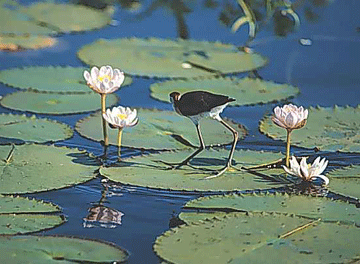 http://www.mirarr.net/media_releases/held-to-ransom-rio-tinto-s-radioactive-legacy-at-kakadu The Mirarr Traditional Owners of Kakadu National Park have accused mining giant Rio Tinto of
holding the World Heritage area to ransom by revealing it will not guarantee the rehabilitation
of the controversial Ranger uranium mine unless the company’s plans to expand operations at
the site are approved.
ERA, 68% majority owned by Rio, has revealed in its annual report that funding for
rehabilitation, despite being legally required, is now likely contingent on securing approval for
the proposed ‘Ranger 3 Deeps’ underground expansion of the mine.
…if the Ranger 3 Deeps mine is not developed, in the absence of any other successful
development, ERA may require an additional source of funding to fully fund the
rehabilitation of the Ranger Project Area. (ERA Annual Report p.17)
At its London AGM this week Rio Tinto boss Sam Walsh attempted to distance the parent
company from Ranger’s rehabilitation, saying it was an issue for ERA. However, Mirarr
Traditional Owners said the company has failed in its obligations despite profiting massively
from mining the area for the past 30 years.
“The attitude of Rio and ERA demonstrates little has changed in the more than three decades
since Galarrwuy Yunupingu described talks over the Ranger mine as ‘like negotiating with a gun
to my head’,” CEO of Gundjeihmi Aboriginal Corporation Justin O’Brien said.
“The mining giants have made enormous profits at the expense of Mirarr traditional lands and
are now holding the Word Heritage listed area to ransom.”
This comes just months after the spill of 1.4 million litres of toxic slurry, while the mine is shut
down and under investigation and while ERA develops its proposal for further mining at Ranger.
“Rio Tinto is a tenant on Mirarr land. They come and they go. If a tenant told you they weren’t
prepared to fix the damage they caused to your house unless you agreed to give them a longer
term lease, you’d laugh them out of the building – what does this type of announcement say
about these tenants?” asked Mr O’Brien.
“It is inconceivably thoughtless and arrogant of any mining company to manage its corporate
social responsibilities in this way and regrettably brings to mind the comment made by Mirarr
Senior Traditional Owner Yvonne Margarula in 2003: ‘The promises never last, but the problems
always do’”.
For further information or comment: Justin O’Brien on 08 8979 2200 or 0427 008 765
Aboriginal community in the North to develop a strategy for the long term
For our power now lies outside of Labor or Liberal. The big parties have lost the true path. The north cannot be developed without our advancement, too. What is required now for remote Aboriginal people is a strategy beyond the election cycle. There are numerous complexities in coaxing participation out of welfare-dependent communities or productivity out of government-funded community programs. Part of the solution is developing an environment where private businesses can grow, in order to foster private wealth. That requires a strategic and efficient program of infrastructure development, including the local Aboriginal workforce.
Instead of driving remote economic development, the Labor and Liberal parties continue to treat remote Aboriginal people as a uniquely unresolvable problem. Australia’s Northern Territory has become a new colony — a moral crisis zone. By now it should be obvious there will be no change in remote Aboriginal communities unless the residents are willing. The arrogance of the major political parties will never inspire willingness.
The only path to advancement is via the bush bloc http://www.theaustralian.com.au/national-affairs/opinion/the-only-path-to-advancement-is-via-the-bush-bloc/story-e6frgd0x-1226881272887# 12 April 14, Alison Anderson MLA for Namatjira.
POWERFUL factions in the major political parties have failed Aboriginal people in the Northern Territory. That failure can be attributed almost wholly to a poor understanding of the aspirations of remote Aboriginal people. It’s simple — the people in power do not want to take the time to sit in the dirt and communicate with the most disadvantaged people, even if those same people gave them their power at the ballot box. Rather, they treat us as useful idiots. Continue reading
Three respected Aborigines resign from Country Liberal Party
 Bush Aborigines are fed up AMOS AIKMAN THE AUSTRALIAN APRIL 04, 2014
TENSION between Aborigines who have remained poor while Darwin has been transformed from a disaster zone after Cyclone Tracy to a “Gateway to Asia” city now has finally burst through the seams, ripping apart the Northern Territory government.
The imminent departure from the ruling Country Liberal Party of three traditional, culturally respected indigenous members not only plunges the government into crisis but could create a watershed for indigenous representation in Australia. Aboriginal votes that enabled the CLP to win power failed to deliver a government in which a majority of Aboriginal members could influence policymaking, resources allocation and the public service to anywhere near their — or, it appears, their constituents’ — satisfaction……….
Since the start of self-government in 1978, the Territory has been a mendicant state administering large amounts of federal funds for the notional benefit of Aborigines. However, a parade of reports has revealed that much of the money is skimmed off before it reaches the ground and, despite the substantial spending, living standards and health outcomes have barely improved in 30 years.
Some indicators, particularly those for children, are going backwards.
Successive governments have tried to contain the competing interests of remote and urban voting constituencies. The division is a socioeconomic one that falls uncomfortably along racial lines. In effect, these two constituencies are hankering for the same government resources rather than, as might be the case elsewhere, partnering in the economy……
Chief Minister Adam Giles was installed in March last year with the help of so-called “bush members”, who hoped the change would bring stability………
Anderson, in particular, objected to Giles axing the indigenous advancement department she had been in charge of, and scrapping a committee established by Mills to bring feedback from the bush directly to the cabinet table.
Giles sacked her from his ministry in September, in a move some now view as counterproductive. Gradually it became clear that, by ousting Mills, Giles and his allies had sundered the CLP in much the same way Julia Gillard did Labor when she replaced Kevin Rudd……….
Giles has focused his attention, at times forcefully, on laying the groundwork for major private-sector investment. While this may be an admirable long-term goal, it has distracted from the small-scale change and consultative policymaking bush residents voted for.
The result has been a chorus of questions about whether Aboriginal people will be drivers or passengers in development of their own land — the sort of concerns that fostered the Aboriginal land rights movement. This has clearly been a problem for Kurrupuwu, Anderson and Lee.
“Our concerns for a long period of time has been that we haven’t delivered for the bush,” Anderson told the ABC recently………
The risk for the federal government is self-evident. While the nation debates controversial racial discrimination legislation, and edges towards a referendum on constitutional recognition of indigenous people, politicians exchange racial epithets and ugly allegations in the Territory……… http://www.theaustralian.com.au/news/features/bush-aborigines-are-fed-up/story-e6frg6z6-1226873925714#
Indigenous future needs security and independence of The Land Account
The Land Account must be protected for future Indigenous generations By Dawn Casey -Online opinion, 1 April 2014
Connections to and caring for land have been central to the lives of Indigenous peoples in Australia for thousands of years. The Indigenous Land Corporation (ILC) has released a Draft Bill to focus attention on a key land issue for the future. The Draft Bill seeks to strengthen and protect the Aboriginal and Torres Strait Islander Land Account and mark an important stage in the journey towards greater recognition of Aboriginal and Torres Strait Islander peoples within our nation.
The Land Account and the Indigenous Land Corporation were legislated together, some 20 years ago, as part of the national settlement following the High Court’s recognition of native title in the Mabo judgment. The Land Account provides partial compensation for the vast majority of Indigenous Australians who are unlikely to benefit from the Native Title Act because they have been dispossessed of their land.
Revenue from the Land Account, which currently has a fixed capital base, provides guaranteed funding for the ILC to buy and manage land for Indigenous Australians for a range of social, cultural, environmental and economic benefits.
As Australia moves towards another landmark—the recognition of Aboriginal and Torres Strait Islander peoples in the Constitution—we must preserve and build on the achievements of the past. The provisions in the ILC’s Draft Bill, if legislated by the Australian Parliament, would place the Land Account above and beyond politics. Its unique and historic status would be recognised. Indigenous involvement in the management of the ILC and the Land Account would be strengthened. The current ILC Board’s commitment to accountability would be locked in for the future. And the Land Account would be able to grow over time. A stronger ILC and a larger Land Account would ensure greater land-related benefits for current and future generations of Indigenous Australians.
Above all, the Draft Bill would prevent the Land Account from being used for anything other than its original legislated purpose: to buy and manage land for Indigenous Australians………..
………..The Land Account and the ILC were part of the ‘grand bargain’ of the mid-1990s. This was a high point in Indigenous peoples’ struggle for recognition in this nation. After the Mabo judgment, Indigenous leaders sat down with the executive level of government to negotiate. For the first time in Australia’s history, they were at the table as equals in a national matter of profound significance to them. We need to be at the table again. http://www.onlineopinion.com.au/view.asp?article=16176
1 This month

of the week – Australians for War Powers Reform (AWPR)
To see nuclear-related stories in greater depth and intensity
 Antinuclear