Wiluna Martu peoples condemn Toro Energy’s expanded uranium mining plan
 Wiluna Martu peoples against uranium mining, The Stringer, by Gerry Georgatos March 29th, 2014 Elders have condemned a move by Toro Energy to expand their yet unrealised Wiluna mine plan into a much larger uranium precinct spanning 100km and which will destroy ecologically sensitive lake systems. Local Wiluna Elder Glen Cooke said everything must be done to prevent this mine which is intended as Western Australia’s first uranium mine – the first of many.
“The lives of not only our people today are at stake but the future of our people into time immemorial. This uranium mining if it goes ahead will spell the end of us as custodians of the land. It will make toxic the land, preventing us from caring for the land, it will poison the rivers that we swim in, drink and fish from,” said Mr Cooke.
First Peoples anti-nuclear groups have coalesced to stand in the way of uranium mining in Western Australia
But the mine is destined to be operational next year.
WA’s Environmental Protection Authority (EPA) released details of the Toro Energy expansion plan. But Wongi anti-nuclear campaigner, Kylie Fitzwater said that Toro had a long way to go in gaining new approvals in expanding from their single-mine approved project. “The company needs to complete additional environmental management, mine closure, tailings management and transport plans for assessment before any mining can commence at the Wiluna site.”
“But we need to stop this mining proposal altogether which will only risk people and communities from toxic radiation,” said Ms Fitzwater.
“It is not just about the cumulative impacts of a regional uranium precinct covering 100km and two lake systems but about the lives lost, the communities destroyed, and the door opening in WA for a rush of nuclear mad investors.”
“Toro plans to double its water consumption and store radioactive mine waste from several mine sites in a Lake bed.”………..
The Central Desert Native Title Service released a statement on the uranium mining proposal. “The Wiluna Martu People’s previous experience with uranium exploration in the Wiluna region has left them with serious and genuine concerns about the health effects of radiation. It also raised questions about the Government’s capacity to properly regulate uranium exploration and mining on their Traditional Lands.”
“The issue of uranium mining is not something that Martu have invited. Rather under the current policy and State regulatory environment it is something they are forced to confront in order to ensure that their Traditional Lands and their people are sufficiently recognised and protected.”http://thestringer.com.au/wiluna-martu-peoples-against-uranium-mining/
Aboriginal elder treated with disrespect by Toro Energy uranium company
Wiluna Martu peoples against uranium mining, The Stringer, by Gerry Georgatos March 29th, 2014 “……. “The Senior Lawmen acknowledge that there are divergent views about uranium mining within the wider Martu community and these divergent views have to be accommodated in this negotiation.”
Late last year and earlier this year Mr Cooke walked into Toro Energy AGMs and expressed his concerns at the prospective impacts on Martu Country were the uranium mines to proceed. He is also concerned that signatories to the mining proposal from within his people have been “misled”.
“The signatories have been persuaded to believe the uranium operation will have low environmental impacts.”
“These people are targeted and influenced by deals to sign over the rights of the land. These people Toro talked to are now driving around in Toyotas they didn’t have before. About eleven Toyotas just appeared,” said Mr Cooke.
“We must care for our land and children and not put our future at risk. These corporations only want to make money, they are full of broken promises.”
Ms Fitzwater accompanied Mr Cooke into the Toro Energy AGM. “When Elder Glen Cooke asked a question he was treated abruptly by Toro and with complete disrespect. He was not permitted to reiterate any questions. It is clear the company tolerates no opposition and has been unfair and biased during their submission period no matter what their convictions.”
“The EPA should seriously reconsider this approval basis and commit to protecting our ecosystem. Our State cannot afford this mistake, we will pay the consequences for an incomprehensible amount of time. This concerns all Australians,” said Ms Fitzwater.
Mr Cooke said he has a complete understanding of the effects of radiation. He was eight years old when the Maralinga atomic tests took place.
Former radiation worker, Bill Macham said that Governments must amend legislation from measures of understanding radiation effects in terms of “half lives and instead to baseline measures of what are biologically safe levels”. With anti-nuclear activists relocating to Alice Springs and the Arnhem to support communities and Elders against uranium expansion, the call for the closure of Jabiluka and for Muckaty to not be used as a radiation waste dump, it appears the next generation’s tensions will highlight the proliferation of uranium mining and the rapacious rise of nuclear reactors.
“For those who care about the earth and people, this is our duty, if those who don’t care about the earth and people win their war to make piles of money, then there will come the day that this earth and its people will pay very high, at what cost to the earth and to people, well we’ve seen Fukishima and Chernobyl,” said Mr Cooke. http://thestringer.com.au/wiluna-martu-peoples-against-uranium-mining/
Abbott would make it open slather for public racial bigotry
 Locked in a war of words to define free speech, SMH, March 29, 2014 Gay Alcorn “………-At the centre of debate is section 18C of the Racial Discrimination Act, which makes it unlawful to do an act publicly that is likely to ”offend, insult, humiliate or intimidate” on the basis of race or ethnic origin. You can do all those things but still be protected if your action was done reasonably and in good faith, and if it’s an artistic, academic or scientific work, or part of a debate in the public interest. It’s a civil, not a criminal, provision – there are no convictions for breaching the act, and remedies are often apologies or small payments.
Court judgment on Andrew Bolt and Racial Discrimination
 Brandis Backs Down on Bigotry, ProBono Australia, March 27, 2014 Federal Attorney General George Brandis has watered down his controversial changes to the racial discrimination laws, however community organisations remain steadfast that no changes should be made to the current law.
Previously the Coalition Government’s proposed changes, as part of an election commitment, were to Section 18C of the Racial Discrimination Act (RDA) , which prohibit public conduct that is reasonably likely to “offend, insult, humiliate or intimidate” a person or groups because of their skin colour or national or ethnic origin.
However, the Government has announced that while continuing to repealing some sections of the Act a new section will be inserted which Senator Brandis claims will preserve the existing protection against intimidation and create a new protection from racial vilification……….
Co-Chairs of Reconciliation Australia, Dr Tom Calma and Melinda Cilento released a joint statement saying they are opposed to any changes to the RDA which weaken the protections against racial discrimination.
“The Racial Discrimination Act 1975 (RDA) currently ensures all Australians are protected from discrimination on the grounds of race, colour, descent or ethnic origin,” Dr Calma and Cilento said.
“Any changes to the RDA that weaken protections from racial vilification would pave the way to a less reconciled, just and equitable Australia. We therefore strongly oppose the current proposed changes to the RDA which repeal Section 18C.”
The Reconciliation Australia Co-Chairs said the use of defamation laws by politicians from both sides of politics was well known and exemplifies the balance between free speech and the need for citizens to be protected from scurrilous and false verbal attacks.
“We note that Section 18D of the current Racial Discrimination Act contains exemptions for ‘anything said or done reasonably and in good faith’ and, in the case of publishing, anything that constitutes ‘a fair and accurate report of any event or matter of public interest’.
“We note that in the key case against which the alleged free speech restrictions of the RDA are being measured – the Andrew Bolt case – the judge, J Bromberg, found that Mr Bolt contravened section 18C because the articles were not written in good faith and contained factual errors, and therefore not made exempt by Section 18D of the RDA.
“In his judgment J Bromberg found the Section 18D exemptions did not apply because of ‘….the manner in which the articles were written, including that they contained errors of fact, distortions of the truth and inflammatory and provocative language’.
“Section 18D does provide free speech protection for comments that may be considered offensive to many Australians as long as these comments are delivered in a reasonable and honest way.”
New South Wales Aboriginal Land Council has also condemned the moves to amend the Commonwealth Racial Discrimination Act………http://www.probonoaustralia.com.au/news/2014/03/brandis-backs-down-bigotry#
INDIGENOUS Land Corporation drafts Bill to protect its funding
Leaders issue $2bn challenge for Abbott PATRICIA KARVELAS
THE AUSTRALIAN MARCH 25, 2014 INDIGENOUS Land Corporation chairwoman Dawn Casey has enlisted the support of the most powerful Aboriginal leaders to seek an emergency meeting with Tony Abbott to protect the $2 billion indigenous “land account”.
In an escalation of tensions between the government and ILC, the taxpayer-funded body has taken the unprecedented step of drafting its own bill that if passed into law would protect its funding from political tampering………
The land account and corporation were established after the High Court’s recognition of native title.
“More than 20 years on from the High Court’s Mabo decision and the passage of the Native Title Act, we want to remind Australians — particularly young people — that the land account was established as part of a national settlement that provided land-title certainty for all Australians,” Dr Casey said.
“The issues at stake are not just administrative arrangements, to be changed at the whim of a minister regardless of what political party.
“They go to the heart of the sort of nation we wish to be.” http://www.theaustralian.com.au/national-affairs/policy/leaders-issue-2bn-challenge-for-abbott/story-fn9hm1pm-1226863684812#
The appalling hidden history of what British settlement did to Tasmania’s Aborigines
 Invasion, Theft, Rape, Murder: The Aboriginal Holocaust in Tasmania Atlanta Black Star, March 19, 2014 by Runoko Rashid DEDICATED TO TRUGANINI “……..The first people of Tasmania, known as Palawa, were marked by tightly curled hair, with skin complexions ranging from black to reddish-brown. They had broad noses, wide mouths, and deep-set brown eyes. They were relatively short in stature with little body fat. They were the indigenous people of Tasmania and their arrival there began at least 35,000 years ago. With the passage of time, the gradual rising of the sea level submerged the Australian-Tasmanian land bridge and the Black aborigines of Tasmania experienced more than 10,000 years of solitude and physical isolation from the rest of the world……..
As early as 1804 the British began to slaughter, kidnap and enslave the Black people of Tasmania. Continue reading
Audio: New book reveals Aborigine’s complex farming and agricultural practices
 AUDIO: Dark Emu argues against ‘Hunter Gatherer’ history of Indigenous Australians ww.abc.net.au/local/audio/2014/03/17/3965103.htm By Hilary Smale and Vanessa Mills
A fresh perspective of Indigenous history showing evidence of village populations, crop harvesting, and irrigation, is all explored Bruce Pascoe’s new book Dark Emu. The common perception of Indigenous Australians leading a ‘hunter-gatherer’ lifestyle before European settlement is ignoring strong evidence of sophisticated farming and agriculture practices, argues Mr  Pascoe.
“There certainly was a lot of movement… but there was also a lot more sedentary living than we were led to believe.”……….Mr Pascoe would like to see the book change how history is now taught.
“I never learnt it when I was at school; my son never learnt it, my daughter never learnt it.
Why are we not telling Australian children of the success and the achievements of Aboriginal Australia?”
Dark Emu is published through Magabala Books.
Bruce Pascoe spoke about Dark Emu with Vanessa Mills for Kimberley Mornings.
Australians must learn from Aboriginal management of the land
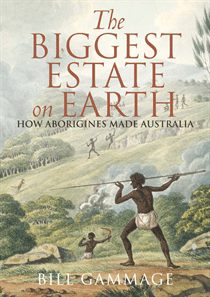
The massive destruction whites have inflicted on the landscape is unforgiveable. Now we have no excuse. Gammage has told us how it was done. Let’s hope it is not too late. As Gammage says, one day we might be able to call ourselves Australian.
Australia: How the Aboriginal people managed ‘the biggest estate on Earth Review by Coral Wynter
The Biggest Estate on Earth: How Aborigines made Australia
By Bill Gammage
Links, March 13, 2014 – Links International Journal of Socialist Renewal –– This is an extraordinary book, one that will increase your appreciation of the country’s first people, as we begin to understand their amazing knowledge and sheer genius in the way they cared for the land, or as Bill Gammage calls it the “biggest estate on Earth”.
Gammage describes with many examples how the Aborigines looked after the land. No corner was forgotten, including deserts, rainforests and rocky outcrops, across the entire continent for at least 60,000 years until the colonisers began to destroy all this labour after their arrival in 1788.
The Aborigines judiciously used fire to create parklands, with huge, stately trees and grass underneath on rich black soil to feed, then harvest kangaroos and wallabies, as well as to grow yams and spinach. They used cool fires to preserve and maintain the biodiversity of Australia’s orchids, ferns, fruit trees and edible plants. They used “templates” to judiciously burn areas with plants sensitive to fire.
Australia in 1788 was a paradise, which was much more than just sustainable, but instead yielded an abundance of food, which could feed a huge population, some estimates say as many as 8 million people. Continue reading
High Court rules: mining leases do not extinguish native title
 Indigenous community hails High Court native title ruling http://www.sbs.com.au/news/article/2014/03/12/indigenous-community-hails-high-court-native-title-rulingThe High Court in Canberra has unanimously held that native title rights held by the Ngarla people in the Pilbara region of Western Australia are not extinguished by the grant of two mineral leases. SBS News, By Myles Morgan Source NITV News 12 Mar 14,
In a one page statement, The High Court of Canberra found the native title rights of the Ngarla people in Western Australia could exist alongside mining leases in the area.
“We’re very satisfied and very happy and jubilant on behalf of the Ngarla people who have obviously fought very hard to get this outcome,” said CEO of the Yamatji Marlpa Aboriginal Corporation, Simon Hawkins.
The dispute was concerned with land situated at the former iron-ore mine at Mount Goldsworthy, located over 1000 kilometres north of Perth in the state’s Pilbara region. The Ngarla people first went to court to claim native title over an area of 11,000 square kilometres in 1998.
Since then, it’s been a constant battle between the West Australian government, mining company BHP Billiton and the Ngarla people.
“Well this ends the matter so there’s nothing that they can do. So effectively, this is the law now and we were successful in challenging the state and others and now this is what everyone has to operate in,” said Mr Hawkins
How Australian Aboriginal policy has always worked in the interests of mining companies
 Neoliberalism, market fundamentalism and the colonization of Aboriginal policy http://challengingthemarket.blogspot.com.au/2014/03/neoliberalism-market-fundamentalism-and.html

“Neo-liberalism is a hungry beast and this 21st Century strain of capitalism is shaping the agenda for control of Aboriginal lands………..Australian Government policy is heavily influenced by neo-liberalism through its extraordinary emphasis on managing access for mining companies to resources on Aboriginal lands. This involves controlling what is still perceived as ‘the Aboriginal problem’ and forcing a social transition from traditional values and cultural practice to ‘mainstream’ modernism of a particular brand. It also involves displacing many Aboriginal people from their traditional lands and concentrating them in ‘growth towns…….To make any sense of the aggression behind most current Indigenous policy in Australia you need to study the impact of neo-liberalism around the globe”
Jeff McMullenThe Australian journalist, writer and social justice campaigner Jeff McMullen has written two cogent and articulate critiques of the colonization of Aboriginal policy making in this country by the cancer of neo-liberalism (or what others call market fundamentalism).
Traditional Aboriginal methods would control bushfires
How Aborigines could solve Australia’s bushfire problem, BBC News, By Jim Carey 1 March 14, Strong winds and soaring temperatures have led to dozens of bushfires in southern Australia. Could Aboriginal “gardening” techniques be used to control them in future? “…..Having lived and evolved on the continent for millennia, Aborigines managed the land almost like a garden – effectively using expertly controlled fires to keep the flora in check.
The resulting grasslands not only attracted animals which the Aborigines could hunt, they also provided massive firebreaks preventing the kind of destructive fires Australia is increasingly suffering.
When the Europeans arrived they kicked the gardeners out of the garden. And the garden went wild…….
It is too late to reverse the clock back to 1788,” says Prof Gammage. “But the kind of damage we are looking at today could be lessened if we employed Aborigines to do something they spent tens of thousands of years perfecting.”….http://www.bbc.com/news/magazine-26174177
In Australia the mining industries are intrinsic to racism and Aboriginal disadvantage
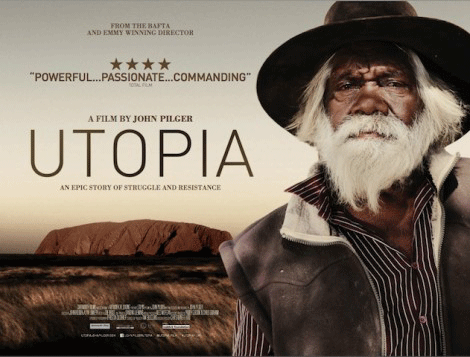 Utopia: An Aboriginal perspective, Black Feminist Blogspot, BY TRACKER, JANUARY 7, 2014 “………There are two huge points Pilger investigates through this section of the film. One is that the greater Australian public has been more than happy to accept the intervention because they readily accept horrible and racist stereotypes of Aboriginal people as fact.its mineral resources, the demonisation of Indigenous Australia is a small price to pay. It’s almost completely impossible to deny the truth of Pilger’s assertions here. Pilger has already so poignantly highlighted many layers of Australian racism by this point, and has juxtaposed this racism with wealth generation repeatedly.
Australia NEEDS to see “Utopia”- and stop white-washing its Aboriginal history
It’s nothing new that other countries are expressing shock and outrage over this film, whilst Australia tries to ignore its content. For further information, check out the mounting pile of political denials following reports from visiting UN officials.Utopia: An Aboriginal perspective, Black Feminist Blogspot, BY TRACKER, JANUARY 7, 2014 Award winning investigative journalist John Pilger’s new film Utopia will be a powerful weapon to raise awareness about Aboriginal Australia, according to Arrente writer Celeste Liddle*. On flicking through the UK reviews of John Pilger’s new documentary film “Utopia”, one thing quickly becomes apparent: Pilger has created a hard-hitting film that is of extraordinary importance.
Insight into Australia’s rich history through Mungo Man
Mungo Man is a physical reminder of the need for Indigenous recognition Forty years on from the discovery of Mungo Man, what he represents is as pertinent now as ever, Guardian, 25 Feb 14 Jim Bowler “………….Mungo Man has given us a rich insight into a dynamic and ancient world. He has delivered an exciting range of scientific firsts, played a significant role in the establishment of the Willandra Lakes as a world heritage area, and, for many Indigenous people, his status has given a sense of pride to the very notion of being Aboriginal. As one of the two foundational burials, with Mungo Lady, he exemplifies Aboriginal Australia’s proudest traditions of antiquity and cultural development on the international stage…….
In emerging from that grave Mungo Man continues to challenge ignorance and prejudice. Such status takes on further legitimacy in the light of his liturgical burial. That action of ceremonial anointing with the earth, the ochre drama, defines new levels of communal self-perception, an awareness and celebration of a people-nature mystique, an acknowledgement of a power beyond. In that sense the burial stands arguably as the world’s oldest example of overt religious expression.
In my pursuit of rational science, those lakeshore sands, originally solely of geological interest, have been transformed into sacred grounds. My eyes have been opened to glimpse and share in some small way that inner view long entrusted to Mungo Man’s Aboriginal descendants, a deep connection to country, to their ancestral spirit-charged lands. I remain ever conscious of Mutthi Mutthi elder Mary Pappin’s admonition: “You did not find Mungo Lady and Mungo Man – they found you!”
Already taking his place in the school curriculum as a key focus in Aboriginal history, Mungo Man’s place as messenger stands in firm justification for national recognition. While Aboriginal Australia must speak in its own voice, as a scientist with a sense of humanity already much deepened by Mungo Man’s contribution, I confidently hope that what has been changed in me will be shared in the lives of many others.
The return opens a new chapter, one in which the voices from the past – the voices from those graves – return in spirit with the bones. My burden remains to speak to and for those voices, to interpret their meaning and to deliver in their death the messages they may have voiced in life.
Mungo Man crosses many boundaries, boundaries between science and traditional cultures, between past and present, between black and white, between life and death. On returning home, his voice takes on new urgency, defining messages for his land and for his people. That occasion, after 40 years in waiting, brings new hope, a reassurance to Indigenous Australians of the nation’s debt to their ancestral history……..http://www.theguardian.com/world/2014/feb/25/mungo-man-physical-reminder-need-for-indigenous-recognition
Brisbane Aboriginal activists to push for land rights and sovereignty
Aboriginal News Aboriginal Way – National Indigenous Radio Service (NIRS) Lateral Love NIRS NEWS STORIES 05 FEBRUARY 2014 A number of Brisbane activists have formed a group to push for and further discussions on treaties, land rights and sovereignty.
Nganyaywana man Callum Clayton-Dixon is a co-founder of the collective and says treaties must be a grass-roots movement and not be administered by government bodies.
Mr. Clayton-Dixon says he welcomes Nigel Scullion and Warren Mundine’s recent interest in treaty talks and wants to bring the discussion into communities.
1 This month

of the week – Australians for War Powers Reform (AWPR)
To see nuclear-related stories in greater depth and intensity
 Antinuclear