The skilled and proud work of Indigenous rangers in remote Australia
 There is a lot of unmanaged country out here. Our people want to get to work managing it. Indigenous rangers and Indigenous Protected Areas are a great success story providing real jobs and good management for our country.
In a federal election year I am calling on all leaders of state and federal political parties to support increased funding for these programs over the next decade. That’s a vision we can all support.
A proving ground for proud carers of country, Canberra Times, Murrandoo Yanner, 13 May 13 2013 A quiet evolution has been occurring in remote Aboriginal communities over the last decade, with ranger programs enabling people to earn a decent income, support their families and experience the pride that comes with that.
…….. quiet evolution has been occurring in remote Aboriginal communities over the last decade that isn’t well understood.
Up to now, indigenous-ranger programs have had bipartisan support, starting under the former Howard government and greatly strengthened by Labor. It’s an evolution because ranger programs are increasing the capacity of our mob and bringing them out of poverty, while also contributing to the evolution of attitudes in remote regions and healing the land….. Continue reading
Murrawarri people campaign for an Aboriginal republic
VIDEO: Activists in northern New South Wales, who’ve declared an Aboriginal republic, say they will take their campaign to the United Nations. http://www.sbs.com.au/news/article/1765174/Murrawarri-people-take-sovereignty-campaign-to-UN The Murrawarri Republic may be the world’s newest country, but for locals it’s been around for tens of thousands of years.
The Republic’s boundaries cross over northern New South Wales and Queensland – covering about 81,000 square kilometres.
Key leaders including Fred Hooper say the push for independence follows many frustrating years of inaction and broken promises.
Clan groups say the Queen of England, the Prime Minister and the Premiers of Queensland and New South Wales have been put on notice and given 21 days to respond to the declaration. They say they will also be asking the UN to formally recognise their republic. “You know according to our laws and customs, she (the Queen of England) does not now have any say over our country,” says Fred Hooper from the People’s Council of the Murrawarri Republic People’s council of the Murrawarri Republic.
“And we’ve also asked her to produce a number of documents. We have asked her to produce a treaty.” The Murrawarri Tribe has its own constitution and bill of rights. Fred Hooper says the new country will be inclusive and is offering non-Murrawarri people incentives, including citizenship and tax concessions. “Certainly what we’re saying at the moment it is the status quo…People will maintain their land.”
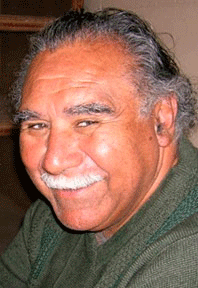 The sovereign union camapaign says the declaration has now taken a step forward. Michael Anderson believes it will spark a new wave of declarations similar to Murrawarri. “The first flame has been lit, it’s now burning. The flames will spread right throughout this country. And there’s nothing Australia can do about it.”
The Murrawarri’s Council has been set up to look at a transition into the republic, including tribal law structures, industry and civil defence.
Aboriginal lawyer launches his Senate campaign for Federal election
 Independent Senate candidate Ribnga Green launches campaign for Federal Election AN ABORIGINAL Senate candidate has likened the nation’s soft foreign ownership laws to the takeover of Australia by the first Europeans. Miles Kemp adelaidenow May 12, 2013
Speaking at his campaign launch at Rymill Park yesterday, independent candidate Ribnga Green, 59, said South Australia’s iconic agricultural areas such as the Barossa Valley and McLaren Vale must be better protected from foreign investors.
Mr Green, an Adelaide lawyer, aims to be the first South Australian Aboriginal politician at the Federal election in September. He said if elected he would push for agricultural areas of Australia, including SA’s wine regions, to be declared essential to the “national interest”.
“I know what it is like to lose an entire continent as an Aboriginal person and I wonder if Australian people generally value the whole issue of land ownership,” Mr Green said. “There are food-bowl areas which should be protected in the national interest and as part of Australia’s ability to supply food to other areas of the world, also.
“Land is also something which is not just a commercial enterprise but a spiritual one.
“Valuing land for reasons other than commercial value is something I think I can share with the rest of Australia.”…… http://www.adelaidenow.com.au/news/south-australia/independent-senate-candidate-ribnga-green-launches-campaign-for-federal-election/story-e6frea83-1226640641295
Cameco uranium project meets determined opposition from Walkatjurra Walkers
 Walkatjurra Walkabout: Resisting Cameco in Australia http://committeeforfuturegenerations.wordpress.com/2013/05/04/walkatjurra-walkabout-resisting-camecos-yeelirrie-uranium-project/ Kado Muir, Traditional Owner, Yeelirrie
‘Walkatjurra Walkabout – Walking for Country’ is a celebration of Wangkatja country, a testament to the strength of the community who have fought to stop uranium mining at Yeelirrie (Cameco acquired the Yeelirrie uranium project from BHP Billiton last year) for over forty years, and a chance to come together to continue share our commitment to a sustainable future without nuclear. It is a chance to reconnect with the land, and to revive the tradition of walking for country.
“Walking for country is to reconnect people with land and culture. The Walkatjurra Walkabout is a pilgrimage across Wangkatja country in the spirit of our ancestors so together, we as present custodians, can protect our land and our culture for future generations.
“My people have resisted destructive mining on our land and our sacred sites for generations. For over forty years we have fought to stop uranium mining at Yeelirrie, we stopped the removal of sacred stones from Weebo and for the last twenty years we have stopped destruction of 200 sites at Yakabindie. We are not opposed to responsible development, but cannot stand wanton destruction of our land, our culture, and our environment.”
A warning to Aboriginal people about Indigenous Land Use Agreements (ILUA)
Don’t sign your sovereign rights away with ILUAs, Aboriginal leader warns, 2 May 13A prominent Aboriginal leader warns Aboriginal and Torres Strait people against signing Indigenous Land Use Agreements (ILUA), saying they cede their sovereignty for a few crumbs if they do.
Michael Ghillar Anderson writes in a media release from Germany that state and Territory governments are trying to coerce Aboriginal peoples into signing ILUAs.
“This is an act of bastardry on the governments’ part as they are NOT informing our peoples of their deceitful intent.
“The ILUAs are designed in such a way that the state, Territory and federal governments can say to the world and the local courts, ‘The Aborigines recognise us as the sovereign state because they signed an ILUA under our law, therefore, they recognise our sovereignty and authority over them, together with sovereignty over the lands, airspace and waters therein.’”
Mr Anderson is the last survivor of the four men who set up the Aboriginal Embassy in Canberra in 1972 and spokesman for the First Nations Interim National Unity Government, which campaigns for sovereignty. He is the leader of the Euahlayi nation in northwest NSW and southwest Queensland.
“In Australia we have reached a very important time in our history. We must come together as distinct sovereign nations to jointly locate a national perspective on our sovereign rights,” he writes.
“We know that the Uncle Toms and Aunt Marys will all tell you that this is all a pie in the sky pipe dream. That is fine because they have always been the people who have betrayed our legal rights and interests. Continue reading
Liberal Party’s Shadow Minister for Education wants to sanitise Australian history
Have we forgotten how often, and easily history can be distorted by those seeking to make history simply a celebration, or quest for freedom?….
History isn’t a party, it’s an honest pursuit of an accurate telling of the past – the whole past, not just bits we like.
 Don’t dismiss nation’s blemishes , SMH April 27, 2013 Julia Baird Historians across Australia buried their faces in their palms again this week when, without warning, retro talk of ”history wars” was revived. It was like being drawn back into 2001, when John Howard was prime minister, George Bush was US president and Vanilla Ice was in jail.
On Monday, the jaunty opposition spokesman for education, Christopher Pyne (at left) criticised the new national school curriculum for putting Aboriginal and multicultural commemoration days in the same league as Anzac Day.
This seemed to come partly from a preference for the festive over the sombre.
Pyne said a Coalition government would review the curriculum because it should promote a more cheerful version of the past: Continue reading
44 Indigenous Carbon Funding projects approved – ready to go
Successful Indigenous Carbon Farming Fund projects announced http://www.investinaustralia.com/news/successful-indigenous-carbon-farming-fund-projects-announced-12c3 24 April 13 Environment Minister Tony Burke and Parliamentary Secretary for Climate Change, Industry and Innovation Yvette D’Ath today announced the 44 successful applications under the Australian Government’s Indigenous Carbon Farming Fund Capacity Building and Business Support stream.
Mr Burke said through this program, the Australian Government is helping Indigenous Australians access carbon farming specialists, business development expertise and legal advice for their carbon farming projects. “These projects are spread across Australia and range from undertaking feasibility assessments to developing carbon farming project ideas and existing carbon farming businesses,” Mr Burke said.
“This program will not only provide benefits for our environment but also provide employment opportunities in indigenous communities.”
Other successful proposals include feasibility assessment of carbon projects, community education, and the development of businesses to provide services or undertake carbon abatement and sequestration activities under the Carbon Farming Initiative (CFI).
Mrs D’Ath said the projects have received funding to assist Indigenous communities to benefit from the Carbon Farming Initiative.
“The Research and Development stream of this initiative provides funding to underpin CFI methodologies and the development of tools for estimating and reporting on emissions,” Mrs D’Ath said. “Up on Cape York Peninsula, where the project area covers an area of up to 2,300,000 ha in Aurukun, one group aims to avoid emissions of approximately 30,000 tonnes CO2 per year.”
The Fund will provide $22.3m over five years to assist Aboriginal and Torres Strait Islander people to participate in the CFI. The CFI enables Indigenous landholders and land managers to earn carbon credits by undertaking projects to reduce emissions or store carbon. Types of projects include early season savannah burning and environmental plantings.
For more information, including a list of successful projects, go tohttp://www.environment.gov.au/cleanenergyfuture/icff/index.html.
Remembering Australia’s wars – what about the one against the Aborigines?
 on the 97.8 per cent of human affairs conducted in this place before colonisation, on the 2000 generations who made their lives where Hyde Park now stands, on what happened in our obtaining of it, and on what became of the ‘dispossessed’, not a word or stone is spent.
It’s time we started talking about how Anzac Day can embrace difficult realities of war and nation, and still do the other things it needs to
The Australian wars that Anzac Day neglects, EUREKA STREET, DEAN ASHENDEN APRIL 21, 2013 For more than 30 years the Australian War Memorial in the nation’s capital has refused to consider any recognition of the long and often violent conflict between black and white.
The proposal that the memorial might commemorate the ‘frontier wars’ first came in 1979 from Geoffrey Blainey. It has since been repeated by commentators and scholars including the then-principal historian at the memorial, Dr Peter Stanley, and a former army chief of staff, Lieut-General John Coates. To no avail.
The memorial is not alone in its silence. Sydney’s Hyde Park, just a few hundred metres from where it all began, has almost as many monuments, memorial gardens and commemorative fountains as trees, most to do with our loss, sacrifice and valour in war, the struggles of our explorers and pioneers, or the sagacity of our civic leaders. Continue reading
Nuclear waste dump: where do New NT Chief Minister Giles and Federal Resources Minister Gray, stand?
 New NT Chief Minister and Federal Resources Minister , by Natalie Wasley, 19 April 13
 approached to meet with Traditional Owners opposed to the waste dump and we hope this meeting will be advanced soon to allow grassroots voices of opposition to be heard and represented.
AREVA was not able to bribe Jeffrey Lee, and Koongarra is safe from uranium minng
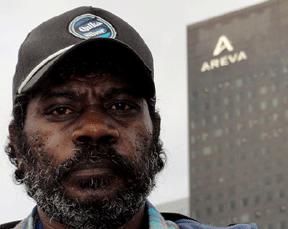 Australia: Koongarra is now permanently protected from uranium companies INTERCONTINENTAL CRY, BY JOHN AHNI SCHERTOW • MAR 18, 2013 The Australian government finally made good on its word. On 6 February, 2013, Environment Minister Tony Burke introduced the “Completion of Kakadu National Park (Koongarra Project Area Repeal) Bill” signalling an end to one of three long standing struggles against uranium mining within the Alligator Rivers Region of Australia’s Northern Territory.
Just a few short days ago, Australia’s senate passed the Bill, ensuring once and for all that Koongarra is permanently protected.
“This is a great day for me, my country and my culture. My mind is at peace now that I know that there will be no mining at Koongarra and that Djok lands will be protected forever in Kakadu National Park,” said Jeffrey Lee, Djok Senior Traditional Owner and the Custodian of Koongarra, in a written statement. Continue reading
Ranger and Jabiluka – the continuing fight against uranium mining
Australia: Koongarra is now permanently protected from uranium companies INTERCONTINENTAL CRY, BY JOHN AHNI SCHERTOW • MAR 18, 2013 “……..Koongarra wasn’t the only area that was excluded from the National Park. The government also left out the “Ranger” and “Jabiluka” sites, both of which are owned by another mining giant, Rio Tinto. Currently, only the Ranger site is being actively exploited.
The Ranger mine is a massive controversy onto itself. Ever since the mining operation began, there have been more than 100 environmental errors and breaches leading to the unintentional release of approximately 12 million liters of contaminated water, as Mirarr Elder Yvonne Margarula explained in a 2011 letter to UN Secretary-General Ban ki-Moon. Despite the concerns, Rio Tinto–through its subsidiary, Energy Resources of Australia (ERA)–wants to expand the Ranger mine.
The Jabiluka site is a very different story. Exploitation of this deposit was halted in 1998, following an eight-month blockade that involved thousands of indigenous and non-indigenous protesters. As a result of that effort, Rio Tinto eventually came to sign the “Jabiluka Long-Term Care and Maintenance Agreement” which guaranteed that the Mirarr would have veto rights over any future ‘development’ at Jabiluka.
However, that’s just not good enough for the Mirarr. Like with the Koongarra site, they want to bring Jabiluka and Ranger into the National Park. Continue reading
Mirarr welcome close scrutiny for Kakadu uranium mine
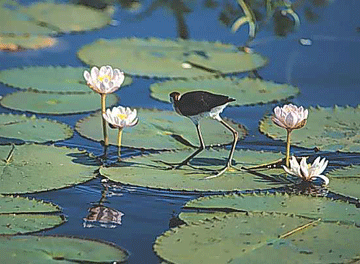 Gundjeihmi Aboriginal Corporation (GAC) has today welcomed Environment Minister Tony Burke’s announcement that Energy Resources of Australia’s proposal to build an underground uranium mine, the so-called Ranger 3 Deeps, will be subject to a full Federal Environmental Impact Statement (EIS).
GAC – the organisation established and run by the Mirarr Traditional Owners of the Ranger uranium mine site, where the underground operations are planned, as well as much of Kakadu National Park – called for this level of assessment. The proposal affects a number of Matters of National Environmental Significance as it is a Nuclear Action occurring within a World Heritage listed Wetland of National Significance.
Kakadu experiences high rainfall and insufficient research has been done to be to predict the effect that underground operations will have on the surrounding wetlands.
“The Mirarr welcome the Minister’s decision. The Ranger 3 Deeps proposal is an entirely new method of mining within the bounds of Kakadu National Park and must therefore be subject to a high level of scrutiny. Energy Resources of Australia (ERA) has no experience with underground mining and the potential for water management or other environmental issues within the World Heritage area demand close examination,” said Justin O’Brien, Executive Officer of Gundjeihmi Aboriginal Corporation.
ERA currently has approval to mine on the Ranger Project Area until 2021 and has not publicly confirmed if it intends to seek a new mining approval beyond that date.
For further information or comment contact Justin O’Brien: 0427 008 765
Ancient Aboriginal art treasures threatened by uranium mining
After years of drilling, Canadian-based mining company Cameco has reported the find in the Wellington Range, where the thousands of Aboriginal artworks adorning cliffs and caves include a painting of the extinct dog-like creature, the thylacine, made in a style that is at least 15,000 years old.
“The importance of this art site is that it’s like a library,” Ronald Lamilami, a traditional Aboriginal landowner in western Arnhem Land and a custodian for the art, told The Global Mail, which on Friday published a detailed feature and map of the rock-art sites at risk nationwide. Lamilami said he fears if mining goes ahead, the works of his ancestors will be damaged…….
The rainbow serpent, fish, kangaroos and other creatures are painted in traditional “X-ray” style and the world’s only known indigenous rock-art stencils depicting whole birds are silhouetted on a cave wall, ……http://www.guardian.co.uk/environment/2013/mar/08/australian-uranium-discovery-art
Marcia Langton’s pro mining lectures raise questions about corporate funding of university lecturers
 Langton failed to disclose mining company funding The Age, Gina McColl 2 March 13, LEADING environmentalists have criticised the ABC and Professor Marcia Langton after revelations her recent ABC Boyer Lectures, in which she praised the mining industry’s role in the emergence of an Aboriginal middle class and delivered a broadside against the green movement, drew on research partially funded by big mining companies.
Santos contributed $45,000, Woodside $30,000, and the federal government’s Indigenous Affairs Department $300,000 to a four-year research project led by Professor Langton into economic empowerment in indigenous communities.
Rio Tinto contributed an undisclosed sum to the $480,000 project, while Marnda Mia, a company that represents local indigenous communities in deals with Rio, offered non-cash support.
Scientist and former Australian of the year Tim Flannery, whom Professor Langton accused in one lecture of racism, said the lectures ”take on a different light” since the big resource companies’ contribution was highlighted by website Crikey. Professor Flannery said the views expressed were consistent with those of the mining industry in their criticism of environmentalists and advocacy of indigenous development and mining expansion going hand in hand.
”This goes to the heart of the credibility of the Boyer Lecture series,” he said. ”There should be requirements for disclosure of this sort of thing and they should be abided by.”
While detailed on the University of Melbourne website, where Professor Langton is foundation chair of Australian indigenous studies, the industry funding was not disclosed to listeners when the lectures were delivered in the ABC’s Brisbane studios late last year, broadcast on Radio National or extracted in Fairfax Media……. an academic with experience researching the Western Australian mining regions said the commercialisation of research did raise questions about independence.
Dr Sarah Holcombe, at the Australian National University, said access to staff and mine sites are controlled by the companies, and that accommodation outside of their mining camps is often non-existent.
Native title laws should shift the onus of proof away from Aboriginal claimants
 PM missed native title chance: Keating, BY:BRIDGET CORMACK The Australian February 25, 2013

 PAUL Keating says the Gillard government has lost an opportunity to make a vital amendment to Native Title laws that would shift the onus of proof away from indigenous claimants.
The former prime minister, who ushered in Australia’s first Native Title laws two decades ago, said the government should have seized the chance to change the laws to make it easier for Aborigines to win rights to their traditional lands. Mr Keating gave a rousing speech yesterday on North Stradbroke Island, 30km south east from Brisbane, where he urged the Quandamooka people to make the most of their hard won land rights, recognised after 16 years of negotiations in an agreement endorsed by the Federal Court in 2011.
While theirs was a victory, he said, the Native Title process was still “far too slow” and the law desperately needed to be given the long-mooted amendment so Aboriginal claimants no longer have to prove a continuous association with their land. “I think the current government has lost the opportunity now to make the amendment,” Mr Keating said. “It would pass the Senate with the Greens and the Independents.”
Mr Keating said the test for proving continuity relied on “written traditions” and was at odds with the “oral traditions” of Aboriginal people.
On the 20th anniversary of the Mabo decision last year the government proposed landmark changes to Native Title laws, including a definition for “good faith” negotiations and allowing historical extinguishment of native title in national parks to be disregarded.
The bill did not reverse the onus of proof. Continue reading
1 This month

of the week – Australians for War Powers Reform (AWPR)
To see nuclear-related stories in greater depth and intensity
 Antinuclear