Australian government pushes on with nuclear dump, tramples on indigenous rights
 Kimba nuke decision dumps on Indigenous rights, https://indaily.com.au/opinion/2020/02/13/kimba-nuke-decision-dumps-on-indigenous-rights/ The federal government’s decision to place a a nuclear waste storage site at Kimba on SA’s Eyre Peninsula turned deaf ears to the opposition of the area’s native title holders, argue Jim Green and Michele Madigan. Kimba nuke decision dumps on Indigenous rights, https://indaily.com.au/opinion/2020/02/13/kimba-nuke-decision-dumps-on-indigenous-rights/ The federal government’s decision to place a a nuclear waste storage site at Kimba on SA’s Eyre Peninsula turned deaf ears to the opposition of the area’s native title holders, argue Jim Green and Michele Madigan.
The federal government recently announced that it plans to establish a national nuclear waste ‘facility’ near Kimba on South Australia’s Eyre Peninsula. It will comprise a permanent dump for low-level nuclear waste, and an ‘interim’ store for long-lived intermediate-level waste. Shamefully, the federal government has decided to move ahead despite the unanimous opposition of the Barngarla Traditional Owners, native title holders over the area. The federal government refused a request from the Barngarla Determination Aboriginal Corporation (BDAC) to include traditional owners in a community ballot held last year. So BDAC initiated a legal action protesting their exclusion. The court case is ongoing and an outcome is expected soon. BDAC also engaged the Australian Election Company to conduct a confidential postal ballot. Not a single Barngarla Traditional Owner voted in favour of the dump. BDAC wrote to the government calling for the dump proposal to be abandoned in light of their unanimous opposition, and stating that BDAC will take whatever steps are necessary to stop it being imposed on Barngarla Country against their will. The National Radioactive Waste Management Act systematically discriminates against Australia’s First Nations. For example, the nomination of a site for a nuclear dump is valid even if Aboriginal traditional owners were not consulted and did not give consent. And the Act has sections which nullify or curtail the application of laws such as the Aboriginal and Torres Strait Islander Heritage Protection Act 1984, and the Native Title Act 1993. The federal government recently announced that it plans to amend the Waste Management Act. While the Act is sorely in need of an overhaul, the planned amendments aren’t those that are needed. Clauses in the Act that dispossess and disempower traditional owners will remain untouched. The SA Labor Party argues that traditional owners ought to have a right of veto over nuclear projects given the sad and sorry history of the nuclear industry in SA, stretching back to the British atomic bomb tests. Deputy Leader of the Opposition Susan Close says that SA Labor is “utterly opposed” to the “appalling” process which led to the recent announcement regarding the Kimba site. Compare that to the federal government, whose mind-set seems not to have advanced from the ‘Aboriginal natives shall not be counted’ clause in the Constitution Act 1900. As Barngarla Traditional Owner Jeanne Miller says, Aboriginal people with no voting power are put back 50 years, “again classed as flora and fauna.” The current debate follows a history of similar proposals ‒ all of them defeated, with traditional owners repeatedly leading successful campaigns. In 2004, after a six-year battle, the Howard government abandoned plans for a national nuclear waste dump in SA. The Kupa Piti Kungka Tjuta ‒ a senior Aboriginal women’s council ‒ congratulated the government for belatedly getting their ‘ears out of their pockets’. In 2016, the plan to import high-level nuclear waste from around the world was abandoned after a Citizens’ Jury noted the lack of Aboriginal consent and concluded that “the government should accept that the Elders have said NO and stop ignoring their opinions.” And last year, the federal government abandoned plans for a national nuclear dump in the Flinders Ranges, a plan that was fiercely contested by Adnyamathanha Traditional Owners. SA Premier Steven Marshall is rightly proud of his record promoting the growth of renewable energy in SA. And he’s proud of his significant role in putting an end to the plan to import high-level nuclear waste from around the world. So where will the Premier ‒ whose portfolio includes Aboriginal Affairs and Reconciliation ‒ stand on this latest nuclear controversy? He needs, as the Kungkas put it, to get his ears out of his pockets and to respect the unanimous opposition of the Barngarla First Nation. Dr. Jim Green is the national nuclear campaigner with Friends of the Earth Australia. Michele Madigan is a Sister of St Joseph who has spent the past 40 years working with Aboriginal people across SA. |
|
Barngarla Native Title Holders excluded from vote on Kimba nuclear waste dump
Bangarla legal case: voting manipulation brought about “Yes” vote for Kimba nuclear waste dump ballot
 Kimba radioactive waste debate hits court as Barngarla community says its concerns have been ‘ignored’
An Aboriginal corporation will launch a fresh legal battle over the Federal Government’s decision to store radioactive waste near Kimba, saying traditional owners’ views were “ignored”. Michelle Etheridge, Regional Reporter, The Advertiser, 4 Feb 2020,
An Aboriginal corporation says it is likely to launch a new legal challenge over the Federal Government’s decision to use farming property Napandee, near Kimba, to store radioactive waste.
It comes as the Barngarla Determination Aboriginal Corporation is already set to return to the Federal Court on February 21.
The organisation, which represents native title holders, is appealing Justice Richard White’s decision in July to dismiss its claim against Kimba Council.
It had argued the council discriminated against native title holders when it decided to exclude those who did not live in the area from a community ballot to gauge support for the radioactive waste storage site.
The Barngarla community conducted its own postal ballot, with all of the 83 traditional landowners who responded rejecting the proposal. It followed the Kimba vote – conducted on the Government’s behalf – finding 62 per cent of respondents were in favour of the facility, which would come with a $31 million community funding package.
In a statement, the Barngarla corporation this week said it would “likely” launch new judicial review proceedings after the results of its ballot were “ignored”.
The Federal Government has maintained that a nuclear waste site must have “broad community support”.
“The only reason why there was a yes vote was because Barngarla were excluded, and this has then been used as the justification to allow the facility to be built, entirely ignoring Barngarla’s views,” the Barngarla statement said. “The Barngarla stand with most of the farming industry against this proposal. However, the more important issue now is the fact that voting manipulation has allowed for the decision to occur.”………https://www.adelaidenow.com.au/business/sa-business-journal/kimba-radioactive-waste-debate-hits-court-as-barngarla-community-says-its-concerns-have-been-ignored/news-story/255f1f0cbbc8ccc33aabae7dad03089a
Aboriginal peoples must be restored as custodians of Country
Research Fellow, University of Melbourne, January 31, 2020 In the wake of devastating bushfires across the country, and with the prospect of losing a billion animals and some entire species, transformational change is required in the way we interact with this land.Australia’s First Peoples have honed and employed holistic land management practices for thousand of generations. These practices are embedded in all aspects of our culture. They are so effective, so perfectly suited to this harshest of continents, that we are the oldest living culture in the world today.
A reintroduction of traditional land management is essential if we want to address the ecological crisis we now face.
Not just ‘consultants Continue reading
Uranium prospects poor, but Indigenous Australians Minister Ken Wyatt and Northern Land Council agree on a new mine
|
NT uranium and gold mine exploration a step closer at Devil’s Elbow near Ranger Mine https://mobile.abc.net.au/news/2020-01-25/ken-wyatt-approves-new-nt-uranium-mine-exploration/11896844 BY FELICITY JAMES Traditional owners and the Indigenous Australians Minister Ken Wyatt have signed off on a new exploration proposal for a uranium, gold and palladium mine in the Northern Territory.Key points:
Traditional owners fought hard against the Ranger Uranium Mine in the Northern Territory.
The Eclipse Metals project still needs approval from the NT Resources Minister but the company said in an ASX announcement it was confident approval would be granted. The site earmarked for exploration, known as Devil’s Elbow, is within Arnhem Land’s Alligator Rivers Uranium Field and lies 65 kilometres east of the Ranger Uranium Mine. The area has previously been explored and abandoned by other companies, including Cameco in 2008. Rio Tinto withdrew from a joint venture to acquire a majority stake in Devil’s Elbow, according to Eclipse Metals’ most recent annual report. The deal had been negotiated in 2016. In its announcement, Eclipse Metals said Mr Wyatt consented to the licence after a “long-standing” negotiation with the Northern Land Council and traditional owners resulted in an agreement. “The terms of the agreement are quite viable in the current market economy, allowing us to develop the Devil’s Elbow’s full potential,” director Carl Popal said in the statement. “The company looks forward to working closely with the traditional owners and the NLC in making the most of each exploration field from 2020, with bilateral benefits.” Scientist says venture may not be worthwhileThe supervising scientist branch of the Environment Department is responsible for protecting the Alligator Rivers region from the effects of uranium mining through monitoring and research. Gavin Mudd, an associate professor of environmental engineering at RMIT University who sits on the Alligator Rivers scientific committee, assists with this role. Associate Professor Mudd was sceptical about the proposal, considering market conditions and the fact the region has already been heavily explored for more than 60 years. “Sometimes you find something that other drillers and other explorers have missed, but often that’s not the case, it’s actually pretty rare,” he said. “There’s not a long-term prospect there. “I think when you’re looking at the uranium industry globally the future is not bright at all, that’s certainly how I read the tea leaves.” Associate Professor Mudd was sceptical about the proposal, considering market conditions and the fact the region has already been heavily explored for more than 60 years. “Sometimes you find something that other drillers and other explorers have missed, but often that’s not the case, it’s actually pretty rare,” he said. “There’s not a long-term prospect there. “I think when you’re looking at the uranium industry globally the future is not bright at all, that’s certainly how I read the tea leaves.”
But Associate Professor Mudd said Rio Tinto deserved some credit for committing funds to the rehabilitation of Ranger. “They haven’t just walked away, which is often what you would see a mining company do when you’ve got a mine that’s not making money anymore,” he said. |
|
The vastly different way that bushfires are experienced by Aboriginal people
The fact is, the experience of Aboriginal peoples in the fire crisis engulfing much of Australia is vastly different to non-Indigenous peoples.
Colonial legacies of eradication, dispossession, assimilation and racism continue to impact the lived realities of Aboriginal peoples. Added to this is the widespread exclusion of our peoples from accessing and managing traditional homelands. These factors compound the trauma of these unprecedented fires.
As Australia picks up the pieces from these fires, it’s more important than ever to understand the unique grief Aboriginal peoples experience. Only through this understanding can effective strategies be put in place to support our communities to recover.
Perpetual grief
Aboriginal peoples live with a sense of perpetual grief. It stems from the as-yet-unresolved matter of the invasion and subsequent colonisation of our homelands…….
Aboriginal people have watched on and been ignored as homelands have been mismanaged and neglected.
Oliver Costello is chief executive of Firesticks Alliance, an Indigenous-led network that aims to re-invigorate cultural burning. As he puts it:
Since colonisation, many Indigenous people have been removed from their land, and their cultural fire management practices have been constrained by authorities, informed by Western views of fire and land management……
Aboriginal peoples’ cultural identity comes from the land.
As such, Aboriginal cultural lives and livelihoods continue to be tied to the land, including landscape features such as waterholes, valleys and mountains, as well as native animals and plants.
The decimation caused by the fires deeply impacts the existence of Aboriginal peoples and in the most severe hit areas, threatens Aboriginal groups as distinct cultural beings attached to the land. As The Guardian’s Indigenous affairs editor Lorena Allam recently wrote:
Like you, I’ve watched in anguish and horror as fire lays waste to precious Yuin land, taking everything with it – lives, homes, animals, trees – but for First Nations people it is also burning up our memories, our sacred places, all the things which make us who we are………
Resilience in the face of ongoing trauma
The long-term effects of colonisation has meant Aboriginal communities are (for better or worse) accustomed to living with catastrophic changes to their societies and lands, adjusting and adapting to keep functioning.
Experts consider these resilience traits as integral for communities to survive and recover from natural disasters……..
If agencies and non-government organisations responsible for leading the recovery from these fires aren’t well-prepared, they risk inflicting new trauma on Aboriginal communities.
The National Disability Insurance Agency offers an example of how to engage with Aboriginal people in culturally sensitive ways. This includes thinking about Country, culture and community, and working with each community’s values and customs to establish respectful, trusting relationships.
The new bushfire recovery agency must use a similar strategy. This would acknowledge both the historical experiences of Aboriginal peoples and our inherent strengths as communities that have not only survived, but remain connected to our homelands.
In this way, perhaps the bushfire crisis might have some positive longer-term outcomes, opening new doors to collaboration with Aboriginal people, drawing on our strengths and values and prioritising our unique interests. https://theconversation.com/strength-from-perpetual-grief-how-aboriginal-people-experience-the-bushfire-crisis-129448?utm_medium=email&utm_campaign=The%20Weekend%20Conversation%20-%201504914324&utm_content=The%20Weekend%20Conversation%20-%201504914324+CID_6dc5e263c454601de4049d9ca867c3a7&utm_source=campaign_monitor&utm_term=Strength%20from%20perpetual%20grief%20how%20Aboriginal%20people%20experience%20the%20bushfire%20crisis
Uncle Kevin warns that the people, and the lizard are fighting back against BHP and its uranium mine
Uncle Kevin “The lizard has had enough and so have the people. And the old country has been ruined, devastated by BHP.
In 2020, we’ll be having serious meetings on the Borefield road, somewhere near Canegrass swamp.
BHP is one of the biggest miners in the world and Olympic dam at Roxby is the biggest uranium mine in the world. They are fully supported by the federal and state governments.
At Canegrass swamp people were tricked by WMC who started this development. We could not do anything about it back then in the 70s and 80s.
Olympic dam development is taking 42m litres of sacred artesian water from the Lake Eyre basin each day. This is going to be expanded to 50m litres per day for the next 25 years. We must stop this now.
Native title and ILUAS have made it harder for us. Our people are being tricked and this has been devastating for the Arabunna people who don’t want their land destroyed.
I am calling out for all people land and water protectors concerned about global warming and environmental destruction to come and help.
The lizard has had enough, come and help us close Roxby down. Dates will be announced, we’re thinking of June/July 2020.
BHP at Roxby are sucking the blood out of the land – the water of the great Lake Eyre basin.
And BHP wants more.
They are killing us.
Turning our mob against each other as they fight over the crumbs of the destruction.
Greed is poison. Their lust for the poison will kill us all unless we take a stand.
Lake Eyre is talking. Be aware.
Are u listening? https://www.facebook.com/groups/941313402573199/
Traditional Aboriginal owners will not give up fight against planned WA uranium mine, despite legal loss
 Traditional Owners lose another fight against planned WA uranium mine, https://www.sbs.com.au/nitv/nitv-news/article/2019/08/01/traditional-owners-lose-another-fight-against-planned-wa-uranium-mine?fbclid=IwAR3fZ4v8xEAU1sPLXNPznPMbbgTM0YSa97czCEvMfQacuYNB2XTsWaOhUgo 1 Aug 19, Environmental approval for Cameco’s Yeelirrie uranium mine proposal in WA still stands after another appeal by Traditional Owners failed. Traditional Owners and the Conservation Council of WA have lost their fight against a proposed uranium mine that the Environmental Protection Authority refused to back, saying risks to subterranean fauna in the project area were too great.Former state environment minister Albert Jacob approved Cameco’s Yeelirrie mine plan in January 2017, just 16 days before the pre-election caretaker mode began. Traditional Owners lose another fight against planned WA uranium mine, https://www.sbs.com.au/nitv/nitv-news/article/2019/08/01/traditional-owners-lose-another-fight-against-planned-wa-uranium-mine?fbclid=IwAR3fZ4v8xEAU1sPLXNPznPMbbgTM0YSa97czCEvMfQacuYNB2XTsWaOhUgo 1 Aug 19, Environmental approval for Cameco’s Yeelirrie uranium mine proposal in WA still stands after another appeal by Traditional Owners failed. Traditional Owners and the Conservation Council of WA have lost their fight against a proposed uranium mine that the Environmental Protection Authority refused to back, saying risks to subterranean fauna in the project area were too great.Former state environment minister Albert Jacob approved Cameco’s Yeelirrie mine plan in January 2017, just 16 days before the pre-election caretaker mode began.
Together with members of the Tjiwarl native title group, CCWA challenged the approval in the Supreme Court but lost, and on Wednesday had their the Court of Appeal challenge dismissed. Traditional Owner Vicki Abdullah said the native title group was disappointed, but taking the case to court had exposed problems with WA’s environmental laws. “We won’t give up – our country is too important. We will continue to fight for Yeelirrie and to change the laws, ” Ms Abdullah said. CCWA director Piers Verstegen said the judgment was appalling and demonstrated WA’s environmental laws urgently needed to be strengthened. “This case has confirmed our worst fears – that it is legally admissible for a minister to sign off on a project against the advice of the EPA and in the knowledge that it would cause the extinction of multiple species, ” he said. “We will consider options for further appeal of this decision. “The mining company can expect a long, expensive process if they want to continue pursuing plans to mine uranium at Yeelirrie.” |
|
Determined Aboriginal opposition to plan for Federal Nuclear Waste dump in rural South Australia
 National waste dump: Aboriginal groups share support as ballot closure approaches, https://www.transcontinental.com.au/story/6504879/national-waste-dump-aboriginal-groups-share-support-as-ballot-closure-approaches/?fbclid=IwAR04J6eadTBu0gBqaT8IBVIo6jvv3wTo0hjnEbTqvbhRDJg6jOPdravwG2w, Amy Green, 21 Nov 19,
The fate of two outback communities at the centre of the federal government’s nuclear waste management facility could be determined before the end of the year.
A three year consultation clouded in controversy will come to a close on December 12 with the completion of a community vote in Hawker.
General Manager of the National Radioactive Waste Management Facility Taskforce Sam Chard said the government has been working to ‘hear the views of all interested parties including local residents, neighbours, business owners, Traditional Owners and the broader community’.
The Wallerberdina Station site has been opposed by the traditional owners, the Adnyamathanha people, for cultural reasons.
The Seven Sisters songline, one of the most significant creation tracks throughout Australia, runs nearby this site.
“We remain suspicious and frustrated by this flawed process of consultation, and we remain unwilling to support a nuclear waste dump on our country,” Ms Marsh said.
“Under our cultural law of the land it is our duty of care to care for the land, yet we feel we are being forced into accepting this poison.
“We ask all Australians to stand with us and end this flawed process of consultation. No more one-sided discussions, no more half-truths about the danger, no more secret deals behind closed doors.”
Speaking on behalf of the Annggumathanha Camp Law Mob, Ms Marsh said the federal government’s decision to exclude the Barngarla Traditional Owners from the Kimba community vote was another blow to First Nations people.
The proposal had been opposed by the Barngarla Determination Aboriginal Corporation, who battled with the federal government in a series of court proceedings.
“We give our heartfelt support to the Barngala Custodians of the Kimba region, we admire their courage and and hope they succeed in their quest to have their voices heard,” Ms Marsh said.
“The independent ballot conducted by Barngarla Determination Aboriginal Corporation once more highlights the flawed process used by federal government.”
Aboriginal group votes against nuclear dump, but government department warns that they cannot veto it
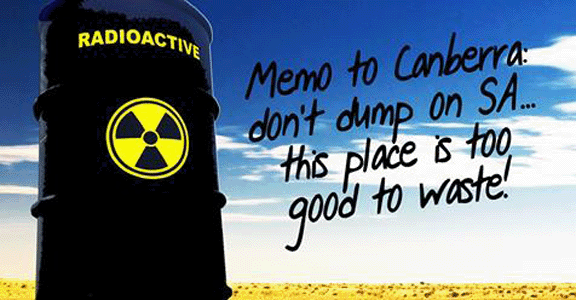 Barngarla ballot shows “no support” for facility https://www.eyretribune.com.au/story/6503108/barngarla-ballot-shows-no-support-for-facility/?fbclid=IwAR1RVmemtqtKZXMRSYPUS85sTAmPayhMAFzTL4b-uCB2YLHVA5FZL80fW8E, Rachel McDonald 20 Nov 19,
The Barngarla Determination Aboriginal Corporation (BDAC) have announced the result of a separate ballot on the two proposed Kimba sites for the National Radioactive Waste Management Facility (NRWMF).
The BDAC recently conducted a confidential postal ballot of its members through independent ballot agent Australian Election Company, asking voters the same question posed to residents of the Kimba District Council area in a ballot which concluded earlier this month.
The Kimba district ballot returned a 61.58 per cent ‘yes’ vote and 38.42% ‘no’ vote.
Of 209 eligible voters in the BDAC ballot, all Barngarla native title holders, 83 valid ‘no’ votes were counted, with zero yes votes returned.
“This unanimous “No” vote demonstrates that there is absolutely no support at all within the Barngarla community for the NRWMF,” the board said in a statement.
The BDAC has written to resources minister Matt Canavan advising him of the result.
“BDAC has requested that given the first people for the area unanimously have voted against the proposed facility that the minister should immediately determine that there is not broad community support for the project,” the board said.
“In light of this total rejection of the NRWMF by the Barngarla people, it is BDAC’s responsibility to continue to give voice to the profound concerns Barngarla traditional owners have regarding the NRWMF, and to take whatever steps are necessary to oppose the NRWMF being located on Barngarla Country.”
A spokesperson for the Department of Industry, Innovation and Science said the ballot would be considered alongside other consultation.
“We will consider the results of the Barngarla’s own ballot alongside the ballot of people who live in Kimba, as well as submissions received, neighbour and business surveys, and direct feedback including at our drop-in offices over several years.
“The department has said on numerous occasions that the facility will only be delivered alongside a community that broadly supports it, that no single metric or number will determine the level of support, and that no one group or individual will have a right to veto the facility.“
The spokesperson said the minister and the department had been working closely with relevant Indigenous representative groups throughout the consultation process and had previously offered to finance a ballot.
“Those conversations are in some instances ongoing.
“With respect to heritage, while native title on both of the Kimba sites has been extinguished, expert heritage consultants were engaged by the department to conduct an independent desktop assessment of Aboriginal cultural heritage, and confirmed no registered heritage sites in or surrounding them.”
Community submissions on the proposed facility will remain open until December 12.
NUCLEAR WASTE DEBATE DIVIDING COMMUNITIES
NUCLEAR WASTE DEBATE DIVIDING COMMUNITIES Fight To Stop Nuclear Waste Dump In Flinders Ranges SA The Transcontinental November 06, 2019, My name is Ken McKenzie. The Flinders Ranges and Port Augusta have always been my home. I now reside in Flinders House in Quorn.
I wish to say that the radioactive waste dump being proposed for our region is going to be very dangerous for all of us and for generations to come if it is allowed to go ahead.
This is something for all South Australians both black and white to be involved in as it will have an effect one way or another on every one of us.
The area where they want to put this dump is on my tribal land. My ancestors are buried here.
The area also holds a huge connection to our women as this is their land overall. The government do not listen when we say we don’t want it.
The earthquakes and flooding stories told to me in our language goes back into time itself.
This is not the place for a radioactive waste dump. If the Lord doesn’t come down in the next few years, this is going to be a threat to all of us and our future generations to come.
I am also very concerned for people over at Kimba who are going thru the same grief that’s happening to us and my family over here.
The money the government are throwing at us, trying to get us to forfeit our land is insulting and disrespectful to us all.
They have divided my family and our communities, and now we hear that without the much more dangerous intermediate radioactive waste being dumped here as well, that there is hardly any value to the community for putting it here.
Why didn’t they tell the communities all this in the first place. We didn’t want it four years ago and we certainly don’t want it now.
This whole process needs to be scrapped and the government needs to look at a new way to get people to ever trust them again.
Maralinga nuclear test site used to house thousands of people, now there’s just three
Maralinga nuclear test site used to house thousands of people, now there’s just three, ABC North and West SA , By Gary-Jon Lysaght and Samantha Jonscher
Between 1956 and 1963, when the British government tested nuclear weapons in outback South Australia, Maralinga was home to thousands of soldiers and scientists.
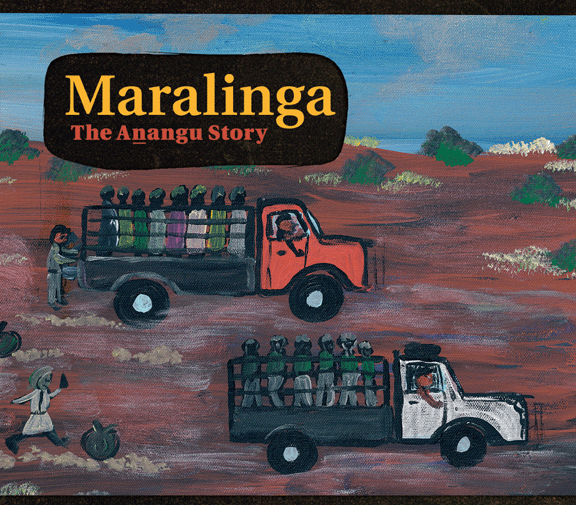 The land was taken from its traditional owners, the Maralinga Tjarutja, before an official hand back in 2009.
Now, Oak Valley to the north is the largest Aboriginal community on the Maralinga Tjarutja lands.
But the former military test site itself is home to three people — two caretakers and a tour guide…….https://www.abc.net.au/news/2019-10-19/maralinga-living-and-working-at-nuclear-test-range/11603496
Barkindji people have title to Darling River area – but their river is dying, killed by drought, and whiteys’mismanagement
Indigenous community say they’ve lost their culture to water mismanagement, SBS, This is the final part in a series of reports from communities along NSW’s Darling River that have been impacted by water mismanagement and drought. BY ANEETA BHOLE 18 Oct 19, An Aboriginal community in rural NSW fears their culture may be lost, as dry conditions and low river flows threaten the future of the Darling River.
The Barkindji people have lived, hunted and passed down their oral history on the banks of the Darling for more than 40,000 years.
Now the river is drying up due to over-extraction by irrigation upstream and drought.
The community’s fears surfaced at a recent corroboree in the small town of Wilcannia, which was once a thriving Murray-Darling River port.
The Yaama Ngunna Barka corroboree had been travelling to towns along the river from Walgett to Menindee. The corroboree have been travelling to towns in outback New South Wales in a bid to raise awareness about the plight of the Darling river.
‘Dead water’
Lilliana Bennett can still recall her grandmother talking about taking the family down the riverbank to fish and hunt for goanna. The river was a place of safety and community for her family.
“It’s a place they go to relax, to tell stories,” she told SBS News.
“For me, it’s been really devastating, I mean we went down and camped by the river where there’s still a bit of water around and it just doesn’t have the same feeling, it’s dead water.”…….
With water levels at an all-time low and the drought continuing to ravage the region, native animals have also started to disappear from the river banks. Many with spiritual significance. …….
The Barkindji community fought for Native Title of the land – covering 128,000 square kilometres — from Wentworth at the Victorian border to near Wanaaring in the state’s north-west, including Broken Hill, Wilcannia, Menindee, Pooncarie and Dareton.
They started the claim in 1997 and won two decades later, but many have said without water flowing in the river they feel robbed. …….
Case for change
Last month, the National Resources Commission (NRC) released an independent report looking into the water-sharing plan of the Barwon-Darling River system.
The system takes in the the Barwon River, from upstream of Mungindi at the confluence of the Macintyre and Weir rivers, to where the Barwon meets the Culgoa River.
At this point the river channel becomes the Darling River and the Barwon–Darling system extends downstream to the Menindee Lakes.
It found that provisions that allow increased access to low flows resulted in poor ecological and social outcomes downstream of Bourke, including the town of Wilcannia where part of the Barkindji community live.
The NRC has made 17 recommendations, including one which has called for stricter regulation of when irrigators, including cotton farmers, can pump water from the river………. HTTPS://WWW.SBS.COM.AU/NEWS/INDIGENOUS-COMMUNITY-SAY-THEY-VE-LOST-THEIR-CULTURE-TO-WATER-MISMANAGEMENT
‘Up to $12,000 owing to Adnyamathanha girl’: Grandmother
‘Up to $12,000 owing to Adnyamathanha girl’: Grandmother, Transcontinental, Greg Mayfield 4 Sep 19
Indigenous woman Janette Milera is caught between two worlds.
Smart as a whip, and adept with her mobile phone and laptop, she is fighting to bridge the gap between the ancient tribal lands of her forebears and the modern reality of mining royalties.
The royalties flow to the tribal land-owners from an estimated $30-40 million payment so far by Beverley uranium mine in the outback under Native Title.
“There should be some sort of Royal Commission or something into the way Native Title operates,” she said.
She said Aboriginal people faced enough difficulties, without missing out on royalties. On behalf of her grand-daughter, she applied to the association in 2013 for payment of royalties, declaring that her grand-daughter had Adnyamathanha heritage and filling out a membership form for the corporation.
The association had replied that they would look into it.
“I am frustrated considering all the emails saying they were going to sort it out for her,” she said. “We hoped she could use the money to set up her own little house or flat when she moves out. She could have everything. She is missing out.”
Ms Milera, of Plympton Park, is an Arabunna woman who formerly lived in Port Augusta where she helped set up the local Community Development Employment Project, now Bungala Corporation. The association has been contacted for comment. The valuable royalties flow to the association from Heathgate Resources’ Beverley uranium mine on Adnyamathanha land in the outback. https://www.transcontinental.com.au/story/6346351/where-are-the-royalties/?cs=1538&fbclid=IwAR02tzupZOSaQT3oidg05qkwkgLjHIj9jM0YTCB5ndwGjF8HiPN8OTOHDsA
Queensland extinguishes native title over Indigenous land to make way for Adani coalmine
Queensland extinguishes native title over Indigenous land to make way for Adani coalmine
Palaszczuk government did not announce decision Wangan and Jagalingou people say makes them trespassers on their own land, Guardian, Ben Doherty@bendohertycorro, Sat 31 Aug 2019 The Queensland government has extinguished native title over 1,385 hectares of Wangan and Jagalingou country for the proposed Adani coalmine in Queensland’s Galilee Basin – without any public announcement of the decision.
The decision could see Wangan and Jagalingou protesters forcibly removed by police from their traditional lands, including lands used for ceremonies.
W&J Council leader Adrian Burragubba, and a group of Wangan and Jagalingou representatives, had been calling on the government to rule out transferring their land, arguing they had never given their consent for Adani to occupy their country.
In a meeting with government officials Friday, seeking a halt on leases being issued for mine infrastructure, they learned the state government had instead granted Adani exclusive possession freehold title over large swathes of their lands on Thursday, including the area currently occupied for ceremonial purposes.
“We have been made trespassers on our own country,” Burragubba said. “Our ceremonial grounds, in place for a time of mourning for our lands as Adani begins its destructive processes, are now controlled by billionaire miner Adani.
“With insider knowledge that the deal was already done, Adani had engaged Queensland police and threatened us with trespass.”
To mine any land under a native title claim, a miner needs an Indigenous land use agreement, essentially a contract that allows the state to extinguish native title.
Adani has a ILUA over the land: five of the 12 native claimants have opposed it, but have lost successive legal challenges in court to prevent it. Seven, a majority, of the native title claimants support the Adani mine.
Burragubba and a group of supporters set up camp on the land ahead of its legal transfer to Adani. He said they will refuse to leave.
He said a notice received by the council said their country “is to be handed over to Adani on 3 August 2019”. The notice also says “Adani will request the assistance of police to remove Mr Burragubba and his supporters from the camp”.
Burragubba, whom Adani has bankrupted over costs from legal challenges, said his group would not abandon their protest nor quit their lands.
“We will never consent to these decisions and will maintain our defence of country,” he said. “We will be on our homelands to care for our lands and waters, hold ceremonies and uphold the ancient, abiding law of the land.” ……..
Australian governments will give $4.4bn in effective subsidies to Adani’s Carmichael coal project, which would otherwise be “unbankable and unviable”, new analysis reported this week has found.
The Institute of Energy Economics and Financial Analysis concluded that the project would benefit from several Australian taxpayer-funded arrangements – including subsidies, favourable deals and tax concessions – over its 30-year project life.
It said the project would be further supported by public handouts, tax breaks and special treatment provided to Adani Power, the proposed end-user of the thermal coal in India.
“If these subsidies were not being provided, Adani’s Carmichael thermal coalmine would be unbankable and unviable,” the IEEFA report said……..https://www.theguardian.com/business/2019/aug/31/queensland-extinguishes-native-title-over-indigenous-land-to-make-way-for-adani-coalmine
1 This month
17 October, Free Public Talk on Nuclear Issues in South Australia
David Noonan will speak on public interest concerns over the new Roxby Downs Indenture Act 2026 on BHP copper-uranium mining and ore processing in SA, and on how AUKUS may face SA with a High-Level nuclear waste agenda.
Dr Jim Green will discuss international developments in the field of nuclear power including ‘small modular reactors’ and Generation 4 ‘advanced’ nuclear reactor concepts.


Help Aunty Sue Protect Her Land and Sacred Sites From Destructive Rocket Testing.
.

Australians deserve the truth
about
AUKUS – https://aukuspublicinquiry.com/

PETITION – To: Prime Minister Anthony Albanese and the Australian Labor Government

of the week – Australians for War Powers Reform (AWPR)
To see nuclear-related stories in greater depth and intensity

