With Liberal Coalition business as usual on energy, thousands of renewable energy jobs will vanish
Up to 11,000 renewable energy jobs at risk if the government ignores calls for new policies, https://www.sbs.com.au/news/up-to-11-000-renewable-energy-jobs-at-risk-if-the-government-ignores-calls-for-new-policies Renewable energy groups are calling for greater public investment as companies risk losing thousands of jobs if the government ignores calls for a policy refresh. BY OMAR DEHEN, 26 June 20, Up to 11,000 jobs in Australia’s renewable energy sector could be lost over the next two years if no additional policies are introduced by the Morrison government, a new report has found.
Modelling from the University of Technology Sydney looked at several scenarios that predicted a reduction of jobs in the industry.
The modelling also examined scenarios that increased employment and reduced electricity costs across Australia.
There is really no market in India for Australia’s uranium
 No market for Australian uranium in India, 23 June 2020, M V Ramana and Cassandra Jeffery, https://www.eastasiaforum.org/2020/06/23/no-market-for-australian-uranium-in-india/
In 2011, the Australian Labor Party (ALP) voted to overturn a ban on uranium sales to India. The Civil Nuclear Cooperation Agreement between Australia and India was then signed in 2014. The Australian Parliament subsequently passed a bill permitting its uranium mining companies to supply nuclear material to India. These efforts were supposedly intended to allow Australia to profit from Indian uranium purchases.
At the 2011 ALP national conference, then prime minister Julia Gillard argued that India was planning to generate 40 per cent of its electricity with nuclear energy by 2050. ‘Having access to this market is good for Australian jobs’, said Gillard during the conference. The Australian Uranium Association projected that ‘Australia could expect to sell some 2500 tonnes of uranium annually to India by 2030, generating export sales of AU$300 million’ (US$205 million). But nearly a decade later, what is the reality?
Aside from a small shipment of uranium sent to India for testing in 2017, no uranium appears to have been exported to India from Australia. In 2018, India’s Ministry of Atomic Energy stated that the country had signed contracts with firms from Kazakhstan, Canada, Russia and France to procure uranium. And in March 2020, India signed a contract with Uzbekistan. There has been no mention of Australia.
A large order for Australian uranium appears unlikely in the future as well. With a net generating capacity of only 6.2 gigawatts (GW), India does not have a large requirement for uranium in the first place. Further, Australian uranium can only be used for reactors under International Atomic Energy Agency (IAEA) safeguards, which attempt to ensure that no materials are used for nuclear weapons. Such reactors amount to less than 2 GW of India’s capacity.
India’s nuclear fleet will not expand dramatically either. India’s Department of Atomic Energy (DAE) has a long history of setting ambitious nuclear power generation targets and failing to meet them. In 1984, the DAE promised a nuclear capacity of 10 GW by 2000. The actual figure in 2000 was 2.7 GW. By then the DAE had set a new target, 20 GW by 2020. Again, today’s current capacity (6.2 GW) is nowhere close to this target.
Seven more reactors, with a total capacity of 4.8 GW, are under construction. But five of these reactors have been significantly delayed. Four of them were supposed to be commissioned in 2015 and 2016. But these reactors are now expected to start operating in October 2020, September 2021, March 2022 and March 2023 respectively.
The fifth is India’s flagship project, the Prototype Fast Breeder Reactor (PFBR). Construction started in 2004 and the reactor was supposed to start functioning in 2010 but is now ‘expected to commence production of electricity in October 2022’.
Costs have increased, too. The PFBR’s estimate has jumped from Rs 34.9 billion (US$457 million) to Rs 68.4 billion (US$896 million). And the PHWRs will cost around 40–45 per cent more than initially projected.
In contrast, India’s renewable energy sector is a different story. Wind and solar power have only recently been introduced to India’s energy mix, but both technologies are expanding rapidly while becoming significantly cheaper. Between 2016 and 2019, installed solar capacity increased from 9.6 GW to 35 GW, while wind capacity increased from 28.7 GW to 37.5 GW. In 2019, both wind (63.3 terawatt-hours (TWh)) and solar (46.3 TWh) power contributed more to overall electricity generation in India than nuclear power (45.2 TWh).
India’s renewable energy sector is expected to continue growing, while nuclear energy will likely remain stagnant. Recently, the Department of Economic Affairs assembled a task force to ‘identify technically feasible and financially viable infrastructure projects that can be initiated in fiscals 2020–25’. The task force foresaw renewable capacity increasing from 22 per cent of the total installed electrical capacity in 2019 to 39 per cent by 2025. Conversely, nuclear capacity stays around 2 per cent of installed capacity.
Even the Indian government expects the divergence between the growing renewable energy sector and the stagnant nuclear sector to increase as the rapidly falling cost of solar power makes nuclear power redundant.
Australian policymakers who advocated for exporting uranium to India were betting on the wrong energy source. Perhaps there were ulterior motives, including recognising India as a major power. But good policy cannot be made on the basis of false claims.
Australian uranium companies continue to insist that India is expanding its nuclear power capacity. Energy Resources of Australia Ltd’s 2017 annual report claims that ‘India has 22 reactors in operation and plans to generate as much as 25 per cent of electricity from nuclear power by 2050’. Paladin and Yellow Cake made similar claims in 2019.
Nuclear power has never constituted more than a few per cent of India’s electricity supply. Given current trends, it will never amount to much more. Nuclear reactors are expensive and time-consuming to construct, factors that explain why the share of electricity supplied by nuclear power plants globally has declined continuously, from 17.5 per cent in 1996 to 10.15 per cent in 2018. This global trend must be considered by Australian policymakers as they deal with lobbyists for uranium mining and the push there to build nuclear plants.
M V Ramana is Professor, Simons Chair in Disarmament, Global and Human Security, and Director of the Liu Institute for Global Issues at the School of Public Policy and Global Affairs, the University of British Colombia. Cassandra Jeffery is a recent Master‘s of Public Policy and Global Affairs graduate of the University of British Columbia.
Up to 40 Energy jobs to be cut from CSIRO
 CSIRO to pull plug on energy jobs, https://www.miragenews.com/csiro-to-pull-plug-on-energy-jobs/ CSIRO management have announced this week that up to 40 jobs will be cut from its energy team, including key scientists, engineers, and researchers.The union representing the public sector including CSIRO workers, the CPSU, are calling on the government to halt cuts to the CSIRO.
These are the latest in a series of staff cuts to hit the CSIRO, bringing the total number of job losses to 619 this financial year alone, due to the impact of the governments’ Average Staffing Level Cap and continued budget cuts.
Projects that could affected as a result of these Energy job cuts are upstream oil and gas, the Low Emissions Technologies program, and post combustion CO2 capture research.
Four energy sites will be affected including Kensington (Western Australia), Clayton (Victoria), Newcastle and North Ryde (New South Wales).
Quotes Attributable to CPSU National Secretary Melissa Donnelly:
“There is no doubt that these cuts will have an enduring impact on the national capability to develop and implement energy and climate policy. At a time when the government should be focussed on the future of our energy needs, they are more concerned with cutting jobs.”
The CSIRO is on track to lose more than 500 jobs by 1 July and that does not include these latest cuts in Energy. We need to be investing in the CSIRO not cutting hundreds upon hundreds of jobs.”
“It’s time for the government to scrap the ASL Cap and invest in Australia’s scientific resources. If the past 6 months have shown us anything, its that the CSIRO is more important than ever.”
Quotes Attributable to CPSU CSIRO Section Secretary Sam Popovski:
“Job losses of any sort in CSIRO are bad news. CSIRO Chief Executive Larry Marshall needs to do a lot more to protect CSIRO jobs and start to make a case for increased public funding.”
“The recent King Review indicates that Australia’s energy policy remains far from settled and diminishing CSIRO’s specialist capabilities in this area harms government decision-making and future innovation.”
“There are growing concerns that the October federal budget may feature spending cuts and Dr Marshall and the Board must ensure that the case for CSIRO public funding is heard loud and clear over coming months,” Mr Popovski said.
The absolutely UNAFFORDABLE NUCLEAR industry – theme for June 2020
Ho w many $trillions is the American government putting into the nuclear industry, especially nuclear weapons? With the USA essentially bankrupt, and the pandemic ushering it into an even more dire financial state – it’s a joke! Or, it would be a joke, if not for the hardship, suffering, poverty, brought upon its people, by this foolish financial extravaganza on behalf of a corrupt, dangerous and useless industry.
Russia, China, UK France, and soon Middle Eastern nations mindlessly follow this suicidal nuclear path.
The banking industry and other financial institutions join in the frenzy to feed this rapacious evil of the nuclear industry.
Sadly so many jobs and community “benefits” are attached to it. It is going to take an enormous effort of brains, integrity, some sacrifice – to unravel the nuclear financial mess,.
But the world had better start unravelling it. Even without the worst outcome – nuclear war, this foul nuclear industry is going to devastate the finances of nations. and prevent action to stall global heating.
In this Covid-19 pandemic era, it is absolutely time to phase nuclear out, and help populations to transition to a cleaner world, where public money is spent on the things that people really need.
A reality check on the cost of nuclear power for Australia
 Nuclear cost and water consumption – The elephants in the control room, Open Forum.com.au. Peter Farley | December 20, 2019 Nuclear cost and water consumption – The elephants in the control room, Open Forum.com.au. Peter Farley | December 20, 2019 Cost There are four nuclear plants being built around the world where public information on costs is reasonably reliable.
These are Plant Vogtle in the US (US$27.5bn, 2.2GW), Framanville France (€12.4bn+, 1.6 GW), Olkiluoto in Finland (around €10 bn+, 1.6 GW) and Hinckley Point in the UK (₤22 bn+, 3.2 GW). There are two further plants whose power costs have been published, Akkuyu in Turkey US$127/MWh and Barakah in the Emirates US$110/MWh. It should be emphasised that none of these costs are the full cost recovery. For example in the British case it is estimated that some $10 bn has been spent by others on upgrading the grid and backup power supplies. In Turkey the cost of the plant is just that, and doesn’t include civil works, grid connections, cooling water supply. In the US plant Vogtle has benefited from some US$8bn of federal government loan guarantees and an unusual form of financing where customers have paid about 8% premium on their bills for 10-12 years before the plant is to be commissioned. All of the plants get catastrophe insurance and some security from their government and most have inadequate bond structures for long term waste storage. They also rarely pay for cooling water. Many have preferential supply agreements which will require other cheaper sources of power to turn off to allow the nuclear plants to keep running. However, even on the published information, nuclear power plants in democracies are running at about A$13m/MW. In our case we do not have an experienced nuclear workforce, Australian construction costs are higher by 20-30% for large projects – and there are 5,000 tradesmen on site at Plant Vogtle out of a workforce of 9,000 as nuclear power plants are very large projects. We do not have the heavy fabrication facilities required, and these cost hundreds of millions to build For example the Osborne Naval Shipyard design for 1/10th of the throughput of a nuclear fab shop cost $380m. Even the inspectors would have to be imported. So it is reasonable to suggest that new nuclear in Australia would cost at least A$16m per MW including subsidised construction finance, resulting in a first day of operation cost of a 2.2 GW plant of A$41 bn. Amortised over 50 years station life at a very low weighted average cost of capital at 5.5% – lower than plant Vogtle – that still works out at about $2.4 bn/yr. Due to the variability of demand in Australia the plants would be unlikely to be able to achieve a capacity factor above about 80% – halfway between the US and France and higher than Korea. So over a typical year a two unit 2.2 GW plant would be expected to generate about 15,500,000 MWh meaning the fixed costs per MWh would be $2.4bn/15.5m or $156/MWh. The daily running costs of US nuclear plants average out at US$40/MWh. This is lower than France and almost certainly lower than any new nuclear plant in Australia could achieve due to the much larger American skill base, higher utilisation and lower operating temperatures. The best case for Australia would be A$60+ for maintenace and operation. Thus an Australian nuclear power station could be expected to deliver power at a cost of A$216/MWh. Now if you use the cheaper Barrakah design at about US$5,300/MW and allow for 15 years of inflation at 1.5% to allow time for the project to come online, and a modest 10% Australian premium, power here could be produced at about A$10.4 bn per GW. After a slightly lower capacity factor of 75%, about the same as Korea, and a realistic WACC of 6.5% the ammortisation amounts to $107/MWh with a similar A$60/MWh operating and maintenance cost and the total delivered cost of power is a mere A $167/MWh. This figure aligns closely with the figure quoted by the CEO of the Barrakah plant some years ago at US$110/MWh The costs of a renewable alternative It should be noted that many of the arguments about relative costs are based on the figures used in the Finkel report. These are well out of date. Nuclear power has become even more expensive and actual renewable contracts in Australia are down 40-50% on the Finkel figures. Thus if we dispersed 2 GW of wind $3.6 bn, 1.2 GW of tracking solar $1.8bn, 2 GW of rooftop solar $2.5 bn, 1 GW of waste/biomass/geothermal $2.5bn and 1 GW/15GWh of pumped hydro $1.8 bn and 1 GW/ 2 GWh of batteries $1.2bn across the NEM the total cost would be $13.5 bn. Annual generation would be 17,500 GWh – more than the nuclear plant – and minimum available output would be 2.5 GW+. Typical hot day peak demand at 5pm would be about 4GW. About 30% of generation would go through storage at 85% efficiency, so net output would be around 16,500 GWh. Some would be curtailed so we can assume a similar annual output to the nuclear plant. However the operating costs average around $18 and the capital, even if amortised over 30 years are only $59/MWh for a total of $77 including backup. In summary, for 1/3rd of the investment, in one third of the time, we can get renewable power and backup for 1/3rd of the cost of nuclear power……https://www.openforum.com.au/nuclear-cost-and-water-consumption-the-elephants-in-the-control-room/?fbclid=IwAR2M3NxMjfrDJNWTG9tatKSARHGUKWVcG_CE-bSW5wtnAbwhGnYxd1ElugU |
|
The Morrison govt’s emergency measures are a massive subsidy to Australia’s largest corporations.

|
Bankster Bailout: will the trickle-down package trickle beyond the banks and big business? Michael West Media, by Michael West | Mar 20, 2020 The Morrison Government’s emergency measures to protect the economy are another massive subsidy from embattled taxpayers to Australia’s largest corporations. They are a failure of government to govern. Michael West reports.
Question: why would a bank lend money to a business with no customers? Answer: it wouldn’t. Question: who will benefit from the Reserve Bank’s massive loan and money-printing program? Answer: banks, bond traders and corporate customers. Question: why? Answer: because the Government has delivered control of its money-printing program to the Reserve Bank and the banks. Instead of simply printing money and handing it to those who need it – indeed to those who will spend it – it is also giving the banks cash for loans (assets) which they are keen to offload. Question: if you were a banker would you lend money to a high risk small business or would you lend it to Qantas, Exxon or Energy Australia? Answer: the latter. You are more likely to get your money back from an airline which is protected by Government, an oil and gas multinational which extracts $10 billion a year from Australian seabeds and pays no tax or an oligopoly which provides essential services and also pays almost no tax. A whole generation of young people, and many not so young, are struggling to pay the rent and survive the coronavirus. But what does the Government do?
This Government really does have trouble actually governing. Lest it be accused of spending too much, its routine accusation against arch-rival Labor, and although it has already more than doubled the nation’s debt, the Government has decided to outsource its spending decisions to the banks. Ironically, the banks have today emerged to say the $90 billion loan package announced this week won’t work. Commonwealth Bank chief, Matt Cormyn, has just stated the obvious, small businesses don’t need a loan as much as direct assistance. Even if they did need a loan it would take a month to organise the $90 billion program and by then, we suspect, it might be too late anyway. Small businesses needed “direct” assistance, Cormyn told the ABC. As for the QE program, it is more nuanced than our explanation above – written to capture the essence of what is going on here (the very mention of the letters QE make the eyes glaze over and that sleepy feeling come on). Dissecting QETo the Reserve Bank’s QE program, Quantitative Easing or QE is technobabble for the RBA creating new money or, as they say, “printing money”. But there is a twist to this QE — a twist which has entirely eluded the mainstream media. Rather than the Government raising money – that is by issuing bonds – it has designed a program, a liquidity facility effectively, to be operated by the banks. In other words, the banks get money at attractive rates and they are expected to lend it to their customers. Herein lies the rub; how do the banks lend their new billions to small businesses with no customers? Anybody who has been awake over the last ten days and has engaged in the old-fashioned activity of conversation will have heard story after story about people who had a business last month but barely have one now. Their problem is not how to grow their business by borrowing money. They don’t have any customers. To be more specific, and as predicted here, the government has privatised its QE program. Instead of issuing bonds and deciding who needs it most, it has outsourced that decision-making process to the banks. How QE works, a simple explanation:………. So, the government has so far seen interest rates cut despite it being clear there will be little relief from even lower rates – and despite the banks declining to pass it all on to customers. It has buck-passed its QE program to the banks – which in reality is more of a liquidity bail-out than anything which can help small business. It has already had its $90 billion loan program queried by the banks themselves – all while ramping up its buying of assets from the banks. Over the past week the Reserve Bank’s repo holdings have soared to $20 billion which means they are using taxpayer money to cover the banks’ risk in their mortgage lending books. Most of this is RMBS, bundles of residential mortgages. Question: what will be the upshot of the coronavirus crisis? Answer: big business will grow in power and market dominance. https://www.michaelwest.com.au/bankster-bailout-will-the-trickle-down-package-trickle-beyond-the-banks-and-big-business/ |
|
Small Nuclear Reactors, like large ones, are out of the question for Australia, due to staggering costs
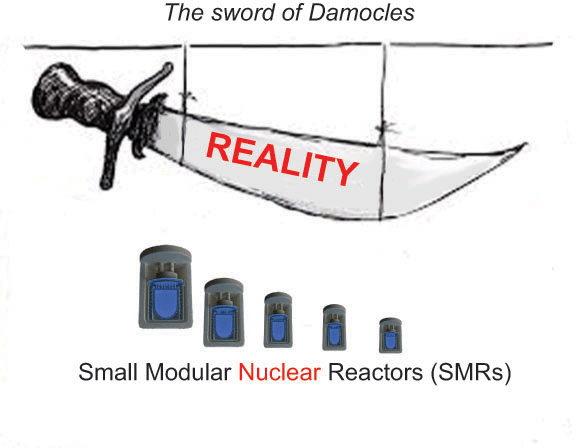
Insiders and lobbyists freely acknowledge that the nuclear power industry is in crisis and that worldwide decline is certain. But its Australian supporters are unfazed. Their only sideways nod to reality is to argue that even if large, conventional reactors are too expensive, the emerging “small modular reactors” would be a good fit for Australia.
Again, a reality check is in order. A handful of small reactors is under construction but they have been subject to huge cost overruns and delays. William Von Hoene, senior vice-president of Exelon ‒ the largest operator of nuclear power plants in the US ‒ says that no more large reactors will be built in the US and that the cost of small reactors is “prohibitive”.
Rolls-Royce sharply reduced its small-reactor investment to “a handful of salaries” in 2018 and is threatening to abandon its R&D altogether unless the British government agrees to an outrageous set of demands and subsidies.
|
March 10, 2020 The NSW Parliament’s State Development Committee released its report into nuclear power last week. Conservative committee members recommended repeal of state laws banning uranium mining and nuclear power, while Labor members want to retain the legal bans.
What the conservatives and other supporters of nuclear power ignore is that it has priced itself out of the energy debate. Continue reading |
The dangers of so called intermediate level nuclear waste, include the devaluation of the region’s agriculture

Bev Spriggs Fight To Stop A Nuclear Waste Dump In South Australia, 10 Mar 20, The dangers of so called intermediate level nuke waste, – it is considered high level waste in the countries that want us to take it. Mr Baldock will be astonished to learn of the devaluation of his crops and the rest of his land and that of his neighbours once that poison comes to town. As for the 45 job creations….that may happen during construction, then they will disappear and there will only be 8 to 10 jobs to caretake the facility. The 31 mill promised for the community will happen once only, when it is gone there will be no more. https://www.facebook.com/groups/941313402573199/
Small nuclear reactors, (just like large) can survive only with massive government subsidies
|
NUCLEAR PRICES ITSELF OUT OF THE FUTURE, HTTPS://WWW.AUMANUFACTURING.COM.AU/NUCLEAR-PRICES-ITSELF-OUT-OF-THE-FUTURE BY PETER ROBERTS, 9 Mar 20, I was at lunch the other day and out came the familiar theme – Australia should go nuclear to de-carbonise the economy. Well, a just-released report from the NSW Parliament’s State Development Committee should put an end to such talk – it is just too expensive and problematic. The report, detailed in Channel 9 media, found the cost of the two reactors being built in the US is now thought to be between $20.4 billion and $22.6 billion for each reactor. In the UK the cost of two reactors being build has jumped seven-fold to $25.9 billion each. And those being built in France and Finland are now costed at upwards of $17.7 billion each. Cost over-runs and delays mean that big nuclear power plants are only going to be built where there are massive government subsidies. And this is even before factoring in the cost of the odd Fukushima or Chernobyl. This morning on social media the pro-nuclear trolls were out in force – people are living happily now at Chernobyl one said. Well I visited Chernobyl 18 months ago and there is nothing normal about it. Maintaining the remains of the reactors at Chernobyl consumes 10 per cent of Ukraine’s admittedly modest GDP, and the long term effects of radiation continue to be felt. This is why nuclear proponents now talk about snazzy new small reactors which are going to be the next big thing. The same story is unfolding in small reactor construction as large – cost over-runs, very few small reactors actually under construction, and the need for massive, yes there’s that word again, government subsidies. We already know what the answer to our carbon crisis is – renewables. Wind and solar plus storage is already cheaper and getting cheaper every day. The future is not nuclear. |
|

So-called ‘Ethical’ super funds invest in coal, oil, gas
 ‘Ethical’ super funds invest in coal, oil, gas, SMH, Charlotte Grieve, March 3, 2020 Sustainable investment options offered by two major industry superannuation groups and wealth giant AMP have millions invested in the fossil fuel industry, despite pledging to apply strict screening based on environmental, social and governance standards.
AustralianSuper’s “socially aware investment option” claims it does not invest in Australian or international companies that directly own fossil fuels while disclosures of its portfolio holdings show it has at least $39 million invested in more than 20 global coal, oil and gas projects. These include Marathon Petroleum Corp, Indian thermal coal plant Adhunik Power and Natural Resources and oil, gas and chemicals company, WorleyParsons.
Latest figures show the fund has more than $2.4 billion invested on behalf of 38,000 members, less than 2 per cent of the $172 billion superannuation giant’s total membership pool.
After conducting a survey of members’ interests, the top investment concern for those wanting an ethical alternative was exposure to coal and other fossil fuels. The socially aware option pledges to screen out companies that own reserves of fossil fuels or uranium, regardless of the size of its ownership.
This screen is not applied to private equity, which makes up 4 per cent of total investments and the fund’s fact-sheet explains it can still invest in companies that provide services to, buy, process or sell products from or invest in the excluded companies.
The fund has a stake in 24 companies that either produce fossil fuels or rely on their production. These include: thermal coal producer Westmoreland Mining that in December announced a six-year coal supply agreement in middle America; $9.6 million in Halliburton, one of the world’s largest providers of drilling and production services for oil, gas and coal companies; and $9.6 million in Marathon Petroleum, the largest refining company in America that produces more than 3 million barrels of crude oil per day.
Other oil and gas companies AustralianSuper’s sustainable fund bankrolls include Fieldwood Energy, a company that claims to be one of the largest producers of oil and gas in the Gulf of Mexico, Perth-based Northern Oil and Gas and Ajax Resources, recently acquired by Texas oil and gas company, Diamondback.
AustralianSuper declined to answer questions about its screening process or if it had plans to create a fund that applies a hard screen to the fossil fuel industry.
Similarly, the 2019 portfolio holdings for $54 billion Hostplus’s sustainable investment option launched in March 2017 includes at least eight oil and gas companies, including Oil Search, Santos and Woodside Petroleum.
Hostplus was contacted for comment.
However, AMP invests in at least nine oil and gas companies, including Oil Search, Woodside Petroleum and Santos……. https://www.smh.com.au/business/banking-and-finance/ethical-super-funds-invest-in-coal-oil-gas-20200228-p545ja.html
Legislation banning nuclear power in Australia should be retained
| Jim Green, Online Opinion, 27 Feb 2020, https://onlineopinion.com.au/view.asp?article=20758&page=0
Nuclear power in Australia is prohibited under the Environmental Protection and Biodiversity Conservation (EPBC) Act 1999. A review of the EPBC Act is underway and there is a strong push from the nuclear industry to remove the bans. However, federal and state laws banning nuclear power have served Australia well and should be retained.
There are many other examples of shocking nuclear costs and cost overruns, including: * The cost of the two reactors under construction in the US state of Georgia has doubled and now stands at A$20.4‒22.6 billion per reactor. * The cost of the only reactor under construction in France has nearly quadrupled and now stands at A$20.0 billion. It is 10 years behind schedule. * The cost of the only reactor under construction in Finland has nearly quadrupled and now stands at A$17.7 billion. It is 10 years behind schedule. * The cost of the four reactors under construction in the United Arab Emirates has increased from A$7.5 billion per reactor to A$10‒12 billion per reactor. * In the UK, the estimated cost of the only two reactors under construction is A$25.9 billion per reactor. A decade ago, the estimated cost was almost seven times lower. The UK National Audit Office estimates that taxpayer subsidies for the project will amount to A$58 billion, despite earlier government promises that no taxpayer subsidies would be made available. Nuclear power has clearly priced itself out of the market and will certainly decline over the coming decades. Indeed the nuclear industry is in crisis ‒ as industry insiders and lobbyists freely acknowledge. Westinghouse ‒ the most experienced reactor builder in the world ‒ filed for bankruptcy in 2017 as a result of catastrophic cost overruns on reactor projects. A growing number of countries are phasing out nuclear power, including Germany, Switzerland, Spain, Belgium, Taiwan and South Korea. Rising power bills: Laws banning nuclear power should be retained because nuclear power could not possibly pass any reasonable economic test. Nuclear power clearly fails the two economic tests set by Prime Minister Scott Morrison. Firstly, nuclear power could not possibly be introduced or maintained without huge taxpayer subsidies. Secondly, nuclear power would undoubtedly result in higher electricity prices.
Former US Vice President Al Gore summarised the proliferation problem: “For eight years in Too slow: Expanding nuclear power is impractical as a short-term response to climate change. An analysis by Australian economist Prof. John Quiggin concludes that it would be “virtually impossible” to get a nuclear power reactor operating in Australia before 2040. More time would elapse before nuclear power has generated as much as energy as was expended in the construction of the reactor: a University of Sydney report concluded that the energy payback time for nuclear reactors is 6.5‒7 years. Taking into account planning and approvals, construction, and the energy payback time, it would be a quarter of a century or more before nuclear power could even begin to reduce greenhouse emissions in Australia (and then only assuming that nuclear power displaced fossil fuels).
Water consumption of different energy sources (litres / kWh): * Nuclear 2.5 * Coal 1.9 * Combined Cycle Gas 0.95 * Solar PV 0.11 * Wind 0.004 Climate change and nuclear hazards: Nuclear power plants are vulnerable to threats which are being exacerbated by climate change. These include dwindling and warming water sources, sea-level rise, storm damage, drought, and jelly-fish swarms. Nuclear engineer David Lochbaum states. “I’ve heard many nuclear proponents say that nuclear power is part of the solution to global warming. It needs to be reversed: You need to solve global warming for nuclear plants to survive.”
By contrast, the REN21 Renewables 2015: Global Status Report states that renewable energy systems “have unique qualities that make them suitable both for reinforcing the resilience of the wider energy infrastructure and for ensuring the provision of energy services under changing climatic conditions.”
To give one example (among many), the National Radioactive Waste Management Act dispossesses and disempowers Traditional Owners in many respects: the nomination of a site for a radioactive waste dump is valid even if Aboriginal owners were not consulted and did not give consent; the Act has sections which nullify State or Territory laws that protect archaeological or heritage values, including those which relate to Indigenous traditions; the Act curtails the application of Commonwealth laws including the Aboriginal and Torres Strait Islander Heritage Protection Act 1984 and the Native Title Act 1993 in the important site-selection stage; and the Native Title Act 1993 is expressly overridden in relation to land acquisition for a radioactive waste dump. No social license: Laws banning nuclear power should be retained because there is no social license to introduce nuclear power to Australia. Opinion polls find that Australians are overwhelmingly opposed to a nuclear power reactor being built in their local vicinity (10‒28% support, 55‒73% opposition); and opinion polls find that support for renewable energy sources far exceeds support for nuclear power (for example a 2015 IPSOS poll found 72‒87% support for solar and wind power but just 26% support for nuclear power). As the Clean Energy Council noted in its submission to the 2019 federal nuclear inquiry, it would require “a minor miracle” to win community support for nuclear power in Australia. The pursuit of nuclear power would also require bipartisan political consensus at state and federal levels for several decades. Good luck with that. Currently, there is a bipartisan consensus at the federal level to retain the legal ban. The noisy, ultra-conservative rump of the Coalition is lobbying for nuclear power but their push has been rejected by, amongst others, the federal Liberal Party leadership, the Queensland Liberal-National Party, the SA Liberal government, the Tasmanian Liberal government, the NSW Liberal Premier and environment minister, and even ultra-conservatives such as Nationals Senator Matt Canavan.
Australia can do better than fuel higher carbon emissions and unnecessary radioactive risk. We need to embrace the fastest growing global energy sector and become a driver of clean energy thinking and technology and a world leader in renewable energy technology. We can grow the jobs of the future here today. This will provide a just transition for energy sector workers, their families and communities and the certainty to ensure vibrant regional economies and secure sustainable and skilled jobs into the future. Renewable energy is affordable, low risk, clean and popular. Nuclear is not. Our shared energy future is renewable, not radioactive. More Information * Don’t Nuke the Climate Australia, www.dont-nuke-the-climate.org.au * Climate Council, 2019, ‘Nuclear Power Stations are Not Appropriate for Australia – and Probably Never Will Be’, https://www.climatecouncil.org.au/nuclear-power-stations-are-not-appropriate-for-australia-and-probably-never-will-be/ * WISE Nuclear Monitor, 25 June 2016, ‘Nuclear power: No solution to climate change’, https://www.wiseinternational.org/nuclear-monitor/806/nuclear-power-no-solution-climate-change Dr. Jim Green is the national nuclear campaigner with Friends of the Earth Australia. |




Climate change extreme weather making parts of Australia uninsurable
 Risks aren’t worth it’: QBE says parts of planet becoming uninsurable due to climate concerns, SMH, Charlotte Grieve February 17, 2020 Global insurance giant QBE has warned climate change poses a material threat to its business and the entire economy as its chief executive Pat Regan said premiums were at risk of becoming too high in areas exposed to repeated, extreme weather……
Mr Regan said there had always been parts of the world that were difficult to insure. But as floods and fires become have dominated headlines this summer, this risk was increasing across “swathes of Australia” and could potentially price out customers from home and business property insurance.
He said climate change was a “big topic” in the sector, requiring the insurance giant to “up its game on a number of fronts”. QBE boosted its reinsurance program for catastrophic events to $2 billion in a process that would be reassessed each year, he said. …..
“The evidence is there for all to see that the amount of weather events globally, not just in Australia, is consistently rising and most of the worst years on record have happened in the last 10 years.”
“The most prone ones [areas] are the ones we see in the news frequently,” Mr Regan said, referencing the Queensland floods and east coast fires…… https://www.smh.com.au/business/banking-and-finance/qbe-warns-of-climate-risk-as-300m-hit-to-revenue-alongside-unusual-weather-20200217-p541e3.html
South Australia’s grain exports could be at risk, if Kimba nuclear waste dump goes ahead
Paul Waldon Fight To Stop A Nuclear Waste Dump In South Australia, 17 Feb 20,Keeping in mind the safe standard for radioactive contaminated food in Australia is 1200 becquerels, which fails to keep up with the safer standards of Japan at only 100 becquerels per kilo. Not only is Japans standards safer than ours but Australia’s grain export to Japan is about $646 million per year, and that could be in jeopardy if the program to turn Kimba into a radioactive dump proceeds.
Dr Bandazhevsky’s study came with the added problem of finding children of Belarus free of contamination, there was also a health cluster in children now recorded and known as Chernobyl heart, a condition of multiple holes in the heart, due to radioactive exposure.
Private investors won’t touch new Coalition-backed coal plant, Labor says
Private investors won’t touch new Coalition-backed coal plant, Labor says, Morrison government to spend up to $4m in grant for feasibility study into coal-fired power plant in Queensland, Guardian, Australian Associated Press, Sat 8 Feb 2020 The federal Labor opposition says private investors will not touch “with a barge pole” the Morrison government’s plan to support a coal-fired power plant in Queensland.
The government says it will spend up to $6m in grants for two new Queensland electricity generation projects, including a coal-fired power plant, as part of a bid to lower power prices……..
Labor’s climate change and energy spokesman, Mark Butler, said private investors would not touch a new coal-fired power station “with a barge pole”.
“The government still has no energy policy – just ideological flights of fantasy,” he said in Adelaide on Saturday. The private investment sector had made it very clear it had no appetite for building expensive coal-fired power stations, he said.
Honeymoon uranium mine might restart this year, and pigs might fly
 Uranium miner flags restart at Honeymoon within a year if prices jump, others aren’t so sure, ABC BROKEN HILL BY DECLAN GOOCH AND SARA TOMEVSKA 22 Jan 2020, The company behind a proposal to restart uranium mining in north-east South Australia says it would be ready to begin production within a year if prices improve.
But the Australian Conservation Foundation (ACF) has cast doubt on the likelihood of that occurring, arguing the market is moving away from uranium.
Key points:
- Honeymoon is one of only four Australian uranium mines with an export licence but has been mothballed since 2013
- New owner Boss Resources says technology will help it lower operational costs and will reopen the mine once uranium prices improve
- Anti-nuclear campaigners doubt the mine’s prospects, saying significant uranium producers have been deferring or halting development
The Honeymoon uranium mine was mothballed in 2013 because it had become too expensive to run.
But in 2015, the mine, which is about 80 kilometres north-west of Broken Hill, was purchased by WA exploration company Boss Resources.
Boss chief executive Duncan Craib said the company had developed new technology to lower operational costs and had finalised a feasibility study.
He said the mine would reopen once uranium prices improved, which he was expecting to happen soon.
“We don’t want to destroy the resource at low uranium prices, so we’d like an uptick in the market before proceeding,” Mr Craib said.
Honeymoon is one of only four Australian uranium mines with an export licence.
However, Mr Craib said uranium was under-utilised in Australia and he would like to see a domestic uptake of nuclear power…….
Optimism baseless, campaigner says
Anti-nuclear campaigner Dave Sweeney from the ACF said he believed the announcement was without substance.
“There is nothing new in their statement,” he said.
“It’s pretty much a holding-pattern statement from a mining company with not a lot of resources, not a lot of projects, that are trying to continue to hold a place in the market, where the market is increasingly in freefall.
“Obviously, Boss is going to say the uranium price is going to soar — they’re a uranium miner.
“We’ve got major producers in this country … We’ve got a third of the world’s uranium and we’re not digging much, and that is because the price is not there.
Mr Sweeney said significant producers were deferring or halting development.
Rio Tinto, a massive mining company, is exiting at the Ranger mine in Kakadu,” he said.
“Cameco, the world’s largest dedicated uranium producer, has written down an asset that it spent $500 million on a decade ago in WA, and says that the best way to preserve the value of uranium is to keep it in the ground.”…….. https://mobile.abc.net.au/news/2020-01-22/honeymoon-uranium-mine-production-within-a-year-company-says/11889466
1 This month

of the week – Australians for War Powers Reform (AWPR)
To see nuclear-related stories in greater depth and intensity
 Antinuclear