As March begins – nuclear and climate news
This week there’s quite a lot of news about nuclear weapons development. Nobody seems very interested – all same-same? Weapons anxiety fatigue? UN disarmament chief hopes upcoming conference will address current nuclear challenges. Some experts think that the subject should get a mention in the USA 2020 election race.
The Coronavirus has gripped the media – with climate change taking a back seat. Bad though that epidemic is, global heating also moves on inexorably.
a bit of good news – Designer Works to Erect First Modern Village to Generate its Own Electricity–and Food–in 100% Sustainable Loop
AUSTRALIA
NUCLEAR.
- Keeping Australia nuclear-free: national campaign meeting in Melbourne.
- Investigative journalism – Legislation banning nuclear power in Australia should be retained. Small Nuclear Reactors- the dying nuclear industry targets Australian tax-payers. No advantage in ‘new’ back-to-the-future nuclear reactors for Australia. Is the real motive military? Busting the lies of the Australian Government about “new” nuclear reactors – Waste management considerations.
- Part 1 of A Study of the “Report of the inquiry into the prerequisites for nuclear energy in Australia” Australian Parliamentary Committee 2020. — The Industry Push to Force Nuclear Power in Australia.
- Australia’s early nuclear history – a scandalously crooked co-operation with Britain.
- In Victoria the goal of the nuclear lobby is to remove Victoria’s Nuclear Activities (Prohibitions) Act.
- Kimba nuclear waste dump – a total mishandling of the truth from Australian government. Greens Senator Hanson-Young calls for Senate Nuclear Waste Inquiry to meet in Whyalla, South Australia. Whyalla urgently needs a policy to prevent becoming the radioactive trash port. Barngarla Aboriginal Corporation lobby Senators– to oppose Bill to set up Kimba nuclear waste dump. The Kimba nuclear waste dump will take a huge toll on the Murray River’s water.
CLIMATE
- Australia’s disappearing beaches, as global heating causes sea level rise.
- Global heating, rising seas, and the plight of Torres Strait Islanders.
- Greens leader Adam Bandt introduces Climate Emergency Bill.
- #ScottyFromMarketing a ‘predatory’ centrist on climate policy with no plans for meaningful emissions reduction. #ScottyFromMarketing dodges the question of how much “climate business as usual will cost the economy.
- Queensland energy minister “deeply concerned” over Coalition plans for new coal generator. Greens seek laws to block Adani, Clive Palmer’s Galilee coal mines.
- Darebin Council, Melbourne – a world first on Climate Emergency.
- So-called ‘Ethical’ super funds invest in coal, oil, gas.
- Former UN climate chief receives human rights award from Sydney Peace Foundation.
RENEWABLE ENERGY Australia could soon export sunshine to Asia via a 3,800km cable . Why an Australian mining giant chose wind and solar over gas for $1 billion project. Australia’s first detailed database on household solar, batteries and EVs goes live. Victoria energy efficiency market rides wave of optimism, NSW hopes to follow. Industry joins call for ARENA funding extension, as Energy MinisterTaylor ducks commitment. Sydney Gay and Lesbian Mardi Gras 2020 – 100% carbon-offset in partnership with Powershop.
INTERNATIONAL
Coronavirus – right-wing media reactions and conspiracy theories.
The Planet Is Screwed, Says Bank That Screwed the Planet. USA fails to stop G20 finance ministers and central bank governors‘ warning on climate change.
Nuclear testing left a signature of radioactive carbon all around the world. The Castle Bravo bomb and its effects on the soldiers, and on the planet.
A Brief Study of Molten Salt Reactors.
Climate action? – you simply couldn’t build enough nuclear reactors.
Antarctic ice walls protect the climate..
No advantage in ‘new’ back-to-the-future nuclear reactors for Australia. Is the real motive military?
Part 2 of A Study of the “Report of the inquiry into the prerequisites for nuclear energy in Australia” Australian Parliamentary Committee 2020. The Industry Push to Force Nuclear Power in Australia
The Parliamentary Committee recommends, in part, the following: Recommendation 2
The Committee recommends that the Australian Government undertake a body of work to progress the understanding of nuclear energy technology by:
- Commissioning the Australian Nuclear Science and Technology Organisation (ANSTO), or other equivalent expert reviewer, to undertake a technological assessment on nuclear energy reactors to:
- produce a list of reactors that are defined under the categories of Generation I, II, III, III+ and IV;
- advise on the technological status of Generation III+ and Generation IV reactors including small modular reactors;
- advise on the feasibility and suitability of Generation III+ and Generation IV reactors including small modular reactors in the Australian context; and
- formulate a framework to be used by Government to monitor the status of new and emerging nuclear technologies.The first item of the recommendation – for ANTSO to compile of reactors according to each one’s status within the table of Generation – 1 to 4 might be a good idea, for many of the Generation IV reactor designs were first envisaged and trialled in the 1950s and 1960s before being discarded. Whereas, at the present time, and since the time the US Department of Energy sought ways of halting the decline of nuclear power’s percentage contribution to global energy supply in the 1990s. For that is the time that the idea of resurrecting old designs and calling them new and “Generation IV” and re marketing them first arose
The waste from the very first molten salt fuelled and cooled reactor, as we saw in the previous post, continues to cost US taxpayers money 60 years later.
In 2014 the Brookings Institute published an essay by Josh Freed entitled “Back to the Future, Advanced Nuclear Energy and the Battle Against Climate Change”. This essay is available to read at http://csweb.brookings.edu/content/research/essays/2014/backtothefuture.html The cover illustration is very interesting.
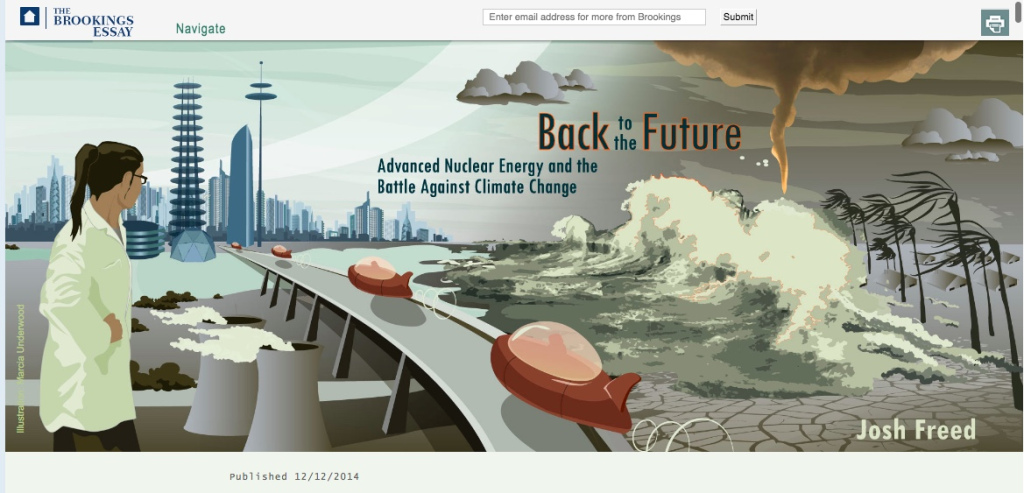
The titled cover includes the disclosure that the nuclear industry sees a future for previously discarded, old reactor designs. It shows a nuclear reactor sitting below sea level, protected by a combined Dyke / Causeway for levitating vehicles. Huge waves threaten the Dyke, vehicles, reactor and giant Science Woman, who is watching on with skilled impartiality. In the distance, buildings taken straight from the cartoon “The Jetsons” appear. The illustration is also, actually, a reinterpretation of the events which occurred in March 2011 at Fukushima. The sub text of the picture admits that nuclear industry cannot keep going in the way that it has done since the days between 1945 and now. The industry would disappear if it did not “modernise”.
The fission industry is dying as more and more competition arises in the form of alternative technologies in the energy generation technology market. Even Fusion research continues to make inroads toward the goal of successful and economic power generation, but it still a few years off. The 1930s fission patents of Szilard are long in the tooth and actually, in terms of economic energy production has always been a failure. Kick started by governments, the standard designs are trusted by fewer and fewer people, especially throughout Asia. Westinghouse Nuclear, GE Nuclear, Toshiba Nuclear are all bankrupt. British Nuclear Fuels Ltd is broke, Sellafield is broke and a growing cleanup cost liability.
So increasingly, the industry needs a unique selling point, something new and radical, something that solves the old nuclear problems. It needs a product which never fails or spills radioactive materials into the biosphere, it needs a product that will not fail because the grid goes down for a few days, it cannot melt down, catch fire like Windscale, Monju and Fermi 1 did.
Seeing as there actually no new concepts, why not look again, in desperation, at the rejected designs of the past? The essay by Josh Freed (his real name) mentions a company called Transatomic. In contrast to the contents of the Freed article, which claims the old new reactor envisioned by Transatomic run on nuclear waste, Transatomic make no such claim. They state that their proposed reactor would run on liquid uranium fuel. As per the original 50s/60s design. They claim that the Molten salt reactor would create less weight of high level waste.
Because the waste would be continuously removed from the reactor. he corporate website for Transatomic is here: http://www.transatomicpower.com/the-science/ And this, from their web site, is precisely what they promise: Molten salt reactors like Transatomic Power’s are fueled by uranium dissolved in a liquid salt. The fuel is not surrounded by cladding, making it possible to continuously remove the fission products that would otherwise stop the nuclear reaction. The liquid fuel is also much more resistant to structural damage from radiation than solid materials – simply, liquids have very little structure to be damaged. With proper filtration, liquid fuel can remain in a molten salt reactor for decades, allowing us to extract much more of its energy.” end quote. They claim their reactor design produces half the nuclear waste of a comparable conventional light water reactor.
This still does not solve the high level nuclear waste stockpile. It adds to it. Given the competition nuclear power has in the modern world, given that the need for ‘baseload’ energy is now shown to be nonsense, what would 1 or 2 small modular molten salt reactors add to Australia? Would they merely replace coal fire powered generation? SA has not had coal fired electricity for some years now. A combination of solar, wind and storage in SA means SA is a net electricity exporter to the Eastern States. We have back up of gas fired generation which very rarely needed.
Sadly for Transatomic, Green Tech Media state the following at https://www.greentechmedia.com/articles/read/transatomic-to-shutter-its-nuclear-reactor-plans-make-its-technology-public announced the following in 2018:
“Transatomic to Shutter It’s Nuclear Reactor Plans, Open-Source It’s Tecnology.
The startup backed by Peter Thiel won’t be able to build its advanced reactor designs—but it’s making its IP available for others to carry on the work.” Source: Jeff St. John, 25 Sept 2018.as given above.
This gift to the world by Transatomic occurred at the time in Australia when various people began a bombastic and highly enthused campaign to convince Australians that Molten Salt Reactors, fuelled with either Uranium or Lithium or nuclear waste, were Jesus Mark 2. “We’ll Save Yer, just like we did in the Cold War. Solar and batteries are for whimps. We Can’t have solar and wind power in Australia, its a threat to Queensland Coal. Let’s nuclear instead and all make a quick a buck with IP”.
Funny that. Talk about drumming up business prospects and investment funds, and in 2020, floating a float on the back of sympathetic and one eyed Parliamentary Inquiry!
Double or Nothing?
The promise made by Transatomics is that molten fuel/molten salt reactors made with modern techniques will reduce by roughly half the amount of high level nuclear waste generated per unit of power generated. However, at the current time the amount of high level nuclear waste (ie, fission products -the transmutation products described in Szilard’s 1930s patents) and the release of the gaseous forms of these substances into the atmosphere, generated by Australian electricity generation is ZERO.
So the introduction of Molten Salt Reactor into Australia for electricity production will RAISE the production of high level nuclear waste from this activity by 100%. It won’t half, it won’t double, it will increase by x grams per watt. It is a spurious argument to say any reactor type will reduce Australia’s power industry high level nuclear waste when we produce zero at the moment. And if Australia continues on its non nuclear path, that zero rate of power related high level waste will remain zero forever. So where is the advantage for Australia in introducing power reactors in the civilian sphere?
I am led to believe that it will take between 10 – 20 years for any Australian nuclear power reactor to come on line from the time it is approved. By that stage the competition from other forms of low carbon power production will be much, much more severe than it is now. And today, in my opinion, only a devotee of nuclear power would see any advantage in introducing any type of nuclear reactor to Australia. Unless the real motive for such a reactor is a military motive. If so, the O’Brien Committee and the government needs to come clean on that. Not that they will. Such an admission is likely to be impossible for several reasons. Besides, no nuclear industry is free to fully disclose the corporate production and disposition of “special nuclear materials”.
So, I suppose in the end the Committee recommend ANTSO compile a list of reactor types and nominate the current industry PR terms for each type. For the Generational types (1 through IV) have actually very little to do with the chronological order and date range over which each type first manifest as a prototype. The small World War 2 German reactors, of which there were many, are little known, and the US ALSOS project has not disclosed that much about them. Germany had at least 4 reactor programs, 7 ways of enriching uranium. Japan had an Army fission project, a Navy fission project, an Air Force Fission project. All were formally abandoned, ironically , in July 1945. Germany was able to enrich uranium.
This is ancient history, but the world remains fairly ignorant I think, as to which reactor type is the safest, most economic, most reliable and so on. So far, all I have heard from the nuclear industry is PR manufactured originally by the US Department of Energy which relabelled the various reactor designs originated in the US according to a “Generation Number” which is completely detached from the chronological sequence in which they occurred.
In World War 2 Germany was working on heavy water reactors. Does that mean Hitler’s heavy water reactors were Generation III+ ? Of course not. They were Gen 1. As was the Canadian heavy water reactor of World War 2 which supplemented the US plutonium production at Hansford. If the Candu reactor is Gen III+ I’m Father Christmas. What the US DOE is doing with its naming is using marketing techniques to sell old concepts as new ideas.
Car companies do the same when naming cars. Makers of garbage trucks send salesmen around to Council depots extolling the virtues of the Gen IV 2 ton rubbish truck, complete with compactor, a tilt tray and 8 track stereo sound. And Depot managers get given toy model rubbish trucks they sit on their book cases to show how technically astute they are in the field of garbage.
Same deal here. It’s a no brainer. Yet, start collecting lists from ANSTO Mr. O’Brien. Great idea sir. It’ll keep you off the streets for awhile.
Busting the lies of the Australian Government about “new” nuclear reactors
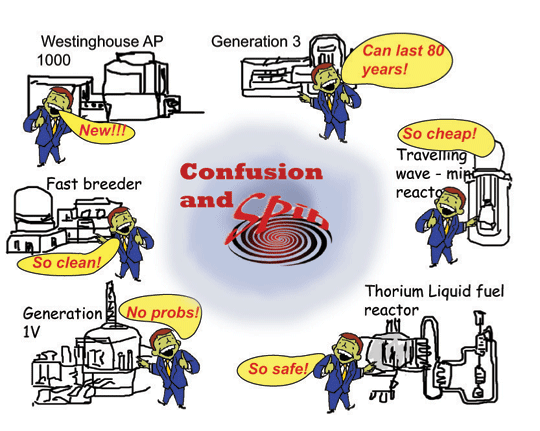
The core propositions of non-traditional reactor proponents – improved economics, proliferation resistance, safety margins, and waste management – should be reevaluated.
Before construction of non-traditional reactors begins, the economic implications of the back end of these nontraditional fuel cycles must be analyzed in detail; disposal costs may be unpalatable………. reprocessing remains a security liability of dubious economic benefit
Non-traditional” is used to encompass both small modular light water reactors (Generation III+) and Generation IV reactors (including fast reactors, thermal-spectrum molten salt reactors, and high temperature gas reactors)
|
Burning waste or playing with fire? Waste management considerations for non-traditional reactors Full Text
The Industry Push to Force Nuclear Power in Australia https://nonuclearpowerinaustralia.wordpress.com/2020/03/02/burning-waste-or-playing-with-fire-waste-management-considerations-for-non-traditional-reactors-full-text/ by nuclearhistory March 2, 2020 The following paper is copied here in order to counter the false, incorrect and erroneous propaganda published by the Australian Government and its Parliamentary Committee for lying to the Australian people about so-called new nuclear reactor designs, all of which were rejected by competent authorities in the 1950s, 1960s, and 1970s. The residues produced by these test reactors continue to cost the American taxpayer money and continue to present the American people with stored, hazardous radioactive waste which is also high chemically reactive. |
Greens leader Adam Bandt introduces climate emergency Bill
 ‘People are angry and anxious’: Adam Bandt introduces climate emergency
 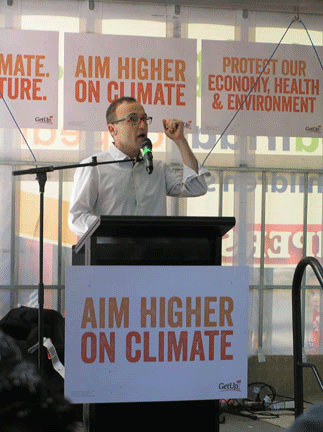 bill, https://www.sbs.com.au/news/people-are-angry-and-anxious-adam-bandt-introduces-climate-emergency-bill Greens leader Adam Bandt has introduced a bill to formally declare a climate emergency and set up a ‘war cabinet’ to tackle the crisis.
Greens leader Adam Bandt has painted a post-apocalyptic future for Australia unless the government declares a climate emergency.
Mr Bandt told parliament on Monday that “environmental collapse was here” as he introduced his bill to formally declare the crisis.
“It is not scaremongering, it is hard physics and we have just had a taste of it over the last summer,” he said.
He said northern Australia would be inhospitable for parts of the year, one-in-six native species would be extinct, mosquito-borne diseases will travel south and the country’s river systems will see more algal blooms that lead to mass fish kills in the Murray-Darling.
Under the bill, the government would be required to set up a “war cabinet” to tackle the crisis, government agencies would refer to the declaration of a climate emergency when developing policy and table annual reports on how they were meeting their obligations.
Mr Bandt’s bill was seconded by independent MP Zali Steggall, who knocked off former Liberal prime minister Tony Abbott for the NSW seat of Warringah at the last election.
“There is no doubt we are in the midst of a climate emergency,” Ms Steggall said.
We have a duty to Australian people … it is time for us all to be accountable.”
A climate emergency motion moved in October fell four votes short.
So-called ‘Ethical’ super funds invest in coal, oil, gas
 ‘Ethical’ super funds invest in coal, oil, gas, SMH, Charlotte Grieve, March 3, 2020 Sustainable investment options offered by two major industry superannuation groups and wealth giant AMP have millions invested in the fossil fuel industry, despite pledging to apply strict screening based on environmental, social and governance standards.
AustralianSuper’s “socially aware investment option” claims it does not invest in Australian or international companies that directly own fossil fuels while disclosures of its portfolio holdings show it has at least $39 million invested in more than 20 global coal, oil and gas projects. These include Marathon Petroleum Corp, Indian thermal coal plant Adhunik Power and Natural Resources and oil, gas and chemicals company, WorleyParsons.
Latest figures show the fund has more than $2.4 billion invested on behalf of 38,000 members, less than 2 per cent of the $172 billion superannuation giant’s total membership pool.
After conducting a survey of members’ interests, the top investment concern for those wanting an ethical alternative was exposure to coal and other fossil fuels. The socially aware option pledges to screen out companies that own reserves of fossil fuels or uranium, regardless of the size of its ownership.
This screen is not applied to private equity, which makes up 4 per cent of total investments and the fund’s fact-sheet explains it can still invest in companies that provide services to, buy, process or sell products from or invest in the excluded companies.
The fund has a stake in 24 companies that either produce fossil fuels or rely on their production. These include: thermal coal producer Westmoreland Mining that in December announced a six-year coal supply agreement in middle America; $9.6 million in Halliburton, one of the world’s largest providers of drilling and production services for oil, gas and coal companies; and $9.6 million in Marathon Petroleum, the largest refining company in America that produces more than 3 million barrels of crude oil per day.
Other oil and gas companies AustralianSuper’s sustainable fund bankrolls include Fieldwood Energy, a company that claims to be one of the largest producers of oil and gas in the Gulf of Mexico, Perth-based Northern Oil and Gas and Ajax Resources, recently acquired by Texas oil and gas company, Diamondback.
AustralianSuper declined to answer questions about its screening process or if it had plans to create a fund that applies a hard screen to the fossil fuel industry.
Similarly, the 2019 portfolio holdings for $54 billion Hostplus’s sustainable investment option launched in March 2017 includes at least eight oil and gas companies, including Oil Search, Santos and Woodside Petroleum.
Hostplus was contacted for comment.
However, AMP invests in at least nine oil and gas companies, including Oil Search, Woodside Petroleum and Santos……. https://www.smh.com.au/business/banking-and-finance/ethical-super-funds-invest-in-coal-oil-gas-20200228-p545ja.html
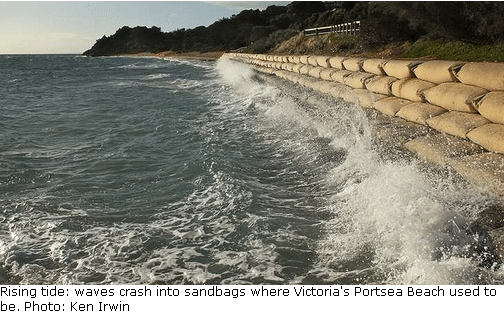
Australia’s disappearing beaches, as global heating causes sea level rise
|
Thousands of kilometres of Australia’s beaches at risk from rising seas, SMH, By Peter Hannam, March 3, 2020 More than 12,000 kilometres of Australia’s sandy beaches are threatened by coastal erosion by the end of the century, with greater losses predicted if greenhouse gas emissions remain high.The projections, made by European researchers and published in Nature Climate Change on Tuesday, used satellite data that tracked shoreline change from 1984 to 2015. They found a “substantial proportion” of the world’s sandy coastline is already eroded, a trend that could worsen as climate change pushes up sea levels.
Under a “moderate” effort to curb emissions – with carbon pollution peaking at 2040 and then declining – at least 12,324 kilometres of Australia’s sandy coast will be threatened with erosion by 2100. That tally is the most of any nation, and would amount to about 40 per cent of the country’s sandy beaches. Should greenhouse gas emissions continue to rise through the century – the so-called 8.5 Representative Concentration Pathway – Australia’s sandy coastline at risk increases to 15,439 kilometres, the paper said. “You have a long coastline and part of the coast is very mildly sloping” and is therefore susceptible to erosion, said Michalis Vousdoukas, a coastal oceanographer at the European Commission and the paper’s lead author. “Melbourne is worse than Sydney,” Dr Vousdoukas told the Herald and The Age, adding Brisbane and Adelaide’s beaches fell between the two in terms of vulnerability to erosion. The researchers said global sea levels had been increasing “at an accelerated rate during the past 25 years and will continue to do so with climate change”. So far, most of the increase had come from the thermal expansion of warmer water but, by mid-century or so, the increase in sea levels would likely come more from melting ice sheets, Dr Vousdoukas said……..https://www.smh.com.au/environment/climate-change/thousands-of-kilometres-of-australia-s-beaches-at-risk-from-rising-seas-20200302-p5463p.html |
|
|
Nuclear testing left a signature of radioactive carbon all around the world
Even after childhood, bomb radiocarbon chronicles the history of our body.
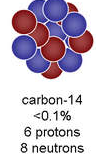 Your Inner H-Bomb Nuclear testing left a signature of radioactive carbon all around the world—in trees and sharks, in oceans and human bodies. Even as that signal disappears, it’s revealing new secrets to scientists. The Atlantic, Story by Carl Zimmer, 2 Mar 20,
 1 This month
17 October, Free Public Talk on Nuclear Issues in South Australia
David Noonan will speak on public interest concerns over the new Roxby Downs Indenture Act 2026 on BHP copper-uranium mining and ore processing in SA, and on how AUKUS may face SA with a High-Level nuclear waste agenda.
Dr Jim Green will discuss international developments in the field of nuclear power including ‘small modular reactors’ and Generation 4 ‘advanced’ nuclear reactor concepts.


Help Aunty Sue Protect Her Land and Sacred Sites From Destructive Rocket Testing.
.

Australians deserve the truth
about
AUKUS – https://aukuspublicinquiry.com/

PETITION – To: Prime Minister Anthony Albanese and the Australian Labor Government

of the week – Australians for War Powers Reform (AWPR)
To see nuclear-related stories in greater depth and intensity

