Bangladesh and Australia- both vulnerable to climate change – but will that stop the coal lobby?
 Despite climate impact, Bangladesh wants Australian coal to fire 29 new power stations, https://www.theage.com.au/politics/federal/rba-told-to-mobilise-all-forces-to-save-the-economy-from-climate-change-20200120-p53szi.html Bangladesh has been criticised for its ambitious plans to build 29 new coal-fired power stations, but its high commissioner to Australia believes the new projects could be an opportunity for greater trade between the two nations. 20 Jan 2020 , BY BRETT MASON SBS chief political correspondent Brett Mason reports from Dhaka, Bangladesh Despite climate impact, Bangladesh wants Australian coal to fire 29 new power stations, https://www.theage.com.au/politics/federal/rba-told-to-mobilise-all-forces-to-save-the-economy-from-climate-change-20200120-p53szi.html Bangladesh has been criticised for its ambitious plans to build 29 new coal-fired power stations, but its high commissioner to Australia believes the new projects could be an opportunity for greater trade between the two nations. 20 Jan 2020 , BY BRETT MASON SBS chief political correspondent Brett Mason reports from Dhaka, Bangladesh
Bangladesh’s high commissioner to Australia has urged the Australian government to consider new trade opportunities with the country, including the potential to supply it with 80 million tonnes of coal over the next five years. SBS News is currently in Bangladesh as part of a parliamentary learning tour organised by Save the Children. Speaking to SBS News ahead of the trip, Mohammad Sufiur Rahman said Bangladesh’s controversial plans to construct 29 new power stations over the next two decades would require a “huge quantum” of coal to power them. “We’ll have to source it from places, either Indonesia, or Australia, or maybe South Africa,” he said. Mr Rahman began spruiking the “enormous” export opportunity to the Australian media last year and doubled down on it in his interview with SBS News. “The quality and calorific value of Australian coal is much better in comparison to other sources,” he said. Climate impactBangladesh has the sixth-highest number of current and proposed coal-powered projects compared to the rest of the world, according to environmental advocacy group Market Forces. But the nation is also particularly vulnerable to climate change, with fears a projected half a metre sea-level rise by 2050 could leave 11 per cent of the country’s landmass underwater and 15 million people displaced. Continue reading |
It is a big MISTAKE to equate COAL MINING with jobs
It is a big MISTAKE to equate COAL MINING with jobs
 1. Australian Tourism employs 10 times more Australians than does mining
2. There are job vacancies in the setting up and maintaining renewables
3. Australia has an opportunity to Lead the World manufacturing and building the equipment and technological infrastructures and components required to set up renewable and sustainable community and economy e.g.. Let’s build Australian Made solar panels instead of importing them
4. Build our own iron ore processing plants run by green hydrogen/hydro/wind/solar/ To make aluminium Keeping profits and jobs in Australia
5. Build sustainable industry, farming, tourism, land management, water management and houses, towns and cities, Leed the world in recycling and green energy transport solutions Manufacture electric cars, buses, commercial vehicles There are so many jobs to be had and created in zero emissions
The world would flock here and pay us to advise and share our sustainable progressive technology and solutions
6. Eco tourism would not only create even more jobs for Austalians boosting the industries that benefit ie. restaurants, bakeries, farmers etc The tourism industry would bring even more billions of $$$$ into Australia
Australia’s $multi-billion climate whammy: Ross Garnaut was right
|
Ross Garnaut’s climate change prediction is coming true and it’s going to cost Australia billions, experts warn, ABC News,
By business reporter Nassim Khadem 8 Jan 2020,Twelve years ago, economist Ross Garnaut made a prophecy that has devastatingly come true.
Key points:
In the 2008 Garnaut Climate Change Review, which examined the scientific evidence around the impacts of climate change on Australia and its economy, he predicted that without adequate action, the nation would face a more frequent and intense fire season by 2020. Speaking to the ABC about the latest bushfires and the potential economic fallout, Professor Garnaut refrained from taking a direct shot at policymakers who ignored many of the review’s calls for action. But he noted: “If you ignore the science when you build a bridge, the bridge falls down.”
The initial damage bill from Australian bushfires that began in September has risen to $700 million, according to Insurance Council of Australia estimates, and is likely to grow. ICA’s Campbell Fuller told ABC News that 1,838 homes have been destroyed across Australia since September and there have been 8,985 insurance claims for fire-related damage and destruction. But insured losses are just a small part of wider economic losses. The total cost of the 2009 Black Saturday bushfires was estimated at $4.4 billion. Conservative estimates put the final cost of the current Australian bushfires well into billions of dollars, while some analysts say it could cost the economy $20 billion in lost output. Economist says cost could hit $3.5 billionThe head of economic analysis at SGS Economics and Planning, Terry Rawnsley, has done some early estimates on the economic cost of the bushfires. Based on previous modelling of the Tathra fires in 2018, and taking account of $700 million worth of insured losses, the economic fallout from the latest fires could be as high as $3.5 billion, he said. Between $2 billion to $3 billion includes the direct costs to fire-affected regions such as the loss of tourism and retail income, and the impact on agricultural production. He predicts that some of the worst-affected communities will never fully recover. And smoke haze in major capital cities could be an additional $500 million drag on the economy. “These are places not directly impacted by bushfires, but people aren’t out and about, and people are calling in sick with respiratory and asthma illnesses,” he said. Mr Rawnsley said while SGS Economics had modelled the loss of income from livestock such as sheep and cattle being destroyed, it had not modelled the actual loss of the assets (the loss of the sheep and cattle itself). Professor Tom Kompas, one of three chief investigators in the Centre of Excellence for Biosecurity Risk Analysis (CEBRA) at the University of Melbourne, said the economic cost of the bushfires would be “massive”. He said he intended to do precise modelling on the impact later this month. His earlier research on economic impacts of climate change had predicted $1.2 trillion in cumulative damages from now to 2050 assuming a global temperature increase of 3.8-4C by 2100. But the $1.2 trillion in losses looks at infrastructure lost due to sea-level rise, losses in agricultural and labour productivity and limited human health and biodiversity impacts. “It does not include the cost of bushfires on infrastructure and resulting increases in insurance premiums,” he said. “It also does not include damages from human health effects due to pollution and smoke-related illnesses, losses in tourism, losses to major environmental assets … or the costs of emergency management, recovery and relocation.” Estimated $20 billion could be wiped off GDPAMP Capital chief economist Shane Oliver estimated a reduction of between 0.25 and 1 per cent in the level of national economic output as a result of the fires, which he forecast would show up mostly in the March quarter. Based on Australia’s gross domestic product (GDP) of about $2 trillion, a 1 per cent drag could equate to about $20 billion. Still, even a lesser 0.25 per cent hit would be a major drag on economic growth, in an already slowing economy.
Everyone would pay to some degree via higher premiums as insurance claims spiked, he said…….. https://www.abc.net.au/news/2020-01-08/economic-bushfires-billions-ross-garnaut-climate-change/11848388 |
|
Not only is the bushfire disaster devastating for Australia: it’s bad for its image, too
 ‘People aren’t stupid’: bushfire crisis scorches Australia’s image, The Age, By Andrew Taylor, January 5, 2020 A photo of a kangaroo leaping across the pages of British newspapers is the sort of free publicity that tourism authorities usually crave.
Except the animal was another victim of the months-long bushfire crisis, fleeing as flames engulfed a house at Lake Conjola on the NSW South Coast.
Another photo of two German tourists wearing surgical masks against a backdrop of the Sydney Opera House and Harbour Bridge published in the Financial Times last month under the headline “Wildfire smoke endangers lives and Sydney outdoor lifestyle” is likewise the sort of coverage money would not want to buy.
Apocalyptic images of tourists sheltering in water as flames threatened the Victorian seaside town of Mallacoota or stranded on beaches on the NSW South Coast have also featured across television screens, newspapers and news websites around the world.
They provided a stark contrast to Sydney’s New Year’s Eve fireworks, which went ahead despite calls for the event to be cancelled.
Images of terrified tourists, fire-devastated communities and distressed wildlife are also a far cry from the idyllic beaches and landscapes in Tourism Australia’s new $15 million tourism campaign targeting the British market…….
The vitriolic debate over climate change was also at odds with Australia’s claim to be laid back and friendly, Mr Derwin said. “Our reputation as a tourist destination would be greatly enhanced by taking leadership on climate change, and showing the world that we’re serious about protecting our natural habitats.”
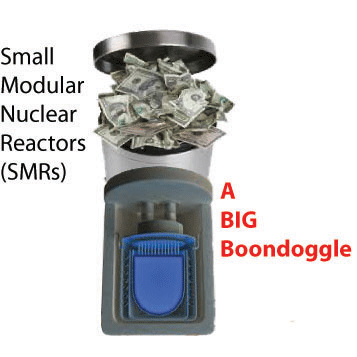
Smaller Nuclear Power Is Not Cheaper Nuclear Power
 Parliamentary Committee Supports Nuclear – But Only If Everyone Is Into It , Solar Quotes, December 19, 2019 by Ronald Brakels “……..Smaller Is Not Cheaper
Small Modular Reactors (SMRs) are suggested in the report as a way of making nuclear power economically viable. The problem with this is they cost more per kilowatt than large ones. This fact should not be a surprise to anyone. The engineers who designed the large nuclear reactors in the world today are not idiots who are currently slapping their foreheads, saying, “I’m so stupid! If only I had thought of making them smaller instead of bigger!” Modern reactors are very large to keep their cost per kilowatt down. Going small has the opposite effect.
That small reactors are not cheap is made obvious by the fact Britain, which has the longest history of nuclear power generation of any country, decided to power their new aircraft carriers with kerosene and diesel rather than small nuclear reactors because of they are so expensive. This is despite the alternative being expensive oil products rather than much cheaper solar and wind energy.
An advantage given for SMRs is they will supposedly suffer from fewer cost overruns. But that sales pitch is not enough to make nuclear energy economically attractive — pay for a more expensive product so you’ll have less of a chance of unpleasant surprise expenses down the line.2…… https://www.solarquotes.com.au/blog/nuclear-energy-australia/
Rio Tinto appeals Takeovers Panel decision on uranium miner ERA
Rio Tinto appeals Takeovers Panel decision on uranium miner ERA, THE AUSTRALIAN, NICK EVANS, RESOURCE WRITER, 13 Dec 19,
 Rio Tinto has appealed a Takeovers Panel decision preventing it from taking complete control of uranium miner ERA, as the fallout from the company’s hard-ball tactics to fund the clean-up of the Ranger uranium mine continues.
The Takeovers Panel handed dissident ERA investor Richard Magides a moral victory on Wednesday, declaring ERA’s decision to accept a Rio offer to underwrite a $476m equity issue was made in “unacceptable circumstances”…...(subscribers only)
A foreign corporation gets 89 BILLION litres of Australia’s water, as drought worsens
|
Water restrictions for you, an endless supply for them: How a foreign corporate giant is snapping up 89 BILLION litres of Australia’s H20 as the country suffers its worst drought ever
By ALISHA ROUSE FOR DAILY MAIL AUSTRALIA DAILY MAIL UK 12 December 2019 |A multi-billion dollar Singaporean food company is selling 89,000 megalitres of Australian water to a Canadian pension fund. The mega sale of Australian permanent water rights comes as the country is crippled by one of the worst droughts in its history. On Tuesday, NSW brought in a complete ban on hoses as part of the toughest water restrictions implemented for more than a decade. But no such problem existed for food and agriculture giant Olam International, which sold the 89billion litres of permanent water rights for an astonishing $490 million. The company sold it to an entity associated with the Public Sector Pension Investment Board, one of Canada’s largest pension investment managers, according to Straits Times. It will use the water to irrigate almond trees, in a business venture likely to draw criticism over foreign ownership of farms and water. The water rights are in the lower Murray-Darling Basin. The chairman of the Victorian Farmers Federation’s water council, Richard Anderson, told the Sydney Morning Herald: ‘Really, all you’ve got is a change of ownership, it (the water) has gone from a Singapore-owned company to a Canadian pension fund……. Water restrictions in Sydney, the Blue Mountains and Illawarra were upgraded to level two as dam levels in the region sank to just 45 per cent capacity, the lowest levels since the Millennium Drought took hold in 2003….. The Bureau of Meteorology has predicted a hot-than-usual summer, with no forecast for significant rain. The sale is understood to be giving Olam a ‘one-time pre-tax capital gain of about $311 million’, the paper reported. The agreement is for 25 years, with the option to renew for another 25. In March, the government released its foreign ownership of water entitlement register, showing that investors from China and the US had the largest stake in Australia’s foreign-owned water entitlements. It showed that one in 10 water entitlements is foreign owned. A water entitlement is the right to an ongoing share of water, which can be sold by irrigators, companies or investors. Acting as a property right, it gives access to an exclusive share of water from a water resource. This is different to a water allocation, which is the right to access a volume of water for use or trade. https://www.dailymail.co.uk/news/article-7780983/Foreign-company-sells-89-billion-litres-Australian-water-rights-490m-drought.html?fbclid=IwAR3wKbYP6OnXTEPhNoZiDeQ2Oj1o6uMzWUmkQSOgMxYjkZn6i0cJFj60Zo4&fbclid=IwAR3oHKAi9vQG4MctY4LMYNppX-pbY88hw0Zj4ACzypNTB_WI9nTtkc710bc |
|
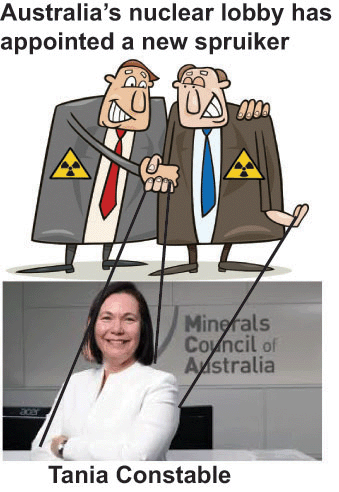
Minerals Council renews push for nuclear energy, but rather coy about its costs
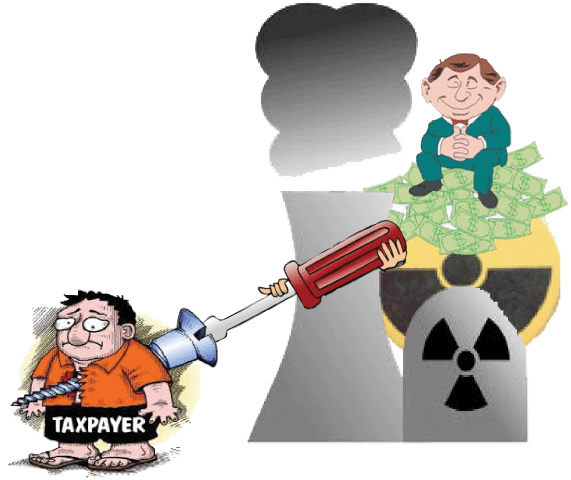
“The construction of nuclear power plants has proven to be an economic disaster for the corporations involved and a massive waste of public monies, given the plants are all entirely reliant on government financial subsidies,” IEEFA said.
Nuclear inquiry sparks industry campaign to lift moratorium, https://www.theage.com.au/politics/federal/nuclear-inquiry-sparks-industry-campaign-to-lift-moratorium-20191201-p53fsz.htl By Mike Foley, December 1, 2019 — The Minerals Council is ramping up its long-run campaign to remove Australia’s ban on nuclear power, claiming new market research shows majority community support for the technology.
Federal Parliament banned nuclear power in 1998, and the moratorium has remained in place with bipartisan support ever since.
The Morrison government has asked the House of Representatives Standing Committee on Environment and Energy to investigate the prerequisites for nuclear energy in Australia.
According to the Minerals Council of Australia, one prerequisite for nuclear power, community support, could be achieved if the public are properly informed about the technology.
The Minerals Council commissioned JWS Research to sample Australians’ support for nuclear power. The survey of 1500 people found 40 per cent support nuclear power and 33 per cent oppose it.
The support for nuclear energy rose to 47 per cent when respondents were presented a range of positive and negative facts about the technology.
“The more people learn about it, the greater the support for nuclear energy,” said Minerals Council chief executive Tania Constable.
She said the survey showed politicians that Australians wanted nuclear to be considered in their future energy mix.
“This should give them the courage to act. Any government serious about addressing climate change must be looking at nuclear, the zero-emissions foundation of electricity systems across the globe.”
The factors for nuclear energy were delivery of emissions-free power around the clock, Australia’s vast landmass could safely house reactors in remote locations, increased uranium mining, and nuclear power plants could bring jobs growth, and Australia already permits uranium exports – which could be utilised at home.
The factors against nuclear energy were the potential for human error to cause accidents at a reactor or waste facility, previous catastrophic failures such as Three Mile Island and Fukushima, concerns of health impacts for people living near reactors or waste facilities, and the risk that uranium exports could be used for weapons.
Energy analyst Lazard’s estimates the current cost of energy production for nuclear is more expensive than renewables.
The levelised cost of solar power around the world for solar power is about $60 per megawatt hour, $42/Mwh for wind, $145/Mwh for coal, and $220/Mwh for nuclear.
Nuclear power production costs could come with new technology. Small to medium sized reactors are proposed as potential cost savers, but there are no commercial examples in operation.
Government contributions would likely be required to underwrite private investment in a nuclear power plant in Australia. The cost of building Britain’s first nuclear plant in a generation, Hinkley Point, has blown out to more than $42 billion. It is contracted to supply the government with power at $176/Mwh.
The Institute for Energy Economics and Financial Analysis submission to the inquiry believes nuclear is one of the most expensive power sources.
“The construction of nuclear power plants has proven to be an economic disaster for the corporations involved and a massive waste of public monies, given the plants are all entirely reliant on government financial subsidies,” IEEFA said.
The Minerals Council submission said nuclear’s zero emissions power generation had to be incorporated into Australia’s future energy mix.
Rio Tinto drives ERA rehabilitation of Ranger uranium mine
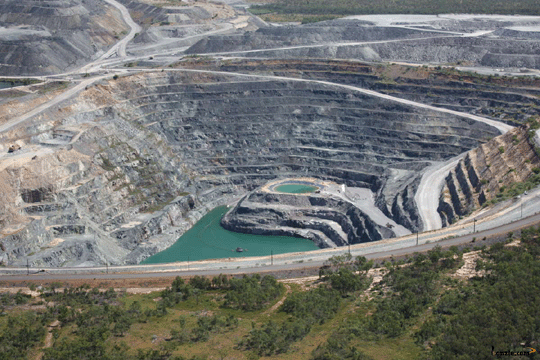 Rio Tinto drives ERA rehabilitation of Ranger, https://www.australianmining.com.au/news/rio-tinto-drives-era-rehabilitation-of-ranger/
The company has announced an offer of new fully paid ordinary shares to raise the rehabilitation funds, with support from majority owner Rio Tinto.
As ERA’s largest shareholder, Rio Tinto is subscribing to its full entitlement of approximately $326 million.
ERA is not able to secure third-party underwriting support, therefore Rio Tinto is also acting as the underwriter to ensure ERA secures the funds it needs.Rio Tinto energy and minerals group executive Bold Baatar said it was committed to ensuring ERA’s position to fund the rehabilitation.
“We take mine closure very seriously and ensuring ERA is able to fund the closure and rehabilitation of the Ranger project area, through participating in this entitlement offer, is a priority,” Baatar said.
The shares will be offered to all eligible shareholders for $0.15 per share, representing a 38 per cent discount to the $0.24 per share 10-day volume weighted average price (VWAP).
After the increase in the rehabilitation provision in 2018, ERA found it did not have sufficient existing cash resources or expected future cash flows to fulfil the Ranger rehabilitation.
ERA believes it will have an achievable plan for the Ranger rehabilitation with the completion of this entitlement officer.
As per the obligation with the Commonwealth and Northern Territory governments and the Traditional Owners, ERA will return the Ranger project area to an environment similar to the nearby Kakadu National Park.
Under its mining approval terms, ERA must end mining and processing at Ranger by January 2021 and finish final rehabilitation by January 2026.
ERA is not expected to generate any direct financial return from the Ranger rehabilitation expenditure.
There’s no market for new uranium mines or re-opening old ones – Cameco
 Cameco: No market for new uranium mines, THE AUSTRALIAN, NICK EVANS, RESOURCE WRITER, NOVEMBER 6, 2019 The world’s biggest uranium company says it cannot see any case for construction of new uranium mines, despite signs the sector is on the cusp of a long-awaited recovery.
Canada’s Cameco delivered the blunt assessment in its third-quarter financial results, released to the market late last week, saying there was still no case for reopening the mines it shut down in 2016 and 2017, stripping more than 20 million pounds of annual uranium oxide production from world supply.
Uranium prices remain in the doldrums, with spot prices averaging only $US25.68 a pound in the September quarter and long-term pricing sitting at an average $US31.50, , but chief executive Tim Gitzel told analysts the company was now receiving more interest in new contracts from customers than at any time since the Fukushima disaster in 2011.
But, as Australia’s state governments face pressure to reverse laws banning uranium mining, and a federal parliamentary commission examines the economics of building a nuclear power plant in Australia, Mr Gitzel warned there would be no case for the construction of new uranium mines for some years to come.
Mr Gitzel said Cameco was seeing increased demand for the conversion of uranium oxide to enriched products, which he said was a precursor for a mining sector recovery. But he warned that nuclear utilities were still reluctant to commit to the long-term supply contracts needed to return mothballed mines back to production amid an excess of uranium oxide still in the market.
Cameco plans to fill more than 70 per cent of the 32 million pounds it needs to deliver to customers next year by buying on the spot market and produce only 9 million pounds from its mines.
“Today, the activity we’re seeing in the spot market is largely churn, the same material changing hands many times. There’s been a lack of fundamental demand (and) is more appropriately thought of as delayed purchasing decisions,” Mr Gitzel said.
“Utilities are delaying their purchasing decisions due to the uncertainty caused by changing market dynamics, including the ongoing market access and trade policy issues.”
Cameco has two Australian uranium projects in Western Australia — Kintyre and Yeelirrie — that have largely negotiated the necessary environmental permitting processes allowing constructions. But both are well out of the money, with Yeelirrie — bought from BHP for $US430m in 2012 — needing a long-term price of $US55-$60 a pound to be viable, and Kintyre, worth $US346m in 2008, closer to $US75 a pound.
While Mr Gitzel said he was concerned the lack of new mines could cause issues for the industry over the next decade if the number of nuclear power plants in the planning became a reality, he said there was no economic case for building new supply.
“Not only does it not make sense to invest in future primary supply, even the lowest-cost producers are deciding to preserve long-term value by leaving uranium in the ground,” Mr Gitzel said in Cameco’s financial report.
Signs of a recovery in the global market, partly spurred by the looming closure of ERA’s Ranger mine in the Northern Territory in 2021, have led to renewed activity from listed uranium plays.
Paladin Energy successfully raised $31.7m in October to fund feasibility studies on the restart of its Langer Heinrich mine in Namibia, and in the September quarter Deep Yellow raised $11.3m for its Namibian uranium exploration.
Cameco chief financial officer Grant Isaac said he did not believe new mines could win financial backing without a far stronger recovery in demand for uranium than was currently on the horizon, given the amount of idled supply sitting on the sidelines.
“It’s pretty hard to say you’re going to take the risk on an asset … that isn’t licensed, isn’t permitted, probably doesn’t have a proven mining method, when you have idle tier 1 capacity that’s licensed, permitted, sitting there,” he said.
Australian company Worley Parsons joins the international throng trying to sell nuclear power to Saudi Arabia
Australian company WorleyParsons will provide consultancy services including project governance, resource management, project services, training and compliance across the full scope of the large nuclear power plant (LNPP), small modular reactors and nuclear fuel cycle.
 US confirms nuclear energy talks with Saudi Arabia, https://www.power-technology.com/comment/us-confirms-nuclear-energy-talks-with-saudi-arabia/ By MEED 30 Oct 19, Riyadh will have to sign an accord with Washington on the peaceful use of nuclear technology for US firms to participate in the projectA senior US official has confirmed that Washington is in talks with Riyadh about supporting Saudi Arabia’s planned nuclear programme. US confirms nuclear energy talks with Saudi Arabia, https://www.power-technology.com/comment/us-confirms-nuclear-energy-talks-with-saudi-arabia/ By MEED 30 Oct 19, Riyadh will have to sign an accord with Washington on the peaceful use of nuclear technology for US firms to participate in the projectA senior US official has confirmed that Washington is in talks with Riyadh about supporting Saudi Arabia’s planned nuclear programme.
Speaking in Abu Dhabi on 26 October, US Energy Secretary Rick Perry Perry confirmed that talks were ongoing. Continue reading |
The failure of nuclear reprocessing and the “Plutonium Economy”
|
No one on the planet has been able to run unspent nuclear fuel through twice, and make it economically viable, let alone the countless times needed to make it ecologically viable.
It costs more to run unspent fuel through once more than to • mine uranium, There is little to NO CHANCE of doing that again, and again. Business history shows this wasn’t possible when; • uranium was at its peak in price in 1980 2019, about to enter the third decade of the 21C, where commodities exchanges show nuclear fuel it is; • LOWEST PRICE than in all of economic history, and yet it still can’t compete with any other energy sources. Nuclear apologists are a joke, delusional. The nuclear sales executives of the nuclear estate have been busy rebranding, white and greenwashing their product is ever since Ronald Reagan announced The Plutonium Economy failed. In point of fact, carbon fuel, gas spinning a turbine, has been producing cheaper energy fully levelized for three decades than any nuclear reactor. As carbon fuel, gas reached parity with nuclear on an LCOE basis, in the late 1980s and that’s when our LNG investment spending kicked off in Australia. Large scale • solar PV and late last decade on an LCOE basis. For this whole decade these; • renewable systems |
|
Australia’s climate crisis: destruction of forests
An epidemic of land clearing is sabotaging efforts to address climate change. Farming communities are bitterly divided over the issue – but it also has global consequences
Roger Fitzgerald’s family has been farming near Moree since 1925. But these days he feels under siege on his own farm. His 1,700-hectare property, 50km north of the town, is now surrounded by the operations of the sprawling agribusiness Beefwood Farms, which has been steadily buying up land in New South Wales to expand its operations.
The old easement to Fitzgerald’s cottage across the sprawling Beefwood property has been planted over with crops. His letterbox has mysteriously disappeared on several occasions, making it hard for visitors to spot the entrance to his farm. But it is the extent of land clearing by his neighbour, Beefwood’s owner, Gerardus Kurstjens, that has upset him the most.
Fitzgerald says the microclimate of the nearby Welbon plains has moved a kilometre further on to his property since losing a tree line on Kurstjens’ property that once sheltered his land.
Pockets of remaining vegetation have been ripped from the grey soil to expand cultivation and square up paddocks – and the first Fitzgerald knows of it is when the bulldozers arrive.
“There is something seriously not right about the extent of land clearing in my little part of the world,” he says.
Think of land clearing like a rezoning in the city. Land cleared for cropping west of Moree sells for $2,500 a hectare whereas grazing land will sell for between $700 and $1000 a hectare. East of Moree most of the prime land has already been converted to crops and sells for $6,800 a hectare, three times the value of grazing land.
Clearing vegetation has the potential to add millions to a property’s value, as well as yielding high returns in a good year.
That alone is enough for farmers to risk up to $1m in fines for illegally clearing, according to one former NSW Office of Environment and Heritage compliance officer, who asked not to be named.
But while land clearing might benefit individual farmers in the short term, the loss of native vegetation comes with enormous costs for the rest of us.
“Land clearance and degradation is one of the greatest crises facing Australia and the world,” says Bill Hare, the chief executive and senior scientist with Berlin-based Climate Analytics. “It undermines the basis for food production, is causing species loss and ecological decline, destroys climate resilience, degrades water resources and reverses carbon storage on the land.”
Pollution from land clearing is projected by the federal government to remain at about 46m tonnes of carbon dioxide a year to 2030, roughly equivalent to emissions from three large coal-fired power plants. The rate at which we are clearing land in Australia is almost immediately wiping out gains being made under tax-payer funded schemes to address climate change.
Australia is among the 11 worst countries when it comes to deforestation, according to the World Wildlife Fund.
Queensland, with its vast swathes of untouched land on Cape York, has the highest clearing rate, but NSW is rapidly becoming a hotspot – and there is less to lose, with only 9% of the state’s vegetation in its original state.
What is becoming clear is that successive NSW governments have failed to explain the science behind preserving native vegetation – both in relation to climate change and protecting the landscape and endangered species – to farmers and the public.
Instead, land clearing laws in the state have been successively weakened, first by Labor and then more comprehensively by the Coalition, with the introduction of amendments to the Local Land Services Act in August 2017.
“NSW’s native vegetation laws were [once] based on the principle that broad-scale land clearing would not be permitted and clearing could only proceed if it could be shown to maintain or improve environmental outcomes,” says Rachel Walmsley, a solicitor at the NSW Environmental Defenders Office.
“The new act brought in a new approach with the twin stated objectives of arresting the current decline in the state’s biodiversity while also facilitating sustainable agricultural development.”
But while farmers are mostly happy with the new rules, environmentalists say they have ushered in an environmental disaster because they allow farmers to self-assess whether clearing is permissible.
The old act also protected paddock trees; the amended act has made it much easier to get rid of them.
Critics say farmers have been given the green light to clear.
“I have sat in meetings where arguments have been put that driving a tractor around a tree is a significant cost in diesel for farmers,” Walmsley says.
“There’s no valuation of the ecosystem services these trees provide: clean water, clean air, healthy soils and hosting pollinators. There’s no dollar value put on vegetation.”………
The facts are unequivocal. NSW is losing vegetation at an alarming rate………………… https://www.theguardian.com/environment/ng-interactive/2019/oct/17/stripped-bare-australias-hidden-climate-crisis
Exposing misleading evidence to the federal nuclear inquiry
Big claims and corporate spin about small nuclear reactor costs, Jim Green, 19 September 2019, RenewEconomy https://reneweconomy.com.au/big-claims-and-corporate-spin-about-small-nuclear-reactor-costs-65726/
The ‘inquiry into the prerequisites for nuclear energy in Australia’ being run by Federal Parliament’s Environment and Energy Committee has finished receiving submissions and is gradually making them publicly available.
The inquiry is particularly interested in ‘small modular reactors’ (SMRs) and thus one point of interest is how enthusiasts spin the economic debate given that previous history with small reactors has shown them to be expensive; the cost of the handful of SMRs under construction is exorbitant; and both the private sector and governments around the world have been unwilling to invest the billions of dollars required to get high-risk SMR demonstration reactors built.
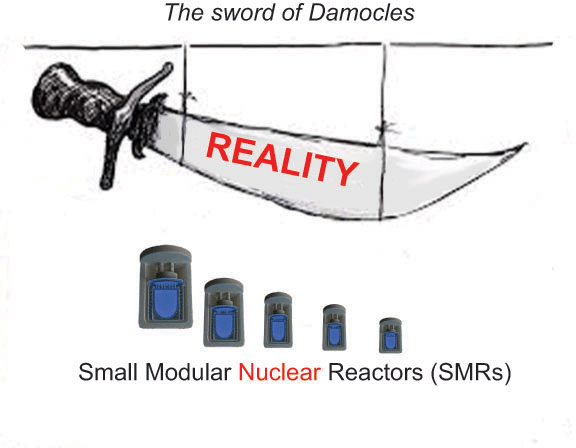 To provide a reality-check before we get to the corporate spin, a submission to the inquiry by the Institute for Energy Economics and Financial Analysis notes that SMRs have been as successful as cold fusion – i.e., not at all. The submission states:
“The construction of nuclear power plants globally has proven to be an ongoing financial disaster for private industry and governments alike, with extraordinary cost and construction time blow-outs, while being a massive waste of public monies due to the ongoing reliance on government financial subsidies. … Governments have repeatedly failed to comprehend that nuclear construction timelines and cost estimates put forward by many corporates (with vested interests) have proven disastrously flawed and wrong.”
The Institute is equally scathing about SMRs:
“For all the hype in certain quarters, commercial deployment of small modular reactors (SMRs) have to-date been as successful as hypothesized cold fusion – that is, not at all. Even assuming massive ongoing taxpayer subsidies, SMR proponents do not expect to make a commercial deployment at scale any time soon, if at all, and more likely in a decade from now if historic delays to proposed timetables are acknowledged.”
Thus the Institute adds its voice to the chorus of informed scepticism about SMRs, such as the 2017 Lloyd’s Register survey of 600 industry professionals and experts who predicted that SMRs have a “low likelihood of eventual take-up, and will have a minimal impact when they do arrive“.
 Corporate spin #1: Minerals Council of Australia
The Minerals Council of Australia claims in its submission to the federal inquiry that SMRs could generate electricity for as little as $60 per megawatt-hour (MWh). That claim is based on a report by the Economic and Finance Working Group (EFWG) of the Canadian government-industry ‘SMR Roadmap’ initiative.
The Canadian EFWG gives lots of possible SMR costs and the Minerals Council’s use of its lowest figure is nothing if not selective. The figure cited by the Minerals Council assumes near-term deployment from a standing start (with no-one offering to risk billions of dollars to build demonstration reactors), plus extraordinary learning rates in an industry notorious for its negative learning rates.
Dr. Ziggy Switkowski noted in his evidence to the federal inquiry that “nuclear power has got more expensive, rather than less expensive”. Yet the EFWG  paper takes a made-up, ridiculously-high learning rate and subjects SMR cost estimates to eight ‘cumulative doublings’ based on the learning rate. That’s creative accounting and one can only wonder why the Minerals Council would present it as a credible estimate.
Here are the first-of-a-kind SMR cost estimates from the EFWG paper, all of them far higher than the figure cited by the Minerals Council:
- 300-megawatt (MW) on-grid SMR: C$162.67 (A$179) / MWh
- 125-MW off-grid heavy industry: C$178.01 (A$196) / MWh
- 20-MW off-grid remote mining: C$344.62 (A$380) / MWh
- 3-MW off-grid remote community: C$894.05 (A$986) / MWh
The government and industry members on the Canadian EFWG are in no doubt that SMRs won’t be built without public subsidies:
 “The federal and provincial governments should, in partnership with industry, investigate ways to best risk-share through policy mechanisms to reduce the cost of capital. This is especially true for the first units deployed, which would likely have a substantially higher cost of capital than a commercially mature SMR.”
The EFWG paper used a range of estimates from the literature and vendors. It notes problems with its inputs, such as the fact that many of the vendor estimates have not been independently vetted, and “the wide variation in costs provided by expert analysts”. Thus, the EFWG qualifies its findings by noting that “actual costs could be higher or lower depending on a number of eventualities”.
Corporate spin #2: NuScale Power
US company NuScale Power has put in a submission to the federal nuclear inquiry, estimating a first-of-a-kind cost for its SMR design of US$4.35 billion / gigawatt (GW) and an nth-of-a-kind cost of US$3.6 billion / GW.
NuScale doesn’t provide a $/MWh estimate in its submission, but the company has previously said it is targeting a cost of US$65/MWh for its first SMR plant. That is 2.4 lower than the US$155/MWh (A$225/MWh) estimate based on the NuScale design in a report by WSP / Parsons Brinckerhoff prepared for the SA Nuclear Fuel Cycle Royal Commission.
 NuScale’s cost estimates should be regarded as promotional and will continue to drop – unless and until the company actually builds an SMR. The estimated cost of power from NuScale’s non-existent SMRs fell from US$98-$108/MWh in 2015 to US$65/MWh by mid-2018. The company announced with some fanfare in 2018 that it had worked out how to make its SMRs almost 20% cheaper – by making them almost 20% bigger!
Lazard estimates costs of US$112-189/MWh for electricity from large nuclear plants. NuScale’s claim that its electricity will be 2-3 times cheaper than that from large nuclear plants is implausible. And even if NuScale achieved costs of US$65/MWh, that would still be higher than Lazard’s figures for wind power (US$29-56) and utility-scale solar (US$36-46).
Likewise, NuScale’s construction construction cost estimate of US$4.35 billion / GW is implausible. The latest cost estimate for the two AP1000 reactors under construction in the US state of Georgia (the only reactors under construction in the US) is US$12.3-13.6 billion / GW. NuScale’s target is just one-third of that cost – despite the unavoidable diseconomies of scale and despite the fact that every independent assessment concludes that SMRs will be more expensive to build (per GW) than large reactors.
Further, the modular factory-line production techniques now being championed by NuScale were trialled with the AP1000 reactor project in South Carolina – a project that was abandoned in 2017 after the expenditure of at least US$9 billion.
Corporate spin #3: Australian company SMR Nuclear Technology
In support of its claim that “it is likely that SMRs will be Australia’s lowest-cost generation source”, Australian company SMR Nuclear Technology Pty Ltd cites in its submission to the federal nuclear inquiry a 2017 report by the US Energy Innovation Reform Project (EIRP).
According to SMR Nuclear Technology, the EIRP study “found that the average levelised cost of electricity (LCOE) from advanced reactors was US$60/MWh.”
However the cost figures used in the EIRP report are nothing more than the optimistic estimates of companies hoping to get ‘advanced’ reactor designs off the ground. Therefore the EIRP authors heavily qualified the report’s findings:
“There is inherent and significant uncertainty in projecting NOAK [nth-of-a-kind] costs from a group of companies that have not yet built a single commercial-scale demonstration reactor, let alone a first commercial plant. Without a commercial-scale plant as a reference, it is difficult to reliably estimate the costs of building out the manufacturing capacity needed to achieve the NOAK costs being reported; many questions still remain unanswered – what scale of investments will be needed to launch the supply chain; what type of capacity building will be needed for the supply chain, and so forth.”
SMR Nuclear Technology’s conclusions – that “it is likely that SMRs will be Australia’s lowest-cost generation source” and that low costs are “likely to make them a game-changer in Australia” – have no more credibility than the company estimates used in the EIRP paper.
SMR Nuclear Technology’s submission does not note that the EIRP inputs were merely company estimates and that the EIRP authors heavily qualified the report’s findings.
The US$60/MWh figure cited by SMR Nuclear Technology is far lower than all independent estimates for SMRs:
- The 2015/16 South Australian Nuclear Fuel Cycle Royal Commission estimated costs of A$180-184/MWh for large light-water reactors, compared to A$225 for an SMR based on the NuScale design (and a slightly lower figure for the ‘mPower’ SMR design that was abandoned in 2017 by Bechtel and Babcock & Wilcox).
- A December 2018 report by CSIRO and the Australian Energy Market Operator found that electricity from SMRs would be more than twice as expensive as that from wind or solar power with storage costs included (two hours of battery storage or six hours of pumped hydro storage).
- A report by the consultancy firm Atkins for the UK Department for Business, Energy and Industrial Strategy found that electricity from the first SMR in the UK would be 30% more expensive than that from large reactors, because of diseconomies of scale and the costs of deploying first-of-a-kind technology. Its optimistic SMR cost estimate is US$107-155 (A$157-226) / MWh.
- A 2015 report by the International Energy Agency and the OECD Nuclear Energy Agency predicted that electricity from SMRs will be 50−100% more expensive than that from large reactors, although it holds out some hope that large-volume factory production could reduce costs.
- An article by four pro-nuclear researchers from Carnegie Mellon University’s Department of Engineering and Public Policy, published in 2018 in the Proceedings of the National Academy of Science, concluded than an SMR industry would only be viable in the US if it received “several hundred billion dollars of direct and indirect subsidies” over the next several decades.
SMR Nuclear Technology’s assertion that “nuclear costs are coming down due to simpler and standardised design; factory-based manufacturing; modularisation; shorter construction time and enhanced financing techniques” is at odds with all available evidence and it is at odds with Dr. Ziggy Switkowski’s observation in a public hearing of the federal inquiry that nuclear “costs per kilowatt hour appear to grow with each new generation of technology”.
SMR Nuclear Technology claims that failing to repeal federal legislative bans against nuclear power would come at “great cost to the economy”. However the introduction of nuclear power to Australia would most likely have resulted in the extraordinary cost overruns and delays that have crippled every reactor construction project in the US and western Europe over the past decade – blowouts amounting to A$10 billion or more per reactor.
Nor would the outcome have been positive if Australia had instead pursued non-existent SMR ‘vaporware‘.
Dr Jim Green is lead author of a Nuclear Monitor report on SMRs and national nuclear campaigner with Friends of the Earth Australia.
Zero-carbon Energy for Asia-Pacific project – a bold plan to make Australia a Pacific energy hub
A radical shift towards renewable energy has the potential to reshape the Australian economy and create exports worth hundreds of billions of dollars, according to the head of a major research project to be announced on Thursday.
1 This month
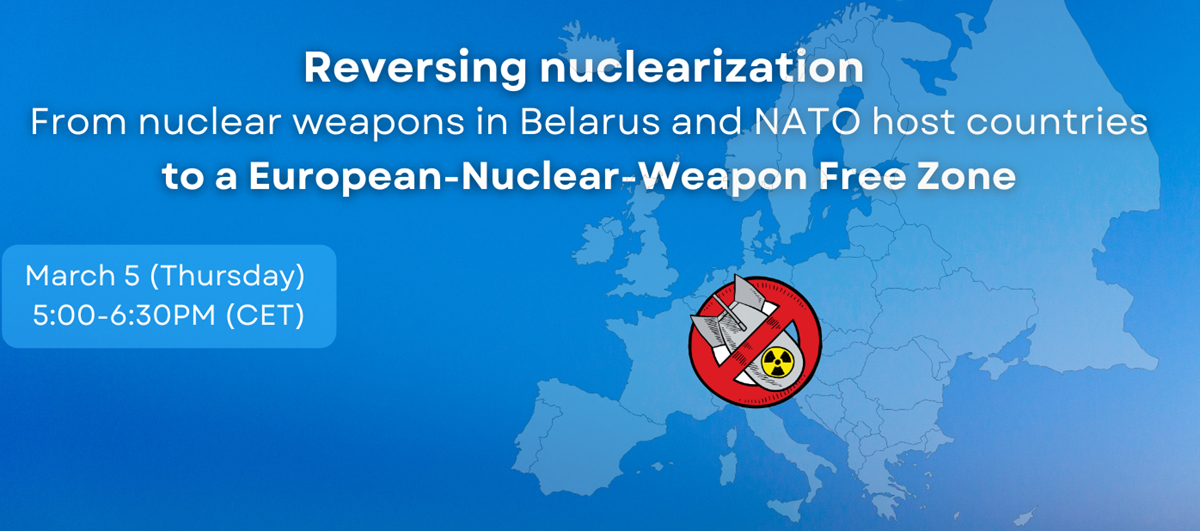
6 March -Online – Reversing nuclearization:
From nuclear weapons in Belarus and NATO host countries to a European-Nuclear-Weapon Free Zone
Mar 6, 2026 03:00 AM in Canberra, Melbourne, Sydney

of the week – Australians for War Powers Reform (AWPR)
To see nuclear-related stories in greater depth and intensity
 Antinuclear