Nuclear Marketing – Australia’s role- theme for July 17
What is Australia’s role in the continuing, desperate, global marketing by the nuclear industry?
The global nuclear marketing campaign suffered a serious blow when South Australia definitively rejected the plan to import radioactive trash. That plan had been essential to setting up nuclear power in South East Asian countries, as it promised to solve their nuclear waste problem.
Today, as the Western world’s nuclear industry collapses, there is new urgency to market nukes internationally. China and Russia (with their State-owned industries) now lead the charge – the campaign to sell the “old” big reactors, and the new (as yet non-existent) big and small ones.
New “start up” companies in America now join with other nations to market the new futuristic nuclear gimmicks. It becomes a global co-operation with Russia and China in the lead.
Australia’s nuclear zealots join in. Enthusiastic propagandists like Ben Heard join in Moscow’s AtomPro advertising extravaganza.

More seriously the Australian Nuclear Science and Technology Organisation (ANSTO) renews its tax-payer funded promotions. Defence hawks and various nuclear industry shills back the new push for Small Nuclear Reactors (SMRs) . The Australian government is about to rubber-stamp ANSTO’s plan for Australia to take part in developing Generation IV nuclear reactors, (ANSTO boss Dr Adi Paterson having pre-empted Parliament by already signing Australia up to GenIV International Forum)
Australia is unwilling to even attend UN international meetings to discuss a nuclear weapons ban treaty . Australia pays lip service only to the international Paris climate change accord.
Yet Australia is happy to follow Russia in a new global nuclear marketing push?
Almost certainly so – because Australia has quite a recent history in promoting nuclear power in co-operation with Russia. In 2007 the then Howard Liberal government invited Sergei Kiriyenko to Australia. On 7 September 2007, head of Rosatom Sergey Kiriyenko and Australian Minister of Foreign Affairs Alexander Downer, in the presence of Prime Minister John Howard and President Putin, signed the Agreement between the Government of Australia and the Government of the Russian Federation on Cooperation in the Use of Nuclear Energy for Peaceful Purposes
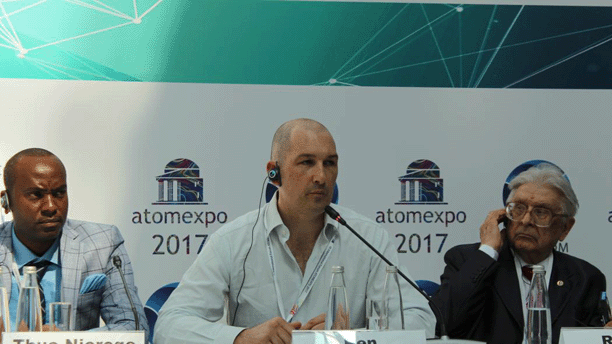
Currently, the Australian nuclear lobby works quietly with Russia, sending nuclear propagandist Ben Heard to Russia to join in Their AtomExpo global promotion of the industry.
Future jobs in Far North Queensland threatened by Adani coal mine
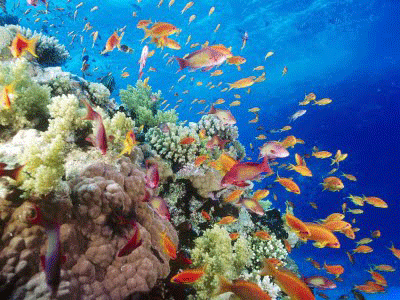 Claims that Adani Coal Mine will threaten future tourism jobs in Far North, Tom Volling, The Cairns Post, June 19, 2017 A GROUP of scientists, doctors and reef conservationists claim a controversial coal mine destined for Central Queensland will negatively impact the Cairns economy.
False promises about Adani coal project have sucked in Queensland Premier and Townsville Mayor
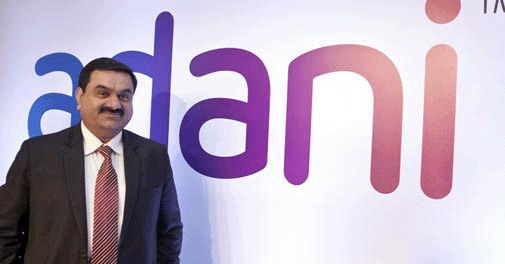 the myriad companies that make up the Adani conglomerate make it nearly impossible to follow the money. What tax on profits will be paid in Australia? How much will be siphoned off to Adani’s “marketing hub” in Singapore and the Adani family company in the Cayman Islands?
It was December 2016 when Gautam Adani flew into Townsville to meet Queensland Premier Annastacia Palaszczuk and the city’s mayor, Jenny Hill. Yes, there was some animosity: a couple of hundred people gathered on the foreshore to protest against Adani’s proposed coal mega-mine, and two native-title owners, Carol Prior and Ken Dodd, were also on his trail.
Clean Energy Seed Fund raises $26m – a “vote of confidence” in sector
 REneweconomy, By Sophie Vorrath on 24 May 2017 The Clean Energy Seed Fund established just under a year ago as the first investment of the Coalition government’s re-badged Clean Energy Innovation Fund, has this week completed a $26 million capital raising, easily surpassing its $20 million target.
The fund’s manager, Artesian Venture Partners, said on Wednesday that the bumper capital raising included $10 million commitments from cornerstone investor the Clean Energy Finance Corporation (CEFC) and Australian Ethical Investment, and further investments from Hostplus and Future Super.
Launched in September 2016 with a $10 million cornerstone commitment from the $1 billion CEIF, the fund was set up to focus on clean energy sub-sectors including the internet of things, battery storage, biofuels and metering and control.
It aims to provide “pull-model” venture capital support to encourage greater investment and participation in the early-stage cleantech sector and co-investment from a wide range of investors, including high net worth individuals, angel investors, venture capital firms, corporates and institutions.
In the short-term, its goal is to invest at seed, angel and later stage follow-on rounds in 30-50 startups over a four-year investment period.
The fund also draws on the finance and skills of both the CEFC and the Australian Renewable Energy Agency (ARENA), the latter of which was, at the time of the fund’s establishment, facing steep budget cuts.
CEFC investment development director, Blair Pritchard said the $26 million of funds raised would be enough to see more dedicated clean energy accelerators popping up around the country….. http://reneweconomy.com.au/clean-energy-seed-fund-raises-26m-vote-confidence-sector-96236/
Australia should not throw away $1 billion on a destructive and doomed Adani coal project
The first stage currently being discussed involves a total investment of around $5 billion, of which the Australian public is supposed to contribute at least a $1 billion.
we may easily end up with the worst of all worlds: no royalties and few jobs for a project that will contribute massively to environmental destruction both locally and globally.
We shouldn’t throw it away on a doomed project that will leave us with, at best, a stranded asset and a legacy of massive environmental damage.
There are better things to spend $1 billion on than the Adani coal mine, Brisbane Times, John Quiggin, 18 May 17

Ever since taking office, the Palaszczuk government has been walking a tightrope with respect to the Adani Group’s proposed Carmichael mine in the Galilee Basin.
On the one hand, it’s obvious that the project is both environmentally disastrous and economically dubious. The government has been keen to avoid putting public money into this mess. On the other hand, if the project falls over, as still appears quite likely, the government is keen to avoid the blame.
The supposed benefits of 10,000 jobs and billions of dollars in royalties make an appealing case to voters at any time and particularly with the mining boom on the edge of failing. For most of the past 18 months, the government has managed the tightrope act successfully, but now it appears to be on the verge of falling. Adani is pushing for a ‘holiday’ from royalties, which might last as long as nine years. The project may go ahead if the government accepts, but the promised benefits to the Queensland public will disappear into the never-never.
The holiday is supposed to be temporary, but that’s unlikely. Continue reading
Adani Carmichael coal mine: climate, health and economics are against it
 Climate Council: climate, health and economics are against Carmichael mine https://theconversation.com/climate-council-climate-health-and-economics-are-against-carmichael-mine-77940, Emeritus professor, Fenner School of Environment and Society, Australian National University, Head of School, School of Public Health and Social Work, Queensland University of Technology May 19, 2017 Despite the overwhelming evidence that fossil fuels are killing the Great Barrier Reef and making many extreme weather events worse; despite the emphatic thumbs-down from the finance sector; and despite the growing awareness of the serious health impacts of coal, the proposed Carmichael coal mine staggers on, zombie-like, amid reports it has been offered a deferment of A$320 million in royalty payments.
A new Climate Council report, Risky Business: Health, Climate and Economic Risks of the Carmichael Coalmine, makes an emphatic case against development of the proposed mine, or of any other coal deposits in Queensland’s Galilee Basin, or indeed elsewhere around the world.
Burning coal is a major contributor to climate change. Australia is already reeling from the escalating impacts of a warming climate. Heatwaves and other extreme weather events are worsening. The Great Barrier Reef has suffered consecutive mass bleaching events in 2016 and 2017. Climate change is likely making drought conditions worse in the agricultural belts of southwest and southeast Australia. Our coastal regions are increasingly exposed to erosion and flooding as sea level rises.
If we are to slow these disturbing trends and stabilise the climate at a level with which we might be able to cope, only a relatively small amount of the world’s remaining coal, oil and gas reserves can actually be used.
The majority must be left unburned in the ground, without developing vast new coal deposits such as those in the Galilee Basin.
On budget
The amount of fossil fuels we can burn for a given temperature target (such as the 1.5℃ and 2℃ targets of the Paris climate agreement) is known as the “carbon budget”.
To give ourselves just a 50% chance of staying within the 2℃ Paris target, we can burn only 38% of the world’s existing fossil fuel reserves. When this budget is apportioned among the various types of fossil fuels, coal is the big loser, because it is more emissions-intensive than other fuels. Nearly 90% of the world’s existing coal reserves must be left in the ground to stay within the 2℃ budget.
When the carbon budget is apportioned by region to maximise the economic benefit of the remaining budget, Australian coal in particular is a big loser. More than 95% of Australia’s existing coal reserves cannot be burned, and the development of new deposits, such as the Galilee Basin, is ruled out.
The health case
Exploiting coal is very harmful to human health, with serious impacts all the way through the process from mining to combustion. Recently the life-threatening “black lung” (coal workers’ pneumoconiosis) has re-emerged in Queensland, with 21 reported cases. Across Australia, the estimated costs of health damages associated with the combustion of coal amount to A$2.6 billion per year.
In India, the country to which coal from the proposed Carmichael mine would likely be exported, coal combustion already takes a heavy toll. An estimated 80,000-115,000 deaths, as well as 20 million cases of asthma, were attributed to pollutants emitted from coal-fired power stations in 2010-11. Up to 10,000 children under the age of five died because of coal pollution in 2012 alone.
Compared with the domestic coal resources in India, Carmichael coal will not reduce these health risks much at all. Galilee Basin coal is of poorer quality than that from other regions of Australia. Its estimated ash content of about 26% is double the Australian benchmark.
This is bad news for children in India or in any other country that ends up burning it.
The economics
The economic case for the Carmichael mine doesn’t stack up either. Converging global trends all point to rapidly reducing demand for coal.
The cost of renewable energy is plummeting, and efficient and increasingly affordable storage technologies are emerging. Coal demand in China is dropping as it ramps up the rollout of renewables. India is moving towards energy independence, and is eyeing its northern neighbour’s push towards renewables.
All of these trends greatly increase the risk that any new coal developments will become stranded assets. It’s little wonder that the financial sector has turned a cold shoulder to the Carmichael mine, and Galilee Basin coal development in general. Some 17 banks worldwide, including the “big four” in Australia, have ruled out any investment in the Carmichael mine.
From any perspective – climate, health, economy – the proposed mine is hard to justify. And yet the project keeps on keeping on.
Top UK fund manager divests from fossil fuels, incl BHP Billiton
 Guardian 15th May 2017, Archbishop of Canterbury plays crucial role in BMO Global Asset Management’s decision to dump £20m of shares in firms such as BHP Billiton One of Britain’s biggest managers of ethical funds is to dump £20m of shares in fossil fuel companies in one of the biggest divestments so farbecause of climate change.
Shares in BHP Billiton, the Anglo-Australian mining giant, will be among those sold by BMO Global Asset Management’s range of “responsible” funds, which manage £1.5bn of assets. They were previously known as the “stewardship” funds, the first ethical funds launched in Britain. The archbishop of Canterbury, Justin Welby, played a crucial role in the divestment, as president of BMO’s responsible investment council. The Church of England has already pulled out of investing in companies that make more than 10% of its revenues from thermal coal or oil from tar sands….. https://www.theguardian.com/environment/2017/may/15/top-uk-fund-manager-divests-from-fossil-fuels
The Global Uranium Industry and Cameco’s Troubled History
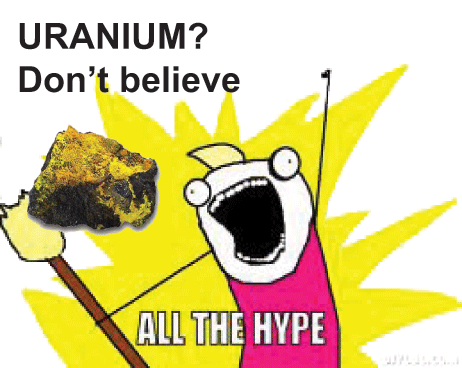 The Global Uranium Industry & Cameco’s Troubled History, May 2017, Jim Green − Friends of the Earth, Australia http://tinyurl.com/cameco-may-2017
Table of Contents
- INTRODUCTION
- THE GLOBAL URANIUM INDUSTRY
Australia’s Uranium Volume and Exports – 2006-2015
Australia’s top export revenue industries – Compared to uranium
“It has never been a worse time for uranium miners”
If there is a recovery, it will be a long time coming
Explaining the uranium market’s malaise
- CAMECO BATTLING URANIUM DOWNTURN, TAX OFFICE, TEPCO
- CAMECO’S URANIUM DEPOSITS IN WESTERN AUSTRALIA ‒ A BRIEF SUMMARY
- CAMECO’S INCIDENTS AND ACCIDENTS: 1981‒2016
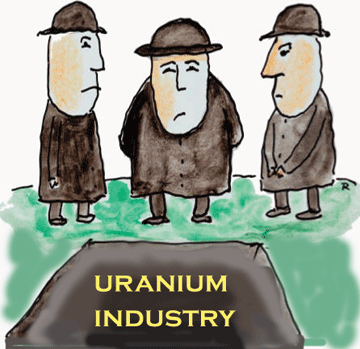 Firstly: the miserable state of the global uranium industry. For several years, the uranium prices (the spot price and long-term contract price) has been well below the level that would incentivise new mines. There is no end in sight to the industry’s current malaise ‒ as acknowledged by numerous industry insiders and market analysts.
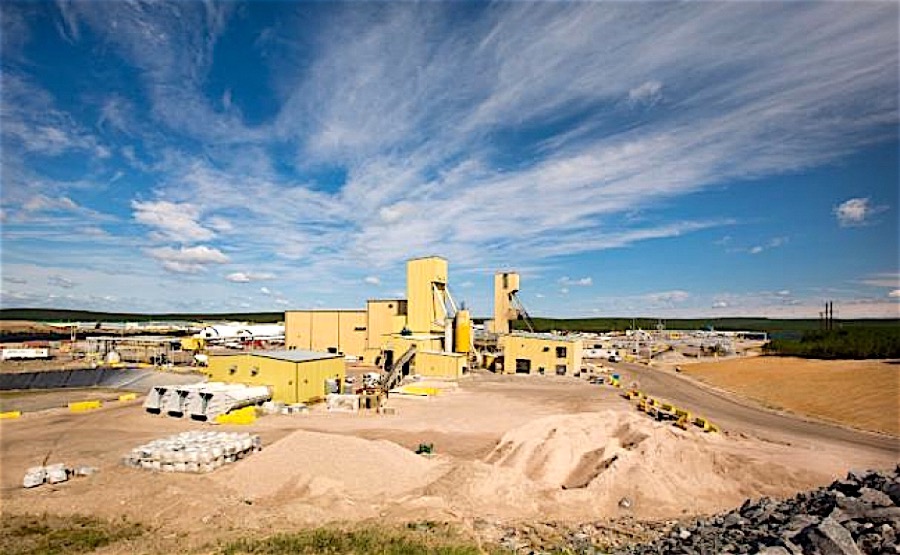 has two uranium projects in Western Australia ‒ Kintyre (70% Cameco / 30% Mitsubishi) and Yeelirrie (100% Cameco).
All about the Adani coal mine expansion plan
 I can no longer keep up with this
http://www.afr.com/news/politics/adani-admits-overseas-steel-cheaper-but-still-prepared-to-buy-local-20170503-gvyfc9
GREEN groups will go to war with the Commonwealth Bank this week after documents revealed a continuing relationship with Adani that helped the controversial Carmichael mine gain approval for a water licence.
http://www.news.com.au/finance/business/green-groups-to-target-commonwealth-bank-over-potential-adani-financing/news-story/94d9701fe05b3801612015bd33bfb9ae
ADANI is facing a new investigation by the Queensland Government into its operations after water released at its Abbot Point facility was found to contain eight times the permitted level of sediment.
http://www.couriermail.com.au/news/queensland/adani-coal-port-under-investigation-from-queensland-government-for-sediment-runoff/news-story/b51d7e9667c5dd7f08b4f4ff8027b736
Survey shows 41% of people support bank’s decision to rule out funding Adani’s Queensland mine, with only 14% against, as the resources minister vows to switch banks
https://www.theguardian.com/environment/2017/may/05/westpacs-adani-decision-finds-public-support-despite-canavans-disapproval
A PROMISE to source $74 million worth of steel from Arrium has been welcomed by the State Government, but Treasurer Tom Koutsantonis warns it won’t be the “saviour” of the Whyalla steelworks.
http://www.adelaidenow.com.au/business/jobs/adanis-deal-to-buy-74-million-in-steel-from-arrium-no-saviour-for-whyalla-says-sa-treasurer/news-story/e89ffd0e26a4662b174e1ff281358aff
Adani faces possible multi-million-dollar fine over Abbot Point sediment water discharge
Mining giant Adani faces a possible multi-million-dollar fine after sediment water eight times above authorised levels was discharged from the Abbot Point coal terminal last month, the ABC can reveal.
http://www.abc.net.au/news/2017-05-03/adani-faces-multi-million-dollar-fine-over-sediment-water/8494398
A QUEENSLAND politician has slammed opponents of coal power, claiming if you don’t support coal, you can “sit under palm trees and weave baskets for a living”.
http://www.couriermail.com.au/news/queensland/queensland-government/gladstone-deputy-mayor-chris-trevor-slams-latte-sippers-who-are-against-coal/news-story/ef369f68cba0f34799928affcadf26e2
David Peetz, Griffith University and Georgina Murray, Griffith University
As the cost of renewable energy falls, funding a new mine is a risky investment.
http://theconversation.com/the-government-is-swimming-against-the-tide-on-westpacs-adani-decision-76950
Adani wards off Whyalla wipeout
The proposed $16.5bn Adani Carmichael mine project has thrown a lifeline to South Australia’s steel industry.
http://www.theaustralian.com.au/business/mining-energy/adani-to-ward-off-whyalla-wipeout-with-pledge-to-use-arriums-steel/news-story/ac0acfb6b7d5f51e63417301ce65e1c1
Westpac in tune with Australians about climate. Government sadly out of touch
Westpac’s anti-coal stance exposes a Coalition out of sync with business and public on climate http://www.theage.com.au/federal-politics/political-opinion/westpacs-anticoal-stance-exposes-a-coalition-out-of-sync-with-business-and-public-on-climate-20170428-gvuw4m.html Mark Kenny, Obviously Westpac’s public ‘un-friending’ of new coal – for which you can read Adani’s Carmichael coal mine in the Galiliee Basin – is a body blow for a project whose backers are thinning by the day.
Westpac is the last of the big four Australian banks to bin Adani’s publicly toxic prospectus.
All are unmoved by the lure of ongoing coal profits, especially if it comes with ties to a venture that has become a byword for climate change denial.
Adani will continue to seek other financiers – including extraordinarily, the Australian taxpayer from whom it is telling Indian backers, it remains eligible for a $1 billion loan. This is despite the Northern Australia Infrastructure Fund rules, which appear to render it ineligible.
With or without that welfare, the business case for new coal generally and the Adani mine in particular, looks to be ebbing. Fast.
Westpac’s decision is an environmental declaration of intent. But it is a coldly commercial one also that recognises what the Australian government defiantly rejects: coal’s day has passed.
Resources and Northern Australia Minister Matt Canavan hit out strongly at the bank, suggesting it had succumbed to the inner-city politics of Sydney rather than the employment needs of the sunshine state. Remarkably, Canavan – cabinet minister – even advocated a boycott, counselling potential customers to back a bank that backs Queensland’s interests.
Doubtless there would be many Queenslanders upset by the Adani venture, not least the thousands already employed around the Great Barrier Reef.
Besides, Westpac is hardly going out on a limb. Try going to the AGL website. One of the nation’s biggest energy companies has announced a new campaign to end its association with coal entirely: “The reasons for getting out of coal are all around us” its homepage proclaims.
Privately, Malcolm Turnbull must surely be hoping the Adani thing just goes away. The PM may be a progressive rationalist at heart but in his head there are other realities to balance. Party room realities like Tony Abbott, Peter Dutton, and the Nationals, whose head-in-the-sand record on climate change has left farmers so exposed that even the National Farmers Federation now proposes a carbon price.
Paul Keating once described Turnbull as a cherry on a compost heap. The trouble with compost heaps is they tend to be stationary. This issue is anything but, and if you want proof, just follow the money.
Taxpayer loan for railway to Adani mine “not in the interests of NSW”: report
http://www.smh.com.au/nsw/taxpayer-loan-for-railway-to-adani-mine-not-in-the-interests-of-nsw-report-20170423-gvqr1r.html ~ Matt Wade @MattWadeSMH http://www.smh.com.au/nsw/by/Matt-Wade-hvejy 24 April 2017:
“The fairness of a proposed Commonwealth loan of nearly $1 billion to fund a rail link to the giant Adani coal mine in Queensland’s Galilee Basin has been called into question by economic modelling showing
it may cost NSW hundreds of millions of dollars a year.
“Adani’s Carmichael mine will increase the global supply of coal by about 6 per cent, putting downward pressure on prices received by NSW coal exporters and slashing mining royalties paid to the state government, the report by the Australia Institute says. … “
Adani coal mine just does not make economic sense
Coal glut, cheaper renewables, Adani makes no sense at all, MichaelWest.com.au April 19, 2017 As public angst over the prospective A$1 billion subsidy to coal magnate Guatam Adani hits fever pitch, a small company is modestly beavering away on another – more worthy – energy project in Far North Queensland.
Genex Power has turned the abandoned Kidston gold mine into a solar farm and pumped-hydro power storage project. Kidston will deliver 145MWh of renewable energy per year. This is enough to power 26,484 homes. In terms of reducing emissions, this is equivalent to taking 33,000 cars off Australian roads.
Like Adani, the Kidston project also got a leg-up from government. It won a grant of nearly A$9 million from ARENA, the Australian Renewable Energy Agency, and struck a deal with the state of Queensland to sell electricity for 20 years.
Unlike Adani’s Carmichael coal mine, however, the Kidston solar project has bankers and investors. Unlike Adani, whose labyrinthine corporate structure wends its way to the Cayman Islands, Genex is listed on the Australian Stock Exchange, has a market value of A$70 million and is owned by small investors. When it delivers its first power in the next three months, it’s likely to pay tax on its profits.
The furore over Adani has so far centred on the putative subsidy for the rail line to cart the coal from the Galilee Basin to the coast. There is no rail line without a mine, however, and so the bigger question is: who is going to tip in the A$10 billion in project finance to build the mine?
Adani’s bankers have long fled the scene – not just for environmental reasons, but because the business case for building this, the world’s biggest new thermal coal mine, is sketchy.
The global seaborne coal market is in structural decline. There is a glut. Thermal coal futures prices are well below the spot price – and even at present spot prices, this is hardly a viable financial proposition…….http://www.michaelwest.com.au/coal-glut-cheaper-renewables-adani-makes-no-sense-at-all/
Adani coal project – a foolish useof tax-payers’ money
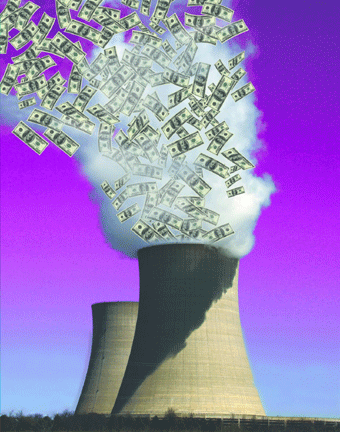 The Adani coal mine would be a poor use of our taxes, SMH, 15 Apr 17, The Adani coal mine in the Galilee Basin of Central Queensland looks like the Trump presidency did around this time last year: a bad idea with foreseeable bad consequences that may yet prove unstoppable.
The project will create “tens of thousands of jobs” and generate “an enormous amount” in taxes and in royalties, revenues for federal and state government”, the Prime Minister enthused. Meanwhile Barnaby Joyce has been banging the drum about how the coal will light up hundreds of thousands of poor households. In other words, lending our taxes to the billionaire proprietor would do India’s poor people a favour.
For now, new native title legislation that would remove one obstacle is blocked in the Senate, but the government is determined to fix that…….
It would be a very bad look indeed if the project goes ahead with the help of funds from the Australian public. It not only goes against this government’s belief in the wisdom of the free market, but would be yet another piece of embarrassing climate change denialism that sets us apart from more forward-thinking nations – including China and India – that are walking away from coal in favour of renewables.
The pivotal question for now is whether the project meets the eligibility criteria for a loan. The fact that the loan would only be available if the project couldn’t proceed otherwise (or would be seriously delayed) creates the bizarre situation that taxpayers are left footing the bill when commercial lenders baulk.
But it’s not up to politicians to decide whether Adani Mining gets the loan, although resources minister Matt Canavan, a strong supporter of the Carmichael mine, has the ultimate sign-off on disbursement of the loan funds. It’s up to the board of the Northern Australia Infrastructure Fund to make a fully independent assessment on commercial grounds. Taxpayers are entitled to expect the board to be scrupulously diligent in its decision.
To date more than a dozen banks and other funding sources have declared they won’t back the project or have pulled out of existing funding arrangements. The project’s opponents say it’s no longer financially viable, if it ever was. It augurs badly that India’s coal and power minister Piyush Goyal has repeatedly stated a goal to stop importing coal, even specifying a time frame of between two and three years, so Adani coal imports would be up against the tide.
Add to that ongoing Indian government investigations into Adani group companies, including for alleged profiteering on coal imported from Indonesia and for international tax arrangements, it’s clear the NAIF board has a lot to consider…….http://www.smh.com.au/comment/smh-editorial/the-adani-coal-mine-would-be-a-poor-use-of-our-taxes-20170413-gvkac0.html
Telecommunications company joins Click energy to challenge coal electricity utilities
 Telco, online energy retailer merge to take on coal-laden utilities, REneweconomy, By Giles Parkinson on 10 April 2017
The potential merger of telecommunications and energy offerings has long been mooted. But, despite Telstra snapping up PowerShop’s Ben Burge last year to head the newly created Telstra Energy and promising its own line of solar and storage, little has happened to date, although combined offerings have become common in the US and Europe.
“I think it will be standard here in the next few years time,” says Dominic Drenen, who will continue his role as CEO of Click Energy. “We think we can put together a bundled product that is quite compelling. For consumers, they will be dealing with one platform, so it’s just one less hassle.”
The two companies think there are significant opportunities for an “asset-light” retailer that is not burdened by legacy assets such as ageing coal-fired power stations.
“Retailing industry players are burdened with complex legacy systems and pricing structures, with most major providers also owning ageing coal-fired generating assets,” amaysim CEO Julian Ogrin said in a presentation. “Customers face large confusing bills, bill shock, no real online engagement or DIY experience and poor customer service is common.”
Ogrin sees a “once-in-a-generation” opportunity in the forced migration of around 8 million Australian homes changing their broadband service by 2020. He says the telco and energy sectors are typically “inert”, so the opportunity to increase market share in the forced migration of NBN is a unique opportunity.
It expects to have its first combined offers available in 2018, and sees major savings in “back-end” IT platforms and other synergies of around $5 million a year…….http://reneweconomy.com.au/telco-online-energy-retailer-merge-to-take-on-coal-laden-utilities-99299/
Insurance companies want big increase in govt disaster mitigation spending
Australia’s biggest insurers want the government to revisit the plans to dramatically increase natural disaster prevention spending, which the commission believes will save billions in post-catastrophe clean-ups.
As the damage wrought by Cyclone Debbie continues to mount, Insurance Australia Group and Suncorp have hit back at politicians’ accusations companies are “stingy” with claims, and have called on the government to adopt the recommendation it commit to an annual $200 million spend on mitigation. The proposal, part of the Productivity Commission Inquiry into Natural Disaster Funding Arrangements, was rejected by the government two days before Christmas last year, after it sat on the report for two years.
“There is overwhelming evidence that shows the economic and social impact savings which upfront mitigation funding could achieve and this is being ignored,” IAG chief executive Peter Harmer told The Weekend Australian.
“The government response in late December …. was disappointing and did not go far enough, particularly in the area of funding for disaster resilience and mitigation.
“We have been advocating for some time that there needs to be a different approach to natural disaster funding, with more focus on mitigation, to avoid some of the impacts we are seeing.”
As of yesterday, insurers had received nearly 47,000 claims from Queensland and NSW policyholders for insured losses stretching to $413m. It is estimated losses will break $1 billion.
The federal government invests about $50m a year on adaptation funding but spends more than $500m on average on post-disaster relief and recovery.
The Australian Business Roundtable for Disaster Resilience said spending $250m a year on preventive infrastructure, such as flood levees, would slash recovery costs in half and generate savings of more than $12bn by 2050.
“The recommendations of the review included significantly reducing recovery funding provided to states, while increasing mitigation funding over time,” a government spokeswoman said……. http://www.theaustralian.com.au/business/news/insurers-call-for-disaster-mitigation-increase/news-story/acf1ecfd783c1422864a4c7ad21908a3

1 This month

of the week – Australians for War Powers Reform (AWPR)
To see nuclear-related stories in greater depth and intensity
 Antinuclear