Nuclear could cost households an extra $450 or more a year by 2030
Australians for Affordable Energy , https://theaimn.net/nuclear-could-cost-households-an-extra-450-or-more-a-year-by-2030/
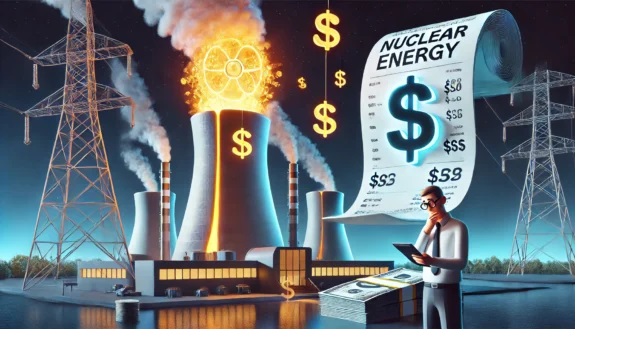
New modelling confirms a shift to nuclear power could significantly increase household electricity bills, with Australians for Affordable Energy (AFAE) urging policymakers to back the most affordable energy option.
The analysis, released by the Clean Energy Council, found households could face a 30 per cent increase in power bills by 2030 under a nuclear pathway, with households paying an additional $450 annually.
“Australians want affordable and reliable energy now. Every independent study we’ve seen suggests nuclear power will be a guaranteed hit to household budgets now and in future,” AFAE spokesperson Jo Dodds said.
“The cost of living is what it’s all about for most Australians, with energy prices a major concern. From everything we know so far, nuclear is the far more expensive option, and cheaper practical alternatives exist.
“While we wait decades for expensive nuclear plants Australians will be forced to rely on expensive gas and aging coal plants, driving bills even higher. A 30 per cent hike in power bills would place even more strain on Australian households who are already grappling with cost-of-living pressures. Our energy policies must prioritise affordability.”
The findings mirror concerns raised in the Climate Change Authority’s recent report, which found nuclear energy could add 2 billion tonnes of emissions and delay Australia’s clean energy transition until 2042.
“It says small businesses could expect an $877 increase in their bills by 2030 if we slow down our clean energy rollout,” Ms Dodds said.
“There’s a clear choice here between affordable energy now or higher bills for decades to come.”
“Any energy policy that doesn’t put affordability front and centre is out of touch with what voters actually want. These are tough times for households, we shouldn’t allow energy policy to make them worse.”
Australians for Affordable Energy is urging policymakers to focus on practical, cost-effective energy solutions that can deliver more affordable power right now.
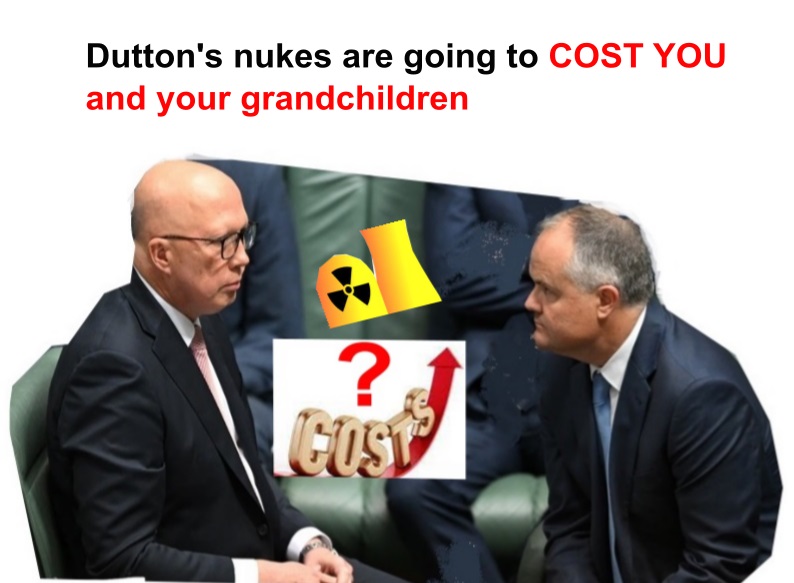
Peter Dutton’s nuclear plan could blow out household electricity bills by up to $600 a year by 2030
https://reneweconomy.com.au/peter-duttons-nuclear-plan-will-blow-out-household-electricity-bills-by-up-to-600-a-year-by-2030/ Sophie Vorrath, Mar 4, 2025
A new report has torpedoed Peter Dutton’s claim that the Coalition’s nuclear power plan for Australia would be 44 per cent cheaper than Labor’s plan for renewables, finding instead that it would inflate average consumer electricity bills by up to 41 per cent between now and 2030.
The report, commissioned by the Clean Energy Council, models the outcomes on electricity prices across Australia’s main grid, the NEM, if the build rate of utility scale renewable generation capacity was reduced significantly – as it promises to be under a Coalition government.
The modelling, conducted by global consultancy, Jacobs, sets a base case using the Australian Energy Market Operator’s (AEMO) Integrated System Plan Step Change Scenario, where 26 gigawatts (GW) of renewables in 2025 grows to 72.7 GW by 2030.
This base case is then contrasted against two scenarios based on the modelling by Frontier Economics for the federal Coalition, which restricts renewables to 49.1 GW by 2030 and relies on coal and gas while waiting for nuclear power.
In that report, Frontier Economics reduced the build rate for renewables, in particular, onshore and offshore wind, big solar and big batteries, in a world where longer term, post 2035 nuclear capacity is installed to meet customer electricity needs.
Frontier’s economic modelling has since been used to underpin claims from Liberal Peter Dutton that his plan for a power system including a significant role for nuclear will be 44% cheaper than a system relying predominantly on renewables.
As Tristan Edis writes in a series of articles starting here, a range of energy analysts and economists have found an array of problems with how this number was derived, but this hasn’t stopped the LNP leader from repeating it every chance he gets.
The Clean Energy Council has therefore decided to fight fire with fire.
Nuclear power struggling to maintain current level of stagnation, let alone achieve any growth
Alongside the risk of Fukushima-scale disasters, the weapons proliferation risks, the risk of attacks on nuclear plants (and the reality of attacks on nuclear plants in Ukraine), and the intractable nuclear waste legacy, the reality is that nuclear power just can’t compete economically.
The industry’s greatest problem at the moment is a recognition of this by investors, resulting in a capital strike.
Darrin Durant, Jim Falk & Jim Green, Mar 3, 2025, https://reneweconomy.com.au/nuclear-power-struggling-to-maintain-current-level-of-stagnation-let-alone-achieve-any-growth/
The current push in Australia to deploy nuclear power reactors once again contrasts an excessive optimism by nuclear proponents against the continuing stagnant situation of nuclear power worldwide. That contrast is the subject of our new report for the EnergyScience Coalition.
The latest nuclear proposals are built on three speculations.
First, projected AI-related energy demand where – as with nuclear power proponents in the 1970’s who projected huge demand that never eventuated – there are already signs demand is overblown. For example the new leading AI entrant DeepSeek requires just 10 per cent of the energy of competitors.
Second, speculative techno-optimism that new technologies such as small modular reactors will resolve industry project management issues. Yet these small reactors are unproven.
Third, prospective wish-fulfilment, where dozens of nuclear ‘newcomer’ countries are offered as saviours, despite not having reactor approvals and funding in place in a large majority of cases.
So what is the state of nuclear power in 2024? A review by the World Nuclear Industry Status Report notes that seven new reactors were connected to grids last year while four reactors were permanently closed. The net increase in operating nuclear capacity was 4.3 gigawatts (GW).
Worldwide nuclear power capacity was 371 gigawatts (GW) at the end of 2024. That figure is near-identical to capacity of 368 GW two decades earlier in 2005.
As of 1 January 2025, the mean age of the nuclear power reactor fleet was 32.1 years. In 1990, the mean age was just 11.3 years. Due to the ageing of the reactor fleet, the International Atomic Energy Agency projects the closure of 325 GW of nuclear capacity from 2018 to 2050 – that’s 88 per cent of current worldwide capacity. Thus the industry faces a daunting challenge just to maintain its pattern of stagnation, let alone achieve any growth.
There were no ‘small modular reactor’ (SMR) startups in 2024. Indeed there has never been a single SMR startup unless you count so-called SMRs not built using factory ‘modular’ construction techniques, in which case there is one each in China and Russia.
The SMR sector continues to go nowhere with setbacks in 2024 including the suspension of the Nuward project in France (following previous decisions to abandon four other SMR projects) and the bankruptcy of US company Ultra Safe Nuclear.
Nuclear growth dwarfed by renewables
In striking contrast to nuclear power’s net gain of 4.3 GW in 2024, the International Energy Agency’s October 2024 ‘Renewables 2024’ report estimates 666 GW of global renewable capacity additions in 2024. Based on the Agency’s estimate, renewables capacity growth was 155 times greater than that of nuclear power.
The International Energy Agency expects renewables to jump sharply from 30 per cent of global electricity generation in 2023 to 46 per cent in 2030.
Conversely, nuclear power’s share of global electricity generation has fallen steadily since the 1990s. As of 1 January 2025, nuclear power accounted for 9.15 per cent of global electricity production, barely half of its peak of 17.5 per cent in 1996.
A Bloomberg analysis finds that renewable energy investments reached $A1.17 trillion in 2024, up 8 per cent on the previous year, whereas nuclear investment was flat at $A55.1 billion. Thus renewable investments were 21 times greater than nuclear investments.
In contrast to massive cost overruns with nuclear projects, renewable costs have fallen sharply.
Lazard investment firm data shows that utility-scale solar and onshore wind became cheaper than nuclear power from 2010-2015. From 2009-2024, the cost of utility-scale solar fell 83 per cent; the cost of onshore wind fell 63 per cent; while nuclear costs increased 49 per cent.
Nuclear newcomer countries
Claims that 40-50 countries are actively considering or planning to introduce nuclear power, in addition to the 32 countries currently operating reactors, do not withstand scrutiny.
As of 1 January 2025, reactors were under construction in just 13 countries, two less than a year earlier. Seven percent of the world’s countries are building reactors; 93 percent are not.
Of the 13 countries building reactors, only three are potential nuclear newcomer countries building their first plant: Egypt, Bangladesh and Turkiye. In those three countries, the nuclear projects are led by Russian nuclear agencies with significant up-front funding from the Russian state.
The World Nuclear Association observes that apart from those three countries, no countries meet its criteria of ‘planned’ reactors, i.e. “approvals, funding or commitment in place, mostly expected to be in operation within the next 15 years.”
The number of potential newcomer countries with approvals and funding in place, or construction underway, is just three and those projects are funded heavily by the Russian state. That is the underwhelming reality underlying exaggerated claims about 40-50 countries pursuing nuclear power.
There is no evidence of a forthcoming wave of nuclear newcomer countries in the coming years and decades. At most there will be a trickle as has been the historical pattern with just seven newcomer countries over the past 40 years and just three this century.
The number of countries operating power reactors in 1996–1997 reached 32. Since then, nuclear newcomer countries have been matched by countries completing nuclear phase-outs and thus the number is stuck at 32. And less than one-third of those countries are building reactors (10/32).
It is doubtful whether the number of nuclear newcomer countries over the next 20-30 years will match the number of countries completing phase-outs.
Capital strike
Alongside the risk of Fukushima-scale disasters, the weapons proliferation risks, the risk of attacks on nuclear plants (and the reality of attacks on nuclear plants in Ukraine), and the intractable nuclear waste legacy, the reality is that nuclear power just can’t compete economically.
The industry’s greatest problem at the moment is a recognition of this by investors, resulting in a capital strike. Even with generous government/taxpayer subsidies, it has become difficult or impossible to fund new reactors – especially outside the sphere of China and Russia’s projects at home and abroad.
Who would bet tens of billions of dollars on nuclear power projects when the recent history in countries with vast expertise and experience has been disastrous?
In France, the latest cost estimate for the only recent reactor construction project increased seven-fold to A$39.4 billion for just one reactor. Construction took 17 years. No reactors are currently under construction in France.
In the US, one project in South Carolina, comprising two Westinghouse AP1000 reactors, was abandoned in 2017 after $A14.3 billion was spent. Westinghouse declared bankruptcy and its debts almost forced its parent company Toshiba into bankruptcy. All that remains is the nukegate scandal: an avalanche of legal action including criminal cases.
The only other reactor construction project in the US – the twin-reactor Vogtle project in the state of Georgia – reached completion at a cost 12 times higher than early estimates. The final cost was at least $A27 billion per reactor. Completion was six to seven years behind schedule.
No power reactors are currently under construction in the US. Thirteen reactors have been permanently shut down over the past 15 years.
The situation is just as bleak in the UK where there have been 24 permanent reactor shut-downs since the last reactor startup 30 years ago, in 1995.
The 3.2 GW twin-reactor Hinkley Point project in Somerset was meant to be complete in 2017 but construction didn’t even begin until 2018 and the estimated completion date has been pushed back to 2030-31.
The latest cost estimate – A$46.6 billion per reactor – is 11.5 times higher than early estimates. The UK National Audit Office estimates that taxpayer subsidies for the Hinkley Point project could amount to $A60.8 billion and the UK Parliament’s Public Accounts Committee said that “consumers are left footing the bill and the poorest consumers will be hit hardest.”
The estimated cost of the planned 3.2 GW twin-reactor Sizewell C project in the UK has jumped to $A81 billion or $A40.5 billion per reactor, twice the cost estimate in 2020. Securing funding to allow construction to begin is proving to be difficult and protracted despite a new ‘Regulated Asset Base’ funding model which foists the enormous risk of enormous cost overruns onto taxpayers and electricity ratepayers.
Lessons for Australia
Those three countries – France, the US and the UK – have vast nuclear expertise and experience. They all enjoy synergies between civil and military nuclear programs – President Macron said in a 2020 speech that without nuclear power in France there would be no nuclear weapons, and vice versa.
All of the above-mentioned construction projects were (or are) on existing nuclear sites. All projects were (or are) long delayed and tens of billions of dollars over-budget.
Claims that potential nuclear newcomer countries such as Australia, without any of those advantages, could build reactors quickly and cheaply are not credible.
Our report expanding on these issues is posted at the EnergyScience Coalition website.
Darrin Durant is Associate Professor in Science and Technology Studies at the University of Melbourne. Jim Falk is a Professorial Fellow in the School of Geography, Earth and Atmospheric Sciences at the University of Melbourne and Emeritus Professor at the University of Wollongong. Dr. Jim Green is the national nuclear campaigner with Friends of the Earth Australia and a member of the Nuclear Consulting Group.
New report details nuclear power’s demise
March 3, 2025 AIMN Editorial, EnergyScience Coalition , https://theaimn.net/new-report-details-nuclear-powers-demise/
A new report by the EnergyScience Coalition corrects false claims by the federal Coalition and others that ‘the world is going nuclear’.
Co-authors Assoc. Prof. Darrin Durant, Prof. Jim Falk and Dr. Jim Green note that:
- The number of operating power reactors worldwide has fallen to 411, which is 27 fewer than the peak of 438 reactors in 2002.
- In 2024 there were 666 gigawatts (GW) of global renewable power additions compared to nuclear growth of 4 gigawatts, a ratio of 155:1. In China the ratio was 100:1.
- Nuclear power’s contribution to global electricity production fell to 9.15 percent last year, barely half of its peak of 17.5 percent in 1996. Conversely, the International Energy Agency expects renewables to jump sharply from 30 percent of global electricity generation in 2023 to 46 percent in 2030.
- Global nuclear power capacity is no greater than it was 20 years ago.
- Of the 32 countries operating power reactors, less than one-third (10) are building new reactors.
- The number of countries building nuclear power reactors fell from 15 to 13 last year. Seven percent of the world’s countries are building reactors; 93 percent are not.
- The number of potential nuclear ‘newcomer’ countries with reactor approvals secured and funding in place, or construction underway, is just three and those projects are all heavily funded by the Russian state.
- The ‘small modular reactor’ sector continues to go nowhere with setbacks in 2024 including the suspension of the Nuward project in France and the bankruptcy of US company Ultra Safe Nuclear.
Report co-author Prof. Jim Falk said: “Reactor construction projects in countries with vast expertise and experience ‒ such as France, the US and the UK ‒ have run literally tens of billions of dollars over-budget and construction schedules have slipped by many years. Since those countries have failed to build reactors on-time and on-budget, it would be naïve to believe that a nuclear ‘newcomer’ country such as Australia could do so.”
Co-author Dr. Jim Green said: “This report provides a factual rebuttal to the pro-nuclear disinformation campaign currently underway in Australia. Simple facts are ignored by the nuclear lobby, such as the fact that there has been zero growth in nuclear power over the past 20 years and the number of countries operating reactors is the same as it was in the late 1990s.”
The report, titled ‘Nuclear Power’s Global Stagnation and Decline’, is co-authored by Assoc. Prof. Darrin Durant (Associate Professor in Science and Technology Studies at the University of Melbourne), Prof. Jim Falk (Professorial Fellow in the School of Geography, Earth and Atmospheric Sciences at the University of Melbourne; Emeritus Professor at the University of Wollongong) and Dr. Jim Green (President of Friends of the Earth Australia and a member of the Nuclear Consulting Group).
Peter Dutton’s nuclear accounting trick #3: Hide the costs of keeping coal
RENEW ECONOMY. Tristan Edis, Feb 21, 2025
This is part 4 of a five part series of articles examining the four accounting tricks that the Liberal-National Party employed in the costing of their energy plan to slow the roll-out of renewables and rely instead on nuclear power. The first article, which provides the overarching context is published here. Part 2 is here. Part 3 is here.
These four accounting tricks act to mislead voters that the Liberal-National Party could lower energy bills through a shift to nuclear when in reality it is likely to increase power bills.
This article focuses on accounting trick three of four: Hide most of the cost of replacing coal with nuclear to outside the time period considered in the costing.
It’s very important to note that the Coalition’s costing of its electricity system cuts out in the year 2051. It only accounts for costs incurred between 2025 to 2051 and anything after that date is ignored.
The LNP’s claim of a 44% saving does not represent the cost of two alternative systems for achieving near zero emissions once they are both completed to see how nuclear might reduce the cost of the system.
Instead, a heavy influence on the cost estimates in the model is the degree to which the scenarios can delay incurring costs in replacing the old, highly polluting and likely to be increasingly unreliable coal power plants.
How is this a problem?
Coal power stations are much like a car – they are exposed to extreme heat, pressure and general mechanical stress that means they wear out and become unreliable as they get old. That’s physics.
Many of us will have experience with an old car that has got to the point where it increasingly encounters mechanical problems and the mechanic is warning us that it really needs some major repairs but these would cost more than the car is worth.
At this point many of us can be tempted to take a gamble by putting off such repairs, and go for temporary, less costly patch-ups and hope the car keeps going. That will be a lot cheaper than buying a new car, at least for as long as we can keep the old car going. But it comes with the risk that it could leave us stranded with a broken-down car at an extremely inconvenient point in time and even pose a danger to our safety and that of others.
The Coalition’s modeled plan chooses to take that gamble with our electricity system. But it doesn’t account for the risks and potentially extreme costs this involves if the gamble goes wrong.
Clare Savage, the head of the Australian Energy Regulator has repeatedly warned that failing to replace aging coal plants risks both power system reliability and also affordability observing, “Coal can’t last until you have nuclear power available.”……………………………………………………………………
Unless Peter Dutton has a secret plan to prioritise curtailment of rooftop solar in favour of coal generators, this is likely to get worse over time.
Now, the way that the consultant, Frontier, constructed Dutton’s costing is that they space out the cost of constructing new power stations as an annualised payment – a bit like how you’d purchase a new car not by paying for it upfront but rather by taking out a loan and then paying it back incrementally over time.
Except in this case the annualised payment for a new power station is spaced out over several decades and for nuclear it is 50 years. Meanwhile for the existing, very old power plants the original cost of constructing those plants is omitted from the annualised costs.
By pushing out the point at which they replace the old power stations with new ones until the 2040’s, the Coalition gets to hide much of the cost of the nuclear plants until towards the very back end of the projection period. We’ll still have to pay for these nuclear power stations well after 2051, but that’s conveniently left out of the costing period.
Meanwhile, in the scenario said to represent Labor Policy, the coal-fired power stations are replaced quite quickly, so the cost of the new, replacement power stations is taken into account across almost the entire time period considered in the model. …………………………
The nuclear plants aren’t really delivering any meaningful saving in the unit cost of energy relative to relying on renewables and storage. Instead, the savings are coming from the Liberal Party delaying the point at which the coal power plants are replaced. ………………………………………. more https://reneweconomy.com.au/peter-duttons-nuclear-accounting-trick-3-hide-the-costs-of-keeping-coal/
Peter Dutton’s nuclear accounting trick #1: Assume you can halve the cost of nuclear power

they claim they will be ordering nuclear plants several years in the future after the nuclear industry has had the chance to improve on what have been some shocking project cost blow outs.
the nuclear industry in the western world has tended to experience escalating, not declining costs over time.
would have to commence the nuclear procurement process immediately.
Tristan Edis, Feb 19, 2025, https://reneweconomy.com.au/peter-duttons-nuclear-accounting-trick-1-assume-you-can-halve-the-cost-of-nuclear-power/
This is part 2 of a five part series of articles examining the four accounting tricks that the Liberal-National Party employed in the costing of its energy plan to slow the roll-out of renewables and rely instead on nuclear power. The first article, which provides the overarching context is published here.
These four accounting tricks act to mislead voters that the Liberal-National Party could lower energy bills through a shift to nuclear when in reality it is likely to increase power bills.
This article focuses on accounting trick one of four: Assume a cost for nuclear reactors which is around half what nuclear reactors have actually cost to build across Europe and North America.
The most important point you need to understand is that the unit cost of energy the Liberal-National Party claims its future nuclear-underpinned power system will deliver – about $80 per megawatt-hour – is unrealistically low.
More realistic cost assumptions for nuclear would inflate the modelled cost of their system per MWh to $141.50 per MWh which is two-thirds higher than what they’ve estimated for the Labor Party scenario.
The Liberal-National Party’s costing has assumed that a nuclear reactor built today in Australia would cost $10,000 per kilowatt of capacity and that cost would decline by 1% per annum. The costing also assumes the first reactors would commence operation in 2036 followed by a rapid scale-up from 2039.
This is far below the real-world construction cost experience of nuclear reactors across Europe and North America in the past 20 years. This experience is detailed in a report I co-authored with energy analyst Johanna Bowyer from the Institute for Energy Economics and Financial Analysis – Nuclear in Australia would increase household power bills.
The table below [on original] lists the costs per kilowatt of plants which have proceeded to construction or managed to get to the point of a contracted price. Importantly you need to consider both the actual price paid to construction contractors (known as the ‘overnight cost’ – the cost if the project could literally be built within a night), but also a range of costs incurred by the owner in building the plant such as financing, known as the ‘all-in costs’.
These owner-incurred costs are very large, mainly because construction takes a long time and leads to significant bank debt interest bill accumulating over this period. The Liberal-National’s costing report does not explain what construction period it assumes for nuclear plants, which is a major black hole in their costing.
For a nuclear reactor with an all in cost of almost $29,000 per kilowatt to recover a commercial financing cost of 6% it would need to capture an electricity price close to $260 per MWh, and that’s if it could operate close to its full capacity without ramping down around solar generation.
If we multiply that out by the amount of electricity nuclear is expected to generate under the Liberal-National Party scenario, that gives us an annualised cost just for the nuclear component of their power system of $27 billion in 2051. We then need to add on top of that the costs to provide the remaining 60% or so of electricity not provided by nuclear.
Unfortunately, the inadequate transparency of the consultant’s report makes it difficult to disentangle these costs. Using the limited data the consultant has provided these non-nuclear costs appear to roughly lie somewhere around $8 to $10 billion.
So, if we use more realistic nuclear costs and then take the mid point for the non-nuclear costs of $9 billion, we end up with a total annualised cost of $36 billion for the complete system in 2051.
This is $7.5 billion higher than what the consultant estimates for the Labor scenario in 2051. It gives us an averaged cost per MWh of around $141.50, which is around two-thirds higher cost per MWh than the Labor scenario.
The Coalition likes to claim that the costs from these real-world nuclear power plant projects are somehow not relevant. This is because they claim they will be ordering nuclear plants several years in the future after the nuclear industry has had the chance to improve on what have been some shocking project cost blow outs.
There are just two fundamental problems with this.
The first is that the nuclear industry in the western world has tended to experience escalating, not declining costs over time. UK’s next planned nuclear project Sizewell C will represent the fifth and sixth European Pressurised Reactor (EPR) design built by French corporate entities.
The latest cost reported by the UK’s Financial Times suggests it will cost around two and half times what the Coalition costing assumes at $24,540 per kW. That’s substantially more expensive than the first EPR they built in Finland – Olkiluoto 3.
The second problem is that for the Coalition to have any chance of meeting its time frame for the roll-out of nuclear it would have to commence the nuclear procurement process immediately. It won’t be able to wait for the nuclear industry to achieve what would amount to some incredible cost breakthroughs.
To explain why it is helpful to look at the Czech Republic experience, where they just very recently completed a nuclear tender process. The tender commenced in 2022 (preparation leading into the tender such as permitting and environmental impact assessments for the reactor site began several years before that but let’s leave that to one side).
Two years later they had selected the winner, being Korean Hydro and Nuclear Power. Yet Korean Hydro and Nuclear Power won’t be able to actually commence the real construction work until 2029. That’s because nuclear power plants are very complex, from both a physical and commercial perspective, and require considerable preparatory work. From there, they don’t expect the nuclear power plant to be fully operational until 2038. Note that this is for a site where preexisting nuclear power plants are already in place with all the associated supporting infrastructure that entails.
So, realistically, if the Coalition wanted to achieve the timelines outlined in its modelling, it really needed to commence the nuclear procurement tender process back several years ago when it was previously in government. It has no time available to wait around for the nuclear industry to come up with the cost breakthroughs its costing relies upon.
Tristan Edis is director of analysis and advisory at Green Energy Markets. Green Energy Markets provides analysis and advice to assist clients make better informed investment, trading and policy decisions in energy and carbon abatement markets.
Peter Dutton sidesteps questions on state-funded nuclear disaster insurance plan
Albanese government also asked if it has considered nuclear insurance pool in context of Aukus nuclear-powered submarines.
Dan Jervis-Bardy Guardian 18 Feb 25
Peter Dutton has sidestepped questions about the potential need for a government-backed insurance pool for nuclear disasters after the industry’s peak body exposed a possible missing piece in his flagship energy plan.
The Insurance Council of Australia on Monday suggested the commonwealth may need to underwrite a scheme to cover communities against nuclear accidents.
“Around the world, nuclear has a special [insurance] cover that is usually done by governments,” the council’s chief executive, Andrew Hall, told ABC RN Breakfast.
“So it’s a conversation: if Australia turns to a net zero nuclear future, then we’re going to need to have a conversation with the government about a pool that would cover communities in the extremely unlikely event something would happen.”
Hall indicated such a scheme would be needed even if the Coalition’s nuclear plans never eventuated, to cover residents living near naval bases for the Aukus nuclear-powered submarines.
Neither the US nor UK has ever experienced a nuclear reactor accident on their submarines.
The insurance question has been largely overlooked in the debate about Dutton’s proposal to build nuclear reactors at seven sites. Attention has focused instead on the cost and timeline for starting an Australian nuclear power industry from scratch.
Countries with established nuclear industries have longstanding insurance schemes to cover personal injury and damage caused by nuclear disaster.
In the US, operators of nuclear power plants pay an annual premium for US$500m (about A$786m) in private insurance for liability coverage for each reactor.
Asked on Monday if the Coalition had modelled the cost of a nuclear insurance scheme, Dutton did not respond to the question, instead reiterating the threat of market intervention if insurers did not lower premiums.
The Nationals leader, David Littleproud, struggled to answer similar questions when pressed repeatedly on ABC radio earlier in the day.
Insurance is not mentioned in either the Coalition’s six-page nuclear blueprint or in the Frontier Economics costings underpinning the proposal.
The Australia Institute thinktank in 2019 described nuclear power as “uninsurable”, warning that if operators were forced to cover the cost of accidents then the reactors would be “completely uncompetitive”.
In a statement to Guardian Australia, an Insurance Council of Australia spokesperson said it was common for insurance policies to exclude loss or damage caused by nuclear power.
“However, insurers in Europe, the US, and other countries where nuclear power generation is common have insurance mechanisms in place to cover liability concerns,” the spokesperson said.
“These include liability insurance pools, international agreements and conventions, and government programs to establish coverage and frameworks for nuclear liability insurance.”
Guardian Australia asked the defence minister, Richard Marles, if the government had considered a nuclear insurance pool in the context of Aukus.
In a statement, an Australian Submarine Agency spokesperson did not comment on the idea of an insurance pool……………………………………………….. more https://www.theguardian.com/australia-news/2025/feb/17/nuclear-disaster-insurance-pool-funding-peter-dutton-questioned-coalition-costing?fbclid=IwY2xjawIh-1VleHRuA2FlbQIxMQABHVTDHY1ZfGqoH8vCwqMsqPd2DFwsmd0_nUu-wn14Gnes6DAWgXMuUXO-ow_aem_JRtSrA2wjsbbfPQiwb-vqg
The four accounting tricks behind Peter Dutton’s nuclear cost claims
So according to the data within the Liberal-National Party’s costing document, Dutton’s power system underpinned by nuclear will generate electricity at 6% lower cost than one that doesn’t rely on nuclear. It leads you to wonder – how on earth did Dutton come up with it being 44% cheaper?
There are four accounting tricks behind the 44% cheaper claim which mean that, in reality, Peter Dutton’s plan is not cheaper and is far more risky.
Tristan Edis, Feb 18, 2025, https://reneweconomy.com.au/the-four-accounting-tricks-behind-peter-duttons-nuclear-cost-claims/
The Liberal-National Coalition claims it has found the solution to bring down energy bills – slow the growth of renewable energy and roll-out nuclear power.
According to Liberal Leader Peter Dutton, their plan for a power system including a significant role for nuclear will be 44% cheaper than a system relying predominantly on renewables. This claim is based on energy market economic modelling it released just before Christmas, prepared by an economic consultant – Frontier Economics.
A range of energy analysts and economists have criticised the Coalition’s claims, finding an array of problems with how this number was derived (see the list at the bottom of this article for examples). Nonetheless this hasn’t made any difference to Peter Dutton’s claims, and earlier this month he was on ABC television telling viewers that he had a plan to deliver voters 44% cheaper power bills.
However, you don’t need to be any kind of expert analyst or economist to work out that the claim nuclear will deliver you 44% lower bills is a bit like a wrinkle cream claiming it will make you look 44% younger.
And in the end, though it might not be obvious, this is really about whether Liberal-National Party have discovered a miraculous cure for aging, and quite potentially the laws of physics. It isn’t really about nuclear.
To explain this you need to do a very simple calculation:
1) Get out a basic calculator.
2) Into this calculator type in the $20.5 billion dollars that the Liberal-National Party costing says will be the annual price of their power system once all the nuclear power plants are complete in 2051 (see Figure 12 on page 38 of the consultant’s report).
3) Then divide this cost by the total amount of electricity that system will deliver in 2051 after deducting generation from energy storage, which is roughly 255 million megawatt-hours (see table 8 on page 34).
That gives you the cost of energy under their system of around $80.30 per megawatt-hour.
Now do the same thing for the power system which Dutton claims to represent Labor’s policy (by the way it’s not really Labor’s policy, it’s the Australian Energy Market Operator’s Step Change modelling scenario). So divide $28.5 billion (Figure 12 on page 38 of consultant’s report) by 333 million megawatt-hours (table 5 on page 28).
That gives a cost of energy of close to $85.50 per megawatt-hour for the so called Labor system.
So according to the data within the Liberal-National Party’s costing document, Dutton’s power system underpinned by nuclear will generate electricity at 6% lower cost than one that doesn’t rely on nuclear. It leads you to wonder – how on earth did Dutton come up with it being 44% cheaper?
There are four accounting tricks behind the 44% cheaper claim which mean that, in reality, Peter Dutton’s plan is not cheaper and is far more risky. The four tricks involve the following:
1) It doesn’t reflect the real cost of building nuclear – the Liberal Party costing assumes a cost for nuclear power plants which is around half what nuclear reactors have actually cost to build. Once you use the average construction cost and construction time of real world nuclear plants, the cost per unit of energy for the Liberal-National Party’s power system is two thirds more expensive than what is estimated for Labor’s scenario, once the system is fully built.
2) Only considers electricity costs while ignoring the cost of petrol and gas – The costing omits much of the costs of energy to heat buildings, fuel vehicles and power industry in the Liberal-National party scenario because they seem to prefer that we continue to heavily rely on petrol to fuel our cars and gas instead of electricity to heat homes and run factories.
Meanwhile, a lot of these costs are included in the scenario for Labor, where electricity has largely replaced the use of petrol and gas for fuelling our vehicles and heating buildings and industrial processes. By just accounting for the 203 billion litres of extra petrol consumption in the Liberal-National scenario the claimed 44% saving evaporates and instead you find their energy system is $80 billion more expensive that what they claim is the cost for the Labor scenario.
3) Tries to hide the cost of replacing old coal power stations with nuclear to outside the time period covered by the costing. The costing only includes costs incurred between 2025 and 2051, anything beyond that point is ignored. Under the costing of the Liberal-National Party’s scenario they’ve pushed most of the costs of replacing old coal power stations to outside the 2025-2051 time period. Meanwhile, the costing ignores the risks and potential large costs associated with extended reliance on increasingly unreliable old power stations.
4) Assumes climate change isn’t an important and urgent problem – The modelling consultant has openly acknowledged the availability of economic data that would allow them to cost the damage from carbon emissions. But instead of using this data from the Australian Energy Regulator, they instead completely ignore the damage costs from the higher emissions under the Coalition’s preferred scenario of extended reliance on coal, petrol and gas.
If the consultant had adhered to the basics of first year economics based on work published back in 1920, and placed a cost on carbon in line with AER guidance, it would add $392 billion to the Liberal-National scenario compared to just $75 billion to the Labor scenario. If you add that to the extra cost of petrol then the Liberal-National scenario is almost $400 billion more expensive than the scenario claimed to be Labor’s across 2025 to 2051. That’s even if we ignore the extra costs associated with accounting tricks 1 and 3.
Over the next few days I’ll go into each one of these four accounting tricks in more detail with an article explaining how that trick acts to mislead voters and means that energy consumers would most likely face higher, not lower energy bills.
This isn’t intended to suggest that the Australian Energy Market Operator’s Step Change scenario (said to represent Labor policy) should go unquestioned. The future is full of uncertainties and we need to examine a range of options for how we can sensibly lower emissions while maintaining reliable and affordable energy suppliers.
Unfortunately, the suggestion that Nuclear Power is the easy fix simply ignores the incredible difficulties and costs Europe, North America and Japan have experienced with Nuclear Power.
Tristan Edis is director of analysis and advisory at Green Energy Markets. Green Energy Markets provides analysis and advice to assist clients make better informed investment, trading and policy decisions in energy and carbon abatement markets.
Nuclear advocates: Splitting atoms and spinning agendas
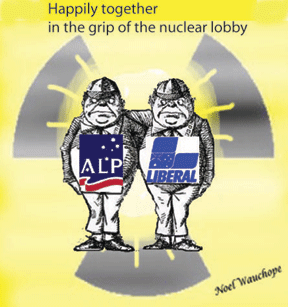
Ed COMMENT. I can’t help noticing how the Liberal ad Labor agendas overlap here – in this carefully controlled pro-nuclear event -described by Sybilla George.
Labor is pushing on with the AUKUS nuclear submarine folly. Liberal is pretending that jt really intends to start nuclear power in Australia.
Both in the grip of USA militarism and the nuclear lobby
Despite having three women on stage – including Stanke – for the panel event, the Celebrity Room at Moonee Valley Racing Club was dominated by men on Saturday night. Opening the evening, Shackel said his charity aimed to “enable civil debate”, yet panels on the tour featured only pro-nuclear views.
By Sybilla George | 6 February 2025, https://independentaustralia.net/environment/environment-display/nuclear-advocates-splitting-atoms-and-spinning-agendas,19407
Former Miss America and nuclear energy activist Grace Stanke‘s Melbourne visit saw a pro-nuclear panel push persuasion over debate, with filtered questions and few dissenting voices, writes Sybilla George.
FOLLOWING EVENTS in Perth and Brisbane, Nuclear for Australia’s ‘An Evening with Miss America 2023 Grace Stanke’ took place last Saturday at the Moonee Valley Racing Club.
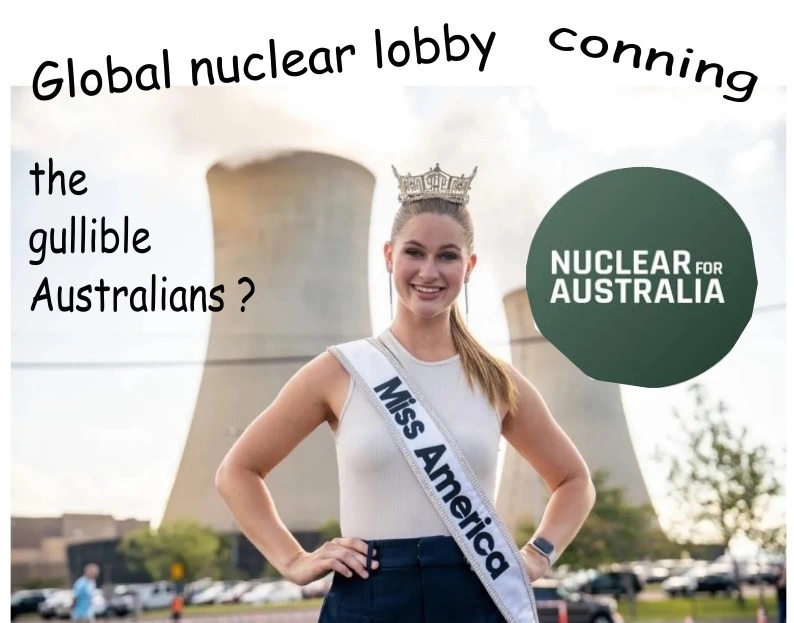
Nuclear for Australia is a nuclear power advocacy charity started in 2023 by teenager Will Shackel and patronised by electronics entrepreneur Dick Smith. The Miss America 2023 Australia Tour is also supported by Smith, according to the Nuclear for Australia website which has served as a platform for Smith’s response to The Guardian’s fact-checking of his anti-renewables arguments.
Nuclear for Australia is a nuclear power advocacy charity started in 2023 by teenager Will Shackel and patronised by electronics entrepreneur Dick Smith. The Miss America 2023 Australia Tour is also supported by Smith, according to the Nuclear for Australia website which has served as a platform for Smith’s response to The Guardian’s fact-checking of his anti-renewables arguments.
The tour aims to ‘help bridge the current divide between men and women for nuclear energy’ and cites the Australian Conservation Foundation statistic that 51% of men versus 21% of women support nuclear energy.
Despite having three women on stage – including Stanke – for the panel event, the Celebrity Room at Moonee Valley Racing Club was dominated by men on Saturday night. Opening the evening, Shackel said his charity aimed to “enable civil debate”, yet panels on the tour featured only pro-nuclear views. Questions put to the panel were selected from those sent in before and during the event, omitting the opportunity for live questions.
Stanke, who has an undergraduate degree in nuclear engineering, advocates for clean energy, including wind, solar and nuclear power. She began working for the United States’ largest nuclear energy provider, Constellation Energy, in 2024. Of Constellation’s energy capacity, 60% derives from nuclear power, while 25% comes from oil and natural gas fossil fuels.
The panel portion of the event featured Stanke alongside fellow American Mark Schneider, former operator of U.S. civil and defence nuclear reactors and current chief nuclear officer for UBH Group — an Australian defence consultancy firm angling for a ‘piece of the AU$368 billion nuclear sub [AUKUS] pie’.
They were joined by energy and resources lawyer Kirsty Braybon and Global Nuclear Security Partners’ (GNSP) Australia branch managing partner Jasmin “Jaz” Diab.
Army officer and nuclear engineer Jaz Diab is a star of the pro-nuclear media circuit. She’s made several appearances on Sky News and spoke at The University of New South Wales (UNSW) Navigating Nuclear conference in May 2024 alongside Coalition Shadow Energy Minister Ted O’Brien, before the Coalition’s nuclear energy plan announcement in July 2024.
Diab joined the business group AUKUS Forum, suggesting GNSP will be making a play for the AUKUS pie and nuclear energy contracts should the Coalition get into government at the next federal election.
As reported by the Australian Financial Review in December 2024, the Australian Department of Defence spent AU$811 million on just the big five consultancy firms in 2022-23.
Braybon, who teaches a subject on nuclear law at the University of Adelaide, responded to a question about the current illegality of nuclear power in Australia under the 1998 Radiation Protection and Nuclear Safety Act.
Some legal barriers to nuclear energy have already been watered down to accommodate AUKUS nuclear-powered submarines, Braybon said, and “no one noticed”, pointing to the entwined framework of defence and civil nuclear programs.
The defence backgrounds of panel members Diab and Schneider also attest to this. Braybon did not specify which law changes she was referring to, however, the Australian Naval Nuclear Power Safety Act 2024, which was pushed through the Senate in October 2024 – designating waste “zones” in Adelaide and Perth for AUKUS-related nuclear waste – was reported on by Independent Australia, Michael West Media, The Advertiser and The Guardian.
While anti-nuclear protesters attended the Perth and Brisbane events – including a community action projecting ‘Nuclear energy distracts from the climate emergency’ outside the Gabba – there were no visible objectors in Melbourne.
However, Latrobe Valley Sustainability Group (LVSG) members attended the Moonee Valley Racing Club ahead of the Morwell event the next evening. The Coalition selected Loy Yang – a coal-fired power station in the Latrobe Valley – as one of seven sites around Australia for proposed nuclear power plants.
LVSG is concerned about the questions that Nuclear for Australia will not answer regarding the impact of nuclear power in fighting climate change and the economic cost of constructing and maintaining nuclear power plants. It points out that renewables have surpassed nuclear energy production in the U.S. in just 15 years and that there is a lack of private investment in nuclear power because of its unprofitability.
Indeed, a popular argument in favour of nuclear power appealing to the increasing energy demands of artificial intelligence data centres took a blow in recent days with the announcement that the Chinese AI program DeepSeek performs a similar function to the U.S. program ChatGPT, at a fraction of the cost and energy.
According to LVSG member Dan Caffrey, the Nuclear for Australia Morwell event attracted 240 attendees, but panel members “expressed a complete ignorance” of issues in the local area that reduce the viability of nuclear power, such as water availability and rehabilitation of the existing coal-fired station. The avoidance of challenging questions about nuclear power was “very disheartening”.
Sybilla George is a freelance writer with an interest in nuclear policy and the Pacific region.
‘No idea what he’s talking about’: Dutton’s nuclear plan could raise – not cut – electricity bills, experts warn
Opposition leader claims a 44% cost reduction compared with Labor’s plan would be passed on to Australian household bills, but not everyone agrees
Graham Readfearn, 4 Feb 25, https://www.theguardian.com/australia-news/2025/feb/04/no-idea-what-hes-talking-about-duttons-nuclear-plan-could-raise-not-cut-electricity-bills-experts-warn
Energy experts have rubbished claims by Peter Dutton that his plan to slow the rollout of renewable energy while waiting more than a decade for taxpayer-funded nuclear plants could bring down electricity bills in the short term.
Dutton said if there was “a 44% reduction in the model of delivering an energy system, you would expect a 44% reduction, or of that order, being passed through in energy bill relief”.
However, that was a “complete misunderstanding “of the Coalition’s own policy, according to Dr Dylan McConnell, an energy systems expert at the University of New South Wales. “He has no idea what he is talking about,” McConnell said.
Speaking to the ABC’s Insiders program on Sunday, Dutton said “power prices will be cheaper under us in the near term as well as in the medium to longer term as well”.
If elected, the Coalition would have to overturn federal and state bans on nuclear power; it claims it could have the first plants built by 2037. Experts, including the CSIRO, say the early 2040s is a more realistic timeframe.
The Coalition has not revealed any details on its near-term plans for electricity generation but Dutton said “we’re going to have to do a lot more with gas, with coal, in the system”.
Analysis by McConnell suggested the Coalition’s reliance on more coal and gas would add 1.7bn tonnes of CO2 to the atmosphere by 2050, compared with Labor’s plan.
Data from the CSIRO suggests using gas for power generation is more expensive than coal, and solar and wind. Nuclear electricity would be at least 50% more expensive than renewables, the CSIRO has said.
Gas prices tripled when the Coalition was in power, according to Tristan Edis, an analyst at Green Energy Markets.
He said energy prices were likely to fall over the next two years after the inflation caused by Russia’s invasion of Ukraine subsides.
“Beyond this two-year period, it is difficult to understand how the Coalition will lower power prices if they intend to simply rely on the power plants which are already in place and not foster additional competition,” he said.
“The coal plants are getting old and banks are reluctant to finance refurbishment costs. If we rely on additional gas, that will push up power prices, not reduce them – because gas is expensive.
Edis said the Coalition’s costs for building a 1GW nuclear plant had been set at $1bn, which was “unrealistically low” and could be at least double that. This would push up wholesale electricity prices and household bills, he said.
Frontier Economics released modelling, backed by the Coalition, that compared the cost of Labor’s preferred renewables-based plan with an electricity system that anticipates less demand for electricity and includes nuclear.
Of Dutton’s claim that modelling showed the Coalition’s approach would cost 44% less than Labor’s plan, McConnell was doubtful.
“That’s a clear misunderstanding of what makes up an electricity bill and what the [modelling report] shows.”
He said only about 45% of a household electricity bill related to the cost of the electricity system and the wholesale costs that relate to the cost of the system referred to by Dutton. The rest related to the costs of local poles and wires, retail costs and environmental charges.
Danny Price, managing director of Frontier Economics, defended Dutton’s comments, saying if he was referring to the energy costs portion of people’s bills then the lower cost should transfer to households.
But on the impact on households’ overall electricity bills, “it’s a much more complicated question” he said, because of uncertainties around how prices are set in the market.
For that reason, his company had not attempted to forecast what the Coalition’s plan would do for people’s electricity bills or to electricity prices.
New UK data sends nuclear warning for Australia

February 4, 2025, https://esdnews.com.au/new-uk-data-sends-nuclear-warning-for-australia/
By Tristan Edis and Johanna Bowyer, Institute for Energy Economics and Financial Analysis (IEEFA)
The UK’s Financial Times recently reported that the 3,260MW Sizewell C project —expected to be the UK’s next nuclear power plant—is now likely to cost around GBP40 billion, or $80 billion in Australian dollars, to construct. That equates to $24,540 per kilowatt of capacity.
Related article: The Coalition reveals the cost of its nuclear power plan—but the devil is in the missing detail
Sizewell C’s latest cost blow-out offers further confirmation that the opposition Liberal-National Coalition’s costing for its proposal to build nuclear power plants in Australia is far too low at $10,000 per kilowatt, and completely unrealistic. It supports IEEFA’s findings on the cost of construction for other nuclear power plants, detailed in our September 2024 report Nuclear in Australia would increase household power bills. The Sizewell C reactor’s newly estimated capital cost is about 2.5 times the capital cost used in the Frontier Economics modelling that has underpinned the Coalition’s plans.
At present, the UK Government is yet to commit to construction of Sizewell C and an official costing for the project is yet to be released. But the latest information in Financial Times, which has reportedly come from government and industry sources close to the project, reinforces the findings from our prior report: that for nuclear power to be viable in Australia, large increases in power prices would be required.
If the reported $80 billion cost only covers the plant’s construction and doesn’t account for the substantial debt interest costs likely to be accumulated over the targeted nine-year construction period, then Sizewell C would need the wholesale power price to rise to average out at around $300/MWh to be commercially viable. Even if this debt interest cost is accounted for in the $80 billion cited by the Financial Times, then it would still need the wholesale power price to rise to around $230/MWh.
By comparison, according to the Australian Competition and Consumer Commission (ACCC), over the 2023-24 financial year electricity retailers across Australia’s National Electricity Market needed to pay $132/MWh on average for wholesale energy to service their household customers.
Shadow Treasurer Angus Taylor has asserted on repeated occasions that any government investment in nuclear power plants would be made on the requirement that they were “commercially viable”, with no subsidies provided that would hit the government’s budget.
So, for a nuclear plant with similar costs to those reported for Sizewell C to be commercially viable in Australia, wholesale energy prices would need to rise by $98 to $168/MWh, relative to 2023-24 levels, to enable cost recovery. This equates to a 74% to 127% rise in wholesale prices, which would be charged on to household electricity consumers.
Related article: Not in my green backyard: Only 5% of people in renewables zones would live near nuclear
Such wholesale prices would mean that average household power bills across the states in the National Electricity Market would increase by between $510 and $874 per year prior to application of GST. Once GST is added then the increase will be between $561 and $961 – assuming electricity retailers don’t add a margin on top. This is based on ACCC data, which indicates average household annual consumption is 5.2MWh.
Dutton’s atomic power bill for a ‘nuclear family’ could be nearly $39K
By Steve Bishop | 28 January 2025, https://independentaustralia.net/politics/politics-display/duttons-atomic-power-bill-for-a-nuclear-family-could-be-nearly-39k,19381
The Dutton nuclear power plan will cost about $264 billion if the type of reactor extolled by Shadow Energy Minister Ted O’Brien is adopted.
That’s equivalent to more than $9,700 for every man, woman and child in Australia — and $38,800 for the proverbial “nuclear family”.
The costings are simple.
Opposition Leader Peter Dutton announced on 13 December:
‘By 2050, our plan will deliver up to 14 GW of nuclear energy, guaranteeing consistent and stable electricity for all Australians.’
O’Brien even produced a video highlighting the virtues of the Bill Gates-backed Natrium reactor, which provides 345 megawatts of power and is costing US$4 billion (AU$6.45 billion) for the first one being built in Wyoming by TerraPower.
Forty-one of the reactors would be needed to produce the promised 14GW of nuclear power at a cost of $264.45 billion.
Australia has an estimated population of 27.2 million, giving a total of $9,724 for every man, woman and child.
Mr Dutton has made it plain he is opposed to big nuclear facilities and the Natrium small modular reactor (SMR) reactor meshes with his pledge to ‘place the latest zero emission nuclear technologies on the sites of seven retiring coal-fired power plants’.
Another reactor that falls within his pledge to use the latest technologies is the Rolls Royce UK SMR 470 MWe which could cost between £3 billion and £4 billion (AU$5.9-7.9 billion) apiece.
Even the lower estimate of £3 billion equates to $5.9 billion. Thirty of them would be needed to meet the 14GW target, at a cost of $176.7 billion.
But Nuclear Consulting Group chairman Paul Dorfman has warned that because the Rolls Royce reactor is more than 50 per cent bigger than an SMR it “will need big sites, standard nuclear safety measures, exclusion zones, core catchers, aircraft crash protection and security”.
Ontario and the Tennessee Valley Authority are planning to use the innovative GE Hitachi BWRX-300 reactor but it has been reported that planning documents reveal a cost of around US$5.4 billion (AU$8.6 billion), amounting to a cost of $369 billion for the 43 needed to produce 14KW of power.
Another new SMR is the Westinghouse AP300 SMR.
An order for four of the reactors has been placed in the UK for the Tees Valley with the Daily Express reporting:
‘The four reactors would cost £10 billion and generate 1.2 gigawatts of power, enough for 1.6 million homes.’
That’s £2.5 billion each, or AU$4.91 billion. Forty-three would be needed to meet the LNP target of 14GW — costing $211 billion. But this does not factor in the sort of cost blow-out experienced with other SMRs.
Mr Dutton was asked by ABC journalist Bridget Brennan in June:
“So, surely Australians need to know right now how much this is going to cost? Is it going to be as much as $16 billion per site?”
The answer is very much more expensive — more than $35 billion for each of the seven sites if Ted O’Brien’s preferred Natrium reactor is adopted.
Labor argues ‘economic madness’ of Coalition’s nuclear plan would cost NSW $1.4tn.
Jim Chalmers says ‘Peter Dutton is the biggest risk to household budgets’ as Coalition defends cheaper costings modelled on a smaller power grid.
Dan Jervis-Bardy, https://www.theguardian.com/australia-news/2024/dec/28/labor-argues-economic-madness-of-coalitions-nuclear-plan-would-cost-nsw-14tn
The Coalition’s nuclear policy will cause a $1.4tn hit to New South Wales over the next 25 years, according to analysis Labor will use to attack the “economic madness” of Peter Dutton’s signature energy scheme.
The federal treasurer, Jim Chalmers, will on Saturday put a dollar figure on the impact on the NSW economy of the Coalition’s plan to build nuclear reactors at seven sites across Australia.
The Albanese government’s analysis is based on the assumption underpinning the Coalition’s costings that less electricity will be needed under its nuclear vision.
Chalmers has argued the Coalition’s plan for a smaller energy grid would result in an economy that is $294bn smaller, with $4tn in lost output, by 2051.
The analysis, to be released on Saturday, suggests that NSW alone would suffer a $1.4tn blow to the state’s economic output over that period, including $114bn in the year 2051.
“Peter Dutton’s nuclear scheme is economic madness,” Chalmers said. “He will push energy prices up and growth down and the people of NSW will be worse off.
“We now know for sure that Peter Dutton is the biggest risk to household budgets and Australia’s economy.”
The new analysis is likely to be quickly dismissed by the Coalition, which brushed off Chalmers’ claims of a $4tn hit to the national economy as “absolute and utter nonsense”.
Asked earlier this month if the Coalition’s plan would shrink the nation’s economy, the opposition’s treasury spokesperson, Angus Taylor, said Labor was already doing that.
The economics of nuclear energy has been thrust to the centre of the political debate after the Coalition released the long-awaited costings for its plan earlier this month.
Frontier Economics modelling suggested the nuclear plan would cost $331bn over 25 years, roughly $263bn cheaper than the estimated bill for Labor’s renewables-focused push to net zero by 2050.
However, the Coalition’s costs are modelled on a scenario – which the Australian Energy Market Operator calls “progressive change” – in which the electricity grid is far smaller than what is envisaged under the “step change” route preferred by Labor.
The rollout of electric vehicles, rooftop solar and the electrification of households and businesses is all expected to be slower under the “progressive change” pathway.
The scenario assumes GDP growth of 1.89% a year through to 2050, compared with 2.21% a year under the “step change” alternative.
The new federal analysis assumes heavy industry, such as aluminium smelters, would have to shut their doors after 2030 because there will not be enough energy to keep operating. That would spell danger for the aluminium smelters in the Hunter Valley in NSW and Portland in Victoria.
The NSW premier, Chris Minns, has repeatedly ruled out lifting the state’s nuclear power ban.
“The bottom line here is that nuclear power costs a lot of money and it takes a lot of time,” Minns said earlier this year.
“And we don’t really have a moment to spare when it comes to renewing our energy grid and thinking about new sources of electricity generation.”
Australian navy advertises nuclear submarine job with $120,000 salary and ‘no experience’ needed
Defence outlines long-term strategy to staff US-built Virginia-class submarines expected in 2030s as part of Aukus deal.
Henry Belot, Guardian, 24 Dec 24
The Australian Navy is offering high school graduates “with no experience at all” up to $120,000 to become nuclear submarine officers who will eventually manage nuclear reactors and weapons systems.
The recruitment drive has been launched despite Defence not being expected to receive a Virginia-class submarine from the US as part of the Aukus deal until at least the early 2030s and amid warnings of cost blowouts and delays.
A navy job ad targets people who may have “recently finished school or are currently studying” with the promise of eventually “driving the vessel and charting its position”.
“Your training will first equip you with technical expertise in nuclear propulsion, the platform, and its equipment,” the ad said. “You will then move into your submarine qualification and oversee day-to-day operations, and you could one day lead the entire crew as commanding officer.”
A Defence spokesperson said the hiring drive was part of a long-term strategy to ensure it had enough specialist staff to deploy the submarine once acquired.
“This is to ensure we have the right mix of candidates and to ensure there is time to generate a sustainable career pathway,” the spokesperson said.
Once accepted, an officer would undergo 12 months of nuclear training in the US along with three months of basic submarine and warfare courses. The officers would then be posted to a seagoing submarine for further training.
Nuclear submarine technicians would receive 18 months of training in the US including six months of nuclear theory and 12 months of practical training on existing vessels. The technicians would also be posted to seagoing submarines…
The job ad also offers recruits “travel opportunities, job security, incremental salary increases as you progress through training and ranks, chef made meals at sea, social and fitness facilities, balance of shore and sea postings [and a] variety of allowances”…………
Defence has previously struggled to recruit enough personnel. In a briefing to Marles in 2022, obtained under freedom of information laws, Defence warned: “The last year has seen lower recruiting achievement and higher separation rates, which have resulted in the ADF and [Department of Defence] workforce size being below approved levels.”
The federal government also funded a new training centre at HMAS Stirling, a Royal Australian Navy base in Western Australia, to train a local workforce to deploy the Virginia-class submarines.
The US plans to sell Australia at least three and potentially five nuclear-powered Virginia-class submarines in the 2030s, before Australian-built submarines enter service in the 2040s.
In the lead-up of the acquisitions, from 2027 at the earliest, there are plans to establish a rotational presence of one Royal Navy Astute-class submarine and up to four US navy Virginia-class submarines at HMAS Stirling. https://www.theguardian.com/world/2024/dec/24/australia-navy-nuclear-submarine-job-salary
Economics of Coalition’s nuclear modelling are worth nothing
There may well still be good reasons to favour nuclear. But on the basis of this modelling, the economics isn’t one of them
Australian Financial Review, .Steven Hamilton, Columnist, 16 Dec 24
On Friday, the Coalition finally released the economic modelling underpinning its plan to produce more than a third of our electricity via nuclear by 2050.
I approached the modelling – produced pro-bono by Frontier Economics – with an open mind. I have no issue with nuclear power so long as the economics stack up. To date, I am yet to read a convincing analysis in its favour in the Australian context.
Alas, after studying the modelling very carefully, I can confirm it is worth about what the Coalition paid for it.
Most critical reporting has focused on the Coalition’s decision, bundled along with nuclear, to abandon the “step change” scenario the government is counting on, which would see significantly greater electricity generation to support widespread electrification of households, transport and business.
But this is a red herring. While the Coalition’s claim that its plan will cost 44 per cent less than the government’s plan relies on the abandonment of step change, the modelling presents both step change and the Coalition’s preferred “progressive” scenario with and without nuclear power.
Within the progressive scenario, nuclear is claimed to reduce costs by a still-substantial 28 per cent. How does the modelling reach such a conclusion? Through sleights of hand, unrealistic assumptions and sheer physical impossibilities.
The first red flag is the odd choice to conduct all cost comparisons across the entire 2025-2051 period. To understand why this matters, consider that the Coalition’s plan involves two big changes.
First, a big slowdown in the renewables rollout paired with delays to coal closures; second, the transition to nuclear of the remaining coal-fired power beginning in 2035, but mostly in the 2040s.
So the claimed cost reductions over 2025-2051 are not driven primarily by nuclear being cheaper than firmed renewables, but by already-sunk coal-fired generation being cheaper than new firmed renewables.
From 2025-2051, nuclear accounts for just 15 per cent of electricity generated; but in 2051, it accounts for 38 per cent. So while the cost difference for 2025-2051 is 28 per cent, the cost difference in 2051, when both systems are fully up and running and producing near-zero-emissions power, is just 12 per cent. And that’s the comparison that matters.
Of course, we should not pretend the decision to swap renewables for coal in the interim is costless. The modelling shows that this will generate two and a half times the emissions from electricity generation from 2025-2051 than Labor’s plan.
That represents 1 billion tonnes of emissions, and that’s ignoring additional emissions outside the electricity sector. Using the Australian Energy Regulator’s “value of emissions reductions” carbon pricing framework, that’s worth $180 billion in today’s dollars. And we can say goodbye to our Paris commitment.
far more capital investment – nuclear or renewables – will be required under the Coalition’s plan than the modelling claims.
So what is driving the claimed 12 per cent cost advantage in 2051? Two key things.
The capital cost of nuclear is assumed to be $10,000 per kilowatt, which then falls by 1 per cent per year from today despite the fact that the first nuclear plant isn’t due until 2035, and most not until the 2040s. So around $8500 per kilowatt in 2040.
But the Centre for Advanced Nuclear Energy Systems at MIT, in an independent assessment of the cost of the next AP1000 units at Vogtle, Georgia, puts the capital cost at a greenfield site at around double this, and that’s likely conservative.
Moreover, historical experience has shown that nuclear costs tend to rise, not fall, as additional units are built. This alone blows through that 12 per cent cost gap.
But there is a bigger problem. Because nuclear is so capital-intensive, the biggest economic challenge it faces is to operate at a high utilisation or “capacity factor”.
s noted by nuclear advocacy group the Nuclear Energy Agency (NEA): “At high levels of renewable generation, for example, as implied by the EU’s 30 per cent renewable penetration target, the nuclear capacity factor is reduced and the volatility of wholesale prices greatly increases whilst the average wholesale price level falls.”
“The increased penetration of intermittent renewables thereby greatly reduces the financial viability of nuclear generation in wholesale markets where intermittent renewable energy capacity is significant,” they say.
But this is completely ignored in the modelling. It assumes an extraordinarily high capacity factor for nuclear of 90 per cent despite 38 per cent of electricity coming from nuclear and 54 per cent from renewables.
This implies nuclear is prioritised to generate near maximum at all times. But then renewables must be forced to serve only residual demand regardless of whether or not the sun is shining or the wind is blowing, pushing down their capacity factor.
Yet the modelling assumes high renewables capacity factors of 26 per cent for solar and 36 per cent for wind. But the real smoking gun is the fact that these capacity factors do not change with the introduction of nuclear producing 38 per cent of generation nearly 24-7. You might imagine storage could soak up surplus energy, but the modelling assumes far less storage with nuclear but with a similar capacity factor.
In practice, one of two things has to happen. Either nuclear’s capacity factor must be reduced below 90 per cent to something closer to coal’s 60 per cent, or renewables’ capacity factor must be reduced to make room for nuclear. Either way, far more capital investment – nuclear or renewables – will be required under the Coalition’s plan than the modelling claims. Which again blows that 12 per cent gap out of the water.
In summary: there may well still be good reasons to favour nuclear. But on the basis of this modelling, the economics isn’t one of them. https://www.afr.com/policy/energy-and-climate/economics-of-coalition-s-nuclear-modelling-are-worth-nothing-20241214-p5kydg?fbclid=IwY2xjawHUWzJleHRuA2FlbQIxMQABHdLavxsUUY_GjBH3PWkhXPoaK5h50Pyy9Zu1WWEt2adqfbAkKQ9zrFsJbg_aem_kbpsngTqQ-zFGfa9cL6s4Q
1 This month
To see nuclear-related stories in greater depth and intensity
– go to https://nuclearinformation.wordpress.com/


 Antinuclear
