South Australia’s nuclear waste dump money mirage
Real juries hear both the Prosecution and Defence cases in open court. What I fear is that my fellow citizens selected for citizen’s jury duty will get to read and hear only what the State Government wants them to read and hear, so that they will give Premier Weatherill the “social licence” he wants in order to proceed with the dump.
South Australians do not need to mortgage their descendants’ future by building a high level nuclear dump in order to make ends meet. The alleged riches that the dump has been claimed to bring are a mirage, but the long-term risks are not.

How a high-level nuclear waste dump could lose money http://indaily.com.au/business/analysis/2016/06/07/how-a-high-level-nuclear-waste-dump-could-lose-money/ June 7 2016 The economic case for a high level nuclear waste facility in South Australia is far from convincing, writes Richard Blandy.
The Nuclear Fuel Cycle Royal Commission delivered its report early in May. I submitted my InDaily article on the Royal Commission’s tentative findings to the inquiry for its consideration. I received no acknowledgement, but I know that the article was discussed within the royal commission’s processes. It does not appear to have had any substantive effect on the report.
Having read the relevant sections of the report, I continue to believe that South Australia should not use part of its land mass as a dump for highly radioactive used fuel from overseas nuclear reactors (sp-called “high level waste”) which, in the royal commission’s own words, “requires isolation from the environment for many hundreds of thousands of years”.
The only reason why most South Australians would give a high level nuclear waste dump even a second’s thought is because it is being sold to them as a financial bonanza – a no-risk economic lifeline to a state down on its luck. Something for nothing.
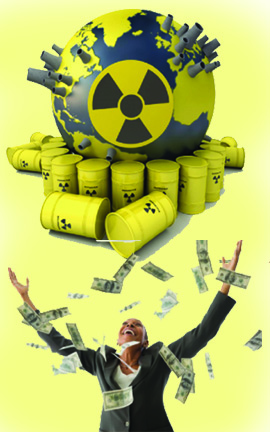
In the summary of its report, the royal commission says that a high level waste dump “could generate more than $100 billion income in excess of expenditure over the 120-year life of the project (or $51 billion discounted at 4 per cent)”. Note that the report says “could”, not “would”.
But, in Appendix J, the report says that “applying a commercial pre-tax discount rate of 10 per cent the net present value of profits to the State would amount to $11.5 billion”. This is a big reduction from the headline number in the summary of $100 billion. Continue reading
Hi-tech renewable energy jobs reviving south-west Victoria’s economy
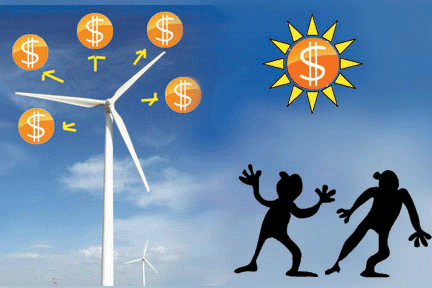 High-tech, clean energy jobs key to future of Geelong, south-west Victoria, ABC News, 5 June 16 By Cameron Best Steve Garner understands how important his wind farm manufacturing business is for the town of Portland in south-west Victoria.
As the state’s traditional manufacturing base continues to decline, jobseekers and the wider economy are looking for the jobs of the future.
Six months ago, Mr Garner’s Keppel Prince Engineering facility lay idle under the Federal Government’s freeze on new wind energy investment and former prime minister Tony Abbott’s desire to reduce the growth rate of what he labelled as “visually awful” wind farms.
Now, under a new Clean Energy Finance Corporation mandate, the production line at Keppel Prince is back up and running with about 300 workers making towers for a project near Ararat.
It has come just in time for Portland, which is facing the possibility of life without its major employer……
“the stronger we can grow something like this [facility], that actually does create a lot of jobs, the better off we’re going to be.
“And if we get government support to do that, we’ve then got a sustainable business for a long period of time.”…
New-wave tech replacing manufacturing of old
High-tech industries are springing up to utilise some of the skilled workers coming out of the automotive industry but in order to remain globally competitive, this new wave of advanced manufacturers cannot afford to be as labour-intensive as the companies of old…….http://www.abc.net.au/news/2016-06-05/high-tech,-clean-energy-jobs-the-key-to-geelong-future/7476816
Things really are crook in the uranium industry
Australia’s uranium industry is also struggling just to stand still. The industry accounts for just 0.2 percent of national export revenue and less than 0.01 percent of all jobs in Australia. Those underwhelming figures are likely to become even less whelming with the end of mining and the winding down of processing at the Ranger mine in the NT.
Uranium on the rocks http://onlineopinion.com.au/view.asp?article=18236&page=0
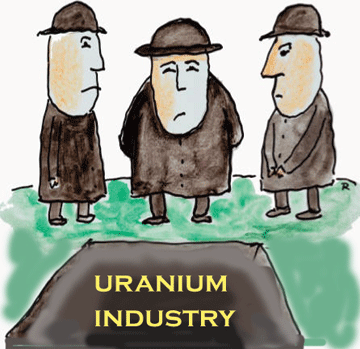
| By Jim Green , 17 May 2016 Indicative of the uranium industry’s worldwide malaise, mining giant Cameco recently announced the suspension of production at Rabbit Lake and reduced production at McArthur River/Key Lake in Canada. Cameco is also curtailing production at its two U.S. uranium mines. About 500 jobs will be lost at Rabbit Lake and 85 at the U.S. mines. A Cameco statement said that “with today’s oversupplied market and uncertainty as to how long these market conditions will persist, we need to focus our resources on our lowest cost assets and maintain a strong balance sheet.”Christopher Ecclestone, mining strategist at Hallgarten & Company, offered this glum assessment of the uranium market: “The long-held theory during the prolonged mining sector slump was that Uranium as an energy metal could potentially break away irrespective of the rest of the metals space. How true they were, but not in the way they intended, for just as the mining space has broken out of its swoon the Uranium price has not only been left behind but has gone into reverse. This is truly dismaying for the trigger for a uranium rebound was supposed to be the Japanese nuclear restart and yet it has had zero effect and indeed maybe has somehow (though the logic escapes us) resulted in a lower price.”
Ecclestone adds that uranium has “made fools and liars of many in recent years, including ourselves” and that “uranium bulls know how Moses felt when he was destined to wander forty years in the desert and never get to see the Promised Land.” He states that uranium exploration “is for the birds” because “the market won’t fund it and investors won’t give credit for whatever you find”. Continue reading |
End of Kakadu uranium era brings old threats, new challenges and new hope
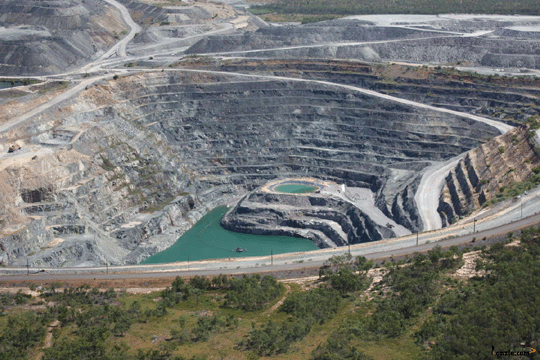 4 May 16 The Australian Conservation Foundation and the Mineral Policy Institute have today welcomed further moves towards the end of the uranium industry in Kakadu and called for confirmation that no underground mining plans will be pursued ahead of Energy Resources of Australia’s (ERA) annual meeting in Darwin today.
Last week ERA confirmed it had finally formalised a A$100 million credit deal with parent company Rio Tinto to provide extra certainty and capacity around rehabilitation of the Ranger mine site. The credit deal, described by ERA as ‘prudent, appropriate and in the best interests of all shareholders,’ is predicated on no further uranium mining at Ranger.
“ERA no longer mines uranium and soon will no longer process uranium at the troubled Ranger site,” said ACF campaigner Dave Sweeney. “This annual meeting is a good time for the company to accept that the uranium production era is over and it is now time for clean-up and repair. ERA should now formally withdraw its Ranger 3 Deep (R3D) application for underground mining at Ranger and instead focus its full efforts on closure, exit and transition”.
All mining and mineral processing at Ranger is required to end by early January 2021 and ERA is obliged to ensure the comprehensive rehabilitation of the mine site and surrounds.
This rehabilitation is required to be of a very high standard – suitable for the former Ranger mine site to be formally included into the surrounding Kakadu World Heritage region. Environment groups will be inside the Darwin meeting and will ask questions of ERA about the future rehabilitation of the site.
“There are massive challenges facing ERA and Rio Tinto at Ranger and they will be long judged by their efforts in the coming years,” said Mineral Policy Institute legacy mines project coordinator Lauren Mellor.
“Ranger has had a troubled and contested history and there is a clear need to now do business differently and better. Many eyes across Australia and around the world are watching ERA and Rio Tinto and this rehabilitation work is a key test of the company’s credibility and responsibility”.
Environment groups will be continuing their efforts to ensure the highest standard rehabilitation and closure work at Ranger and to support the aspirations of the region’s Mirarr Traditional Owners in the transition to a vibrant post mining regional economy.
#NuclearCommissionSAust sets up a pro nuclear Committee for Adelaide overseas junket
Business SA chief Nigel McBride, who will join the tour, told InDaily the delegation would examine “what most people regard as a state-of-the-art piece of engineering [in terms of a] high-level waste repository”. “We don’t want to see people rely on fear and oozing-green Simpsons-cartoon-like imagery”
 SA leaders to tour key nuclear sites, Committee for Adelaide, 25 Apr 15 A high-powered delegation of South Australian business leaders and parliamentarians will jet off to Europe next month to visit key nuclear sites in a bid to facilitate a community debate on the merits of expanding the state’s role in the nuclear fuel cycle.
The trip was organised after consultation with Kevin Scarce’s Royal Commission, which last month handed down tentative findings outlining a multi-billion-dollar economic boon if SA established a high-level nuclear waste dump.
The delegation – to be capped at 10, plus prospective MPs and their staff – was organised by the Committee for Adelaide, an independent think-tank of community leaders, and will likely include representatives from environmental business consultants Golders, property group Knight Frank, engineering consultancy Mott MacDonald and Business SA, among others.

Committee for Adelaide general manager Matt Clemow told InDaily the tour would take in France, Finland, the UK and possibly Sweden, and was designed “to understand the issues and opportunities involved in the nuclear fuel cycle with specific focus on safety, alignment with agriculture and tourism, and associated industry regulations”.
The tour also aims “to create a cohort of SA people who have experienced the operations of the nuclear fuel cycle and will be able to contribute to the public discourse”.
The delegation – whose members will pay their own way – departs in late April, returning the day before Scarce hands down his final recommendations on May 6……
ERA’s uranium mining at Ranger ends: ERA can afford rehabilitation of site
ERA to unveil strategy as Ranger mining ends BARRY FITZGERALD, RESOURCES EDITOR, THE AUSTRALIAN APRIL 12, 2016 MELBOURNE BARRY FITZGERALD HAS COVERED THE RESOURCES INDUSTRY FOR 30 YEARS. THE INAUGURAL WINNER OF THE DIGGERS & DEALERS MEDIA AWARD IN 2003, BARRY IS A COMMITTEE MEMBER OF THE MELBOURNE MINING CLUB, A NON-PROFIT ORGANISATION FORMED TO FOSTER INDUSTRY DEBATE.
Energy Resources of Australia is close to releasing the outcome of its strategic review into its future. The review was forced upon the company after Rio Tinto and Ranger’s traditional owners rejected its plan to extend the life of its uranium mining and processing operations inside Kakadu by developing the Ranger Deeps deposit.
Its pending release comes as ERA continues to narrow the gap between its cash balance and the $509 million needed to complete the rehabilitation of Ranger. At last report, ERA was holding cash of $433m and had no debt after adding $72m to its cash balance during 2015.
While mining operations have stopped, ERA continues to produce from stockpiled material, and has said previously it could possibly continue to do so until late 2020.
The rate of cash accumulation over the past five years suggests ERA could end up with cash surplus to the rehabilitation costs, raising the prospect of an eventual capital return to shareholders, depending on what plans for ERA’s future emerge from the strategic review. Continue reading
Australia cuts aid to Africa, encourages Ugly Australian Mining Companies
Last year, the International Consortium of Investigative Journalists released a report called Fatal Extraction: Australian Mining Companies Digging a Deadly Footprint in Africa. It reported that Australian mining companies were the most rapidly expanding of all mining investors in Africa. From 2000 to 2009, prospecting licences held by Australian companies in Botswana alone increased from 14 to 260.
According to the report, Australian mining companies were responsible for multiple cases of negligence, unfair dismissal, violence and environmental law-breaking across Africa. It claims that since 2004 more than 380 people have died in mining accidents or in offsite skirmishes connected to Australian mining companies in 13 countries in Africa.
In comparison with Australia, African tax regulations are relatively flexible, while wages and working conditions, environmental protection, and occupational health and safety laws are weak.
Last year Foreign Minister Julie Bishop announced that the Australian government would actively promote the interests of the mining sector ahead of economic aid to Africa.
Australian miners in South Africa In the wake of a local activist’s murder, Australian mining interests in Africa are being called into question. https://www.thesaturdaypaper.com.au/news/resources/2016/04/09/australian-miners-south-africa/14601240003106 PHILLIP WALKER 9 Apr 16 Thee assassination of South African community activist Sikhosiphi “Bazooka” Radebe was shocking but sadly not surprising.
On the night of his death – March 22 – Radebe had warned his colleagues in the Amadiba Crisis Committee of a hit list. An hour later, two men masquerading as police arrived at Radebe’s house and shot him eight times in the head.
Radebe had been opposing titanium mining at Xolobeni, on the ancestral land of the Pondo people on South Africa’s east coast. The mining company involved is Australian-based Mineral Commodities Limited.
At Radebe’s funeral last weekend, Chief Cinani, representing the Queen and the Royal House of the amaMpondo, criticised the government’s acceptance of Australian investment and investment from the Indian business family the Guptas. “I am blaming the government because the government gave permits for those Australians, while people were saying ‘no’ to the government . It is clear that the business community is ruling the government. It is not only about the Guptas. Now we have seen the Australians. People are coming here with huge sums of money to divide the people.”
Through its director, Mark Caruso, Mineral Commodities Limited (MRC) and its South African subsidiary, Transworld Energy & Minerals Resources (TEM), have long been in dispute with the Amadiba community. The latest tragedy marks an escalation of hostility in a conflict now entering its 10th year. Continue reading
The Panama Papers: The files reveal the darker side of the BHP Billiton merger
 The Panama Papers: The files reveal the darker side of the BHP Billiton merger
The Mossack Fonseca files raise questions about the 2001 merger between South African miner Billiton Plc and BHP Ltd— beginning with how dependent the British arm of the big miner has become on tax-free profits from its Singapore marketing hub to pay dividends. (subscribers only)
http://www.afr.com/news/policy/tax/the-panama-papers-what-the-files-reveal-about-the-billiton-merger-20160404-gny1fo#ixzz44tblBLDa
Australia’s home solar battery company launches new product
Australian company launches home solar storage battery to take on electronics giant Tesla With the number of depleted home solar batteries being thrown away tipped to rise over the coming years, one Australian company is taking on electronic giants such as Tesla and Panasonic with the launch of an easily recyclable power source.
http://www.abc.net.au/news/2016-03-30/recyclable-solar-storage-battaries-to-take-on-giants-tesla/7284518?section=environment
Australian designed ZCell home battery storage system to be available by midyear
AN Australian-designed battery system partly built in Adelaide will allow householders to use stored solar power during the night. But it will cost you.
http://www.adelaidenow.com.au/business/simon-hackettbacked-redflow-launches-zcell-home-battery-storage-system/news-story/c5cc9be96f517103b02c363adae6a6b5
The country that fuelled Fukushima to sell uranium to the country that gave us Chernobyl

 Australian Conservation Foundation, Dave Sweeney, 30 Mar 16 The Foreign Minister’s plan to sell Australian uranium to Ukraine is a dangerous retreat from responsibility, the Australian Conservation Foundation said today.
Foreign Minister Julie Bishop has announced she will sign an agreement this week with Ukrainian President Petro Poroshenko to supply Australian uranium to Ukraine.
“Australia, the country that directly fuelled Fukushima plans to sell uranium to Ukraine, the country that gave the world Chernobyl – this is hardly a match made in heaven,” said ACF nuclear free campaigner Dave Sweeney. “Thirty years since the Chernobyl nuclear disaster five million people still live in contaminated areas in Belarus, Ukraine and Russia.
“There remain serious containment and waste management issues at Chernobyl and there are very real security concerns about Ukrainian nuclear facilities being targeted in the current conflict with Russia.
“Australia has properly suspended uranium sales to Russia – it makes no sense to start selling uranium to Ukraine now.
“There can be no nuclear business-as-usual in the shadow of Fukushima – a disaster that was fuelled by Australian uranium.
“Following Fukushima the UN Secretary-General called for Australia to have a dedicated risk analysis of the impacts of the uranium sector – this has not happened and needs to.
“This deal and the recent deal with India – which was signed despite a recommendation by the Joint Standing Committee on Treaties (JSCOT) that Australia not supply uranium to India at this time or on these terms – are a dangerous retreat from responsibility.”
France, (and everybody else) touting sales of nuclear submarines to Australia
France pitches nuclear submarine option Sky News, , Thursday, 24 March 2016 “………As part of its sales pitch, DCNS is touting a nuclear growth path.
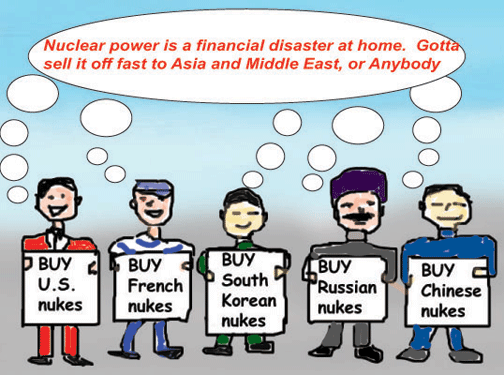
‘If, in 2050, Australia wants a nuclear submarine, they can design a nuclear submarine,’ DCNS chief executive Herve Guillou told AAP this week in Cherbourg. The DCNS bid offers Australia the eventual capability to come up with our own submarine whether nuclear or conventionally powered. Deputy chief executive Marie-Pierre De Bailliencourt says the Shortfin Barracuda was conceived from a vessel designed to nuclear standards, especially safety. That’s all way down the track.
In the meantime DCNS has to convince the Australian competitive evaluation process panel its proposal is better than those of Germany or Japan. German firm TKMS is proposing its 4000-tonne Type 216, a new design based on its widely exported Type 214. The Japanese government is offering its 4200-tonne Soryu-class boat, manufactured by Mitsubishi Heavy Industries and Kawasaki Shipbuilding Corporation.
Of the three designs, only the Soryu actually exists and is in service with Japanese navy. However, it would still need substantial modifications to meet Australian requirements for range and endurance……….
This will be Australia’s biggest-ever defence procurement by a large distance, costing as much as $50 billion for acquisition and perhaps $150 billion through their life. Continue reading
Is there REALLY profit in nuclear waste importing industry?
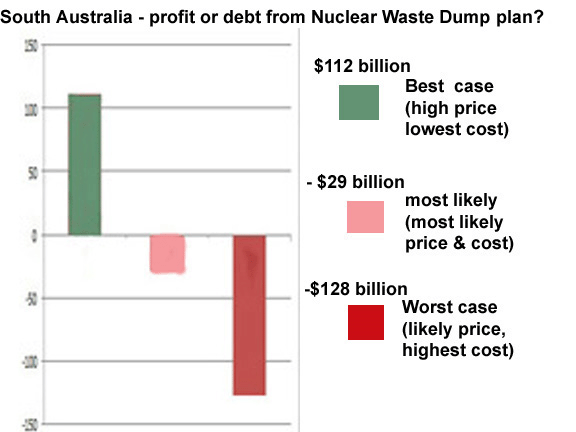
Conservation Council South Australia 18 Mar 16 A high-level nuclear waste dump for SA
Should we do it for the money?
The Nuclear Royal Commission claims some eye-popping revenue figures to take the world’s high-level nuclear waste.
Australia’s uneconomic and declining uranium industry
 Fukushima five years on, and the lessons we failed to learn, Guardian, Dave Sweeney, 11 Mar 16 “…….As home to around 35% of the world’s uranium reserves, Australia has long been a significant player in the global nuclear trade.
Since the 1980s Australian uranium mining has been dominated by two major operations – Ranger in Kakadu and Olympic Dam in northern South Australia. Both operations and their heavyweight owners have been voting with their feet and their finances since 2011. Processing of stockpiled ore continues at Ranger but mining has ended and parent company Rio Tinto is now preparing to commence costly and complex rehabilitation work.
At Olympic Dam the world’s biggest mining company BHP Billiton stunned the South Australian government in 2012 when it shelved an approved and long planned multi-billion dollar mine expansion.
Smaller mines like Honeymoon in South Australia have been placed on extended care and maintenance, junior companies have abandoned the field and the sectors prevailing business model is to get the paperwork in order and wait in hope for better times.
Historically the sector has been constrained by political uncertainty, restrictions on the number of mines, a consistent lack of social license and strong Aboriginal and community resistance.
Recent years have seen fewer political constraints but a dramatic decline in the price of uranium and popularity of nuclear power following Fukushima.
Australia now accounts for approximately 11% of global uranium production, down from over 18% a decade earlier. Australia’s uranium production of 5,000 tonnes in 2014 was the lowest for 16 years.The industry generates less than 0.2% of national export revenue and accounts for less than 0.02% of jobs in Australia. Less than one thousand people are employed in Australia’s uranium industry.
In an attempt to jump start the flat-lining uranium trade, successive federal governments have preferred enthusiasm to evidence. They have failed to conduct the requested industry review and instead fast-tracked increasingly irresponsible uranium sales deals, most recently with India.
Approvals are fast-tracked, regulators are complacent, community concerns are air-brushed away and all for a sector that never really made sense and now doesn’t even make dollars.
In short, Australia’s uranium sector is high risk and low return. It leaves polluted mine sites and home and drives nuclear risk and insecurity abroad. And it fuelled Fukushima – a profound environmental, economic and human disaster that continues to negatively impact lives in Japan and far beyond.http://www.theguardian.com/commentisfree/2016/mar/11/fukushima-five-years-on-and-the-lessons-we-failed-to-learn
Australia’s uranium -nuclear sector – high risk, low return
Failed Uranium Promises Highlights Need For Caution On Radioactive Waste Plans New Matilda, By Dave Sweeney on March 3, 2016 There’s no market, there’s no expertise, and there’s no need for Australia to become the world’s nuclear waste dump.
Having failed to deliver on promises of national wealth from uranium mining – nuclear industry promoters are now talking up the prospect of ‘stupendous’ riches from Australia hosting the world’s high-level radioactive waste.
The South Australian Nuclear Fuel Cycle Royal Commission, headed by former Governor Rear Admiral Kevin Scarce, has unleashed a frontier style enthusiasm that has seen SA’s Adelaide Advertiser newspaper trumpeting the “Scrooge McDuck levels of cash which the state would be swimming in”.
With the promised dollar signs shinier in the eyes of many politicians and commentators than the very real danger signs, it is time for some cool heads when it comes to plans to import hot wastes.
As home to around 35 per cent of the world’s uranium reserves, Australia has long been a significant player in the global nuclear trade and there are some useful lessons from this experience.
Since the 1980’s the ‘modern’ period of Australian uranium mining has been dominated by two major operations – Ranger in Kakadu and Olympic Dam in northern South Australia.
The sector has been constrained by political uncertainty, restrictions on the number of permissible mines, a consistent lack of social license and strong Aboriginal and community resistance.
Recent years have seen fewer political constraints but a dramatic decline in the price of uranium and popularity of nuclear power, following the Australian uranium fuelled Fukushima nuclear crisis – which is fast approaching its five year anniversary, and whose radioactive fallout continues to negatively impact lives in Japan and beyond.
Australia now accounts for approximately 11 per cent of global uranium production, down from over 18 per cent a decade earlier.
Australia’s uranium production of 5,000 tonnes in 2014 was the lowest for 16 years.
The industry generates less than 0.2 per cent of national export revenue and accounts for less than 0.02 per cent of jobs in Australia. Less than one thousand people are employed in Australia’s uranium industry.
In short, the sector is high risk and low return………. https://newmatilda.com/2016/03/03/failed-uranium-promises-highlights-need-for-caution-on-radioactive-waste-plans/
Could renewable power be Port Augusta’s saviour?

THE “dominoes” are lined up for Port Augusta to switch from coal-fired to solar thermal power generation and advocates are urging governments to summon the “political will” to secure the project….(subscribers only)
http://www.adelaidenow.com.au/news/south-australia/solar-thermal-power-push-to-keep-jobs-in-port-augusta/news-story/dd0e42df6d28e5e0bb5959966ac676be
1 This month
15 April – Zoom –Nuclear Power is Not the Solution
Apr 15, 2026 01:00 AM in Canberra, Melbourne, Sydney

Join the International Physicians for the Prevention of Nuclear War (IPPNW) on Tuesday, April 14th for a timely webinar exploring the risks associated with nuclear power and challenging the myth that it offers a simple, safe, carbon-free solution to the climate crisis

of the week – Australians for War Powers Reform (AWPR)
To see nuclear-related stories in greater depth and intensity
 Antinuclear