Rockefeller Brothers Fund warns Australia on diseconomics of investing in coal
Australian Government ‘stuck in the past’ defending fossil fuels, descendant of John D Rockefeller says, ABC News Four Corners By Geoff Thompson 15 June 15 A descendant of America’s first billionaire John D Rockefeller, whose fortune was built on oil, has accused the Australian Government of being “stuck in the past” for continuing to defend fossil fuels like coal.
Valerie Rockefeller Wayne is the chair of the $1.1 billion Rockefeller Brothers Fund, a charity committed to social change. The fund last year joined a growing “divestment” movement by abandoning its investments in coal companies.
“The value of coal stock in the United States has gone down 60 to 90 per cent,” Ms Rockefeller told the ABC’s Four Corners program. “This is a global phenomenon and we want to get out of those because we see the fossil fuel investments as risky.”
Ms Rockefeller said the numbers for coal no longer added up in Australia either.
“If you look just at the financial data in Australia … over the past five years, the SNP500 has gone up by 76 per cent,” she said. “The value of coal stocks has gone down by 71 per cent, so you’ve lost a lot of money if you’ve been in coal.”…………..
“In my mind Australia’s an extremely progressive country that has been an international player on so many issues. “It is baffling to me why the current Australian Government is stuck in the past rather than looking towards the future and becoming part of the solution.”
Ten days ago Norway decided one of the world’s richest government pension funds, the $1.1 trillion Norwegian Sovereign Wealth fund, would divest from companies that derive more than 30 per cent of their income from coal.
Last week the G7 group of industrial nations agreed to give up fossil fuels by the end of the century. http://www.abc.net.au/news/2015-06-15/government-stuck-in-the-past-defending-fossil-fuels-rockefeller/6544200
Uranium glut, Ranger shutdown, leave Rio Tinto with $300M writedown
 Rio Tinto mulls $300M writedown as uranium mine expansion cancelled, Mining.com Cecilia Jamasmie | June 12, 2015 Mining giant Rio Tinto (LON, ASX:RIO) is contemplating to take a writedown of about $300 million after its subsidiary Energy Resources of Australia (ASX:ERA) decided to cancel plans to expand a uranium mine.
ERA, in which Rio has a 68.4% stake, said on Thursday that it would not proceed with the final feasibility study of its Ranger 3 Deeps uranium project in Australia’s Northern Territory, citing weak market conditions.
The decision underscores the ongoing strains in the nuclear industry following the Fukushima meltdown in 2011, which prompted Japan to mothball its 43 operable reactors, causing uranium prices to drop as a result of a worldwide supply glut……..http://www.mining.com/rio-tinto-mulls-300m-writedown-as-uranium-mine-expansion-cancelled/
Energy Resources of Australia(ERA) announces it is not proceeding with Ranger uranium min eexpansion
 Uranium miner Energy Resources Australia pulls plug on 3 Deeps expansion, ABC News 11 June 15 Uranium miner Energy Resources of Australia (ERA) will not proceed with its proposed 3 Deeps expansion project at the present time, the company has announced to the stock exchange.
In a statement, the company said the uranium market has not improved like ERA had previously expected and there is uncertainty as to what prices would do in the future.
The company also said the mine only had the authority to operate until 2021, and the economics of the project required certainty beyond that point. Those conditions meant ERA would not proceed to a final feasibility study at this time, the statement said. ERA will continue to “process stockpiles and meet obligations to its customers”, the statement said.
The 3 Deeps expansion would have seen the Ranger Uranium Mine commence underground operations for the first time. Its current operations are open-cut.
ERA said it had engaged its major shareholder, Rio Tinto, about funding to rehabilitate the mine site, which is completely ensconced by Kakadu National Park.
The company previously said rehabilitation was funded under its current business plan, but if the 3 Deeps expansion did not go ahead it would require another source of funding to pay for all of the rehabilitation works…… http://www.abc.net.au/news/2015-06-11/energy-resources-australia-pulls-plug-on-3-deeps-expansion/6540046
Cut price loans by NAB for solar and energy efficiency program s
 NAB to offer discounted energy efficiency, solar loans, Climate Spectator JOHN CONROY 9 JUN, The National Australia Bank will offer cut-price equipment loans to small and medium-sized businesses investing in energy efficiency and renewable power equipment as part of a $120m funding program backed by the Clean Energy Finance Corporation.
The agreement to fund energy-saving equipment or renewables generation will see NAB offer a rate 70 basis points below its standard equipment finance rate.
Finance will be offered through NAB, and will be across a diverse range of pre-approved assets including cars, irrigation systems, solar PV, building upgrades, lighting upgrades, processing line improvements and refrigeration……..http://www.businessspectator.com.au/news/2015/6/9/policy-politics/nab-offer-discounted-energy-efficiency-solar-loans
Paladin (apparently not Australian owned) signs Western Australian uranium deal
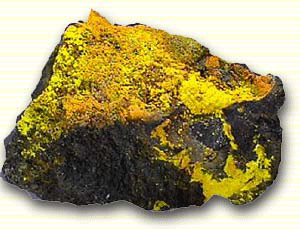 Paladin signs uranium land deal MICHAEL RODDAN BUSINESS SPECTATOR JUNE 01, 2015 Uranium miner Paladin Energy will pay $16 million for land containing a uranium deposit as the group looks to enhance the value of its neighbouring project.
Paladin (PDN) will take over Energia Minerals’ Carley Bore uranium project in north west Western Australia for $15.8 million in cash and shares.
The Carley Bore project in the Carnarvon Basin consists of three connected exploration licenses, located 100km south of Paladin’s Manyingee uranium project, and will increase the miner’s mineral resources in the area by more than 30 per cent……….But the miner has said it will not develop any new projects before it is confident of a sustainable uranium price of at least $US70 a pound. The material has traded between $US34 and $US40 a pound this year.
“The current low uranium price and sustained sector weakness have created an opportunity to consolidate our portfolio in strategically important regions,” Paladin chief executive John Borshoff said.
The takeover is subject to regulatory approval by the Foreign Investment review Board, as Paladin is deemed to be a foreign corporation under Australian law. http://www.theaustralian.com.au/business/mining-energy/paladin-signs-uranium-land-deal/story-e6frg9df-1227377778419
The ANZ Bank’s first green bond issuance a resounding success
Australian investors lap up ANZ green bonds THE AUSTRALIAN JOHN CONROY MAY 28, 2015 The ANZ Bank’s first green bond issuance – and Australia’s largest – has been a “resounding success”, the Clean Energy Finance Corporation said, with the CEFC not needing to provide the $75m it had committed to back the issuance.
The $600m ANZ green bond issuance – which has been certified by the Climate Bonds Initiative – was fully subscribed by private sector investors and will back investment in utility-scale wind and solar as well as green buildings.
About 40% of the green bond funds will go into green building projects in Australian and New Zealand, as well as some parts of Asia, with the remaining 60% to be invested in renewable energy, largely wind and solar, The Fifth Estate reports, with Australian institutional investors making up the majority of subscribers.
The five-year fixed rate bond had a coupon of 3.25% and was rated AA-, the website said. The Fifth Estate also quotes CBI as saying the issuance was actually oversubscribed, at $725m. CEFC CEO Oliver Yates said the “high quality” bonds would expand and diversify the investor base for clean energy.
“Green bonds provide investors with a unique opportunity to invest in renewable energy and energy efficiency through a low-risk, high quality fixed-income product. At the same time, green bonds support long term investment in important low carbon infrastructure projects which can benefit the broader economy,” he said.
He said investors were increasingly seeking additional benefits, such as an environmental or social return……..http://www.theaustralian.com.au/business/latest/australian-investors-lap-up-anz-green-bonds/story-e6frg90f-1227372751422
Funding method to help off-grid renewable energy take off in rural Australia
 CLOSING THE GAP
Renewable energy sources (in particular, solar and wind) have a significant relevance in the off-grid setting of Australia’s remote rural and indigenous communities.
At present these communities are serviced almost exclusively by off-grid diesel and gas. While these traditional fuels haven’t yet become prohibitively expensive, they are subject to price fluctuations and, in the case of diesel, affordable only as a result of government subsidies.
Fuel subsidies are also regularly under threat of repeal; and yet renewable energy has made enormous progress in providing an environmentally-friendly alternative which is competitive in terms of price and efficiency.
Taking diesel and solar powered energy as examples: while the cost of diesel generation has remained stable at around the $220-$300/MWh mark, the cost of solar energy is now about $200-$240/MWh; drastically down from $600/MWh in 2008 and likely to get cheaper with evolving technology and economies of scale.
Combine the comparative cost with the obvious environmental benefits of solar or wind and the case for their adoption looks compelling.
Renewable energy for remote Australia – can our rural and indigenous communities go off-grid?http://www.lexology.com/library/detail.aspx?g=1d65ab6f-6d9c-4499-abd7-de3a45c72191 Corrs Chambers Westgarth Australia May 21 2015
THE PRESENT DILEMMA
The renewable energy industry in Australia has taken more hits in recent years than a punch-drunk boxer. It may be uncharitable to say that Australia’s politicians were the only ones throwing the upper-cuts, but there’s little doubt they’ve played a significant role.
The current state of the renewable energy industry in Australia can be traced back to the repeal of the carbon price mechanism and has been further compounded by the prolonged political impasse surrounding the future of the Renewable Energy Target (RET).[1].
Running parallel to the renewable energy sector’s struggles, is the pressure on governments to reduce spending in the face of an undiminished social imperative to service the energy (and wider infrastructure) needs of remote rural and indigenous communities across the country.
In light of technological advances, off-grid renewable energy should be a key part of the solution to energy security.
In funding such a solution, debt-funded models could be a more practical way for industry to raise the capital it needs than waiting for government funding.
For government, private capital investment has long been an attractive funding solution for infrastructure projects as it allows for the deferral of upfront capital costs.
Equally, financiers benefit from the certainty that comes with government-sourced revenue streams – in this way circumventing the uncertainty that has so severely hamstrung renewable energy investment in recent years.
If a debt-funded model is to be pursued, the real question then becomes: how to structure that funding to make it attractive for all parties concerned? Continue reading
$6 billion cut to investment as result of new renewable energy target will mean
New renewable energy target will mean $6 billion cut to investment: analysts, SMH, May 18, 2015 Lisa Cox National political reporter Six billion dollars in investment in wind and solar power will be lost as a result of a compromise deal on the renewable energy target, energy market analysts say.
Bloomberg New Energy Finance says investment in Australian projects will fall from an expected $20.6 billion by 2020 to $14.7 billion after the Abbott government and Labor reached a deal to reduce the target.
Monday’s agreement, which came after more than 12 months of political gridlock, will slash the original large-scale target of 41,000 gigawatt hours of annual renewable energy production by 2020 to 33,000 gigawatt hours.
Clean Energy Council chief executive Kane Thornton said the expected drop in projects is “what we’ve had to accept in order to resolve this situation”.
“The industry was entirely frozen. There was no new investment if the situation continued,” he said. Continue reading
Uranium market down the gurgler again, and AREVA nuclear giant in trouble
 Uranium’s Glow Still Smothered by Safety Concerns Wall Street Daily, Fri, May 15, 2015 | Shelley Goldberg, Commodity Strategist Just when it looked like it was time to jump back into the uranium market, prices have faltered yet again.
Uranium prices have taken a turn for the worse due to a combination of factors that pulled the floor from underneath the commodity.
Back in November 2014, prices spiked from $28 per pound to $44 per pound. This was largely due to the sanctions imposed on Russia after the annexation of Crimea, thus portending a supply shortage.
But the price is currently close to $35 per pound. And technical indicators are pointing south once again……..
France was so confident in its atomic energy capabilities that, about 10 years ago, the French nuclear establishment made a bet on a new generation of reactors using European pressurize reactor (EPR) technology. These reactors were touted as the safest and most powerful ever made.
 But, France isn’t living up to its promises. New plants that would ostensibly showcase the most cutting edge of nuclear energy prowess are years behind schedule and billions of euros over budget. Some are as much as three times more expensive than the original cost projections! At this point, many are questioning if they’ll ever be completed.
Plus, The New York Times reported on April 7 that one reactor, the Autorite de Surete Nucleaire, had discovered imperfections in the steel used by Areva (AREVA.PA) to make the caps of the main reactor vessel.
The caps contain the extreme heat, pressure, and radiation produced by nuclear fission. These same parts were used for a plant under construction in Taishan, China, which is being built in partnership with France……http://www.wallstreetdaily.com/2015/05/15/uranium-commodity-concerns/
World Bank warns Malawi not to re-open Paladin Australia’s uneconomic uranium mine
 Malawi warned against reopening uranium mine http://www.ventures-africa.com/archives/62631 May 12, 2015 – The World Bank has warned Malawi against reopening its only uranium mine, saying the project should be put on hold until global prices improve.
Australia mining company, Paladin Energy, is developing Malawi’s only uranium mine, the Kayelekera uranium mine, in Karonga, northern Malawi. The project was initial suspended in 2014 because of the then unfavourable price climate, but there are indications that the company plans to resume operations in the coming months. “Whether or not the mine at Kayelekera eventually resumes operations will depend primarily on future prospects for global uranium prices, for which the immediate outlook is uncertain,” the World Bank told Malawi in its latest report.Uranium from mining is used almost entirely as fuel for nuclear power plants.
In 2013, Malawi was ranked as the third largest producer of uranium in Africa and tenth in the world. It is behind Namibia and Niger in Africa.
Last year, uranium global prices crashed to $36, from $51 per pound. This posed a major setback to Paladin Energy Africa, having invested heavily on the premise that prices will climb to $70. The Kayelekera uranium deposit was discovered by UK’s CEGB firm and a feasibility study was subsequently undertaken in the 1980s. Paladin acquired the deposit in 1997, accepted a Bankable Feasibility Study early in 2007, and, following environmental approval, undertook a $220 million development. The mine was opened in April 2009.
Paladin Energy (Africa) Ltd holds Paladin’s 85 percent interest following the Development Agreement with the Government of Malawi in control of the remaining 15 percent. Kayelekera production commenced in mid-2009, and in 2012 production reached 1103 tU, followed by 1134 tU in 2013.
Next Australian stock exchange winner could be renewable energy
 Could Renewable Energy be the Next Big ASX Winner? Money Morning 5 May 15 On Wednesday, Infratech Industries announced their intention to list on the ASX. It’s a bold move for the fledgling renewables company, which was established in April 2012.
The company is behind the $17.5 million floating solar panels project currently being expanded in South Australia. They say their tracking and cooling technology produces 57% more power than land-based solar panels. It’s a big deal for the entire solar industry.
Chief executive Raj Nellore says that soon, more capital will be required to keep up with demand. Of listing on the ASX, he said ‘once we get to a certain size, [it] makes sense’.
Infratech has partnered up with the Centre for NanoScale Science and Technology at Flinders University (CNST) for research. CNST has backing from the South Australian state government. So their funding — and the partnership with Infratech — is subject to budget changes.
There are other forces that might pressure Infratech to go public sooner rather than later. For example, they may need to raise money to expand their US operations too. Their US entity was opened in June 2014. They signed their first US customer — the City of Holtville, California — in November. That’s pretty much all they’ve done there.
Whenever they do float, they won’t be alone. A small group of renewable energy companies are already listed on the ASX.
Which renewable energy companies are currently on the ASX?
Wave power Carnegie Wave Energy [ASX:CWE] ………
Solar Dyesol [ASX:DYE] ……Enviromission [ASX:EVM]……..
Geothermal The Raya Group [ASX:RYG]……http://www.moneymorning.com.au/20150505/could-renewable-energy-be-the-next-big-asx-winner-cw.html
Slump in uranium production by Australian company Paladin
 Paladin uranium output slumps THE AUSTRALIAN, 24 Apr 15 Paladin said today production at the group’s Langer Heinrich mine during the March quarter had slumped 10 per cent from the December quarter to 1.23 million pounds of uranium oxide.
Rio Tinto and ERA passing the buck to each other on who pays for Ranger uranium clean-up
As Ranger approaches its end of mine life the stark question of which company bears responsibility for the costly, complex and technically challenging rehabilitation effort is increasingly being asked. ERA says it doesn’t have the funding capacity and Rio Tinto claim it hasn’t the legal responsibility.
Rio Tinto and ERA are playing a game of corporate convenience and the stakes are very high as the miners are required by law to bring the former mineral lease to a standard whereby it can be incorporated into the surrounding Kakadu National Park.
 Rio Tinto and Energy Resources of Australia: Uranium Uncertainty and Radioactive Responsibility, Environment Centre NT 22 Apr 15 “The fate of Energy Resources Australia hangs in precarious balance with majority-owner Rio Tinto growing increasingly uncertain about the competitive economics and investment risk of a life-sustaining underground expansion” Financial Review, April 2015
Rio Tinto owns 68 per cent and is the parent company of Energy Resources of Australia, an Australian-listed uranium miner who’s only operating asset is the troubled Ranger mine in Kakadu – a 30-year-old mine with a long history of accidents, spills and security breaches.
Mining at Ranger’s open pit ceased over two years ago and production is currently sustained by processing stockpiles. All mining and mineral processing at the site must end in January 2021, to be followed by a mandated five year rehabilitation period.
But as the window on mining at Ranger closes there is growing concern that Rio Tinto may seek to avoid its near $700 million rehabilitation responsibilities and leave a lasting radioactive hole in the heart of Kakadu National Park.
RIO HOLDING THE REINS AT RANGER Continue reading
South Australia faces job losses if Renewable Energy Target is cut
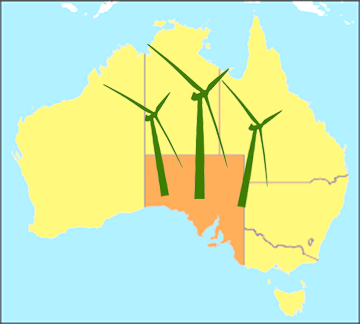
 Renewable Energy Target: Conservation Foundation warns cut would threaten potential SA jobs http://www.abc.net.au/news/2015-04-20/acf-warns-against-renewable-energy-target-cut/6405544 The Australian Conservation Foundation (ACF) says South Australia could lose up to $6 billion worth of investment, if the Renewable Energy Target (RET) is reduced.
The Federal Government wants to cut the target from 41,000 gigawatt hours to less than 32,000 gigawatt hours by 2020.
The foundation’s energy analyst, Tristan Knowles, said leaving the target as is would have huge benefits for South Australia.
“The bigger picture here if the RET isn’t weakened is that there’s 10 wind projects across South Australia that have been approved and the investment potential for those is about $6 billion and if they went ahead there’d be over 6,000 construction jobs and 31 ongoing jobs,” he said.
“So there’s a lot of potential.”
“South Australia was the only state that saw a drop between 2009 and 2014, so if these projects go ahead, they will generate jobs in construction and in ongoing maintenance and operations.”
S.A. Nuclear Royal Commission to Mt Gambier: note the issues that will NOT be on the agenda
They don’t mention the health and environmental aspects of the nuclear fuel chain. They don’t mention the national laws that will have to be overturned. They don’t mention the existing problems from Australia’s history of uranium mining.
And then there’s the continuing nuclear radiation crisis at Fukushima – you can bet that will not be on the agenda. Nor will they be talking about the global nuclear decline in the nuclear industry, and the fact that the new geewhiz nuclear reprocessing reactors (a) don’t exist yet and (b) nobody wants to invest in them
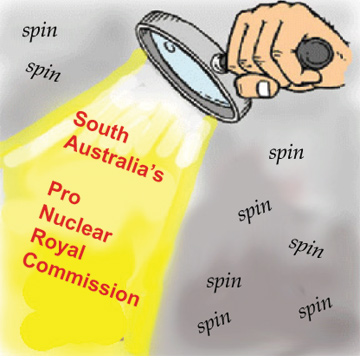 17 APRIL 2015 – NUCLEAR FUEL CYCLE ROYAL COMMISSION VISITS MOUNT GAMBIER The first public forum of the Nuclear Fuel Cycle Royal Commission will be held in Mount Gambier on Monday 20 April – the formal start of a three month state-wide community engagement program.
The public meeting to be held at City Hall at midday is an opportunity for community, industry and other interested stakeholders to hear more about the Royal Commission and how they might take part in the process. It will also be the first time the Commission’s Issues Papers will be presented to the public for comment.
While in Mount Gambier, Royal Commissioner Rear Admiral the Honourable Kevin Scarce AC CSC RANR (Rtd) will also meet with city representatives and community leaders.
Key areas of discussion will include those activities relating to the potential for the expansion of exploration and extraction of minerals; the undertaking of further processing of minerals and manufacture of materials containing radioactive substances; the use of nuclear fuels for electricity generation; and the storage and disposal of radioactive and nuclear waste……http://nuclearrc.sa.gov.au/media-centre/17-april-2015-nuclear-fuel-cycle-royal-commission-visits-mount-gambier/
1 This month
7 April – WEBINAR – Australia and the Doomsday Clock – Preventing nuclear war through NoFirstUse and other policies
Online | Tuesday April 7, 4:00-5:30pm, Australian Eastern Time / 8:00-9:30am Central Europe Time
– Access the registration link
15 April – Zoom –Nuclear Power is Not the Solution
Apr 15, 2026 01:00 AM in Canberra, Melbourne, Sydney

Join the International Physicians for the Prevention of Nuclear War (IPPNW) on Tuesday, April 14th for a timely webinar exploring the risks associated with nuclear power and challenging the myth that it offers a simple, safe, carbon-free solution to the climate crisis

21 April Webinar: No Nuclear Weapons in Australia
Start: 2026-04-21 18:00:00 UTC Canberra, Melbourne, Sydney (GMT+10:00)
End: 2026-04-21 19:30:00 UTC Canberra, Melbourne, Sydney (GMT+10:00)
Event Type: Virtual
A virtual link will be communicated before the event.
Host Contact Info: australia@icanw.org

of the week – Australians for War Powers Reform (AWPR)
To see nuclear-related stories in greater depth and intensity
 Antinuclear