Australian Capital Territory a winner for renewable energy jobs
ACT renewable energy jobs soar in past five years April 14, 2015 Henry Belot Canberra Times Reporter The number of jobs in the ACT renewable energy industry has increased by more than 400 percent over the past five years, the largest increase in Australia.
According to Australian Bureau of Statistics data released earlier this week, 630 people were employed by the renewable energy industry last year with 480 employed by the government or non-profit institutions and 150 in solar power.

But while the ABS figures indicated a growth in ACT employment they revealed more than 2000 jobs had been lost in the industry nationwide over the past two years.
Some 12,590 people were employed full-time in the wind, solar and other renewable energy industries last year down from almost 15,000 two years earlier…….
In late 2013, the ACT government legislated a 90 percent renewable energy target for the territory by 2020 drawing praise from the Climate Council as a welcome contrast to federal uncertainty. …………
Mr Antflick Elementus Energy manager director Ashleigh Antflick,said he expected the solar farm, which will be relocated from a proposed site near the Uriarra village to beside the Monaro Highway at Williamsdale, to be a long-term stable employer of skilled labour in the ACT.
“We are looking at working with a number of tertiary education institutions in the territory to be part of their skills programs for undergraduate and technical training programs,” he said.
Mr Antflick said the ACT government and broader community were supportive or major solar power investments despite a concerted public relations campaign from Uriarra villagers to relocate the solar farm.
“There is a pretty clear understanding by territorians of the broader climatic benefits of solar energy and I think broad support for doing something to make a positive contribution to climate change,” he said. http://www.canberratimes.com.au/act-news/act-renewable-energy-jobs-soar-in-past-five-years-20150414-1mku8a.html
Big investment banks walk away from Queensland’s Galilee Basin coal projects
 Big Banks Closing The Vault On Big Coal, Adding To Adani’s Woes, New Matilda, By Thom Mitchell 11 Apr 15 Plans to build one of the world’s largest coal mines in Queensland have hit yet another roadblock, with international investment banks refusing to back the project. Thom Mitchell reports.
Big investment banks continue to walk away from the massive new coal field proposed for the Galilee Basin in Queensland, with three French Banks – Société Générale, Crédit Agricole and BNP Paribas – yesterday joining nine others in not banking on the project’s success.
It is “due to the number and magnitude of issues linked to the planned coal development projects in the Galilee Basin,” that Credit Agricole SA, one of the three French banks, advised company Market Forces it “does not intend to finance these projects or their associated facilities”. Continue reading
Australia’s energy and mining companies in $60 billion tax avoidance?
 Energy company’s $11 billion transfer to Singapore rings tax avoidance alarm bells, The Age, April 4, 2015 – Heath Aston Political reporter An energy company operating in Australia transferred more than $11 billion to the low-tax jurisdiction of Singapore in a single year, heightening concerns that Australia is being duped by tax-minimising multinationals.
The extraordinary scale of funds being moved out of the country by individual companies is revealed in an internal Australian Tax Office memo, obtained under Freedom of Information.
It lists 10 companies that channelled a combined $31.4 billion from Australia to Singapore in the 2011-2012 financial year.
An estimated $60 billion in so-called “related parties” transactions went from Australia to tax havens in the same year.
The Tax Office is particularly concerned about mining and energy companies extracting Australian minerals which have established “marketing hubs” in Singapore that appear to have little use other than as a destination for shifted profits. Continue reading
Doubts about the future of ERA’s Ranger uranium mine
Any attempt to extend the lease will be controversial.
As colleague Peter Ker reported in February, the traditional owners seem pretty wedded to the idea that mining stops in 2021 and rehab is completed by 2026.
 Ranger’s community issues stretch well beyond its sometimes fractured relationships with its local hosts, the Mirarr people. An extension will become an issue of serious contest across a sweep of the environmental movement both because of what it mines (uranium) and where it is (inside the Kakadu National Park).
Rio Tinto worried about ERA’s Ranger uranium mine http://www.afr.com/business/mining/uranium/rio-tinto-worried-about-eras-ranger-uranium-mine-20150402-1mctl1 by Matthew Stevens
The fate of Energy Resources Australia hangs in precarious balance with majority-owner Rio Tinto growing increasingly uncertain about the competitive economics and investment risk of a life-sustaining underground expansion at Australia’s most productive uranium project, the Ranger mine.
Rio owns 68 per cent of ERA and the Australian-listed uranium miner’s only operating asset is Ranger, a 30-year-old mine of occasionally extreme controversy.
Mining at Ranger’s open pit stopped more than two years ago and production is currently sustained by legacy stockpiles.
The longer future of ERA swings on an underground project called Ranger 3 Deeps, which has been the subject of $200 million in pre-feasibility investment over the past two years alone and requires up to $60 million more before a final investment decision might be secured. Continue reading
Poor uranium market, and Labor policy – French nuclear giant AREVA not to explore in Queensland
 French abandon Far North uranium prospects DANIEL BATEMAN THE CAIRNS POST MARCH 18, 2015 ONE of the world’s largest uranium producers is pulling out of the Far North following the State Government’s renewed ban on uranium mining.
Areva Resources Australia has confirmed it is in the process of relinquishing its 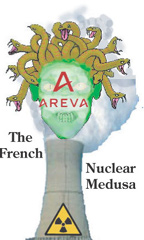 exploration projects in Queensland on “technical” grounds.
Minister for State Development, Natural Resources and Mines Anthony Lynham has said a statewide prohibition will once again be put in place over uranium mining, forcing several companies to shelve development plans.
Areva had been exploring in the Karumba and Carpentaria basins since about 2012.
Areva Resources Australia managing director Joe Potter said the company would not be applying for new exploration tenements in Queensland in the near future, in light of the recent state policy changes and general downturn in the uranium market…….
Australian Conservation Foundation Northern Australia program officer Andrew Picone welcomed the return of a ban and the departure of Areva.
“The fact that Areva have pulled up stumps in Queensland’s Gulf only illustrates the market’s global contraction,’’ he said. http://www.cairnspost.com.au/business/french-abandon-far-north-uranium-prospects/story-fnjpusdv-1227266987603
Companies not keen to take up New South Wales uranium exploration licenses
Slow uptake of NSW uranium exploration licenses http://www.abc.net.au/news/2015-03-18/slow-uptake-of-nsw-uranium-exploration-licenses/6328100 By Jacqueline Breen, 18 Mar 15, Only one of the six companies invited by the State Government to apply for a uranium exploration license has done so. The ban on mining uranium in New South Wales remains in place, but the Coalition has lifted the ban on exploration.
Last year the government invited six companies to apply for licenses to explore for deposits around Broken Hill, Cobar and Dubbo.
Only EJ Resources has submitted an application, seeking three licenses to explore north of Broken Hill.
The other companies–Australian Zirconia, Callabonna Resources, Hartz Rare Earths, Iluka Resources and Marmota Energy–did not apply before the government’s March deadline passed. When the government announced the shortlist last year Resources Minister Anthony Roberts said the state needed a “stock-take” of its uranium resources.
“This will allow us to understand fully what the uranium reserves are in New South Wales,” he said.
If EJ Resources’ license application is successful, the state government’s Division of Energy and Resources said only low impact monitoring that doesn’t disturb land can be carried out, unless further approval is sought.
The division said a land access agreement with landholders must be in place before any exploration begins.
Nigel McBride sees $billions in welcoming in the world’s radioactive trash
 Nuclear Royal Commission urged to fast-track storage talks DANIEL WILLS STATE POLITICAL EDITOR THE ADVERTISER MARCH 03
BUSINESS has urged South Australia’s nuclear Royal Commission to fast-track consideration of hosting the nation’s first major waste dump, amid fears the state could miss out on a lucrative opportunity to take a foothold in a future storage industry.
The Federal Government has announced a new tender process for a national radioactive waste management facility and is seeking site nominations until May 5. However, South Australia’s Royal Commission is not expected to conclude until late this year or early 2016.
Australia has 4248 cubic metres of low level and 656 cubic metres of intermediate level waste in temporary storage, which the Federal Government is seeking to consolidate.
Most has been produced as the by-product of medical, research and industrial processes.
BusinessSA chief executive Nigel McBride said waste storage was a multibillion-dollar opportunity for the state and could become a major new revenue stream for government.
“The thing that really stands out as an opportunity is spent nuclear fuel storage,” he said.
“Maybe we need to fast track that. Maybe that’s the part of the Commission that needs to come out first. “We can’t just wait until the Commission is over. They’re calling for it now…….
Australian Conservation Foundation nuclear free campaigner Dave Sweeney called for the tender to be delayed amid fears a rushed process could harm communities and the environment.
“There are no compelling social or technical reasons to rush a decision on an issue that demands the highest quality decision making,” he said. “We have time to get this issue right.” http://www.adelaidenow.com.au/news/south-australia/nuclear-royal-commission-urged-to-fast-track-storage-talks/story-fni6uo1m-1227246749276
Port Adelaide doesn’t want a nuclear reactor – “Put it in Port Augusta”
Port Adelaide community leaders say they don’t want a nuclear power plant in the heart of the Port KURTIS EICHLER PORTSIDE MESSENGER FEBRUARY 18, 2015
THE Port Adelaide Mayor and a local MP say they do not want a nuclear reactor built in their patch.Port Adelaide Enfield Mayor Gary Johanson and State Labor Port Adelaide MP Susan Close say any such plan for the heart of the Port would not be viable.
Mr Johanson said because the district was only 14km from the city it should not be an option for generating nuclear energy.He said Port Augusta, 322km north of Adelaide, was a better and more “convenient” option for the state.
While Mr Johanson would not be drawn on the viability of storing the state’s nuclear waste on the Le Fevre Peninsula, he said a power plant would not work even if it did create jobs………
“There are benefits in job creation in other areas such as freight but I don’t think it is feasible to have a nuclear power plant in the Port,” Mr Johanson said.
“I can’t see you would want to build it anywhere in metropolitan Adelaide.” Mr Johanson said most Port Adelaide residents would not want to live near a nuclear reactor……..
Dr Close agreed the Port was ill-suited for nuclear power. “The idea of a nuclear plant in the Port is a ridiculous and inflammatory suggestion and I don’t support it,” she said.Local real estate agent Rob McLachlan said a nuclear power plant in the heart of the Port would not attract people to live in the area.
Port Augusta mayor Sam Johnson did not return calls before the Portside Messenger’s deadline. http://www.adelaidenow.com.au/messenger/west-beaches/port-adelaide-community-leaders-say-they-dont-want-a-nuclear-power-plant-in-the-heart-of-the-port/story-fni9llx9-1227223707411
ERA uranium miner posted profit losses for past 4 years
The ERA full year report for 2014 shows sales revenue up from $356.1 million in 2013 to $379.2 million, however nets profits have dropped from -$135.8 million to -$187.8 million.
Production has copped a beating as the Ranger begins to reach the end of its mine life, down to 1165 drummed tonnes in 2014, compared to 2960 in 2013 and 3710 in 2012.
The Ranger mine will continue mining until 2021, with full rehabilitation required by 2026, and has spent $378 million on rehab and water management over the past 2 years……http://www.miningaustralia.com.au/news/uranium-miner-era-posts-new-profit-losses
Australia loses jobs as the Abbott government attacks renewable energy
 By leaving the current target in place and providing an assurance that they support renewable investment the government could make a tangible and significant step to help restart an industry that will stimulate employment.
Renewable energy is popular, and job growth is essential. Committing to the existing Renewable Energy Target would be a good first step for policy makers on all sides to show they are serious about creating Australia jobs rather than fighting ideological battles.
This is occurring while renewable energy companies such as TrustPower, Infigen Energy and Pacific Hydro are suspending further investments in Australia because of the uncertainty around the RET. Continue reading
Australia’s uranium industry in a sick and sorry state
 Australia’s uranium industry is in a sick and sorry state. Production of 5000 tonnes in 2014 was the lowest for 16 years. The industry generates less than 0.2 per cent of national export revenue and accounts for less than 0.02 per cent of jobs in Australia (about 1200 jobs).
The Ranger open-cut mine in the NT has been mined out and the planned Ranger 3 Deeps underground mine is subject to doubt and delay. Energy Resources of Australia has posted losses for each of the past five years, totalling $500 million. The uranium industry in the NT may come to an end when the last of the Ranger ore stockpile is milled in two years time.
In South Australia, the planned expansion of the Olympic Dam copper-uranium mine was cancelled in 2012, and hundreds of workers have been retrenched by BHP Billiton since then. The Honeymoon mine has been put into care-and-maintenance. Beverley Four Mile started production last year, at the same time as the nearby Beverley mine was put into care-and-maintenance. Instead of the usual fanfare, The Advertiser reported: “South Australia’s newest mine will lose money and won’t create any jobs.”
Nuclear non-starter: Oversupplied, losing money and without a constituency, Climate Spectator, JIM GREEN 16 Feb 15 As discussed in Climate Spectator recently, some nuclear insiders and lobbyists are starting to confront the reality that the global pattern of nuclear power stagnation is likely to continue. With the number of ‘operable’ power reactors declining from 443 to 437 over the past decade, the rhetoric about a nuclear renaissance is becoming hard to sustain.
Similar opinions about the uranium industry are becoming increasingly common. Continue reading
Uranium miner Energy Resources of Australia tight-lipped about its Ranger mine’s gloomy financial situation
 ERA keeps its Ranger delay very hush-hush BY CRAIG DUNLOP NT NEWS FEBRUARY 11, 2015 ENERGY Resources Australia has quietly delayed the expansion of the Ranger uranium mine, with work now set to commence at an unspecified date in 2016, rather than its original target date of late 2015.
The company, 68 per cent owned by mining giant Rio Tinto, made the announcement to the Australian Stock Exchange late on Friday.
“Dependent on the outcome of further work, and subject to board and regulatory approvals, first development ore for Ranger 3 Deeps is now expected to be in 2016,” the report said.
It also said that ERA was likely to require further investment for the expansion to go ahead.
The knock-on effects from the failure of a leach tank in 2013 continued to be felt until mid-2014, as the company was forced to purchase, and then onsell, uranium in order to meet its prearranged sales contracts.
The delay has pleased environmental groups, who have long objected to Ranger 3, with the Environment Centre NT and the Australian Conservation Foundation labelling the expansion plans “unviable”.
The Environment Centre NT’s Lauren Mellor said: “The delay on investment in the Ranger 3 Deeps project is a major setback for both Rio and ERA, with costs continuing to blow out and time running out for this short-term, high-risk venture.”………
- In light of the losses and the investment required in Ranger 3, the company’s directors have not issued a dividend.
Rio’s investment delay adds difficulty to Ranger 3 Deeps uranium mine proposal
13 Feb 15 National and Territory Environment Groups have today welcomed the announcement that investment in Ranger 3 Deeps, a controversial new underground uranium mine proposal has been significantly delayed by Rio Tinto, majority owner of the embattled Ranger uranium mine within the boundaries of Kakadu National Park.
The decision came off the back of further record losses for Rio subsidiary and Ranger mine operator Energy Resources of Australia of $188 million in 2014 and $136 million in 2013. ERA have now suffered five consecutive yearly losses totalling $500 million.
“Ranger’s underground mine has become a money pit for Rio Tinto, with the company investing hundreds of millions in feasibility studies and an underground decline tunnel in recent years, and has faced unprecedented community opposition receiving over 4500 public submissions opposing the mine during the Environment Impact Assessment public comment phase in December last year,” Lauren Mellor, Nuclear-free Campaigner with the Environment Centre NT said.
“The delay on investment in the Ranger 3 Deeps project is a major setback for both Rio and ERA, with costs continuing to blow out and time running out for this short-term, high risk venture. Years of sustained uranium company and sector losses have shown even the industry’s biggest players are getting cold feet for new mines, with no commodity price recovery predicted within ten years – well past the legal operating timeframe for Ranger 3 Deeps.”
“This decision by the Rio board is a long overdue recognition that the project, like the wider uranium industry, is unviable. It has a very limited lease life, with all mining on the Ranger lease mandated to end in 2021, at a time when the commodity price has never been lower, making old mines like Ranger struggle, and new projects like Ranger 3 Deeps buckle.” said Dave Sweeney of the Australian Conservation Foundation.
“Day by day, every delay and every lost dollar makes this project less viable and less likely. “The nuclear industry simply can’t compete, on cost, construction times and on community standards for environmental protection. Like Ranger mine its well past its use by date and the NT and Federal governments should be using this company delay to instead accelerate a rehabilitation plan for Kakadu that will see the region and its inhabitants protected for the long haul.”
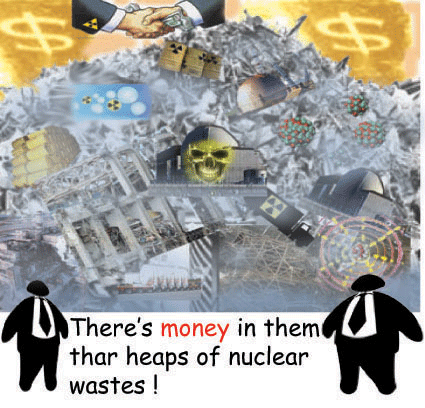
The greedy people who want to make money out of importing radioactive trash
 These are some of the people behind the push that got South Australia’s Premier Jay Weatherill to change his tune and open the door to the toxic nuclear chain in Australia. Note that I write “chain” – not “cycle”
Directors at SA Nuclear Energy Systems Pty Ltd – the list includes former Labor federal MP Bob Catley, Ian Kowalick, a former head of the Department of Premier and Cabinet during John Olsen’s Liberal Government and later an information technology consultant to the Rann Labor Government, and climate scientists Professor Stephen Lincoln and Professor Tom Wigley
The nuke lobby would have us believe in a cycle, whereby suddenly, by magic – radioactive trash is no long trash. It becomes a “valuable resource” – recycled into gee-whiz new (exiting only in blueprint) innocuous little nuclear reactors.
Apart from all the disecoomics, and health and environment aspects – the promised new reactors themselves create highly toxic radioactive wastes, and eventually themselves become highly toxic radioactive corpses.
South Australian Business and Premier want to import radioactive waste
Business groups embrace nuclear industry debate in South Australia ABC News 9 Feb 2015,The prospect of a nuclear industry in South Australia has been embraced by the state’s peak business group as a multi-million-dollar industry. Business SA chief executive Nigel McBride said it would be good for the state and could result in reduced carbon emissions.
“We’re talking about a massive, potential nuclear recycling industry,” he said.
“We’re talking about low energy costs and a huge rise in job opportunities through cheaper manufacturing, cheaper water.” SA Chamber of Mines and Energy chief executive Jason Kuchel said it was “about time” options for the future were discussed.
“One of those things that we would be hopeful for is that we might able to consider enriching uranium in South Australia,” he said.
Mr Weatherill …. indicated that he did not think the establishment of a SA nuclear power plant was on the horizon but said a nuclear waste dump and the creation of a nuclear enrichment industry should be considered……
But the Conservation Council’s chief executive Craig Wilkins described any use of nuclear energy in SA as “unwanted” and “unsafe”.
“It’s old thinking, rather than new thinking and it’s so frustrating to spend time, energy and resources investigating this when we are on the cusp of an energy revolution in renewable,” he said….http://www.abc.net.au/news/2015-02-09/business-lobby-embraces-nuclear-debate/6079348
1 This month
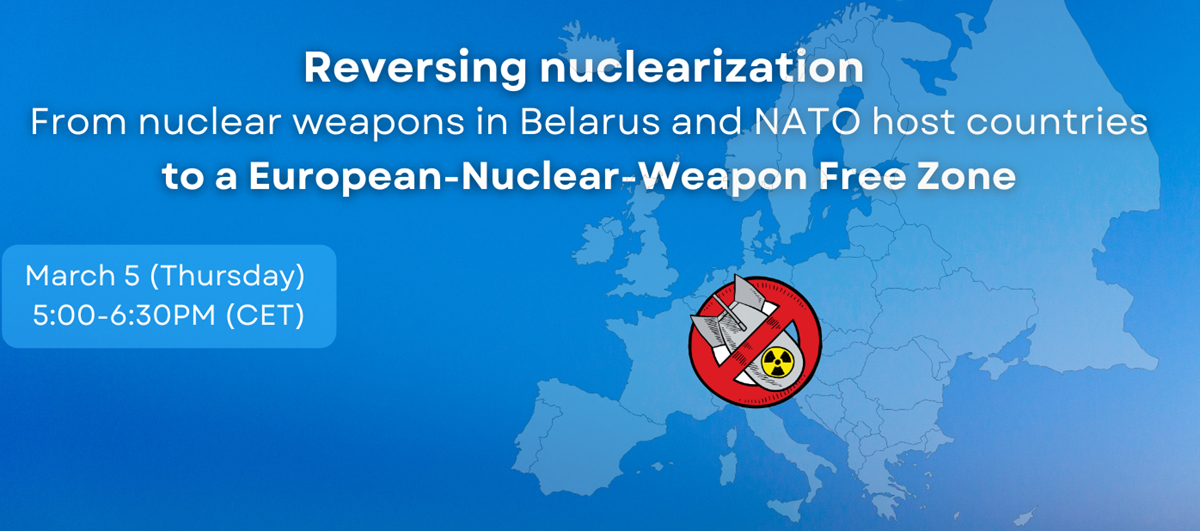
6 March -Online – Reversing nuclearization:
From nuclear weapons in Belarus and NATO host countries to a European-Nuclear-Weapon Free Zone
Mar 6, 2026 03:00 AM in Canberra, Melbourne, Sydney

of the week – Australians for War Powers Reform (AWPR)
To see nuclear-related stories in greater depth and intensity
 Antinuclear