Uranium miner Energy Resources of Australia tight-lipped about its Ranger mine’s gloomy financial situation
 ERA keeps its Ranger delay very hush-hush BY CRAIG DUNLOP NT NEWS FEBRUARY 11, 2015 ENERGY Resources Australia has quietly delayed the expansion of the Ranger uranium mine, with work now set to commence at an unspecified date in 2016, rather than its original target date of late 2015.
The company, 68 per cent owned by mining giant Rio Tinto, made the announcement to the Australian Stock Exchange late on Friday.
“Dependent on the outcome of further work, and subject to board and regulatory approvals, first development ore for Ranger 3 Deeps is now expected to be in 2016,” the report said.
It also said that ERA was likely to require further investment for the expansion to go ahead.
The knock-on effects from the failure of a leach tank in 2013 continued to be felt until mid-2014, as the company was forced to purchase, and then onsell, uranium in order to meet its prearranged sales contracts.
The delay has pleased environmental groups, who have long objected to Ranger 3, with the Environment Centre NT and the Australian Conservation Foundation labelling the expansion plans “unviable”.
The Environment Centre NT’s Lauren Mellor said: “The delay on investment in the Ranger 3 Deeps project is a major setback for both Rio and ERA, with costs continuing to blow out and time running out for this short-term, high-risk venture.”………
- In light of the losses and the investment required in Ranger 3, the company’s directors have not issued a dividend.
Rio’s investment delay adds difficulty to Ranger 3 Deeps uranium mine proposal
 13 Feb 15 National and Territory Environment Groups have today welcomed the announcement that investment in Ranger 3 Deeps, a controversial new underground uranium mine proposal has been significantly delayed by Rio Tinto, majority owner of the embattled Ranger uranium mine within the boundaries of Kakadu National Park.
The decision came off the back of further record losses for Rio subsidiary and Ranger mine operator Energy Resources of Australia of $188 million in 2014 and $136 million in 2013. ERA have now suffered five consecutive yearly losses totalling $500 million.
“Ranger’s underground mine has become a money pit for Rio Tinto, with the company investing hundreds of millions in feasibility studies and an underground decline tunnel in recent years, and has faced unprecedented community opposition receiving over 4500 public submissions opposing the mine during the Environment Impact Assessment public comment phase in December last year,” Lauren Mellor, Nuclear-free Campaigner with the Environment Centre NT said.
“The delay on investment in the Ranger 3 Deeps project is a major setback for both Rio and ERA, with costs continuing to blow out and time running out for this short-term, high risk venture. Years of sustained uranium company and sector losses have shown even the industry’s biggest players are getting cold feet for new mines, with no commodity price recovery predicted within ten years – well past the legal operating timeframe for Ranger 3 Deeps.”
“This decision by the Rio board is a long overdue recognition that the project, like the wider uranium industry, is unviable. It has a very limited lease life, with all mining on the Ranger lease mandated to end in 2021, at a time when the commodity price has never been lower, making old mines like Ranger struggle, and new projects like Ranger 3 Deeps buckle.” said Dave Sweeney of the Australian Conservation Foundation.
“Day by day, every delay and every lost dollar makes this project less viable and less likely. “The nuclear industry simply can’t compete, on cost, construction times and on community standards for environmental protection. Like Ranger mine its well past its use by date and the NT and Federal governments should be using this company delay to instead accelerate a rehabilitation plan for Kakadu that will see the region and its inhabitants protected for the long haul.”
The greedy people who want to make money out of importing radioactive trash
 These are some of the people behind the push that got South Australia’s Premier Jay Weatherill to change his tune and open the door to the toxic nuclear chain in Australia. Note that I write “chain” – not “cycle”
Directors at SA Nuclear Energy Systems Pty Ltd – the list includes former Labor federal MP Bob Catley, Ian Kowalick, a former head of the Department of Premier and Cabinet during John Olsen’s Liberal Government and later an information technology consultant to the Rann Labor Government, and climate scientists Professor Stephen Lincoln and Professor Tom Wigley
The nuke lobby would have us believe in a cycle, whereby suddenly, by magic – radioactive trash is no long trash. It becomes a “valuable resource” – recycled into gee-whiz new (exiting only in blueprint) innocuous little nuclear reactors.
Apart from all the disecoomics, and health and environment aspects – the promised new reactors themselves create highly toxic radioactive wastes, and eventually themselves become highly toxic radioactive corpses.
South Australian Business and Premier want to import radioactive waste
Business groups embrace nuclear industry debate in South Australia ABC News 9 Feb 2015,The prospect of a nuclear industry in South Australia has been embraced by the state’s peak business group as a multi-million-dollar industry. Business SA chief executive Nigel McBride said it would be good for the state and could result in reduced carbon emissions.
“We’re talking about a massive, potential nuclear recycling industry,” he said.
“We’re talking about low energy costs and a huge rise in job opportunities through cheaper manufacturing, cheaper water.” SA Chamber of Mines and Energy chief executive Jason Kuchel said it was “about time” options for the future were discussed.
“One of those things that we would be hopeful for is that we might able to consider enriching uranium in South Australia,” he said.
Mr Weatherill …. indicated that he did not think the establishment of a SA nuclear power plant was on the horizon but said a nuclear waste dump and the creation of a nuclear enrichment industry should be considered……
But the Conservation Council’s chief executive Craig Wilkins described any use of nuclear energy in SA as “unwanted” and “unsafe”.
“It’s old thinking, rather than new thinking and it’s so frustrating to spend time, energy and resources investigating this when we are on the cusp of an energy revolution in renewable,” he said….http://www.abc.net.au/news/2015-02-09/business-lobby-embraces-nuclear-debate/6079348
Energy Resources of Australia, uranium miner, suffers another annual loss
Uranium miner’s loss widens, Yahoo News 7 Feb 15 The operator of the Ranger uranium mine in Kakadu National Park has suffered another annual loss and expects the uranium market to remain challenging.
The Rio Tinto-owned Energy Resources of Australia made a $188 million loss in 2014, after suffering a loss of $136 million in 2013.
The company expects to increase its uranium production in 2015, after output was dented in 2014 because of the suspension of processing operations for more than six months after the failure of a leach tank in December 2013.
The company’s purchase of uranium oxide to fulfil sales dragged on its earnings……..https://au.finance.yahoo.com/news/uranium-miners-loss-widens-100814187.html
Investors are wary, as Australian miner Paladin sells uranium at way below cost of producing it
 Paladin Energy Ltd revenues soar 79% but shares sink Motley Fool By Mike King – January 19, 2015 Uranium miner Paladin Energy Ltd (ASX: PDN) has announced sales of US$69.9 million in the December quarter, a rise of 79% over the previous quarter.
But despite the news, shares are down 2.8% at 35 cents at lunchtime.
So why are investors selling out of a stock reporting such strong growth?
The problem is that Paladin sold 1.9 million pounds of uranium in the quarter, at an average price of US$36.58 per pound. That last figure is the issue – that price is well below what it costs Paladin to produce the uranium, and there are no signs that the price is…[members only] http://www.fool.com.au/2015/01/19/paladin-energy-ltd-revenues-soar-79-but-shares-sink/
Uranium price rally was short-lived
 Uranium Rally Running Low on Juice After shooting higher, prices have come back down amid questions about how much more of the radioactive metal China needs to buy. BARRON’S
 Uranium bulls have long pointed to China’s nuclear-industry expansion as a catalyst for a recovery in the market. In mainland China, there are 22 nuclear reactors currently operating, 26 being built and more about to start construction, according to the World Nuclear Association.
However, Australian investment bank Macquarie thinks there are now “serious question marks” about how much uranium the world’s No. 2 economy will need. “China is clearly the most positive story globally when it comes to nuclear-power-capacity expansion,” according to Macquarie analysts. “The concern, however, is that China has already procured a substantial amount of uranium well in excess of what it has consumed and that this advance purchasing might limit its need to enter the market to source material over the next few years,” they add in a note.
Uranium prices have mostly languished since the 2011 Fukushima disaster………with uranium prices rising 37% from August through November as Japan moved closer to restarting its idled reactors. Consultants Ernst & Young said they thought the market had bottomed. Analysts at Australian brokerage Bell Potter agreed.
BUT THAT RECOVERY HAS STALLED…….While the revival of Japan’s nuclear sector is positive for prices, China’s potential demand is more important……..But Macquarie’s analysts say China’s growing store of uranium may be bigger than anyone previously thought. Their latest analysis suggests China increased its stockpiles by 17% last year and now has enough uranium to meet domestic demand for about seven years at forecast 2020 consumption rates. China doesn’t provide data on its uranium inventories…. JPMorgan expects uranium prices to average $30.70 a pound this year, down from last year’s $31.70…….http://online.barrons.com/articles/uranium-rally-running-low-on-juice-1421462807
Despite Minderoo’s objections, uranium exploration will go ahead on Andrew Forrest’s land in W.A.
West Australian Mines Minister Bill Marmion gave the exploration proposal the go-ahead after the mining warden recommended it be rejected in February 2014.
Mining Warden Kevin Tavener said the application for three exploration permits on Minderoo should be rejected because of the company’s low cash position.
It was a decision that reverberated throughout the industry as junior mining companies typically do not have access to deep cash reserves……..
Forrest’s Minderoo expressed its disappointment at the decision.
“Minderoo is disappointed at the minister’s decision to allow exploration by Cauldron Energy within the historical and environmentally fragile parts of Minderoo station,” a spokesperson said.
“As we have continuously stated on the public record, Minderoo supports development as long as it has no negative impact on the environment, and specifically protects the delicate environment of the Ashburton River.”http://www.miningaustralia.com.au/news/uranium-exploration-given-the-go-ahead-on-forrest
Andrew Forrest a majority shareholder in uranium company
The deal comes just days after Forrest bought Harvey Beef for a reported $40 million.
The uranium buy came as a surprise to the industry, with spot prices yet to recover to pre-Fukushima levels and dropping as low as US$30.75……..http://www.miningaustralia.com.au/news/andrew-forrest-invests-in-west-australian-uranium
Dive in renewable energy investment in Australia, contrasting with global rise
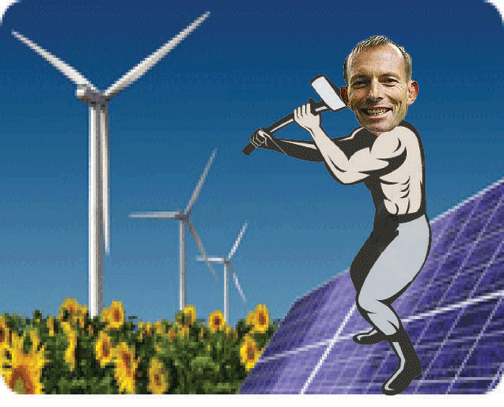 Renewable investment dives in Australia, bucking global trend, SMH January 10, 2015 – Peter Hannam Environment Editor, The Sydney Morning Herald Investments in renewable energy rose to record levels globally in 2014 but fell sharply in Australia because of uncertainty triggered by the Abbott government’s review of the industry, Bloomberg New Energy Finance said.
Worldwide investment in wind farms, solar photovoltaics and other clean energy sources jumped 16 per cent last year to $US310 billion ($383 billion), or more than five times the tally of a decade earlier. Solar investments accounted for almost half the total.
China led the way, with investment soaring almost one-third to $US89.5 billion, while US investment gained 8 per cent to $US51.8 billion, and Brazil’s almost doubled to $US7.9 billion.
Australia, though, went the other way, with investment sinking 35 per cent to $US3.7 billion. BNEF said the amount was the “lowest since 2009, as wind and solar project developers delayed decisions while they awaited the government’s response to its Renewable Energy Target review”.
The Australian tally in fact masks a much steeper dive for large-scale renewable plants as small-scale solar PV largely held its own in 2014 even as state-based support schemes were wound back further.
“Four wind farms are currently under construction, but these signed contracts before the last RET review,” said Darren Gladman, the acting policy director for the Clean Energy Council.
“No more projects in the country have imminent construction plans.
“Australia is not just at risk of falling behind the rest of the world on renewable energy, we have already slipped off the back of the wave. We have some of the best sun, wind and waves in the world, but this new research shows that we are squandering some of our huge natural advantages.”
Fairfax Media sought comment from Industry Minister Ian Macfarlane, who has sought to cut the country’s renewable energy target from the current goal of 41 terawatt-hours annually by 2020 to as low as 27tWh.
So far, the Senate has blocked such a move but uncertainty over whether and when the goal will be reset has made it almost impossible to raise financing for new projects………..http://www.smh.com.au/business/renewable-investment-dives-in-australia-bucking-global-trend-20150109-12kqhk.html
Australian companies uranium miner Paladin, and OceanaGold will be forced to come clean on tax matters
 Canada transparency laws force ASX companies to disclose tax bills, The Age December 26, 2014 Georgia Wilkins Business reporter Two Australian mining companies will be forced to disclose how much tax they pay in every country around the world by new transparency laws introduced in Canada.
Paladin Energy and OceanaGold, both dual-listed in Australia and Canada, will have to comply with new Canadian laws requiring all oil, gas and mining companies to report payments they make to governments overseas, including taxes, royalties, bonuses, regulatory charges and licence fees.
The Australian government is being pushed to introduce similar rules. Continue reading
Australian businesses lose $millions as action on renewable energy is delayed
 RET Impasse Costing Australian Renewables Millions http://www.energymatters.com.au/renewable-news/ret-impasse-cost-em4594/ December 11, 2014 Energy Matters The Federal Government’s drawn-out review of Australia’s Renewable Energy Target is costing the sector between $400 and $500 million a year in lost investment, according to the Clean Energy Council.
An analysis by the CEC says the ongoing impasse will continue to wreak more than $400 million of damage every year to renewable energy projects already operating.
CEC Chief Executive Kane Thornton said the RET had delivered $10 billion worth of investment in large-scale projects to date; investments made in good faith that the legislated target would continue unchanged.
“A breakdown in that bipartisanship has had a material impact on the market confidence in the policy and is affecting the revenue that flows to those projects,” Mr Thornton said.
“We are staring down the barrel of job losses, business closures, negative financial effects on the $10 billion of renewable energy projects already operating, and a halt in the development of new large-scale renewable energy projects across the country.”
Referring to 2014 as a dark year for large scale renewables, Mr. Thornton points out more than $2 billion was invested in 2013, but the first three quarters of this year has seen a comparatively paltry $238 million invested – directly the result of the Federal Government’s apparent determination to gut the RET.
“If the government is genuine about its intent to resolve the current political impasse, move beyond its previous position and support a target that delivers a strong future for renewable energy in Australia, we would encourage Labor to return to negotiations,” said Mr. Thornton.n November, the ALP walked away from negotiations with the Federal Government that would have resulted in the dilution of the RET.
The CEC briefing paper “Lost opportunity and big costs: The impact of an unresolved RET review” can be downloaded here.
A very recent example of the impact the situation is having is in the NSW Southern Tablelands where a fourth generation farmer had hit tough times – and wind turbines were to be his saviour. However, with the continuing RET uncertainty,the farmer may still have to sell his property – one that has been in his family for four generations. This particular situation goes beyond this single farmer’s woes, with jobs and investment in the local region also at stake.
In October, a major wind turbine tower manufacturer in Victoria announced it will be shedding 100 jobs; partly due to the RET situation.
Even where concessions have been made concerning the RET, there still appears to be a great deal of devil in the detail. Yesterday, ClimateSpectator reported Environment Minister Hunt’s office communicated that “solar up to 100kw is proposed to stay in the SRES due to the red tape that would be involved if it moved into the LRET.”
There had been fears commercial solar would be lumped in with the large-scale target. Even this good news came with a potential barb. It’s unclear if up-front deeming will remain; i.e. whether the full government subsidy will continue to be made available upfront when a system is installed; rather than incrementally as the power is generated – as is the case with projects under the LRET
For the Mirrar Aboriginal people, a new era may be opening up, if ERA’s Ranger uranium mine finally closes
 Uranium mining in Kakadu at a crucial point, SMH, 29 Nov 14 Peter Ker Resources reporter “……..place facing an uncertain future. Jabiru is a town in limbo. Four decades after arriving, uranium miner Energy Resources of Australia (ERA) will decide soon whether it will continue digging here. There is a chance it will choose not to, which will bring down the curtain on perhaps nation’s most controversial mine, Ranger.
Built on the faultlines of environmental and indigenous land rights policy, Ranger is at a defining moment. It has provided fuel to nuclear power stations of the world but the end of its working life is in doubt.
The end of mining at Ranger would be cause for celebration for some. Continue reading
ERA’s very Bad Timing to consider a new Uranium Development
Uranium mining in Kakadu at a crucial point, SMH, Peter Ker, Resources Reporter, 29 Nov 14 “….. As fate would have it, ERA could barely have picked a worse time to evaluate a new uranium development.
Prices for uranium have been depressed since an earthquake and tsunami sparked a nuclear crisis in Japan in 2011.
Most Australian uranium miners haven’t made a profit since. ERA has received just $US46 ($54) a pound for its product during most of this year. That is 12 per cent below the price it received in 2009.
Commodity prices are not the only threat to the project going ahead. A series of events over the past year have shaken investors’ confidence.
A tank failure in December last year spewed toxic substances around the Ranger site and prompted a six-month shutdown. Despite official surveys suggesting none of the substances escaped into Kakadu, a fierce debate ensued over the mine’s social licence to operate in such a delicate and difficult location.
The exploration results for the project have also fuelled concerns, with some analysts expressing alarm at the quality of some sections of the underground geology and cases of unstable rock formations.
At the same time ERA’s 68 per cent shareholder, Rio Tinto, is aggressively cutting back capital spending on new projects.
With Rio focused on boosting dividends rather than building large numbers of new mines, many doubt it will be willing to spend the hundreds of millions of dollars that would be required to go ahead with a new underground mine at Ranger.
When the geological concerns were reported to the market in July, Credit Suisse published the most pessimistic research note on the project to date.
“We believe the results of the Deeps resource drilling are poor,” the note said.
“Ranger Deeps either adds value or there is close to none, and risks are increasing towards the latter. If ERA announces at the end of this year that Ranger Deeps is not viable, then the share price should collapse to very low levels.”……..
JP Morgan analysts said the weak uranium prices, combined with the 2021 expiry of the mining lease, put ERA in a difficult position.
“We believe the project likely needs prices of $US50 per pound to $US60 per pound over the life of the project,” they wrote. ……..
ERA chief Andrea Sutton said the geological results had been consistent with expectations, and sufficiently good for the company to conduct less drilling than planned.
The spot uranium price enjoyed a small surge in early November, and while the longevity of that rise is unclear, Sutton said the company was confident the price would rebound in the medium term……….http://www.smh.com.au/business/mining-and-resources/uranium-mining-in-kakadu-at-a-crucial-point-20141128-11vmr3.html
Australian uranium miner Paladin continues its downward plunge
 Paladin continues uranium plunge, Yahoo 7 News, Nick Evans November 14, 2014 A surge in the uranium spot price failed to help Paladin Energy’s bottom line, with the company declaring a net after-tax loss from operations of $US45.8 million for the September quarter.
According to Paladin’s latest financial results, released late yesterday, revenue for the quarter crashed 43 per cent to $US39.3 million………
The unexpectedly big loss will put further pressure on Paladin’s balance sheet, despite the completion of a $US190 million company-saving deal with China National Nuclear Corporation for the sale of a 25 per cent stake in Langer Heinrich. Closure of the deal left Paladin with cash holdings worth $US209.5 million at September 30.
Paladin also refinanced its existing $US110 million project finance loan and $US20 million working capital facility in the quarter, and used some of the CNNC cash to pay down debt.
But the company still faces the task of refinancing $US300 million of convertible bonds maturing next November, as well as paying $US40.4 million in interest and principal repayments before next September…….https://au.news.yahoo.com/thewest/business/wa/a/25512522/paladin-continues-uranium-plunge/
1 This month.
20 September –National Day of Action in Melbourne on the International Day of Peace


Help Aunty Sue Protect Her Land and Sacred Sites From Destructive Rocket Testing.
.

Australians deserve the truth
about
AUKUS – https://aukuspublicinquiry.com/
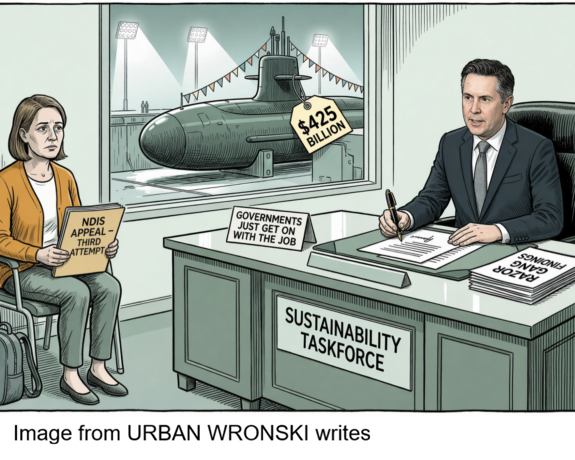

PETITION – To: Prime Minister Anthony Albanese and the Australian Labor Government

of the week – Australians for War Powers Reform (AWPR)
To see nuclear-related stories in greater depth and intensity
 Antinuclear