Tony Abbott and Campbell Newman cannot be trusted about the true economics of coal
Will Abbott and Newman show us their coal portfolios? Will they hold their investments until 2020? olddogthoughts November 16, 2014 Standing up for coal – Abbott and Newman give investment advice November 16, 2014 by: Kaye Lee
Tony Abbott has told a G20 leaders’ discussion on energy he was “standing up for coal” as the Queensland government prepares to unveil new infrastructure spending to help the development of Australia’s largest coal mine.Abbott, who recently said coal was “good for humanity”, also endorsed the mine, proposed by the Indian company Adani, to the meeting.
The Australian government has given all environmental and regulatory clearances for the $7.5 billion coal mining, rail and port project, said Gautam Adani, chairman, Adani Group, in an interview to The Indian Express.
And Campbell Newman is happy to put your money where his mouth is. “We are prepared to invest in core, common-user infrastructure,” Mr Newman said. “The role of government is to make targeted investments to get something going and exit in a few years’ time.”
Despite poor market conditions, high costs and the massive outpouring of concern over the environmental impacts of their projects, Indian companies GVK and Adani remain hell-bent on opening up the Galilee Basin in Queensland. The smallest mine is as large as Australia’s biggest operating coal mine and the largest, twice the size. All of the proposals in the Galilee Basin would produce enough coal to chew up 7% of the world’s remaining carbon budget, drastically reducing our chances of keeping a lid on global warming.
Adani and fellow Indian company GVK are pushing their projects and Adani wants to start construction early next year, but the key problem is access to funds.
Few banks are willing to lend when coal prices are so low and the industry is facing issues with climate change.
There are also issues with both companies………………….. Continue reading
Australia well out of the race, as renewable energy investment goes to China and USA
 Australia losing renewable energy business to China and the USA http://www.9news.com.au/national/2014/11/10/00/04/australia-losing-green-business-overseas Investment in renewable energy has dropped by 70 per cent as Australia loses green business overseas, a report has found.
The slide in investment has seen China consolidate its position as the world’s renewable energy powerhouse, according to the Climate Council Report, Lagging Behind: Australia and the Global Response to Climate Change.
“Investment that could be coming to Australia is instead going overseas to countries that are moving to a renewables energy future,” report’s co-author, Professor Tim Flannery said. “Unfortunately the lack of federal government commitment to renewable energy is hurting the industry.”
Australia has come under pressure to cut its carbon emissions deeper after the European Union last week agreed on a new target of 40 per cent by 2030.
The agreement, labelled by the EU as a new global standard, also includes a 27 per cent target for renewable energy by 2030. The coalition government has said it will consider a new post-2020 target in early 2015 before a United Nations conference in Paris, where a new commitment will be discussed and possibly settled.
Prof Flannery said over the past year investment in Australian renewable energy projects dropped 70 per cent, while China installed more renewable energy capacity than fossil fuels in 2013. Continue reading
BHP is firm on mothballing Olympic Dam uranium mine expansion
BHP offers little hope of revisiting Olympic Dam expansion The global miner shelved plans for the multi-billion-dollar expansion in 2012 after a year-long study. MineWeb 03 Nov 2014 SYDNEY (REUTERS) – Expansion by BHP Billiton’s giant Olympic Dam mine in Australia, once considered among its prized growth assets, is off the agenda due to low metals prices and productivity inefficiencies, the company said on Friday.
BHP shelved plans for a multi-billion-dollar expansion of the copper, gold and uranium mine in 2012 after a year-long study, citing a need to reign in spending as the Australian mining boom started to fade.
Since then business leaders and politicians, including Australian Prime Minister Tony Abbott, have implored BHP to reconsider its decision, hoping to alleviate job losses caused by the exit of car manufacturing inAustralia.
But BHP has stood firm and on Friday reiterated its mothballing of expansion plans for Olympic Dam. http://www.mineweb.com/mineweb/content/en/mineweb-gold-news?oid=258553&sn=Detail
Cameco – another loss, after write-off of failed Global Laser uranium enrichment project
 Uranium producer Cameco reports a third-quarter loss By Jim Brumm StarNewsOnline.com, November 3, 2014 “……..The Canadian uranium producer reported a third-quarter loss last week after writing off its $184 million investment in Global Laser, citing General Electric’s unexpected July cut in funding to “pace our investment in line with market.”
At the time Silex, the Australian owner of the laser technology, said GE responded “to worsening trading conditions in the global nuclear fuel markets, initially triggered by the events in Fukushima, Japan, in March 2011.”
“The market has declined more than 50 percent since” the Global Laser project started in 2007, GE spokesman Christopher White said in July without describing the measurement cited………
Cameco’s charge indicates a total Global Laser worth of $767 million and values GE’s 51 percent at $391 million. Hitachi, which owns the remaining 25 percent, hasn’t discussed a charge.
GE has declined to discuss the dollar value of the Global Laser charge it took against second-quarter earnings, but Nuclear Intelligence Weekly put the amount at $194 million. That would be 49.6 percent of the total value of GE’s Global Laser holdings as indicated by Cameco. http://www.starnewsonline.com/article/20141103/ARTICLES/141109942/-1/topic24?Title=Uranium-producer-Cameco-reports-a-third-quarter-loss-
Renewable energy is cheaper: union recommends switching to Powershop
 I switched to Powershop recently, I had several satisfactory years of fully renewable energy with AGL. But now I am especially glad about the switch. Apart from Powershop being cheaper and more efficient – it IS dedicated to renewable energy. And alas, looks as if AGL has now gone well and truly over to the dark side. (See the article further down this page.)
 ETU branch urges members to back Powershop http://www.heraldsun.com.au/business/breaking-news/etu-branch-urges-members-to-back-powershop/story-fnn9c0hb-1227105301934 JOHN CONROY OCTOBER 28, 2014
The Electrical Trades Union – Victorian Branch (ETU) has announced that it will be recommending an electricity offer with new Victorian market entrant and renewable energy backed electricity retailer Powershop to its members.
ETU State Secretary Troy Gray said: “We are urging our 20,000 strong membership in Victoria to switch to Powershop to show their support for the Renewable Energy Target (RET) and Australia’s renewable energy future.”
“For us it was a no brainer. Powershop has been ranked the greenest energy company in Australia by Greenpeace, they are backed by 100 percent renewable energy generator Meridian, they are the only energy company to put up a fight to defend the Renewable Energy Target and the jobs and investment it creates and they are 100 percent carbon neutral too.”
“Our research indicated that companies, like Powershop, who support the RET, are 20-30 per cent cheaper than those who oppose it. The Warburton Review of the RET failed to make the case that the RET drives up power prices and with Powershop we know that our members can back renewable energy and the RET and save money.
“Importantly, by encouraging our members to switch to Powershop, we can also help break the cycle of the big three energy companies (AGL, Origin and Energy Australia) ripping off our members with rapacious deals and self serving energy policies.”
“For too long, our members, and other consumers across Victoria, have been in the grip of an oligopoly that has kept them at arms length from their own energy usage data. The emergence of Powershop, enabled by the RET, has brought unprecedented levels of innovation and choice to a broken market.”
Powershop is backed by Australasia’s largest renewable energy company, NZ-based Meridian Energy. It launched on the Victorian market in February 2014 and has recruited over 20,000 customers to date. Powershop says it is a modern power company that’s designed from the ground up with the sole purpose of empowering consumers and saving them money.
The company has been working to make the case that renewable energy reduces the cost of electricity for consumers. When Renew Economy reviewed submissions to the RET review from energy companies in June 2014, Powershop was found to be “the only retailer to call unequivocally for the current (renewable energy) target to be retained.”
The ETU will not be receiving a payment from Powershop related to this offer to its members. ETU members switching to Powershop through this offer will each receive a sign up credit payment.
AGL electricity utility wants complete scrapping of Renewable Energy Target!
 AGL Energy calls for renewables target to be scrapped completely Echo Net Daily 28 Oct 14, RenewEconomy, by Giles Parkinson
AGL Energy – once the ‘greenest’ retailer in the country and now the largest producer of coal-fired energy – has called for the renewable energy target to be scrapped altogether.
As speculation increased in Canberra and media circles that the Abbott government and Labor would agree on a compromise that would result in a significant hair-cut to the current 41,000GWh target, AGL intervened in the debate by saying that was not good enough – the RET should be dumped completely.
Chief executive Michael Fraser, who has overseen the change in AGL Energy’s business model fromgreen to black, says the RET policy is broken. He endorses the controversial Warburton Review’s more extreme finding that the target should be dumped altogether.……..
There are a couple of issues with what Fraser has said. For a start, as all the inquiries to date have found, the RET has actually worked very well. It spurred billions of dollars of investment, thousands of jobs, and in states such as South Australia has caused dramatic falls in emissions.
What has caused the hiatus in the last two years is the uncertainty caused by the Abbott government’s review, and the inability of developers to get power purchase agreements from the likes of AGL Energy and others, and therefore to get finance. Still, the government likes to use the ‘target is impossible’ argument – despite its own modelling rejecting the idea. ……
AGL Energy has an interest in not having a carbon price, or a renewable energy target, particularly since its purchase of the 2.2GW Loy Yang A brown coal generator, and the 4.6GW Bayswater and Liddell coal-fired generators in NSW. That changed the colour of its revenues to $12 black for every $1 of green energy.
As it made clear in July, its long-term business interests now lie firmly in removing environmental policies such as the carbon price and renewables:
‘While the removal of the carbon tax and associated transitional assistance has a negative impact on the short-term earnings of the Loy Yang A power station, it has a materially positive impact on its long-term value. Any reduction in the Renewable Energy Target would also have a positive impact on the value of Loy Yang A.’ Ditto for Macquarie Generation.
AGL Energy, therefore, has an interest in ensuring that carbon and renewables do not trouble its business plan. ………http://www.echo.net.au/2014/10/agl-energy-calls-renewables-target-scrapped-completely/
Australian companies going to Germany to develop renewable energy technologies
Germany’s renewable energy incentives and regulations attracting Australian companies Yahoo News, By Emily Stewart for The BusinessOctober 29, 2014, 1
An Australian company which invented a renewable energy electricity generator says it was forced to move its operation to Germany because of a lack of opportunities in Australia.
Ceramic Fuel Cells, a Melbourne-based CSIRO spin-off company, said its generator could cut electricity bills by up to 50 per cent for households and small businesses.
But the company moved its operations to Germany two years ago to benefit from generous German government subsidies not on offer in Australia.
“This is what we need right now,” the company’s Germany-based managing director, Frank Obertnitz said.
“We are at an early stage. We need to commercialise the product and the incentives in Europe are much better for that.”
Germany is in the middle of an energy transition it calls Energiewende, which aims to shut down nuclear plants, reduce carbon emissions and increase electricity produced from renewable sources.
“After Chernobyl, and then Fukushima, the German population said no to nuclear,” said Dr Patrick Graichen of the influential think-tank, Agora Energiewende.
The program was accelerated after the Fukushima nuclear disaster in 2011. Before then, Germany was heavily reliant on nuclear and fossil fuels………..https://au.news.yahoo.com/vic/a/25372077/germanys-renewable-energy-incentives-and-regulations-attracting-australian-companies/
Macquarie Bank invests in uranium
 Going nuclear: Australia’s Macquarie buys Deutsche uranium book -source By David Sheppard LONDON, Oct 21 (Reuters) – Australian investment bank Macquarie Group has bought Deutsche Bank’s uranium book, a source familiar with the matter said, as the increasingly commodities-focused lender pushes deeper into global energy trading.
The deal includes Deutsche’s long-term trading contracts and stockpiles of low-grade uranium yellowcake, which were valued at the end of last year at around $200 million.
Industry experts say they comprise enough uranium to fuel around 10 average-sized nuclear power plants for 12-18 months………
Trading firms hold uranium stockpiles in warehouses specially licensed to store the fuel, like U.S. conglomerate Honeywell International Inc’s ConverDyn facility in Illinois; Cameco’s Port Hope facility in Ontario; and Areva SA’s facility in France. http://www.reuters.com/article/2014/10/22/macquarie-uranium-commodities-idUSL6N0SH3PN20141022
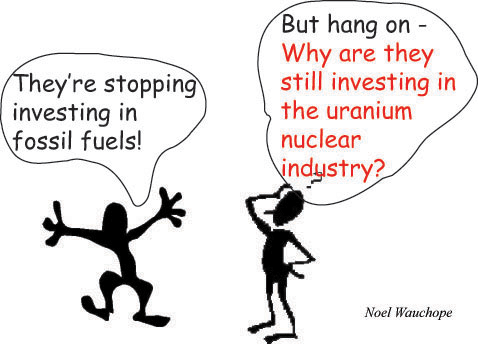
Uranium companies rejoice, as universities and groups get out of fossil fuel investments?
 Divestors painting themselves into the uranium corner, JAMES KIRBY THE AUSTRALIAN OCTOBER 11, 2014
SUDDENLY the urge to “divest” is reaching fever pitch. Inside a couple of weeks there has been more noise than we have had in years as universities, religious groups and super funds announce they are “getting out of polluters”.
Indeed, the ANU’s plan to divest itself of seven resource companies, including oil and gas major Santos, has been branded a “disgrace” by federal Infrastructure Minister Jamie Briggs.
Like most trends, this started in the US where a number of leading funds have been loudly exiting resource stocks. The rush reached something of a climax in recent weeks when the heirs of Standard Oil founder John D Rockefeller said they were getting out of oil.
Now Australia will mark a national “Divestment Day of Action” targeted largely at banks that invest in resources on October 18, an initiative backed by 350.org………
Australian National University divesting from fossil fuels, but not from uranium
ANU defends divestments, says fossil fuels companies must diversify into new energy, The Age Heath Aston, political correspondent October 13, 2014 – The head of the Australian National University has defended a decision to dump certain resources stocks from the university’s $1 billion investment portfolio on ethical grounds, saying fossil fuel-reliant companies will not survive the next 20 to 30 years unless they diversify into new energies……
ANU is the first Australian university to divest from fossil fuels but in the United States 19 universities have sold out of investments deemed unethical or a risk to the environment, including the prestigious Stanford University, which has purged its $US19 billion ($22 billion) investment fund. ANU modelled its socially responsible investment policy on that of Stanford.
Professor Young said there had been a “torrent of support” from students and the wider community.
“They have been saying ‘don’t back down’,” he said. “There is tremendous enthusiasm out there around environmental issues and investment.”
ANU Student Association president Cam Wilson said 82% of 2000 students polled before the university made its decision supported divestment.
In an opinion piece written for Fairfax Media, Professor Young, whose ocean research has resulted in his consulting to a range offshore gas and oil companies, questioned the short-term thinking of the divestment critics.
“What will our industries be in 20 or 30 years’ time?” he writes. “I am confident they will not be in producing fossil fuels.”
He told Fairfax Media: “I don’t think fossil fuels will be a big part of the world economy in 20 to 30 years’ time. But, that said, there is a big opportunity for these companies to change the mix of what they produce.”
While seven resources stocks were dumped, ANU has retained investments in mining groups BHP Billiton and Rio Tinto, as well as in Woodside Petroleum and Wesfarmers.
Professor Young said those groups were more diversified and showed signs of evolving to new energy sources in future……. http://www.theage.com.au/federal-politics/political-news/anu-defends-divestments-says-fossil-fuels-companies-must-diversify-into-new-energy-20141012-114ypp.html
Toro Energy hoping against hope that the uranium market picks up in the future
 Toro seeks to expand planned WA uranium mine ABC News By David Weber 8 Oct 14
A company hoping to become the first to export uranium from Western Australia has released plans for an expansion of its currently untapped mine in the state’s mid-west.
Toro Energy last year received federal environmental approval for the Wiluna project to exploit the Lake Way and Centipede deposits.
But a new environmental scoping document included two more deposits, Millipede and Lake Maitland.
The plans are open for comment with the state’s Environmental Protection Authority (EPA)………
the WA Conservation Council said the existing conditional approval should be revoked and a completely new assessment done.The council’s Mia Pepper said the added impacts of an expansion needed to be considered.”While they might think that they know a lot, there’s a lot of impacts that are unknown when you add additional deposits,” she said.
“You add additional land clearing and impact area.”What they need to do and what they should be doing as any responsible company would is look at the cumulative impacts of that increase.”
Mr Yeeles said the start of mining was some way off.
“The market is not right, the price is not right for mining at the moment but by the time we complete the assessment for Millipede and Lake Maitland, we would expect the market conditions to have improved,” he said.
Toro expects the assessment process may take up to two years. http://www.abc.net.au/news/2014-10-06/uranium-miners-toro-seek-project-expansion-at-wiluna-site/5794318
Does Australia have any ethical banks?

Market Forces, an Australian ethical banking advocacy group, says the company [Westpac] has invested in fossil fuels. Market Forces reckons between them, the big four, “ANZ, Commonwealth, NAB and Westpac have loaned almost $20 billion to fossil fuel projects in Australia.”…….The advocacy group, Market Forces, is suggesting that Australians concerned the ethics of their current bank, particularly those funding the fossil fuel industry, should consider moving their hard earned dollars to a institution more in line with their personal values. Their campaign is known as Divestment Day. On October 18, they’re asking Australians to consider the ethics of their bank and switch, if necessary.
On the money when it comes to ethical investing WARREN MCLAREN, ABC, 6 OCT 14 “………….Does Australia have any ethical banks?
Ethisphere thinks so. In its global register of what it labels as the World’s Most Ethical (WME) companies, the 2014 compilation included five banks. Impressively three of those were Australian. This was Westpac’s seventh consecutive year, on the eight-year-old list. NAB nabbed a fourth year, and Teachers Mutual was a first timer.
The Global Alliance for Banking on Values is an international organisation whose member banks have combined assets of approximately $100 billion in 25 countries. Earlier this year it held its annual conference in Melbourne, even though it has but only one Australian member: bankmecu.
Formed from an amalgam of over 50 credit unions bankmecu was Australia’s first customer owned bank, and is currently its largest. Not surprising for a customer owned bank, their customer approval rating have been greater than 90 per cent for more than a decade.
That’s not to suggest that bankmecu has the market all to their lonesome. The Australian Customer Owned Banking Association includes 96 such member institutions. Continue reading
Four Mile uranium mine ships batch to Canada
Alliance Resources ships first batch of uranium ore Four Mile mine, Australia http://nuclearfuels.energy-business-review.com/news/alliance-resources-ships-first-batch-of-uranium-ore-four-mile-mine-australia-061014-4395242 EBR Staff Writer 06 October 2014 Alliance Resources has shipped first batch of uranium ore concentrate from its Four Mile mine in South Australia.
The ore concentrate has been shipped to Cameco’s facility at Blind River, Ontario, in September for further testing prior to sale.
The company is set to make a second shipment in mid-October to Canada.Alliance said that the first shipment comprised 300,000lb, while second shipment contains 210,000lb.
Due to limited availability of maritime transport, the first shipment of uranium was delayed.
Located 550km north of Adelaide, the Four Mile project is a joint venture of Alliance Resources and Quasar Resources, which owns 75% of the mine. It was commissioned in March and was opened in June.Alliance’s, Alliance Craton Explorer holds 25% of ML6402 and EL5017.
ERA digs itself into a deeper hole with underground uranium plan
 Dave Sweeney, 6 Oct 14 Today’s announcement that Energy Resources of Australia (ERA) has lodged its Environmental Impact Statement for underground mining (the Ranger 3 Deeps or R3D project) at its embattled Ranger uranium mine in Kakadu raises serious concerns about the project’s environmental impacts and economic viability, the Australian Conservation Foundation said today.
This application faces significant procedural and market hurdles and will be actively contested by national and NT environment groups.
“Uranium mining at Ranger has been the source of headlines, heartache and hazard for years but all mining and mineral processing ends in January 2021 when a mandated rehabilitation and closure process commences. ERA faces a serious management challenge to rehabilitate the Ranger site to a standard suitable for inclusion in the surrounding World Heritage listed Kakadu National Park”, said ACF nuclear free campaigner Dave Sweeney.
“Ranger 3 Deeps would add considerable cost and complexity to this challenge. Instead of literally digging itself into a deeper hole ERA and parent company Rio Tinto should be advancing a comprehensive clean-up and closure program at Ranger”.
“ERA runs a failing mine in a fragile place. Kakadu deserves the highest protection and ERA requires the highest scrutiny. Instead of promises and plans to go underground Rio Tinto needs to ensure its under-performing subsidiary ERA meets its rehabilitation requirements in time and in total. After decades of being able to mine and mill Rio Tinto must not now be allowed to cut and run”.
Concerns around the planned R3D project include:
- the projects impact on the required rehabilitation of the Ranger site (note: ERA’s authority for mining and mineral processing expires in January 2021)
- doubts over the capacity of ERA and the commitment of parent company Rio Tinto to fund required rehabilitation works at Ranger. The former mine will need to be rehabilitated to a standard suitable for inclusion in the surrounding World Heritage listed Kakadu National Park. This complex and costly task is being actively undermined by the lack of certainty surrounding rehabilitation financing. Rio Tinto argue they have no legal obligation to do the job, while ERA say they do not have the money. One corporation lacks commitment, the other capacity and Kakadu is held to ransom.
- uncertainty surrounding the safety and adequacy of related infrastructure at the Ranger site (most starkly highlighted by the collapse of a leach tank and spill of overa million litres of radioactive and acidic slurry in December 2013)
- ERA’s poor operational history which has seen over 200 leaks, spill, licence breaches and incidents at the Ranger mine and detailed concerns raised over the adequacy of the mine’s regulatory regime.
- The poor uranium commodity price post Fukushima – a continuing nuclear crisis directly fuelled by Australian uranium – ERA’s revenue has been steadily declining and net profit after tax has been negative in the last three years (2011-13). There is a real concern that falling costs will lead to ERA cutting corners.
Context and comment: Dave Sweeney, ACF – 0408 317 812
Ranger uranium mine new plan, dubious, now scrutinised by Aborignal land owners
 Traditional owners scrutinise environment plan for Ranger uranium mine SMH October 6, 2014 Angela Macdonald-Smith The traditional owners of the Ranger uranium mine will look carefully at a draft environmental impact statement for an underground expansion lodged by Energy Resources of Australia on Friday, says Gundjeihmi Aboriginal Corporation chief executive Justin O’Brien.
He said the group, which represents the Mirarr people, would “weigh up the cultural, social and environmental considerations that will bring to bear on our decision-making”.
Rio Tinto-controlled ERA has pressed ahead with the potential expansion of the mine, near Kakadu, despite heightened fears among traditional owners over safety and health since a radioactive leak at the site late last year.
Chief executive officer Andrea Sutton said the company would “continue to seek their support” for the Ranger 3 Deeps project, which could start producing ore in December 2015……concerns over safety and health were still high since a leach tank accident last December and due to “the history of leaks and spills and accidents over many decades”.
ERA does not technically need the backing of the Mirarr traditional owners to go ahead with the underground mine, but Ms Sutton said “we certainly are seeking their support”.
Mr O’Brien said the economic dependence of Jabiru and the Mirarr people on Ranger, as well as cultural considerations would come into play in the Gundjeihmi Aboriginal Corporation’s decision, alongside the environmental issues.
The open pit at Ranger has already been depleted and is being re-filled, leaving ERA dependent on the processing of low-grade ore for production until production starts from any underground mine.
However, some analysts have voiced doubts about the underground project after ERA warned earlier this year that geotechnical conditions at the site were “less favourable than assumed”, leading to expectations it could cost more than originally anticipated.
Ms Sutton said it was too early to estimate costs for the underground project for which a pre-feasibility study is due for completion by the year-end. It is then due to be considered by the board in the first quarter of 2015……..
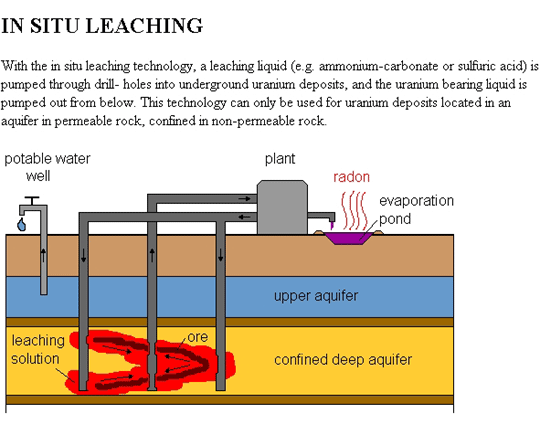
Making the project more difficult is the weak uranium price, which has recovered from this year’s low of $US28 ($32) to about $35 but still remains less than half of the level most analysts say is required for a new green-field mine.
However, Ranger Deeps would be a brown-field expansion and Ms Sutton said ERA was not in any case counting on a material lift in the price until “mid to late this decade”. http://www.smh.com.au/business/mining-and-resources/traditional-owners-scrutinise-environment-plan-for-ranger-uranium-mine-20141005-10qhbd.html#ixzz3FOVx41Yf
1 This month.
20 September –National Day of Action in Melbourne on the International Day of Peace


Help Aunty Sue Protect Her Land and Sacred Sites From Destructive Rocket Testing.
.

Australians deserve the truth
about
AUKUS – https://aukuspublicinquiry.com/

PETITION – To: Prime Minister Anthony Albanese and the Australian Labor Government

of the week – Australians for War Powers Reform (AWPR)
To see nuclear-related stories in greater depth and intensity
 Antinuclear