French company AREVA will get to have 51% interest , later more, in joint uranium venture with Toro Energy
 Toro signs NT deal with AREVA https://au.news.yahoo.com/thewest/business/wa/a/25132512/toro-signs-nt-deal-with-areva/ The West AustralianSeptember 29, 2014 Toro Energy has signed a farm-in and joint venture agreement with French uranium and nuclear power giant AREVA in the Northern Territory.
The agreement covers a 2292sqkm tenement package in the Wiso Basin, southwest of Tennant Creek.
“Toro believes that its relatively unexplored Wiso Basin tenement package is ideally placed for exploring for a sandstone-hosted uranium mineralising system of a size and scale not unlike those found in Kazakhstan, where six of the world’s top 15 producing uranium mines are currently in operation,” the company said in a statement.
Toro’s managing director Dr Vanessa Guthrie said the company was excited to have AREVA participate in a substantial exploration portfolio at a time when few companies were actively exploring for uranium in Australia.
“We look forward to adding value to our NT exploration targets through a long and beneficial relationship with one of the world’s most respected uranium groups,” she said. Under the terms of the agreement, AREVA will spend $500,000 within two years of to earn a 51 per cent interest in the joint venture properties.
Upon reaching 51 per cent, AREVA will then have the option to spend another $1.5 million over four years for a further 29 per cent interest for a total 80 per cent stake.
Drilling is expected to begin in the first half of 2015.
Toro shares closed steady at 9.1 cents.
Fossil fuel industries lobby against solar power: gas joins attack by coal utilities
 What neither industry likes to talk about is the pricing of the network – did they invest too much money in network infrastructure, and shouldn’t they take a write down on those assets, rather than just charging customers more?.
Gas networks attack solar policies, fearing mass defections By Giles Parkinson on 26 September 2014 Gas industry calls for solar hot water rebates to remove to try to slow down mass defections from gas networks it fears will be caused by soaring gas prices.
The Energy Network Association has released a report that suggests the industry could lose one quarter of its customers as a result of soaring prices. It says 1.15 million households could drop gas and defect to solar hot water in coming years. Continue reading
Investors representing $1 trillion lobby Abbott to keep Renewable Energy Target
 Investors lobby PM on renewable energy http://www.investordaily.com.au/36340-investors-lobby-pm-on-renewable-energy 01 October 2014 | Staff Reporter A group of institutional investors representing $1 trillion has accused the prime minister of undermining the Renewable Energy Target.
In an open letter to Prime Minister Tony Abbott published in the Australian Financial Review, the Investor Group on Climate Change argued that the savings of more than 10 million Australians are invested in a “clean energy future”.
“The health of our economy is vitally dependent on investor confidence in government and the stability of its policies,” the letter said.
“For years we’re been investing the savings of Australians in projects on the basis of bipartisan support for boosting renewable energy,” it said.
“This is now at risk. Our investments, together with skilled industries and jobs that the Renewable Energy Target is creating, are at risk due to the uncertainty of your government’s commitment to the legislated 41,000 giga-watt-hour target.”
Australia ought to be growing renewable energy rather than “stepping back” from its international commitments, said the letter.
“Investors need predictable long-term policies to be confident to make investments in the energy sources of the future,” it said.
“This environment requires bipartisanship on the need for more renewable energy, not less. We encourage you not to change that now,” said the letter.
The Investor Group on Climate Change includes AustralianSuper, BT Financial Group, AMP Capital Investors, Colonial First State Global Asset Managers and Cbus among its members.
Melbourne and Moree get new solar businesses and employment openings
Spanish renewable energy firm sets up Melbourne-based subsidiary, THE FIFTH ESTATE 23 September 2014 Spain’s Elecnor Group has ignored the current political climate in Australia’s renewable energy sector and launched an infrastructure subsidiary based in Melbourne. ……..
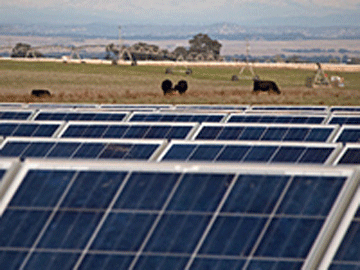
Elecnor Australia’s first project is the $164 million solar photovoltaic farm in Moree, New South Wales for the Moree Solar Farm Company Pty Ltd, part of Fotowatio Renewables Venture. The joint venture originally included Pacific Hydro, which announced in August it was withdrawing from the project due to the policy-driven uncertainties impacting the renewable energy industry.
The Australian Renewable Energy Agency has contributed $101.7 million towards construction and operation of the project, and $47 million has been provided by the Clean Energy Finance Corporation.
Covering 191 hectares, the farm will comprise 232,960 panels with a forecast annual output of 150 gigawatt-hours direct into the main energy grid, enough to power about 15,000 homes. It is expected to be complete and commissioned by the second quarter of 2015.
In a media statement, Elecnor said Australia will be a base for it to expand operations in the Asia-Pacific region, focusing on developing business infrastructure and renewable energies………
The Moree project has already created a number of positions to be based at the town, with the firm earlier this month advertising for an assistant project manager (engineer), a construction manager, six technical engineers as sub-contract supervisors, mechanical and electrical engineers, a civil engineer, two draftpersons, accounts and administration, purchasing and logistics.http://www.thefifthestate.com.au/business/investment-deals/spanish-renewable-energy-firm-sets-up-melbourne-based-subsidiary/67877
Slashing of Renewable Energy Target will mean loss of thousands of rural jobs
 Renewables energy suppliers warn on RET jobs http://www.businessspectator.com.au/news/2014/9/19/policy-politics/renewables-energy-suppliers-warn-ret-jobs 19 SEP,
Suppliers working on Australia’s renewable energy projects say many thousands of jobs will be lost – most of them in rural and regional areas – if the federal government slashes the Renewable Energy Target (RET).
Forty small and medium businesses from around Australia have jointly written to the government, urging it to retain the current policy, rejecting the recommendations of the recent Warburton review to shut down or severely reduce the RET.
“We are writing as suppliers to Australia’s renewable energy industry, which has now generated more than $10 billion worth of investment in large-scale renewable energy projects,” the companies said.
The companies (listed at bottom) between them operate across all Australian states and territories. “Our businesses build electrical infrastructure, roads and components for power stations in wind, solar, hydro and bioenergy, along with supplying safety equipment, cranes, trucks and cement.
“They provide catering, cleaning services, security, logistics and accommodation to construction teams, manage environmental and cultural heritage plans, and supply many other essential inputs to the renewable energy industry.
“While the industry directly employs 21,000 people, our companies collectively employ many thousands more as a result of the clean energy sector.”
The companies, whose sizes range from 1 to 2000 employees, said Australia’s 68 wind farms, 49 large-scale solar projects, 139 bioenergy projects, 123 hydro projects and trial marine and geothermal projects had provided the incentive to grow and employ more workers.
“Many of these jobs are in rural and regional areas where other job opportunities are scarce,” they said.
“We have hired and trained workers and invested in our businesses on the basis of the development of renewable energy in Australia. Maintaining the RET in its current form will help us continue to create jobs and opportunities for Australian workers,” they wrote.
The companies also referred to analysis undertaken by ACIL Allen for the Federal Government, which found that retail electricity prices will be lower over the long term if the RET is maintained, as it will help shield Australians from rising gas prices.
“This is beneficial to all Australians, consumers and businesses alike,” the companies said.
Signatories: ………
Risks of uranium mining outweigh any benefits
 Anti-uranium activists criticise NSW exploration program, Australian Mining 15 September, 2014 Vicky Validakis Anti-nuclear campaigners have criticised the NSW government for opening up the state to uranium exploration.
Last week the state government invited six companies to apply for exploration licences.
The move comes two years after NSW overturned a uranium exploration ban. Mining uranium is still restricted.
Three locations around NSW – near Broken Hill, near Cobar and south of Dubbo – have been earmarked for drilling activity.
Natalie Wasley, spokeswomen for the Beyond Nuclear Initiative, said the decision was disappointing, ABC reported.
“Uranium has very unique and dangerous properties and risks,” Wasley said. “It’s linked to the production of the world’s most toxic and long-lasting industrial waste, as well as proliferation of the world’s most destructive weapons, so it poses a risk to workers, to communities and the environment.”
Wasley said the sector will only create a small number of jobs, and claims the risks associated with uranium outweigh any economic benefits. “We know that in rural and regional areas there’s a much better opportunity for long-lasting sustainable jobs in the renewable sector.”
“We’d really encourage those local governments and the state governments to be putting money and resources into developing more creative, long-term and sustainable jobs for people.”……..
The six companies invited to apply for licenses are Australian Zirconia, Callabonna Resources, EJ Resources, Hartz Rare Earths, Iluka Resources and Marmota Energy. http://www.miningaustralia.com.au/news/anti-uranium-activists-criticise-nsw-exploration-p
Uranium mining still prohibited in New South Wales, and not considered economically viable
Uranium exploration in western NSW – but mining is still prohibited NSW Country Hour Sally Bryant and Julie Clift 15 Sept 14, The New South Wales Government has invited six mining companies to put in expressions of interest to explore for uranium, but mining will remain prohibited, until deposits prove economically viable.
However not all of the mining companies who are involved in this process are actually interested in mining for uranium.
One of six companies invited to tender for an exploration licence, Alkane Resources, is developing a rare earth project near Dubbo, in the state’s central west.

Alkane say they’re not interested in uranium, that they are merely protecting their rare earth project from other resource companies applying for an exploration licence over the top of them
Managing Director Ian Chalmers says this is an insurance policy for his company……..http://www.abc.net.au/news/2014-09-15/uranium-exploration-in-western-nsw/5743584
Uranium oversupply bodes ill for the future of the industry
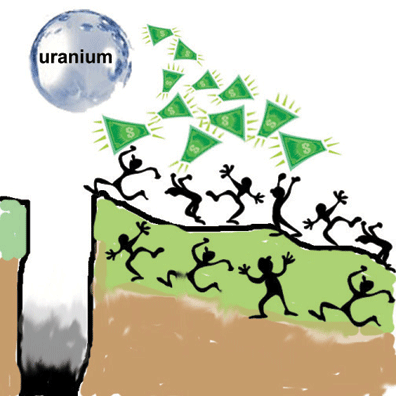 Rally in Uranium Prices Is Unlikely to Last, WSJ, 14 Sep 14 Gains Fueled by Ukraine Crisis, Mine Unrest Don’t Offset Oversupply SYDNEY—A multiweek rally in uranium prices fanned by the Ukraine conflict and labor unrest at a large mine in Canada looks unlikely to continue for long as the reality of oversupply and lackluster demand sinks in among buyers of the nuclear fuel.
Industry analysts and some uranium producers believe that even as supplies fall, a substantial increase in demand is needed to drive prices up to levels that would make new investments worthwhile, when many operations are running at a loss……..
Demand for the fuel hasn’t recovered since the disaster at Japan’s Fukushima Daiichi nuclear-power plant in 2011, which sparked nuclear-plant closures across the country and tarnished uranium’s image globally…….
state governments in resource-rich Australia have been encouraging the growth of the nation’s uranium industry. A decadeslong ban on uranium production in Queensland was lifted in July, opening the door to new applications to build mines in the state. The government of New South Wales this month said it would invite six companies to apply for exploration licenses.
Still, there is expected to be little investment in new projects until the market stages a more substantial comeback. Cameco said it would need to see much higher uranium prices before it started construction of its proposed Kintyre uranium mine in Western Australia.
“The nuclear industry is still in the midst of upheaval,” said Jonathan Hinze, senior vice president at nuclear-research firm Ux Consulting Co. …http://online.wsj.com/articles/rally-in-uranium-prices-is-unlikely-to-last-1410726782
Forget the hype – Australia’s uranium trade with India is of little economic benefit
The future is renewable, not radioactive http://www.hindustantimes.com/comment/analysis/the-future-is-renewable-not-radioactive/article1-1263460.aspx?utm_medium=twitter&utm_source=twitterfeed Jim Green 12 Sept 14 India and Australia have signed a nuclear cooperation agreement that may open the door for uranium sales. However, obstacles remain and claims of an economic bonanza for both countries ignore facts.If Australia supplies 20% of that demand, uranium export revenue will increase by 3% — two orders of magnitude short of the figure in the Fairfax press.
Indian demand would have to grow ten-fold just to sustain one small uranium mine in Australia. Projections of exponential growth leading to hundreds of gigawatts (GW) of nuclear capacity in India should be disregarded. Continue reading
CLAIMS about the potential economic benefits of uranium sales to India are laughable.
Directly or indirectly, Australia will be fuelling a nuclear arms race in South Asia … for a pittance in return.
It is foolish and dangerous to sell uranium to a country that is actively expanding its nuclear weapons arsenal and refuses to sign the Nuclear Non-Proliferation Treaty or the Comprehensive Test Ban Treaty.
Opinion: Race to export uranium to India only has a booby prize http://www.couriermail.com.au/news/opinion/opinion-race-to-export-uranium-to-india-only-has-a-booby-prize/story-fnihsr9v-1227050580065 JIM GREEN THE COURIER-MAIL SEPTEMBER 08, 2014
- CLAIMS about the potential economic benefits of uranium sales to India are laughable.
Michael Angwin from the Australian Uranium Association claimed that Australia could sell 2500 tonnes of uranium annually to India by 2030, generating export sales of $300 million. A 2011 report in the Fairfax press claimed that uranium sales to India could generate $1.7 billion in annual exports.
Such claims ignore readily available facts.
According to the World Nuclear Association, India’s uranium demand this year will amount to just 913 tonnes – just 1.4 per cent of world demand. If Australia supplies 20 per cent of that demand, uranium export revenue will increase by 3 per cent.
 Vanessa Guthrie from Adelaide-based uranium explorer Toro Energy, who is accompanying Prime Minister Tony Abbott on his trip to India, claims that by 2018-19 the uranium industry could generate 10,000 jobs.
But according to the most generous estimate, that of the World Nuclear Association, uranium mining and exploration account for just 1700 jobs in Australia – that’s 0.015 per cent of all jobs. So Guthrie anticipates a sixfold expansion in just five years, at a time when global nuclear power capacity is stagnant?
That’s laughable. Mr Abbott may struggle to keep a straight face as Guthrie dishes up this nonsense in India.
But there’s nothing funny about other aspects of the proposal to sell uranium to India. Continue reading
Rare Earths mining in Central Australia
 Note: We mightn’t like mining, and it will be good when eventually product design is such that recycling of rare earths will pretty much eliminate this. Still, rare earths are needed in 21st Century technologies, especially in renewables. At least this company is not involved in the difficult and hazardous rare earths processing. I understand that processing is to be done in China, – where, after their disastrous history, they now do have the most advanced methods
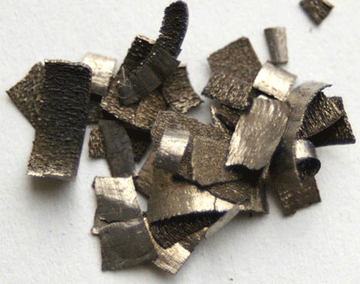 Mining company Arafura Resources says plans to mine rare earth minerals in central Australia remain ‘on track’, despite uncertainty over future funding for the project, ABC Rural News 3 Sept 14, NT Country Hour By Carmen Brown
The company hopes to extract up to 20,000 tonnes of rare earth oxide per year from the Nolan’s Bore deposit, 135 kilometres north-east of Alice Springs in the Northern Territory.
A comprehensive project report released this week, indicates mining could begin at the site in 2019, six years later than previously expected. General manager of exploration and business development, Richard Brescianini, says while there has been strong interest in the project from investors, the company is yet to secure full financial backing for the mine……http://www.abc.net.au/news/2014-09-03/rare-earth-mine-on-track-for-central-australia/5715100
Queensland government wants India to invest in uranium mining in Queensland
 Australia’s Queensland state seeks investment from Indian firms in uranium mining Business Today Anilesh S Mahajan August 29, 2014 A week before Australian Prime Minister Tony Abbott lands in New Delhi on his first trip to India, the Australian state of Queensland is soliciting investments from Indian companies to mine uranium…….
Uranium miner Paladin reports another big loss
 Weak uranium price hits Paladin NICK SAS The West AustralianAugust 29, 2014 The weak uranium price has hit Perth miner Paladin Energy, with the company reporting a $338 million loss for the year.
Late last night the John Borshoff-run company reported a basic operating loss of $3.4 million – which it blamed on the weak uranium price – compared to its operating profit of $55.9 million last year.
The $338 million book loss came on the back of a $226 million impairment on its Queensland exploration assets, along with smaller impairments at its African mines.
The Kayelekera Mine, which it put on care-and-maintenance in May, was the main culprit in the operating blowout, with the mine reporting basic cash costs – but not all-in costs – of $US42.6 a pound.
The uranium price has been hovering around the $30/lb pound mark for much of the year……….
Chinese solar energy firm to close its research in Australia, due to Abbott govt policies
Solar giant to close Australian R&D unit August 22, 2014 Peter Hannam ENVIRONMENT EDITOR, THE SYDNEY MORNING HERALD A GIANT CHINESE SOLAR ENERGY FIRM, ORIGINALLY BASED ON AUSTRALIAN TECHNOLOGY, PLANS TO CLOSE ITS LOCAL RESEARCH ARM AMID CONCERNS ABOUT THE FUTURE OF RENEWABLE ENERGY IN THE COUNTRY.
Suntech, founded by Australian-trained former “Sun King” billionaire Shi Zhengrong, will next month close its Suntech R&D Australia unit with the loss of about a dozen jobs.
The company, now owned by a Hong Kong solar tycoon Cheng Kin Ming and renamed Wuxi Suntech, said in May it invests more than $3 million a year in Australian research and development.
“Suntech wants to continue a relationship with Australia, but it no longer makes the same sense to keep a research team [here],” Renate Egan, managing director of the Sydney-based R&D unit, said.
“Clearly the market’s not going to grow here,” Dr Egan said, referring to large-scale projects.
The government is yet to release the recommendations of its hand-picked panel reviewing the Renewable Energy Target. Clean energy investors fear the panel, headed by former Caltex chairman and climate change sceptic Dick Warburton, will back a cut of the current goal of supplying 41,000 gigawatt-hours of renewable energy by 2020 – if not scrap it entirely for new entrants……….
Richard Corkish, chief operating officer of the Australian Centre for Advanced Photovoltaics at the UNSW, said the loss of the Suntech unit could see significant talent head overseas.
“We hope as big a fraction as possible [of the researchers] can remain in Australia,” Dr Corkish said, adding that there has “not been too much good news” lately for the industry’s outlook in Australia.
While Australia continues to conduct world-leading research into aspects of solar PV research – such as UNSW’s work on increasing the productivity of solar panels – the level of support is likely to shrink because of government cutbacks, Dr Corkish said.
The Australian Renewable Energy Agency currently provides grants for UNSW, Monash University and other institutions.
However, the Abbott government has vowed to scrap the agency and is expected to try again in the Senate………
While Australia’s take-up of renewable energy may be about to slow markedly, other nations are likely to press ahead.
A research report out this week by investment giant UBS estimates solar panels combined with storage are likely to be competitive with conventional power grids by 2020. Battery prices are likely to halve by the decade’s end – and continue to fall – giving the solar-storage combination a payback period of six to eight years by then……..http://www.smh.com.au/environment/climate-change/solar-giant-to-close-australian-rd-unit-20140822-10758l.html
Australia’s uranium industry digging anew hole – for its coffin?
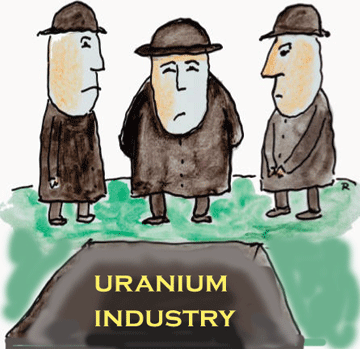 Australia’s uranium industry in a hole Nuclear Monitor #789, August 2014 Developments in South Australia highlight the uranium industry’s ongoing problems. The opening of the state’s latest uranium mine − the Beverley Four Mile in-situ leach mine − would normally be accompanied by considerable fanfare. The Advertiser − a Murdoch tabloid, and the only mass circulation newspaper in the state − might be expected to parrot industry lies about jobs and export revenue.[1,2]
But as The Advertiser said: “South Australia’s newest mine will lose money and won’t create any jobs.” Part of the problem is that the uranium price is well below the cost of production. And General Atomics has put the nearby Beverley mine into care-and-maintenance and shifted the workforce to Beverley Four Mile − so no jobs have been created. Alliance Resources Ltd. which holds a 25% stake in Beverley Four Mile, is seeking to sell out of the project.[1,2]
The Honeymoon uranium mining, also in the north-east of South Australia, was equally underwhelming. Just months after first production in 2011, project partner Mitsui announced its decision to withdraw as it “could not foresee sufficient economic return from the project”. And last year the mine owner − a subsidiary of Russia’s Rosatom − put the mine into care-and-maintenance because it was running at a loss.
Another Murdoch newspaper, The Australian, says it may be years before uranium regains its “sexy sector”.[3]
In Western Australia, United Uranium, which holds several uranium exploration licences, has decided to get out of uranium exploration and instead focus on property development. The company said its strategic review “underlined a consistent theme, that junior resource companies and in particular uranium focussed companies, are currently ‘unloved’ by the investment community”.[4]
Also in Western Australia, Areva Resources Australia, a subsidiary of the French nuclear giant, has formally withdrawn from the North Canning exploration project because it was not viable. It is believed Areva spent up to A$5 million on the project. Aboriginal Traditional Owners in the region were opposed to the project and refused to negotiate with Areva.[5]
In June, RBC Capital Markets Analysts cut its 2014 spot price forecast to US$31.50 a pound, down from US$45. The 2015 target was cut to US$40 (from US$60), and targets for 2016−2018 fell to just US$40-US$45 from US$75-US$80. RBC believes the uranium market is going to be in surplus until 2021. “Active annual supply exceeds demand by a significant margin, and on top of that, significant excess inventories have been and continue to be accumulated post the Fukushima disaster, particularly in Japan,” RBC said, adding that it believes only four Japanese reactors will restart this year, and just 28 (out of 50) will be online by 2018.[6]
[2] www.abc.net.au/news/2014-06-25/four-mile-becomes-newest-uranium-mine/5549648
[4] www.miningaustralia.com.au/news/price-collapse-sees-junior-miner-ditch-uranium-to
[5] https://au.news.yahoo.com/thewest/business/wa/a/24679387/areva-quits-nw-nuke-project/
[6] http://business.financialpost.com/2014/06/05/rbc-annihilates-uranium-price-outlook/
1 This month
7 April – WEBINAR – Australia and the Doomsday Clock – Preventing nuclear war through NoFirstUse and other policies
Online | Tuesday April 7, 4:00-5:30pm, Australian Eastern Time / 8:00-9:30am Central Europe Time
– Access the registration link
15 April – Zoom –Nuclear Power is Not the Solution
Apr 15, 2026 01:00 AM in Canberra, Melbourne, Sydney

Join the International Physicians for the Prevention of Nuclear War (IPPNW) on Tuesday, April 14th for a timely webinar exploring the risks associated with nuclear power and challenging the myth that it offers a simple, safe, carbon-free solution to the climate crisis

21 April Webinar: No Nuclear Weapons in Australia
Start: 2026-04-21 18:00:00 UTC Canberra, Melbourne, Sydney (GMT+10:00)
End: 2026-04-21 19:30:00 UTC Canberra, Melbourne, Sydney (GMT+10:00)
Event Type: Virtual
A virtual link will be communicated before the event.
Host Contact Info: australia@icanw.org

of the week – Australians for War Powers Reform (AWPR)
To see nuclear-related stories in greater depth and intensity
 Antinuclear