Nuclear in Australia would increase household power bills
Report Nuclear Electric Grid Energy Policy Australia
September 20, 2024, Johanna Bowyer and Tristan Edis, https://ieefa.org/resources/nuclear-australia-would-increase-household-power-bills
Key Findings
Typical Australian households could see electricity bills rise by AUD665/year on average under the opposition Coalition’s plans to introduce nuclear to the country’s energy mix.
IEEFA analysed six scenarios based on relevant international examples of nuclear power construction projects; in every scenario, bills increased by hundreds of dollars.
For households that use more electricity, bills could rise more – for a four-person household, the bill rise was found to be AUD972/year on average across nuclear scenarios and regions.
The cost of electricity generated from nuclear plants would likely be 1.5 to 3.8 times the current cost of electricity generation in eastern Australia.
Australia’s main federal opposition, the Liberal-National Coalition, has proposed building seven nuclear power plants across the country, including both large-scale reactors and small modular reactors (SMRs). This report seeks to detail the likely impact on household consumers’ electricity bills from such a plan, based on recent real-world experience from construction costs for nuclear power plants around the world.
Rather than use theoretical projected costs, we have calculated the potential electricity bill impact for a range of nuclear cost recovery scenarios, based on the following real-world examples:
Finland: Olkiluoto Unit 3. France: Flamanville Unit 3. UK: Hinkley Point C. US: Vogtle Units 3 and 4.US SMR: NuScale SMR. Czech Republic: Dukovany proposed plant expansion.
The first four scenarios are based on actual, recent nuclear power plant construction costs and timeframes for countries in liberal democracies where costs are transparent. Commenting on nuclear construction cost estimates, electricity market economist Professor Paul Joskow states: “The best estimates are drawn from actual experience rather than engineering cost models.”
In the case of SMRs, no plants have been successfully completed in a democratic country, so we instead used the one example of a binding contract offer to build such a plant in the US, the now-cancelled NuScale project. We also used this approach for assessing the costs for a proposal to build South Korean APR technology (a design that the Coalition has cited for potential implementation in Australia) in a separate democratic country with laws protecting labour rights, outside of its country of origin – the Czech Republic.
Household electricity bills impact
We found that electricity bills would need to rise in order for nuclear costs to be recovered. The chart below illustrates the resulting increase in typical household power bills if nuclear power plants with similar costs and characteristics to the international examples were built in Australia. The average bill increase was AUD665/year across states and nuclear scenarios for households with a median level of electricity consumption. The lowest impact is equivalent to bill increases of AUD260-AUD353 per year, linked to estimated costs for the pre-construction project Dukovany, which is highly likely to underestimate final costs. The lowest impact from a nuclear plant successfully completed (Vogtle) is AUD383-AUD461 per year for an average household. Meanwhile, the UK experience with Hinkley Point C indicates electricity bill rises of more than AUD1,000 per year are possible.
Figure 1 [on original]: Increase in typical household electricity bill to recover cost of nuclear plants based on different countries’ experience (AUD/year)
The range of costs is wide due to the significant cost differentials for large-scale nuclear in different countries, and the significant cost uncertainty for SMR technology, which is still under development. The impact in each state can vary due to differing typical electricity consumption levels in each state, and different electricity bill cost structures.
For households using more electricity than the median level, the bill increases from nuclear would be higher. For example, for a four-person household the bill impact would be AUD972/year on average across nuclear scenarios and states, and for a five-person household AUD1,182/year.
How nuclear costs are reflected on electricity bills
These results might come as surprising to some, because large-scale nuclear is a mature technology currently in use across a wide range of countries. In addition, misinterpreted data on retail electricity prices (which also include the costs of powerlines and taxes, not just generators and so is misleading) can show some cases of nations that use nuclear who have lower retail prices than Australia.
However, in almost all cases around the world, the cost of nuclear power plant construction and financing is not fully reflected in market prices for power. This is because either nuclear power plants are very old and their costs are largely depreciated, or governments have acted to recover the costs either through taxpayers, or via levies which are independent of electricity markets – for example in France, the UK and Ontario, Canada. In other jurisdictions, such as a number of US states including Georgia where the Vogtle power plant is located, there isn’t actually an electricity market in operation, with consumers instead served by a regulated monopoly without any competitive choice.
The Coalition has outlined something different, ruling out taxpayer subsidies and stating that any government investments in nuclear plants would receive a commercial return. This implies that the Coalition expect that wholesale electricity market prices will be sufficient for nuclear power plants in each state to recover their construction costs plus a commercial level of return. The Coalition has also outlined that these nuclear power plants would operate at full capacity almost all of the time. Therefore, power prices would need to average out at the level a nuclear plant needs to be commercially viable – to recover their costs – almost all of the time.
High costs of recent nuclear projects
The reason bills increased in this study is because recent large-scale nuclear projects across Europe and North America involved very high costs. The European Pressured Reactor (EPR) program had promised to deliver more efficient, safer nuclear power. However, the three recent projects (Olkiluoto 3, Flamanville 3 and Hinkley Point C), which have either just been completed or are under construction, have all faced construction challenges, delays and cost-blowouts. If plants with similar costs and characteristics were built in Australia, they would require a levelised cost of electricity (LCOE) between AUD250 per megawatt-hour (MWh) and AUD346/MWh to recover their costs.
A few other types of reactors are being built or considered internationally of a similar design to what the Coalition indicates might be built in Australia: the South Korean APR1000 design proposed at Dukovany in the Czech Republic; and a Westinghouse AP1000 design recently completed at Vogtle in the US. The Vogtle plant experienced seven years of delays and actual capital costs (excluding financing costs) 1.7 times the original estimates. Those plants present LCOEs of between AUD197 and AUD220 per MWh in an Australian context – noting the Dukovany costs are only initial pre-construction estimates and could rise.
Based on NuScale, we estimate that the LCOE of nuclear SMR in an Australian context would be AUD289/MWh – but could be far higher if construction extends beyond the 3.25 years used in this study – as financing costs increase as construction timelines extend.
Capital costs (excluding financing costs) of recent nuclear power builds have tended to blow out by a factor of between 1.7 and 3.4, leading to financial difficulties for companies involved. All conventional nuclear projects built in recent years in the US and Europe – Vogtle, Olkiluoto 3, Hinkley Point C and Flamanville 3 – have contributed to financial difficulties for companies involved. Westinghouse, which was the technology provider for Vogtle, filed for bankruptcy protection in 2017. France’s AREVA, who was the original technology provider for Olkiluoto 3, Flamanville 3 and Hinkley Point C, came close to bankruptcy over 2015, which required a French Government-sponsored bail-out.
The chart below [on original] details the wholesale market prices required for each of the recently constructed or quoted nuclear plants to be commercially viable, relative to the current wholesale electricity costs being passed through in household electricity bills in the regions of Victoria, NSW, South East Queensland (SEQ) and South Australia (SA).
[Figure 2: Current wholesale energy cost (WEC) component of current household bills compared to commercial price to recover nuclear plant costs in Australian context (AUD/MWh)]
Australia would likely face even higher large-scale nuclear costs than these recent international examples, due to the country’s limited nuclear capability and the small size of any potential Australian nuclear build-out program. With seven nuclear power stations proposed (two of them SMR-only), all at separate sites, there will be limited scope to achieve learning-based cost reductions like those seen in a large continuous build program, for example the build program in South Korea on which CSIRO’s GenCost costings are based. South Korea has built 26 reactors since the 1970s. Further, the assumptions in this report have provided an optimistic levelised cost of electricity for nuclear, for example using a 60-year economic lifetime, 93% capacity factor, and a low discount rate.
Our analysis suggests household power bills would need to rise significantly for nuclear power plants to become a commercially viable investment in the absence of substantial, taxpayer-funded government subsidies. In IEEFA’s opinion, any plan to introduce nuclear energy in Australia – such as that proposed by the Coalition – should be examined thoroughly, with particular focus on the potential impact on electricity system costs and household bills, and with detailed analysis of alternative technologies such as renewables and firming.
Czech nuclear deal shows CSIRO GenCost is too optimistic, and new nukes are hopelessly uneconomic
John Quiggin, Jul 21, 2024, https://reneweconomy.com.au/czech-nuclear-deal-shows-csiro-gencost-is-too-optimistic-and-new-nukes-are-hopelessly-uneconomic/
The big unanswered question about nuclear power in Australia is how much it would cost. The handful of plants completed recently in the US and Europe have run way over time and over budget, but perhaps such failures can be avoided. On the other hand, the relatively successful Barakah project in the United Arab Emirates was undertaken in conditions that aren’t comparable to a democratic high-wage country like Australia. Moreover, the cost of the project, wrapped up in a long-term contract for both construction and maintenance, remains opaque. Most other projects are being constructed by Chinese or Russian firms, not an option for Australia.
In these circumstances, CSIRO’s Gencost project relied mainly on evidence from Korea, one of the few developed countries to maintain a nuclear construction program. Adjusting for the costs of starting from scratch, CSIRO has come up with an estimated construction cost for a 1000 MW nuclear plant of at least $A8.6 billion, leading to an estimated Levelised Cost of Energy (LCOE) of between $163/MWh-$264/MWh, for large-scale nuclear. But, given the limited evidence base, critics like Dick Smith have been able to argue that CSIRO has overestimated the capital costs.
Thanks to a recent announcement from Czechia, we now have the basis for a more informed estimate. Ever since the commissioning its last nuclear plant in 2003, Czech governments have sought commercial agreements for the construction of more nuclear power plants, with little success until recently.
Finally, after a process beginning in 2020, the Czech government sought tenders from three firms to build at least two, and possibly four 1000 MW reactors. After Westinghouse was excluded for unspecified failures to meet tender conditions, two contenders remained: EDF and KNHP. On 17 July it was announced that KNHP had submitted the winning bid, which, coincidentally, set the cost per GW at $8.6 billion.
Sadly for nuclear advocates, that figure is in $US. Converted to $A, it’s 12.8 billion, around 50 per cent more than the CSIRO Gencost estimate. At that price, the LCOE, even on the most favorable assumptions, will exceed $225/MWh.
And unlike the case in Australia, Czechia is offering a brownfield site, at no additional cost. The new plants will replace existing Soviet-era reactors at Dukovany. By contrast, in Australia under Dutton’s proposals, the costs of a nuclear plant would need to include the compulsory acquisition of existing sites, from mostly unwilling vendors.
The bad news doesn’t stop there. The (inevitably optimistic) target date for electricity generation is 2038, about the time Australia’s last coal plants will be closing. But the Czechs have at least a five year head start on Australia, even assuming that a Dutton government could begin a tender process soon after taking office. In reality, it would be necessary to establish and staff both a publicly owned nuclear generation enterprise and a nuclear regulatory agency with an appropriate legislative framework.
And there’s one more wrinkle. Westinghouse, excluded from the Czech bid is engaged on long-running litigation with KNHP, claiming a breach of intellectual property. It’s been unsuccessful so far, but a final ruling is not expected until 2025. If Westinghouse succeeds, the Czech project will almost certainly be delayed.
Summing up, taking the Czech announcement as a baseline, building two to four 1000 MW nuclear plants in Australia would probably cost $50-$100 billion, and not be complete until well into the 2040s.
If nuclear power is so costly, why have the Czechs chosen to pursue this technology. The explanation is partly historical. The former Czechoslovakia was an early adopter of nuclear power and, despite the usual delays and cost overruns, enthusiasm for the technology seems to have persisted.
More significant, however, is the influence of one man, Vaclav Klaus, a dominant figure in Czech politics from the dissolution of the Soviet bloc to the 2010s. Apart from sharing the same first name, Klaus has little in common with the architect of Czech freedom, Vaclav Havel. Klaus was, and remains an extreme climate science denialist, whose views are reflected by the rightwing party he founded, the Civic Democratic Party (ODS). Although Klaus himself left office under a cloud in 2013, ODS remained a dominant force.
The current Czech Prime Minister, Petr Fiala (also ODS) has followed the same evolution as other ‘sceptics’, shifting from outright denial to what Chris Bowen has described as “all-too-hard-ism”. And with high carbon prices in Europe, persisting with coal is even less tenable than in Australia. In political terms, nuclear power is the ideal solution to the problem of replacing coal without embracing renewables. It’s just a pity about the economics.
With luck, Australia can learn from the Czech lesson. Even under the favorable conditions of a brownfield site and an established nuclear industry, new nuclear power is hopelessly uneconomic.
John Quiggin is a professor of economics at the University of Queensland.
What are the steps (and the COSTS) to building nuclear power stations – by Peter Farley
22 July 24, https://www.aumanufacturing.com.au/what-are-the-steps-to-building-nuclear-power-stations-by-peter-farley
In this, the third part of a series about Coalition plans for nuclear power in Australia, Peter Farley asks the question – How would we establish a nuclear power industry?
It is often claimed that many countries are going nuclear and if Australia wants to be a ‘Developed Country’ we should have nuclear power.
If that is the case, how would we go about it?
The first step is to build a regulatory framework. Regulations differ from country to country partly for historical reasons and partly different circumstances.
Then like all codes, the regulations are modified bit by bit in response to new hazards or changes in practice, but they become cluttered with deadwood with slightly conflicting requirements which make compliance difficult and expensive.
Typically, it takes two to three years and US$1-2bn to get a licence to build a new nuclear plant in the US, even if the plant itself is an approved design on an existing site.
We could work with the international agencies to develop a modern set of regulations, but that could easily take 4-5 years.
So, let’s say we agree to just doing a quick copy and paste job after legislation is passed in late 2025 and we start to recruit the necessary staff in 2026.
The UK has 700 regulation staff, France 1,500 and the US 2,700 so by 2030 the regulations would be published, and site selection could proceed.
The French regulator has a budget of €150m/y and French salaries are about 25 percent lower than ours.
We can then estimate that the first thirty years of the Regulator’s life would cost the taxpayer $3-5bn.
The nuclear workforce
At the same time, we need to establish and train the construction workforce.
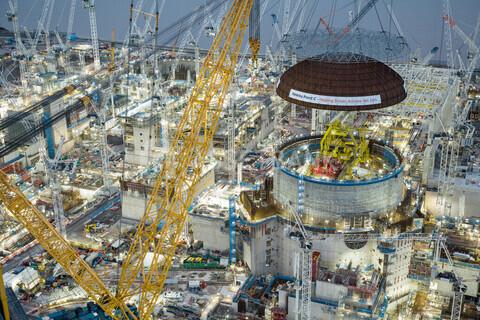
EDF Energy claims that 22,000 people in Britain are working on the Hinckley Point C power station (pictured). This is nine times the size of the Snowy II workforce and almost three times the size of the entire Australian oil and gas extraction industry.
Most of these people would need security clearance and many would need additional training and certification.
If we say that on average it is 3 months training for two thirds of the staff, that is an initial training load of about 900,000 person days, say 1,000,000 days including training the trainers.
ver seven years, that is a cost of about $200m not including students wages.
However, Britain is building two plants in about 17 years. If we want six plants on line by 2065 we would be building a peak of five at one time so the workforce would reach 45-50,000.
With retirements and departures, the training and security bill will be over $700m over thirty years
Fabricating nuclear power stations
Now apart from the lack of skills, we don’t have fabrication workshops with twin 500 tonne cranes and appropriate welding and heat treatment equipment.
These cost about $200m to build and equip.
Further, transport constraints and the distance between projects means that new workshops will probably need to be built near each site as would concrete batching plants etc. Some equipment would be shared but $500m in plant costs is not unreasonable.
Then there is the question of build cost. CSIRO used Korean figures, but they are highly questionable as there have been no public updates since 2018 and the company building and operating the nuclear plants is carrying US$150bn in debt, about two years annual sales.
We do have public data on other reactors, although that data usually doesn’t include all the losses made by contractors such as Westinghouse and Siemens who withdrew from projects after billions in losses.
All these plants are built on existing sites with plentiful cold cooling water and robust transmission access and an established nuclear workforce.
Access to cooling water can’t be dismissed. A single reactor cooling tower evaporates enough water for a city of 350,000 people.
Even without the traditional ‘Australian Premium’ for construction projects, believing we could build plants at less than a 10 percent premium over experienced northern hemisphere countries is stretching credibility, so A$42-45bn each in 2024 dollars is likely with another $2-4bn on water and transmission infrastructure per reactor.
Adding up the bill for nuclear power
ll up the bill is approaching $270bn over thirty years to build enough nuclear capacity to supply about 50-55,000 GWh/y.
If we build the cheapest plant above and somehow manage to give the Americans twenty-three years start and build them for the same cost, it is still close to A$175bn for less than 50,000 GWh/y.
According to the US Department of Energy, fuel, operations, security, maintenance and other overheads are around A$50-65/MWh.
At current cost of capital, amortising the establishment cost over 60 years, finance and depreciation works out at about $400-500/MWh.
Best case total cost of $450/MWh.
Further, as it is not uncommon to have three or four of six plants offline at once for six weeks or more, we would need to maintain even more gas/coal/hydro than we have now to supply 500-600,000 GWh/y of demand in 2060-70.
Or what of wind, solar?
On the other hand, we are currently building enough wind/solar/storage every year to add 7-10,000 GWh/y, roughly the equivalent of one nuclear power plant.
With enough storage to make wind/solar as reliable as nuclear, if the government offered a guaranteed price of A$120/MWh they would be knocked over in the rush.
Further reading:
Nuclear does not mean reliable power for Australia – by Peter Farley
Peter Farley holds an engineering degree and is a manufacturing leader who built pioneering CNC machine tools for export winning many export and engineering awards. Peter has been studying the electricity sector since his 2012 Election to the Victorian Committee of Engineers Australia.
A realistic time frame for building nuclear- by Peter Farley
Aboriginal supporter of right-wing racism, Warren Mundine’s interests in mining uranium -not doing too well.
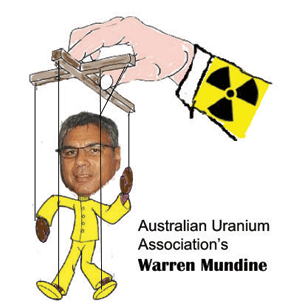
Mundine was one of the two main faces of the “No” campaign against last year’s Indigenous Voice to parliament referendum, campaigning against so-called “elites”.
The Voice “No” campaign was run by far-right lobby group Advance which ran a campaign of aggressively attacking so-called “elites” who it said were behind the Voice.
In fact, as previously reported, the No campaign was bankrolled by a handful of mega wealthy individuals, many with deep ties to the mining and fossil fuels sector.
The struggles facing Aura Energy coincide with a fierce political debate over the future of nuclear energy in Australia, with the federal Opposition calling for a nuclear rollout despite it being vastly more expensive than renewables.
Mundine uranium company shares collapse
ANTHONY KLAN, 9 July 24 https://theklaxon.com.au/mundine-uranium-company-shares-collapse/
A uranium exploration company overseen by businessman Warren Mundine has seen its share price crash after its auditor warned it was in danger of collapse.
Over $60 million has been wiped from the value of ASX-listed Aura Energy since its auditor waived the red flag — and a subsequent emergency capital raising has seen new investors left heavily in the red.
Company document show that on March 15 the auditor of Aura Energy — which states it has “major uranium projects” in “Africa and Europe” — warned there was a “material uncertainty” that it would be able to remain solvent.
Aura Energy had made losses of $9.79m in the 18 months to December 31 and had a remaining cash balance of just $5.86m.
Shares in the company — which is not covered by any analysts or stockbrokers — immediately crashed 33%, to 16.5c.
Aura Energy conducted a capital raising to help it stave off insolvency, but shares it sold under the offer only six weeks ago at 18c yesterday closed at just 13.5c.
Since January — while Australia has been engaged in a fierce debate over nuclear energy — the share price of Aura Energy has halved.
Mundine, who was appointed a director of Aura Energy in December 2021, is a major public advocate of nuclear energy was previously a director of Australian Uranium Association.
The woes facing Aura Energy follow the collapse of the planned $10m IPO of Mundine’s “minerals exploration” company Fuse Minerals in April.
That company, chaired by Mundine, was forced to scrap its plans to float on the ASX after failing to raise enough funds, despite it extending its capital raising period by more than eight-fold, from two weeks to more than four months.
Fuse Minerals had never earned a cent in revenue or conducted a single drill.
Mundine was one of the two main faces of the “No” campaign against last year’s Indigenous Voice to parliament referendum, campaigning against so-called “elites”.
He has repeatedly refused to comment when contacted by The Klaxon.
Company filings show Aura Energy entered a trading halt on March 15 and three days published its accounts for the six months to December 31.
In the six months it lost $2.99m, on the back of $6.80m in losses in the year to June 30, 2023.
In the half-year report, Aura Energy’s auditors Hall Chadwick state there is a “material uncertainty that may cast significant doubt” over the company’s “ability to continue as a going concern”.
In the report Aura Energy’s directors state the company is “dependent on further capital raises or external financing” to stay afloat.
“As the Group is in the exploration stage and does not generate operating cash inflows, the Group is dependent on further capital raises or external financing to maintain operations which results in a material uncertainty which may cast significant doubt on whether the Group can continue as a going concern,” the directors state.
On March 18 — the same day it published those half-year accounts — Aura Energy announced it had conducted a “successful placement” to raise $16.2m from “professional and sophisticated investors” by issuing 90.2m shares at 18c a share.
It would also raise $2m from the public, also at 18c a share, with those shares listed on the ASX on May 30.
Under both raisings, for every four shares bought there were also three “free” attached options, with an exercise price of 30c and a two year expiry. (Meaning they would have value if Aura Energy’s share price goes above 30c in the next two years).
In advertising the public raising, Fuse Minerals said the price of 18c a share was at an “18.2% discount” to the 22c a share they were trading at on the day the offer was announced.
Further, 18c a share was a “23.5% discount” to the average price the shares had been trading at over the five days before the offer was announced.
On the day the public offer shares were listed on the ASX, May 30, the company’s shared were trading at 16.5c.
Yesterday they closed at 13.5c.
At January 1 the company had 623m shares on issue and a share price of 26.5c, giving it a “market capitalisation” of $165.1m.
Yesterday its market capitalisation was $103m, down $62.1m.
The struggles facing Aura Energy coincide with a fierce political debate over the future of nuclear energy in Australia, with the federal Opposition calling for a nuclear rollout despite it being vastly more expensive than renewables.
Mundine and Senator Jacinta Price were the most prominent faces of the “No” campaign against the Indigenous Voice to parliament, which was voted down in October.
Two weeks later Mundine announced he was chair of Fuse Minerals — and that the company was seeking to raise up to $10m and list on the ASX.
The Klaxon subsequently revealed Fuse Minerals owned only one of the nine exploration licences listed in its prospectus — and that its own “independent expert” had warned it was in danger of collapse.
By January Fuse Minerals had raised just $1.86m, well short of the $6m-$10m sought and was legally required to refund money to investors seeking to exit.
On March 28 Fuse Minerals was forced to scrap the offer entirely.
The Voice “No” campaign was run by far-right lobby group Advance which ran a campaign of aggressively attacking so-called “elites” who it said were behind the Voice.
In fact, as previously reported, the No campaign was bankrolled by a handful of mega wealthy individuals, many with deep ties to the mining and fossil fuels sector.
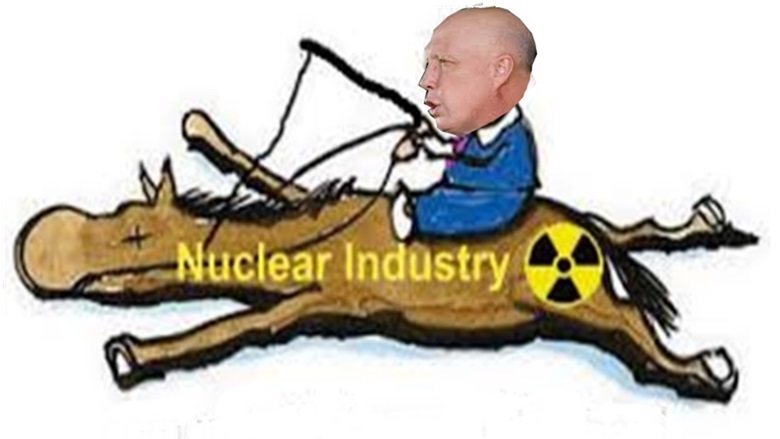
Too uncertain, too slow: funds rule out financing Dutton nuclear plan
The investment bosses of half a dozen funds also agreed there was not enough policy certainty to justify any serious consideration of nuclear energy investments.
In a public consultation paper released in May, the groups proposed excluding nuclear power as a sustainable investment option under the taxonomy as its development is currently illegal in Australia.
AFR, Hannah Wootton 7 July 24
Investment chiefs from the country’s biggest superannuation funds will not bankroll Opposition Leader Peter Dutton’s nuclear power plan, despite strong appetite for other energy transition assets and a shortage of domestic investment opportunities.
Aware Super CIO Damian Graham said the production timelines on nuclear were too long to help meet the fund’s own net-zero targets. His counterpart at UniSuper, John Pearce, said nuclear investments would not make money for members fast enough, while Cbus ruled it out completely.
The investment bosses of half a dozen funds also agreed there was not enough policy certainty to justify any serious consideration of nuclear energy investments.
Broader appetite for private investment in nuclear has been low, with Mr Dutton conceding his scheme will need to be publicly funded despite the Liberal Party’s historic dislike of state-owned energy.
Funds’ dismissal of nuclear also comes as they pour billions of dollars into renewables, and Treasurer Jim Chalmers calls on the $3.6 trillion sector to deploy some of its ever-growing asset pool into “nation building” areas like the energy transition.
“The main reason [we won’t] is the payback time is way too long for us – we’re talking decades, not just years,” Mr Pearce said on possible investments in nuclear.
“We know that nuclear is proven, scalable technology, and you’ve got your ESG considerations as well as economic, but from that economic side, it just doesn’t stack up [as an investment] for a super fund for us.”
Cbus’ CIO Brett Chatfield said: “We don’t see nuclear as a part of the energy transition going forward.”
Cbus, which is chaired by former Labor treasurer Wayne Swan, has been the biggest backer of “nation building” projects to date, including as the only super fund to invest in the government’s controversial Housing Australia Future Fund.
But Mr Chatfield said the fund was “much more focused on the renewable area, particularly onshore and offshore wind and solar” when it came to supporting the energy transition.
Too slow
For Mr Graham, nuclear did not meet the “near time” emissions reduction strategies Aware needed to invest in to meet its energy transition targets.
These include a 45 per cent reduction in scope one and two emissions in its portfolio and net zero by 2050.
“We’re working towards that, and that doesn’t involve investing in nuclear,” Mr Graham.
“If there was a change [in policy] and there were new opportunities, we’d need to understand them … but the general view we have is we need to be making more near-time progress that I think nuclear appears to provide.
“It’s a long-term build, no doubt about it, and we need to be making really clear progress by 2030.”
He pointed to renewables and other transition-supporting technologies as attractive investment opportunities for the $170 billion super fund instead.
Mr Dutton pledged two nuclear power plants would be operational by 2035 under his plan and more potentially by 2037 if he was elected next year, despite the CSIRO estimating the first full operation of a station could be “no sooner” than 2040.
HESTA head of portfolio management Jeff Brunton declined to comment categorically on whether the healthcare workers’ fund would invest in nuclear, but noted some of its decarbonisation targets also had deadlines of 2030 rather than 2050.
It planned to invest 10 per cent of its funds under management into “green solutions” such as renewable energy and cut the carbon intensity of its overall portfolio by 50 per cent by 2050.
“So we need to deploy into those sorts of ideas – batteries, solar, wind farms – now,” Mr Brunton said.
He also noted HESTA would invest in line with the Australian Sustainable Finance Institute and Commonwealth Treasury’s sustainable investment taxonomy, which is currently being developed.
In a public consultation paper released in May, the groups proposed excluding nuclear power as a sustainable investment option under the taxonomy as its development is currently illegal in Australia.
Uncertainty abounds
Other CIOs said proposed policies to introduce nuclear power in Australia were too vague to justify considering investment.
Mr Dutton was criticised when he released his plan to introduce nuclear power to Australia for its lack of detail. He proposed seven sites for government-owned power plants, but did not provide any costing for the scheme and partly relied on technology that is not yet commercially viable.
“We don’t want to front-run [nuclear] saying we see an opportunity when there’s not the policy,” Mark Delaney, who runs AustralianSuper’s $335 billion investment portfolio, said.
He said nuclear was “a classic ESG issue” as it involved looking for long-term issues – in this case decarbonisation – that could positively or negatively affect returns, but there were still too many uncertainties.
“The policy will set the topography which any investment takes place in … [so] when they’ve worked out their policy, we will look for the opportunities.”
Colonial First State CIO Jonathan Armitage was on the hunt for undervalued infrastructure assets to bolster his fund’s unlisted exposure, but said nuclear was not part of that mix.
“Right now, there’s not enough information to make an informed decision,” he said. It would take “a lot more” to enable any serious consideration.
Don’t let Dutton nuclear waste our taxes
Philip White – letter sent to Adelaide Advertiser, 8 July 24
Nuclear proponents have to discredit CSIRO’s costings, or the Coalition’s nuclear energy policy looks ridiculous. They say CSIRO underestimates reactors’ operating lives and utilisation rate.
Due to the time value of money, increasing the lifespan doesn’t make as much difference as you might think. But what sensible person would base their investment decision on 60, or 80, or even 100 year lifespans?
The oldest operating reactor in the world is 54 years old, while the mean age of the 29 units taken off the grid between 2018 and 2022 was 43.5 years.
As for utilisation, the Coalition’s suggested 90% plus rate would actually present a problem for the grid. When demand is low you’d have to shut down all other generation.
But it’s not realistic anyway. Nuclear proponents love to point to France as their poster child, but its utilisation rate in 2022 was just 62%. More than half of its reactors were taken offline due to maintenance or technical problems. It also had to limit output due to problems cooling the reactors during the hot summer.
French nuclear giant scraps SMR plans due to soaring costs, will start over
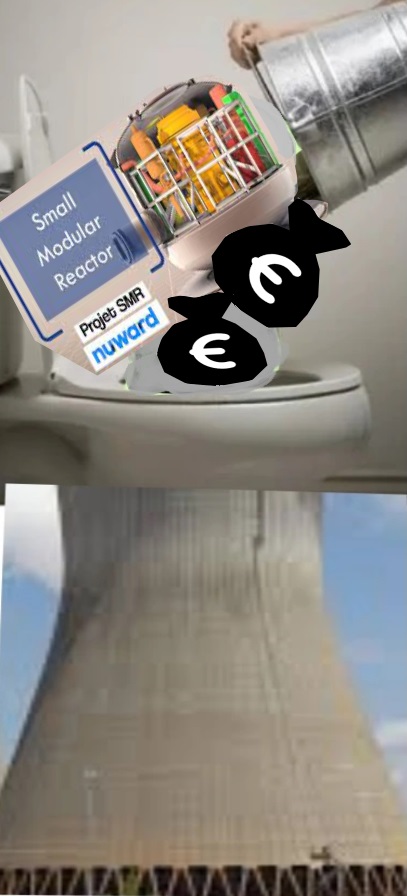
Another Small Modular Nuclear Reactor project goes down the toilet
This time it’s that great nuclear poster boy France that is facing the humiliation and embarrassment of wasting billions on “New Nuclear”
Last time it was the USA with the NuScale fiasco
Giles Parkinson Jul 2, 2024, https://reneweconomy.com.au/french-nuclear-giant-scraps-smr-plans-due-to-soaring-costs-will-start-over/
The French nuclear giant EdF, the government owned company that manages the country’s vast fleet of nuclear power stations, has reportedly scrapped its plans to develop a new design for small nuclear reactors because of fears of soaring costs.
EdF, which is now fully government owned after facing potential bankruptcy due to delays and massive cost over-runs at its latest generation large scale nuclear plants, had reportedly been working on a new design for SMRs for the last four years.
The French investigative outlet L’Informé reported on Monday that EdF had scrapped its new internal SMR design – dubbed Nuward – because of engineering problems and cost overruns. It cited company sources as saying EdF would now partner with other companies to use “simpler” technologies in an attempt to avoid delays and budget overruns.
Reuters confirmed the development, citing an email from a company spokesman that confirmed the program had been abandoned after the basic design had been completed.
“The reorientation consists of developing a design built exclusively from proven technological bricks. It will offer better conditions for success by facilitating technical feasibility,” an EDF spokesperson told Reuters via email.
It’s the latest problem to hit SMR technology, which the federal Coalition wants to roll out in Australia – starting with reactors in South Australia and Western Australia – as part of its goal of keeping coal plants open, building more gas, stopping renewables and putting clean energy hopes on nuclear.
The federal Coalition says it can have the first SMR up and running by 2035, but no SMRs have been built in the western world, and none have even got a licence to be built.
The closest to reach that landmark, the US-based NuScale, abandoned its plans after massive cost overruns and push back from its customers, who refused to pay high prices.
The EdF plans appears to have run into similar problems. Its potential customers, the European energy companies Vattenfall, CEZ and Fortum, wanted guarantees that the SMRs would not have a levelised cost of energy of more than €100 a megawatt hour ($161/MWh) and EdF decided that that was not possible.
It is now not expected to produce its first SMR until the 2030s, at the earliest – even though France is desperate for new reactors to replace its ageing power plants. Because of the costs, it expects to significantly reduce the share of nuclear in its energy mix as it focuses more on large scale solar and offshore wind.
EdF has run into similar problems with its large scale technology. The Flammanville project in France was announced in 2004 with a budget of €3 billion and a deadline of 2012. It is still not in operation and its costs have soared at least four-fold to €13.2 billion.
The Hinkley C project in the UK has been an even bigger disaster. EdF had promised in 2007 that it would be “cooking Christmas turkeys” in England by 2017, at a cost of £9 billion, but is already delayed to 2031 with a spiralling cost of £48 billion when inflation is taken into account, or $A93 billion.
EdF announced another impairment charge of €12.9 billion ($A20.7 billion) from Hinkley earlier this year. It had to be bailed out by the government last year after suffering record losses in 2022 caused by outages at nearly half of its nuclear power plants due to maintenance at its reactors across France.
Tim Buckley, from Climate and Energy Finance, seized on the news and called on Opposition leader Peter Dutton and energy spokesman Ted O’Brien to provide more details of their nuclear plans beyond the one page press release they released last month.
“Come’on guys, how naive do you take the average Australian voter for?” Buckley wrote.
“In your alternate fact world, who do you think will pay for the permanent around 50% increase in Australian energy prices for consumers? Are you really intent on destroying the international competitiveness of Australian industry purely in the service of your fossil fuel funders?”
Numerous cost assessments, particularly by the CSIRO and the Australian Energy Market Operator, have put the cost of nuclear at more than double the cost of wind, solar and storage. But they also point out that first of their kind projects in Australia could cost double that amount, and SMR technology is likely to be even more expensive.
The Coalition has attacked those reports, and the reputation of the CSIRO and AEMO – in concert with a group of so-called “think tanks” and the Murdoch media – but the latest polling from Essential Media suggests that the public might not be buying it.
The poll found that votes believe renewables are the most desirable (59 per cent) and the best for the environment (55 per cent). Nuclear energy was regarded by more as the most expensive (38 per cent versus 35 per cent for renewables).
An overwhelming majority of people aged 18 to 54 thought Peter Dutton’s nuclear energy plan “is just an attempt to extend the life of gas and limit investment in large-scale renewables”, while a majority of those aged over 55 thought the nuclear plan is serious and should be part of the future energy mix, Essential Media’s Peter Lewis wrote.
The federal Coalition has argued that nuclear might be expensive to build, but will deliver cheaper power to consumers. It has not explained how, but it has said that its reactors would be government owned, suggesting that – like France and Ontario – the costs would be borne by taxpayers and the supply of power to customers would be heavily subsidised.
Giles Parkinson is founder and editor of Renew Economy, and is also the founder of One Step Off The Grid and founder/editor of the EV-focused The Driven. He is the co-host of the weekly Energy Insiders Podcast. Giles has been a journalist for more than 40 years and is a former business and deputy editor of the Australian Financial Review. You can find him on LinkedIn and on Twitter.
Unanimous trade union opposition to Dutton’s nuclear plans
Jim Green, 1 July 24
Here’s a list of unions that endorsed a 2019 statement opposing nuclear power in Australia:
Australian Council of Trade Unions, Tasmanian Unions, Unions ACT, Unions WA, Unions SA, Unions NT, Victorian Trades Hall Council, Australian Education Union, Australian Manufacturing Workers Union, Australian Nursing and Midwifery Federation, Australian Services Union, Communication Workers Union, Electrical Trades Union, Independent Education Union (Vic – Tas), Maritime Union of Australia, National Union of Workers, United Voice, and the United Firefighters Union.
And the AWU and MEU are opposing Dutton’s nuclear plans (see below)… the only two unions previously supporting nuclear power.
Seems there is now 100% trade union opposition to nuclear power in Australia?
Undermining the frequent claim from Dutton and Ted O’Brien that ‘high energy IQ’ workers at coal plants will support nuclear power.
Two Labor-aligned unions accused of ‘backflipping’ on their ‘long held’ support for nuclear energy after Coalition policy announcement
Two Labor-aligned unions have been slammed for “backflipping” on their “long held” support for nuclear energy after they attacked the opposition’s nuclear policy despite recently calling on state and federal governments to back nuclear.
Two Labor-aligned unions accused of ‘backflipping’ on their ‘long held’ support for nuclear energy after Coalition policy announcement
Two Labor-aligned unions have been slammed for “backflipping” on their “long held” support for nuclear energy after they attacked the opposition’s nuclear policy despite recently calling on state and federal governments to back nuclear.
Sky News, 1 July 24, , 2024
Two Labor-aligned unions have been accused of “backflipping” on their “long-held” support for nuclear energy, after they attacked the Coalition’s proposal to build nuclear plants on the sites of aging coal plants.
Both the Australian Workers Union and the Mining and Energy Union (formerly the CFMEU’s mining and energy division) have long records of supporting nuclear energy, with the head of the AWU lobbying the government to lift the ban on nuclear as recently as December last year.
Despite this, both the AWU and MEU condemned the Coalition’s nuclear policy after the opposition revealed the seven sites where it is proposing to build nuclear reactors to replace aging coal-fired power plants……..
While neither the AWU or MEU reacted to the policy with images of toxic wastelands, both unions were quick to attack the policy.
The AWU hit out at the Coalition’s plans in a social media message posted just hours after the announcement, describing it as a “half-baked fantasy” that will “slam the brakes on our energy transition and put our industries in peril”.
“The Coalition must give up its nuclear dreaming and back the Future Gas Strategy,” AWU national secretary Paul Farrow was quoted as saying in the post.
In follow up posts the powerful union – which is aligned with Labor’s right faction – followed up with posts stating that this mean “investing now in firmed renewables backed up with gas.”
“It doesn’t mean sitting on our hands for decades to pay more for nuclear if and when it finally arrives,” the AWU post said.
“This proposal has no interest in solving real challenges faced by industry and workers today. Energy is not a political football: it’s our livelihoods. We deserve so much better.”………………………………….
The MEU also attacked the Coalition’s nuclear policy, despite years of advocating for nuclear as a solution to impending job losses from the closure of coal-fired power plants.
In a media release put out on June 19, the MEU described it as a “distraction” that would fail to provide jobs for workers in coal-fired plants before they shut down.
“Now is not the time for distractions. We need to be acting to deliver an orderly transition that focuses on jobs, economic activity in affected regions and positive social outcomes for affected workers while we still have the chance,” MEU General Secretary Grahame Kelly said.
Nuclear industry workers face significant, inevitable and unavoidable radiation health risks
By Tony Webb, 24 June 24, https://johnmenadue.com/nuclear-industry-workers-face-significant-inevitable-and-unavoidable-radiation-health-risks/
Nuclear industry workers face significant, inevitable and largely unavoidable radiation health risks which have so far not been addressed in the debate about Australia possibly buying into this industry.
In addition to the important arguments against the coalition policy that currently proposes building seven nuclear power plants to replace closing coal fired generators, notably that such:
will be likely cost about twice that of firmed renewable generation and take at least 15 years to build – and this in the context where most nuclear plant construction worldwide appears to routinely involve a doubling of both cost and time to build
– and so are dangerously irrelevant to meeting the existential challenge to reduce carbon and methane emissions that are driving climate change;
will require legislative changes at state and federal levels that are to say the least unlikely to be achieved;ignores the challenge of developing workforce skills to manage this technology;
ignores the as yet intractable if not insoluble problem of managing long lived nuclear wastes;
and poses significant risks to the public in the event of nuclear accidents as witnessed in the USA, Ukraine/former USSR, and Japan;
There is also an inevitable and unavoidable risk to workers in the industry and public ‘downwind’ from such reactors from routine exposure to ionising radiation.
This last has to date received little attention and whenever raised results in dismissive but misleading arguments from the nuclear industry advocates, notably that any such exposures to individuals are small and pose little, indeed ‘acceptable’ health risks compared to other risks faced in day to day living and working. Tackling this misinformation as part of the campaign has much to offer in convincing the nuclear target communities and the workers in these that might be seduced by prospects of employment in these facilities that the risks they face are far from insignificant – that, as a community they will face an increase in the incidence of fatal and ‘treatable / curable’ cancers, an increase in other, notably cardio vascular diseases and increased risk of genetic damage affecting children and future generations.
Allow me to introduce myself. I have been an active campaigner on the health effects of ionising radiation since the late 1970s. With two colleagues in 1978 I founded the UK based Radiation and Health Information Service that highlighted the evidence showing the risk estimates from radiation exposure, on which the national and international occupational and public exposure limits were based, grossly under-represented the actual risk.
This radiation-health argument was developed as part of a national campaign that resulted in a significant change of the, until then, pro-nuclear policies of UK unions with members in the industry and a review of Trade Union Congress policy in 1979. It was also an integral part of the union-led national Anti-Nuclear Campaign opposing the Thatcher government’s nuclear expansion – revealed in leaked cabinet minutes as part of the government strategy for undermining the power of the unions, particularly the National Union of Mineworkers (NUM), the Transport and General Workers Union, (T&GWU) and the General and Municipal, Boilermakers’ and Allied Trades union (GMBATU). In late 1980 I took this work on Occupational Radiation risks to the USA establishing the US Radiation and Health Labor Project, auspiced by the Foundation for National Progress / Mother Jones Magazine, that built union support across the country for AFL-CIO policy calling for a reduction in the occupational exposure limit.
Subsequently I worked as a consultant to the Canadian union (CPSU – local 2000) representing workers in the nuclear power industry and built a Canadian coalition of five Unions representing workers exposed to radiation on the job. Linking these North American union demands with those of UK and European unions (also similar concerns from unions in Australia following a 1988 organising tour) reinforced pressures from within the scientific community – notably the US Biological Effects of Ionising Radiation (BEIR) committee.
These sustained pressures led eventually to the International Commission on Radiological Protection (ICRP) reducing the recommended limits for permissible occupational (and public) exposures in 1991. Despite evidence that would have justified a ten-fold reduction (from the 50 mSv annual occupational limit to a limit of 5 mSv) the ICRP limit was only reduced by 40% (to 20 mSv a year but with individual exposures still permitted to 50 mSv in any year so long as the average over 5 years was no higher than 20 mSv).
Since then, a large-scale study of UK, EU, and US nuclear industry workers has shown radiation-induced cancer risks to be on average 2.6 times higher than the estimates used to set the ICRP limits. To put it in simple if statistical terms, the lifetime cancer risk for a worker exposed to the permissible annual dose of radiation over say a 25-year career would be of the order of 6.5% higher than normal. To this should be added the significant health effects of non-fatal cancers, an approximate doubling of the normal rate of cardio-vascular disease and a not insignificant increase in genetic damage to workers children and future generations. Nuclear industry workers face significant, inevitable and largely unavoidable radiation health risks which have so far not been addressed in the debate about Australia possibly buying into this industry.
What needs to be more clearly understood however is that the concern is not just in relation to risks faced by individuals exposed on the job, or from relatively small amounts of radiation released from routine operations of nuclear plants. What is of far greater public concern is the impact of the collective exposure. What is not fully appreciated is that there is simply no safe level of exposure – any dose however small may be the one that causes damage at cellular level in the human body that may show up years later as cancer, genetic damage or some other health effect. it is the total/collective dose that will determine the number of such health effects. Spreading the dose over a larger population will reduce the risk to any individual but not the total health effects. Indeed, it may increase it. An individual affected by cancer can only die once.
These arguments carry weight. They formed a significant part if the discussions within the 2016 South Australian government’s ‘Citizens Jury’ convened to consider proposals to import and store around a third of the world’s nuclear wastes. The concern about radiation and health received special note in the report of this jury to the SA Premier that a two-thirds majority said ‘no – under any circumstances’ to the radioactive waste proposal. The issues can also form the basis for increased collaboration between the trade union, environment, medical reform and public health movements as was the case in the mid 1990s when UK, Labour MP Frank Cook convened a Radiation Roundtable that brought together representatives of these constituencies.
So, within the current debate about a possible Australian Nuclear Power program – alongside the arguments already made about its excessive cost, extended construction time frame, ill-fit within an essential decentralised renewable energy program, risks of major accidents, and the intractable problems of multi-generation waste management, can we please add this concern over health effects that will inevitably result from occupational and public exposures to radiation. Can we particularly focus the attention of trade unions and their members in the seven former coal-fired generation-dependent communities on the effect of these exposures on health of workers who might seek to be employed in operating these facilities and on the health of their families, neighbours, and future generations.
A key demand from unions should be that the occupational limit for annual radiation exposures cbe reduced from the current ICRP level of 20 mSv to a maximum of 5 mSv a year with a lifetime limit of 50 mSV. This revision of standards would put real pressure on the nuclear industry – the current uranium mining and any future enrichment, fuel fabrication, nuclear generation, fuel reprocessing, and waste management – to keep such exposures as low as possible. In the unlikely event of any of the reactor proposals getting the go-ahead there should be baseline monitoring of the health of the community and any workers employed so that any detrimental increase in health effects can be detected early and possibly remediated in the future.
Peter Dutton’s flimsy charade is first and foremost a gas plan not a nuclear power plan

Dutton’s nuclear castle is made of cardboard. Close questioning over the many months until election day will show that behind the costly facade, it’s not so much a nuclear plan, as a plan to give up on our climate targets, turn our back on a clean energy future and burn a lot more gas (and money).
Simon Holmes à Court, 21 June 24, https://www.theguardian.com/commentisfree/article/2024/jun/21/peter-dutton-nuclear-power-plan-gas-energy
Straight from the Donald Trump playbook the opposition leader left Australia with more questions than answers.
Finally, on Wednesday morning Peter Dutton announced his nuclear plan … well, it’s more a vibe than a plan – a flimsy announcement leaving us with more questions than answers.
If there’s any doubt that Dutton has internalised the Trump playbook, here’s an example of how he’s deployed the infamous Steve Bannon technique: “flood the zone with shit”.
The media conference was a stream of falsehoods, empty rhetoric and veiled swipes, deftly delivered with unwavering confidence.
As an energy nerd, there’s a lot I like about nuclear technology, and my long-held interest has led me to visit reactors in three countries. Last year I took a nuclear course at MIT and met nuclear developers, potential customers, innovators and investors, tracing many footsteps of the shadow energy minister, Ted O’Brien.
I strongly believe nuclear power is an important technology – but it has to make sense where it’s used and that requires close questioning. Here are some important questions, and what we know so far.
How to remove the current bans?
Nuclear is banned in Australia by two acts of parliament. Naturally, to repeal the ban the Coalition would need to win back control of the house – a daunting task when they are 21 seats shy of a majority – and control of the Senate, power it hasn’t held since the end of the Howard era.
Once the federal ban is lifted, Dutton needs a plan for lifting state bans in Victoria, New South Wales and Queensland.
The leaders of the Labor governments and their Coalition oppositions in each of these key states have expressed their clear opposition. Dutton rehashed the old quip that you wouldn’t want to stand between a state premier and a bucket of money, indicating that he thinks dangling commonwealth carrots will solve the issue.
They will not be cheap carrots!
Where will the reactors go?
The Coalition has named seven specific locations, two in Queensland, two in New South Wales and one each in Victoria, South Australia and Western Australia, all on sites of retired or soon-to-be-retired coal power stations.
One big problem – the commonwealth doesn’t own any of these sites, and in many cases the owners of the sites have plans to redevelop the sites, such as a $750m battery on the site of the old Liddell power station being built by AGL.
On Wednesday Dutton hinted that if the owners wouldn’t sell the sites, he had legal advice that the commonwealth could compulsorily acquire them. That’ll go down well.
How do we keep the lights on?
Australia’s 19 coal power stations generated 125 TWh of electricity last year. The Australian Energy Market Operator expects all will be retired by 2037. On top of that, our energy demand is expected to increase by more than 230 TWh by 2050. Over the next 25 years we need to build facilities that generate at least 355 TWh every year.
Dutton announced that the Coalition would build five large reactors and two small modular reactors by 2050. This would be about 6.5 GW of new capacity, which at best could be expected to generate 50 TWh a year – less than 15% of the new generation needed.
The Coalition has been quite clear that it wants to see renewable energy development slowed to a crawl. This would leave a massive hole in our energy supply, which could only be filled by extending the life of coal and a massive increase in gas power generation.
This is first and foremost a gas plan, not a nuclear plan.
What will it cost?
Gas is the most expensive form of bulk energy supply in the electricity market … at least until nuclear is available.
Replacing the cheapest form of energy – wind and solar, even including integration costs – with the two most expensive forms can only send energy prices higher.
The Coalition’s announcement is too vague to cost precisely and nobody really knows what SMRs will cost, but a reasonable estimate using assumptions from CSIRO’s GenCost would be in the order of $120bn, or to coin a new unit of money, one-third of an Aukus.
What does this mean for emissions?
An analysis by Solutions for Climate Australia, released before Wednesday’s announcement and which assumes a much more aggressive nuclear build, shows an aggregate increase in emissions by 3.2bn tonnes of carbon dioxide by 2050 – the emissions equivalent of extending the life of our entire coal fleet by 25 years.
While the Coalition has turned its back on Australia’s legislated 2030 target, their talking points say they’re still committed to net zero emissions by 2050. This does not compute. Dutton’s proposal would see high emissions in the electricity sector all the way to 2050 and beyond, blowing our carbon budget and every emissions target along the way.
What if locals object?
For years Coalition members have been running around the country fomenting then amplifying community concern around wind and solar farms. Genuine community consultation, which has sometimes been lacking, is the best antidote to opposition.
Yet the Coalition has made a massive blunder in telling communities exactly where they’ll go before any consultation. Worse, it has adopted a strong-man posture that communities will have to accept that the reactors are in the national interest. It will be fascinating to watch how the Coalition handles local opposition over the coming months.
How will they be built?
With a combination of astronomical costs and zero interest by energy companies, there only ever was one possible owner of a nuclear power station in Australia: the commonwealth government.
One of the biggest challenges will be locking in major contractors. With the high likelihood that a future Labor government would cancel any contracts, no contractor would proceed without very expensive cancellation protection.
When will the reactors come online?
We often hear that a nuclear reactor can be built in eight years. In reality it takes three to four years from signing the contract to completing the civil works to begin ‘construction’, and it would very optimistically take four years to complete site selection, planning, licensing, vendor selection and contracting. Add in the inevitable legal challenges and it’s highly unlikely a reactor could be delivered by 2035 – as Dutton claimed – let alone before the early 2040s.
The newest reactors in the United States took 18 years from announcement to commercial operation, while in the UAE, it took 13 years under an authoritarian regime … and I’m being kind by not mentioning contemporary projects in France, the UK, Finland and Argentina.
Dutton has said he favours the Rolls-Royce SMR, tweeting an artist’s rendering on Wednesday.
These SMRs exist only on paper, yet Dutton wants us to believe he can provide one by 2035. Remember, this is the mob that brought us the NBN and the Snowy 2.0 disaster. This is the team that couldn’t even build commuter car parks.
What about the water and the waste?
I think we can relax a little about water and waste. Yes, nuclear power stations generally require large volumes of water for cooling, but so do coal power stations. By choosing sites with existing access to cooling water, the Coalition has sidestepped this concern.
Public concern around nuclear waste is high, but ultimately the problem is manageable. The waste will be kept on site, likely in dry casks and eventually moved to wherever Australia decides to store its waste from the Aukus program. Nobody has ever been harmed by spent nuclear fuel.
Who will provide disaster insurance?
While serious nuclear accidents are very rare, their costs can be astronomical. The Japan Centre for Economic Research has estimated that total costs related to the 2011 Fukushima Daiichi nuclear accident may reach $350 to 750bn. The only viable solution is for the commonwealth to accept liability.
For a long time the Coalition’s nuclear plan sat beyond the horizon, to be unveiled before the election. But now Dutton’s built a castle and he has to defend it.
Dutton is still learning about nuclear. On Wednesday he said that an SMR would emit only a “coke can” of nuclear waste a year. In reality it would probably produce more than 2,000 times that.
Nuclear energy is complex. He and his team will keep making mistakes. Keith Pitt, a Nationals backbencher told RN Breakfast on the same day that the grid couldn’t handle more than 10% wind and solar power combined. Over the past year the grid has averaged 31% wind and solar.
Some people want to believe there are simple solutions to the complex solutions behind the cost of living crisis, and like his political forebear Tony Abbott, Dutton has a knack for delivering simple messages with cold competence.
But Dutton’s nuclear castle is made of cardboard. Close questioning over the many months until election day will show that behind the costly facade, it’s not so much a nuclear plan, as a plan to give up on our climate targets, turn our back on a clean energy future and burn a lot more gas (and money).
- Simon Holmes à Court is a Director of The Superpower Institute, the Smart Energy Council and convener of Climate 200. Contrary to Coalition belief, he is not a large investor in renewable energy.
Australian Futures: Bringing AUKUS Out of Stealth Mode, and the true financial costs

June 21, 2024, by: The AIM Network, By Denis Bright
With both sides of the mainstream Australian political divide supporting the AUKUS deal, debate about the merits of this commitment by Scott Morrison has largely gone into recess.
As the third anniversary of Scott Morrison’s announcement of the AUKUS deal on 16 September 2021 approaches, there is growing confidence in the defence establishment that Australians have accepted the need for nuclear-powered submarines. The Defence Special Supplement in The Australian (28 May 2024) is a sign of this confidence. Multinational defence companies have lined up to fund advertisements which demonstrated their patriotic commitment to AUKUS with the support of the South Australia Government.
Each of the defence companies listed maintains a profitable involvement in both military and civilian projects. The KBR engineering company of Houston emphasizes a benign involvement in Australian civilian engineering projects like the Snowy Mountains upgrade and the Adelaide to Darwin Railway. This company is more deeply involved in the military sector globally.
Readers with access to the Defence Supplement can undertake their own research to uncover the ownership and activities of each of the British and US companies listed in the supplement. Here is a sample of the defence outreach from KPR Engineering:
KBR’s Defense Systems Engineering Business Unit goes beyond providing full spectrum engineering and technical solutions across the lifecycle of DoD military systems on land, at sea, in the air, and in space. KBR differentiates itself in the industry by integrating emerging technologies with platform experience to deliver increased value to US DoD and our allies.
Advertising in combination with sensational eyewitness news reporting works in eroding resistance to AUKUS. The Lowy Institute has monitored quite favourable public support for AUKUS arrangements:
Expect concerns about AUKUS to resurface in the future as the cost burdens increase and the encirclement of China by the US Global Alliance takes its toll on longer-term trade and investment relationships between Australia and China. Strategic mishaps are always possible as surface vessels and submarines compete for space in the South China Sea, the Taiwan Strait and the East China Sea. Sabre rattling over uninhabited rock outcrops and remote islands has continued for a couple of decades over rival claims about freedom of navigation. Fortunately. There have been no major mishaps.
Ironically, the US has not ratified the UN’s Freedom of Navigation conventions from the 1980s. Its strategic policies seek alternatives to Chinese trade and investment links with countries across the US Global Alliance as an afford to the peace outreach of China:
The costs of the AUKUS extend well beyond the financial and strategic costs of future naval hardware. Australia’s support for the naval encirclement of our best trading partnership will have an unknown impact on our own regional economic diplomacy. Australia’s Future Fund Chief Executive Dr Raphael Arndt dared to warn that global strategic tensions had intruded into financial decision-making and risk assessments (AFR Weekend 15 June 2024). The longer-term impact on Australian trade and investment with China is still a matter for speculation.
Financial Costs of AUKUS
According to Al Jazeera News (11 June 2022), the Albanese government completed a final payment to France of approximately $850 million for breach of contract over the abandonment of the purchase of twelve Attack-class submarines from Naval Group. Despite cost increases and construction delays, delivery of the diesel-electric submarines should have commenced in the late 2020s at a cost that was a fraction of the AUKUS estimates.
The costs of the AUKUS deal are less transparent. Construction costs alone extending over 30 years were initially set at up to $368 billion (AFR 17 March 2023). The extended delivery dates are a cause for concern. US and British supplied nuclear-powered (SSN) submarines might be deployed here in the late 2020s. At least three Virginia class submarines will be built for Australia with a new class of British submarines arriving in the late 2030s before Australian built SSNs come online in the 2040s.
Strategic Risks
Hopefully, the strategic risks of maintaining a new SSN fleet were considered prior to the AUKUS announcement by Scott Morrison on 16 September 2021. How could this have been achieved competently with a critical review from only three cabinet ministers?
Media concerns should have been raised after Scott Morrison claimed in the 7.30 Report interview with Sarah Ferguson that discussions on the AUKUS alternatives were made with just two other ministers at a time when he held multiple ministerial portfolios with the approval of the Australian Governor General between March 2020 and the election in 2022 (14 March 2023).
Before attending the G-7 Summit in Cornwall as a specially invited guest of the Summit Chair Boris Johnson, Scott Morrison had been sworn into the portfolios of Health, Finance, Industry, Science, Energy and Resources, Home Affairs and Treasury. The 47th G-7 Summit convened a month after Scott Morrison’s last two ministerial appointments. Perhaps Boris Johnson could be quizzed on this issue. Both Boris Johnson and Scott Morrison met in person at the G7 Summit in Cornwall (11-13 June 2021). It is logical for them to have discussed the emergent AUKUS deal which was hardly the brainchild of Scott Morrison as claimed by Sky News (27 February 2024).
New SSN submarines place at risk our currently favourable economic diplomacy with China. There are hazards for extended operations in stealth mode in disputed waters. Readers can always investigate the risks of accidental collisions, mechanical malfunction, radioactive hazards and psychological stress on crew members.
Even in friendly waters off Hawaii, the USS Greeneville (SSN-772) surfaced too close to a Japanese fishery high school training ship Ehime Maru. It sank with the loss of nine people on 9 February 2001.
A show of force to diffuse a territorial dispute is an archaic concept. Such gimmicks belong to the pre-1914 era. Both Britain and the US have a long history of involving middle powers in bolstering their strategic outreach…………………………………………………………………………………………………………………………
Both sides of Australian mainstream politics want to hoist those imperial umbrellas at great financial and strategic costs to future generations. Continuing to quiz political insiders about the consequences of their strategic and diplomatic policies is imperative in these troubled times. Asking questions should be imperative for all political parties. https://theaimn.com/australian-futures-bringing-aukus-out-of-stealth-mode/
‘Peter Dutton’s nuclear plan is an economic disaster that would leave Australians paying more for electricity
If we use Vogtle as an example, which is the one completed project that employed Dutton’s favoured Westinghouse AP1000 technology, the extra cost to consumers would be very high.
Almost all nuclear power plants in Europe and North America were constructed in the 1970s and 1980s
The Peter Dutton-led Coalition has announced that, if elected, the government will build seven nuclear power stations located across every mainland state.
One can understand the appeal of nuclear power to those who are unfamiliar with the history of the technology. Nuclear power has been with us for many decades, supplying large amounts of emission-free power across a wide number of democratic, developed countries in Europe and North America. Why wouldn’t we make use of a power source that can be turned up and down independent of the weather and which other developed nations have used for decades?
What many Australians probably don’t realise is that almost all of these nuclear power plants were constructed in the 1970s and 1980s. The technology was then largely abandoned as an option for new power supply. Over the 2000s there was talk of a renaissance of the technology as concerns around global warming grew, and the industry unveiled new “generation 3” designs to address nuclear meltdown risks. Yet this expected renaissance never eventuated, with just five generation 3 nuclear power plants under construction over the past decade across Europe and North America.
There is a very good reason for why the appetite to build new nuclear power stations in western nations that already have nuclear power is minimal. Fans of nuclear like to think this is just because of irrational fears of reactor meltdowns and radiation. But in reality it’s got more to do with the fact that nuclear power plants cost too much to build.
What several countries, particularly France and the United States, encountered during their nuclear build programs over the 1970s and 1980s was that the promised costs for nuclear reactors turned out to be badly underestimated. They also found that things didn’t improve as they built more of these reactors – instead they got worse.
Oxford University professor Bent Flyvbjerg, an expert in construction management, has built up a large database of the time and budget records for 16,000 major construction projects across the globe covering a wide array of fields. He finds that nuclear reactors encounter the greatest budget and time blowouts in his database of construction projects, with the exception of just two other project types. One, worryingly, is nuclear waste repositories, which Australia would also need to build. The other is host city Olympic Games infrastructure. Interestingly, Flyvbjerg’s database also reveals the projects which are most likely to achieve construction timeframes and budgets are wind and solar power.
The poor experience over the 1970s and 80s meant there was almost no new nuclear plant construction commitments in Europe and North America until the second half of the 2000s. The table below [on original] summarises the horrific budget blowouts with the five generation 3 reactors committed to construction since then. Of note is that the two projects in the US used the same reactor model Dutton has indicated he’d like to use – Westinghouse’s AP1000. Also worth noting is actual real world experience indicates costs for nuclear per megawatt of capacity, which are significantly higher than the $8.6m estimated recently by the CSIRO.
What we can see is that, contrary to the promises of nuclear technology companies, generation 3 designs did not improve on past experience of budget blow-outs. It should also be noted that one of these projects – Virgil C Summer – was abandoned prior to completion, as the cost blowouts became too great to bear. Unfortunately for South Carolina energy consumers, this was only after the expenditure of $13.5bn on the failed project.
So what does this all mean for you personally?
Contrary to Dutton’s claims, it means you’ll be paying more on your electricity bill. As the table above [on original] shows, exactly how much more will be subject to wide variation depending on how badly the construction process unfolds, as well as a range of other assumptions.
If we use Vogtle as an example, which is the one completed project that employed Dutton’s favoured Westinghouse AP1000 technology, the extra cost to consumers would be very high. Power retailers would need to pay prices for wholesale energy at least three times higher than what they currently pay to recover the cost of this plant. For the average household that would result in an increase in their power bill in the realm of $1,000 per year from Dutton’s plan to go nuclear.
Tristan Edis is a director at Green Energy Markets – a provider of analysis and advice on energy and carbon abatement policy and markets
Nuclear plan is fiscal irresponsibility on an epic scale and rank political opportunism

The LNP wants to burn untold tens of billions of public money in a nuclear debt bin fire because nuclear is 100% uncommercial – no private investor will touch it with a ten foot pole short of massive multi-decade subsidies.
The LNP wants to burn untold tens of billions of public money in a nuclear debt bin fire because nuclear is 100% uncommercial – no private investor will touch it with a ten foot pole short of massive multi-decade subsidies.
Tim Buckley & AM Jonson, ReNeweconomy, Jun 19, 2024
While the Coalition has failed to release any detail or costings, today we have confirmation that if it gets into office, Australians will be paying a mult-billion dollar “nukebuilder” tax for generations to come for a national build out of government-owned nuclear reactors across seven locations, including on the sites of former coal-fired power stations.
It beggars belief that opposition leader Peter Dutton proposes nationalising a nuclear public debt bomb and detonating it at the heart of energy policy in this country.
This exacerbates the problem that electricity generated from nuclear is two to four times as expensive as power from firmed renewables – as the CSIRO has confirmed – and would permanently lock in higher energy prices for consumers already crushed by cost of living pressures.
The medium term energy price implications are horrendous. Electricity prices would skyrocket as private investment in new replacement capacity is crowded out, resulting in undersupply for the next 15-25 years while we wait for the LNP’s nuclear white elephants to arrive.
We know that firmed renewables – utility scale solar and wind, backed by big batteries, and orchestrated with accelerated deployments of distributed consumer energy resources such as rooftop solar, storage and EVs in a modernised grid – can and will keep the lights on, delivering consistent, secure, reliable and affordable supply at a fraction of the cost. This transition is already underway and accelerating.
Critically, the Coalition’s announcement puts at serious and imminent risk planned private capital investments in clean energy as policy uncertainty and chaos make proposals uninvestable – especially in light of public statements by Nationals Leader David Littleproud that the LNP would, bizarrely, “cap” renewables investment here.
The thought bubble released this week threatens to undermine our energy and economic security and our future prosperity as it creates sovereign risk.
By destroying investor confidence, it deters the private clean energy capital we need to attract at speed and scale – capital for which we are competing with the rest of the world.
The LNP wants to burn untold tens of billions of public money in a nuclear debt bin fire because nuclear is 100% uncommercial – no private investor will touch it with a ten foot pole short of massive multi-decade subsidies.
As the Investor Group on Climate Change, representing energy investors with $35tn in assets, said, there is “no interest” among investors in nuclear, when nuclear has time blowouts up 15+ years and cost blowouts in the tens of billions, and lowest-cost technologies – renewables, batteries and so on – are available to deploy now.
Further, to model our energy transition on the great government-owned public infrastructure debacles of the last quarter century – Snowy 2.0 and the NBN – is an egregious blunder with dire consequences now and for future generations.
The LNP’s Snowy 2.0 was due to be operational in 2021 at a cost of $2bn. After a rolling series of crises, it’s now expected to come online around 2028 and is likely to cost Australians $15bn, a budget blowout of 700%. And we have been lumped with one of the world’s worst, slowest (64th fastest in the world) and most expensive NBNs after a litany of LNP mismanagement.
The idea that nuclear could be up and running in 2035-37 is fanciful. Community opposition, inevitable protracted state and federal legal challenges, technological hurdles and the requirement that nationwide legislative bans on nuclear be overturned make a 2035 timeline impossible.
There is zero mention of how Australia plans to deal with nuclear waste for many centuries to come, or provide for the $10bn per nuclear plant end of life closure costs, another two LNP debt burdens dumped on future generations. The people of Japan are funding the US$200bn cleanup of the Fukushima disaster for the next century.
The international experience shows that the western nuclear industry is plagued with massive delays and cost blowouts. There is zero reason to expect Australia would be any different when the risks for us are higher, as we have no history of deployment of nuclear energy generation here.
The Vogtle nuclear power plant expansion debacle in Georgia, US, is a case point, massively delayed and the most expensive public works project in US history at $35bn, with consumers left to carry the can for the runaway costs.
And the £33bn Hinkley Point C nuclear plant in England – with completion now delayed to 2031 – is a millstone around UK citizens’ necks for the next 60 years or so, even as owner EDF of France took a €12bn writedown on this white elephant after China General Nuclear (CGN) walked away.
Dutton now centres Australian energy and climate policy on nuclear against the explicit and unequivocal advice of our flagship national scientific agency, the CSIRO, which warned that nuclear would take until at least 2040 to stand up in Australia, if legislative bans and other barriers could be overcome, and the energy generated would cost at least twice that of firmed renewables. …………………………………………………………………………… more https://reneweconomy.com.au/nuclear-plan-is-fiscal-irresponsibility-on-an-epic-scale-and-rank-political-opportunism/
Eraring deal signals death of baseload power in Australia, and Dutton’s nuclear fantasy
Giles Parkinson, Jun 4, 2024, https://reneweconomy.com.au/eraring-deal-signals-death-of-baseload-power-in-australia-and-duttons-nuclear-fantasy/
Australia’s biggest coal generator will operate with the same capacity factor as the average solar farm as a result of the deal to delay the Eraring closure. It confirms baseload power has no future in Australia, so what does Peter Dutton think he is going to do with a big nuclear plant?
The one thing that you can say about the federal Coalition energy policy over the last two decades is that it has been consistent, at least in so far as the technology that they don’t want to support: Let’s call it “Anything but renewables.”
Two decades ago John Howard scrapped the then mandatory renewable energy target after being convinced by the fossil fuel lobby of the potential horrors of doubling wind and solar output from just one per cent to two per cent.
Nearly a decade later Tony Abbott scrapped the carbon price, and then tried to do the same with the current renewable energy target, and the institutions that supported it. He was thwarted by an unlikely combination of Al Gore and Clive Palmer, but succeeded all the same in creating a two year investment drought.
Now the Peter Dutton led Coalition is having another crack, albeit from Opposition, demanding that the rollout of large scale renewables – wind, solar and storage – be brought to a crashing halt, and promising to rip up contracts with the commonwealth if they are returned to power.
So absolute is their hatred and fear of renewables that it is just a little surprising that they haven’t yet figured out the alternative for the country’s ageing fleet of increasingly unreliable and highly polluting coal fired power stations.
The Coalition started with a fixation on new coal fired power stations – remember HELE – laughingly called high efficiency, low emissions, but in reality exactly the opposite?
That didn’t last long because they realised that no one would actually want to build one, although if you search into the bowels of X, you might just find a cosplay former Coalition minister still singing the fossil fuel’s tunes.
Then it was the turn of nuclear small modular reactors (SMRs), before it dawned on them that the sort of machines the travelling salespeople had been talking to them about with such enthusiasm don’t actually exist – and probably won’t for a while and will likely be terribly costly when they do.
Clean Energy Council boss Kane Thornton on Tuesday described the push for nuclear – six times more costly than renewables and storage and two decades until it could possibly be produced for the first time in Australia – as a “mad-hatters’ tea party”. That is the almost unanimous view in the energy industry, but the FUD – fear uncertainty and doubt being spread by the Coalition and right wing media creates a different picture in the public arena.
The nuclear boosters thought they had a victory last month when they assumed the delay in closing the country’s biggest coal generator Eraring was vindication of their insistence that wind and solar won’t work, and that the only way to replace centralised fossil fuel generation is with another centralised baseload fuel source.
But the extraordinary – and many say unnecessary – deal struck by the NSW government and the Eraring owner is anything but.
Yes, the 2.88 GW official closure is pushed back by two years – not because wind, solar and storage can’t do the job, but because it hasn’t been built quickly enough, and that’s the fault of both Eraring owner Origin and the state government.
The delay is not due to reliability concerns because there is no obligation on Eraring to be producing power at the time that the market operator says it will need it most – the “tail risk” events that might occur in the middle of summer, for instance, when an intense heatwave creates a surge of demand and renders other generation useless.
The extension is really just about the risk and fear of high prices – exacerbated by the delays in new projects – and the fact that these might occur in the lead up to the next election in early 2027.
One thing that the government can observe is that the energy industry exercises no self control about bidding practices, which is why an automatic price cap had to be imposed last month when a bunch of coal generators were out of action. There is no doubt that, given the same opportunity, they will repeat the dose.
But here’s what the Eraring deal really tells us, and it’s a big problem for Opposition leader Peter Dutton’s nuclear fantasies: It’s a signal – indeed confirmation – that the concept of “baseload” power – interpreted by most as “always one” generation and the fundamental back drop to energy markets for half a century – is now dead in the water.
The deal with the government only requires Origin to operate Eraring at just one quarter of its rated capacity, about the same capacity factor as your average solar farm, and less than most wind farms.
The deal requires it to provide little more than one third of its recent average annual output – just 6 terawatt hours. Last year it produced 16 TWh. That’s partly because the plants are getting old – but it’s also because there is simply no room in the grid for an ‘always on’ big baseload generator any more.
This has been admitted by the owners of Eraring, Origin Energy, for some time. It was clear more than a decade ago that this was going to happen, and Origin admitted as much in 2018. “The idea of base-load power stations is well and truly gone,” said Greg Jarvis, the head of markets said then.
It is expected that Origin will cycle two or three of its Eraring units over summer, and perhaps just one over winter. One thing that is for sure, it won’t be running at baseload, and so won’t likely be in the market for so-called “baseload” swaps. Which means, according to some analysts, it might just pick the moments when prices are higher.
Running a big baseload plant at low capacity factors, is clearly not economic, at least at face value. So if Origin can’t pick high priced moments for Eraring, it has at least the security of having the NSW taxpayer on the hook to underwrite its looses – up to a hefty $225 million a year – and pay for any major equipment upgrades.
The other private operators of coal generators in Australia agree that baseload is dead as a concept. AGL says there is simply not the demand to operate coal fired power stations as “baseload,” and EnergyAustralia is pushing for contracts that will allow its last remaining coal generator, Mt Piper, to switch off completely in certain seasons.
There is speculation that its Yallourn generator in Victoria will end up doing the same thing, notwithstanding the current but hidden contract to keep it open until 2028.
The CSIRO, of course, took this into account when estimating its generously low costs for large-scale nuclear in the recently released final version of the GenCost report.
The Coalition and its supporters howled their disapproval. Energy spokesman Ted O’Brien wants the CSIRO to calculate capacity factors of 92 per cent, without ever explaining how this can possibly fit into a grid where rooftop solar in many states already accounts for all, or nearly all, daytime demand.
It’s not the only problem with large scale, of course. There are questions about the need for more standby capacity for such large machines (1.4 GW) and there is the question about critical system services which in many other countries nuclear is given a grid pass on because it requires them to produce less power, which they don’t like doing.
The nuclear lobby has also been absolutely insistent that the CSIRO include integration and transmission costs for wind and solar, which the CSIRO has done. Curiously, they haven’t said a peep about the considerable integration, storage and transmission costs for nuclear, which are not included in the CSIRO report.
There was a big range of reactions to the Eraring decision – from frustration and anger from those who think it is not needed and not justified, to quiet resignation and a roll of the eyes from many in the energy market, and as some sort of validation for the renewable naysers and nuclear junketeers.
One of the most inventive responses came from the Centre for Independent Studies, which decided that fossil fuel subsidies, like the $450 million offered to Eraring to keep less than half its output going for another two years, are really subsidies to the renewable energy industry, because – they argue – it is in response to its failures.
Full marks for creativity, but none for reality. The nuclear boosters have decided, like Donald Trump, that the best way to disguise a dud deal is to make ever more outrageous claims.
It underpins the carefully choreographed claims that nuclear is cheap (it’s not), that everyone is doing it (they are not), that nuclear can be built in Australia faster than anywhere else in the world (it can’t), and that is the only technology that can keep the lights on (clearly not true)..
Denial has morphed from climate change to technology. But it doesn’t stack up. If the lowest cost “baseload” can’t find room in the market, then there’s not much hope for the most expensive “baseload.” And climate science tells us there is no time to wait.
Scott Morrison on the revolving door- government nuclear AUKUS deal, to Dyne, company advising on AUKUS
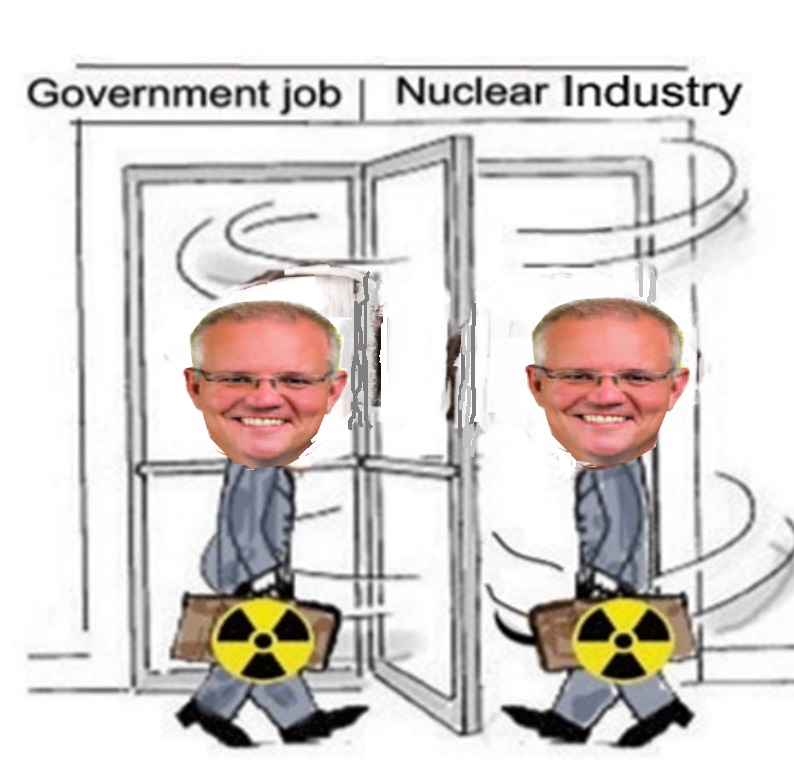
As a strategic advisor to DYNE, Morrison hopes to advance investment in dual-use technologies — inventions that have military and civilian applications. That innovation is being helped by the second pillar of AUKUS, the one that has to do with tearing down military-industrial trade barriers between the US, UK and Australia.
Facing post-Parliament poverty, multitasking Morrison looks to seafloor for riches
What to do when your taxpayer-funded salary drops from $549k, to $225k, to nothing? Multitask, of course.
Crikey, ANTON NILSSON, MAY 30, 2024
Scott Morrison has yet another new job — and like some of his other post-Parliament gigs, it’s tangentially linked to the AUKUS submarine pact he helped set up as prime minister.
The Age reports Morrison is listed as a strategic advisor at a newly created venture called the Seafloor Minerals Fund, alongside ex-US secretary of state Mike Pompeo. Both men are also behind venture capital firm DYNE, set up to support the strategic goals of AUKUS, and which also has interests in deep sea mining, according to the story.
Crikey figured it was time to have another look at Morrison’s post-politics career.
In need of cash …………………………………………..
Multitasking
So what has Morrison done to set himself up for success? His LinkedIn lists three jobs: author, non-executive vice chairman of American Global Strategies, and board member at “various companies”. The voters who brought you Scott Morrison want stronger anti-corruption protectionsRead More
As an author, he’s already published his first work: the religious memoir Plans For Your Good. The book was aimed at the $1.175 billion US Christian book market, but in Australia, it’s reportedly sold very few copies so far.
At American Global Strategies, Morrison is working with two former Donald Trump staffers to “help clients navigate a highly dynamic geopolitical landscape that presents risks and opportunities”, in the ex-PM’s own words.
As a strategic advisor to DYNE, Morrison hopes to advance investment in dual-use technologies — inventions that have military and civilian applications. That innovation is being helped by the second pillar of AUKUS, the one that has to do with tearing down military-industrial trade barriers between the US, UK and Australia. The new gig, with the Seafloor Minerals Fund, will set Morrison and Pompeo up for taking advantage of the estimated trillions of dollars in rare metals estimated to be on the seafloor. According to The Age, Australians can expect a fierce future debate about the merits and risks of mining the seabed for minerals, as China seeks to do the same. https://www.crikey.com.au/2024/05/30/scott-morrison-seafloor-minerals-fund/?utm_medium=Social&utm_source=Twitter#Echobox=1717042244
1 This month

of the week – Australians for War Powers Reform (AWPR)
To see nuclear-related stories in greater depth and intensity
 Antinuclear