CSIRO stands by nuclear power costings that contradict Coalition claims

The Coalition has attacked the GenCost report that found nuclear power plants would be at least 50% more expensive than solar and wind
Graham Readfearn, 29 May 24, https://www.theguardian.com/australia-news/article/2024/may/29/csiro-nuclear-power-plant-australia-cost-peter-dutton-liberal-coalition
The CSIRO says it stands by its analysis on the costs of future nuclear power plants in Australia after the Coalition attacked the work, which contradicted its claims reactors would provide cheap electricity and be available within a decade.
The opposition’s energy spokesperson, Ted O’Brien, claimed on Tuesday in the Australian newspaper that the CSIRO should re-run its modelling to account for longer life-spans and running times of nuclear generators in other countries with nuclear programs.
Last week the CSIRO released its GenCost report on the costs of different generation technologies, saying nuclear would be at least 50% more expensive than solar and wind and would not be available any sooner than 2040.
The Coalition has yet to reveal any detail on its nuclear plan, including what type of reactors it would build, how large they would be and where they would put them.
A CSIRO spokesperson told Guardian Australia: “CSIRO provides impartial and independent advice and does not undertake modelling for specific policy directions.
“While we stand by the data provided, any alternative scenarios assessed by others would not carry CSIRO’s endorsement.”
O’Brien pointed to an assumption used in the GenCost report that nuclear plants would have a “capacity factor” – how often they are generating electricity relative to their maximum capacity – of between 53% and 89%.
O’Brien wanted the CSIRO to use a higher figure of 92.7% for nuclear based on the performance of plants in the US.
But the GenCost report discusses the reasons for setting capacity factors, saying new baseload generators such as nuclear “are expected to struggle to present the lowest cost bids to the dispatch market” and would, therefore, likely be generating less often.
O’Brien also wanted the CSIRO to model the full lifespan of nuclear plants – which could be as long as 80 years – and to add a start date of 2035 to its modelling.
The report provides cost estimates for power from different generation technologies, including both large and small reactors, for the years 2023, 2030 and 2040.
The CSIRO spokesperson said: “Specific issues in regard to economic life of generation assets and capacity utilisation, including large scale nuclear, have been assessed by the GenCost team as part of the consultation process for the 2023-24 report.”
Australia has never built a nuclear reactor for electricity and the technology has been banned since 1998.
The CSIRO report said if a decision was made in 2025 to adopt nuclear power, it would be at least 15 years until a reactor was producing power.
The report said: “Nuclear technologies need to undergo more extensive safety and security permitting, nuclear prohibitions need to be removed at the state and commonwealth level and the safety authorities need to be established.”
The report estimated if Australia could establish a nuclear industry, then a 1,000MW plant would cost $8.6bn, but the first reactors could cost double that amount – more than $17bn.
The report said: “Given the lack of a development pipeline and the additional legal and safety and security steps required, the first nuclear plant in Australia will be significantly delayed. Subsequent nuclear plant could be built more quickly as part of a pipeline of plants.”
Nuclear will cost Queensland jobs

JOINT STATEMENT Premier The Honourable Steven Miles, Minister for Energy and Clean Economy Jobs, The Honourable Mick de Brenni, 13 May, 2024 https://statements.qld.gov.au/statements/100305
- The LNP backed “Nuclear for Climate Australia” has identified multiple sites in North Queensland for nuclear reactors.
- This would see nuclear reactors in Townsville, the Sunshine Coast, Rockhampton, Brisbane Valley, Toowoomba, the Darling Downs and more.
- LNP going nuclear risks Copperstring jobs, critical minerals boom for Townsville to Mount Isa
- Labor backs clean and renewable energy not nuclear.
- The Miles Government is already delivering jobs and clean energy through the Queensland Energy and Jobs Plan and development of the SuperGrid.
- Those jobs would be at risk with the LNP’s nuclear plans.
The Miles Government is focussing on clean energy jobs and has a working plan for a safe and responsible transition to renewable energy, that will protect existing jobs and create new ones.
Queenslanders from Townsville to Mt Isa are at the heart of Labor’s leading plan for a clean economy future.
Our plan to build CopperString will provide more than 800 jobs during construction and will unlock the $500 billion North West Minerals Province, by linking it with Hughenden and up to 6,000 MW of renewable energy.
This is the nation’s largest expansion to the power grid and it is paid for by progressive coal royalties.
By putting their fossil fuel friends before Queensland’s transition, the LNP is risking thousands of jobs and return to high unemployment.
The LNP’s nuclear option is an LNP recipe for a cost-of-living meltdown. Nuclear is the most expensive option. It is 5 times the price of renewables.
International examples show it will take around 19 years to build a nuclear power station.
This is decades too late for Townsville employers who need clean, affordable energy now to remain competitive.
Nuclear is neither clean nor renewable. And it’s illegal in both Queensland and Australia.
The LNP backed proposal targets nuclear power stations in Townsville, Gladstone, Sunshine Coast, Toowoomba, Brisbane Valley, Ipswich, Darling Downs, the Western Downs, Rockhampton, and Callide.
Quotes attributable to Premier Steven Miles:
“The LNP are proposing nuclear reactors right across this state. Up to three near Townsville, while they have earmarked locations on the Sunshine Coast, Toowoomba, Brisbane Valley and Ipswich.
“What we know about those nuclear reactors is that they will be much more expensive. As much as five times more expensive for your household power bills.
“We also know that as a result of those reactors, future generations of Queenslanders will have to manage nuclear waste forever.
“That’s the LNP’s plan. Higher prices and nuclear waste; putting our waterways, our environment and our beautiful state at risk.”
Quotes attributable to Energy Minister Mick de Brenni:
“Everyone from Townsville Enterprise to the Queensland Resources Council backs Labor’s plan on renewable energy, because Copperstring means jobs and long-term prosperity for the region.
“The only exception is the LNP, who voted in Parliament to oppose the Energy and Jobs Plan, because they are opposed to renewables and public ownership.
“It seems that everybody in Townsville wants local manufacturing and jobs here, except David Crisafulli, who will not stand up to Peter Dutton and Ted O’Brien and actually back Townsville jobs.
“We know how risky and expensive nuclear is and we know David Crisafulli deserted North Queensland for the glitter strip on the Gold Coast, and now he’s setting Townsville up for an unemployment and cost of living meltdown.
“North Queensland already has the world’s best plan to protect local jobs through the transition, so why would the LNP turn its back on the Queensland Energy and Jobs Plan and Copperstring, just so they can cosy up to their big donors?
“Labor is backing renewable energy because it protects jobs in North Queensland, from Townsville to Mt Isa and beyond, and Labor is not prepared to risk those jobs.”
Quotes attributable To Thuringowa MP Aaron Harper:
“I do not want to see a nuclear reactor in Townsville and anywhere near the banks of the much loved and well used Ross River.
“Nobody in Thuringowa and the Upper Ross will accept nuclear waste travelling down Riverway Drive.
“We know the LNP back nuclear energy and are against renewable energy.
“We know that David Crisafulli and the state LNP are too weak to stand up to Peter Dutton’s nuclear agenda.
“There are serious questions to answer from the LNP about their connections to Nuclear for Climate’s plan for nuclear power in Townsville.
“Peter Dutton and David Crisafulli’s nuclear agenda pose an unacceptable risk to Townsville.”
Background information:
- Nuclear for Climate Australia, which has the backing of the Coalition, has identified multiple sites in Queensland as ideal spots to host nuclear reactors.
- Nuclear power is currently illegal in Queensland.
- Miles Government is delivering cheaper, cleaner, reliable power to develop the North West Minerals Province.
- Nation’s largest expansion to the power grid – SuperGrid, not a MiniGrid.
- CopperString will connect nation’s largest renewable energy zone at Hughenden and power a critical minerals industry that will supply world’s transition
- CopperString will be 100% publicly owned
Fast Facts
- Nuclear power production is prohibited under two pieces of legislation:
- Australian Radiation Protection and Nuclear Safety Act 1998
- Environment Protection and Biodiversity Conservation Act 1999
- CSIRO estimate the capital cost of small modular reactors in 2030 to be $15,959/kW, compared to wind at $2105/kW and solar at $1134/kW.
Nuclear more than 6 times the cost of renewables – report

20 May 2024, https://www.aumanufacturing.com.au/nuclear-more-than-6-times-the-cost-of-renewables-report
An independent report by consulting and engineering firm Egis and commissioned by the Clean Energy Council has confirmed that nuclear is the most expensive form of new energy in Australia.
The review analysed the CSIRO and Australian Energy Market Operator (AEMO)’s GenCost report against the Lazard Review and the Mineral Council of Australia (MCA)’s research into Small Modular Nuclear Reactors.
The report found that nuclear energy is up to six times more expensive than renewable energy and even on the most favourable reading for nuclear, and that renewables remained the cheapest form of new-build electricity.
Nuclear may be even higher cost than forecast as waste management and decommissioning of nuclear plants had been omitted in cost calculations.
The report also found:
- The safe operation of nuclear power requires strong nuclear safety regulations and enforcement agencies, none of which exist in Australia
- And the economic viability of nuclear energy will further diminish as more wind, solar and battery storage enters the grid.
“Put simply, nuclear plants are too heavy and too slow to compete with renewables and can’t survive on their own in Australian energy markets.”
Clean Energy Council Chief Executive Kane Thornton, said households would need to pay a hefty price to subsidise nuclear reactors.
Thornton said: “Taxpayers also need to understand the costs that will be borne if they are forced to foot the bill for building a nuclear industry from scratch over a period of decades.
“Nuclear power is also a poor fit with our increasingly renewable power system.
“Nuclear power stations are expensive and have to run constantly in order to break even – but that doesn’t work in a world with an abundance of cheap renewables.”
The Egis report also found the MCA’s research on Small Modular Reactors (SMRs) did not anticipate the current long delay in SMR projects around the world.
How long does it take to build a nuclear reactor? We ask France

Sophie Vorrath, May 8, 2024, https://reneweconomy.com.au/how-long-does-it-take-to-build-a-nuclear-reactor-we-ask-france/
A short answer to this question might be, it depends who you ask. Ask Opposition leader Peter Dutton, for instance, and he will tell you a federal Coalition government under his leadership could have a nuclear power plant up and running in Australia within a decade.
Ask the highly experienced French state-owned nuclear power giant EDF, which manages 56 reactors in the world’s most nuclear dependent country, and you would get rather a different answer.
Bloomberg reports that EDF this week got regulatory approval to start up its newest nuclear reactor, the 1.6GW Flamanville plant in France’s north west – a milestone that is 12 years behind schedule and more than four times over budget, thanks to a range of construction problems including concrete weakness and faulty pipe welds.
The green light allows EDF to load the fuel in the reactor, proceed with trials, then begin operations, the Autorite de Surete Nucleaire said in a statement on Tuesday. Further approvals will be needed upon reaching key milestones during the trial phase, the regulator said.
According to other reports, EDF said last month it hoped to connect the Flamanville pressurised reactor to the national grid by the European summer and reach full power by the end of the year.
But it will not be smooth sailing from there. A faulty vessel cover still needs replacing at the plant, with reports suggesting this has been pushed out to 2026, when the plant would be shut down for up to a year.
Meanwhile, EDF in March raised its cost estimate for the construction of six new nuclear reactors to €67.4 billion ($A102.5 billion), Reuters has reported, up from the company’s first estimated their cost of €51.7 billion.
So, how long does it take to build a nuclear reactor?
Kobad Bhavnagri, Bloomberg New Energy Finance’s energy expert and global head of strategy says the long delay and cost blowout at Flamanville 3 is not an isolated incident.
“Very similar delays and multifold cost blowouts have occurred with recent reactor builds in the UK, Finland and USA,” Bhavnagri writes on LinkedIn.
“Countries with well established nuclear industries.
“The lesson here? Don’t believe anyone who says they know how much it will cost and how long it will take to build a new nuclear plant (unless they are in China).”
Critical worker shortage menaces nuclear-powered submarine workforce

INDUSTRY, 29 APRIL 2024, By: Liam Garman
The document, sourced through a freedom of information request from former independent senator for South Australia Rex Patrick, examined the civilian nuclear workforce required to maintain a nuclear reactor plant.
According to the document, Australia will require over 75,000 additional electricians, construction managers, metal machinists and welders in its “feeder workforce”, a term for Australia’s pool of workers that are eligible to pursue a career in the submarine workforce.
In particular, by financial year 2030–2031, Australia will require:
- An additional 33,553 electricians;
- An additional 19,364 construction managers;
- An additional 11,753 metal machinists;
- An additional 12,280 welders.
The figures were assessed by calculating the difference between the projected demand and supply of skilled workers.
The document warns that the total shortfall will be even larger than the initial figures, confirming that the totals do not include additional demand produced by the nuclear-powered submarine industry.
The report raises an alarm for policymakers, noting that Australia has neither a skilled nuclear-powered workforce to leverage for the construction and maintenance of nuclear-powered submarines, nor does it have a big enough pool of eligible candidates.
“There is no current Australian talent pool with the required mix of qualifications, skills, experience, and behaviours to fulfil the civilian nuclear workforce roles,” the document read……………………………………………………………
Defence may also face additional constraints with the decision to build the SSN-AUKUS at Osborne in South Australia and maintain the capability in Henderson in Western Australia.
The research found the greatest feeder workforce is located in NSW, followed by Victoria and Queensland, while the state with the fewest skills is South Australia. https://www.defenceconnect.com.au/industry/13993-critical-worker-shortage-menaces-nuclear-powered-submarine-workforce
Secret Agreements: The Australian-Israel Defence Memorandum of Understanding

Elbit Systems, Israel’s notorious drone manufacturer and creator of the Hermes 450 aerial device responsible for this month’s killing of seven World Central Kitchen aid workers including the Australian national, Lalzawmi “Zomi” Frankcom, was rewarded with a A$917 million contract. Business, even over bodies, exerts a corrupting force.
Binoy Kampmark, 14 Apr 24, https://theaimn.com/secret-agreements-the-australian-israel-defence-memorandum-of-understanding/
While the Australian government continues to pirouette with shallow constancy on the issue of Israel’s war in Gaza, making vacuous utterances on Palestinian statehood even as it denies supplying the Israeli Defense Forces (IDF) with weapons (spare parts, it would seem, are a different, footnoted matter), efforts made to unearth details of the defence relationship between the countries have so far come to naught.
The brief on Australian-Israel relations published by the Department of Trade and Foreign Affairs is deplorably skimpy, noting that both countries have, since 2017, “expanded cooperation on national security, defence and cyber security.” Since 2018, we are told that annual talks have been conducted between defence officials, while Australia appointed, in early 2018, a resident Defence Attaché to the embassy in Tel Aviv. What is conspicuously absent are details of the Memorandum of Understanding on defence cooperation both countries signed in 2017.
A little bit of scrapping around reveals that 2017 was something of a critical year, a true bumper return. The Australia-Israel Defence Industry Cooperation Joint Working Group was created that October. A following Australian Defence media release notes the group’s intention: “to strengthen ties between Australia and Israel, explore defence industry and innovation opportunities, identify export opportunities, and support our industries to cooperate in the development of innovative technologies for shared capability challenges.”
The intentions of the group were well borne out. Defence contracts followed with sweet indulgence: the February 2018 contract between Israel-based Rafael Advanced Defence Systems with Australia’s Bisalloy Steels worth A$900,000; an August 2018 joint venture between the Australian defence engineering company Varley Group and Rafael, behind such “leading weapons systems” as “the Spike LR2 anti-tank guided missile”; and the Electro Optic Systems-Elbit Systems agreement from 2019 responsible for developing “a modular medium-calibre turret that can be configured for a range of platforms, including lightweight reconnaissance and heavy fighting vehicles.”
In February this year, Elbit Systems, Israel’s notorious drone manufacturer and creator of the Hermes 450 aerial device responsible for this month’s killing of seven World Central Kitchen aid workers including the Australian national, Lalzawmi “Zomi” Frankcom, was rewarded with a A$917 million contract. Business, even over bodies, exerts a corrupting force.
In a heartbeat after the outbreak of the latest Gaza War last October, the Australian Greens filed a Freedom of Information (FOI) request seeking a copy of the barely mentioned MOU. After a period of three months, the Australian Defence Department reached the boring conclusion that the application should be rejected. It fell, the argument went, within the category of exemptions so treasured by secretive bureaucrats keen to make sure the “freedom” in FOI is kept spare and bare.
What follows is repulsive to intellect and denigrating to morality. “The document within the scope of this request,” went the letter from the Defence Department, “contains information which, if released, could reasonably be expected to damage the international relations of the Commonwealth.” The MOU “contains information communicated to Australia by a foreign government and its officials under the expectation that it would not be disclosed.” Releasing “such information could harm Australia’s international standing and reputation.”
A telling, and troubling role was played by Israel in the process. With characteristic, jellied spinelessness, Australian defence officials notified Israel of the FOI request in December 2023. In February, the Netanyahu government responded with its views, of which we can only speculate. The Greens were duly informed by the Australian Information Commissioner (OAIC) that the relevant decision maker in Defence “will consider the foreign government’s consultation response to make an informed and robust decision.” With such words, a negative response was nigh predictable.
Greens Senator David Shoebridge, in responding to the decision, was adamant that, “There is no place for secret arms treaties and secret arms deals between countries.” Furthermore, there was “no place for giving other countries veto power over what the Australian government tells the public about our government defence and arms deals.” The case is even more pressing given allegations of war crimes, crimes against humanity and genocide taking place in the Gaza strip.
This regrettable episode retains a certain familiar repulsiveness. Unfortunately for devotees of open government, a fraught term if ever there was one, Australia’s FOI regime remains stringently archaic and pathologically secretive.
Decision makers are given directions to frustrate, not aid applications to reveal information, notably on sensitive topics such as security, defence and international relations. Spurious notions about damage to international relations are advanced to ensure secrecy and the muzzling of debate. The OAIC has also shown itself to be lamentably weak, tardy and inefficient in reviewing applications. In March 2023, it was revealed that almost 600 unresolved FOI cases had bottled up over the course of three years.
The latest refusal from the Defence Department to disclose the Israel-Australian MOU to members of Parliament, a decision reached after discussions with a foreign power (that fact is staggering and disheartening in of itself), betrays much doubletalk regarding defence ties between Canberra, the IDF, and the Israeli government. More than that, it confirms that those in Canberra are being steered by other interests, longing for the approval of foreign eyes and foreign interests.
Coalition nuclear plan would force consumers to wait 20 years longer for 30% higher electricity bills
ReNewEconomy, Ben Rose, Apr 11, 2024
The Coalition is making unproven assertions that 100% ‘zero emissions’ electricity can be provided more cheaply and reliably by nuclear than renewable energy. It has even proposed sites for nuclear reactors, including Collie in Western Australia, which currently has three coal fired power stations.
This article compares weighted average levelized cost of energy (WALCOE) for nuclear grid scenarios, with those of renewable energy (RE) grid scenarios for Western Australia’s South West Integrated System (SWIS). The modelled scenarios deliver 95% and 100% near zero emissions energy (Table 1)
Much has been written about the impediments to nuclear in Australia, including laws prohibiting it, storage of nuclear waste, costly insurance/ underwriting of plants, 10-15 year lead time, the unavailability of commercial small modular reactors and likely cost overruns, all of which would add to the cost.
LCOE modelling does not include any of these ‘externalized items’ and therefore considerably underestimates the real cost of nuclear.
In this analysis I have used the renewable energy modelling software SIREN and my LCOE modelling software PowerBalance2, which uses the formula: WALCOE of grid scenario = (sum annualized amortized capital costs plus fixed costs plus variable costs including fuels, of all power stations) / grid annual energy demand.
Capital costs, technology, life time and interest rates are from CSIRO, 2024 Gen Cost draft report, 2024. (Appendices B2, B5, B6).
From Table 1 [on original] it is clear that scenario 1, ‘RE generation with 8 hour batteries plus 24 hr pumped hydro storage (PHS)’ would deliver the lowest cost 95% near zero emissions (NZE) scenario at $119/MWh.
Converting the OCGT generation to green hydrogen (H2) at an assumed cost of 5 times natural gas gives a 100% scenario costing $133/ MWh, which is still 28% cheaper than replacing Collie coal with nuclear and provides the rest of the energy requirements with RE.
All scenarios assume 1.66 times 2017 demand, which should be enough to cover 2030 demand including vehicle electrification………………………………………………
The lowest cost nuclear option is replacing the existing 1550 MW of coal generators at Collie/ Muja with 1800 MW of nuclear, assumed to be small 300 MW units, allowing one to cover down time.
If this were commenced in 2027, the earliest possible for a Coalition government to initiate it, renewable energy installation would slow from that date and the nuclear plant would not be completed until after 2040. Table 1 shows the cost of this scenario is $171/ MWh, 28% higher than ‘RE with batteries and pumped hydro (PHS)’.
Due to its inability to switch on and off and ramp below 50%, nuclear has to continue to generate even when much lower cost RE is available and has to be spilled (See Figure 2). This is the major issue that makes nuclear unsuitable for integration with RE.
‘Nuclear with Existing RE’, (scenario 5 in Table 1) is the other ‘less implausible’ scenario. RE build is curtailed in 2027 and 3900 MW of nuclear would be completed after 2040. This would provide electricity at $203/ MWh, which is 59% higher the RE scenario 1.
Scenarios 6 and 7 – ‘Nuclear and natural gas’ and ‘Nuclear only’ – are included for cost comparison only. They could never be implemented as the electricity cost is exorbitant – 80% and 115% respectively higher than the RE equivalent scenarios.
Also, existing and planned RE – about 1300 MW of wind and 2000 MW of mainly rooftop PV – would have to be decommissioned.
The unthinkable situation of doing nothing until 2040 then waiting until 2055 for a nuclear near zero emissions grid was also modelled (Table 1 column 5).
The CSIRO GenCost forecasts that all capex costs will fall and that nuclear cost will decline most (from $21.2 million to $11.2 m / MWh). LCOEs of scenarios 4 -7 with increasing amounts of nuclear were still 10% – 49% higher than the corresponding RE scenarios.
This analysis has been overly generous to nuclear. The costs of radioactive waste disposal and Government underwriting have not been included.
There are unrealistic assumptions that small nuclear reactors could actually be constructed at the reducing costs predicted by GenCost without over-runs and that there would be no new transmission and connection costs for the high nuclear scenarios.
Nevertheless, even omitting these externalized costs, all nuclear scenarios are still more expensive than those based on wind and solar generation, which do not incur cost over-runs and have proved reliable.
In conclusion the most cost effective near zero electricity (NZE) scenarios for the WA SWIS grid are 95% and 100% RE generation, 95% being achievable by 2035……………. https://reneweconomy.com.au/coalition-nuclear-plan-would-force-consumers-to-wait-20-years-longer-for-30-higher-electricity-bills/
IFM Investors steers clear of nuclear projects
Jenny Wiggins, Infrastructure reporter, AFR, 28 May 24
IFM Investors, which manages some $217 billion for Australian superannuation funds, is steering clear of investments in nuclear projects due to the difficulties of managing nuclear waste.
While IFM Investors believes “energy security is fundamental,” it hasn’t invested in any nuclear projects to date, global head of infrastructure Kyle Mangini told The Australian Financial Review.…………… (Subscribers only) https://www.afr.com/companies/infrastructure/ifm-investors-steers-clear-of-nuclear-projects-20240325-p5ff1h
Nuclear ranks last on list of good investments by big institutions
Marion Rae, Mar 25, 2024, https://reneweconomy.com.au/nuclear-ranks-last-on-list-of-good-investments-by-big-institutions/
Nuclear energy is last on the list of technologies that investors want exposure to, according to a survey of big financial institutions.
The vast majority of investors do not see nuclear power as a good investment, with less than one in 10 exploring this technology, the survey released on Monday found.
Opposition Leader Peter Dutton is spruiking nuclear reactors as an option for Australia’s future low-carbon economy although the energy source is illegal under existing laws and Labor has ruled it out.
Renewable energy is tipped to deliver the best long-term financial returns, with half the investors surveyed exploring opportunities to invest.
Investors have also become more confident about Australian climate policy under the Albanese government, according to the survey by the Investor Group on Climate Change.
“Investors have given the government a pretty good report card,” the group’s policy chief Erwin Jackson said.
But Australia will need globally competitive, targeted incentives to suit the nation’s economic strengths and values to stop “ongoing capital flight” to the United States and Europe where there are more generous tax breaks.
Clear timelines for the phase-out of fossil fuels by 2050 would also help investors manage transition risks and remain invested in the Australian economy, according to the group.
This year’s data includes 63 superannuation funds as well as other asset owners and managers, with more than $37 trillion in assets under management globally. Their beneficiaries include more than 15 million Australians.
Emerging priorities include clear timelines for phasing out coal, oil and gas and clear policies to build resilience and adapt to physical damage from climate change.
Opinions citing policy and regulatory uncertainty as a barrier to clean economy investment in Australia have changed dramatically, supported by four out of 10 investors compared with 7 out of 10 in 2021.
Renewable energy (47 per cent) was picked as the best option for long-term climate solutions, followed by nature-based schemes including biodiversity projects (34 per cent).
But investors are still in the dark on the federal government’s sector-by-sector decarbonisation plans for heavy polluters such as the energy, transport, agriculture and resources industries – and on the scope of the 2035 emissions reduction target.
“Credible and clear sector by sector decarbonisation plans to achieve a 2035 target with the highest possible level of ambition are critical for investment and it is critical to build on the steps already taken,” Mr Jackson said.
Climate Change and Energy Minister Chris Bowen has said the 2035 target will be “ambitious and achievable”, with advice to come from Australia’s recently beefed-up Climate Change Authority.
The sectoral review by the authority has an August 1 deadline, and will be released shortly afterwards.
AAP
The AUKUS Cash Cow: Robbing the Australian Taxpayer
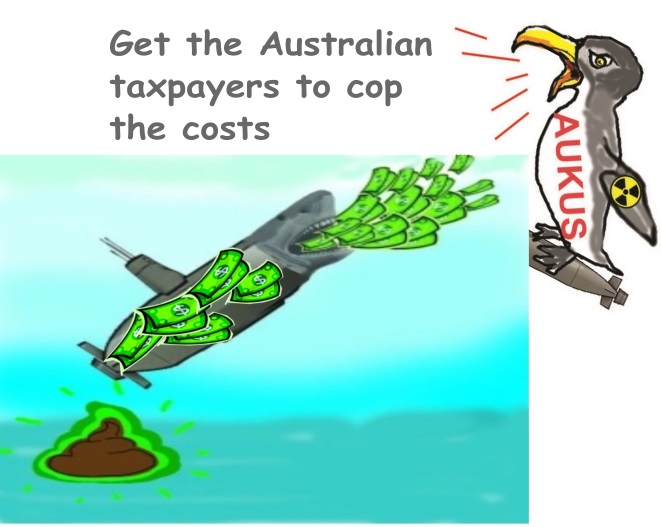
The eye-opener in the AUKMIN chatter is the promise from Canberra to send A$4.6 billion (£2.4 billion) to speed up lethargic construction at the Rolls-Royce nuclear reactor production line. There are already questions that the reactor cores, being built at Derby, will be delayed for the UK’s own Dreadnought nuclear submarine.
The eye-opener in the AUKMIN chatter is the promise from Canberra to send A$4.6 billion (£2.4 billion) to speed up lethargic construction at the Rolls-Royce nuclear reactor production line.
March 26, 2024, by: Dr Binoy Kampmark, https://theaimn.com/the-aukus-cash-cow-robbing-the-australian-taxpayer/
Two British ministers, the UK Foreign Secretary David Cameron and Defence Secretary Grant Shapps, paid a recent visit to Australia recently as part of the AUKMIN (Australia-United Kingdom Ministerial Consultations) talks. It showed, yet again, that Australia’s government loves being mugged. Stomped on. Mowed over. Beaten.
It was mugged, from the outset, in its unconditional surrender to the US military industrial complex with the AUKUS security agreement. It was mugged in throwing money (that of the Australian taxpayer) at the US submarine industry, which is lagging in its production schedule for both the Virginia-class boats and new designs such as the Columbia class. British shipyards were hardly going to miss out on this generous distribution of Australian money, largesse ill-deserved for a flagging production line.
A joint statement on the March 22 meeting, conducted with Defence Minister Richard Marles and Foreign Minister Penny Wong, was packed with trite observations and lazy reflections about the nature of the “international order”. Ministers “agreed the contemporary [UK-Australian] relationship is responding in an agile and coordinated way to global challenges.” When it comes to matters of submarine finance and construction, agility is that last word that comes to mind.
Boxes were ticked with managerial, inconsequential rigour. Russia, condemned for its “full-scale, illegal and immoral invasion of Ukraine.” Encouragement offered for Australia in training Ukrainian personnel through Operation Kudu and joining the Drone Capability Coalition. Exaggerated “concern at the catastrophic humanitarian crisis in Gaza.” Praise for the United Nations Convention on the Law of the Sea (UNCLOS) and “respect of navigation.”
The relevant pointers were to be found later in the statement. The UK has been hoping for a greater engagement in the Indo-Pacific (those damn French take all the plaudits from the European power perspective), and the AUKUS bridge has been one excuse for doing so. Accordingly, this signalled a “commitment to a comprehensive and modern defence relationship, underlined by the signing of the updated Agreement between the Government of Australia and the Government of the United Kingdom of Great Britain and Northern Ireland for Defence and Security Cooperation.”
When politicians need to justify opening the public wallet, such tired terms as “unprecedented”, “threat” and “changing” are used. These are the words of foreign minister Wong: “Australia and the United Kingdom are building on our longstanding strategic partnership to address our challenging and rapidly changing world.” Marles preferred the words “an increasingly complex strategic environment.” Shapps followed a similar line of thinking. “Nuclear-powered submarines are not cheap, but we live in a much more dangerous world, where we are seeing a much more assertive region [with] China, a much more dangerous world all around with what is happening in the Middle East and Europe.” Hardly a basis for the submarines, but the fetish is strong and gripping.
With dread, critics of AUKUS would have noted yet another round of promised disgorging. Britain’s submarine industry is even more lagging than that of the United States, and bringing Britannia aboard the subsidy truck is yet another signal that the AUKUS submarines, when and if they ever get off the design page and groan off the shipyards, are guaranteed well deserved obsolescence or glorious unworkability.
A separate statement released by all the partners of the AUKUS agreement glories in the SSN-AUKUS submarine, intended as a joint effort between BAE Systems and the Australian Submarine Corporation (ASC). (BAE Systems, it should be remembered, is behind the troubled Hunter-class frigate program, one plagued by difficulties in unproven capabilities.)
An already challenging series of ingredients is further complicated by the US role as well. “SSN-AUKUS is being trilaterally developed, based on the United Kingdom’s next designs and incorporation technology from all three nations, including cutting edge United States submarine technologies.” This fabled fiction “will be equipped for intelligence, surveillance, undersea warfare and strike missions, and will provide maximum interoperability among AUKUS partners.” The ink on this is clear: the Royal Australian Navy will, as with any of the promised second-hand Virginia-class boats, be a subordinate partner.
In this, a false sense of submarine construction is being conveyed through what is termed the “Optimal Pathway”, ostensibly to “create a stronger, more resilient trilateral submarine industrial base, supporting submarine production and maintenance in all three countries.” In actual fact, the Australian leg of this entire effort is considerably greater in supporting the two partners, be it in terms of upgrading HMAS Stirling in Western Australia to permit UK and US SSNs to dock as part of Submarine Rotational Force West from 2027, and infrastructure upgrades in South Australia. It all has the appearance of garrisoning by foreign powers, a reality all the more startling given various upgrades to land and aerial platforms for the United States in the Northern Territory.
The eye-opener in the AUKMIN chatter is the promise from Canberra to send A$4.6 billion (£2.4 billion) to speed up lethargic construction at the Rolls-Royce nuclear reactor production line. There are already questions that the reactor cores, being built at Derby, will be delayed for the UK’s own Dreadnought nuclear submarine. The amount, it was stated by the Australian government, was deemed “an appropriate and proportionate contribution to expand production and accommodate Australia’s requirements.” Hardly.
Ultimately, this absurd spectacle entails a windfall of cash, ill-deserved funding to two powers with little promise of returns and no guarantees of speedier boat construction. The shipyards of both the UK and the United States can take much joy from this, as can those keen to further proliferate nuclear platforms, leaving the Australian voter with that terrible feeling of being, well, mugged.
The extraordinary financial costs of ‘small’ nuclear power stations

By Alan Finkel, Cosmos, 21 Mar 24
Partial extract from an article to be posted in 360info.org
They’re being touted as the solution to kickstarting a nuclear power industry in Australia.
According to the Opposition’s Minister for Climate Change and Energy, Ted O’Brien, small modular reactors (SMR) could be built within ten-year period if it wins the next election.
However, it would likely take 20 years to commence commercial operation of any nuclear reactors in Australia from the time in-principle approval was reached. To reach that starting point and enable detailed consideration of the challenges and costs of nuclear power, the existing legislative ban on nuclear power in Australia will need to be removed.
There are other obstacles.
While there’s plenty of excitement about SMRs, the problem is there just isn’t enough data about them, mainly because there are none operating in any OECD country.
And it’s unknown when any might be. As Allison Macfarlane, former chair of the US Nuclear Regulatory commission, argues in her article,The end of Oppenheimer’s energy dream, the proposal for small modular reactors to help us in the clean energy transition is fanciful.
The SMR furthest along the US Nuclear Regulatory Commission (NRC) approval process, from the US company NuScale, cancelled its first planned installation in Utah last November when the initial cost blew out to USD$9 billion, corresponding to USD$20 billion per GW.
The only countries with working SMRs are China and Russia.
Micro and large reactors
Micro reactors are intended to generate electrical power up to 10 MW per unit. Although companies such as Rolls Royce are developing these, there do not appear to be any commercial micro modular reactors that have completed their design.
That leaves full-scale reactors, which have also been mentioned as part of a possible Australian nuclear power play.
Korean company KEPCO builds most of the nuclear reactors in Korea and has now built one at Barakah in the United Arab Emirates. This 5.6 GW plant, scheduled to open this year, has taken 16 years to complete and cost USD$24 billion (AUD$36 billion). At 5.6 GW, that is AUD$6.4 billion per GW. Given salaries and skills shortages in Australia, inflation, interest rates and our regulatory requirements, it would cost more and take longer in Australia.
The Hinkley C plant in the UK was supposed to be finished in 2017 but has been delayed again until 2031 – 23 years after approval. The estimated construction cost ballooned to AUD$89 billion. At 3.2 GW electrical power, that is AUD$28 billion per GW.
In the US, the most recent nuclear reactors to be built are the Vogtle 3 and 4built at the existing facility that is home to the Vogtle 1 and 2 reactors. Both were anticipated to be in service in 2016. Vogtle 3 began commercial operation in July 2023. Vogtle 4 is projected to commence operation in the second quarter of 2024 – 15 years after the construction contract was awarded.
Construction cost USD$34 billion (AUD$52 billion) for the combined 2.2 GW output of the two reactors, or AUD$24 billion per GW.
Construction of nuclear plants in the United States has declined dramatically over the years. Approximately 130 were built from the mid 1950s to the mid 1990s. Only four commenced operation in the 30 years from the mid 1990s to now, and at the time of writing there are no nuclear reactors under construction in the United States.
In France, only one nuclear power plant is under construction. The 1.65 GW Flamanville EPR reactor is hoped to be completed and begin to supply electricity later this year, 17 years after construction began. The most recent cost estimate was AUD$22 billion or AUD$13 billion per GW. No other nuclear power plants are planned in France.
These high costs and long delivery durations for full-scale reactors are the reasons SMRs are proposed as a way forward in Australia. However, SMRs are a new technology. There are none in operation or construction in any OECD countries, thus it is not possible to estimate the costs or delivery schedules. NuScale’s investment to date suggests that the capital cost for the first units to be delivered will be very high. ………… https://cosmosmagazine.com/technology/energy/the-extraordinary-financial-costs-of-nuclear-power/
Climate-conscious investors put nuclear dead last on list of desirable Australian ventures
Fewer than one in 10 investors exploring new investments in the technology, with most preferring renewables
Guardian, Paul Karp Chief political correspondent, 25 Mar 24
Nuclear energy ranks last on the list of climate technologies that big institutional investors want exposure to, according to a survey of climate conscious investors with $37tn under management.
Fewer than one in 10 investors were exploring new investments in nuclear technology in the survey of the Investor Group on Climate Change, whose 100 members include super funds and asset managers looking after the funds of 15 million Australians.
The survey found a rebound in confidence in Australia’s climate policy but a growing appetite for clear timelines for the phase-out of coal, oil and gas.
The opposition, led by Peter Dutton, plans to propose locating nuclear power plants on the site of retiring coal power plants, claiming that this would save having to build new transmission infrastructure for renewables.
But the plan has been widely panned. The energy department has estimated it would cost $387bn to go nuclear, and Dutton faces opposition from his own state colleagues.
Australia’s big private electricity generators have dismissed nuclear energy as a viable source of power for their customers for at least another decade, and likely more.
In the yearly survey by the Investor Group on Climate Change investors were asked which energy and climate solutions they believed had good long-term returns. Nuclear energy was ranked last of 14 possible responses, along with sustainable oceans.
“This is due to nuclear energy’s very high cost, and the lack of maturity and deployment in next generation technologies,” a policy brief on the survey said, citing the CSIRO’s gencost report.
The five most popular options were: renewable energy (backed by 47% of respondents); nature solutions, including biodiversity or nature capital (34%); energy storage (32%); low carbon transport (32%); and industry/materials, including critical minerals (32%).
In 2021 about 70% of investors cited policy and regulatory uncertainty as a barrier to investing in climate solutions, a figure that dropped to 40% in the 2023 data released on Monday.
Asked to nominate the policies they wanted the government to prioritise, most investors (56%) called for sector-by-sector decarbonisation plans to keep global heating under the 1.5C threshold.
There was also majority support for improved carbon pricing through the safeguard mechanism (54%), funding support for new technology (53%), and phasing out fossil fuel subsidies (51%).
The policy brief said “emerging priorities” included mandatory climate-related disclosures, timelines for the phase-out of coal, oil and gas, and clear policies to build resilience and adapt to the physical damages of climate change.
Erwin Jackson, Investor Group on Climate Change’s managing director of policy, said: “Investors have given the government a pretty good report card………………………………………………….more https://www.theguardian.com/australia-news/2024/mar/25/climate-conscious-investors-put-nuclear-dead-last-on-list-of-desirable-australian-ventures
Financiers shun nuclear, upbeat on climate investment
By Marion Rae, March 25 2024 https://www.canberratimes.com.au/story/8566564/financiers-shun-nuclear-upbeat-on-climate-investment/
Nuclear energy is last on the list of technologies that investors want exposure to, according to a survey of big institutions.
The vast majority of investors do not see nuclear power as a good investment, with less than one in 10 exploring this technology, the survey released on Monday found.
Opposition Leader Peter Dutton is spruiking nuclear reactors as an option for Australia’s future low-carbon economy although the energy source is illegal under existing laws and Labor has ruled it out.
Renewable energy is tipped to deliver the best long-term financial returns, with half the investors surveyed exploring opportunities to invest.
Investors have also become more confident about Australian climate policy under the Albanese government, according to the survey by the Investor Group on Climate Change.
“Investors have given the government a pretty good report card,” the group’s policy chief Erwin Jackson said.
But Australia will need globally competitive, targeted incentives to suit the nation’s economic strengths and values to stop “ongoing capital flight” to the United States and Europe where there are more generous tax breaks.
Clear timelines for the phase-out of fossil fuels by 2050 would also help investors manage transition risks and remain invested in the Australian economy, according to the group.
This year’s data includes 63 superannuation funds as well as other asset owners and managers, with more than $37 trillion in assets under management globally. Their beneficiaries include more than 15 million Australians.
Emerging priorities include clear timelines for phasing out coal, oil and gas and clear policies to build resilience and adapt to physical damage from climate change.
Opinions citing policy and regulatory uncertainty as a barrier to clean economy investment in Australia have changed dramatically, supported by four out of 10 investors compared with 7 out of 10 in 2021.
Renewable energy (47 per cent) was picked as the best option for long-term climate solutions, followed by nature-based schemes including biodiversity projects (34 per cent).
But investors are still in the dark on the federal government’s sector-by-sector decarbonisation plans for heavy polluters such as the energy, transport, agriculture and resources industries – and on the scope of the 2035 emissions reduction target.
“Credible and clear sector by sector decarbonisation plans to achieve a 2035 target with the highest possible level of ambition are critical for investment and it is critical to build on the steps already taken,” Mr Jackson said.
Climate Change and Energy Minister Chris Bowen has said the 2035 target will be “ambitious and achievable”, with advice to come from Australia’s recently beefed-up Climate Change Authority.
The sectoral review by the authority has an August 1 deadline, and will be released shortly afterwards.
Australian Associated Press
Chief scientist backs renewables, calls nuclear power ‘expensive’
Q+A / By Jason Whittaker 18 Mar 24
- In short: Chief Scientist Cathy Foley says nuclear energy is “expensive” and the energy debate must be guided by research.
- Opposition Leader Peter Dutton has criticised the CSIRO, which says renewables like solar and wind are cheaper.
- What’s next? Retired Major General Gus McLachlan says the purchase of nuclear-powered submarines is a test of leadership.
Australia’s chief scientist has backed a renewables-led path to net zero emissions over the “expensive technology” of nuclear energy.
After the federal opposition puts nuclear-fired power generation back on the national agenda, Cathy Foley told Q+A that any assessment of energy sources should be guided by evidence.
“If you look at the reports that have been done, it’s [nuclear power] an expensive technology and it’s one where it would take some time to build up the capability to do that in Australia,” Dr Foley said.
“As chief scientist, it’s not for me to actually say what the government should do.
“What we should be doing is looking at the evidence and the information that is available and making sure that we make good decisions based on all the different things we have to take into account.”
Last week, Opposition Leader Peter Dutton attacked research from the CSIRO on the higher cost of nuclear power over renewables such as solar and wind, prompting a public defence from the nation’s leading science institution.
“It’s not relied on. It’s not a genuine piece of work,” Mr Dutton said on Friday, calling the research “discredited”.
In response, CSIRO chief executive Douglas Hilton said in a statement: “I will staunchly defend our scientists and our organisation against unfounded criticism.”
Dr Foley spent 15 years at the CSIRO before becoming the nation’s chief scientist.
Asked by Q+A host Patricia Karvelas if nuclear power should be on the table, she said: “I don’t think we should be making that decision without getting the information that’s needed.”
“So at the moment the plan is to be able to get to zero emissions using renewables and batteries …
“Australia has got a fantastic situation where we have so much energy from wind and solar that we should be making the most of that.
“We have the potential to have renewables based on solar panels and wind and batteries and that is the pathway that the government has been putting forward and is on a plan to get there by getting to zero emissions.”
The power of ‘little suns’
Leading American physicist Bryan Greene said nuclear is a “wonderful energy source” — but it’s the next generation of the technology (nuclear fusion) that offers the most promise.
“Once that is on the table, everything changes,” the Columbia University professor told Q+A.
“That will be the approach that will take over, say, from 2050 or 2060 onwards.”
Current nuclear fission technology — splitting large atoms to generate energy — leaves radioactive waste and the danger of reactor meltdowns……………………more https://www.abc.net.au/news/2024-03-19/chief-scientist-cathy-foley-nuclear-expensive-backs-renewables/103602312
Australia’s big electricity generators say nuclear not viable for at least a decade
AGL Energy, Alinta, EnergyAustralia and Origin Energy say they will remain focused on renewables despite Coalition support for nuclear reactors
Peter Hannam, Guardian. 19 Mar 24
Australia’s big private electricity generators have dismissed nuclear energy as a viable source of power for their customers for at least a decade.
They say they will remain focused on developing renewable sources as coal and gas plants exit the grid.
The comments – from AGL Energy, Alinta, EnergyAustralia and Origin Energy – follow an announcement by the opposition leader, Peter Dutton, that the Coalition would back both large-scale and small modular nuclear reactors (SMR) as a way to cut electricity prices and increase grid reliability.
Energy Australia, whose Hong Kong-listed owner CLP currently operates two large nuclear power stations in mainland China, said the company was “committed to Australia’s clean energy transformation, reducing emissions as quickly and affordably as possible while maintaining system reliability”…………………………………………
NSW’s chief scientist, Hugh Durrant-Whyte, dismissed the comparisons by nuclear energy advocates of places such as Ontario, Canada. That country had spent decades building a nuclear industry employing 70,000 people.
“Nobody in this country has even the faintest idea how to build a nuclear power plant,” Durrant-Whyte, a former nuclear adviser to the UK government, told NSW upper house estimates earlier this month. https://www.theguardian.com/australia-news/2024/mar/19/australias-big-electricity-generators-say-nuclear-not-viable-for-at-least-a-decade
1 This month
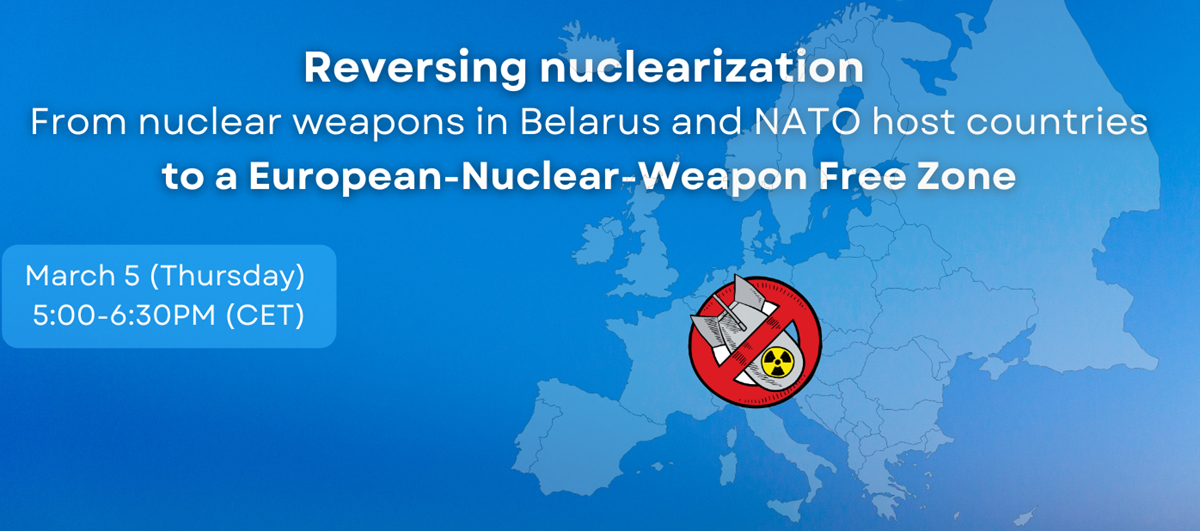
6 March -Online – Reversing nuclearization:
From nuclear weapons in Belarus and NATO host countries to a European-Nuclear-Weapon Free Zone
Mar 6, 2026 03:00 AM in Canberra, Melbourne, Sydney

of the week – Australians for War Powers Reform (AWPR)
To see nuclear-related stories in greater depth and intensity
 Antinuclear